

Automotive Body Electronics Market Report 2026
Global Outlook – By Component (Control Modules, Sensors, Actuators, Switches And Relays, Wiring Harnesses And Connectors), By Function (Lighting Control, Power Windows and Door Locks, Climate Control, Seat Control, Mirror Control, Wiper Systems, Sunroof Control, Horn and Alarm Systems, Tire Pressure Monitoring Systems, Keyless Entry and Immobilizer Systems), By Connectivity (Controller Area Network (CAN), Local Interconnect Network (LIN), FlexRay, Ethernet, Wireless Connectivity), By Vehicle Type (Passenger Cars, Light Commercial Vehicles, Heavy Commercial Vehicles), By Powertrain Type (Internal Combustion Engine Vehicles, Hybrid Electric Vehicles, Battery Electric Vehicles, Plug-In Hybrid Electric Vehicles) – Market Size, Trends, Strategies, and Forecast to 2030
Automotive Body Electronics Market Overview
• Automotive Body Electronics market size has reached to $36.05 billion in 2025 • Expected to grow to $51.37 billion in 2030 at a compound annual growth rate (CAGR) of 7.3% • Growth Driver: Increasing Adoption Of Electric And Hybrid Vehicles Fueling The Growth Of The Market Due To Rising Demand For Advanced Electronic Control Systems • Market Trend: Innovations In Automotive Microcontroller Technology Enhance Body Electronics Control And Functional Safety • Asia-Pacific was the largest region and fastest growing region.What Is Covered Under Automotive Body Electronics Market?
Automotive body electronics refer to the electronic systems that manage and coordinate a vehicle's non-engine functions related to the body and cabin. These systems improve vehicle functionality, comfort, convenience, and overall user experience by controlling various electrical operations throughout the vehicle. It also supports communication between different electronic devices to ensure efficient and reliable vehicle operation. The main components in the automotive body electronics include control modules, sensors, actuators, switches and relays, and wiring harnesses and connectors. Control modules refer to electronic devices that manage and coordinate various vehicle body functions based on inputs from sensors and other vehicle systems. These components support functions such as lighting control, power windows and door locks, climate control, seat control, mirror control, wiper systems, sunroof control, horn and alarm systems, tire pressure monitoring systems, and keyless entry and immobilizer systems. They use connectivity technologies including Controller Area Network (CAN), Local Interconnect Network (LIN), FlexRay, Ethernet, and wireless connectivity. Automotive body electronics are used across passenger cars, light commercial vehicles, and heavy commercial vehicles and are incorporated into internal combustion engine vehicles, hybrid electric vehicles, battery electric vehicles, and plug-in hybrid electric vehicles.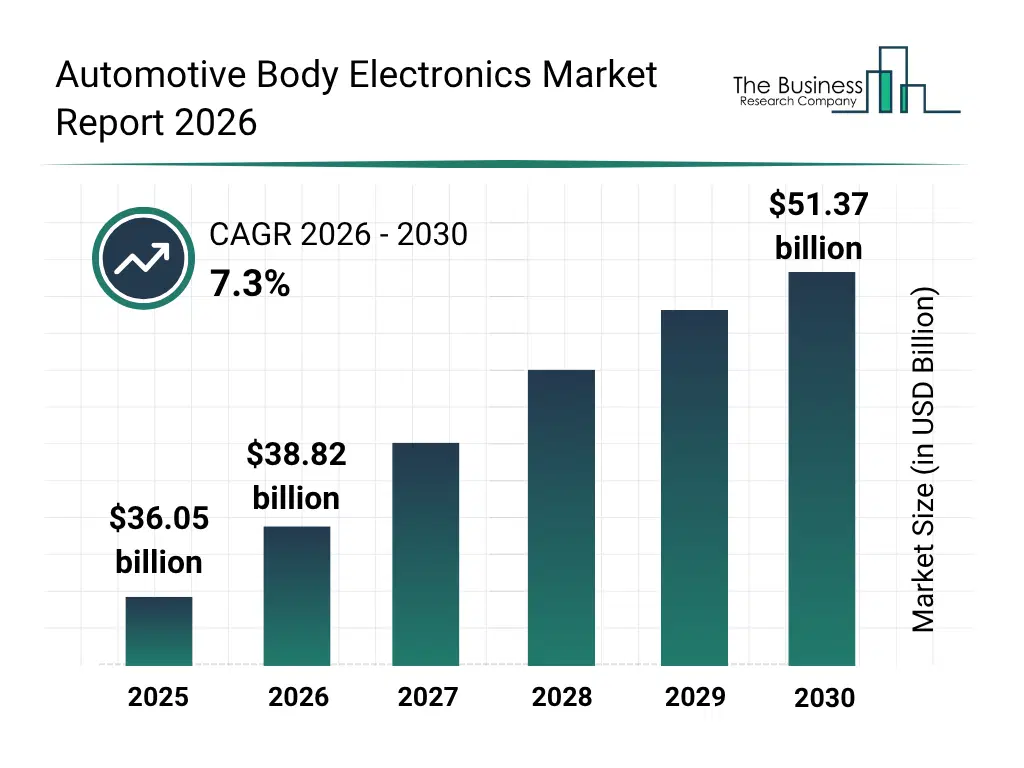
What Is The Automotive Body Electronics Market Size and Share 2026?
The automotive body electronics market size has grown strongly in recent years. It will grow from $36.05 billion in 2025 to $38.82 billion in 2026 at a compound annual growth rate (CAGR) of 7.7%. The growth in the historic period can be attributed to increasing vehicle electrification, rising demand for vehicle comfort and convenience features, growing adoption of advanced safety features, increasing vehicle production volumes, rising integration of electronic components in vehicles.What Is The Automotive Body Electronics Market Growth Forecast?
The automotive body electronics market size is expected to see strong growth in the next few years. It will grow to $51.37 billion in 2030 at a compound annual growth rate (CAGR) of 7.3%. The growth in the forecast period can be attributed to expanding adoption of software-defined vehicles, increasing demand for premium vehicle features, growing deployment of intelligent lighting systems, rising use of advanced driver monitoring and occupant sensing technologies, increasing integration of vehicle-to-everything communication. Major trends in the forecast period include increasing integration of zonal body electronic architectures, growing adoption of solid-state power distribution modules, rising use of centralized body domain controllers, increasing integration of multi-function body control systems, growing demand for lightweight and compact electronic components.Tariff Impact On Automotive Body Electronics Market
Tariffs are impacting the automotive body electronics market by increasing the cost of imported semiconductors, sensors, actuators, connectors, wiring harnesses, and electronic control components used in vehicle body systems. This is increasing manufacturing costs and affecting body control modules, sensors, actuators, and wiring harnesses, particularly in North America, Europe, and Asia-Pacific where automotive electronics supply chains rely on cross-border sourcing. Component-intensive segments such as control modules and wiring harnesses are most affected due to their dependence on imported electronic components and specialized materials. However, tariffs can encourage regional sourcing, localized manufacturing, supply-chain diversification, and investment in domestic automotive electronics production.
Global Automotive Body Electronics Market Segmentation
1) By Component: Control Modules, Sensors, Actuators, Switches And Relays, Wiring Harnesses And Connectors 2) By Function: Lighting Control, Power Windows and Door Locks, Climate Control, Seat Control, Mirror Control, Wiper Systems, Sunroof Control, Horn and Alarm Systems, Tire Pressure Monitoring Systems, Keyless Entry and Immobilizer Systems 3) By Connectivity: Controller Area Network (CAN), Local Interconnect Network (LIN), FlexRay, Ethernet, Wireless Connectivity 4) By Vehicle Type: Passenger Cars, Light Commercial Vehicles, Heavy Commercial Vehicles 5) By Powertrain Type: Internal Combustion Engine Vehicles, Hybrid Electric Vehicles, Battery Electric Vehicles, Plug-In Hybrid Electric Vehicles Subsegments: 1) By Control Modules: Body Control Modules, Door Control Modules, Seat Control Modules, Lighting Control Modules, Climate Control Modules, Sunroof Control Modules, Wiper Control Modules, Gateway Control Modules 2) By Sensors: Rain Sensors, Ambient Light Sensors, Occupant Detection Sensors, Door Position Sensors, Window Position Sensors, Seat Position Sensors, Temperature Sensors, Ultrasonic Sensors 3) By Actuators: Door Lock Actuators, Window Lift Actuators, Mirror Actuators, Seat Adjustment Actuators, Tailgate Actuators, Sunroof Actuators, HVAC Blend Door Actuators, Trunk Release Actuators 4) By Switches And Relays: Power Window Switches, Door Lock Switches, Mirror Adjustment Switches, Headlamp Switches, Wiper Switches, Ignition Relays, Power Relays, Lighting Relays 5) By Wiring Harnesses And Connectors: Body Wiring Harnesses, Door Wiring Harnesses, Instrument Panel Wiring Harnesses, Roof Wiring Harnesses, Floor Wiring Harnesses, Waterproof Connectors, Multi-Pin Connectors, High-Speed ConnectorsWhat Is The Driver Of The Automotive Body Electronics Market?
The increasing adoption of electric and hybrid vehicles is expected to propel the growth of the automotive body electronics market going forward. Electric and hybrid vehicles are automobiles powered fully or partially by electric propulsion systems that use rechargeable batteries alongside or instead of internal combustion engines. Electric and hybrid vehicles are increasing because governments are introducing stricter emission regulations and offering incentives for cleaner transportation. Electric and hybrid vehicles support automotive body electronics by increasing the need for advanced electronic systems that manage vehicle body functions, power distribution, energy efficiency, and communication between different electronic components. For instance, in May 2025, according to the International Energy Agency (IEA), a France-based intergovernmental organization, global electric car sales were expected to exceed 20 million units in 2025, representing more than one-quarter of global car sales. Electric car sales increased by 35% year-on-year in the first quarter of 2025, with record first-quarter sales across all major markets. Therefore, the increasing adoption of electric and hybrid vehicles is driving the growth of the automotive body electronics industry.Key Players In The Global Automotive Body Electronics Market
Major companies operating in the automotive body electronics market are Robert Bosch GmbH, Denso Corporation, Sumitomo Electric Industries Ltd, Continental AG, ZF Friedrichshafen AG, LG Electronics Inc, Panasonic Corporation, Texas Instruments Incorporated, Magna International Inc, Aptiv PLC, Yazaki Corporation, Valeo SE, Lear Corporation, Renesas Electronics Corporation, Mitsubishi Electric Corporation, STMicroelectronics NV, Amphenol Corporation, Astemo Ltd, Visteon Corporation, Furukawa Electric Co Ltd, Samvardhana Motherson International Limited, HELLA GmbH & Co KGaA, MAHLE GmbH, Gentex Corporation
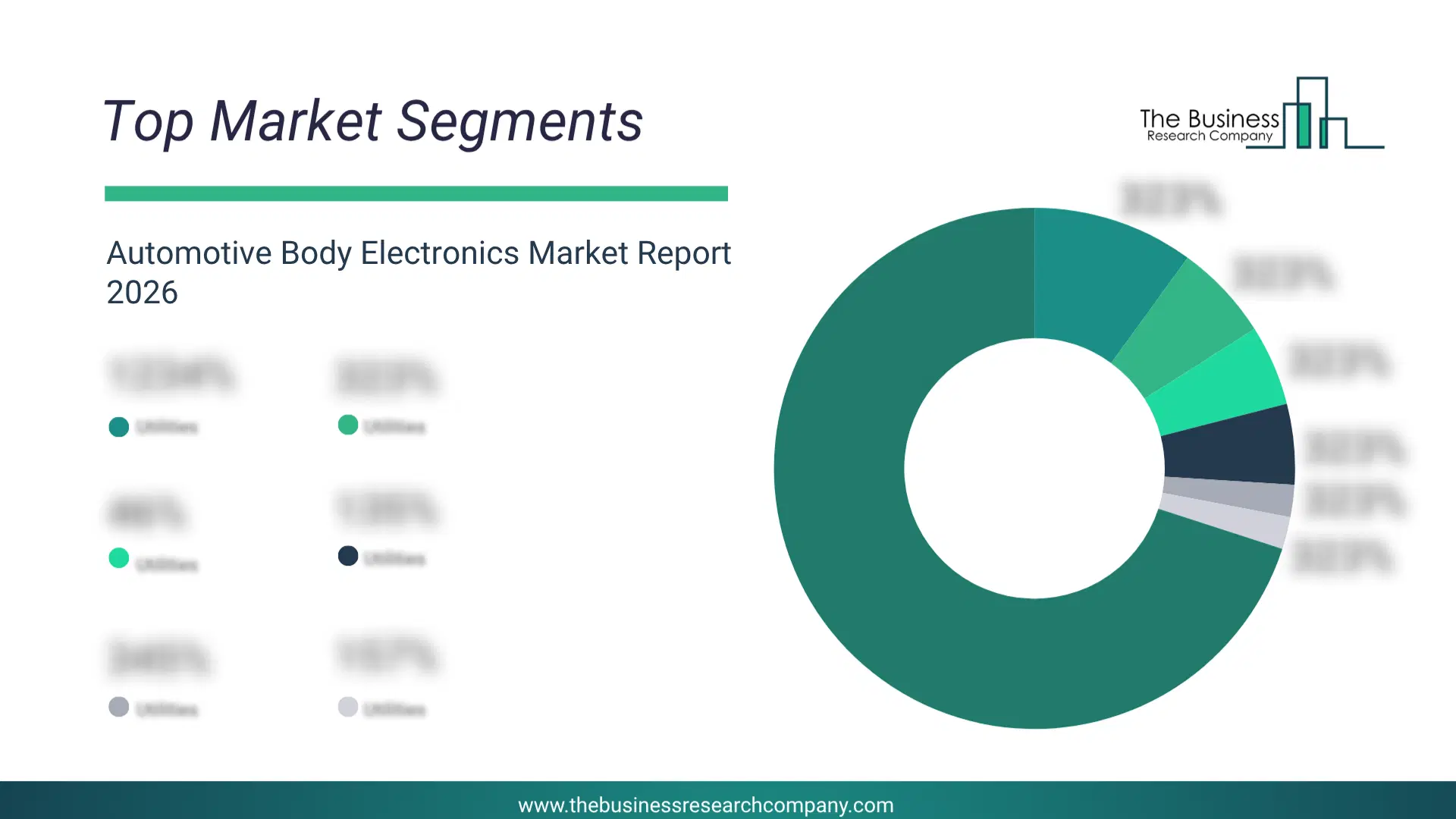
This chart is for illustrative purposes; the full report includes a detailed competitor analysis and comprehensive overview of the top 10 companies in the market.
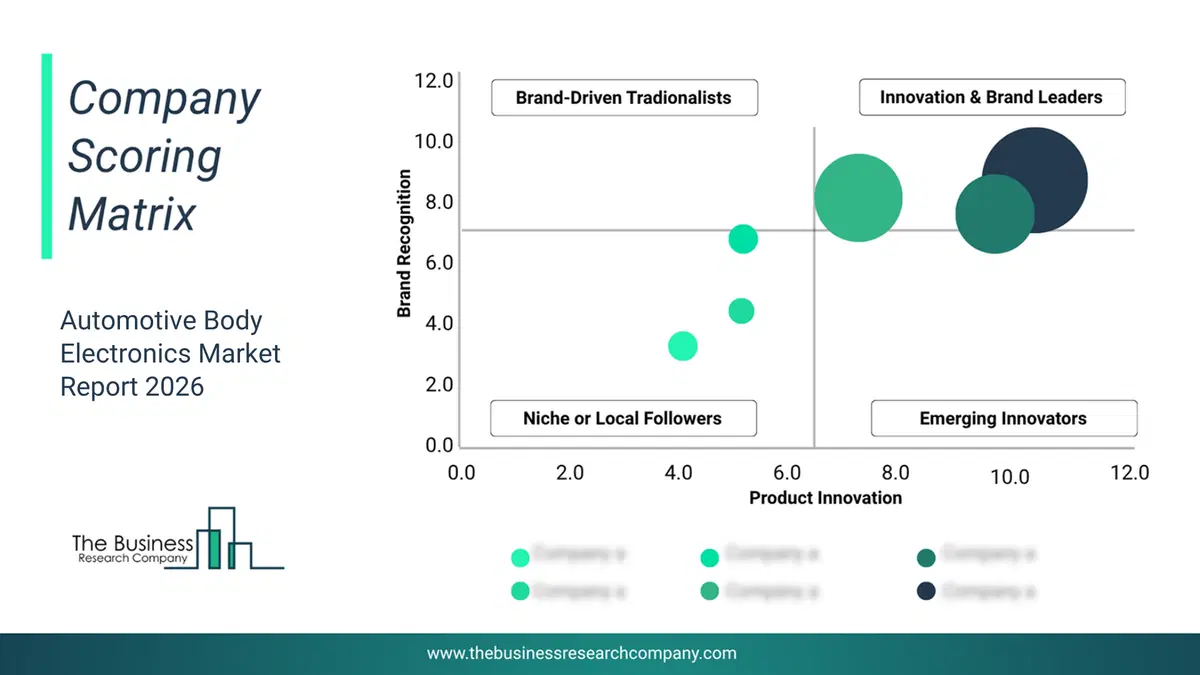
This chart maps companies by product innovation and brand strength, with bubble size indicating relative revenue, helping identify market leaders, challengers, and niche players. This is an illustrative chart; the full report provides a complete and accurate competitive analysis.
Global Automotive Body Electronics Market Trends and Insights
Major companies operating in the automotive body electronics market are focusing on developing advanced microcontrollers, such as automotive-grade control microcontrollers, to enhance vehicle control, connectivity, functional safety, and power efficiency. Automotive microcontrollers are semiconductor devices that process real-time control functions and manage communication between electronic control units and vehicle components. For instance, in March 2026, Renesas Electronics Corporation, a Japan-based semiconductor company, launched the RH850/U2C, a 32-bit automotive microcontroller manufactured using 28-nanometer technology and designed for applications including body control, chassis, safety systems, and battery management systems. The microcontroller integrates high-performance processing cores, up to 8 MB of flash memory, and advanced Ethernet, Controller Area Network Flexible Data Rate (CAN-FD), Controller Area Network Extended Layer (CAN-XL), and Local Interconnect Network (LIN) interfaces. It supports ISO 26262 Automotive Safety Integrity Level D (ASIL D) functional safety and ISO/SAE 21434 cybersecurity requirements. These capabilities enhance the reliability, connectivity, and safety of automotive body electronics.What Are Latest Mergers And Acquisitions In The Automotive Body Electronics Market?
In July 2025, HiRain Technologies, a China-based automotive electronics company, entered into a strategic cooperation with Changchun Faway Hella Automotive Lighting Co. Ltd. to jointly develop and promote intelligent vehicle lighting solutions. With this collaboration, HiRain expanded its capabilities in automotive intelligent lighting by combining its automotive lighting electronic control and drive technologies with Faway Hella's automotive lighting manufacturing capabilities, supporting the development of intelligent lighting applications such as pixel headlights, welcome projection lighting, ambient lighting, and interactive lighting. Changchun Faway Hella Automotive Lighting Co. Ltd. is a China-based automotive lighting manufacturer specializing in intelligent vehicle lighting systems.
Regional Outlook
Asia-Pacific was the largest region in the automotive body electronics market in 2025. Asia-Pacific is expected to be the fastest-growing region in the forecast period. The regions covered in this market report are Asia-Pacific, South East Asia, Western Europe, Eastern Europe, North America, South America, Middle East, Africa. The countries covered in this market report are Australia, Brazil, China, France, Germany, India, Indonesia, Japan, Taiwan, Russia, South Korea, UK, USA, Canada, Italy, Spain.What Defines the Automotive Body Electronics Market?
The automotive body electronics market consists of sales of window regulators, electronic parking brake systems, steering column control units, rain and light sensor modules, and vehicle access control units. Values in this market are ‘factory gate’ values, that is, the value of goods sold by the manufacturers or creators of the goods, whether to other entities (including downstream manufacturers, wholesalers, distributors, and retailers) or directly to end customers. The value of goods in this market includes related services sold by the creators of the goods.How is Market Value Defined and Measured?
The market value is defined as the revenues that enterprises gain from the sale of goods and/or services within the specified market and geography through sales, grants, or donations in terms of the currency (in USD unless otherwise specified). The revenues for a specified geography are consumption values that are revenues generated by organizations in the specified geography within the market, irrespective of where they are produced. It does not include revenues from resales along the supply chain, either further along the supply chain or as part of other products.
This chart presents market attractiveness based on a quantitative evaluation of growth, competition, strategic alignment, and risk, offering a clear view of opportunity areas for decision-making. This chart is for illustrative purposes; the full report contains the complete analysis.

This chart highlights the Total Addressable Market (TAM) by estimating the maximum revenue opportunity using an assumption-driven approach, supporting strategic planning and opportunity sizing across markets. The chart is illustrative; the full report provides a more comprehensive analysis.
What Key Data and Analysis Are Included in the Automotive Body Electronics Market Report 2026?
The automotive body electronics market research report is one of a series of new reports from The Business Research Company that provides market statistics, including industry global market size, regional shares, competitors with the market share, detailed market segments, market trends and opportunities, and any further data you may need to thrive in the automotive body electronics industry. The market research report delivers a complete perspective of everything you need, with an in-depth analysis of the current and future state of the industry.Automotive Body Electronics Market Report Forecast Analysis
| Report Attribute | Details |
|---|---|
| Market Size Value In 2026 | $38.82 billion |
| Revenue Forecast In 2030 | $51.37 billion |
| Growth Rate | CAGR of 7.3% from 2026 to 2030 |
| Base Year For Estimation | 2025 |
| Actual Estimates/Historical Data | 2020-2025 |
| Forecast Period | 2026 - 2030 |
| Market Representation | Revenue in USD Billion and CAGR from 2026 to 2030 |
| Segments Covered | Component, Function, Connectivity, Vehicle Type, Powertrain Type |
| Regional Scope | Asia-Pacific, Western Europe, Eastern Europe, North America, South America, Middle East, Africa |
| Country Scope | The countries covered in the report are Australia, Brazil, China, France, Germany, India, Indonesia, Japan, Taiwan, Russia, South Korea, UK, USA, Canada, Italy, Spain. |
| Key Companies Profiled | Robert Bosch GmbH, Denso Corporation, Sumitomo Electric Industries Ltd, Continental AG, ZF Friedrichshafen AG, LG Electronics Inc, Panasonic Corporation, Texas Instruments Incorporated, Magna International Inc, Aptiv PLC, Yazaki Corporation, Valeo SE, Lear Corporation, Renesas Electronics Corporation, Mitsubishi Electric Corporation, STMicroelectronics NV, Amphenol Corporation, Astemo Ltd, Visteon Corporation, Furukawa Electric Co Ltd, Samvardhana Motherson International Limited, HELLA GmbH & Co KGaA, MAHLE GmbH, Gentex Corporation |
| Customization Scope | Request for Customization |
| Pricing And Purchase Options | Explore Purchase Options |