

Automotive Brake Systems Market Report 2026
Global Outlook – By Product Type (Disc Brakes, Drum Brakes), By Technology (Antilock Braking Systems (ABS), Electronic Stability Control (ESC), Traction Stability Control (TCS), Electronic Brakeforce Distribution (EBD)), By Sales Channel (Original Equipment Manufacturers (OEMs), Aftermarket), By Vehicle Type (Passenger Car, Light-commercial Vehicles (LCV), Truck, Bus) – Market Size, Trends, Strategies, and Forecast to 2030
Automotive Brake Systems Market Overview
• Automotive Brake Systems market size has reached to $39.25 billion in 2025 • Expected to grow to $56.76 billion in 2030 at a compound annual growth rate (CAGR) of 7.7% • Growth Driver: Surging Vehicle Demand Accelerates Growth In Automotive Brake Systems Market • Market Trend: An Advanced Electronic Brake System For Enhanced Safety And Efficiency In Electric Vehicles • Asia-Pacific was the largest region in 2025.Market Gains By 2030 – Top Opportunities By Segment
Market Gain identifies the most promising market opportunities by highlighting the segments or products expected to generate the highest incremental revenue growth over the next five years.
What Is Covered Under Automotive Brake Systems Market?
Automotive brake systems refer to a system that focuses on slowing down or bringing a vehicle to a halt. It works based on friction as they create resistance to the movement by exerting two objects against each other. Automatic braking systems prevent a vehicle from skidding and help restore traction tires; they also prevent the vehicle's wheels from locking up and avoid accidents. The main types of automotive brake systems are disc brakes and drum brakes. The disc brakes are used in automotive for less brake fade to offer better performance in wet conditions. These brakes use a brake caliper, metal rotor, and brake pads to stop the vehicle. The various types of technologies in automotive brake systems include antilock braking systems (ABS), electronic stability control (ESC), traction stability control (TCS), and electronic brakeforce distribution (EBD) that are sold or distributed through original equipment manufacturers (OEM) and aftermarket. The automotive brake systems are suitable for passenger cars, light commercial vehicles (LCV), trucks, and buses.
What Is The Automotive Brake Systems Market Size and Share 2026?
The automotive brake systems market size has grown strongly in recent years. It will grow from $39.25 billion in 2025 to $42.13 billion in 2026 at a compound annual growth rate (CAGR) of 7.3%. The growth in the historic period can be attributed to vehicle safety regulation enforcement, adoption of abs systems, growth of passenger vehicles, conventional hydraulic braking, accident reduction initiatives.What Is The Automotive Brake Systems Market Growth Forecast?
The automotive brake systems market size is expected to see strong growth in the next few years. It will grow to $56.76 billion in 2030 at a compound annual growth rate (CAGR) of 7.7%. The growth in the forecast period can be attributed to adas-driven braking demand, electrification of braking systems, autonomous vehicle development, demand for intelligent safety systems, regulatory safety mandates. Major trends in the forecast period include integration of advanced braking technologies, growth of electronic stability systems, rising demand for safety features, expansion of adas integration, shift toward brake-by-wire.
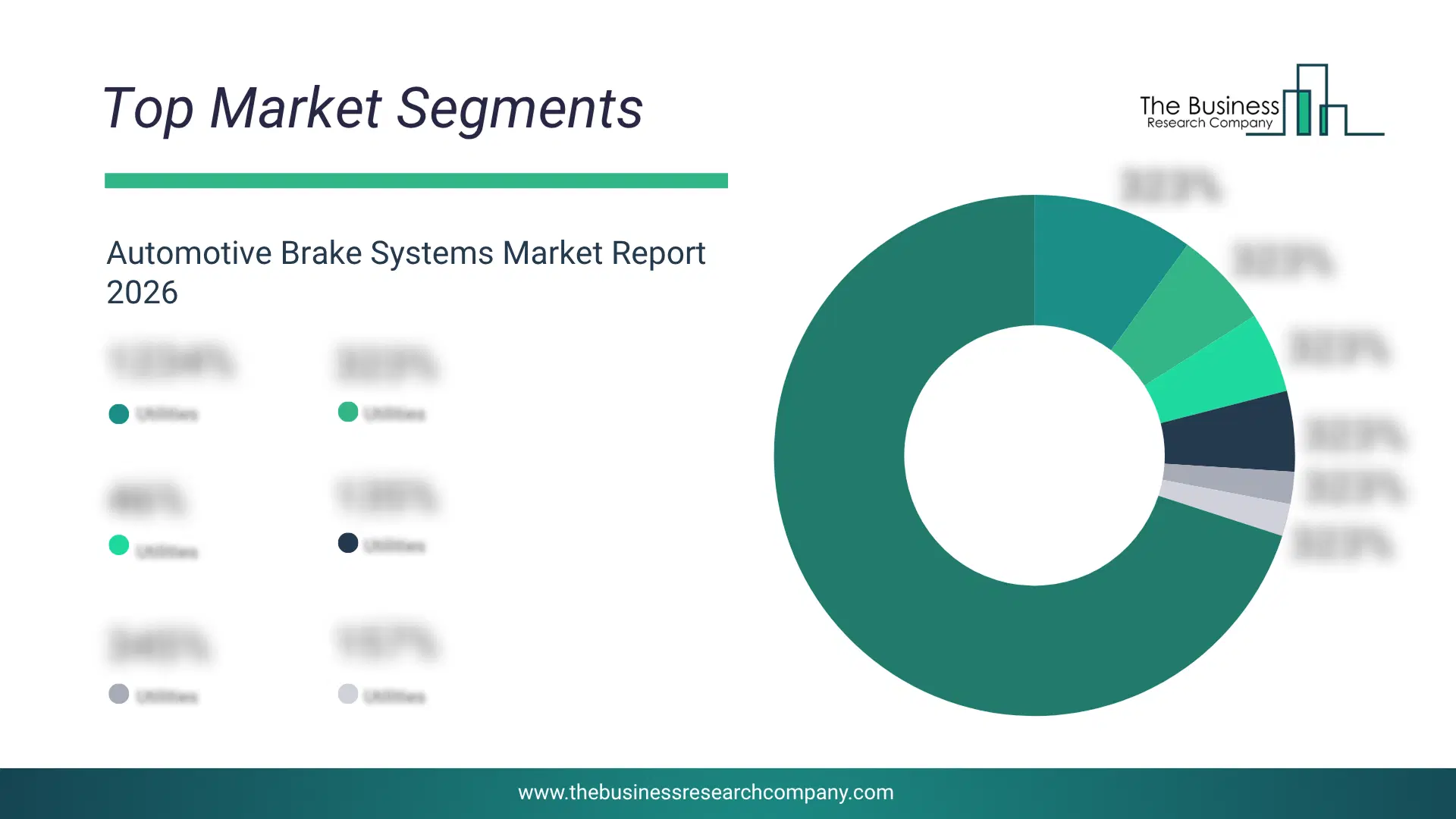
Global Automotive Brake Systems Market Segmentation
1) By Product Type: Disc Brakes, Drum Brakes 2) By Technology: Antilock Braking Systems (ABS), Electronic Stability Control (ESC), Traction Stability Control (TCS), Electronic Brakeforce Distribution (EBD) 3) By Sales Channel: Original Equipment Manufacturers (OEMs), Aftermarket 4) By Vehicle Type: Passenger Car, Light-commercial Vehicles (LCV), Truck, Bus Subsegments: 1) By Disc Brakes: Ventilated Disc Brakes, Solid Disc Brakes, Performance Disc Brakes 2) By Drum Brakes: Leading Trailing Drum Brakes, Duo-Servo Drum Brakes, Self-Adjusting Drum Brakes The top segments in the automotive brake systems market will be: • Disc Brakes will reach $35 Billion by 2030. • Drum Brakes will reach $21 Billion by 2030.What Is The Driver Of The Automotive Brake Systems Market?
The rising demand for passenger and commercial vehicles is expected to drive the automotive brake systems market. Rapid growth in disposable income among individuals in both developing and developed countries and growing demand for a personal vehicle for daily commute to work has contributed to rapid growth in demand for passenger and commercial vehicles. The rapid growth in demand for passenger and commercial vehicles is expected to the boost utilization of automotive brake systems, as they are a vital component in the manufacturing of automotive vehicles. For instance, in January 2024, according to the Society of Motor Manufacturers and Traders, a UK-based trade association, UK commercial vehicle (CV) production rose by 18.5% in 2023, with 120,357 vans, trucks, taxis, buses, and coaches produced on factory lines. Therefore, the increased demand for passenger and commercial vehicles is expected to boost demand for automotive brake systems during the forecast period.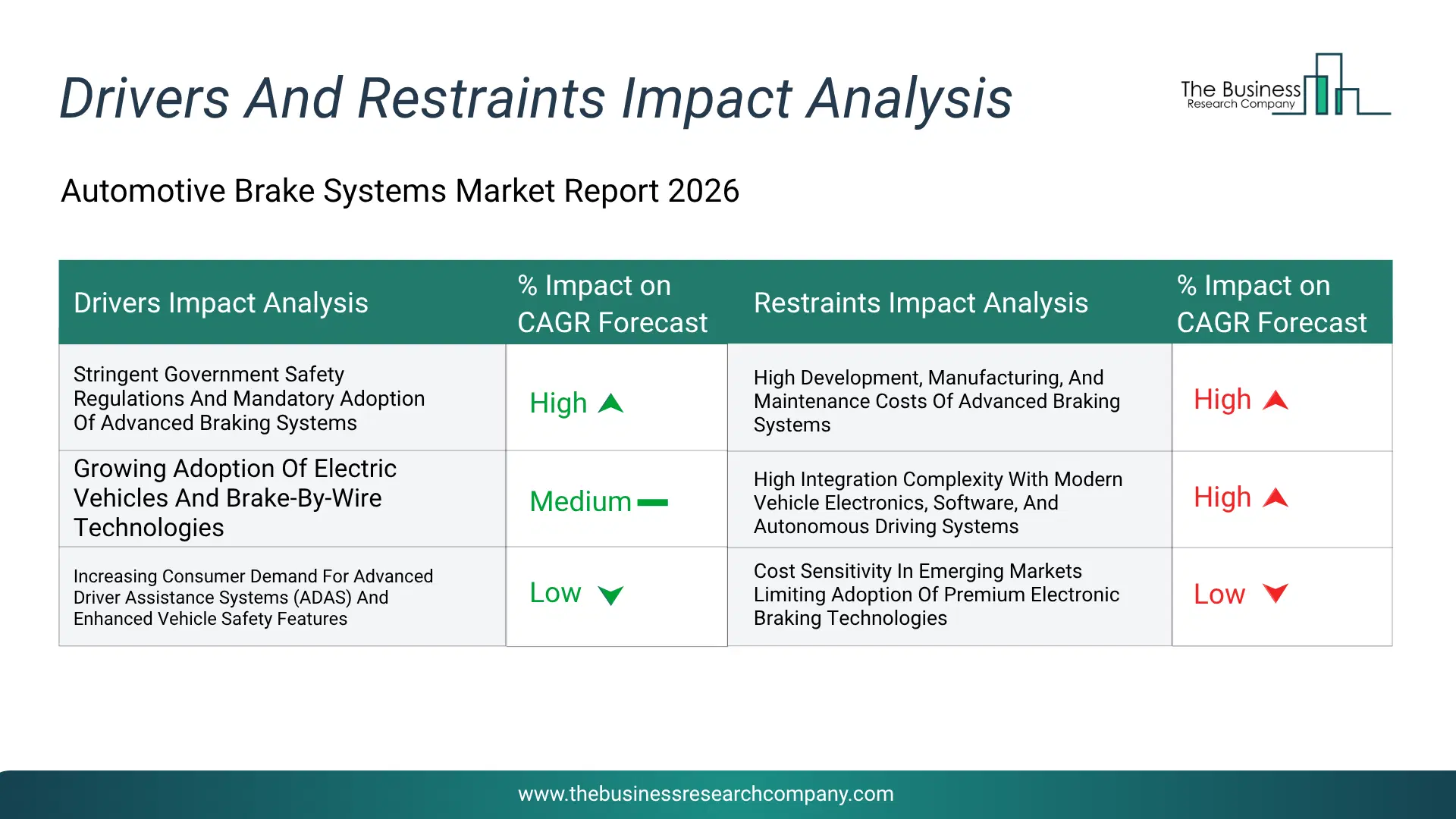
Infographic Chart Showing Key Market Drivers Analysis And Restraints For Automotive Brake Systems Market
The chart presents an impact analysis of key drivers and restraints, quantifying their relative influence on the market's growth rate and helping assess the balance between growth enablers and limiting factors. This chart offers a high-level perspective; the full report contains more detailed insights.
How Will The Drivers Impact Growth In The Global Automotive Brake Systems Market?
• Stringent Government Safety Regulations And Mandatory Adoption Of Advanced Braking Systems (High) – During the forecast period, the stringent government safety regulations and mandatory adoption of advanced braking systems are expected to emerge as a major factor driving the expansion of the automotive brake systems market by 2030. governments and vehicle safety authorities are enforcing stricter standards that require technologies such as ABS, ESC, EBD, and automatic emergency braking across a broader range of vehicle categories. in addition, higher safety rating programs are encouraging automakers to integrate intelligent braking systems, electronic controls, and advanced sensing technologies into new vehicle platforms. • Growing Adoption Of Electric Vehicles And Brake-By-Wire Technologies (Medium) – During the forecast period, the growing adoption of electric vehicles and brake-by-wire technologies is expected to emerge as a major factor driving the expansion of the automotive brake systems market by 2030. electrified vehicles require sophisticated braking architectures that seamlessly coordinate regenerative and friction braking while maximizing energy recovery and vehicle stability. the rapid expansion of electric vehicle production is therefore accelerating demand for electronic brake controllers, intelligent actuators, lightweight braking components, and software-defined braking platforms. • Increasing Consumer Demand For Advanced Driver Assistance Systems (ADAS) And Enhanced Vehicle Safety Features (Low) – During the forecast period, the increasing consumer demand for advanced driver assistance systems (ADAS) and enhanced vehicle safety features is expected to act as a key growth catalyst for the automotive brake systems market by 2030. intelligent braking technologies are becoming essential for supporting functions such as adaptive cruise control, forward collision warning, lane keeping assistance, and automatic emergency braking. rising consumer preference for safer vehicles and increasing competition among manufacturers to deliver premium safety capabilities are further strengthening demand for advanced electronic braking solutions.How Will The Restraints Impact Growth In The Global Automotive Brake Systems Market?
• High Development, Manufacturing, And Maintenance Costs Of Advanced Braking Systems (High) – During the forecast period, high Development, Manufacturing, And Maintenance Costs Of Advanced Braking Systems remain one of the most significant restraints limiting market expansion. Modern braking systems incorporate numerous sophisticated components including electronic control units, hydraulic modules, radar interfaces, wheel speed sensors, brake actuators, brake-by-wire technologies, and advanced software algorithms. Developing these technologies requires substantial investments in research and development, engineering validation, durability testing, regulatory compliance, and manufacturing infrastructure. Additionally, servicing and replacing electronic brake components are considerably more expensive than conventional braking systems due to specialized diagnostic equipment and skilled technicians. These higher production and ownership costs increase vehicle prices, making advanced braking systems less affordable for consumers in cost-sensitive regions and limiting adoption among entry-level vehicle manufacturers. • High Integration Complexity With Modern Vehicle Electronics, Software, And Autonomous Driving Systems (Medium) – During the forecast period, high Integration Complexity With Modern Vehicle Electronics, Software, And Autonomous Driving Systems poses a major technical challenge for automotive manufacturers and brake system suppliers. Today's braking systems must seamlessly interact with multiple vehicle subsystems including steering, suspension, battery management systems, powertrain controllers, ADAS platforms, telematics, and autonomous driving software. Achieving real-time communication among these systems requires sophisticated software architecture, cybersecurity protection, extensive calibration, and rigorous testing under various driving conditions. The growing complexity increases product development timelines, engineering costs, validation requirements, and system certification expenses. Smaller automotive suppliers often struggle to invest in these advanced capabilities, while automakers face challenges in ensuring system reliability and compliance with evolving functional safety standards, thereby slowing the deployment of next-generation braking technologies. • Cost Sensitivity In Emerging Markets Limiting Adoption Of Premium Electronic Braking Technologies (Low) – During the forecast period, cost Sensitivity In Emerging Markets Limiting Adoption Of Premium Electronic Braking Technologies continues to restrict the pace of market growth despite increasing awareness of vehicle safety. In many developing countries across Asia, Africa, and Latin America, purchasing decisions remain heavily influenced by vehicle affordability rather than advanced safety features. Consequently, automakers often offer conventional braking systems in entry-level vehicle models while reserving advanced technologies such as brake-by-wire, electronic parking brakes, automatic emergency braking, and integrated stability control for premium variants. Limited consumer purchasing power, lower disposable incomes, inadequate service infrastructure, and concerns regarding maintenance costs further reduce adoption of sophisticated braking technologies. This pricing pressure forces manufacturers to balance regulatory compliance with cost competitiveness, slowing the widespread penetration of advanced Automotive Brake Systems across high-volume vehicle segments.Key Players In The Global Automotive Brake Systems Market
Major companies operating in the automotive brake systems market report include Advics Co. Ltd., Aisin Seiki Co. Ltd., Akebono Brake Industry Co. Ltd., Brembo SpA, Continental AG, Robert Bosch GmbH, ZF Friedrichshafen AG, Federal-Mogul Motorparts LLC, Bendix Commercial Vehicle Systems LLC, Knorr-Bremse AG, WABCO Holdings Inc., Mando Corporation, Haldex AB, Nissin Kogyo Co Ltd., Meritor Inc., Advanced Braking Technology Ltd., TMD Friction Holdings GmbH, Midwest Air Technologies Inc., Nisshinbo Holdings Inc., ADVICS CO. LTD., FTE automotive Group, Hella Pagid GmbH, Endless Co. Ltd., Bremskerl Reibbelagwerke Emmerling GmbH & Co. KG, Brembo SpA, Performance Friction Corporation, Arc Remanufacturing Inc., Muller Brakes America Inc., Allgemeine Technische Entwicklungen GmbH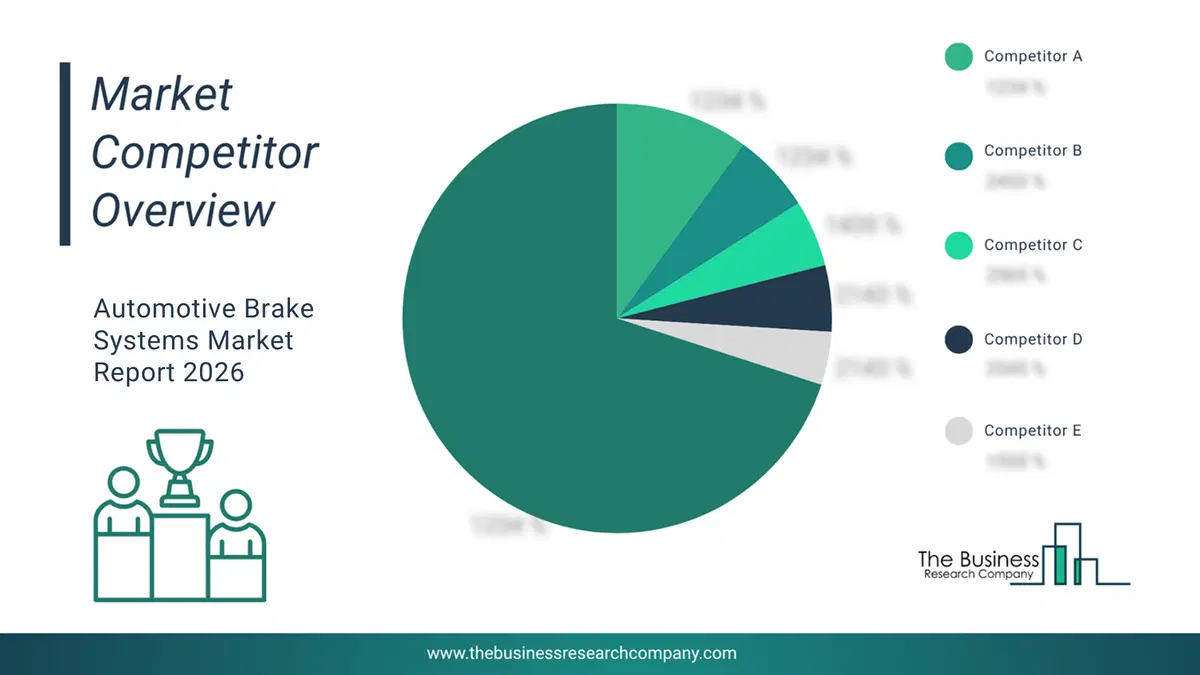
This chart is for illustrative purposes; the full report includes a detailed competitor analysis and comprehensive overview of the top 10 companies in the market.
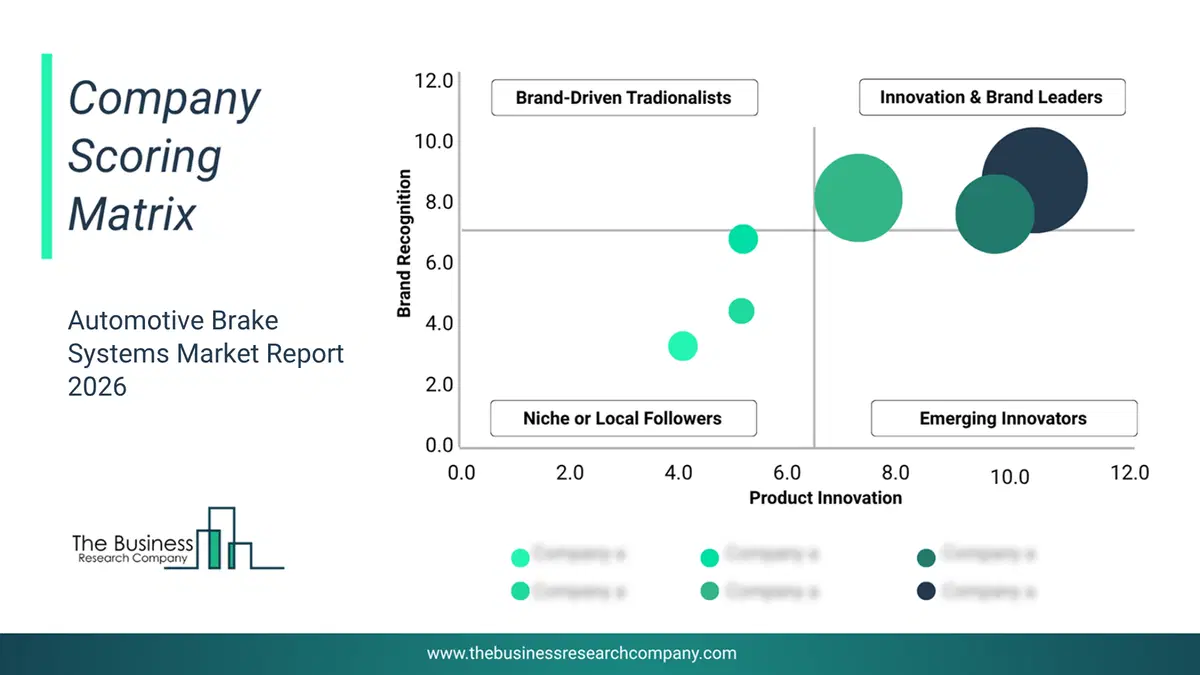
This chart maps companies by product innovation and brand strength, with bubble size indicating relative revenue, helping identify market leaders, challengers, and niche players. This is an illustrative chart; the full report provides a complete and accurate competitive analysis.
Global Automotive Brake Systems Market Trends and Insights
Major companies operating in the automotive brake systems market are focusing on developing innovative solutions, such as new generation electronic brake systems, to enhance vehicle safety, improve responsiveness, and optimize braking performance. A new generation electronic brake system refers to an advanced braking technology that utilizes electronic controls and sensors to enhance the performance and safety of a vehicle's braking mechanism. For instance, in May 2023, Continental AG, a Germany-based automotive parts manufacturing company, launched the MK 120 ESC, a new generation electronic brake system designed for enhanced safety and efficiency in vehicles, particularly suitable for electric models. Initially deployed in Changan's Oshan X5 Plus and Uni-T, this system is approximately 5% lighter and 7% smaller than its predecessor, contributing to energy savings and reduced emissions. It features advanced cyber security measures, including an embedded hardware security module for secure key generation, and supports over-the-air updates for continuous improvements.What Are Latest Mergers And Acquisitions In The Automotive Brake Systems Market?
In January 2025, Advik, an India-based automotive component manufacturer, acquired Powersports MTG for an undisclosed amount. Through this acquisition, Advik aims to enhance its automotive brake system portfolio by integrating Powersports MTG’s advanced braking technologies and expanding its global footprint in high-performance braking solutions. Powersports MTG is a Germany-based company that specializes in designing and manufacturing braking systems for various automotive and powersports applications.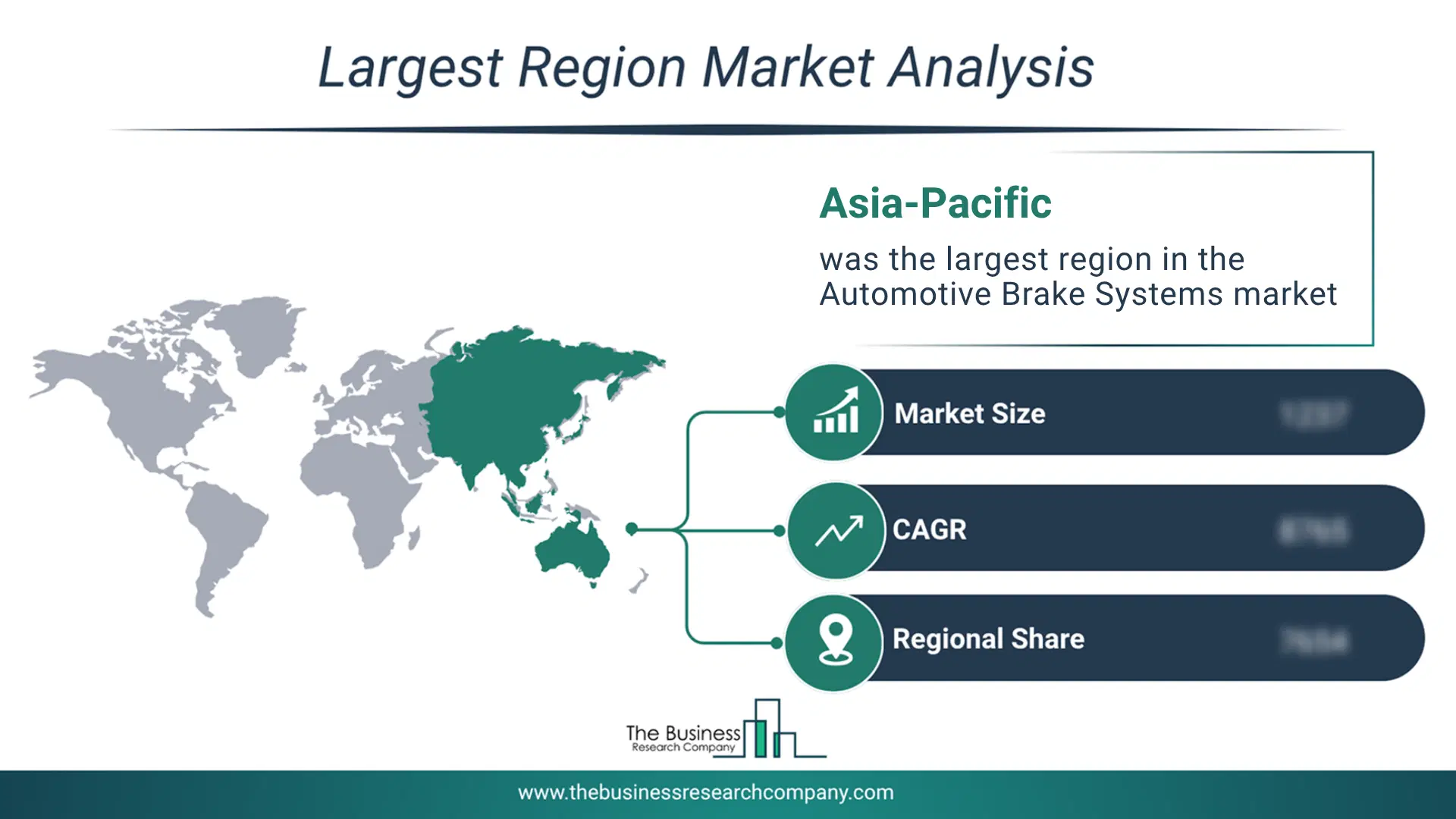
Regional Outlook
Asia-Pacific was the largest region in the automotive brake system market in 2025. The regions covered in this market report include Asia-Pacific, South East Asia, Western Europe, Eastern Europe, North America, South America, Middle East, Africa. The countries covered in this market report include Australia, Brazil, China, France, Germany, India, Indonesia, Japan, Taiwan, Russia, South Korea, UK, USA, Canada, Italy, SpainWhat Defines the Automotive Brake Systems Market?
The automotive brakes systems market consists of sales of emergency brakes and anti-lock brakes. Values in this market are ‘factory gate’ values, that is the value of goods sold by the manufacturers or creators of the goods, whether to other entities (including downstream manufacturers, wholesalers, distributors and retailers) or directly to end customers. The value of goods in this market includes related services sold by the creators of the goods.How is Market Value Defined and Measured?
The market value is defined as the revenues that enterprises gain from the sale of goods and/or services within the specified market and geography through sales, grants, or donations in terms of the currency (in USD unless otherwise specified). The revenues for a specified geography are consumption values that are revenues generated by organizations in the specified geography within the market, irrespective of where they are produced. It does not include revenues from resales along the supply chain, either further along the supply chain or as part of other products.
This chart presents market attractiveness based on a quantitative evaluation of growth, competition, strategic alignment, and risk, offering a clear view of opportunity areas for decision-making. This chart is for illustrative purposes; the full report contains the complete analysis.

This chart highlights the Total Addressable Market (TAM) by estimating the maximum revenue opportunity using an assumption-driven approach, supporting strategic planning and opportunity sizing across markets. The chart is illustrative; the full report provides a more comprehensive analysis.
What Key Data and Analysis Are Included in the Automotive Brake Systems Market Report 2026?
The automotive brake systems market research report is one of a series of new reports from The Business Research Company that provides market statistics, including industry global market size, regional shares, competitors with the market share, detailed market segments, market trends and opportunities, and any further data you may need to thrive in the automotive brake systems industry. The market research report delivers a complete perspective of everything you need, with an in-depth analysis of the current and future state of the industry.Automotive Brake Systems Market Report Forecast Analysis
| Report Attribute | Details |
|---|---|
| Market Size Value In 2026 | $42.13 billion |
| Revenue Forecast In 2030 | $56.76 billion |
| Growth Rate | CAGR of 7.7% from 2026 to 2030 |
| Base Year For Estimation | 2025 |
| Actual Estimates/Historical Data | 2020-2025 |
| Forecast Period | 2026 - 2030 |
| Market Representation | Revenue in USD Billion and CAGR from 2026 to 2030 |
| Segments Covered | Product Type, Technology, Sales Channel, Vehicle Type |
| Regional Scope | Asia-Pacific, Western Europe, Eastern Europe, North America, South America, Middle East, Africa |
| Country Scope | The countries covered in the report are Australia, Brazil, China, France, Germany, India, Indonesia, Japan, Taiwan, Russia, South Korea, UK, USA, Canada, Italy, Spain. |
| Key Companies Profiled | Advics Co. Ltd., Aisin Seiki Co. Ltd., Akebono Brake Industry Co. Ltd., Brembo SpA, Continental AG, Robert Bosch GmbH, ZF Friedrichshafen AG, Federal-Mogul Motorparts LLC, Bendix Commercial Vehicle Systems LLC, Knorr-Bremse AG, WABCO Holdings Inc., Mando Corporation, Haldex AB, Nissin Kogyo Co Ltd., Meritor Inc., Advanced Braking Technology Ltd., TMD Friction Holdings GmbH, Midwest Air Technologies Inc., Nisshinbo Holdings Inc., ADVICS CO. LTD., FTE automotive Group, Hella Pagid GmbH, Endless Co. Ltd., Bremskerl Reibbelagwerke Emmerling GmbH & Co. KG, Brembo SpA, Performance Friction Corporation, Arc Remanufacturing Inc., Muller Brakes America Inc., Allgemeine Technische Entwicklungen GmbH |
| Customization Scope | Request for Customization |
| Pricing And Purchase Options | Explore Purchase Options |