

Automotive Camera Module Market Report 2026
Global Outlook – By Type (Park Assist Cameras, Surround View Cameras, Driver Monitoring Cameras, Blind Spot Detection Cameras, Forward Collision Warning Cameras), By Technology (Digital Camera Modules, Infrared Camera Modules, Thermal Camera Modules, Monocular Camera Modules, Stereo Camera Modules), By Distribution Channel (Original Equipment Manufacturers, Aftermarket), By Application (Advanced Driver Assistance Systems, Parking Assistance, Driver Monitoring, Blind Spot Detection, Lane Departure Warning, Traffic Sign Recognition, Autonomous Driving, Interior Monitoring, Vehicle Surveillance) – Market Size, Trends, Strategies, and Forecast to 2030
Automotive Camera Module Market Overview
• Automotive Camera Module market size has reached to $8.89 billion in 2025 • Expected to grow to $14.57 billion in 2030 at a compound annual growth rate (CAGR) of 10.4% • Growth Driver: Surge In Adoption Of Advanced Driver Assistance Systems Fueling The Growth Of The Market Due To Rising Vehicle Safety Demand • Market Trend: Advancements In Thermal Imaging Camera Technology Enhance Vehicle Safety And ADAS Performance • Asia-Pacific was the largest region and fastest growing region.What Is Covered Under Automotive Camera Module Market?
An automotive camera module is an integrated imaging system installed in vehicles to capture visual data from the surrounding environment and convert it into digital signals for processing and analysis. It typically consists of a camera sensor, lens assembly, image processor, and supporting electronic components designed to operate reliably under varying automotive conditions. Automotive camera modules enhance vehicle visibility, environmental perception, and driving safety by providing real-time imaging for monitoring, detection, and navigation functions. The main types of automotive camera module include park assist cameras, surround view cameras, driver monitoring cameras, blind spot detection cameras, and forward collision warning cameras. Park assist cameras refer to vehicle-mounted imaging systems that provide drivers with real-time visual assistance during parking and low-speed maneuvering to improve safety and convenience. These camera modules utilize technologies such as digital camera modules, infrared camera modules, thermal camera modules, monocular camera modules, and stereo camera modules. They are supplied through original equipment manufacturers and aftermarket channels and they find application in advanced driver assistance systems, parking assistance, driver monitoring, blind spot detection, lane departure warning, traffic sign recognition, autonomous driving, interior monitoring, and vehicle surveillance.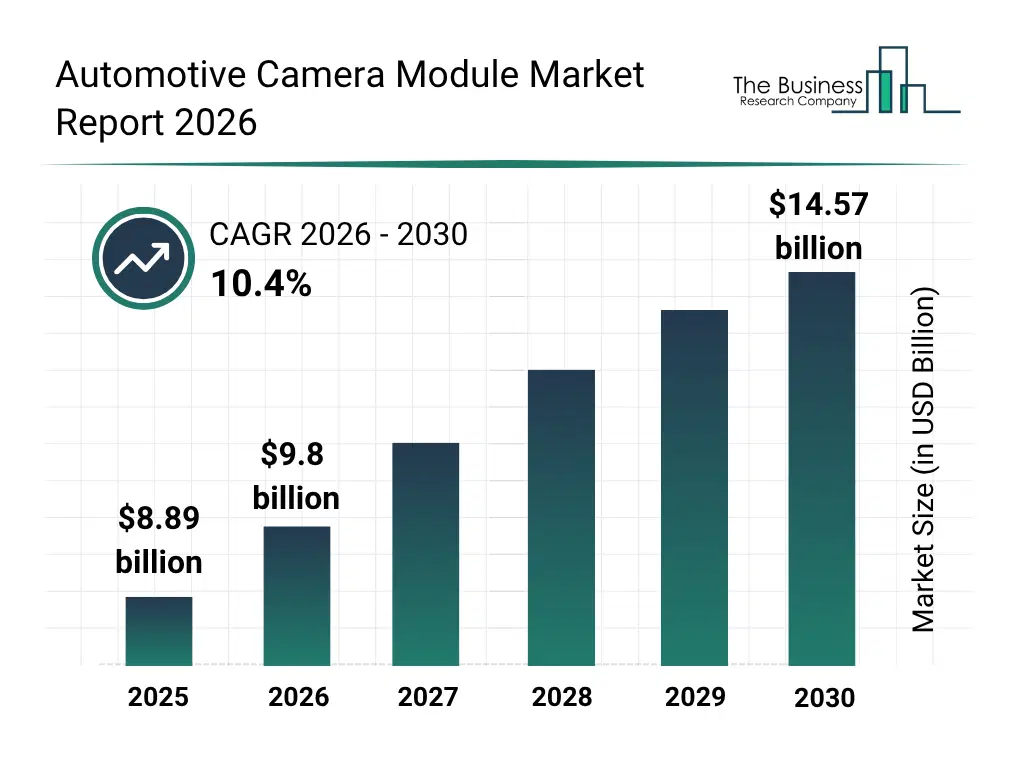
What Is The Automotive Camera Module Market Size and Share 2026?
The automotive camera module market size has grown rapidly in recent years. It will grow from $8.89 billion in 2025 to $9.8 billion in 2026 at a compound annual growth rate (CAGR) of 10.2%. The growth in the historic period can be attributed to increasing adoption of advanced driver assistance systems, growing demand for vehicle safety features, rising production of passenger vehicles, expanding integration of vision-based monitoring systems, strengthening automotive safety regulations.What Is The Automotive Camera Module Market Growth Forecast?
The automotive camera module market size is expected to see rapid growth in the next few years. It will grow to $14.57 billion in 2030 at a compound annual growth rate (CAGR) of 10.4%.The growth in the forecast period can be attributed to growing deployment of autonomous vehicles, increasing demand for high performance vehicle imaging systems, rising investments in automotive sensor technologies, expanding adoption of connected vehicle platforms, increasing focus on enhancing driver and passenger safety. Major trends in the forecast period include increasing adoption of high resolution automotive camera modules, growing demand for multi camera vehicle vision systems, rising integration of wide dynamic range imaging solutions, expansion of compact and lightweight camera module designs, increasing development of all weather automotive camera modules.
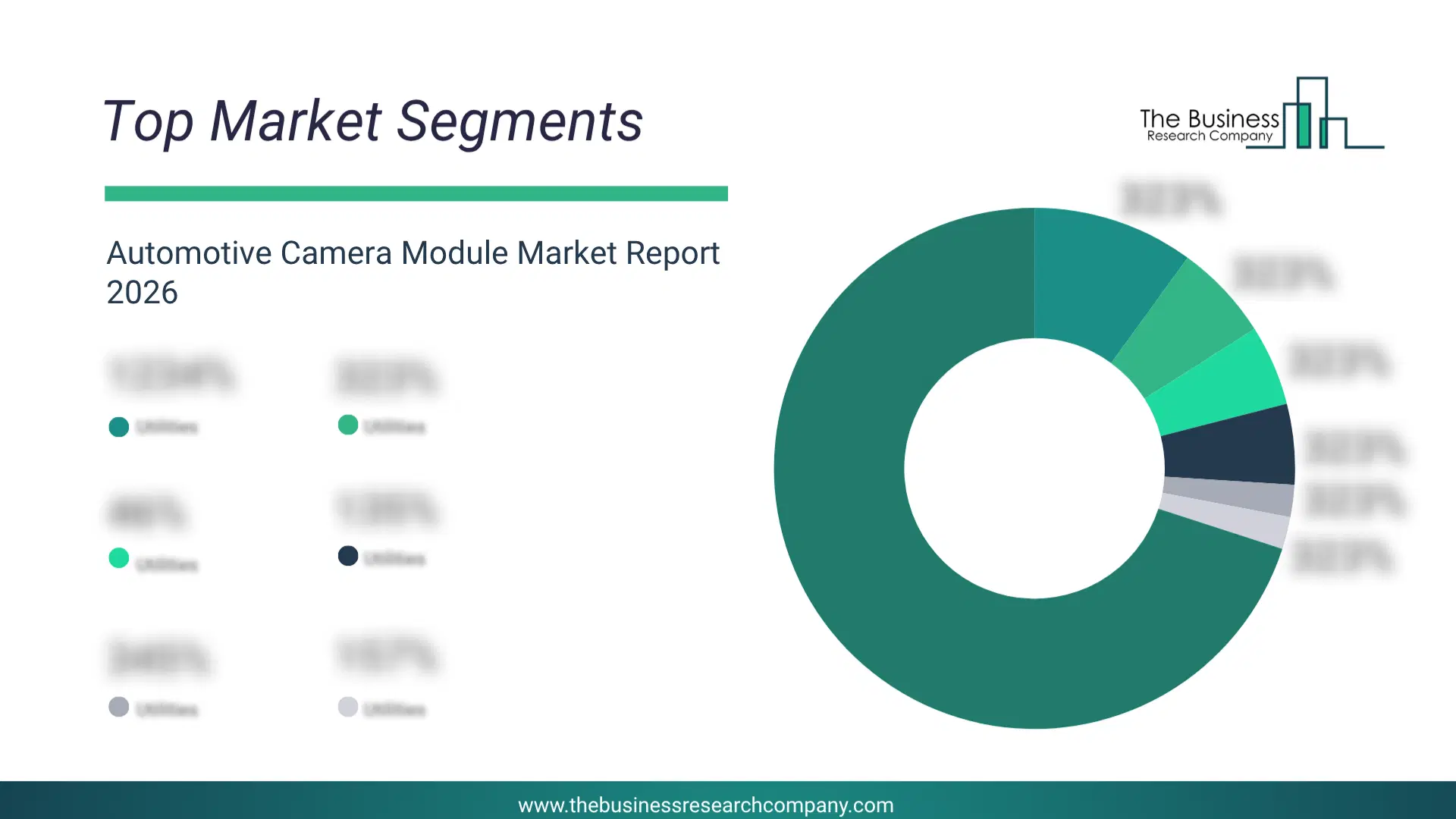
Global Automotive Camera Module Market Segmentation
2) By Technology: Digital Camera Modules, Infrared Camera Modules, Thermal Camera Modules, Monocular Camera Modules, Stereo Camera Modules 3) By Distribution Channel: Original Equipment Manufacturers, Aftermarket 4) By Application: Advanced Driver Assistance Systems, Parking Assistance, Driver Monitoring, Blind Spot Detection, Lane Departure Warning, Traffic Sign Recognition, Autonomous Driving, Interior Monitoring, Vehicle Surveillance Subsegments: 1) By Park Assist Cameras: Front Park Assist Cameras, Rear Park Assist Cameras, Side Park Assist Cameras, Ultra Wide Angle Park Assist Cameras, High Definition Park Assist Cameras 2) By Surround View Cameras: Four Camera Surround View Systems, Six Camera Surround View Systems, Eight Camera Surround View Systems, High Definition Surround View Cameras, Panoramic Surround View Cameras 3) By Driver Monitoring Cameras: Facial Recognition Cameras, Eye Tracking Cameras, Head Position Monitoring Cameras, Driver Fatigue Detection Cameras, Attention Monitoring Cameras 4) By Blind Spot Detection Cameras: Side Mirror Blind Spot Cameras, Rear Corner Blind Spot Cameras, Wide Angle Blind Spot Cameras, High Resolution Blind Spot Cameras, Multi Direction Blind Spot Cameras 5) By Forward Collision Warning Cameras: Monocular Forward Collision Cameras, Stereo Vision Forward Collision Cameras, Long Range Forward Collision Cameras, High Dynamic Range Forward Collision Cameras, Object Recognition Forward Collision CamerasWhat Is The Driver Of The Automotive Camera Module Market?
The increasing adoption of advanced driver assistance systems (ADAS) is expected to propel the growth of the automotive camera module market going forward. Advanced driver assistance systems refer to electronic technologies that assist drivers by enhancing vehicle safety, improving driving performance, and helping prevent collisions through automated warnings and intervention features. The increasing adoption of advanced driver assistance systems is driven by growing demand for vehicle safety, as these systems help reduce accidents by providing real-time warnings, driver support, and automated intervention features. Automotive camera modules support advanced driver assistance systems by providing real-time visual data that enables features such as lane departure warning, traffic sign recognition, collision avoidance, and pedestrian detection, thereby enhancing vehicle safety and driving assistance capabilities. For instance, in September 2024, according to the MITRE Corporation, a US-based not-for-profit organization, 10 of 14 advanced driver assistance system features had achieved over 50% market penetration by 2023, while five features exceeded 90% adoption. Therefore, the increasing adoption of advanced driver assistance systems (ADAS) is driving the growth of the automotive camera module industry.Key Players In The Global Automotive Camera Module Market
Major companies operating in the automotive camera module market are Aptiv PLC, Autoliv Inc., Calin Technology Co. Ltd., CAMOS Co. Ltd., Continental AG, DENSO Corporation, e-con Systems India Private Limited, FORVIA SE, Gentex Corporation, Kappa Optronics GmbH, KYOCERA Corporation, Leopard Imaging Inc., Magna International Inc., MCNEX Co. Ltd., Mobileye Global Inc., Panasonic Holdings Corporation, Q Technology (Group) Company Limited, Robert Bosch GmbH, Samsung Electronics Co. Ltd., Samvardhana Motherson International Limited, SEKONIX Co. Ltd., Shenzhen Stonkam Co. Ltd., Sunny Optical Technology (Group) Company Limited, Tung Thih Electronic Co. Ltd., Waysion Technology Co. Ltd.
This chart is for illustrative purposes; the full report includes a detailed competitor analysis and comprehensive overview of the top 10 companies in the market.
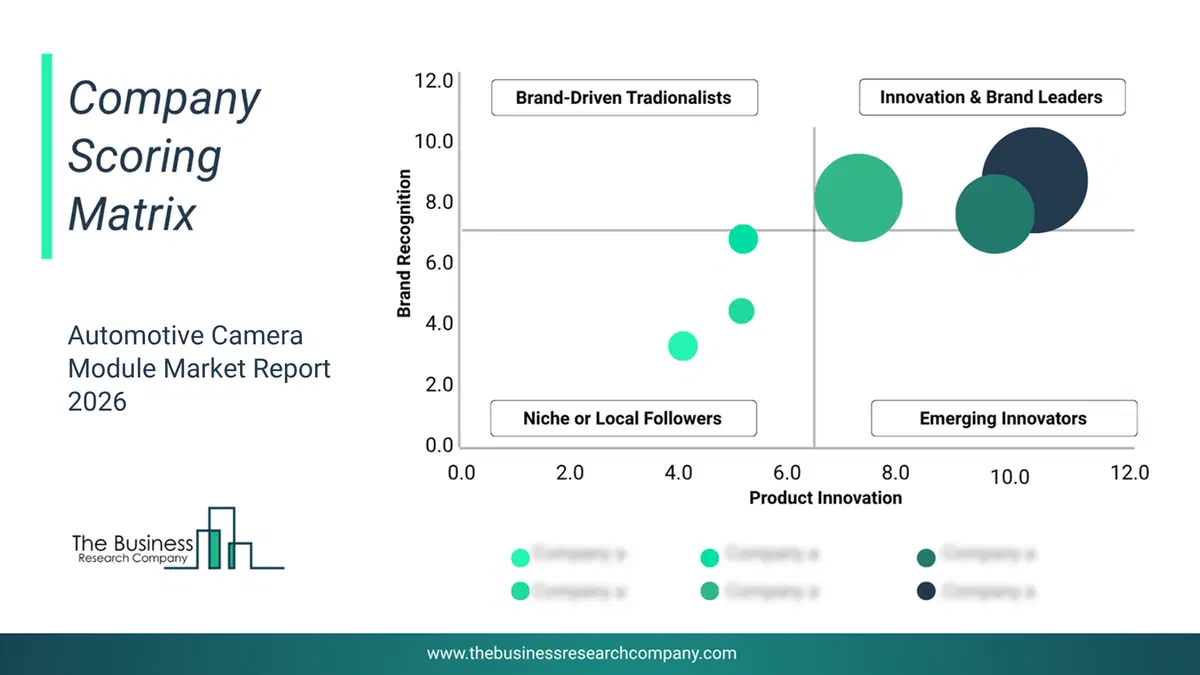
This chart maps companies by product innovation and brand strength, with bubble size indicating relative revenue, helping identify market leaders, challengers, and niche players. This is an illustrative chart; the full report provides a complete and accurate competitive analysis.
Global Automotive Camera Module Market Trends and Insights
Major companies operating in the automotive camera module market are focusing on developing advanced imaging products, such as automotive-qualified thermal imaging camera modules, to improve vehicle perception, pedestrian detection, and autonomous driving safety in low-visibility conditions. An automotive-qualified thermal imaging camera module is a vehicle-grade sensor that detects heat signatures to enhance visibility and improve driver assistance and safety in low-light and adverse weather conditions. For instance, in January 2026, Teledyne FLIR OEM, a US-based thermal imaging technology company, launched Tura, the industry's first Automotive Safety Integrity Level (ASIL-B) thermal longwave infrared (LWIR) camera developed in compliance with ISO 26262 functional safety standards. It is designed for advanced driver assistance systems (ADAS), autonomous vehicles, and vehicle night vision applications. The camera features a high-performance 640 × 512 far-infrared sensor with industry-leading sensitivity for detecting pedestrians, animals, and other vulnerable road users. The solution enhances perception beyond headlights in complete darkness and challenging conditions such as fog, smoke, and glare, supporting improved automatic emergency braking and overall vehicle safety.What Are Latest Mergers And Acquisitions In The Automotive Camera Module Market?
In January 2024, Ficosa, a Spain-based manufacturer of advanced automotive camera modules and vision systems, partnered with indie Semiconductor to develop AI-based automotive camera solutions. Through this partnership, Ficosa and Indie Semiconductor aimed to develop AI-powered automotive camera solutions that enhance vehicle safety, improve environmental perception, and strengthen advanced driver assistance system (ADAS) performance. Indie Semiconductor is a US-based automotive fabless semiconductor company.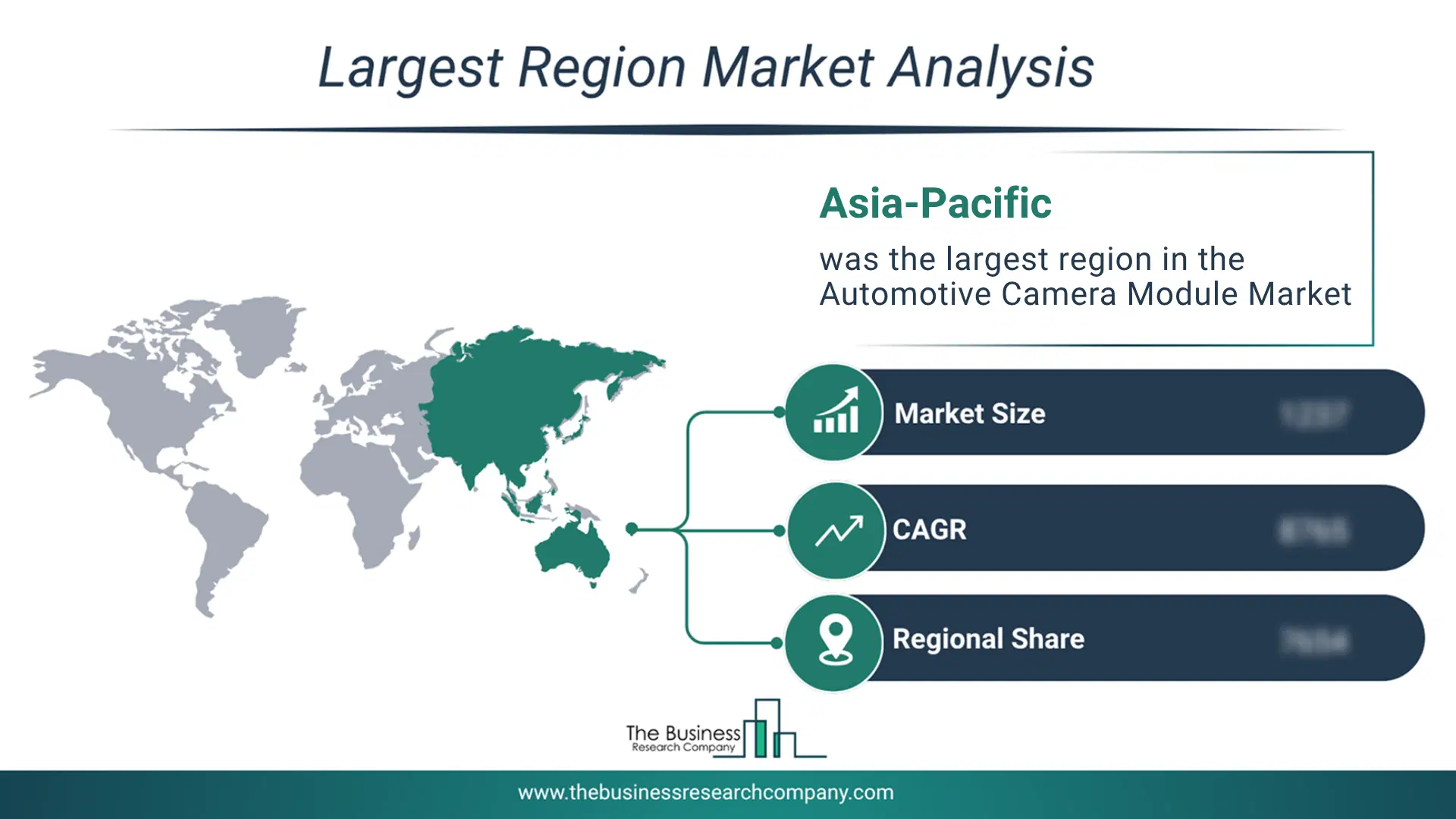
Regional Outlook/Insights
Asia-Pacific was the largest region in the automotive camera module market in 2025. Asia-Pacific is expected to be the fastest-growing region in the forecast period. The regions covered in this market report are Asia-Pacific, South East Asia, Western Europe, Eastern Europe, North America, South America, Middle East, Africa. The countries covered in this market report are Australia, Brazil, China, France, Germany, India, Indonesia, Japan, Taiwan, Russia, South Korea, UK, USA, Canada, Italy, Spain.What Defines the Automotive Camera Module Market?
The automotive camera module market consists of sales of rear-view cameras, lane departure warning cameras, night vision cameras, and traffic sign recognition cameras. Values in this market are ‘factory gate’ values, that is, the value of goods sold by the manufacturers or creators of the goods, whether to other entities (including downstream manufacturers, wholesalers, distributors, and retailers) or directly to end customers. The value of goods in this market includes related services sold by the creators of the goods.How is Market Value Defined and Measured?
The market value is defined as the revenues that enterprises gain from the sale of goods and/or services within the specified market and geography through sales, grants, or donations in terms of the currency (in USD unless otherwise specified). The revenues for a specified geography are consumption values that are revenues generated by organizations in the specified geography within the market, irrespective of where they are produced. It does not include revenues from resales along the supply chain, either further along the supply chain or as part of other products.
This chart presents market attractiveness based on a quantitative evaluation of growth, competition, strategic alignment, and risk, offering a clear view of opportunity areas for decision-making. This chart is for illustrative purposes; the full report contains the complete analysis.

This chart highlights the Total Addressable Market (TAM) by estimating the maximum revenue opportunity using an assumption-driven approach, supporting strategic planning and opportunity sizing across markets. The chart is illustrative; the full report provides a more comprehensive analysis.
What Key Data and Analysis Are Included in the Automotive Camera Module Market Report 2026?
The automotive camera module market research report is one of a series of new reports from The Business Research Company that provides automotive camera module market statistics, including automotive camera module industry global market size, regional shares, competitors with a automotive camera module market share, detailed automotive camera module market segments, market trends and opportunities, and any further data you may need to thrive in the automotive camera module industry. This automotive camera module market research report delivers a complete perspective of everything you need, with an in-depth analysis of the current and future scenario of the industry.Automotive Camera Module Market Report Forecast Analysis
| Report Attribute | Details |
|---|---|
| Market Size Value In 2026 | $9.8 billion |
| Revenue Forecast In 2030 | $14.57 billion |
| Growth Rate | CAGR of 10.4% from 2026 to 2030 |
| Base Year For Estimation | 2025 |
| Actual Estimates/Historical Data | 2020-2025 |
| Forecast Period | 2026 - 2030 |
| Market Representation | Revenue in USD Billion and CAGR from 2026 to 2030 |
| Segments Covered | Type, Technology, Distribution Channel, Application |
| Regional Scope | Asia-Pacific, Western Europe, Eastern Europe, North America, South America, Middle East, Africa |
| Country Scope | The countries covered in the report are Australia, Brazil, China, France, Germany, India, Indonesia, Japan, Taiwan, Russia, South Korea, UK, USA, Canada, Italy, Spain. |
| Key Companies Profiled | Aptiv PLC, Autoliv Inc., Calin Technology Co. Ltd., CAMOS Co. Ltd., Continental AG, DENSO Corporation, e-con Systems India Private Limited, FORVIA SE, Gentex Corporation, Kappa Optronics GmbH, KYOCERA Corporation, Leopard Imaging Inc., Magna International Inc., MCNEX Co. Ltd., Mobileye Global Inc., Panasonic Holdings Corporation, Q Technology (Group) Company Limited, Robert Bosch GmbH, Samsung Electronics Co. Ltd., Samvardhana Motherson International Limited, SEKONIX Co. Ltd., Shenzhen Stonkam Co. Ltd., Sunny Optical Technology (Group) Company Limited, Tung Thih Electronic Co. Ltd., Waysion Technology Co. Ltd. |
| Customization Scope | Request for Customization |
| Pricing And Purchase Options | Explore Purchase Options |