
Automotive Carbon Ceramic Brake Market Report 2026
Global Outlook – By Type (Single Disc Brake, Multiple Disc Brake), By Fiber State (Short Fiber Discs, Long Fiber Discs), By Application (Passenger Car, Light Commercial Vehicle (LCV), Heavy Commercial Vehicle (HCV)), By Sales Channel (Original Equipment Manufacturer (OEM), Original Equipment Supplier (OES), Independent Aftermarket (IAM)) – Market Size, Trends, Strategies, and Forecast to 2030
Automotive Carbon Ceramic Brake Market Overview
• Automotive Carbon Ceramic Brake market size has reached to $1.02 billion in 2025 • Expected to grow to $1.62 billion in 2030 at a compound annual growth rate (CAGR) of 9.5% • Growth Driver: Rising Vehicle Registrations Driving The Growth Of The Market Due To Increased Demand For Sports And Luxury Vehicles • Market Trend: Advancements In Lightweight Carbon Ceramic Brake Systems For High-Performance Automotive Applications • North America was the largest region in 2025 and Asia-Pacific is the fastest growing region.What Is Covered Under Automotive Carbon Ceramic Brake Market?
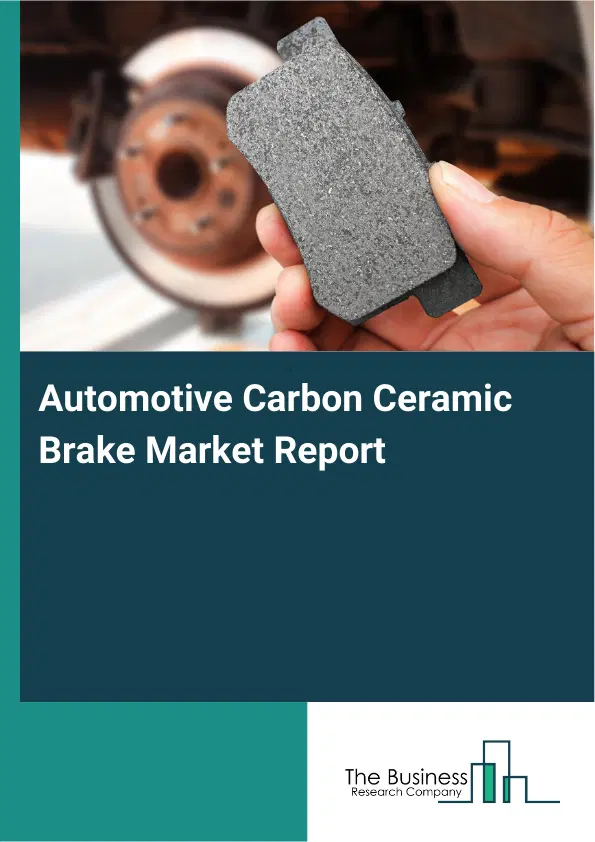
Automotive carbon ceramic brakes are high-performance braking systems made from a composite material consisting primarily of carbon fiber and ceramic. These brakes are designed to provide superior stopping power, durability, and heat resistance compared to traditional metal or cast iron brake systems. The main type of automotive carbon ceramic brake are single disc brake, multiple disc brake. The type of fiber state included are short fiber discs, long fiber discs. It is applied to passenger car, light commercial vehicle (LCV), and heavy commercial vehicle (HCV), which are distributed through original equipment manufacturer (OEM), original equipment supplier (OES), and independent aftermarket (IAM).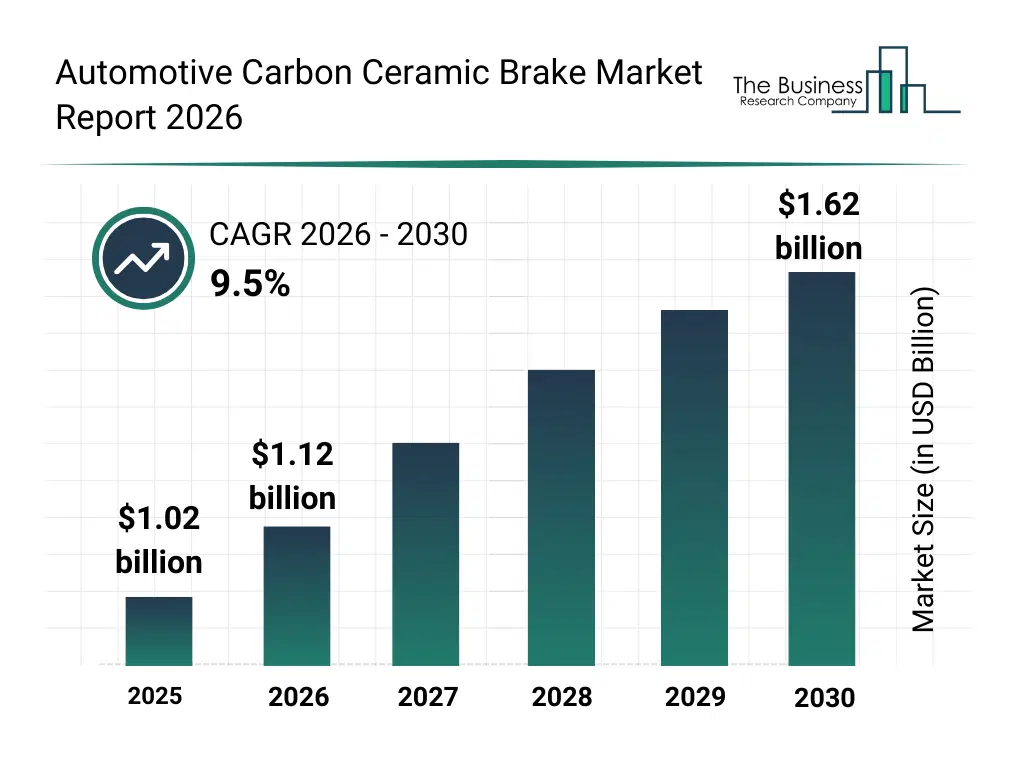
What Is The Automotive Carbon Ceramic Brake Market Size and Share 2026?
The automotive carbon ceramic brake market size has grown rapidly in recent years. It will grow from $1.02 billion in 2025 to $1.12 billion in 2026 at a compound annual growth rate (CAGR) of 10.5%. The growth in the historic period can be attributed to motorsports adoption, luxury vehicle growth, demand for high braking performance, performance car manufacturing, heat-resistant materials development.What Is The Automotive Carbon Ceramic Brake Market Growth Forecast?
The automotive carbon ceramic brake market size is expected to see strong growth in the next few years. It will grow to $1.62 billion in 2030 at a compound annual growth rate (CAGR) of 9.5%. The growth in the forecast period can be attributed to electric vehicle performance requirements, demand for extended brake life, lightweighting initiatives, premium vehicle sales growth, advanced composite adoption. Major trends in the forecast period include growing demand in high-performance vehicles, adoption in electric and luxury cars, shift toward lightweight braking systems, expansion of oem fitment, increased focus on thermal stability.
Global Automotive Carbon Ceramic Brake Market Segmentation
1) By Type: Single Disc Brake, Multiple Disc Brake 2) By Fiber State: Short Fiber Discs, Long Fiber Discs 3) By Application: Passenger Car, Light Commercial Vehicle (LCV), Heavy Commercial Vehicle (HCV) 4) By Sales Channel: Original Equipment Manufacturer (OEM), Original Equipment Supplier (OES), Independent Aftermarket (IAM) Subsegments: 1) By Single Disc Brake: Front Single Disc Brake, Rear Single Disc Brake, Performance Single Disc Brake, Lightweight Single Disc Brake 2) By Multiple Disc Brake: Dual Disc Brake Systems, Multi-Piston Disc Brake Systems, Four-Disc Brake Systems, High-Performance Multi-Disc Brake Systems, Carbon Ceramic Multi-Disc Brake Systems For Racing Or Sports CarsWhat Is The Driver Of The Automotive Carbon Ceramic Brake Market?
The rising vehicle registrations are expected to propel the growth of the automotive carbon ceramic brake market going forward. Vehicle registrations refer to the total number of motor vehicles officially recorded with the authorities within a specific period, indicating active demand and use. The increase in registrations is due to growing consumer preference for sports and luxury vehicles, which offer high performance, comfort, and advanced features. Automotive carbon ceramic brakes in these vehicles provide superior braking performance, reduced weight, and enhanced durability, improving overall driving efficiency and safety. For instance, in December 2024, according to the International Council on Clean Transportation, a US-based nonprofit organization focused on advancing clean, efficient, and sustainable transportation, approximately 10.6 million new cars were registered in the European Union in 2023, an increase of 14% more than in 2022. Therefore, the rising vehicle registrations are driving the growth of the automotive carbon ceramic brake industry.Key Players In The Global Automotive Carbon Ceramic Brake Market
Major companies operating in the automotive carbon ceramic brake market report include Brembo SpA, Surface Transforms PLC, SGL Carbon GmbH, Wilwood Engineering Inc., Performance Friction Corporation, Baer Inc., Tarox Srl, Rotora Inc., Disc Brakes Australia (DBA), Alcon Components Ltd, Endless Brake Technology Co. Ltd., Carbon Lorraine, CarboTech Engineering LLC, CCB Brakes International Ltd, CeramTec GmbH, Porsche AG, Ferrari N.V., Lamborghini S.p.A., Pagani Automobili S.p.A., Koenigsegg Automotive AB
This chart is for illustrative purposes; the full report includes a detailed competitor analysis and comprehensive overview of the top 10 companies in the market.
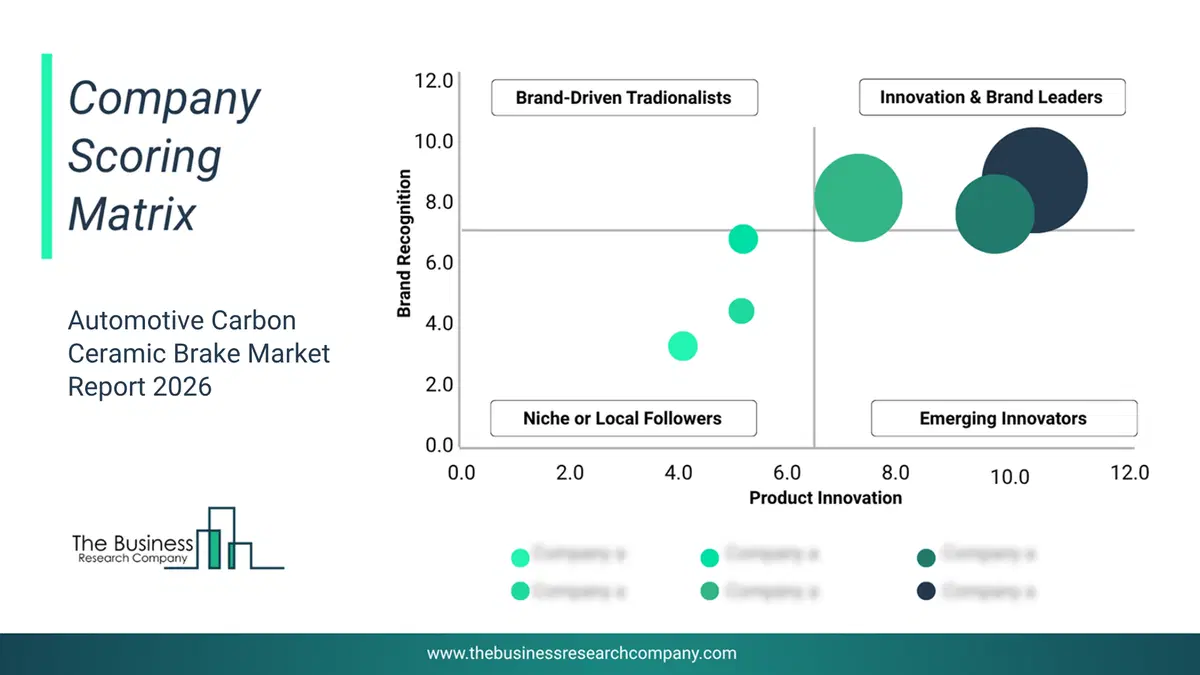
This chart maps companies by product innovation and brand strength, with bubble size indicating relative revenue, helping identify market leaders, challengers, and niche players. This is an illustrative chart; the full report provides a complete and accurate competitive analysis.
Global Automotive Carbon Ceramic Brake Market Trends and Insights
Major companies operating in the automotive carbon ceramic brake market are innovating lightweight braking systems, such as brake skins, to provide durable braking solutions suitable for extreme conditions. Brake skins are lightweight components that offer superior braking performance, high thermal conductivity, and durability in high-performance automotive applications. For instance, in February 2023, Inspeed Technology (Shenzhen) Co., Ltd., a China-based brake system solution provider, launched its new carbon ceramic brake disc, offering superior performance with advantages like low weight, high strength, excellent heat resistance (up to 1400 degrees Fahrenheit), and a long service life exceeding 300,000 kilometers. It is compatible with various multi-piston brake calipers. It enhances vehicle dynamics and safety with high friction coefficients in dry and wet conditions, ensuring reliable handling and shorter braking distances.What Are Latest Mergers And Acquisitions In The Automotive Carbon Ceramic Brake Market?
In February 2023, Tex Tech Industries, a US-based high-performance material manufacturer, acquired a manufacturing plant in California from SGL Carbon GmbH for an undisclosed amount. With this acquisition, Tex Tech aims to leverage its unique manufacturing capabilities and meet the increasing demands of customers in the fast-growing automotive and commercial aerospace sectors. SGL Carbon GmbH is a Germany-based carbon and graphite product manufacturing company offering carbon ceramic brake systems for automotive applications.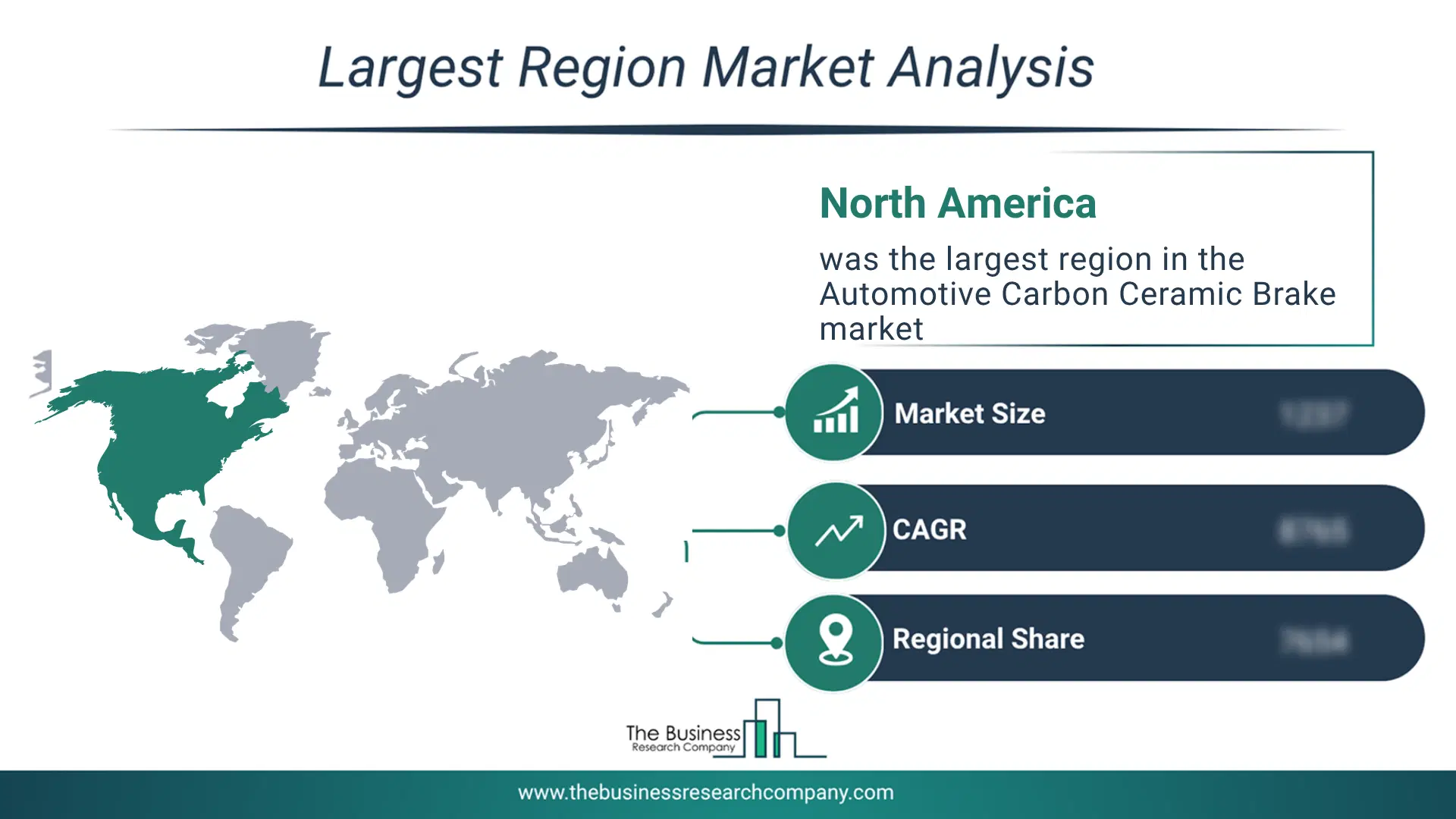
Regional Outlook
North America was the largest region in the automotive carbon ceramic brake market in 2025. Asia-Pacific is expected to be the fastest-growing region in the forecast period. The regions covered in this market report include Asia-Pacific, South East Asia, Western Europe, Eastern Europe, North America, South America, Middle East, Africa. The countries covered in this market report include Australia, Brazil, China, France, Germany, India, Indonesia, Japan, Taiwan, Russia, South Korea, UK, USA, Canada, Italy, SpainWhat Defines the Automotive Carbon Ceramic Brake Market?
The automotive carbon ceramic brakes market consists of sales of high-performance braking systems, including brake discs, pads, calipers, and complete brake systems, made from a carbon fiber and ceramic composite. Values in this market are ‘factory gate’ values, that is the value of goods sold by the manufacturers or creators of the goods, whether to other entities (including downstream manufacturers, wholesalers, distributors and retailers) or directly to end customers. The value of goods in this market includes related services sold by the creators of the goods.How is Market Value Defined and Measured?
The market value is defined as the revenues that enterprises gain from the sale of goods and/or services within the specified market and geography through sales, grants, or donations in terms of the currency (in USD unless otherwise specified). The revenues for a specified geography are consumption values that are revenues generated by organizations in the specified geography within the market, irrespective of where they are produced. It does not include revenues from resales along the supply chain, either further along the supply chain or as part of other products.
This chart presents market attractiveness based on a quantitative evaluation of growth, competition, strategic alignment, and risk, offering a clear view of opportunity areas for decision-making. This chart is for illustrative purposes; the full report contains the complete analysis.

This chart highlights the Total Addressable Market (TAM) by estimating the maximum revenue opportunity using an assumption-driven approach, supporting strategic planning and opportunity sizing across markets. The chart is illustrative; the full report provides a more comprehensive analysis.
What Key Data and Analysis Are Included in the Automotive Carbon Ceramic Brake Market Report 2026?
The automotive carbon ceramic brake market research report is one of a series of new reports from The Business Research Company that provides market statistics, including industry global market size, regional shares, competitors with the market share, detailed market segments, market trends and opportunities, and any further data you may need to thrive in the automotive carbon ceramic brake industry. The market research report delivers a complete perspective of everything you need, with an in-depth analysis of the current and future state of the industry.Automotive Carbon Ceramic Brake Market Report Forecast Analysis
| Report Attribute | Details |
|---|---|
| Market Size Value In 2026 | $1.12 billion |
| Revenue Forecast In 2030 | $1.62 billion |
| Growth Rate | CAGR of 10.5% from 2026 to 2030 |
| Base Year For Estimation | 2025 |
| Actual Estimates/Historical Data | 2020-2025 |
| Forecast Period | 2026 - 2030 - 2030 |
| Market Representation | Revenue in USD Billion and CAGR from 2026 to 2030 |
| Segments Covered | Type, Fiber State, Application, Sales Channel |
| Regional Scope | Asia-Pacific, Western Europe, Eastern Europe, North America, South America, Middle East, Africa |
| Country Scope | The countries covered in the report are Australia, Brazil, China, France, Germany, India, Indonesia, Japan, Taiwan, Russia, South Korea, UK, USA, Canada, Italy, Spain. |
| Key Companies Profiled | Brembo SpA, Surface Transforms PLC, SGL Carbon GmbH, Wilwood Engineering Inc., Performance Friction Corporation, Baer Inc., Tarox Srl, Rotora Inc., Disc Brakes Australia (DBA), Alcon Components Ltd, Endless Brake Technology Co. Ltd., Carbon Lorraine, CarboTech Engineering LLC, CCB Brakes International Ltd, CeramTec GmbH, Porsche AG, Ferrari N.V., Lamborghini S.p.A., Pagani Automobili S.p.A., Koenigsegg Automotive AB |
| Customization Scope | Request for Customization |
| Pricing And Purchase Options | Explore Purchase Options |