
Automotive Carbon Fiber Composites Parts Market Report 2026
Global Outlook – By Type (Brake Discs, Battery Housing, Mirror Housing, Chassis, Pillars, Other Types), By Resin (Thermoplastic, Thermoset), By Application (Original Equipment Manufacturer (OEM), Aftermarket) – Market Size, Trends, Strategies, and Forecast to 2030
Automotive Carbon Fiber Composites Parts Market Overview
• Automotive Carbon Fiber Composites Parts market size has reached to $26.34 billion in 2025 • Expected to grow to $53.92 billion in 2030 at a compound annual growth rate (CAGR) of 15.4% • Growth Driver: Surging Demand For Electric Vehicles Propels Automotive Carbon Fiber Composites Parts Market • Market Trend: Product Innovations In Rapid Molding Technology Accelerate Automotive CFRP Parts Production • Europe was the largest region in 2025.Market Gains By 2030 – Top Opportunities By Segment
Market Gain identifies the most promising market opportunities by highlighting the segments or products expected to generate the highest incremental revenue growth over the next five years.
What Is Covered Under Automotive Carbon Fiber Composites Parts Market?
Automotive carbon fiber composite parts refer to automotive parts made up of carbon fiber composite material. They are used to reduce the weight of the vehicle to make it more energy efficient. The main types of automotive carbon fiber composite parts are brake discs, brake pads, battery housing, mirror housing, chassis, pillars, and others. Brake discs refer to the metal disc that revolves around the wheel in a disc brake. The various resins involved are thermoplastic and thermoset which are used by original equipment manufacturers (OEM) and aftermarket applications.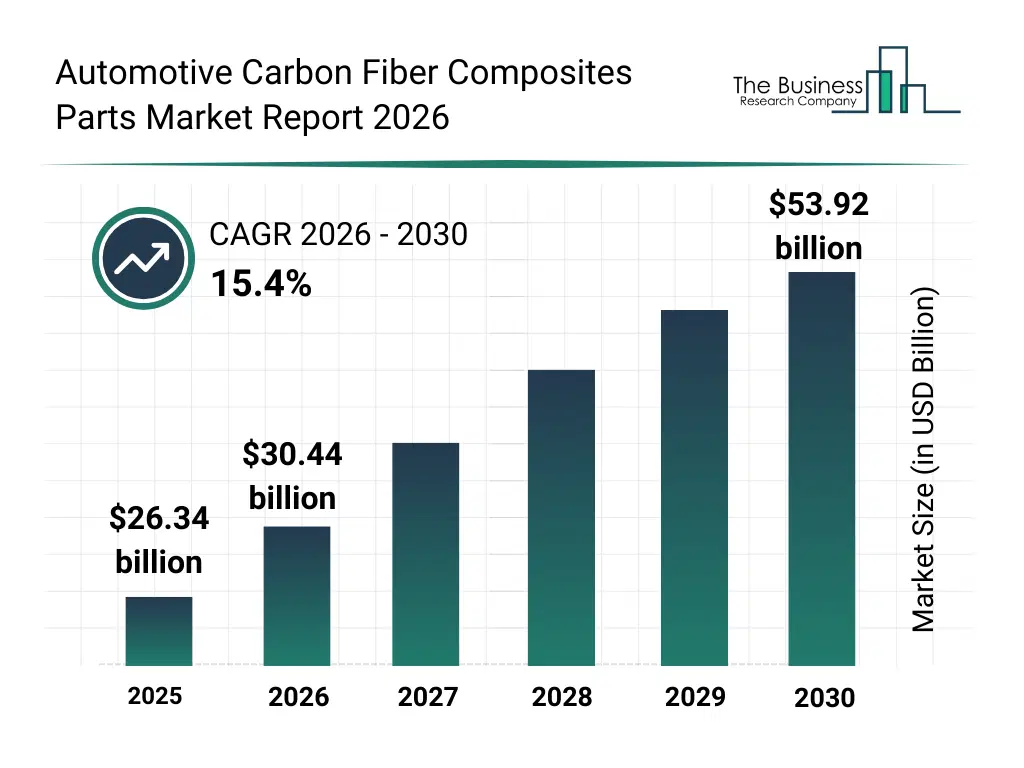
What Is The Automotive Carbon Fiber Composites Parts Market Size and Share 2026?
The automotive carbon fiber composites parts market size has grown rapidly in recent years. It will grow from $26.34 billion in 2025 to $30.44 billion in 2026 at a compound annual growth rate (CAGR) of 15.6%. The growth in the historic period can be attributed to vehicle lightweighting initiatives, motorsports material adoption, premium vehicle manufacturing, composite material advancements, fuel efficiency regulations.What Is The Automotive Carbon Fiber Composites Parts Market Growth Forecast?
The automotive carbon fiber composites parts market size is expected to see rapid growth in the next few years. It will grow to $53.92 billion in 2030 at a compound annual growth rate (CAGR) of 15.4%. The growth in the forecast period can be attributed to electric vehicle range optimization, carbon emission regulations, advanced manufacturing scale-up, battery safety requirements, cost reduction in composites. Major trends in the forecast period include increasing use in lightweight vehicle design, expansion of ev structural components, adoption of advanced resin systems, growth of battery housing applications, focus on structural strength.
Global Automotive Carbon Fiber Composites Parts Market Segmentation
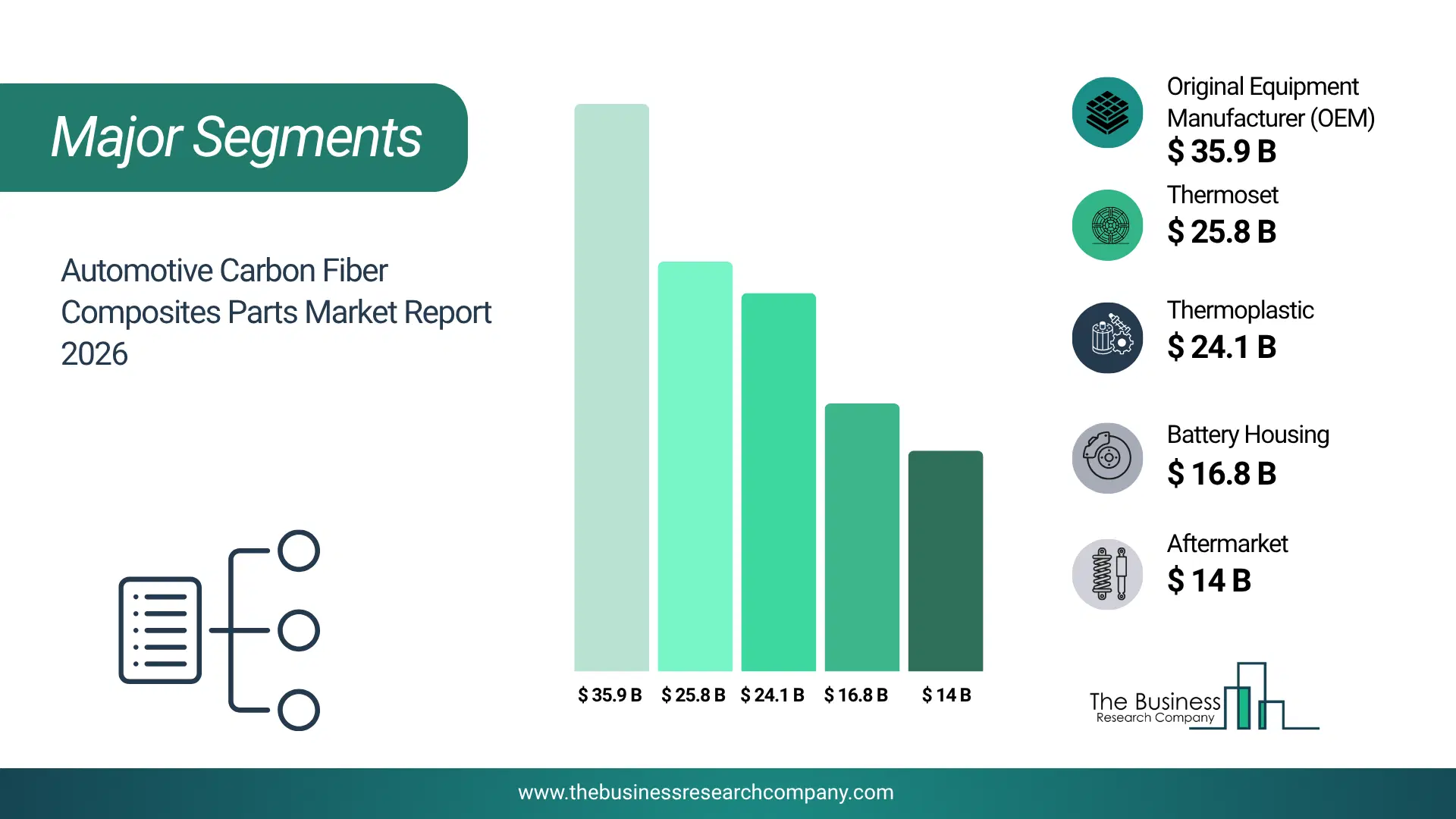
1) By Type: Brake Discs, Battery Housing, Mirror Housing, Chassis, Pillars, Other Types 2) By Resin: Thermoplastic, Thermoset 3) By Application: Original Equipment Manufacturer (OEM), Aftermarket Subsegments: 1) By Brake Discs: Solid Brake Discs, Ventilated Brake Discs 2) By Battery Housing: EV Battery Enclosures, Hybrid Battery Housing 4) By Mirror Housing: Side Mirror Casings, Rearview Mirror Casings 5) By Chassis: Structural Chassis Components, Lightweight Chassis Frames 6) By Pillars: A-Pillars, B-Pillars, C-Pillars 7) By Other Types: Body Panels, Interior Components, Structural Reinforcements The top segments in the automotive carbon fiber composites parts market will be: • Original Equipment Manufacturer (OEM) will reach $35892.3 Million by 2030. • Thermoset will reach $25870.99 Million by 2030. • Thermoplastic will reach $24097.7 Million by 2030. • Battery Housing will reach $16825.88 Million by 2030. • Aftermarket will reach $14076.39 Million by 2030.What Is The Driver Of The Automotive Carbon Fiber Composites Parts Market?
Surging demand for electric vehicles is significantly contributing to the automotive carbon fiber composites parts market going forward. Electric vehicles refer to vehicles that have an electric motor capable of drawing power from a battery and having the ability to receive external charging. Parts made from carbon fiber composites are used in electric vehicles to reduce weight and, in turn, minimize the vehicle’s energy consumption. For instance, in November 2025, according to the International Council on Clean Transportation (ICCT), a U.S.-based nonprofit organization focused on sustainable transportation, electric vehicles represented 10.5% of new light-duty vehicle sales in the United States, with more than 1.2 million EVs sold during the first three quarters of 2025. Therefore, the rising adoption of electric vehicles is driving the growth of the automotive carbon fiber composite parts market.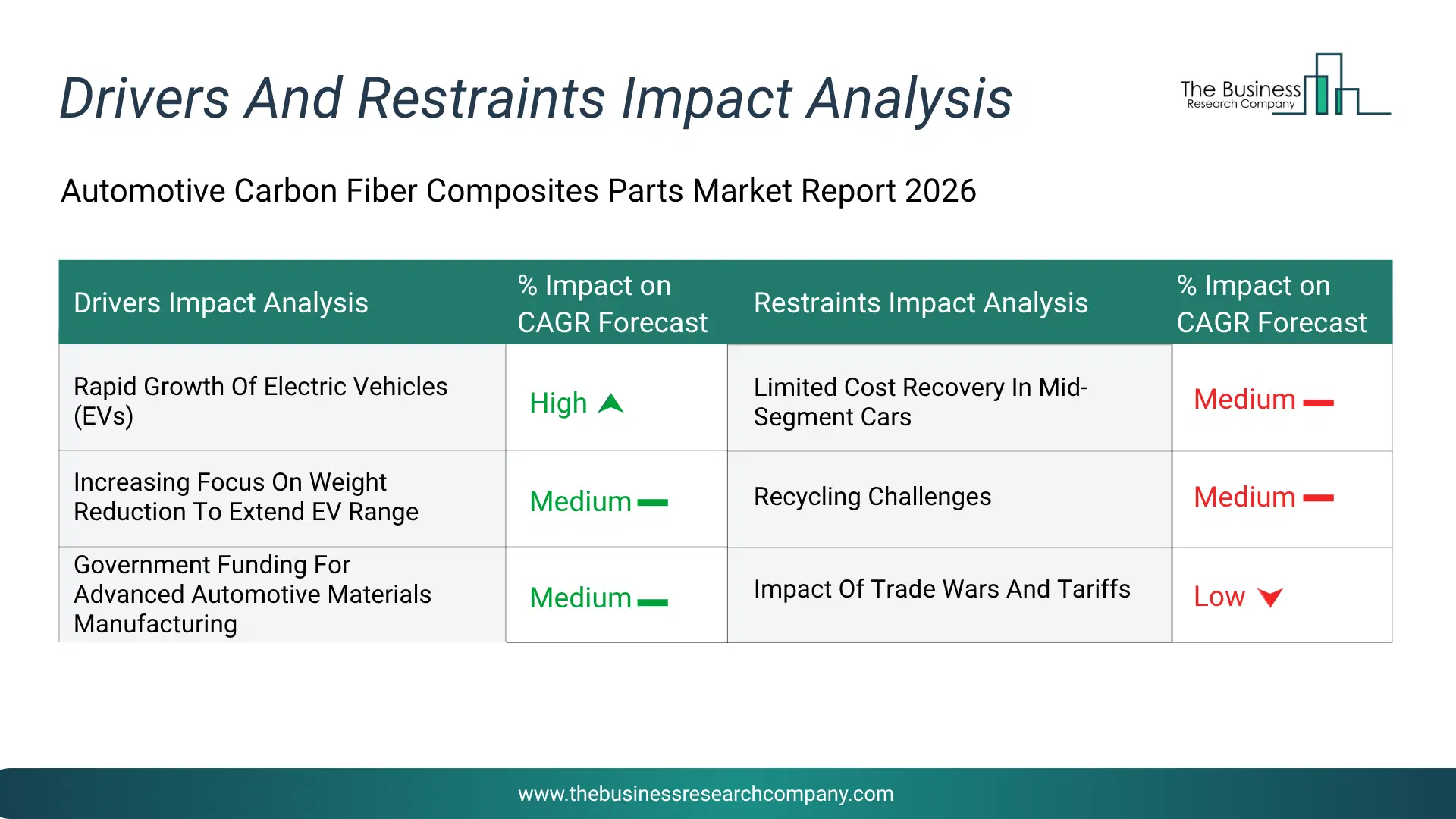
Infographic Chart Showing Key Market Drivers Analysis And Restraints For Automotive Carbon Fiber Composites Parts Market
The chart presents an impact analysis of key drivers and restraints, quantifying their relative influence on the market's growth rate and helping assess the balance between growth enablers and limiting factors. This chart offers a high-level perspective; the full report contains more detailed insights.
How Will The Drivers Impact Growth In The Global Automotive Carbon Fiber Composites Parts Market?
• Rapid Growth Of Electric Vehicles (EVs) (High) – During the forecast period, the rapid growth of electric vehicles (EVs) is expected to be a key driver propelling expansion in the automotive carbon fiber composites parts market. As EV production expands across multiple vehicle categories, manufacturers face new engineering constraints related to battery weight, structural integration and overall vehicle efficiency. Carbon fiber composites offer an optimal balance of lightweight properties, high strength and design flexibility, making them increasingly attractive for EV architectures. The structural requirements of battery housings, chassis components and load-bearing elements in EVs further amplify the relevance of carbon fiber composites, as these parts must support heavy battery systems while maintaining crash safety and durability. The rapid growth of electric vehicles (EVs) growth contribution during the forecast period in 2025 is 2.0%. • Increasing Focus On Weight Reduction To Extend EV Range (Medium) – During the forecast period, the increasing focus on weight reduction to extend EV range are expected to be a key driver propelling growth in the automotive carbon fiber composites parts market. Vehicle mass has a pronounced impact on energy consumption in EVs, influencing both driving range and battery efficiency. Carbon fiber composites enable substantial weight reduction compared to traditional metal materials while maintaining structural integrity and safety performance. As range anxiety remains a key consideration for EV buyers, automakers are expected to prioritize lightweight materials throughout vehicle design to maximize efficiency without increasing battery size. The increasing focus on weight reduction to extend EV range during the forecast period in 2025 is 1.8%. • Government Funding For Advanced Automotive Materials Manufacturing (Medium) – During the forecast period, the growth in government funding for advanced automotive materials manufacturing is expected to be a key driver propelling growth in the automotive carbon fiber composites parts market. Public investment in manufacturing innovation, material science and industrial modernization supports the development of scalable, cost-efficient composite production technologies. Such funding encourages collaboration between material suppliers, automotive manufacturers and research institutions, helping reduce technical and economic barriers associated with carbon fiber composite adoption. By strengthening domestic manufacturing capabilities and promoting advanced materials as part of broader industrial and sustainability strategies, government support is expected to facilitate wider integration of carbon fiber composites into automotive supply chains. The growth in government funding for advanced automotive materials manufacturing growth contribution during the forecast period in 2025 is 1.3%. • Consumer Preference For Premium Features Or Materials (Low) – During the forecast period, the expansion of consumer preference for premium features or materials is expected to be a key driver propelling growth in the automotive carbon fiber composites parts market. Carbon fiber is widely perceived as a high-performance, technologically advanced material associated with innovation, exclusivity and superior engineering. As consumers increasingly seek vehicles that combine functionality with premium aesthetics, automakers are expected to expand the use of carbon fiber composite components in both visible and structural applications. This trend is particularly pronounced in premium and performance-oriented vehicle segments, where differentiation through material choice plays a critical role in brand positioning. The expansion of consumer preference for premium features or materials growth contribution during the forecast period in 2025 is 0.8%.How Will The Restraints Impact Growth In The Global Automotive Carbon Fiber Composites Parts Market?
• Limited Cost Recovery In Mid-Segment Cars (High) – During the forecast period, limited cost recovery in mid-segment cars is restricting the growth of the automotive carbon fiber composites parts market. While premium and performance vehicles can absorb higher component costs through pricing strategies and brand positioning, mid-segment vehicles operate under strict cost constraints and high price sensitivity. The incremental benefits of carbon fiber composites in these segments are often difficult to translate into higher vehicle prices that consumers are willing to pay. As a result, automakers face challenges justifying large-scale integration of carbon fiber composite components in mid-segment models, leading to selective or minimal use. This limitation reduces potential volume growth for carbon fiber composite parts and slows their penetration into mainstream automotive platforms. Growth affected by limited cost recovery in mid-segment cars during the forecast period in 2025 is -1.5%. • Recycling Challenges (Medium) – During the forecast period, recycling challenges is restricting the growth of the automotive carbon fiber composites parts market. Carbon fiber composites are inherently more complex to recycle than traditional automotive materials due to their multi-layered structures and strong resin-fiber bonding. Limited recycling infrastructure and evolving recycling technologies make it difficult for manufacturers to efficiently recover and reuse carbon fiber materials at scale. These challenges create uncertainty around circular economy objectives and can discourage automakers from expanding the use of carbon fiber composites, particularly as environmental regulations increasingly emphasize recyclability and material recovery. Growth affected by the recycling challenges during the forecast period in 2025 is -1.0%. • Impact Of Trade Wars And Tariffs (Medium) – During the forecast period, the impact of trade wars and tariffs is restricting the growth of the automotive carbon fiber composites parts market. Trade tensions and tariff measures affecting raw materials, intermediate products, or finished composite components can raise input costs and disrupt cross-border supply networks. Carbon fiber composites often rely on globally integrated supply chains, making them particularly sensitive to changes in trade policies. Uncertainty around tariffs and trade restrictions complicates long-term sourcing and investment decisions for both material suppliers and automotive manufacturers. This environment of unpredictability discourages aggressive expansion of carbon fiber composite applications and slows market growth by increasing financial and operational risk. Growth affected by impact of trade wars and tariffs during the forecast period in 2025 is -0.3%.Key Players In The Global Automotive Carbon Fiber Composites Parts Market
Major companies operating in the automotive carbon fiber composites parts market report include Plasan Carbon Composites Inc., Faurecia SE, Toray Industries Inc., Mitsubishi Chemical Carbon Fiber and Composites, SGL Carbon, Composite Resources Inc., Hexcel Corporation, Teijin Limited, BUCCI COMPOSITES S.p.A., CBS Composites, Cobra Advanced Composites Co. Ltd., TOPKEY Excellence In Composites, Action Composite Technology Limited, Zhongfu Shenying Carbon Fiber Xining Co. Ltd., Martec Spa, Gigante Technologies Pvt. Ltd., Cytec Industries Incorporated, ACP Composites Inc., Clearwater Composites LLC, Owens Corning, HITCO Carbon Composites Inc., Polar Manufacturing Limited, Rock West Composites Inc., Zoltek Companies Inc., Gurit Holding AG, Solvay S.A., Continental Structural Plastics Inc., Magna International Inc., Toho Tenax Co. Ltd., Formtech Composite Limited, Quantum Composites Inc., PlastiComp Inc., TenCate Advanced Composites, Fiberforge Corporation, Albany Engineered Composites Inc., BASF SE, DSM Composite Resins AG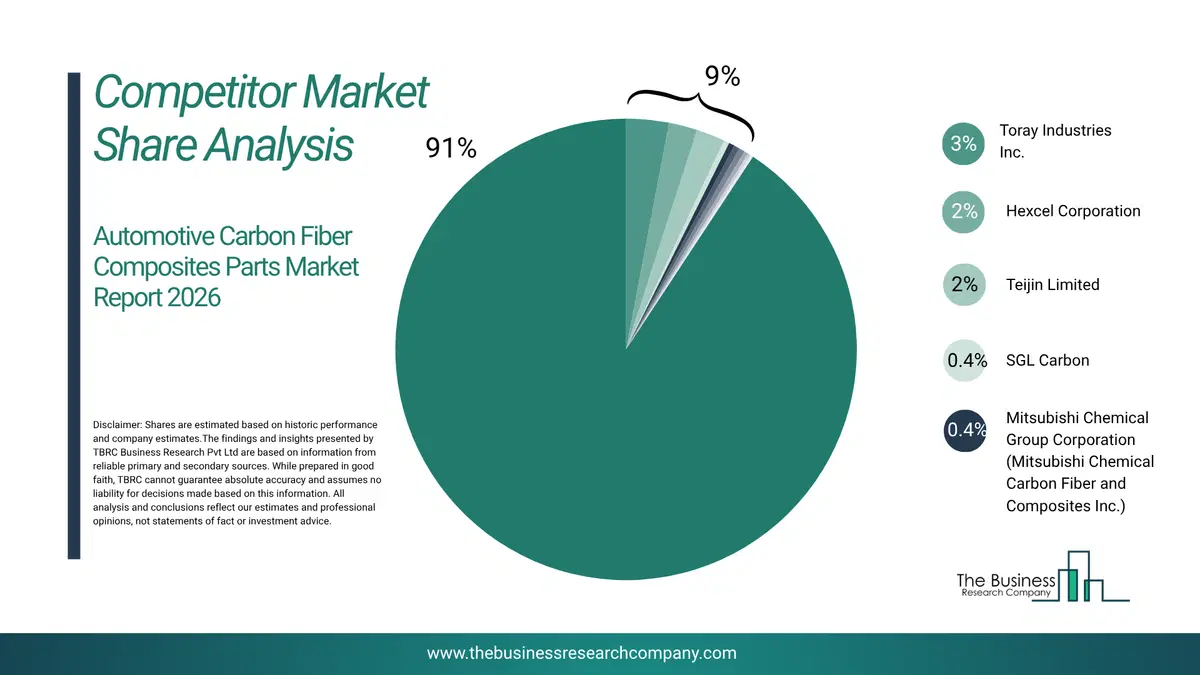
This chart is for illustrative purposes; the full report includes a detailed competitor analysis and comprehensive overview of the top 10 companies in the market.
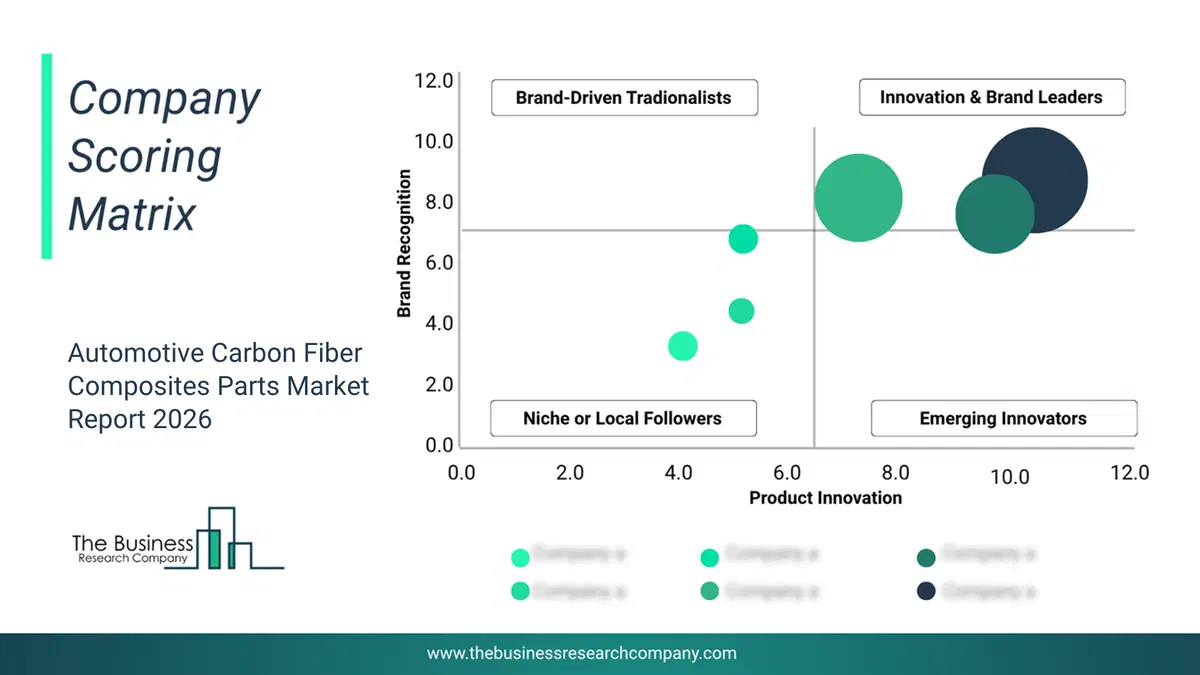
This chart maps companies by product innovation and brand strength, with bubble size indicating relative revenue, helping identify market leaders, challengers, and niche players. This is an illustrative chart; the full report provides a complete and accurate competitive analysis.
Global Automotive Carbon Fiber Composites Parts Market Trends and Insights
Major companies operating in the carbon fiber composites parts market are focusing on developing advanced solutions, such as rapid integrated molding technology, to enhance production efficiency and component lightweighting. Rapid integrated molding technology simultaneously shapes, thermosets, molds, and bonds a carbon fiber-reinforced foam core with a prepreg skin in a single mold, synchronizing the foam expansion with prepreg curing to enable faster production and reliable adhesive-free bonding. For instance, in March 2023, Toray Industries, Inc., a Japan-based chemical industry company, launched a rapid integrated molding process for CFRP mobility components. The technology enabled the production of a large automobile roof panel measuring 1.2 meters by 1.2 meters with a thickness of 2.3 millimeters in just five minutes, which is 10 times faster than conventional autoclave methods. The molded panels achieved high mechanical properties, excellent strength, elastic modulus, and impact resistance, and were about half the weight of equivalent steel parts. This innovation supports lightweight vehicle design and contributes to extending the cruising range of electric vehicles by reducing component weight.What Are Latest Mergers And Acquisitions In The Automotive Carbon Fiber Composites Parts Market?
In November 2023, RECARO Automotive North America Inc., a US-based manufacturer of high-quality automotive seats, acquired C12 Technology for an undisclosed amount. Through this acquisition, RECARO Automotive North America Inc. aims to enhance its leadership in the premium performance seat market by leveraging C12 Technology's expertise in advanced material development and production techniques. C12 Technology is a US-based firm focused on providing software solutions for the design and manufacturing of automotive carbon fiber composite parts.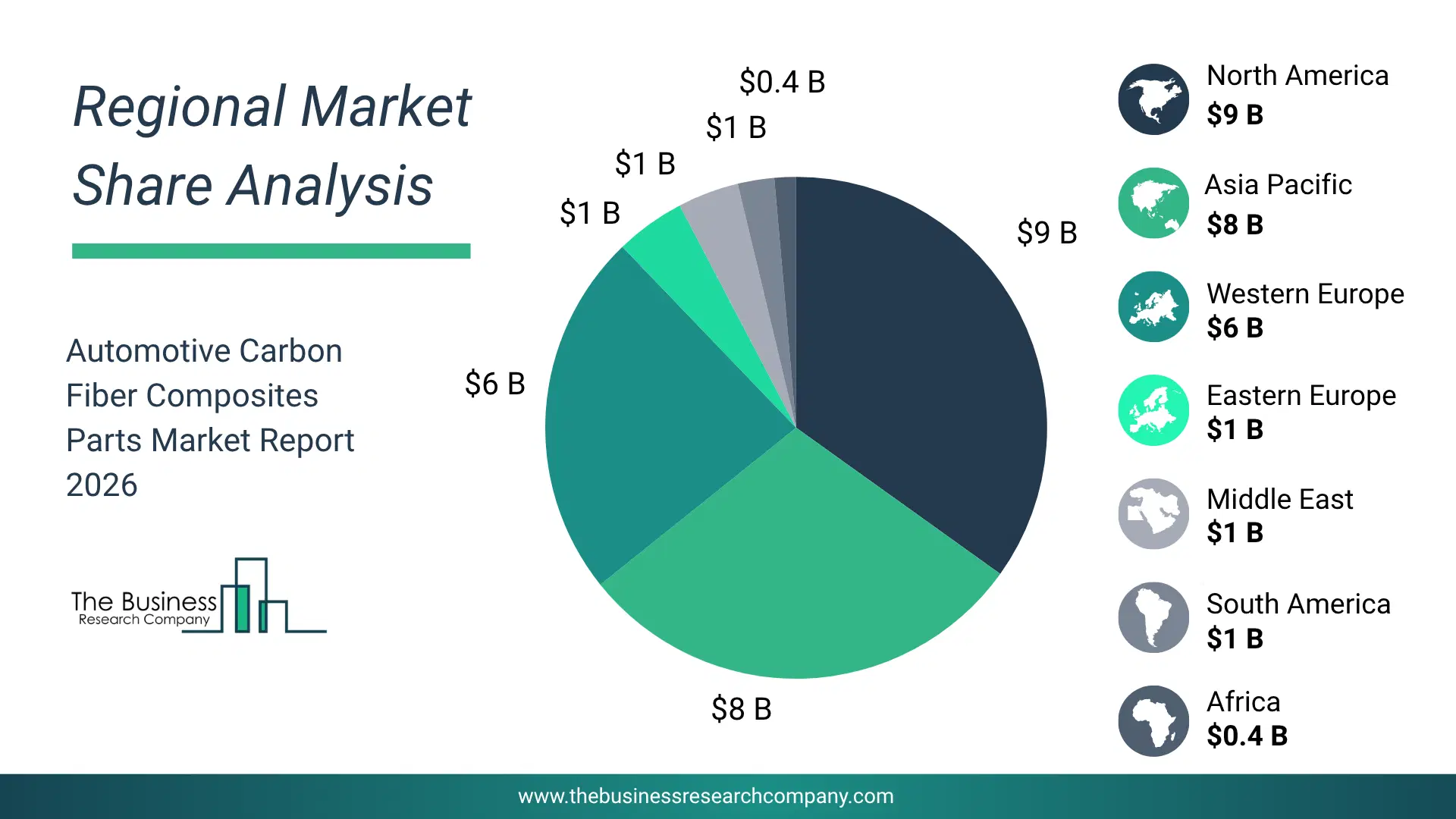
Regional Outlook
Europe was the largest region in the automotive carbon fiber composites parts market in 2025. The regions covered in this market report include Asia-Pacific, South East Asia, Western Europe, Eastern Europe, North America, South America, Middle East, Africa. The countries covered in this market report include Australia, Brazil, China, France, Germany, India, Indonesia, Japan, Taiwan, Russia, South Korea, UK, USA, Canada, Italy, SpainWhat Defines the Automotive Carbon Fiber Composites Parts Market?
The automotive carbon fiber composites parts market consists of sales of carbon fiber composite propeller shafts, carbon fiber composite monocoques, and carbon fiber composite upholstery. Values in this market are ‘factory gate’ values, that is the value of goods sold by the manufacturers or creators of the goods, whether to other entities (including downstream manufacturers, wholesalers, distributors and retailers) or directly to end customers. The value of goods in this market includes related services sold by the creators of the goods.How is Market Value Defined and Measured?
The market value is defined as the revenues that enterprises gain from the sale of goods and/or services within the specified market and geography through sales, grants, or donations in terms of the currency (in USD unless otherwise specified). The revenues for a specified geography are consumption values that are revenues generated by organizations in the specified geography within the market, irrespective of where they are produced. It does not include revenues from resales along the supply chain, either further along the supply chain or as part of other products.
This chart presents market attractiveness based on a quantitative evaluation of growth, competition, strategic alignment, and risk, offering a clear view of opportunity areas for decision-making. This chart is for illustrative purposes; the full report contains the complete analysis.

This chart highlights the Total Addressable Market (TAM) by estimating the maximum revenue opportunity using an assumption-driven approach, supporting strategic planning and opportunity sizing across markets. The chart is illustrative; the full report provides a more comprehensive analysis.
What Key Data and Analysis Are Included in the Automotive Carbon Fiber Composites Parts Market Report 2026?
The automotive carbon fiber composites parts market research report is one of a series of new reports from The Business Research Company that provides market statistics, including industry global market size, regional shares, competitors with the market share, detailed market segments, market trends and opportunities, and any further data you may need to thrive in the automotive carbon fiber composites parts industry. The market research report delivers a complete perspective of everything you need, with an in-depth analysis of the current and future state of the industry.Automotive Carbon Fiber Composites Parts Market Report Forecast Analysis
| Report Attribute | Details |
|---|---|
| Market Size Value In 2026 | $30.44 billion |
| Revenue Forecast In 2030 | $53.92 billion |
| Growth Rate | CAGR of 15.6% from 2026 to 2030 |
| Base Year For Estimation | 2025 |
| Actual Estimates/Historical Data | 2020-2025 |
| Forecast Period | 2026 - 2030 - 2035 |
| Market Representation | Revenue in USD Billion and CAGR from 2026 to 2030 |
| Segments Covered | Type, Resin, Application |
| Regional Scope | Asia-Pacific, Western Europe, Eastern Europe, North America, South America, Middle East, Africa |
| Country Scope | The countries covered in the report are Australia, Brazil, China, France, Germany, India, Indonesia, Japan, Taiwan, Russia, South Korea, UK, USA, Canada, Italy, Spain. |
| Key Companies Profiled | Plasan Carbon Composites Inc., Faurecia SE, Toray Industries Inc., Mitsubishi Chemical Carbon Fiber and Composites, SGL Carbon, Composite Resources Inc., Hexcel Corporation, Teijin Limited, BUCCI COMPOSITES S.p.A., CBS Composites, Cobra Advanced Composites Co. Ltd., TOPKEY Excellence In Composites, Action Composite Technology Limited, Zhongfu Shenying Carbon Fiber Xining Co. Ltd., Martec Spa, Gigante Technologies Pvt. Ltd., Cytec Industries Incorporated, ACP Composites Inc., Clearwater Composites LLC, Owens Corning, HITCO Carbon Composites Inc., Polar Manufacturing Limited, Rock West Composites Inc., Zoltek Companies Inc., Gurit Holding AG, Solvay S.A., Continental Structural Plastics Inc., Magna International Inc., Toho Tenax Co. Ltd., Formtech Composite Limited, Quantum Composites Inc., PlastiComp Inc., TenCate Advanced Composites, Fiberforge Corporation, Albany Engineered Composites Inc., BASF SE, DSM Composite Resins AG |
| Customization Scope | Request for Customization |
| Pricing And Purchase Options | Explore Purchase Options |