

Contact Us
  Search
The Business Research Company Logo
Automotive Carbon Fiber Composites Parts Global Market Opportunities And Strategies To 2035
Published :June 2026
Pages :239
Format :PDF
Delivery Time :2-3 Business Days
Why 2-3 days? We update the report with the latest data and news before delivery. Let us know if you need us to expedite.
Report Price :$4,490.00

Automotive Carbon Fiber Composites Parts Global Market Opportunities And Strategies To 2035

By Type (Brake Discs, Battery Housing, Mirror Housing, Chassis, Pillars, Other Types), By Resin (Thermoplastic, Thermoset), By Application (Original Equipment Manufacturer (OEM), Aftermarket), And By Region, Opportunities And Strategies – Global Forecast To 2035

Automotive Carbon Fiber Composite Parts Market Definition

Automotive carbon fiber composite parts are vehicle components made from carbon fiber reinforced polymers (CFRP), combining high-strength carbon fibers with a resin matrix. These materials offer exceptional strength-to-weight ratio, stiffness and corrosion resistance, making them ideal for high-performance and lightweight vehicle applications. The primary purpose of automotive carbon fiber composite parts is to reduce vehicle weight while maintaining or improving structural strength and safety. The automotive carbon fiber composites parts market consists of sales by entities (organizations, sole traders and partnerships) of automotive carbon fiber composites parts that are widely used by a wide range of vehicles, including high-performance sports cars, luxury vehicles and increasingly in mass-market models aiming to reduce emissions and improve mileage.
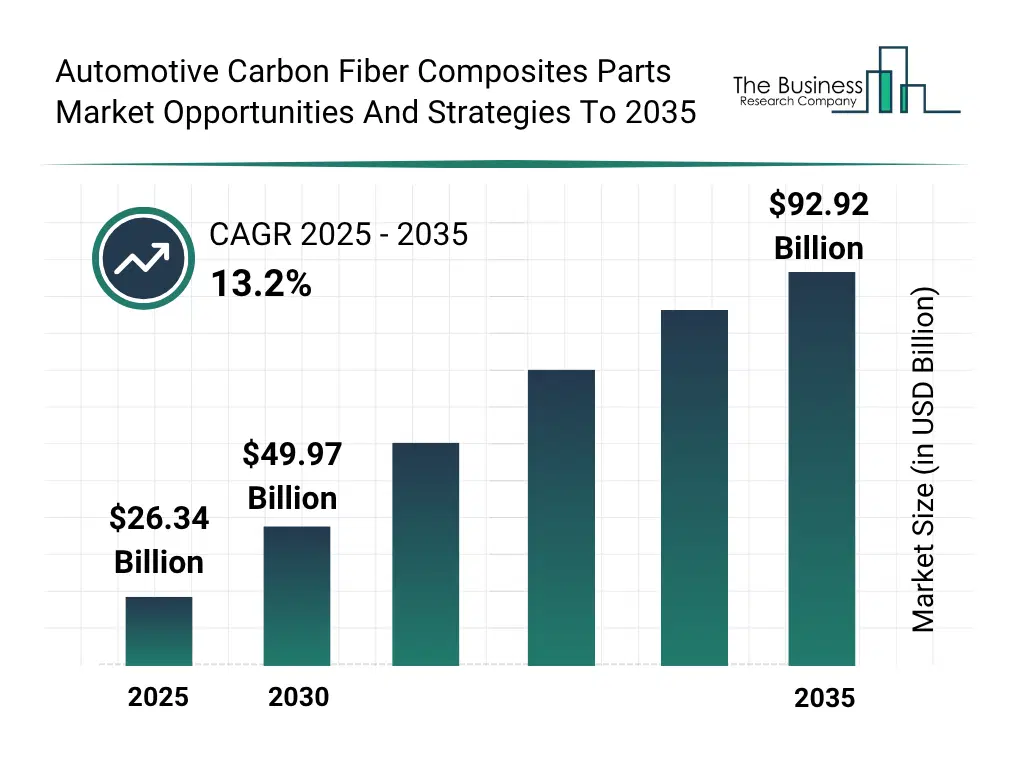
Automotive Carbon Fiber Composites Parts Global Market Opportunities And Strategies To 2035 Market Size and growth rate 2026 to 2030: Graph

Automotive Carbon Fiber Composite Parts Market Size

The global aerospace and defense additive manufacturing market reached a value of nearly The global automotive carbon fiber composites parts market reached a value of nearly $26,340.7 million in 2025, having grown at a compound annual growth rate (CAGR) of 15.1% since 2020. The market is expected to grow from $26,340.7 million in 2025 to $49,968.7 million in 2030 at a rate of 13.7%. The market is then expected to grow at a CAGR of 13.2% from 2030 and reach $92,921.9 million in 2035. Growth in the historic period resulted from stringent emissions and efficiency regulations, rising demand for lightweight vehicles, increased usage of commercial vehicles and growing demand for sporty and performance interiors. Factors that negatively affected growth in the historic period were high material costs and dependence on limited carbon fiber suppliers. Going forward, rapid growth of electric vehicles (EVs), consumer preference for premium features or materials, increasing focus on weight reduction to extend EV range and government funding for advanced automotive materials manufacturing will drive the growth. Factors that could hinder the growth of the automotive carbon fiber composites parts market in the future include limited cost recovery in mid-segment cars, recycling challenges and impact of trade wars and tariffs.
Research Expert

Book your 30 minutes free consultation with our research experts

Automotive Carbon Fiber Composite Parts Market Segmentation

The automotive carbon fiber composite parts market is segmented by type, by resin, and by application.

By Type –
The automotive carbon fiber composite parts market is segmented by type into:
    • a) Brake Discs
    • b) Battery Housing
    • c) Mirror Housing
    • d) Chassis
    • e) Pillars
    • f) Other Types
The battery housing was the largest segment of the automotive carbon fiber composites parts market segmented by type, accounting for 25.7% or $6,777.6 million of the total in 2025. Going forward, the battery housing segment is expected to be the fastest-growing segment in the automotive carbon fiber composites parts market segmented by type, at a CAGR of 19.9% during 2025-2030.

By Resin –
The automotive carbon fiber composite parts market is segmented by resin into:
    • a) Thermoplastic
    • b) Thermoset
The thermoset market was the largest segment of the automotive carbon fiber composites parts market segmented by resin, accounting for 54.8% or $14,421.8 million of the total in 2025. Going forward, the thermoplastic segment is expected to be the fastest-growing segment in the automotive carbon fiber composites parts market segmented by resin, at a CAGR of 15.1% during 2025-2030.

By Application –
The automotive carbon fiber composite parts market is segmented by application into:
  1. a) Original Equipment Manufacturer (OEM)
  2. b) Aftermarket
The original equipment manufacturer (OEM) market was the largest segment of the automotive carbon fiber composites parts market segmented by application, accounting for 75.1% or $19,769.3 million of the total in 2025. Going forward, the aftermarket segment is expected to be the fastest-growing segment in the automotive carbon fiber composites parts market segmented by application, at a CAGR of 16.5% during 2025-2030.

By Geography - The automotive carbon fiber composite parts market is segmented by geography into:
      o Asia Pacific
      • China
      • India
      • Japan
      • Australia
      • South Korea
      • Taiwan
      o South East Asia
    • Indonesia
    • o North America
      • USA
      • Canada
      o South America
      • Brazil
      o Western Europe
      • France
      • Germany
      • UK
      • Italy
      • Spain
      o Eastern Europe
      • Russia
      o Middle East
      o Africa
North America was the largest region in the automotive carbon fiber composites parts market, accounting for 34.9% or $9,188.6 million of the total in 2025. It was followed by Asia Pacific, Western Europe and then the other regions. Going forward, the fastest-growing regions in the automotive carbon fiber composites parts market will be Asia Pacific and Eastern Europe where growth will be at CAGRs of 16.1% and 15.9% respectively. These will be followed by Western Europe and South America where the markets are expected to grow at CAGRs of 14.9% and 13.1% respectively.

Automotive Carbon Fiber Composites Parts Market Competitive Landscape

Major Competitors are:

  • Toray Industries Inc.
  • Hexcel Corporation
  • Teijin Limited
  • SGL Carbon
  • Mitsubishi Chemical Group Corporation (Mitsubishi Chemical Carbon Fiber and Composites Inc.)
  • Other Competitors Include:

  • Solavy SA
  • Plasan Carbon Composites Inc.
  • Zhongfu Shenying Carbon Fiber Xining Co. Ltd.
  • Dow (DowAksa)
  • Mubea Carbo Tech
  • Faurecia
  • Cobra Advanced Composites Co. Ltd
  • Action Composites
  • Gigante Technologies
  • Cytec Industries
  • Rock West Composites
  • Zoltek Corporation
  • Gurit
  • Albany Engineered Composites
  • Jiangsu Hengshen Co., Ltd
  • Weihai Guangwei Composites
  • Taekwang Industrial
  • Nippon Graphite Fiber Corporation
  • HS Hyosung Corporation
  • Hyundai Motor Group
  • Supreem Carbon
  • Jiangsu Changhai Composite Material Co., Ltd.
  • Sinofiber
  • Tianniao Company
  • Shenzhen Xinbo Composites Co., Ltd.
  • Hankuk Carbon Co., Ltd.
  • DACC Carbon Co., Ltd.
  • Midwest Composites Sdn. Bhd.
  • Composites Technology Research Malaysia
  • P1 Composites
  • Cosmos Composite Co., Ltd.
  • 3MB Co., Ltd.
  • Kyowa NT (Thailand) Co., Ltd.
  • Hexion Composite Materials
  • Advanced International Multitech Co., Ltd.
  • A&P Technology
  • Triac Composites
  • Voith Composites
  • ElringKlinger AG
  • Röchling SE & Co. KG
  • Bucci Composites
  • KS Composites Limited
  • Composite Resources Inc.
  • HITCO Carbon Composites Inc.
  • Continental Structural Plastics Inc.
  • PlastiComp Inc.
  • Fiberforge Corporation
  • HB Composites
  • Comparts
  • Magna International Inc
  • Automotive Carbon Fiber Composite Parts Market Drivers

    The key drivers of the automotive carbon fiber composite parts market include: Rapid Growth Of Electric Vehicles (EVs) During the forecast period, the rapid growth of electric vehicles (EVs) is expected to be a key driver propelling expansion in the automotive carbon fiber composites parts market. As EV production expands across multiple vehicle categories, manufacturers face new engineering constraints related to battery weight, structural integration and overall vehicle efficiency. Carbon fiber composites offer an optimal balance of lightweight properties, high strength and design flexibility, making them increasingly attractive for EV architectures. The structural requirements of battery housings, chassis components and load-bearing elements in EVs further amplify the relevance of carbon fiber composites, as these parts must support heavy battery systems while maintaining crash safety and durability.

    Automotive Carbon Fiber Composite Parts Market Restraints

    The key restraints on the automotive carbon fiber composite parts market include: Limited Cost Recovery In Mid-Segment Cars During the forecast period, limited cost recovery in mid-segment cars is restricting the growth of the automotive carbon fiber composites parts market. While premium and performance vehicles can absorb higher component costs through pricing strategies and brand positioning, mid-segment vehicles operate under strict cost constraints and high price sensitivity. The incremental benefits of carbon fiber composites in these segments are often difficult to translate into higher vehicle prices that consumers are willing to pay. As a result, automakers face challenges justifying large-scale integration of carbon fiber composite components in mid-segment models, leading to selective or minimal use. This limitation reduces potential volume growth for carbon fiber composite parts and slows their penetration into mainstream automotive platforms.

    Need data on a specific region in this market?

    Opportunities And Recommendations In The Automotive Carbon Fiber Composite Parts Market

    Opportunities – The top opportunities in the automotive carbon fiber composites parts market segmented by type will arise in the battery housing segment, which will gain $10,048.3 million of global annual sales by 2030. The top opportunities in the automotive carbon fiber composites parts market segmented by resin will arise in the thermoplastic segment, which will gain $12,178.8 million of global annual sales by 2030. The top opportunities in the automotive carbon fiber composites parts market segmented by application will arise in the original equipment manufacturer (OEM) segment, which will gain $16,123.0 million of global annual sales by 2030. The automotive carbon fiber composites parts market size will gain the most in the USA at $4,727.6 million. Recommendations- To take advantage of the opportunities, The Business Research Company recommends the automotive carbon fiber composites part companies to focus on high-performance electrification applications in ultra-luxury segments, focus on expanding structural carbon fiber solutions for electric vehicle platforms, focus on integrating recycled carbon fiber for sustainable growth, focus on scaling bio-based and mass-balance composite materials, focus on battery housing segment for accelerated growth, focus on thermoplastic segment for high growth and scalability, expand in emerging markets, continue to focus on developed markets, focus on expanding multi channel distribution near oem hubs, focus on value-based tiered pricing with cost discipline, focus on clear value communication and targeted technical messaging, focus on technical authority and partnership driven promotion, focus on high-growth aftermarket segment for scalable expansion.
    Chat with us