
Automotive Ceramics Market Report 2026
Global Outlook – By Material (Alumina, Zirconia, Other Materials), By Vehicle Type (Passenger Vehicles, Commercial Vehicles), By Application (Engine parts, Automotive electronics, Exhaust systems) – Market Size, Trends, Strategies, and Forecast to 2030
Automotive Ceramics Market Overview
• Automotive Ceramics market size has reached to $2.41 billion in 2025 • Expected to grow to $3.2 billion in 2030 at a compound annual growth rate (CAGR) of 5.8% • Growth Driver: Rise In Electric Vehicle Adoption Driving The Growth Of The Market Due To Enhanced Efficiency And Sustainability • Market Trend: CeramTec GmbH Launches High-Performance Rubalit ZTA For EV Applications • Asia-Pacific was the largest region and fastest growing region.What Is Covered Under Automotive Ceramics Market?
Automotive ceramics are high-performance ceramic materials used in the automotive industry to enhance various vehicle components' durability, efficiency, and performance. These ceramics are engineered to withstand extreme temperatures, wear, and corrosion. Automotive ceramics are commonly employed in applications such as engine components, brake systems, sensors, and coatings, where their properties, such as high thermal stability, low friction, and excellent wear resistance, help improve overall vehicle reliability and efficiency. The main materials of automotive ceramics are alumina, zirconia, and others. Alumina, or aluminum oxide, is a ceramic material known for its high hardness, excellent thermal stability, and resistance to corrosion. In the automotive industry, alumina is commonly used in components such as sensors, electronic substrates, and spark plug insulators due to its electrical insulation properties. The various vehicle types include passenger vehicles and commercial vehicles and are used in several applications such as engine parts, automotive electronics, and exhaust systems.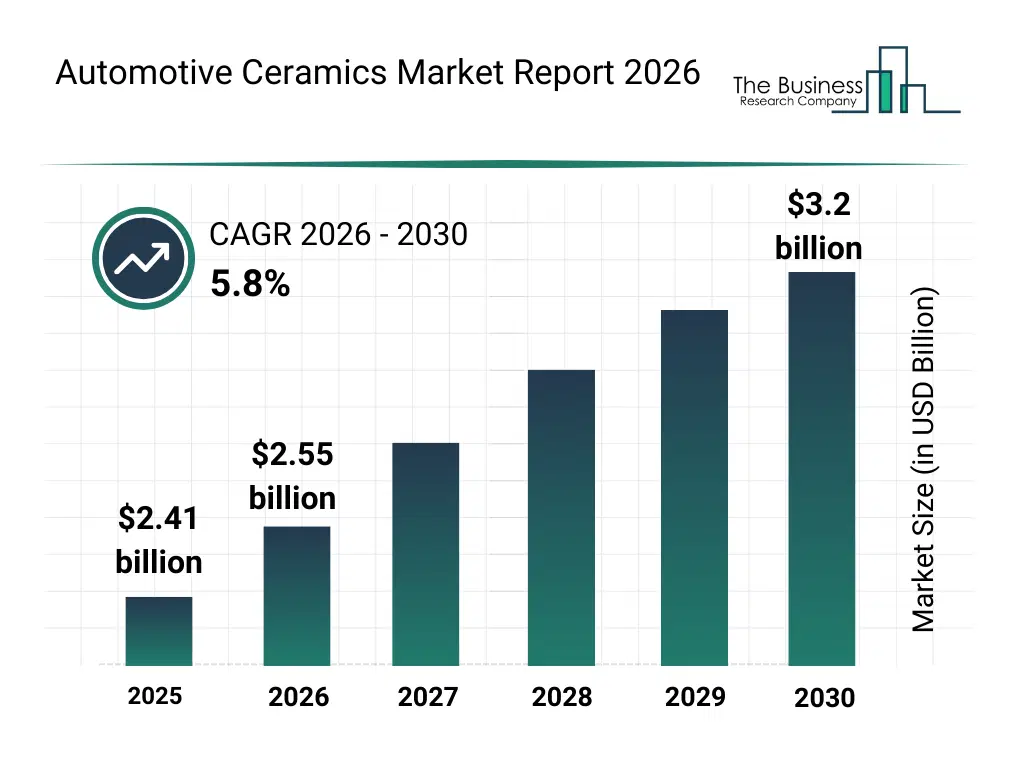
What Is The Automotive Ceramics Market Size and Share 2026?
The automotive ceramics market size has grown strongly in recent years. It will grow from $2.41 billion in 2025 to $2.55 billion in 2026 at a compound annual growth rate (CAGR) of 5.7%. The growth in the historic period can be attributed to engine downsizing trends, demand for wear-resistant materials, growth of performance vehicles, adoption of ceramic coatings, emission control needs.What Is The Automotive Ceramics Market Growth Forecast?
The automotive ceramics market size is expected to see strong growth in the next few years. It will grow to $3.2 billion in 2030 at a compound annual growth rate (CAGR) of 5.8%. The growth in the forecast period can be attributed to electric vehicle growth, demand for thermal management solutions, lightweighting initiatives, advanced material innovation, high-performance component demand. Major trends in the forecast period include growing use in ev powertrains, expansion of ceramic brake components, adoption in high-temperature engine parts, increased use in automotive sensors, focus on lightweight materials.
Global Automotive Ceramics Market Segmentation
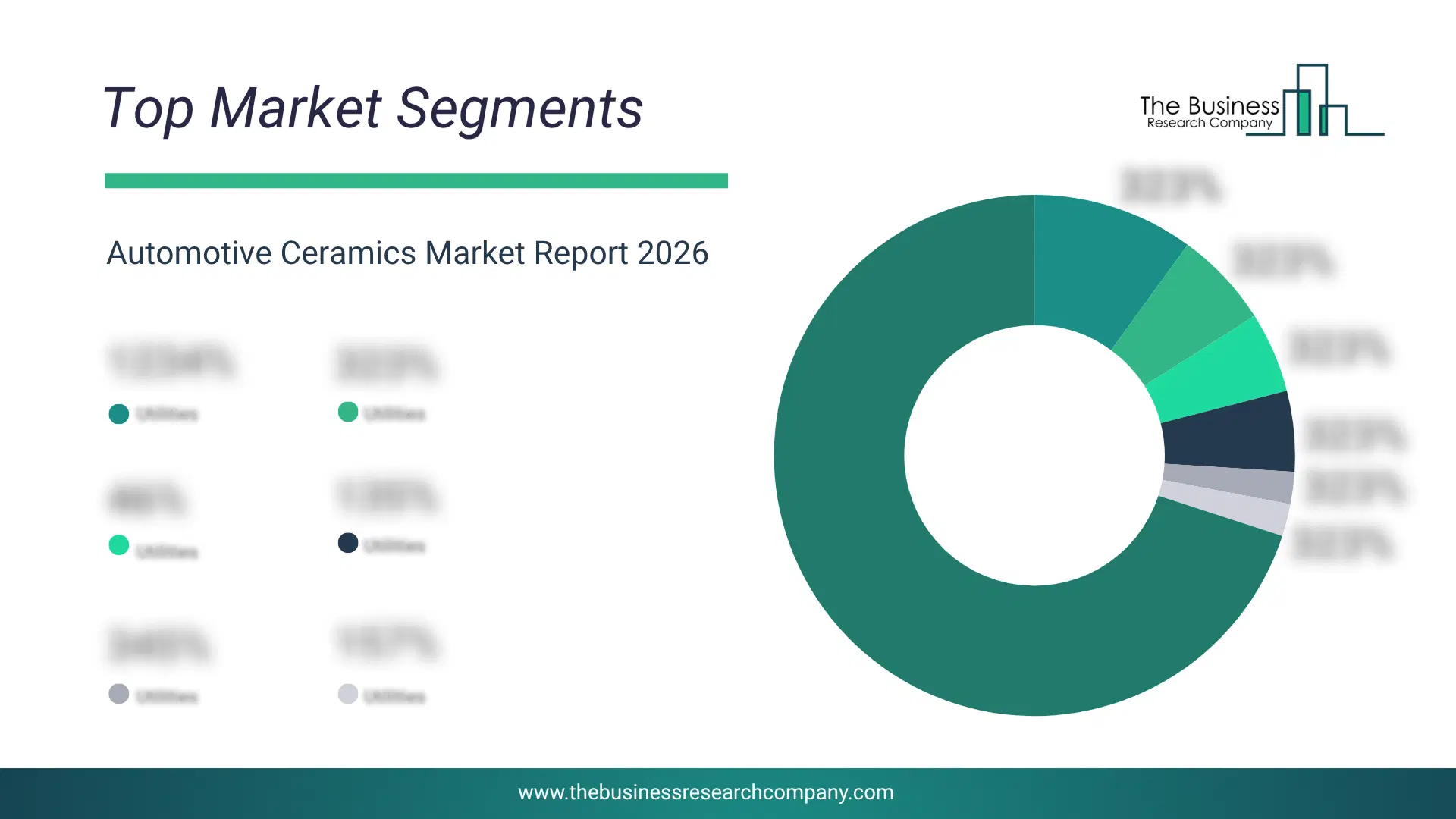
1) By Material: Alumina, Zirconia, Other Materials 2) By Vehicle Type: Passenger Vehicles, Commercial Vehicles 3) By Application: Engine parts, Automotive electronics, Exhaust systems Subsegments: 1) By Alumina: High-Purity Alumina, Alumina-Based Composites, Toughened Alumina 2) By Zirconia: Yttria-Stabilized Zirconia (YSZ), Magnesia-Stabilized Zirconia (MSZ), Partially Stabilized Zirconia (PSZ) 3) By Other Materials: Silicon Carbide (SiC), Silicon Nitride (Si₃N₄), Titanate-Based CeramicsWhat Is The Driver Of The Automotive Ceramics Market?
The growing adoption of electric vehicles (EVs) is expected to propel the growth of the automotive ceramics market going forward. Electric vehicles (EVs) are vehicles powered by electric motors using rechargeable batteries instead of internal combustion engines. The rise in the adoption of electric vehicles (EVs) is due to environmental concerns, government incentives and regulations, and advancements in EV technology. Growing awareness of climate change and the environmental impact of fossil fuels has prompted consumers to seek cleaner alternatives, such as electric vehicles, which produce zero emissions. Automotive ceramics are important in enhancing electric vehicles' performance, durability, and efficiency (EVs). Their unique properties, such as high-temperature resistance, wear resistance, and lightweight nature, make them ideal for various EV applications. For instance, in December 2024, according to the International Energy Agency, a US-based intergovernmental organization, electric car sales in 2023 saw a year-on-year increase of 35%, with 3.5 million more units sold compared to 2022. Therefore, the growing adoption of electric vehicles is driving the growth of the automotive ceramics industry.Key Players In The Global Automotive Ceramics Market
Major companies operating in the automotive ceramics market report include Saint-Gobain Ceramic Materials, Sumitomo Electric Industries Ltd., Kyocera Corporation, Corning Incorporated, Murata Manufacturing Co. Ltd., Hitachi Metals Ltd., Tosoh Corporation, NGK Insulators Ltd., Ibiden Co. Ltd., Denka Company Limited, CoorsTek Inc., Morgan Advanced Materials plc, Ferrotec Holdings Corporation, CeramTec GmbH, CTS Corporation, Schunk Ingenieurkeramik GmbH, 3M India Limited, Maruwa Co. Ltd., Ceradyne Inc., Nippon Carbon Co. Ltd.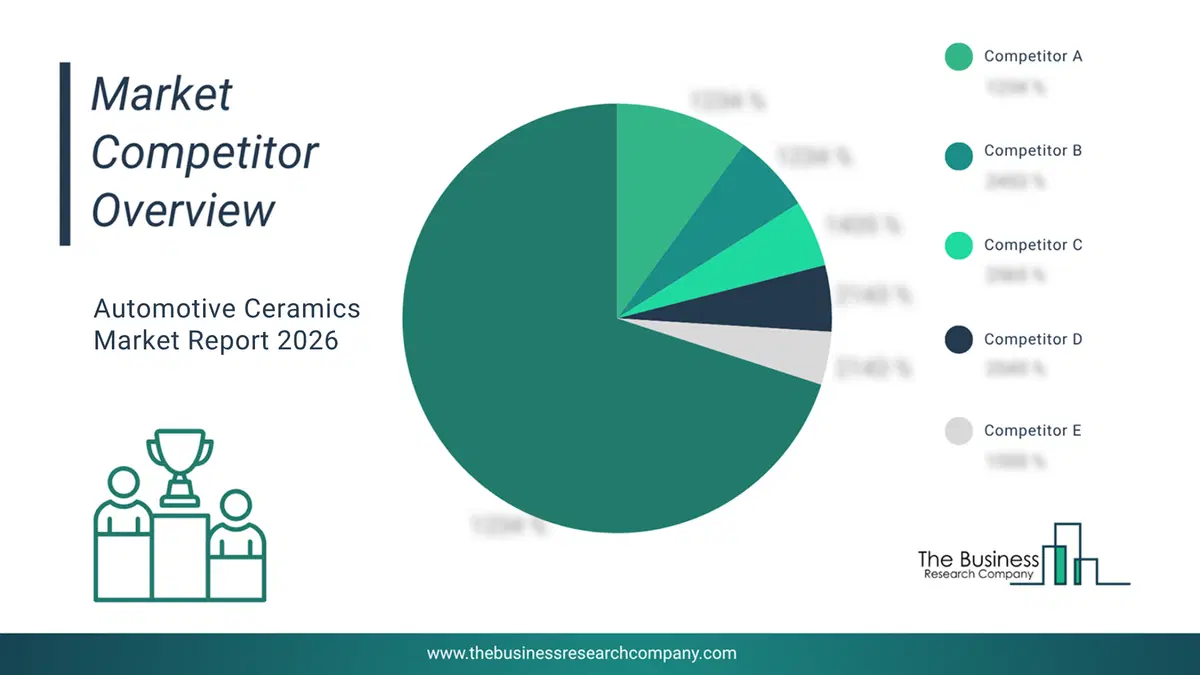
This chart is for illustrative purposes; the full report includes a detailed competitor analysis and comprehensive overview of the top 10 companies in the market.
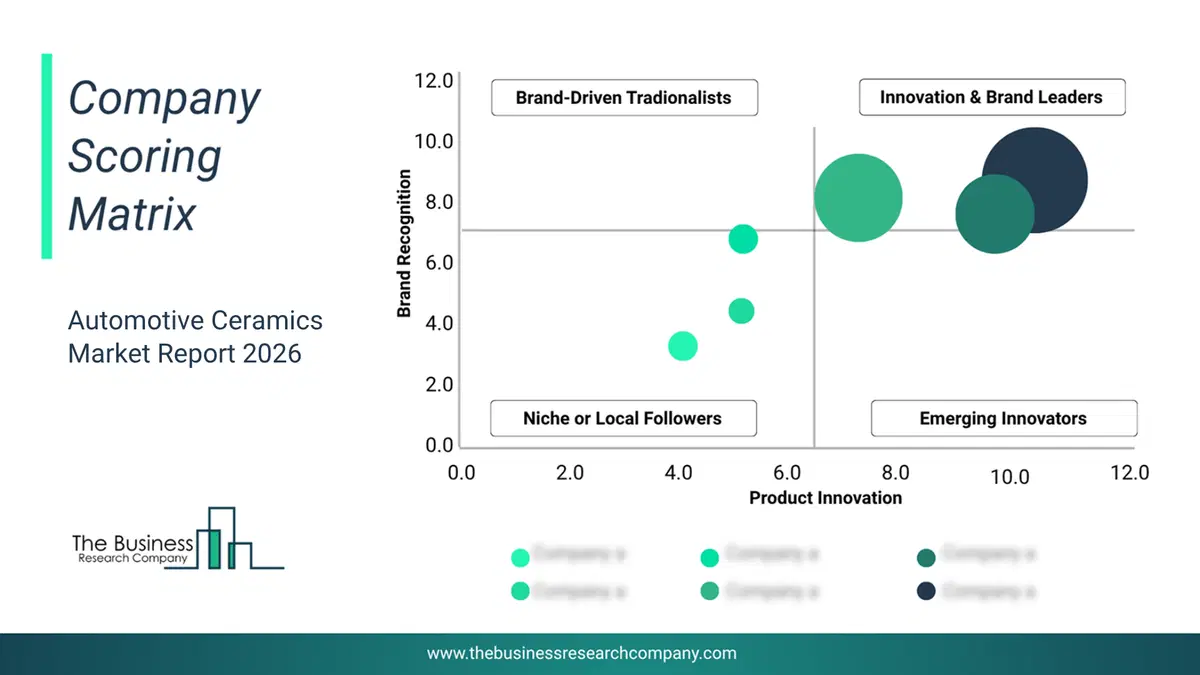
This chart maps companies by product innovation and brand strength, with bubble size indicating relative revenue, helping identify market leaders, challengers, and niche players. This is an illustrative chart; the full report provides a complete and accurate competitive analysis.
Global Automotive Ceramics Market Trends and Insights
Major companies operating in the automotive ceramics market are focusing on developing innovative products, such as high-performance ceramic substrates, to enhance thermal management, improve efficiency, and support the growing adoption of electric vehicles. A high-performance ceramic substrate in the automotive industry refers to a specialized ceramic material used as a base or foundation in various automotive components, especially electronic systems. For instance, in May 2023, CeramTec GmbH, a Germany-based chemical company, launched Rub alit ZTA, a high-performance ceramic substrate. This new material offers high flexural strength, good thermal conductivity, excellent electrical insulation, and top-tier dielectric strength. Specifically tailored for use in highly electrified industries and e-mobility, Rub alit ZTA aims to support the growing demand for advanced ceramic solutions in electric vehicles and other high-performance automotive applications.What Are Latest Mergers And Acquisitions In The Automotive Ceramics Market?
In January 2025, Schunk Group, a Germany-based company specializing in advanced materials and engineering solutions, acquired ESK-SIC GmbH for an undisclosed sum. With this acquisition, Schunk aims to strengthen its portfolio in silicon carbide (SiC) materials, enhance its expertise in high-performance ceramics, and expand its presence in the automotive, electronics, and renewable energy industries. ESK-SIC GmbH is a Germany-based company that manufactures high-quality silicon carbide (SiC) products, which are increasingly used in the automotive industry.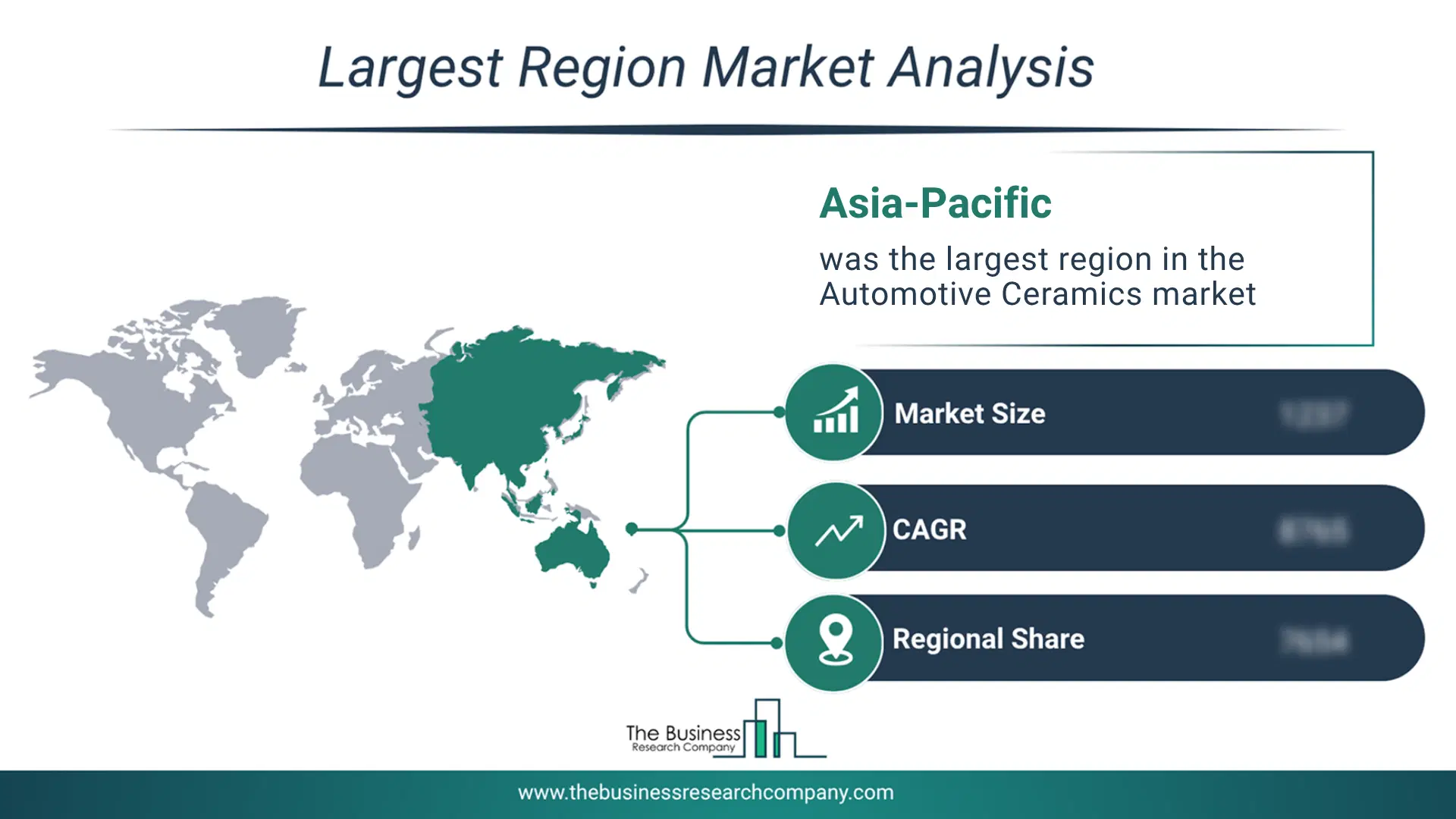
Regional Outlook
Asia-Pacific was the largest region in the automotive ceramics market in 2025. Asia-Pacific is expected to be the fastest-growing region in the forecast period. The regions covered in this market report include Asia-Pacific, South East Asia, Western Europe, Eastern Europe, North America, South America, Middle East, Africa. The countries covered in this market report include Australia, Brazil, China, France, Germany, India, Indonesia, Japan, Taiwan, Russia, South Korea, UK, USA, Canada, Italy, SpainWhat Defines the Automotive Ceramics Market?
The automotive ceramics market consists of sales of ceramic brake discs, ceramic catalytic substrates, and ceramic spark plugs. Values in this market are ‘factory gate’ values, that is, the value of goods sold by the manufacturers or creators of the goods, whether to other entities (including downstream manufacturers, wholesalers, distributors, and retailers) or directly to end customers. The value of goods in this market includes related services sold by the creators of the goods.How is Market Value Defined and Measured?
The market value is defined as the revenues that enterprises gain from the sale of goods and/or services within the specified market and geography through sales, grants, or donations in terms of the currency (in USD unless otherwise specified). The revenues for a specified geography are consumption values that are revenues generated by organizations in the specified geography within the market, irrespective of where they are produced. It does not include revenues from resales along the supply chain, either further along the supply chain or as part of other products.
This chart presents market attractiveness based on a quantitative evaluation of growth, competition, strategic alignment, and risk, offering a clear view of opportunity areas for decision-making. This chart is for illustrative purposes; the full report contains the complete analysis.

This chart highlights the Total Addressable Market (TAM) by estimating the maximum revenue opportunity using an assumption-driven approach, supporting strategic planning and opportunity sizing across markets. The chart is illustrative; the full report provides a more comprehensive analysis.
What Key Data and Analysis Are Included in the Automotive Ceramics Market Report 2026?
The automotive ceramics market research report is one of a series of new reports from The Business Research Company that provides market statistics, including industry global market size, regional shares, competitors with the market share, detailed market segments, market trends and opportunities, and any further data you may need to thrive in the automotive ceramics industry. The market research report delivers a complete perspective of everything you need, with an in-depth analysis of the current and future state of the industry.Automotive Ceramics Market Report Forecast Analysis
| Report Attribute | Details |
|---|---|
| Market Size Value In 2026 | $2.55 billion |
| Revenue Forecast In 2030 | $3.2 billion |
| Growth Rate | CAGR of 5.7% from 2026 to 2030 |
| Base Year For Estimation | 2025 |
| Actual Estimates/Historical Data | 2020-2025 |
| Forecast Period | 2026 - 2030 - 2030 |
| Market Representation | Revenue in USD Billion and CAGR from 2026 to 2030 |
| Segments Covered | Material, Vehicle Type, Application |
| Regional Scope | Asia-Pacific, Western Europe, Eastern Europe, North America, South America, Middle East, Africa |
| Country Scope | The countries covered in the report are Australia, Brazil, China, France, Germany, India, Indonesia, Japan, Taiwan, Russia, South Korea, UK, USA, Canada, Italy, Spain. |
| Key Companies Profiled | Saint-Gobain Ceramic Materials, Sumitomo Electric Industries Ltd., Kyocera Corporation, Corning Incorporated, Murata Manufacturing Co. Ltd., Hitachi Metals Ltd., Tosoh Corporation, NGK Insulators Ltd., Ibiden Co. Ltd., Denka Company Limited, CoorsTek Inc., Morgan Advanced Materials plc, Ferrotec Holdings Corporation, CeramTec GmbH, CTS Corporation, Schunk Ingenieurkeramik GmbH, 3M India Limited, Maruwa Co. Ltd., Ceradyne Inc., Nippon Carbon Co. Ltd. |
| Customization Scope | Request for Customization |
| Pricing And Purchase Options | Explore Purchase Options |