

Automotive Coatings Market Report 2026
Global Outlook – By Coat Type (Clearcoat, Basecoat, E-Coat, Primer), By Resin Type (Polyurethane, Epoxy, Acrylic), By Technology (Waterborne Coatings, Solventborne Coatings, Powder coatings, UV-Cured Coatings), By Substrate (Metal, Plastics), By End-Use (Light Vehicle OEM, Commercial OEM, Automotive Refinish) – Market Size, Trends, Strategies, and Forecast to 2030
Automotive Coatings Market Overview
• Automotive Coatings market size has reached to $23.37 billion in 2025 • Expected to grow to $36.13 billion in 2030 at a compound annual growth rate (CAGR) of 9% • Growth Driver: Lightweight Vehicles Fueling Growth In The Automotive Coatings Market • Market Trend: Nanotechnology-Based Innovations Meeting Market Demands • Asia-Pacific was the largest region and fastest growing region.Market Gains By 2030 – Top Opportunities By Segment
Market Gain identifies the most promising market opportunities by highlighting the segments or products expected to generate the highest incremental revenue growth over the next five years.
What Is Covered Under Automotive Coatings Market?
The automotive coatings are applied to the surface of automobiles to protect them from corrosion and improve their aesthetic value. Automotive coatings are used to coat interior and exterior parts of vehicles with some powder or liquid to enhance the look and toughness of automobiles and also to make them heat- and shock-resistant. The main types of automotive coatings are clearcoat, basecoat, e-coat, and primer. The vehicle clear coat is the final coat of paint that is applied to the vehicle after the primer and pigmented paint have been applied. It's a clear, glossy coating that's meant to improve the look of the vehicle's paint while also protecting it from environmental damage. The coatings are manufactured based on various technologies, such as solvent-borne, water-borne, and powder coatings using polyurethane, epoxy, and acrylic resins. Automotive coatings are used on metal and plastic substrates for OEM and refinishing applications.
What Is The Automotive Coatings Market Size and Share 2026?
The automotive coatings market size has grown strongly in recent years. It will grow from $23.37 billion in 2025 to $25.58 billion in 2026 at a compound annual growth rate (CAGR) of 9.5%. The growth in the historic period can be attributed to growth of global automotive production, rising use of multi-layer coating systems, expansion of vehicle customization trends, increasing application of e-coat technologies, availability of advanced resin chemistries.What Is The Automotive Coatings Market Growth Forecast?
The automotive coatings market size is expected to see strong growth in the next few years. It will grow to $36.13 billion in 2030 at a compound annual growth rate (CAGR) of 9.0%. The growth in the forecast period can be attributed to increasing electric vehicle production, rising demand for sustainable coating solutions, expansion of automotive refinish activities, growing focus on scratch-resistant and durable coatings, increasing integration of smart manufacturing in coating processes. Major trends in the forecast period include increasing adoption of waterborne and low-voc coatings, rising demand for advanced corrosion-resistant coatings, growing use of lightweight substrate coatings, expansion of uv-cured and powder coatings, enhanced focus on aesthetic customization.
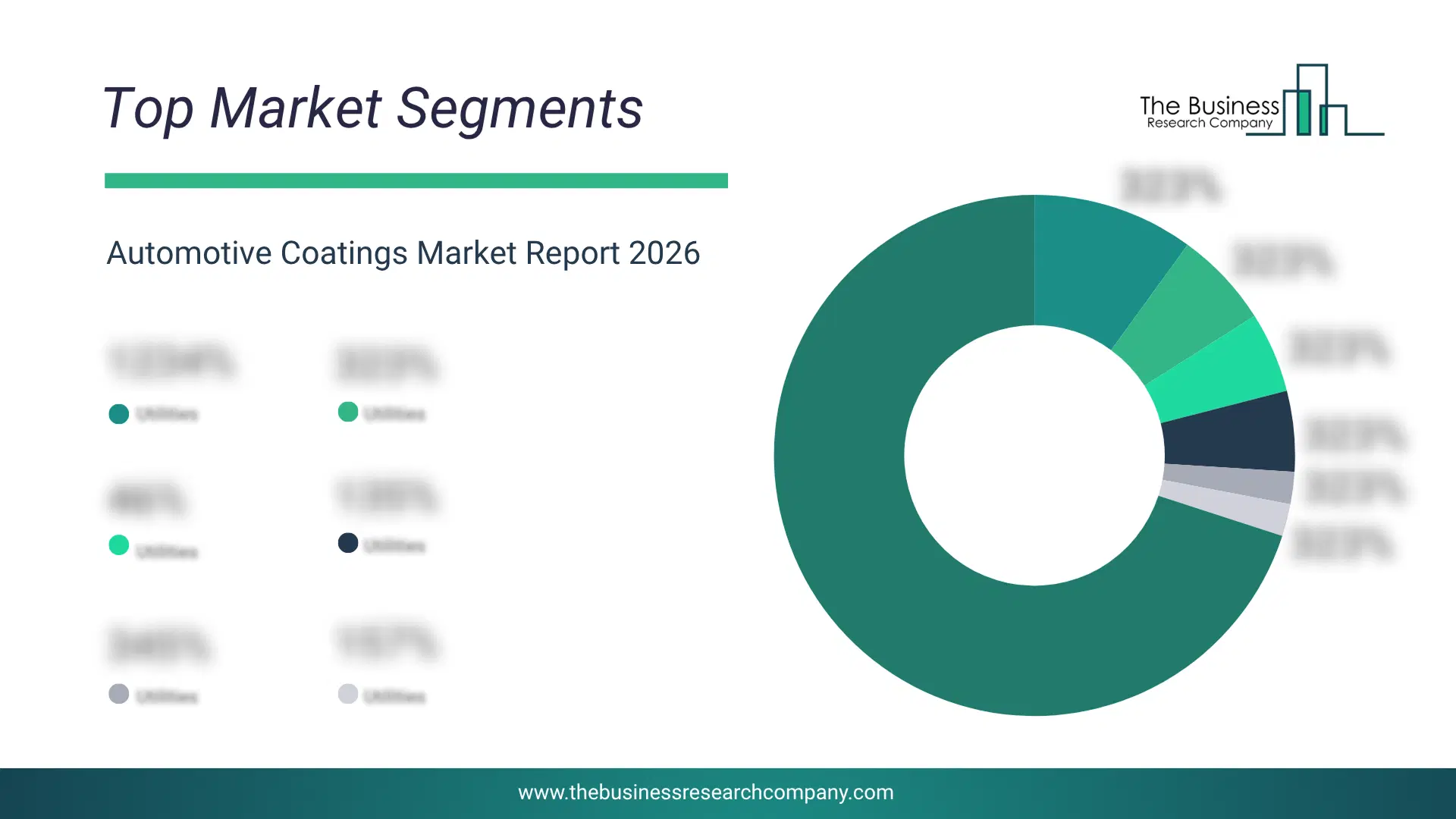
Global Automotive Coatings Market Segmentation
1) By Coat Type: Clearcoat, Basecoat, E-Coat, Primer 2) By Resin Type: Polyurethane, Epoxy, Acrylic 3) By Technology: Waterborne Coatings, Solventborne Coatings, Powder coatings, UV-Cured Coatings 4) By Substrate: Metal, Plastics 5) By End-Use: Light Vehicle OEM, Commercial OEM, Automotive Refinish Subsegments: 1) By Clearcoat: Urethane Clearcoat, Acrylic Clearcoat, Polyester Clearcoat 2) By Basecoat: Metallic Basecoat, Solid Basecoat, Pearlescent Basecoat 3) By E-Coat: Cataphoretic Coating (Cationic), Anionic Electrocoating 4) By Primer: Epoxy Primer, Urethane Primer, Wash Primer, High-Performance Primer The top segments in the automotive coatings market will be: • E-Coat will reach $14 Billion by 2030. • Primer will reach $11 Billion by 2030. • Basecoat will reach $7 Billion by 2030. • Clearcoat will reach $4 Billion by 2030.What Is The Driver Of The Automotive Coatings Market?
The increase in demand for lightweight vehicles is significantly contributing to the growth of the automotive coatings market. Stringent emission norms and the growing need for a reduction in fuel consumption have supported the demand for lightweight vehicles. The lightweight vehicle surfaces are coated with different types of coatings for protective as well as decorative purposes. Automotive coatings protect the automobile surface from corrosion as well as decrease the overall weight of vehicles. For instance, in August 2024, according to the Federal Reserve Economic Data, a US-based government organization, in January 2024, sales of lightweight vehicles, comprising autos and light trucks, increased to 15.002 million units, compared to 13.431 million units in January 2023, reflecting a growth of approximately 11.7% year-over-year. Therefore, the increase in demand for lightweight is expected to support the growth of the automotive coatings industry going forward.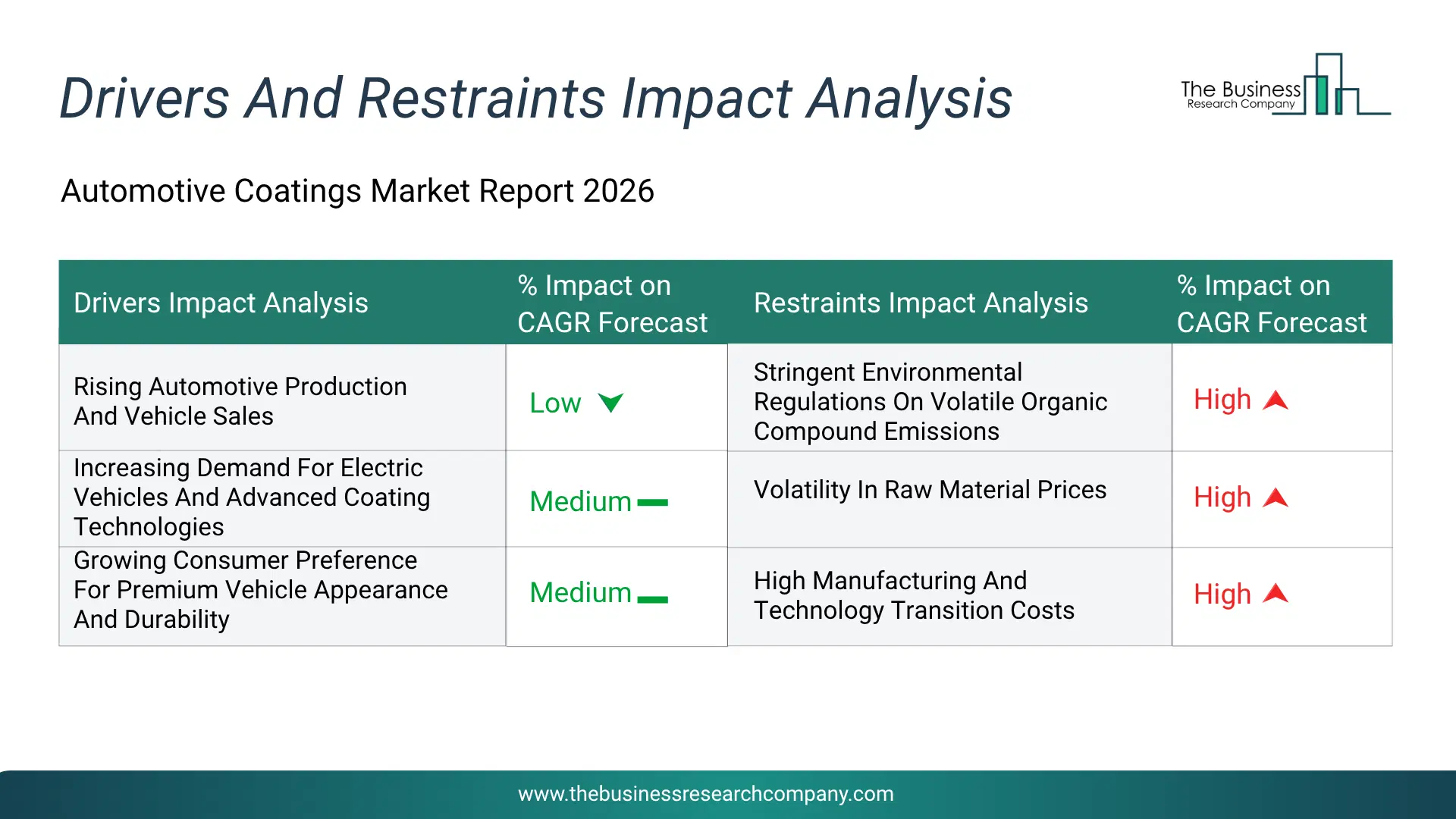
Infographic Chart Showing Key Market Drivers Analysis And Restraints For Automotive Coatings Market
The chart presents an impact analysis of key drivers and restraints, quantifying their relative influence on the market's growth rate and helping assess the balance between growth enablers and limiting factors. This chart offers a high-level perspective; the full report contains more detailed insights.
How Will The Drivers Impact Growth In The Global Automotive Coatings Market?
• Rising Automotive Production And Vehicle Sales (Low) – During the forecast period, the rising automotive production and vehicle sales are expected to emerge as a major factor driving the expansion of the automotive coatings market by 2030. higher manufacturing volumes of passenger cars, commercial vehicles, and light trucks are increasing demand for electrocoats, primers, basecoats, and clearcoats that provide corrosion protection, weather resistance, and enhanced vehicle aesthetics. expanding OEM manufacturing capacity, recovery in global vehicle production, and increasing automobile exports from major manufacturing hubs are further supporting coating consumption across both original equipment and aftermarket applications. • Increasing Demand For Electric Vehicles And Advanced Coating Technologies (Medium) – During the forecast period, the increasing demand for electric vehicles and advanced coating technologies is expected to emerge as a major factor driving the expansion of the automotive coatings market by 2030. electric vehicle production is creating demand for specialized coatings that improve battery protection, thermal management, corrosion resistance, and lightweight component performance. at the same time, continuous innovation in self-healing, anti-scratch, UV-curable, anti-microbial, and heat-reflective coatings is enabling manufacturers to enhance vehicle functionality while meeting evolving environmental and performance requirements. • Growing Consumer Preference For Premium Vehicle Appearance And Durability (Medium) – During the forecast period, the growing consumer preference for premium vehicle appearance and durability is expected to act as a key growth catalyst for the automotive coatings market by 2030. demand for metallic, pearl, matte, and customized finishes is increasing as consumers seek improved aesthetics, higher resale value, and long-lasting surface protection. advanced coating systems that deliver superior gloss retention, scratch resistance, UV protection, and easier maintenance are also supporting growth in both the luxury vehicle segment and automotive refinishing applications.How Will The Restraints Impact Growth In The Global Automotive Coatings Market?
• Stringent Environmental Regulations On Volatile Organic Compound Emissions (Low) – During the forecast period, stringent Environmental Regulations On Volatile Organic Compound Emissions represent one of the most significant restraints for the Automotive Coatings Market because conventional solvent-based coatings release volatile organic compounds (VOCs) that contribute to air pollution, smog formation, and environmental degradation. Governments and environmental agencies across North America, Europe, Japan, and several Asia-Pacific countries continue to implement increasingly strict regulations governing VOC emissions, hazardous air pollutants, and chemical usage during coating production and application. These regulations require manufacturers to transition toward waterborne, powder, UV-curable, and other low-emission coating technologies. While these sustainable alternatives reduce environmental impact, they require extensive research and development, process modifications, equipment upgrades, regulatory testing, and compliance certification. The additional costs associated with meeting evolving environmental standards increase operational expenses and create financial challenges, particularly for small and medium-sized coating manufacturers, thereby slowing overall market growth. • Volatility In Raw Material Prices (Medium) – During the forecast period, volatility In Raw Material Prices is a major restraint affecting the Automotive Coatings Market because coating manufacturers rely heavily on petroleum-based raw materials such as resins, solvents, pigments, additives, curing agents, and specialty chemicals whose prices fluctuate due to crude oil price changes, geopolitical tensions, trade restrictions, inflation, and global supply chain disruptions. Unexpected increases in raw material costs directly raise manufacturing expenses and reduce profit margins for coating producers. Since automotive OEMs often operate under long-term supply contracts with fixed pricing, manufacturers are not always able to pass increased costs on to customers immediately. Furthermore, disruptions in the availability of specialty chemicals and pigments can delay production schedules and increase procurement complexity. These pricing uncertainties negatively affect investment planning, production efficiency, and overall profitability, limiting the market's growth potential. • High Manufacturing And Technology Transition Costs (Medium) – During the forecast period, high Manufacturing And Technology Transition Costs act as an important restraint for the Automotive Coatings Market because manufacturers are increasingly required to adopt advanced, environmentally sustainable coating technologies to remain competitive and comply with evolving regulations. Transitioning from conventional solvent-based coatings to waterborne, powder, and UV-curable systems requires substantial capital investment in new production facilities, automated coating equipment, application technologies, quality testing laboratories, employee training, and process optimization. In addition, continuous investment is necessary to develop innovative coating formulations that offer improved durability, corrosion resistance, lightweight performance, and environmental compliance. These high capital requirements create financial barriers for small and medium-sized manufacturers, limiting their ability to compete with larger multinational companies. As a result, technology adoption occurs at a slower pace in several developing regions, restraining the overall expansion of the Automotive Coatings Market.Key Players In The Global Automotive Coatings Market
Major companies operating in the automotive coatings market are The Valspar Corporation, Sherwin-Williams Company, Pittsburgh Plate Glass Company (PPG), Nippon Paint Automotive Coatings Co. Ltd., Kansai Paint Co. Ltd., BASF SE, Axalta Coating Systems Ltd., Akzo Nobel N.V., Berger Paints India Limited, Becker Industrial Coatings LLC, Jotun India Pvt. Ltd., Mankiewicz India Private Limited, Samhwa Paints Industries Co. Ltd., Nihon Toksuhu Toryo Co. Ltd., National Paint Factories Pvt. Ltd., Teknos Coatings And Paints Private Limited, Kelly-Moore Paints, Hempel A/S, Deutsche Amphibolin-Werke von Robert Murjahn Stiftung & Co. KG, Tiger Coatings GmbH & Co. KG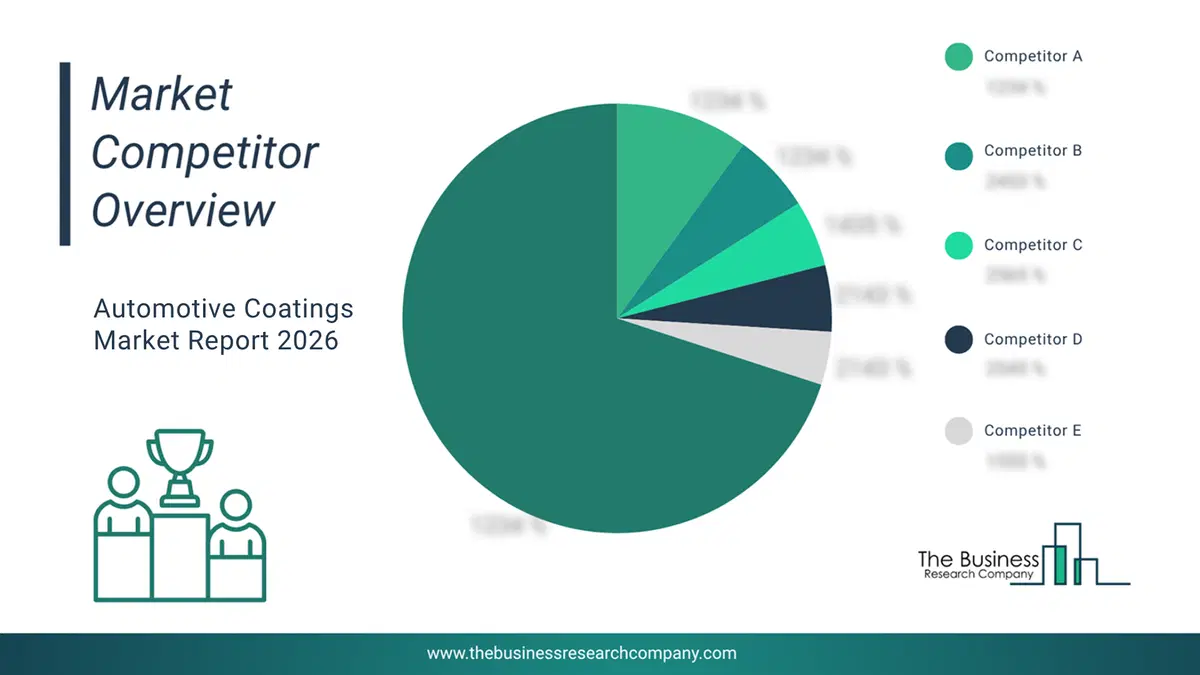
This chart is for illustrative purposes; the full report includes a detailed competitor analysis and comprehensive overview of the top 10 companies in the market.
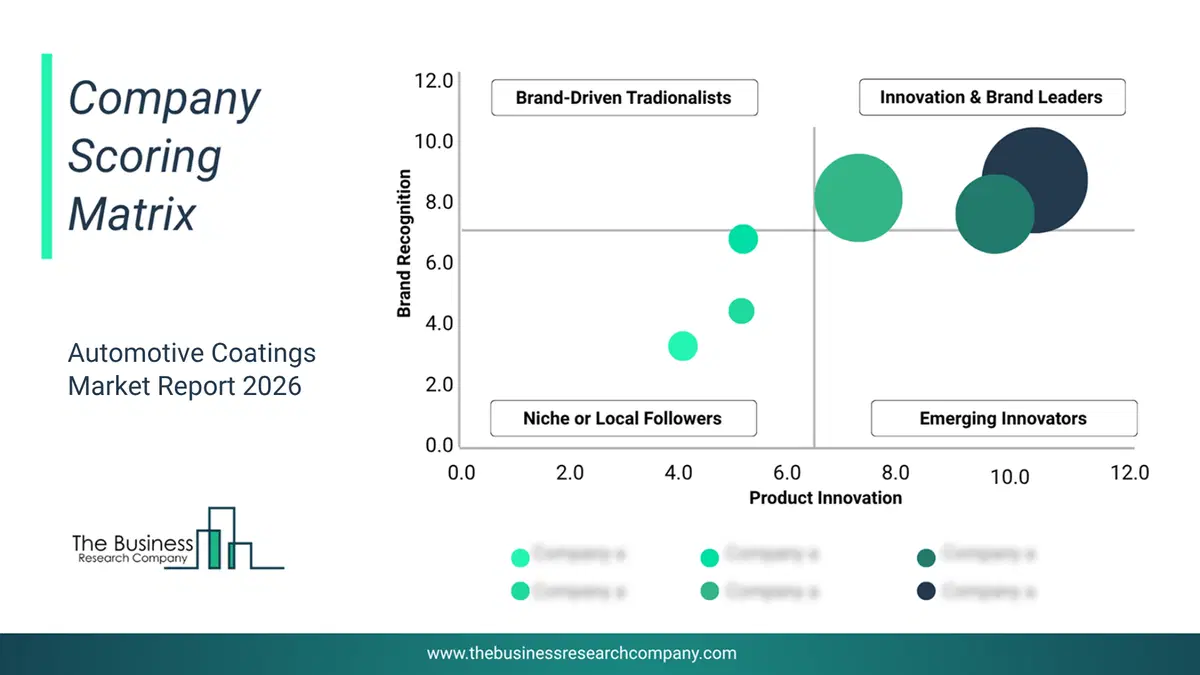
This chart maps companies by product innovation and brand strength, with bubble size indicating relative revenue, helping identify market leaders, challengers, and niche players. This is an illustrative chart; the full report provides a complete and accurate competitive analysis.
Global Automotive Coatings Market Trends and Insights
Major companies operating in the automotive coatings market are focusing on technological innovations such as nanotechnology-based technologies to meet the growing demand for automotive coatings. Nanotechnology-based automotive coatings refer to the application of coatings or surface treatments at the nanoscale level using nanomaterials or nanoparticles. For instance, in July 2023, Hyundai Motor Company, a South Korea-based automotive manufacturer, introduced an innovative nanotechnology-based automotive self-healing coating feature that coats a car with macromolecules that return to their previous form, effectively healing any scratches or dents.What Are Latest Mergers And Acquisitions In The Automotive Coatings Market?
In July 2024, Axalta, a US-based manufacturing company of photonic devices and systems, acquired The CoverFlexx Group for an undisclosed amount. The aim of Axalta's acquisition is to enhance its offerings in the automotive refinish coatings market and support growth in that segment, particularly focusing on economy customers in North America. The CoverFlexx Group is Netherlands-based manufacturing company specializes incoatings specifically for automotive refinish and aftermarket applications.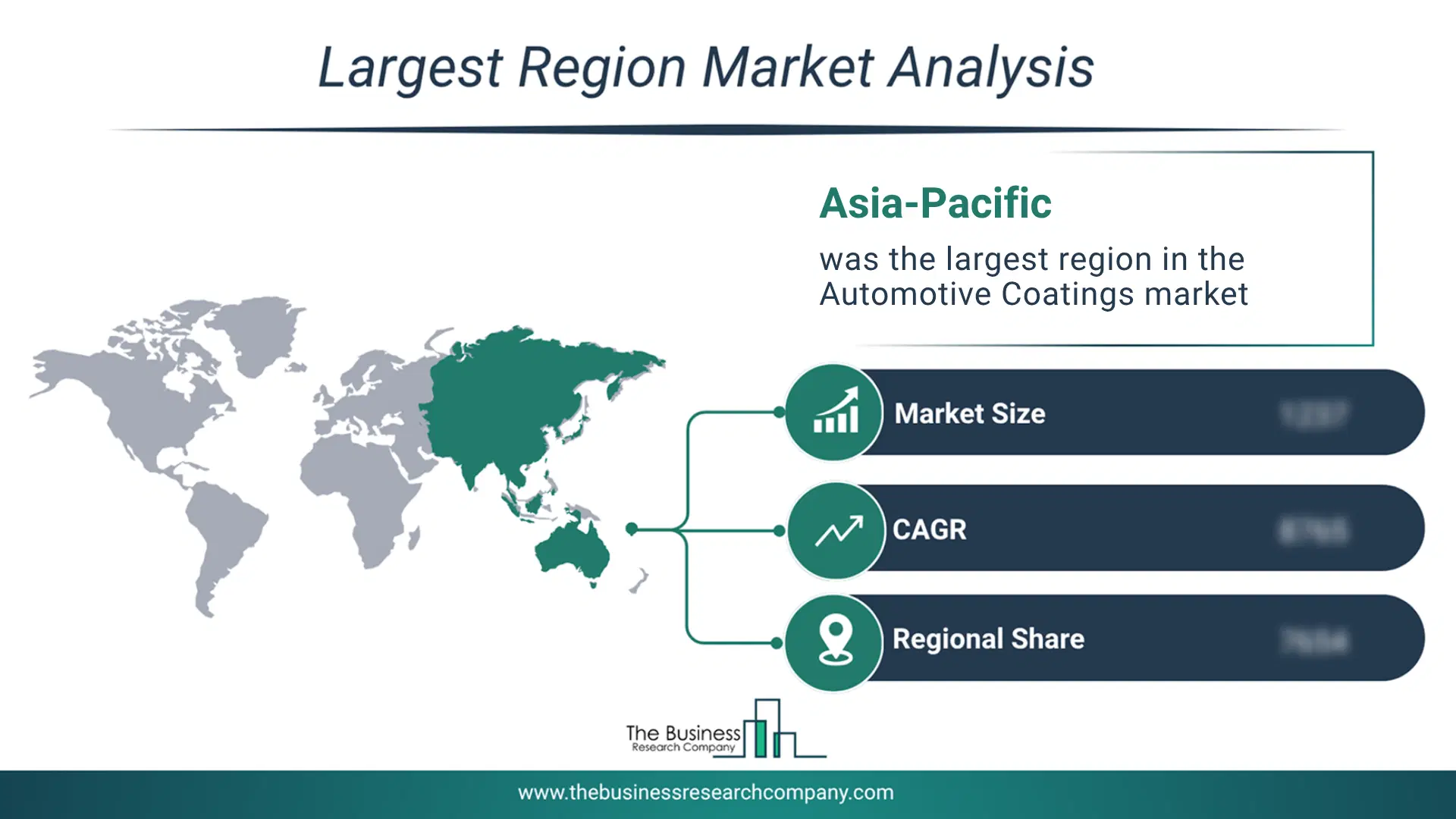
Regional Insights
Asia-Pacific was the largest region in the automotive coatings market in 2025. Asia-Pacific is expected to be the fastest-growing region in the forecast period. The regions covered in this market report are Asia-Pacific, South East Asia, Western Europe, Eastern Europe, North America, South America, Middle East, Africa The countries covered in this market report are Australia, Brazil, China, France, Germany, India, Indonesia, Japan, Taiwan, Russia, South Korea, UK, USA, Canada, Italy, SpainWhat Defines the Automotive Coatings Market?
The automotive coatings market consists of sales of automotive coating technology, including UV-cured coating. Values in this market are ‘factory gate’ values, that is, the value of goods sold by the manufacturers or creators of the goods, whether to other entities (including downstream manufacturers, wholesalers, distributors, and retailers) or directly to end customers. The value of goods in this market includes related services sold by the creators of the goods.How is Market Value Defined and Measured?
The market value is defined as the revenues that enterprises gain from the sale of goods and/or services within the specified market and geography through sales, grants, or donations in terms of the currency (in USD unless otherwise specified). The revenues for a specified geography are consumption values that are revenues generated by organizations in the specified geography within the market, irrespective of where they are produced. It does not include revenues from resales along the supply chain, either further along the supply chain or as part of other products.
This chart presents market attractiveness based on a quantitative evaluation of growth, competition, strategic alignment, and risk, offering a clear view of opportunity areas for decision-making. This chart is for illustrative purposes; the full report contains the complete analysis.

This chart highlights the Total Addressable Market (TAM) by estimating the maximum revenue opportunity using an assumption-driven approach, supporting strategic planning and opportunity sizing across markets. The chart is illustrative; the full report provides a more comprehensive analysis.
What Key Data and Analysis Are Included in the Automotive Coatings Market Report 2026?
The automotive coatings market research report is one of a series of new reports from The Business Research Company that provides market statistics, including industry global market size, regional shares, competitors with the market share, detailed market segments, market trends and opportunities, and any further data you may need to thrive in the automotive coatings industry. The market research report delivers a complete perspective of everything you need, with an in-depth analysis of the current and future state of the industry.Automotive Coatings Market Report Forecast Analysis
| Report Attribute | Details |
|---|---|
| Market Size Value In 2026 | $25.58 billion |
| Revenue Forecast In 2030 | $36.13 billion |
| Growth Rate | CAGR of 9% from 2026 to 2030 |
| Base Year For Estimation | 2025 |
| Actual Estimates/Historical Data | 2020-2025 |
| Forecast Period | 2026 - 2030 |
| Market Representation | Revenue in USD Billion and CAGR from 2026 to 2030 |
| Segments Covered | Coat Type, Resin Type, Technology, Substrate, End-Use |
| Regional Scope | Asia-Pacific, Western Europe, Eastern Europe, North America, South America, Middle East, Africa |
| Country Scope | The countries covered in the report are Australia, Brazil, China, France, Germany, India, Indonesia, Japan, Taiwan, Russia, South Korea, UK, USA, Canada, Italy, Spain. |
| Key Companies Profiled | The Valspar Corporation, Sherwin-Williams Company, Pittsburgh Plate Glass Company (PPG), Nippon Paint Automotive Coatings Co. Ltd., Kansai Paint Co. Ltd., BASF SE, Axalta Coating Systems Ltd., Akzo Nobel N.V., Berger Paints India Limited, Becker Industrial Coatings LLC, Jotun India Pvt. Ltd., Mankiewicz India Private Limited, Samhwa Paints Industries Co. Ltd., Nihon Toksuhu Toryo Co. Ltd., National Paint Factories Pvt. Ltd., Teknos Coatings And Paints Private Limited, Kelly-Moore Paints, Hempel A/S, Deutsche Amphibolin-Werke von Robert Murjahn Stiftung & Co. KG, Tiger Coatings GmbH & Co. KG |
| Customization Scope | Request for Customization |
| Pricing And Purchase Options | Explore Purchase Options |