

Automotive Constant Velocity Joint Market Report 2026
Global Outlook – By Joint Type (Rzeppa Joints, Tripod Joints, Fixed And Plunge Joint, Other Joint Types), By Propulsion (Internal Combustion Engine (ICE), Electric And Hybrid, Other Propulsions), By Application (Passenger Car, Commercial Vehicle), By End-User (Original Equipment Manufacturer (OEM), Aftermarket) – Market Size, Trends, Strategies, and Forecast to 2030
Automotive Constant Velocity Joint Market Overview
• Automotive Constant Velocity Joint market size has reached to $3.89 billion in 2025 • Expected to grow to $5.27 billion in 2030 at a compound annual growth rate (CAGR) of 6.5% • Growth Driver: Growing Demand For Commercial Vehicles Boosts The Automotive Constant Velocity Joint Market • Market Trend: Advancements in CV Axles: GSP Inc. Introduces the Performance Revolution Axle Line • North America was the largest region in 2025.What Is Covered Under Automotive Constant Velocity Joint Market?
An automotive constant velocity joint is a mechanical component that transmits torque and rotation between two shafts at varying angles while maintaining a consistent velocity output. Automotive constant velocity joint is essential to keep stable and smooth power transfer, especially in vehicles with front-wheel drive (FWD), all-wheel drive (AWD), and independent suspension systems. The main types of automotive constant velocity joints are rzeppa joints, tripod joints, fixed and plunge joints, and others. Rzeppa joints are a type of constant-velocity joint that consists of an inner race, an outer race, and a set of ball bearings arranged in a cage. They are used in front-wheel-drive vehicles' outer joints due to their ability to handle different angles. They are also used in internal combustion engine (ICE) and electric and hybrid-propelled vehicles, such as passenger cars and commercial vehicles for various end users such as original equipment manufacturers (OEM) and aftermarket.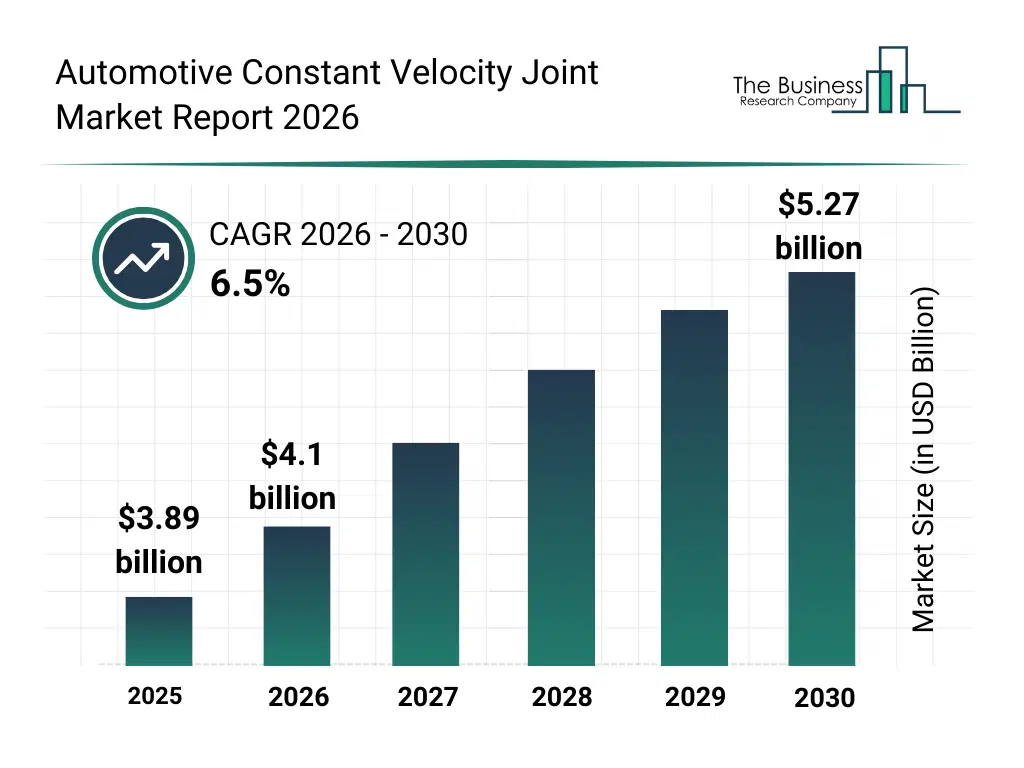
What Is The Automotive Constant Velocity Joint Market Size and Share 2026?
The automotive constant velocity joint market size has grown strongly in recent years. It will grow from $3.89 billion in 2025 to $4.1 billion in 2026 at a compound annual growth rate (CAGR) of 5.4%. The growth in the historic period can be attributed to front-wheel drive adoption, passenger vehicle production growth, demand for smooth power transfer, drivetrain standardization, mass vehicle manufacturing.What Is The Automotive Constant Velocity Joint Market Growth Forecast?
The automotive constant velocity joint market size is expected to see strong growth in the next few years. It will grow to $5.27 billion in 2030 at a compound annual growth rate (CAGR) of 6.5%. The growth in the forecast period can be attributed to electric vehicle penetration, lightweight material adoption, performance vehicle demand, advanced suspension systems, drivetrain efficiency optimization. Major trends in the forecast period include design optimization for electric vehicles, demand for high-durability cv joints, growth of awd and fwd platforms, expansion of lightweight drivetrain components, focus on reduced nvh levels.

Global Automotive Constant Velocity Joint Market Segmentation
1) By Joint Type: Rzeppa Joints, Tripod Joints, Fixed And Plunge Joint, Other Joint Types 2) By Propulsion: Internal Combustion Engine (ICE), Electric And Hybrid, Other Propulsions 3) By Application: Passenger Car, Commercial Vehicle 4) By End-User: Original Equipment Manufacturer (OEM), Aftermarket Subsegments: 1) By Rzeppa Joints: Standard Rzeppa Joints, Heavy-Duty Rzeppa Joints 2) By Tripod Joints: Single-Tripod Joints, Multi-Tripod Joints 3) By Fixed And Plunge Joint: Fixed Joints, Plunge Joints 4) By Other Joint Types: Cross-Groove Joints, Double-Offset Joints, Spherical JointsWhat Are The Drivers Of The Automotive Constant Velocity Joint Market?
An increase in demand for commercial vehicles is expected to propel the growth of the automotive constant velocity joint market going forward. Commercial vehicles refer to a category of vehicles that are used for business, the transportation of goods and cargo, or providing services in exchange for compensation. Increasing demand for commercial vehicles such as trucks and delivery vehicles fuels the need for CV joints to transmit power from the vehicle's transmission or differential to the wheels, enhancing driving comfort and stability. For instance, in March 2024, according to a report published by the European Automobile Manufacturers' Association (ACEA), a Belgium-based standards group of the automobile industry in the European Union, over 76 million passenger cars were produced globally in 2023, up 10.2% from the previous year. Therefore, the increase in demand for commercial vehicles will drive the growth of the automotive constant velocity joint industry. The rising adoption of electric and hybrid vehicles is expected to propel the growth of the automotive constant velocity joint market going forward. Electric and hybrid vehicles are automobiles that utilize electric motors either partially or fully to power the drivetrain, often combined with traditional internal combustion engines or operating independently on battery power. The growing adoption of electric and hybrid vehicles is primarily driven by government incentives and declining battery costs, as these factors make electric mobility more financially accessible to consumers and accelerate the transition away from conventional gasoline-powered transportation. Electric and hybrid vehicles require specialized constant velocity joints that can handle higher torque loads from electric motors and ensure efficient power transmission across the drivetrain at various angles. For instance, in May 2024, according to the U.S. Department of Energy, a US-based federal agency, hybrid electric vehicle sales saw strong momentum in 2023, rising by 53% compared to 2022 and hitting a new record of almost 1.2 million units sold. Therefore, the rising adoption of electric and hybrid vehicles is driving the growth of the automotive constant velocity joint industry.Key Players In The Global Automotive Constant Velocity Joint Market
Major companies operating in the automotive constant velocity joint market report include JTEKT Corp., Wanxiang Group Corporation, Dana Inc., SKF AB, GKN Automotive Ltd., Hyundai WIA Corporation, American Axle and Manufacturing Holdings Inc., NTN Corp., Nexteer Automotive Group Ltd., IFA Holding GmbH, Xiangyang Automobile Bearing Co. Ltd., GSP Automotive Group Wenzhou Co. Ltd., Wonh Industries Co Ltd., C&U Americas LLC, Aikoku Alpha Corporation, Nuova Tecnodelta Spa, Taizhou Heri Auto Parts Co. Ltd., Shandong Kaifurui Auto Parts Co. Ltd., Eco Shaft (M) Sdn Bhd, Falga Srl, Zhejiang Feizhou Vehicle Industry Co. Ltd., Shandong Huifeng Auto Fittings Co. Ltd., Heri Automotive Inc., Wenzhou Guansheng Auto Parts Manufacture Co. Ltd.
This chart is for illustrative purposes; the full report includes a detailed competitor analysis and comprehensive overview of the top 10 companies in the market.
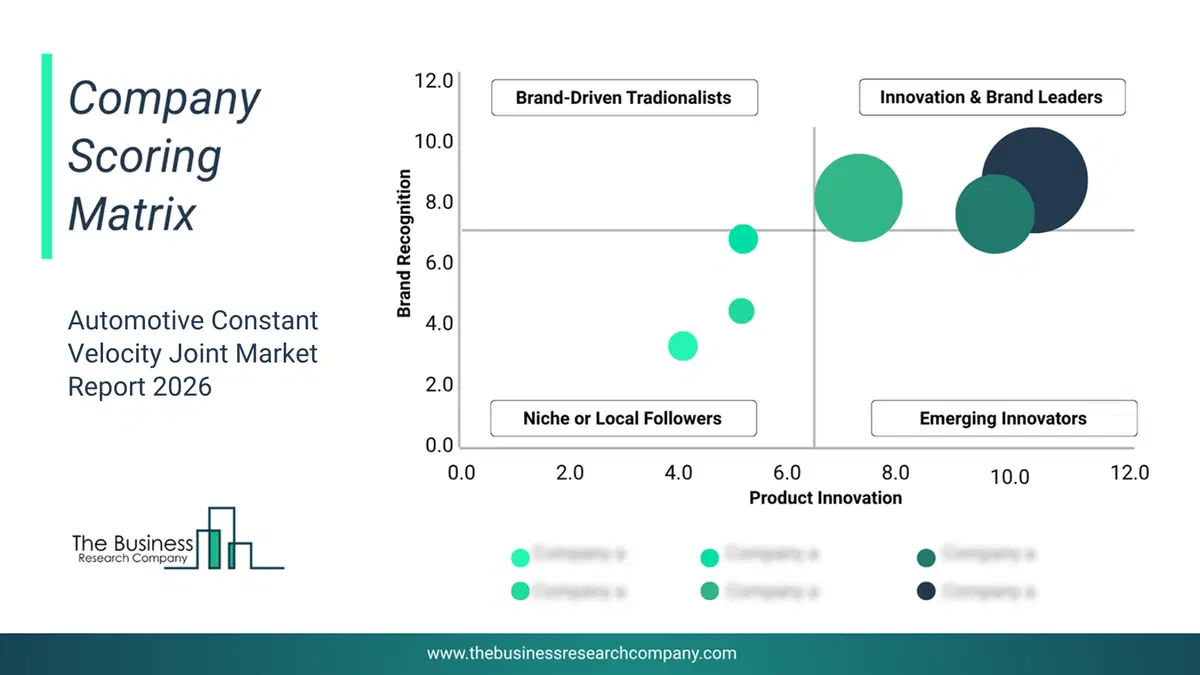
This chart maps companies by product innovation and brand strength, with bubble size indicating relative revenue, helping identify market leaders, challengers, and niche players. This is an illustrative chart; the full report provides a complete and accurate competitive analysis.
Global Automotive Constant Velocity Joint Market Trends and Insights
Major companies operating in the Automotive Constant Velocity Joint Market are focusing on developing innovative products such as CV axles to enhance vehicle performance, improve fuel efficiency, and reduce vibrations. CV Axles (constant velocity axes) are components in a vehicle's drivetrain that connect the transmission to the wheels, allowing for smooth power transfer while accommodating the up-and-down movement of the suspension. For instance, in September 2023, GSP Inc., a US-based manufacturing company, launched the Performance Revolution Axle Line to withstand rigorous conditions. This product features include a high-performance CV boot and clamp for superior longevity, a proprietary import spline design, and an oxidized coating that provides maximum corrosion resistance. Each axle comes with all necessary hardware for easy installation, ensuring a hassle-free experience for users while maintaining the quality expected from premium automotive components.
Regional Outlook
North America was the largest region in the automotive constant velocity joint market in 2025. The regions covered in this market report include Asia-Pacific, South East Asia, Western Europe, Eastern Europe, North America, South America, Middle East, Africa. The countries covered in this market report include Australia, Brazil, China, France, Germany, India, Indonesia, Japan, Taiwan, Russia, South Korea, UK, USA, Canada, Italy, SpainWhat Defines the Automotive Constant Velocity Joint Market?
The automotive constant velocity joint market consists of sales of CV joint assemblies and CV joint lubrication tools. Values in this market are ‘factory gate’ values, that is the value of goods sold by the manufacturers or creators of the goods, whether to other entities (including downstream manufacturers, wholesalers, distributors and retailers) or directly to end customers. The value of goods in this market includes related services sold by the creators of the goods.How is Market Value Defined and Measured?
The market value is defined as the revenues that enterprises gain from the sale of goods and/or services within the specified market and geography through sales, grants, or donations in terms of the currency (in USD unless otherwise specified). The revenues for a specified geography are consumption values that are revenues generated by organizations in the specified geography within the market, irrespective of where they are produced. It does not include revenues from resales along the supply chain, either further along the supply chain or as part of other products.
This chart presents market attractiveness based on a quantitative evaluation of growth, competition, strategic alignment, and risk, offering a clear view of opportunity areas for decision-making. This chart is for illustrative purposes; the full report contains the complete analysis.

This chart highlights the Total Addressable Market (TAM) by estimating the maximum revenue opportunity using an assumption-driven approach, supporting strategic planning and opportunity sizing across markets. The chart is illustrative; the full report provides a more comprehensive analysis.
What Key Data and Analysis Are Included in the Automotive Constant Velocity Joint Market Report 2026?
The automotive constant velocity joint market research report is one of a series of new reports from The Business Research Company that provides market statistics, including industry global market size, regional shares, competitors with the market share, detailed market segments, market trends and opportunities, and any further data you may need to thrive in the automotive constant velocity joint industry. The market research report delivers a complete perspective of everything you need, with an in-depth analysis of the current and future state of the industry.Automotive Constant Velocity Joint Market Report Forecast Analysis
| Report Attribute | Details |
|---|---|
| Market Size Value In 2026 | $4.1 billion |
| Revenue Forecast In 2030 | $5.27 billion |
| Growth Rate | CAGR of 5.4% from 2026 to 2030 |
| Base Year For Estimation | 2025 |
| Actual Estimates/Historical Data | 2020-2025 |
| Forecast Period | 2026 - 2030 - 2030 |
| Market Representation | Revenue in USD Billion and CAGR from 2026 to 2030 |
| Segments Covered | Joint Type, Propulsion, Application, End-User |
| Regional Scope | Asia-Pacific, Western Europe, Eastern Europe, North America, South America, Middle East, Africa |
| Country Scope | The countries covered in the report are Australia, Brazil, China, France, Germany, India, Indonesia, Japan, Taiwan, Russia, South Korea, UK, USA, Canada, Italy, Spain. |
| Key Companies Profiled | JTEKT Corp., Wanxiang Group Corporation, Dana Inc., SKF AB, GKN Automotive Ltd., Hyundai WIA Corporation, American Axle and Manufacturing Holdings Inc., NTN Corp., Nexteer Automotive Group Ltd., IFA Holding GmbH, Xiangyang Automobile Bearing Co. Ltd., GSP Automotive Group Wenzhou Co. Ltd., Wonh Industries Co Ltd., C&U Americas LLC, Aikoku Alpha Corporation, Nuova Tecnodelta Spa, Taizhou Heri Auto Parts Co. Ltd., Shandong Kaifurui Auto Parts Co. Ltd., Eco Shaft (M) Sdn Bhd, Falga Srl, Zhejiang Feizhou Vehicle Industry Co. Ltd., Shandong Huifeng Auto Fittings Co. Ltd., Heri Automotive Inc., Wenzhou Guansheng Auto Parts Manufacture Co. Ltd. |
| Customization Scope | Request for Customization |
| Pricing And Purchase Options | Explore Purchase Options |