
Automotive Digital Signal Processors Market Report 2026
Global Outlook – By Core Type (Single-Core Digital Signal Processors, Multi-Core Digital Signal Processors), By Component Type (Application-Specific Integrated Circuits, Field-Programmable Gate Arrays, General-Purpose Digital Signal Processor Chips, Hybrid Signal Processors), By Vehicle Type (Passenger Vehicles, Commercial Vehicles, Electric Vehicles, Hybrid Vehicles), By Application (Advanced Driver Assistance Systems And Autonomous Vehicles, Infotainment And Connectivity, Powertrain Control Systems, Safety And Security Systems, Vehicle Networking And Vehicle-To-Everything Communication), By End User (Original Equipment Manufacturers, Aftermarket) – Market Size, Trends, Strategies, and Forecast to 2030
Automotive Digital Signal Processors Market Overview
• Automotive Digital Signal Processors market size has reached to $6.75 billion in 2025 • Expected to grow to $11.8 billion in 2030 at a compound annual growth rate (CAGR) of 11.7% • Growth Driver: Growing Demand For Connected Vehicles Driving the Market Growth Due to Rising Vehicle Adoption • Market Trend: Advanced Automotive Audio Digital Signal Processors Improve In-Vehicle Infotainment And Voice Processing • North America was the largest region in 2025 and Asia-Pacific is the fastest growing region.What Is Covered Under Automotive Digital Signal Processors Market?
Automotive digital signal processors are specialized microprocessors designed to process and analyze real-time digital signals across various vehicle systems. They deliver high-speed computing for audio processing, sensor data analysis, and communication signal management, enabling advanced automotive features while ensuring low latency, high reliability, and energy-efficient performance in demanding vehicle environments. The main core types of automotive digital signal processors include single-core digital signal processors and multi-core digital signal processors. Single-core digital signal processors refer to processors with a single processing core designed to execute digital signal processing tasks such as audio processing, sensor data analysis, and communication signal processing in automotive systems. These processors are available through component types including application-specific integrated circuits, field-programmable gate arrays, general-purpose digital signal processor chips, and hybrid signal processors and are used across passenger vehicles, commercial vehicles, electric vehicles, and hybrid vehicles. The key applications of advanced driver assistance systems and autonomous vehicles, infotainment and connectivity, powertrain control systems, safety and security systems, and vehicle networking and vehicle-to-everything communication, while the end-users original equipment manufacturers and aftermarket.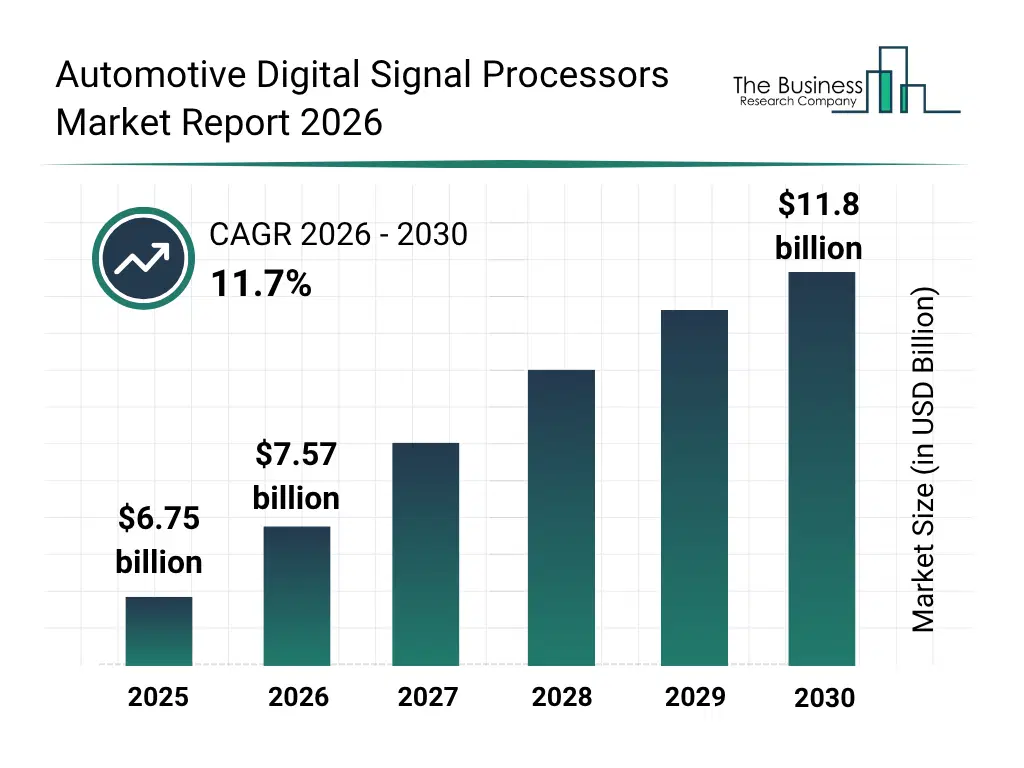
What Is The Automotive Digital Signal Processors Market Size and Share 2026?
The automotive digital signal processors market size has grown rapidly in recent years. It will grow from $6.75 billion in 2025 to $7.57 billion in 2026 at a compound annual growth rate (CAGR) of 12.1%. The growth in the historic period can be attributed to increasing vehicle electronics integration, rising demand for automotive infotainment systems, growing adoption of advanced driver assistance systems, increasing vehicle connectivity requirements, expanding use of digital audio processing.What Is The Automotive Digital Signal Processors Market Growth Forecast?
The automotive digital signal processors market size is expected to see rapid growth in the next few years. It will grow to $11.8 billion in 2030 at a compound annual growth rate (CAGR) of 11.7%. The growth in the forecast period can be attributed to rising demand for autonomous driving capabilities, increasing deployment of electric vehicles, growing need for high-speed sensor data processing, rising demand for vehicle-to-everything communication, increasing need for energy-efficient automotive computing. Major trends in the forecast period include increasing adoption of high-performance digital signal processors, rising demand for real-time signal processing, growing use of multi-core processing architectures, increasing demand for low-latency signal computation, rising integration of signal processing across vehicle systems.
Global Automotive Digital Signal Processors Market Segmentation
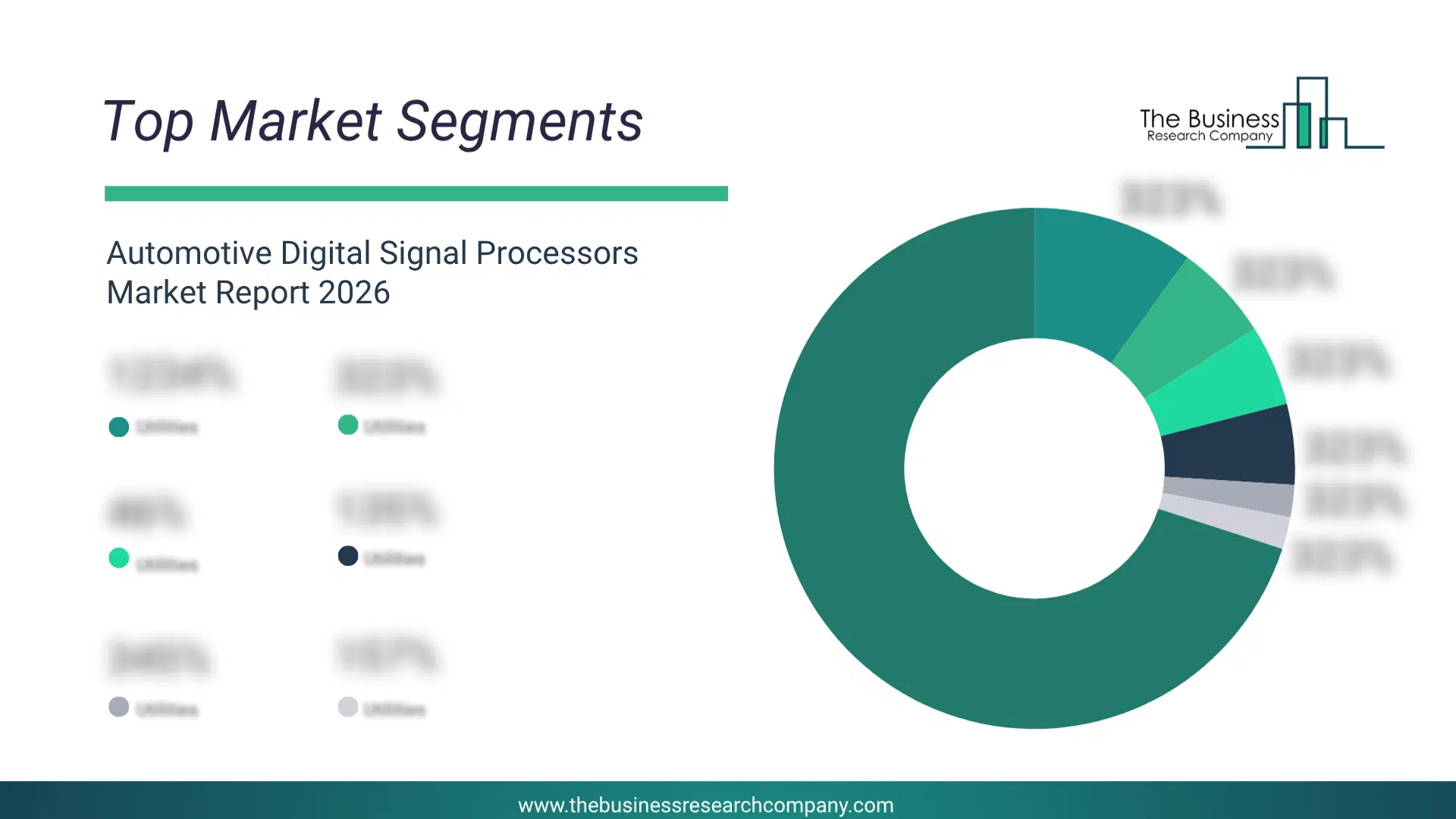
1) By Core Type: Single-Core Digital Signal Processors, Multi-Core Digital Signal Processors 2) By Component Type: Application-Specific Integrated Circuits, Field-Programmable Gate Arrays, General-Purpose Digital Signal Processor Chips, Hybrid Signal Processors 3) By Vehicle Type: Passenger Vehicles, Commercial Vehicles, Electric Vehicles, Hybrid Vehicles 4) By Application: Advanced Driver Assistance Systems And Autonomous Vehicles, Infotainment And Connectivity, Powertrain Control Systems, Safety And Security Systems, Vehicle Networking And Vehicle-To-Everything Communication 5) By End User: Original Equipment Manufacturers, Aftermarket Subsegments: 1) By Single-Core Digital Signal Processors: Fixed-Point Digital Signal Processors, Floating-Point Digital Signal Processors, Hybrid-Precision Digital Signal Processors 2) By Multi-Core Digital Signal Processors: Symmetric Multi-Core Digital Signal Processors, Heterogeneous Multi-Core Digital Signal Processors, Clustered Multi-Core Digital Signal ProcessorsWhat Is The Driver Of The Automotive Digital Signal Processors Market?
The growing demand for connected vehicles is expected to propel the growth of the automotive digital signal processors market going forward. Connected vehicles are automobiles equipped with internet-enabled systems that allow communication with external networks, other vehicles, and digital infrastructure to enhance safety, navigation, and in-vehicle experiences. Connected vehicle demand is rising due to increasing vehicle ownership, expanding the installed vehicle base, and driving greater integration of real-time data processing, advanced driver assistance systems, and infotainment technologies. Automotive digital signal processors support connected vehicles by enabling real-time processing of sensor and communication data, ensuring seamless connectivity, faster decision-making, and enhanced vehicle safety and performance. For instance, in February 2025, according to Scania, a Sweden-based commercial vehicle manufacturer, by the end of 2024, Scania had approximately 638,000 connected vehicles, and this figure is growing rapidly. Therefore, the growing demand for connected vehicles is driving the growth of the automotive digital signal processors industry.Key Players In The Global Automotive Digital Signal Processors Market
Major companies operating in the automotive digital signal processors market are Samsung Electronics Co. Ltd., NVIDIA Corporation, Broadcom Inc., Intel Corporation, Qualcomm Incorporated, Renesas Electronics Corporation, MediaTek Inc., Texas Instruments Incorporated, Infineon Technologies AG, NXP Semiconductors N.V., STMicroelectronics N.V., Analog Devices Inc., ON Semiconductor Corporation, Arm Holdings plc, Microchip Technology Incorporated, Realtek Semiconductor Corp., ROHM Co. Ltd., Ambarella Inc., SiFive Inc., Rockchip Electronics Co. Ltd., CEVA Inc., Andes Technology Corporation, Codasip s.r.o.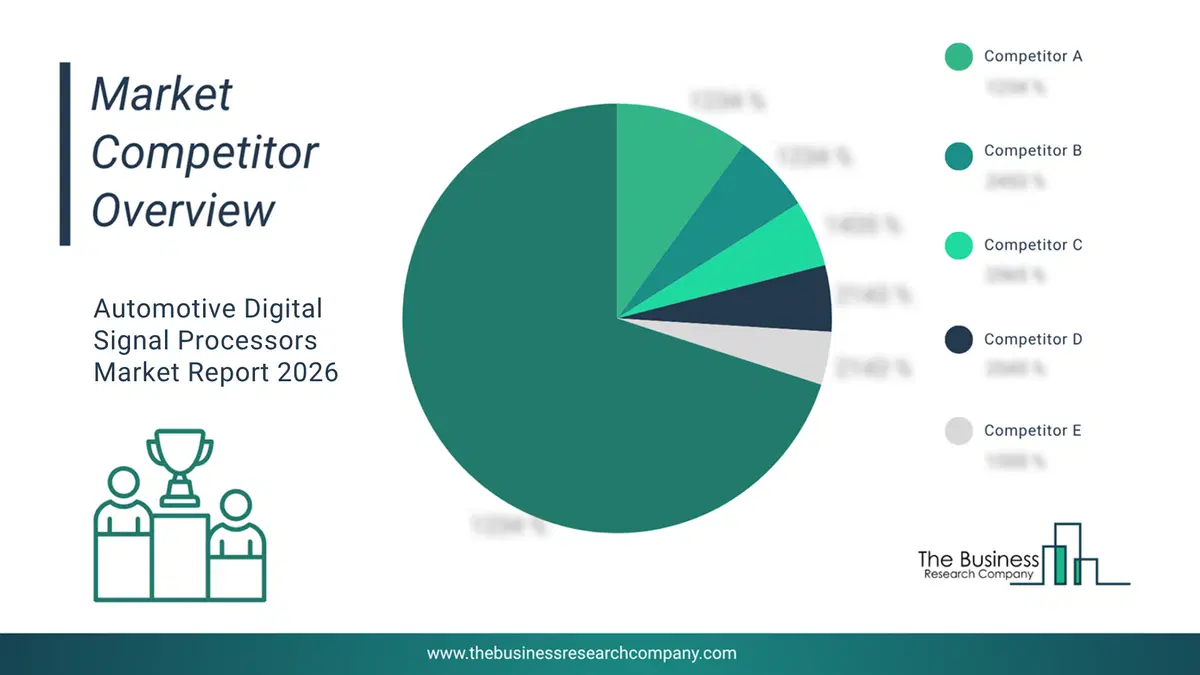
This chart is for illustrative purposes; the full report includes a detailed competitor analysis and comprehensive overview of the top 10 companies in the market.
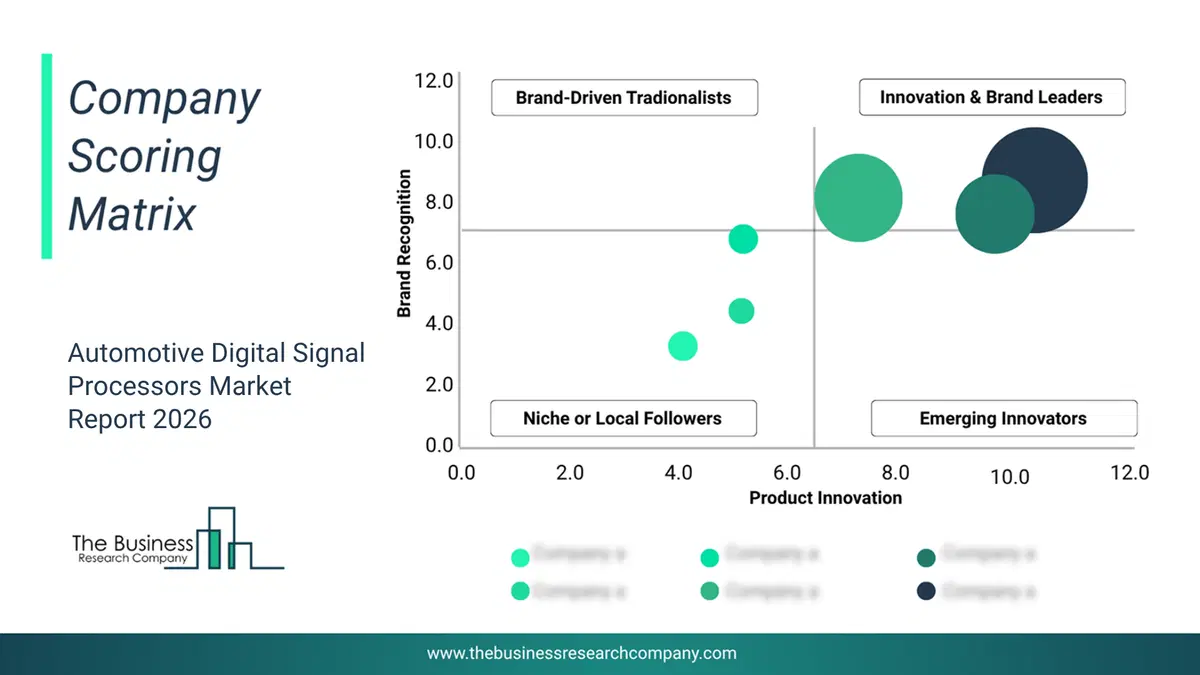
This chart maps companies by product innovation and brand strength, with bubble size indicating relative revenue, helping identify market leaders, challengers, and niche players. This is an illustrative chart; the full report provides a complete and accurate competitive analysis.
Global Automotive Digital Signal Processors Market Trends and Insights
Major companies operating in the automotive digital signal processors market are focusing on developing advanced automotive audio digital signal processors to enhance in-vehicle infotainment, improve voice processing capabilities, and enable scalable audio application development. Automotive audio digital signal processors are specialized processors that efficiently handle real-time audio and voice data for applications such as infotainment, hands-free communication, active noise cancellation, and premium in-vehicle sound systems. For instance, in December 2023, Asahi Kasei Microdevices Corporation (AKM), a Japan-based semiconductor company, launched the AK7018 and AK7017 automotive audio digital signal processors featuring dual and single HiFi 4 CPU architectures with support for DSP Concepts' Audio Weaver platform. The new processors enable flexible and scalable development of automotive audio and voice applications, support simultaneous high-resolution audio and voice processing, and are designed for advanced in-vehicle infotainment systems with enhanced audio performance and customizable processing capabilities.What Are Latest Mergers And Acquisitions In The Automotive Digital Signal Processors Market?
In February 2024, Monolithic Power Systems Inc., a US-based semiconductor company, acquired Axign B.V. for an undisclosed amount. Through this acquisition, Monolithic Power Systems aims to strengthen its automotive digital signal processor capabilities by integrating Axign's programmable multicore DSP technology and advanced audio signal processing solutions to deliver high-performance, energy-efficient automotive audio systems. Axign B.V. is a Netherlands-based fabless semiconductor company that develops programmable multicore digital signal processors for automotive and consumer audio applications.
Regional Insights
North America was the largest region in the automotive digital signal processors market in 2025. Asia-Pacific is expected to be the fastest-growing region in the forecast period. The regions covered in this market report are Asia-Pacific, South East Asia, Western Europe, Eastern Europe, North America, South America, Middle East, Africa. The countries covered in this market report are Australia, Brazil, China, France, Germany, India, Indonesia, Japan, Taiwan, Russia, South Korea, UK, USA, Canada, Italy, Spain.What Defines the Automotive Digital Signal Processors Market?
The automotive digital signal processors market consists of sales of audio digital signal processors, radar signal processors, image signal processors, and sensor fusion processors. Values in this market are ‘factory gate’ values, that is, the value of goods sold by the manufacturers or creators of the goods, whether to other entities (including downstream manufacturers, wholesalers, distributors, and retailers) or directly to end customers. The value of goods in this market includes related services sold by the creators of the goods.How is Market Value Defined and Measured?
The market value is defined as the revenues that enterprises gain from the sale of goods and/or services within the specified market and geography through sales, grants, or donations in terms of the currency (in USD unless otherwise specified). The revenues for a specified geography are consumption values that are revenues generated by organizations in the specified geography within the market, irrespective of where they are produced. It does not include revenues from resales along the supply chain, either further along the supply chain or as part of other products.
This chart presents market attractiveness based on a quantitative evaluation of growth, competition, strategic alignment, and risk, offering a clear view of opportunity areas for decision-making. This chart is for illustrative purposes; the full report contains the complete analysis.

This chart highlights the Total Addressable Market (TAM) by estimating the maximum revenue opportunity using an assumption-driven approach, supporting strategic planning and opportunity sizing across markets. The chart is illustrative; the full report provides a more comprehensive analysis.
What Key Data and Analysis Are Included in the Automotive Digital Signal Processors Market Report 2026?
The automotive digital signal processors market research report is one of a series of new reports from The Business Research Company that provides market statistics, including industry global market size, regional shares, competitors with the market share, detailed market segments, market trends and opportunities, and any further data you may need to thrive in the automotive digital signal processors industry. The market research report delivers a complete perspective of everything you need, with an in-depth analysis of the current and future state of the industry.Automotive Digital Signal Processors Market Report Forecast Analysis
| Report Attribute | Details |
|---|---|
| Market Size Value In 2026 | $7.57 billion |
| Revenue Forecast In 2030 | $11.8 billion |
| Growth Rate | CAGR of 11.7% from 2026 to 2030 |
| Base Year For Estimation | 2025 |
| Actual Estimates/Historical Data | 2020-2025 |
| Forecast Period | 2026 - 2030 |
| Market Representation | Revenue in USD Billion and CAGR from 2026 to 2030 |
| Segments Covered | Core Type, Component Type, Vehicle Type, Application, End User |
| Regional Scope | Asia-Pacific, Western Europe, Eastern Europe, North America, South America, Middle East, Africa |
| Country Scope | The countries covered in the report are Australia, Brazil, China, France, Germany, India, Indonesia, Japan, Taiwan, Russia, South Korea, UK, USA, Canada, Italy, Spain. |
| Key Companies Profiled | Samsung Electronics Co. Ltd., NVIDIA Corporation, Broadcom Inc., Intel Corporation, Qualcomm Incorporated, Renesas Electronics Corporation, MediaTek Inc., Texas Instruments Incorporated, Infineon Technologies AG, NXP Semiconductors N.V., STMicroelectronics N.V., Analog Devices Inc., ON Semiconductor Corporation, Arm Holdings plc, Microchip Technology Incorporated, Realtek Semiconductor Corp., ROHM Co. Ltd., Ambarella Inc., SiFive Inc., Rockchip Electronics Co. Ltd., CEVA Inc., Andes Technology Corporation, Codasip s.r.o. |
| Customization Scope | Request for Customization |
| Pricing And Purchase Options | Explore Purchase Options |