
Automotive Display Heat Management Market Report 2026
Global Outlook – By Product Type (Passive Heat Management, Active Heat Management), By Display Type (Liquid Crystal Display (LCD), Organic Light Emitting Diode (OLED), Thin-Film Transistor (TFT), Other Displays), By Vehicle Type (Passenger Cars, Commercial Vehicles, Electric Vehicles), By Application (Instrument Cluster, Center Stack Display, Head-Up Display, Rear Seat Entertainment, Other Applications), By End User (Original Equipment Manufacturer (OEM), Aftermarket) – Market Size, Trends, Strategies, and Forecast to 2030
Automotive Display Heat Management Market Overview
• Automotive Display Heat Management market size has reached to $1.34 billion in 2025 • Expected to grow to $2.3 billion in 2030 at a compound annual growth rate (CAGR) of 11.3% • Growth Driver: Rising Electric Vehicle Adoption Driving Growth In The Market Due To Increasing Demand For Efficient Thermal Management Of High-Tech Displays • Market Trend: Advancements In Automotive Interior Temperature Control Technologies For Enhanced Comfort And Efficiency • Asia-Pacific was the largest region in 2025 and Europe is the fastest growing region.What Is Covered Under Automotive Display Heat Management Market?
Automotive display heat management is the process of controlling and dissipating heat generated by in-vehicle displays to ensure reliable performance, prevent overheating, and extend component lifespan. It uses passive methods such as heat sinks and thermal materials, or active solutions such as fans and liquid cooling, to maintain safe operating temperatures under varying automotive conditions. The main product types of automotive display heat management are passive heat management and active heat management. Passive heat management involves dissipating heat naturally without external energy, using methods such as specialized materials, heat sinks, or ventilation systems. It covers various display types, including liquid crystal display (LCD), organic light-emitting diode (OLED), thin-film transistor (TFT), and others, across different vehicle types such as passenger cars, commercial vehicles, and electric vehicles. These are applied in the instrument cluster, center stack display, head-up display, rear seat entertainment, and others, catering to end users, including original equipment manufacturers (OEM) and the aftermarket.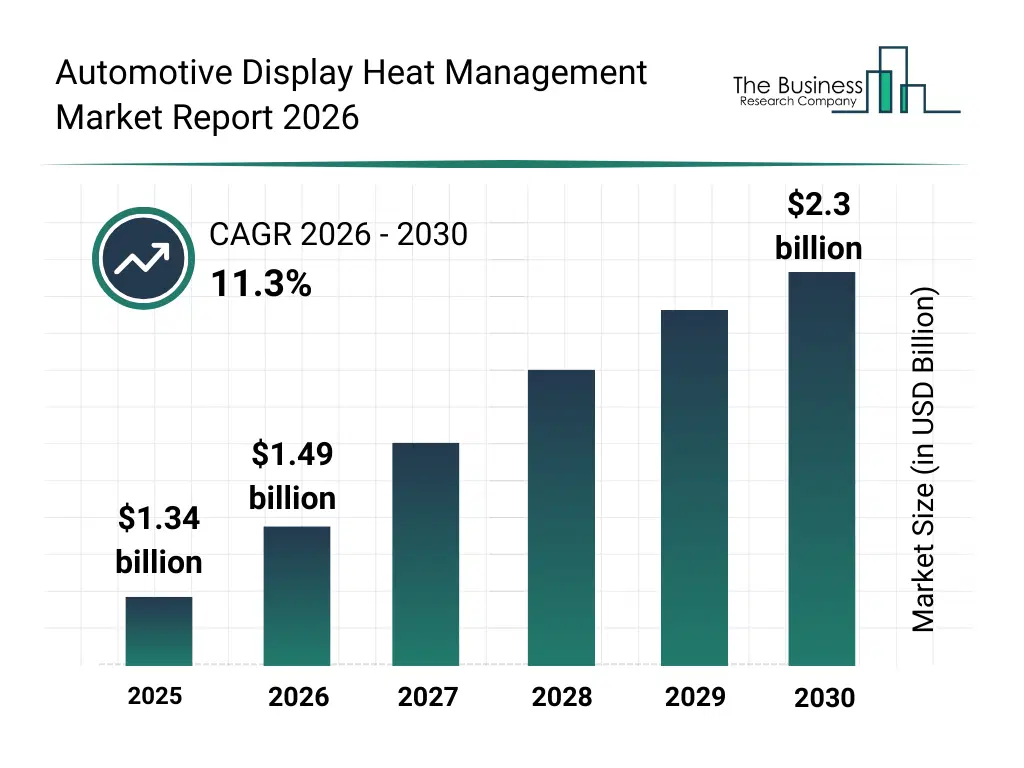
What Is The Automotive Display Heat Management Market Size and Share 2026?
The automotive display heat management market size has grown rapidly in recent years. It will grow from $1.34 billion in 2025 to $1.49 billion in 2026 at a compound annual growth rate (CAGR) of 11.6%. The growth in the historic period can be attributed to growth of in-vehicle infotainment, higher display integration, early thermal material adoption, automotive electronics expansion, cockpit digitization.What Is The Automotive Display Heat Management Market Growth Forecast?
The automotive display heat management market size is expected to see rapid growth in the next few years. It will grow to $2.3 billion in 2030 at a compound annual growth rate (CAGR) of 11.3%. The growth in the forecast period can be attributed to electric vehicle penetration, advanced display architectures, demand for long display lifespan, lightweight thermal materials, smart thermal control. Major trends in the forecast period include increasing display size and brightness, adoption of oled displays, integration of active cooling systems, demand from electric vehicles, focus on thermal reliability.
Global Automotive Display Heat Management Market Segmentation
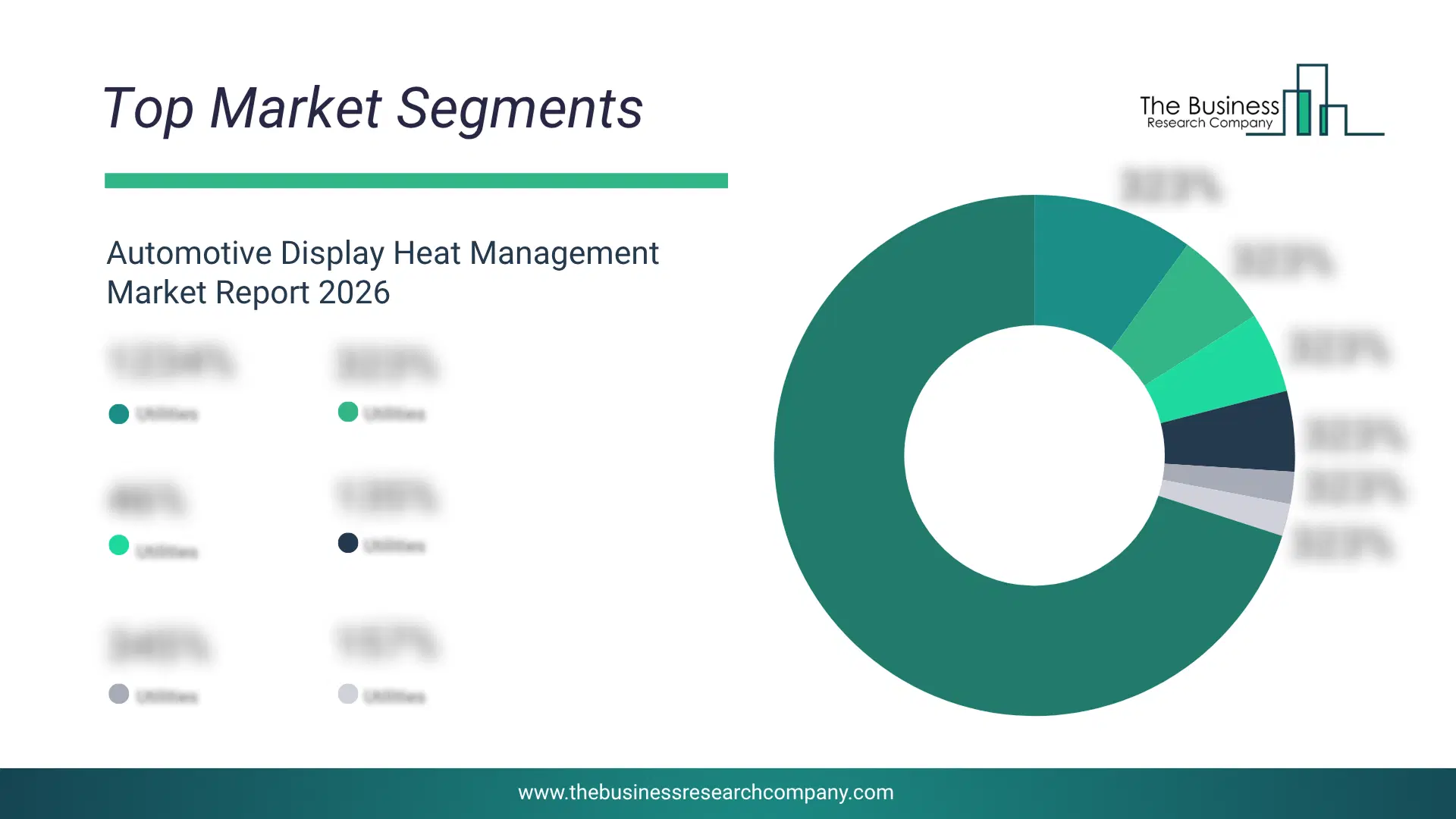
1) By Product Type: Passive Heat Management, Active Heat Management 2) By Display Type: Liquid Crystal Display (LCD), Organic Light Emitting Diode (OLED), Thin-Film Transistor (TFT), Other Displays 3) By Vehicle Type: Passenger Cars, Commercial Vehicles, Electric Vehicles 4) By Application: Instrument Cluster, Center Stack Display, Head-Up Display, Rear Seat Entertainment, Other Applications 5) By End User: Original Equipment Manufacturer (OEM), Aftermarket Subsegments: 1) By Passive Heat Management: Thermal Insulation Materials, Heat Spreaders, Reflective Coatings And Films 2) By Active Heat Management: Thermoelectric Coolers, Liquid Cooling Systems, Forced Air CoolingWhat Is The Driver Of The Automotive Display Heat Management Market?
The rising adoption of electric vehicles is expected to drive the growth of the automotive display heat management market in the future. Electric vehicles are powered by electric motors using rechargeable batteries. They offer low-emission and efficient transportation. The adoption of electric vehicles is increasing due to growing environmental concerns. These vehicles produce lower greenhouse gas emissions compared to conventional vehicles, helping reduce air pollution and combat climate change. Automotive display heat management ensures electric vehicles' displays maintain clarity, reliability, and longevity. It also protects sensitive electronics. For instance, in March 2024, according to the International Energy Agency (IEA), a France-based autonomous intergovernmental organization, sales of electric cars in 2023 were 3.5 million higher than in 2022, a 35% year-on-year increase. Therefore, the rising adoption of electric vehicles is driving the growth of the automotive display heat management industry.Key Players In The Global Automotive Display Heat Management Market
Major companies operating in the automotive display heat management market report include Samsung Display Co. Ltd., ZF Friedrichshafen AG, Denso Corporation, Dow Inc., Honeywell International Inc., 3M Company, Valeo SE, Henkel AG & Co. KGaA, LG Display Co. Ltd., Kyocera Corporation, BorgWarner Inc., DuPont, AU Optronics Corp., Visteon Corporation, Boyd Corporation, Gentherm Incorporated, Continental AG, Polymer Science Inc., Robert Bosch GmbH, Touch International Inc., Panasonic Automotive Systems Co. Ltd., Faytech AG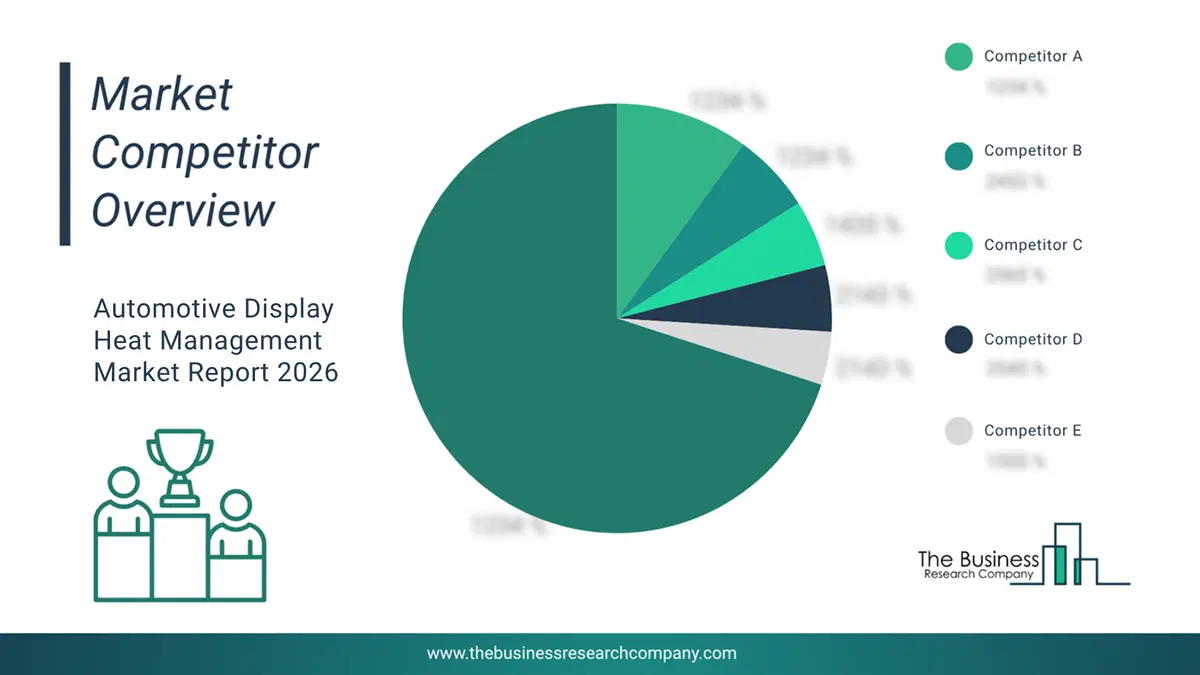
This chart is for illustrative purposes; the full report includes a detailed competitor analysis and comprehensive overview of the top 10 companies in the market.
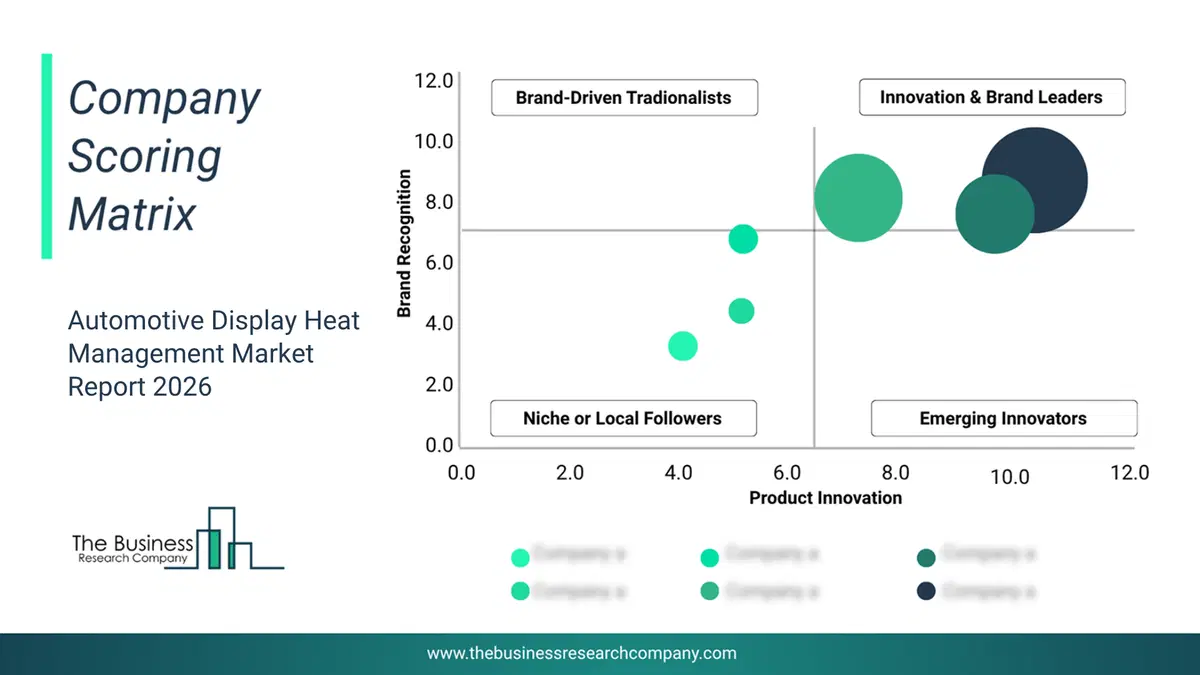
This chart maps companies by product innovation and brand strength, with bubble size indicating relative revenue, helping identify market leaders, challengers, and niche players. This is an illustrative chart; the full report provides a complete and accurate competitive analysis.
Global Automotive Display Heat Management Market Trends and Insights
Major companies operating in the automotive display heat management market are focusing on developing advanced solutions, such as interior temperature control technologies to enhance driver and passenger comfort, improve the reliability and lifespan of in-vehicle displays, prevent overheating of sensitive electronic components, and optimize energy efficiency in electric and hybrid vehicles. Interior temperature control technologies refer to systems and solutions within a vehicle that manage and regulate the temperature inside the cabin to ensure comfort, safety, and optimal performance of both passengers and electronic components. For instance, in August 2024, Hyundai Motor Company, a South Korea-based automotive manufacturer, and Kia Corporation, a South Korea-based automotive manufacturer, showcased three advanced interior temperature control technologies at ‘Heat Tech Day’ in Seoul, aimed at enhancing passenger comfort and energy efficiency. The innovations include Nano Cooling Film for cooling vehicle glass in hot weather, a Radiant Heating System for quickly warming passengers in cold conditions, and Metal-Coated Heated Glass, a 48V system that rapidly removes frost and moisture. All three technologies are ready for mass production and reflect the companies’ focus on creating comfortable, energy-efficient, and customer-centric vehicle environments in the era of electrification.What Are Latest Mergers And Acquisitions In The Automotive Display Heat Management Market?
In June 2025, Innolux Corporation, a Taiwan-based electronics company, acquired Pioneer Corporation for $1.1 billion. With this acquisition Innolux Corporation aims to quickly enter the Japanese automakers' supply chain, transform from a panel maker into a tier-1 smart cockpit system supplier, and expand its global automotive electronics presence by leveraging synergies with Pioneer’s audio and HMI expertise. Pioneer Corporation is a Japan-based manufacturing company that offers automotive display heat management.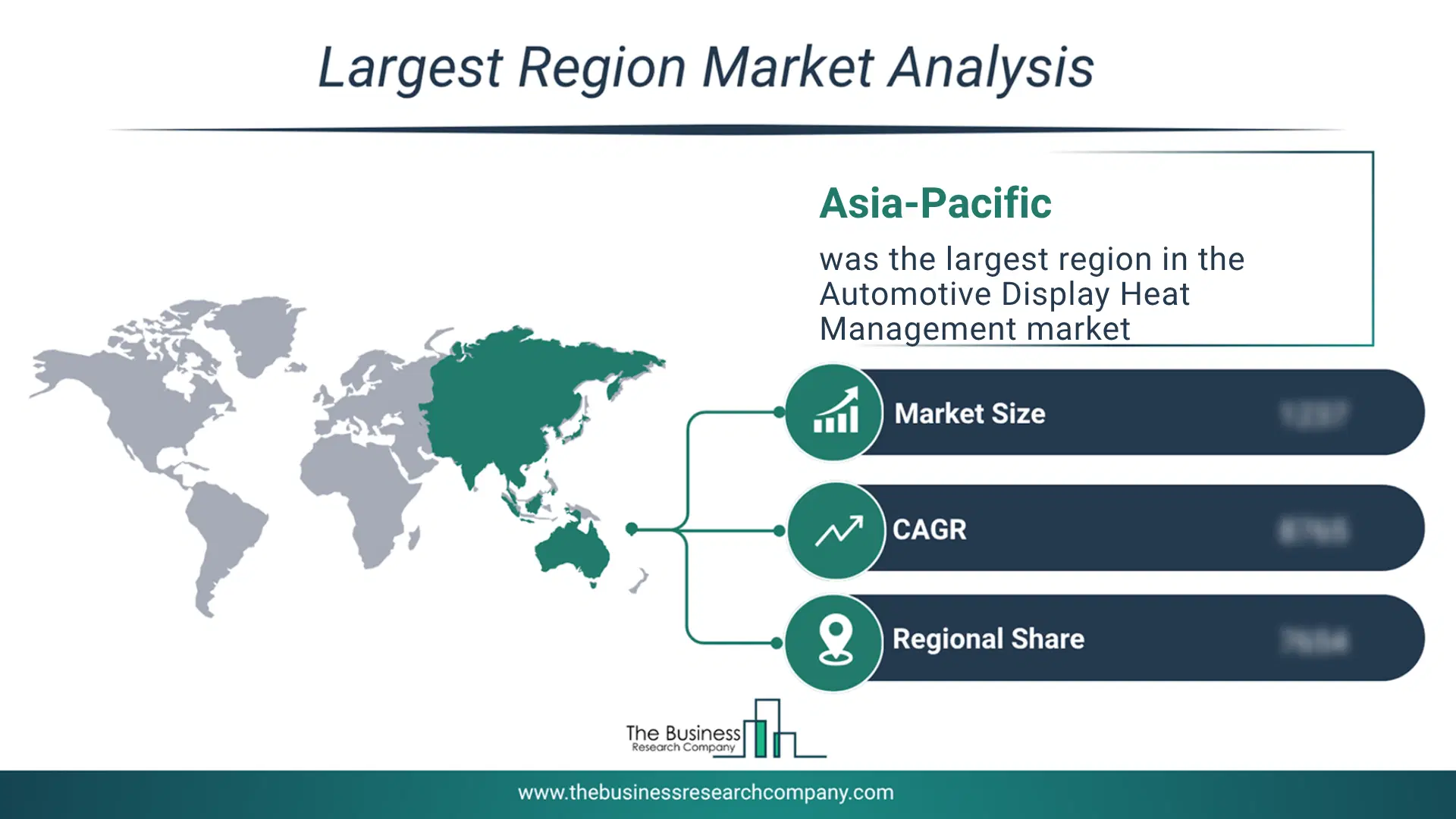
Regional Outlook
Asia-Pacific was the largest region in the automotive display heat management market in 2025. Europe is expected to be the fastest-growing region in the forecast period. The regions covered in this market report include Asia-Pacific, South East Asia, Western Europe, Eastern Europe, North America, South America, Middle East, Africa. The countries covered in this market report include Australia, Brazil, China, France, Germany, India, Indonesia, Japan, Taiwan, Russia, South Korea, UK, USA, Canada, Italy, SpainWhat Defines the Automotive Display Heat Management Market?
The automotive display heat management market consists of revenues earned by entities by providing services such as thermal analysis and simulation, custom cooling solutions design, and integration and installation support. The market value includes the value of related goods sold by the service provider or included within the service offering. The automotive display heat management market also includes sales of heat sinks, cooling fans and blowers, and temperature sensors and controllers. Values in this market are ‘factory gate’ values; that is, the value of goods sold by the manufacturers or creators of the goods, whether to other entities (including downstream manufacturers, wholesalers, distributors, and retailers) or directly to end customers. The value of goods in this market includes related services sold by the creators of the goods.How is Market Value Defined and Measured?
The market value is defined as the revenues that enterprises gain from the sale of goods and/or services within the specified market and geography through sales, grants, or donations in terms of the currency (in USD unless otherwise specified). The revenues for a specified geography are consumption values that are revenues generated by organizations in the specified geography within the market, irrespective of where they are produced. It does not include revenues from resales along the supply chain, either further along the supply chain or as part of other products.
This chart presents market attractiveness based on a quantitative evaluation of growth, competition, strategic alignment, and risk, offering a clear view of opportunity areas for decision-making. This chart is for illustrative purposes; the full report contains the complete analysis.

This chart highlights the Total Addressable Market (TAM) by estimating the maximum revenue opportunity using an assumption-driven approach, supporting strategic planning and opportunity sizing across markets. The chart is illustrative; the full report provides a more comprehensive analysis.
What Key Data and Analysis Are Included in the Automotive Display Heat Management Market Report 2026?
The automotive display heat management market research report is one of a series of new reports from The Business Research Company that provides market statistics, including industry global market size, regional shares, competitors with the market share, detailed market segments, market trends and opportunities, and any further data you may need to thrive in the automotive display heat management industry. The market research report delivers a complete perspective of everything you need, with an in-depth analysis of the current and future state of the industry.Automotive Display Heat Management Market Report Forecast Analysis
| Report Attribute | Details |
|---|---|
| Market Size Value In 2026 | $1.49 billion |
| Revenue Forecast In 2030 | $2.3 billion |
| Growth Rate | CAGR of 11.6% from 2026 to 2030 |
| Base Year For Estimation | 2025 |
| Actual Estimates/Historical Data | 2020-2025 |
| Forecast Period | 2026 - 2030 - 2030 |
| Market Representation | Revenue in USD Billion and CAGR from 2026 to 2030 |
| Segments Covered | Product Type, Display Type, Vehicle Type, Application, End User |
| Regional Scope | Asia-Pacific, Western Europe, Eastern Europe, North America, South America, Middle East, Africa |
| Country Scope | The countries covered in the report are Australia, Brazil, China, France, Germany, India, Indonesia, Japan, Taiwan, Russia, South Korea, UK, USA, Canada, Italy, Spain. |
| Key Companies Profiled | Samsung Display Co. Ltd., ZF Friedrichshafen AG, Denso Corporation, Dow Inc., Honeywell International Inc., 3M Company, Valeo SE, Henkel AG & Co. KGaA, LG Display Co. Ltd., Kyocera Corporation, BorgWarner Inc., DuPont, AU Optronics Corp., Visteon Corporation, Boyd Corporation, Gentherm Incorporated, Continental AG, Polymer Science Inc., Robert Bosch GmbH, Touch International Inc., Panasonic Automotive Systems Co. Ltd., Faytech AG |
| Customization Scope | Request for Customization |
| Pricing And Purchase Options | Explore Purchase Options |