
Automotive Electronic Controller Market Report 2026
Global Outlook – By Product Type ( Engine Control Units (ECUs), Transmission Control Units (TCUs), Body Control Modules (BCMs), Electronic Stability Control (ESC) Systems, Electronic Brake Systems (EBS), Other Products), By Vehicle Type ( Light-Duty Vehicles, Heavy Commercial Vehicles, Construction And Mining Equipment, Agricultural Tractors), By Propulsion Type ( Battery Electric Vehicles (BEVs), Hybrid Vehicles, Internal Combustion Engines Vehicles), By Application ( Advanced Driver Assistance Systems And Safety System, Body Control And Comfort System, Infotainment And Communication System, Powertrain System) – Market Size, Trends, Strategies, and Forecast to 2030
Automotive Electronic Controller Market Overview
• Automotive Electronic Controller market size has reached to $66.67 billion in 2025 • Expected to grow to $96.9 billion in 2030 at a compound annual growth rate (CAGR) of 7.8% • Growth Driver: Growing Adoption Of Electric Vehicles • Market Trend: Increasing Focus On Introducing High-performance Electronic Control Unit (ECU) To Maximize Profits • Asia-Pacific was the largest region in 2025.What Is Covered Under Automotive Electronic Controller Market?
An automotive electronic controller, or an electronic control unit (ECU) is a microprocessor-based device that manages and controls various electrical and electronic systems within a vehicle, such as engine performance, safety features, and entertainment systems. It is controlled by embedded software and is crucial to enhancing vehicle functionality, efficiency, and safety. The main types of products included in automotive electronic controllers are engine control units (ECUs), transmission control units (TCUs), body control modules (BCMs), electronic stability control (ESC) systems, electronic brake systems (EBS), and others. An engine control unit (ECU) is an embedded system in automotive electronics that controls one or more of the electrical systems or subsystems in a car or other motor vehicle. These are used in various types of vehicles, including light-duty vehicles, heavy commercial vehicles, construction and mining equipment, and agricultural tractors, of several propulsion types, such as battery electric vehicles (BEVs), hybrid vehicles, and internal combustion engine vehicles. These are used for numerous applications, including advanced driver assistance systems and safety systems, body control and comfort systems, infotainment and communication systems, and powertrain systems.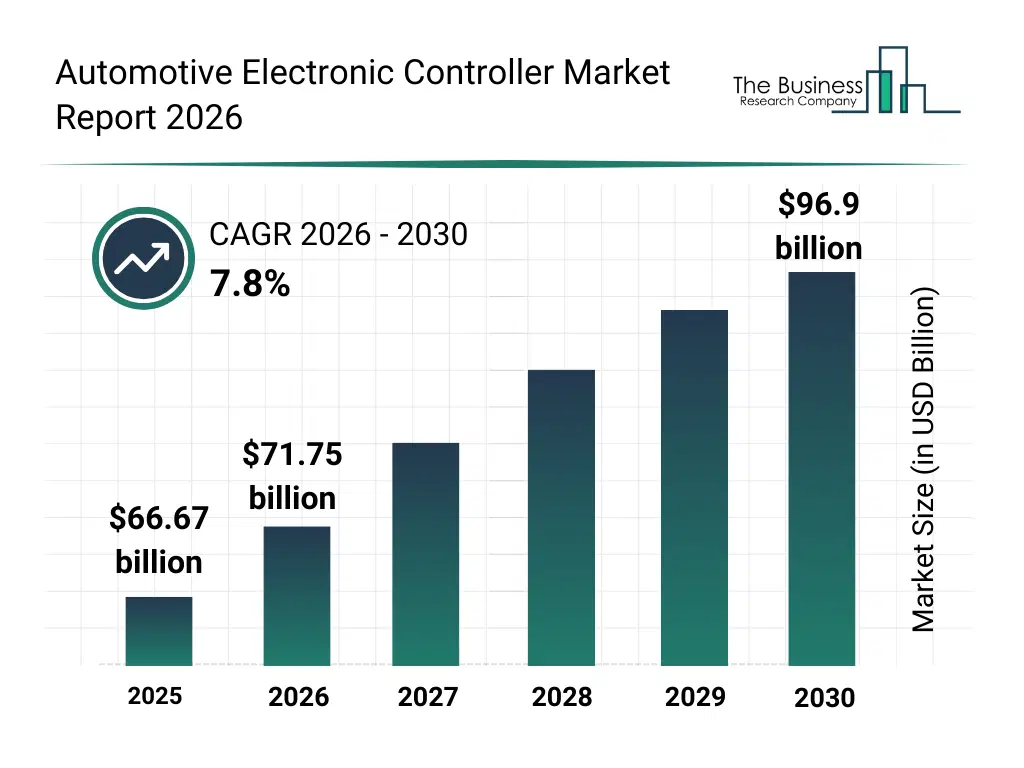
What Is The Automotive Electronic Controller Market Size 2026 And Growth Rate?
The automotive electronic controller market size has grown strongly in recent years. It will grow from $66.67 billion in 2025 to $71.75 billion in 2026 at a compound annual growth rate (CAGR) of 7.6%. The growth in the historic period can be attributed to growing adoption of electronic safety systems, rise of electronic controlled engine management, increased installation of infotainment modules, early integration of body control electronics, expansion of automotive electronics manufacturing.What Is The Automotive Electronic Controller Market Growth Forecast?
The automotive electronic controller market size is expected to see strong growth in the next few years. It will grow to $96.9 billion in 2030 at a compound annual growth rate (CAGR) of 7.8%. The growth in the forecast period can be attributed to shift toward autonomous driving technologies, increasing penetration of bev and hybrid vehicles, growing need for cybersecurity in vehicle electronics, rising demand for high speed communication networks in vehicles, expansion of advanced powertrain control systems. Major trends in the forecast period include adoption of AI enabled automotive control systems, rising use of connected and networked ecu architectures, increasing demand for advanced powertrain electronic modules, growth in safety critical electronic control applications, integration of high performance embedded processing in vehicles.
Global Automotive Electronic Controller Market Segmentation
1) By Product Type: Engine Control Units (ECUs), Transmission Control Units (TCUs), Body Control Modules (BCMs), Electronic Stability Control (ESC) Systems, Electronic Brake Systems (EBS), Other Products 2) By Vehicle Type: Light-Duty Vehicles, Heavy Commercial Vehicles, Construction And Mining Equipment, Agricultural Tractors 3) By Propulsion Type: Battery Electric Vehicles (BEVs), Hybrid Vehicles, Internal Combustion Engines Vehicles 4) By Application: Advanced Driver Assistance Systems And Safety System, Body Control And Comfort System, Infotainment And Communication System, Powertrain System Subsegments: 1) By Engine Control Units (ECUs): Powertrain ECUs, Fuel Management ECUs, Ignition ECUs 2) By Transmission Control Units (TCUs): Automatic Transmission TCUs, Manual Transmission TCUs 3) By Body Control Modules (BCMs): Lighting Control Modules, Window And Door Control Modules, Climate Control Modules 4) By Electronic Stability Control (ESC) Systems: Sensor-based ESC Systems, Brake-Based ESC Systems 5) By Electronic Brake Systems (EBS): Anti-lock Braking System (ABS), Electronic Brake-force Distribution (EBD), Brake Assist Systems 6) By Other Product: Advanced Driver Assistance Systems (ADAS) Controllers, Battery Management Systems (BMS), Charging Control UnitsWhat Is The Driver Of The Automotive Electronic Controller Market?
The growing adoption of electric vehicles is expected to propel the growth of the automotive electronic controller market going forward. Electric vehicles (EVs) are vehicles powered by electricity stored in batteries or other energy storage systems, eliminating the need for internal combustion engines. Automotive electronic controllers in electric vehicles (EVs) manage power distribution and optimize battery performance, enhancing overall efficiency and range while enabling advanced features like regenerative braking. For instance, in July 2023, according to the International Energy Agency, a France-based intergovernmental organization, sales of electric vehicles were 10 million in 2022, and there will be an increase to 14 million sales of electric vehicles in 2023. Therefore, the growing adoption of electric vehicles is driving the growth of the automotive electronic controller industry.Key Players In The Global Automotive Electronic Controller Market
Major companies operating in the automotive electronic controller market are Robert Bosch GmbH, Hitachi Automotive Systems Ltd., Panasonic Corporation, DENSO Corporation, Continental AG, ZF Friedrichshafen AG, HyundAI Mobis Co. Ltd, Toshiba Electronic Devices & Storage Corporation, Lear Corporation, Texas Instruments Incorporated, Nidec Motors and Actuators Inc., TE Connectivity Ltd., STMicroelectronics N.V., BorgWarner Inc., Infineon Technologies AG, NXP Semiconductors N.V., Renesas Electronics Corporation, Amphenol Corporation, Analog Devices Inc., ON Semiconductor Corporation, Microchip Technology Inc., Omron Corporation, Vishay Intertechnology Inc., Sanken Electric Co. Ltd., Diodes Incorporated, Melexis N.V., Magneti Marelli S.p.A., Pektron Group Limited, HGM Automotive Electronics Inc.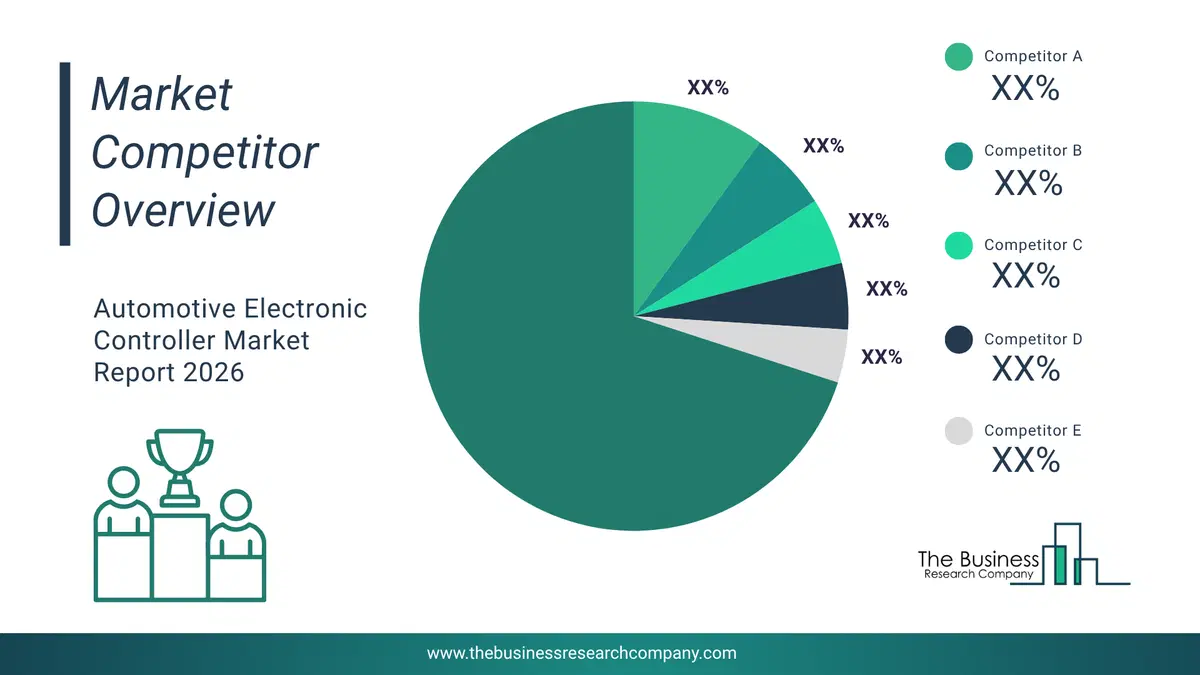
This chart is for illustrative purposes; the full report includes a detailed competitor analysis and comprehensive overview of the top 10 companies in the market.
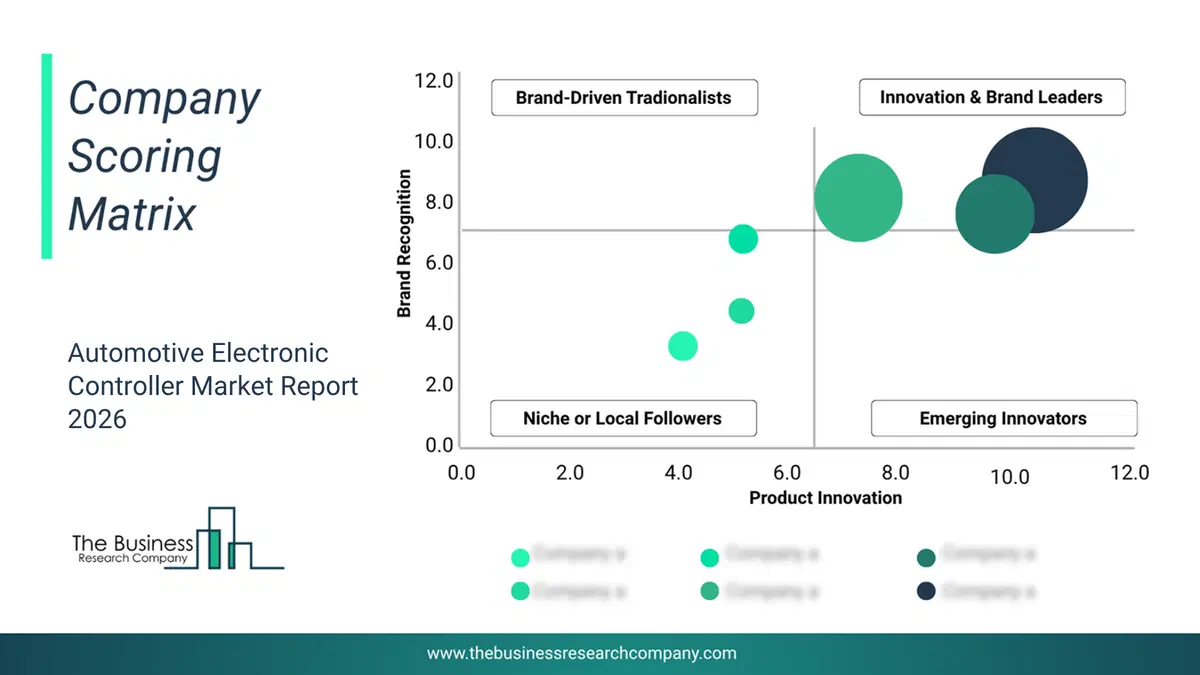
This chart maps companies by product innovation and brand strength, with bubble size indicating relative revenue, helping identify market leaders, challengers, and niche players. This is an illustrative chart; the full report provides a complete and accurate competitive analysis.
Global Automotive Electronic Controller Market Trends and Insights
Major companies operating in the automotive electronic controller market are increasing their focus on developing a high-performance electronic control unit (ECU) to maximize their profits in the market. A high-performance electronic control unit (ECU) is a specialized computer that efficiently manages and optimizes various functions in vehicles or industrial systems, delivering exceptional speed and precision in real-time operations. For instance, in April 2023, TTTech Auto AG, an Austria-based provider of car safety solutions, launched the N4 Network Controller, a high-performance electronic control unit (ECU) with advanced networking capabilities. The N4 electronic control unit is equipped with advanced networking features that enable it to support the latest automotive communication protocols, including Ethernet, CAN FD (controller area network flexible data rate), and FlexRay. This electronic control unit (ECU) is designed to meet the increasing demand for high-bandwidth communication in modern vehicles, which require more advanced driver assistance systems, infotainment, and other features.What Are Latest Mergers And Acquisitions In The Automotive Electronic Controller Market?
In June 2025, NXP Semiconductors, a Netherlands-based manufacturer of automotive electronic controllers, entered into a strategic partnership with Rimac Technology Co. to simplify vehicle electronics for smarter, software-defined mobility. The partnership aims to co-develop a centralized vehicle architecture that consolidates multiple ECUs, enhances computational power, and enables scalable, secure, and efficient software-defined vehicle solutions. Rimac Technology Co. is a Croatia-based provider of high-performance electric vehicle technologies, battery systems, and advanced vehicle control solutions.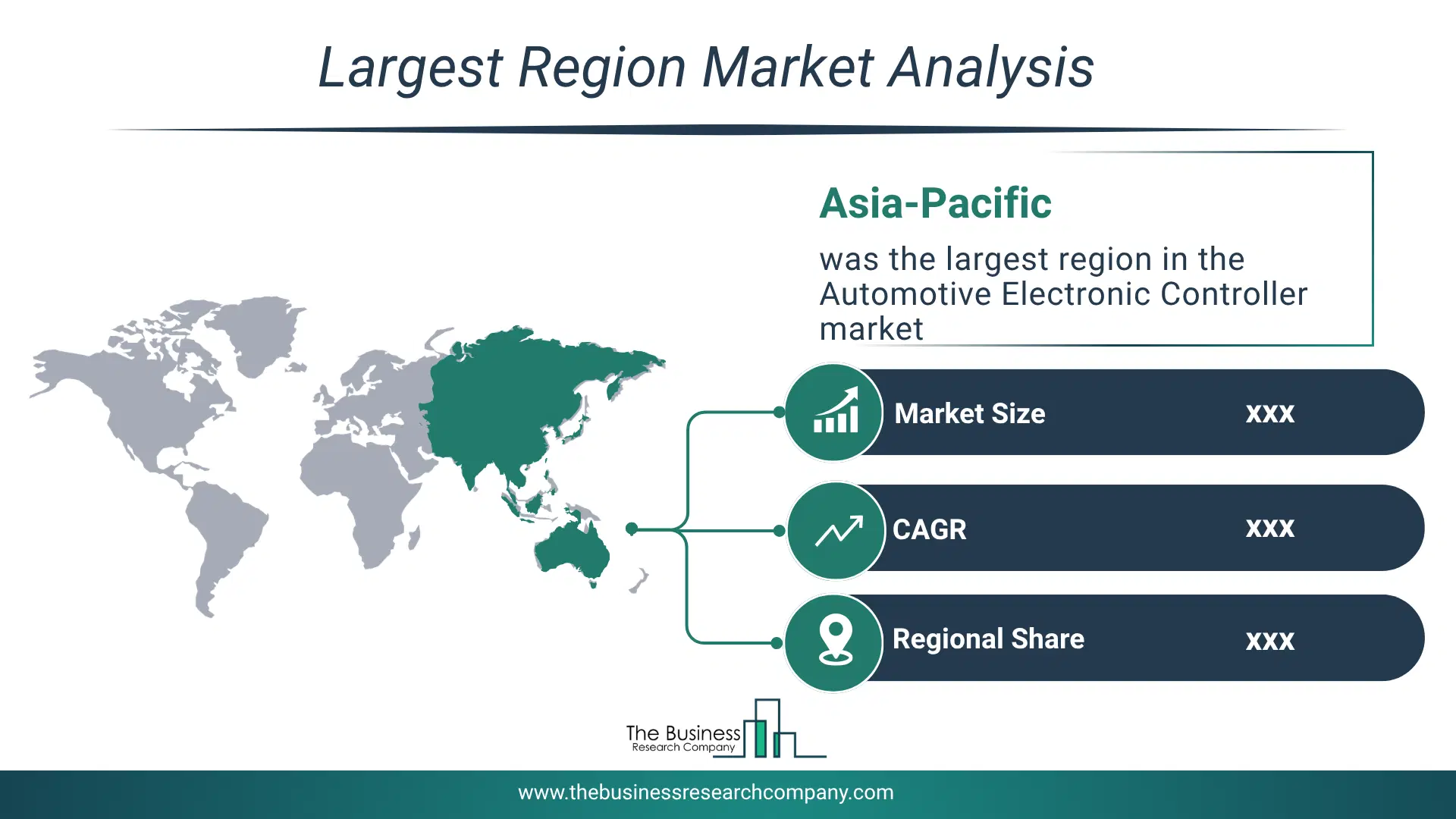
Regional Outlook
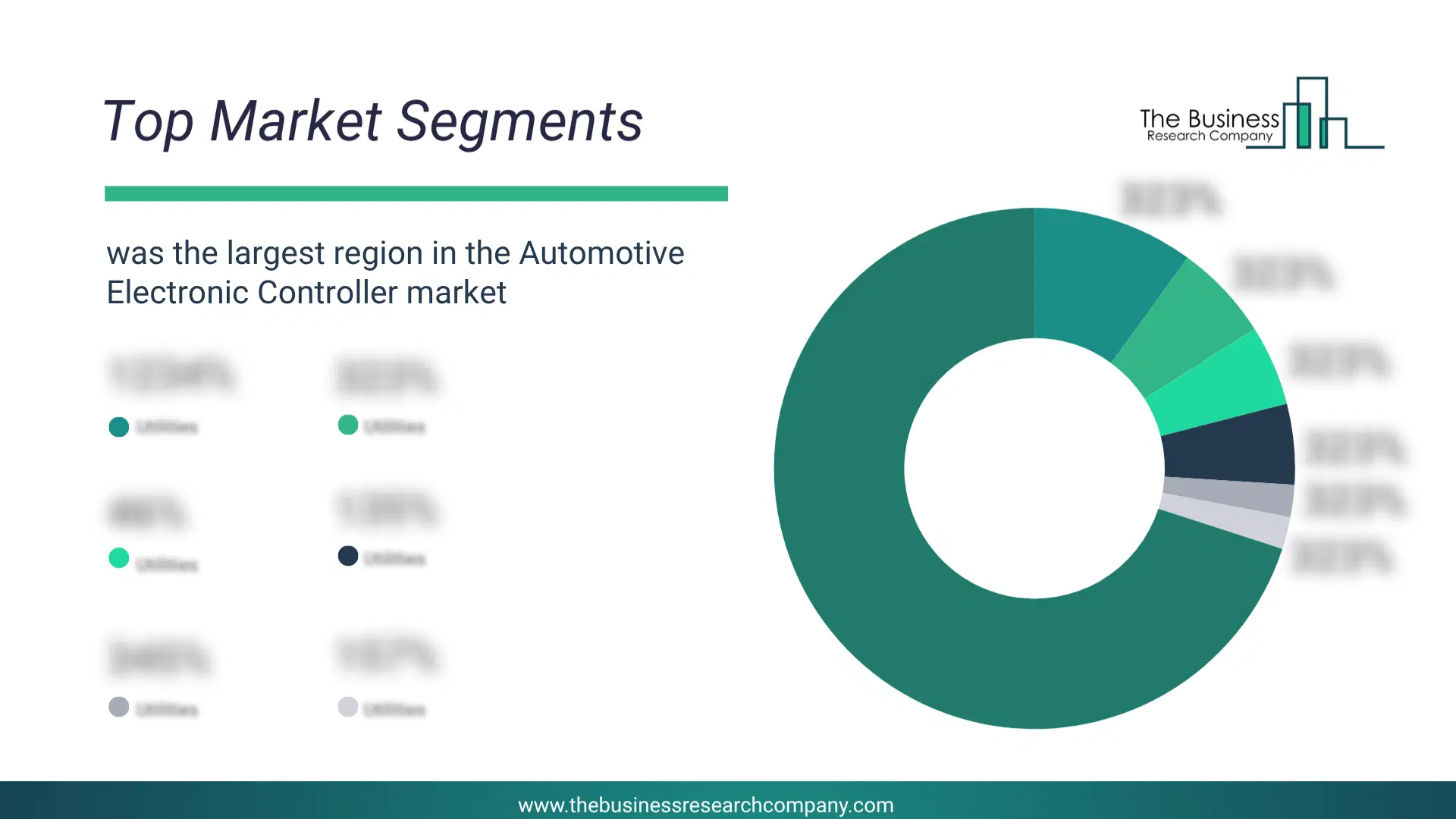
Asia-Pacific was the largest region in the automotive electronic controller market in 2025. The regions covered in this market report are Asia-Pacific, South East Asia, Western Europe, Eastern Europe, North America, South America, Middle East, Africa. The countries covered in this market report are Australia, Brazil, China, France, Germany, India, Indonesia, Japan, Taiwan, Russia, South Korea, UK, USA, Canada, Italy, Spain.What Defines the Automotive Electronic Controller Market?
The automotive electronic controller market consists of sales of airbag control modules (ACM), climate control modules, fuel injection control modules, ignition control modules, and adaptive cruise control modules. Values in this market are ‘factory gate’ values, that is, the value of goods sold by the manufacturers or creators of the goods, whether to other entities (including downstream manufacturers, wholesalers, distributors, and retailers) or directly to end customers. The value of goods in this market includes related services sold by the creators of the goods.How is Market Value Defined and Measured?
The market value is defined as the revenues that enterprises gain from the sale of goods and/or services within the specified market and geography through sales, grants, or donations in terms of the currency (in USD unless otherwise specified). The revenues for a specified geography are consumption values that are revenues generated by organizations in the specified geography within the market, irrespective of where they are produced. It does not include revenues from resales along the supply chain, either further along the supply chain or as part of other products.
This chart presents market attractiveness based on a quantitative evaluation of growth, competition, strategic alignment, and risk, offering a clear view of opportunity areas for decision-making. This chart is for illustrative purposes; the full report contains the complete analysis.

This chart highlights the Total Addressable Market (TAM) by estimating the maximum revenue opportunity using an assumption-driven approach, supporting strategic planning and opportunity sizing across markets. The chart is illustrative; the full report provides a more comprehensive analysis.
What Key Data and Analysis Are Included in the Automotive Electronic Controller Market Report 2026?
The automotive electronic controller market research report is one of a series of new reports from The Business Research Company that provides market statistics, including industry global market size, regional shares, competitors with the market share, detailed market segments, market trends and opportunities, and any further data you may need to thrive in the automotive electronic controller industry. The market research report delivers a complete perspective of everything you need, with an in-depth analysis of the current and future state of the industry.Automotive Electronic Controller Market Report Forecast Analysis
| Report Attribute | Details |
|---|---|
| Market Size Value In 2026 | $71.75 billion |
| Revenue Forecast In 2030 | $96.9 billion |
| Growth Rate | CAGR of 7.8% from 2026 to 2030 |
| Base Year For Estimation | 2025 |
| Actual Estimates/Historical Data | 2020-2025 |
| Forecast Period | 2026 - 2030 |
| Market Representation | Revenue in USD Billion and CAGR from 2026 to 2030 |
| Segments Covered | Product Type, Vehicle Type, Propulsion Type, Application |
| Regional Scope | Asia-Pacific, Western Europe, Eastern Europe, North America, South America, Middle East, Africa |
| Country Scope | The countries covered in the report are Australia, Brazil, China, France, Germany, India, Indonesia, Japan, Taiwan, Russia, South Korea, UK, USA, Canada, Italy, Spain. |
| Key Companies Profiled | Robert Bosch GmbH, Hitachi Automotive Systems Ltd., Panasonic Corporation, DENSO Corporation, Continental AG, ZF Friedrichshafen AG, HyundAI Mobis Co. Ltd, Toshiba Electronic Devices & Storage Corporation, Lear Corporation, Texas Instruments Incorporated, Nidec Motors and Actuators Inc., TE Connectivity Ltd., STMicroelectronics N.V., BorgWarner Inc., Infineon Technologies AG, NXP Semiconductors N.V., Renesas Electronics Corporation, Amphenol Corporation, Analog Devices Inc., ON Semiconductor Corporation, Microchip Technology Inc., Omron Corporation, Vishay Intertechnology Inc., Sanken Electric Co. Ltd., Diodes Incorporated, Melexis N.V., Magneti Marelli S.p.A., Pektron Group Limited, HGM Automotive Electronics Inc. |
| Customization Scope | Request for Customization |
| Pricing And Purchase Options | Explore Purchase Options |