

Automotive Engine Oil Market Report 2026
Global Outlook – By Grade (Mineral, Synthetic, Semi-Synthetic), By Engine (Gasoline, Diesel), By Technology (Premium Conventional Engine Oil, Full Synthetic Engine Oil, Synthetic Blend Engine Oil, Higher Mileage Engine Oil), By Application (Passenger Vehicles, LCV, HCV, Two-Wheelers, Other Applications) – Market Size, Trends, Strategies, and Forecast to 2030
Automotive Engine Oil Market Overview
• Automotive Engine Oil market size has reached to $45.56 billion in 2025 • Expected to grow to $58.81 billion in 2030 at a compound annual growth rate (CAGR) of 5.3% • Growth Driver: SMEs’ Demand For Carrier Vehicles Fuels The Automotive Engine Oil Market • Market Trend: Launching Advanced Engine Oil Products To Meet Modern Vehicle Needs • Asia-Pacific was the largest region in 2025.What Is Covered Under Automotive Engine Oil Market?
Automotive engine oil is a type of oil used to lubricate the engine and other internal engine parts of a vehicle. For an engine to run smoothly throughout time, automotive engine oil performs a variety of functions such as lubrication, cleaning, cooling, and so on. The automotive engine oil is used to reduce friction between the engine parts and cool down the automotive engine. The main grades of automotive engine oil are mineral, synthetic, and semi-synthetic. Mineral oil refers to conventional petroleum oil that has been processed to work well throughout a wide temperature range and is suitable for general commuter use. The different engines include gasoline, diesel, and alternative fuels that are operated using various technologies, including premium conventional engine oil, fully synthetic engine oil, synthetic blend engine oil, and higher mileage engine oil. It is used in numerous applications, such as passenger vehicles, LCV, HCV, two-wheelers, and others.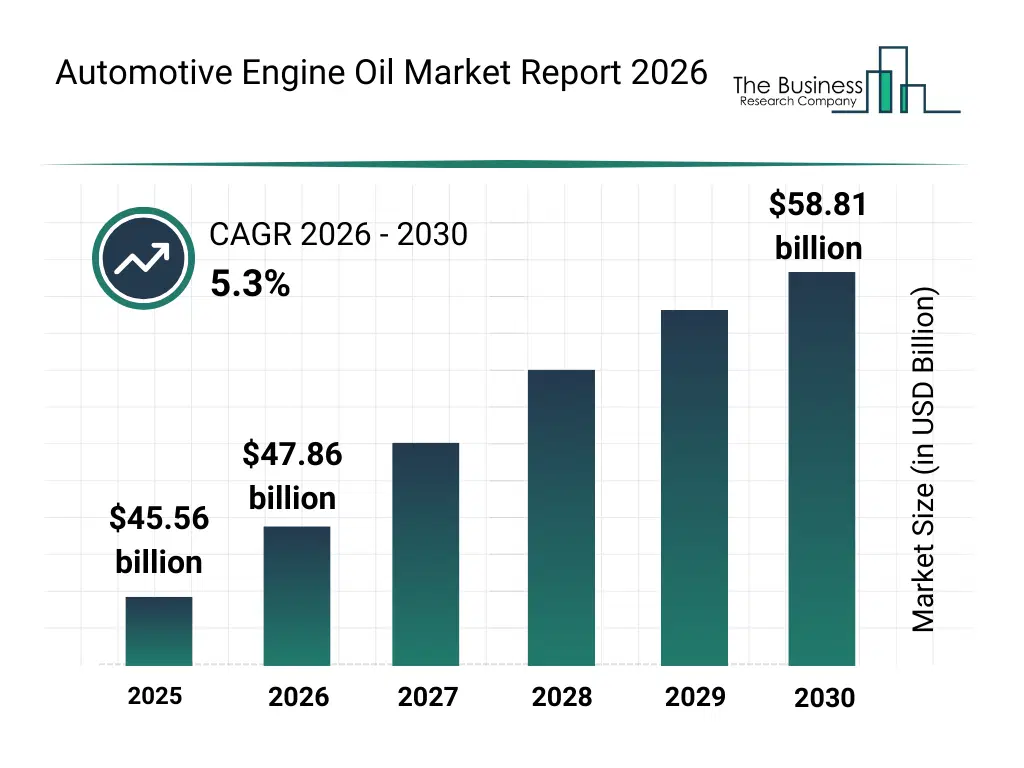
What Is The Automotive Engine Oil Market Size and Share 2026?
The automotive engine oil market size has grown strongly in recent years. It will grow from $45.56 billion in 2025 to $47.86 billion in 2026 at a compound annual growth rate (CAGR) of 5.0%. The growth in the historic period can be attributed to growth in vehicle parc, routine vehicle maintenance demand, dominance of internal combustion engines, expansion of aftermarket servicing, lubricant brand penetration.What Is The Automotive Engine Oil Market Growth Forecast?
The automotive engine oil market size is expected to see strong growth in the next few years. It will grow to $58.81 billion in 2030 at a compound annual growth rate (CAGR) of 5.3%. The growth in the forecast period can be attributed to low-emission lubricant formulations, electric vehicle fluid requirements, stricter fuel efficiency norms, growth of premium lubricants, sustainability-driven oil innovation. Major trends in the forecast period include shift toward synthetic and low-viscosity oils, demand for extended drain intervals, growth of high-mileage engine oils, expansion of ev-compatible fluids, focus on engine protection.
Global Automotive Engine Oil Market Segmentation
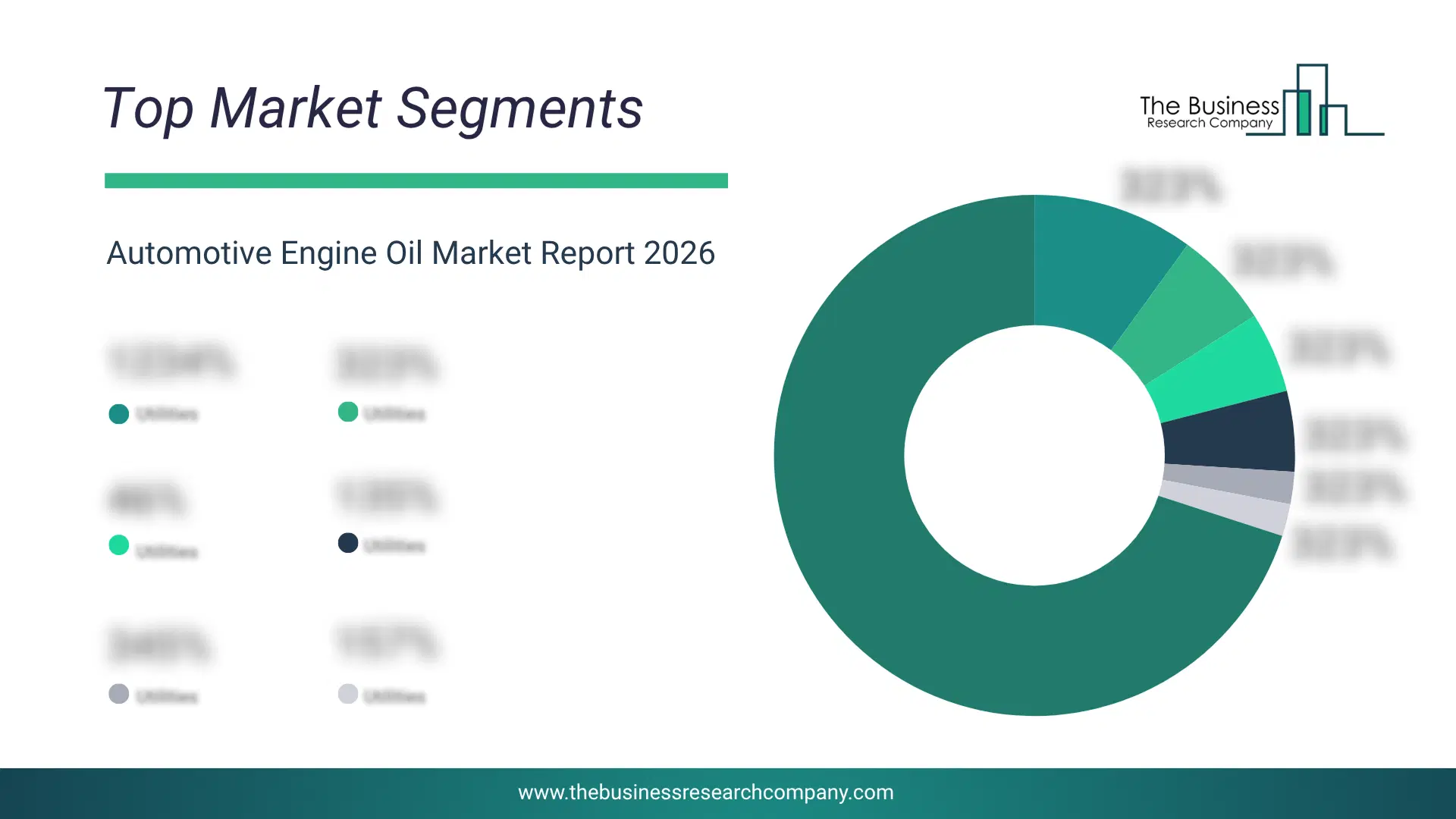
1) By Grade: Mineral, Synthetic, Semi-Synthetic 2) By Engine: Gasoline, Diesel 3) By Technology: Premium Conventional Engine Oil, Full Synthetic Engine Oil, Synthetic Blend Engine Oil, Higher Mileage Engine Oil 4) By Application: Passenger Vehicles, LCV, HCV, Two-Wheelers, Other Applications Subsegments: 1) By Mineral: Conventional Mineral Oil, Additive-Enhanced Mineral Oil 2) By Synthetic: Full Synthetic Oil, Group IV (PAO) Synthetic Oil, Group V Synthetic Oil 3) By Semi-Synthetic: Synthetic Blend Oil, Partial Synthetic OilWhat Is The Driver Of The Automotive Engine Oil Market?
The increasing demand for carrier vehicles from small and medium-scale enterprises is significantly driving the growth of the automotive engine oil market. The carrier vehicles are lightweight commercial vehicles used to carry goods. The production of lightweight commercial vehicles is increasing globally. This incremental increase in the production of light commercial vehicles (carrier vehicles) will invariably increase the demand for automotive engine oil to be used in them. For instance, in August 2025, according to the American Trucking Associations (ATA), a US-based national trade association for the trucking industry, in 2024, U.S. domestic truck freight shipments totaled an estimated 11.27 billion tons, representing only primary shipments. In 2023, the country had 14.89 million registered trucks, including both single-unit and combination vehicles, which accounted for 5% of all registered motor vehicles.Therefore, the increasing demand for carrier vehicles is promoting the growth of the automotive engine oil industry.Key Players In The Global Automotive Engine Oil Market
Major companies operating in the automotive engine oil market report include Exxon Mobil Corporation, Valvoline Inc., Fuchs Petrolub SE, Castrol Ltd., Shell plc, Chevron Corporation, BP plc, TotalEnergies SE, Sinopec Group, Motul SA, Petroliam Nasional Berhad, Pentagon Lubricants, Eni SpA, Hinduja Group, Saudi Arabian Oil Co., PetroChina Company Limited, Idemitsu Kosan Co. Ltd., JXTG Nippon Oil & Energy Corporation, Lukoil Oil Company, Phillips 66 Company, Indian Oil Corporation Limited, Hindustan Petroleum Corporation Limited, Bharat Petroleum Corporation Limited, Petronas Lubricants International Sdn Bhd, Caltex Australia Petroleum Pty Ltd., SK Lubricants Co. Ltd., Repsol SA, PTT Public Company Limited, PT Pertamina, Gazprom Neft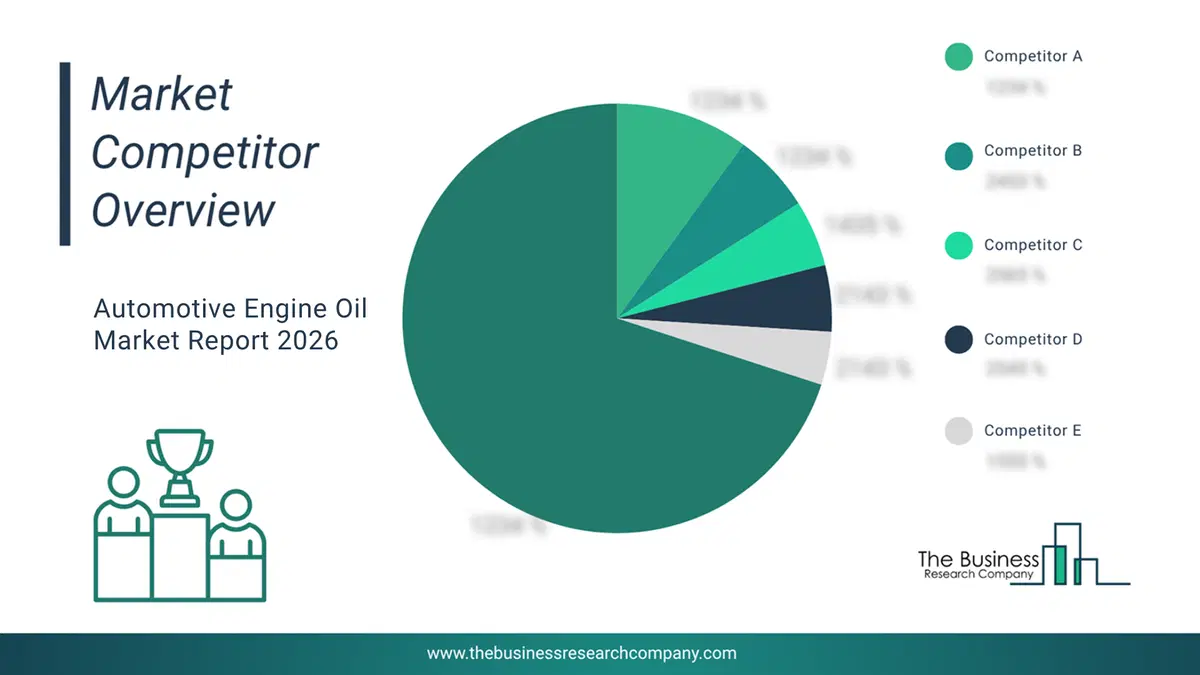
This chart is for illustrative purposes; the full report includes a detailed competitor analysis and comprehensive overview of the top 10 companies in the market.
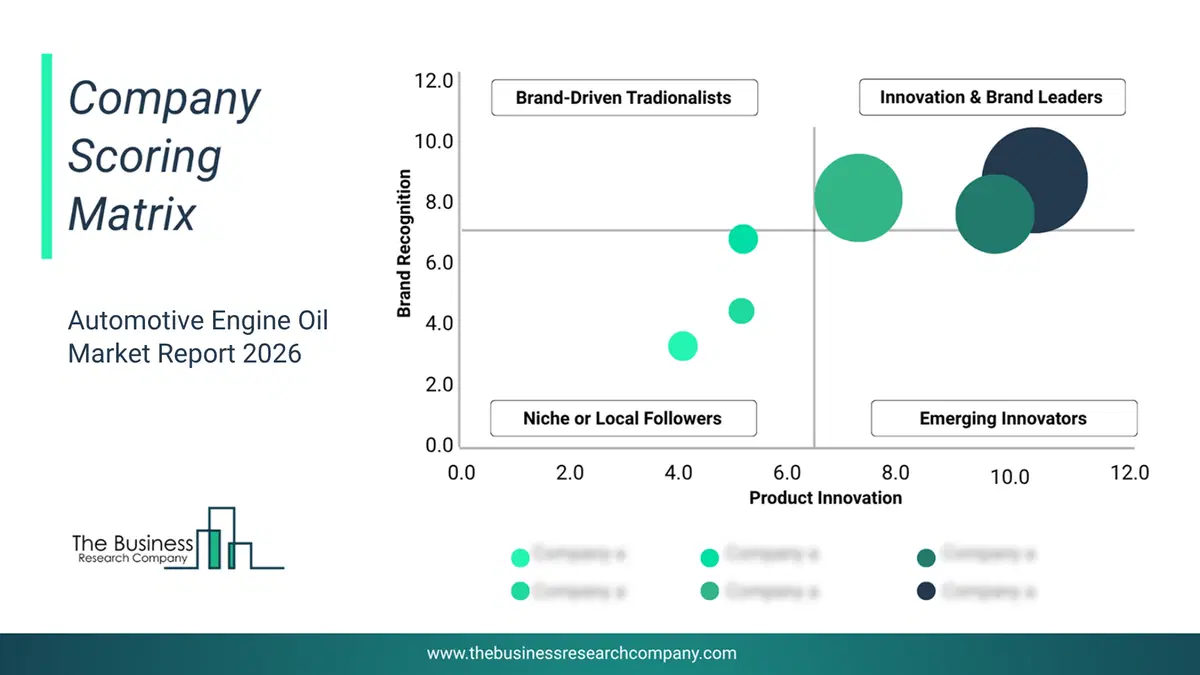
This chart maps companies by product innovation and brand strength, with bubble size indicating relative revenue, helping identify market leaders, challengers, and niche players. This is an illustrative chart; the full report provides a complete and accurate competitive analysis.
Global Automotive Engine Oil Market Trends and Insights
Major companies operating in the automotive engine oil market are focusing on the development of innovative products to satisfy increasing demand from passenger cars and commercial vehicles. Companies in the market are launching engine oil that is compliant with the latest norms and caters to all new generations of engines. For example, in April 2023, Brakes India, an India-based supplier of braking systems, launched the engine oil Revia. Revia 15W40 CK4 engine oil is compliant with the latest BS6 (Bharat Stage 6) norms and caters to all new generation engines. Advanced additives in Revia engine oil, like HyperZDP technology for passenger cars and turbo boosters for commercial vehicles, boost engine longevity and performance.What Are Latest Mergers And Acquisitions In The Automotive Engine Oil Market?
In May 2023, AMSOIL INC., a US based synthetic lubricant technology company, acquired Milwaukee-based Benz Oil for an undisclosed amount. Benz Oil will become part of AMSOIL and the AMSOIL Industrial business unit. Milwaukee-based Benz Oil is a US based company that specializes in the development, manufacture and supply of industrial and metalworking fluids.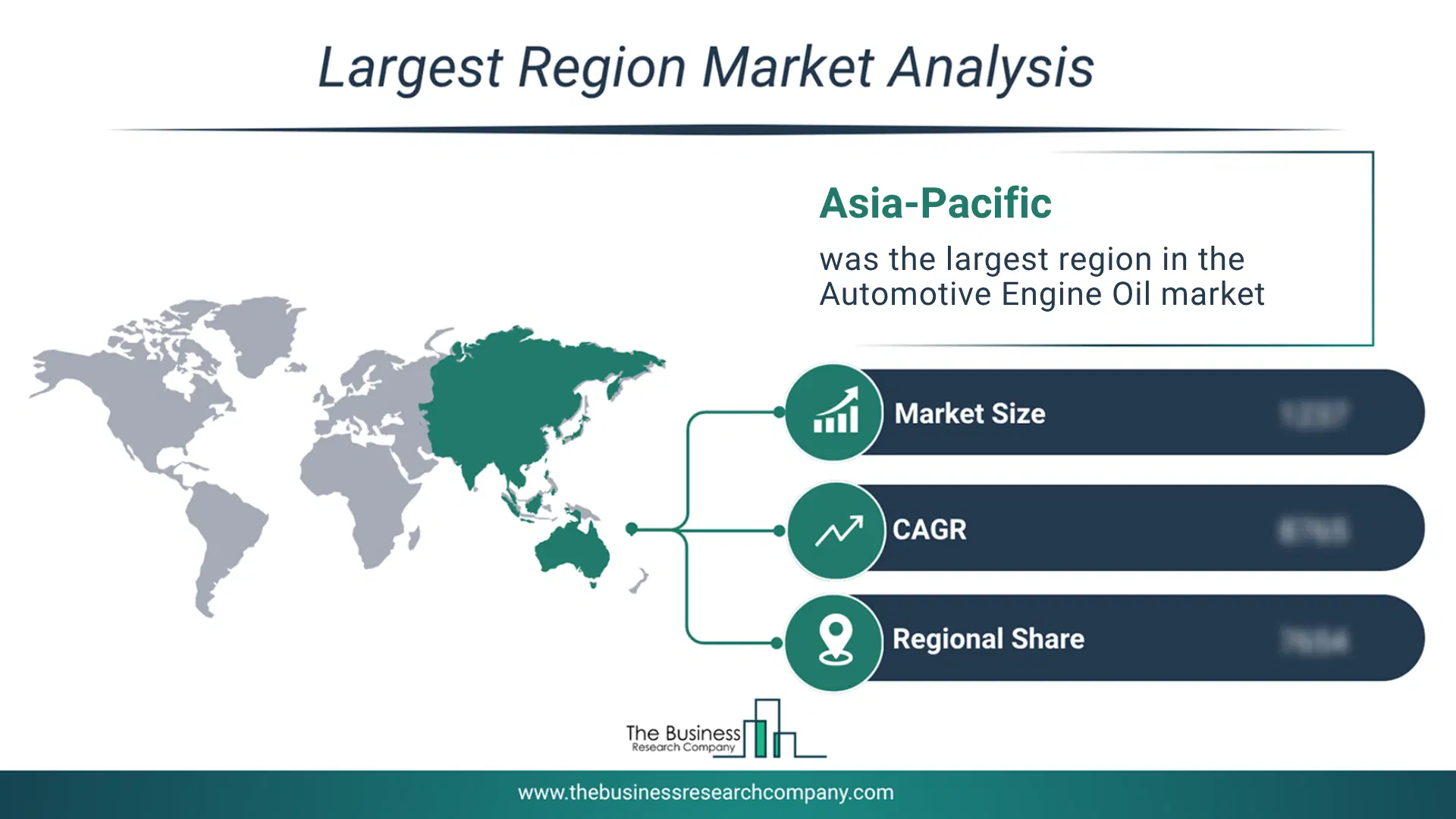
Regional Outlook
Asia-Pacific was the largest region in the automotive engine oil market in 2025. The regions covered in this market report include Asia-Pacific, South East Asia, Western Europe, Eastern Europe, North America, South America, Middle East, Africa. The countries covered in this market report include Australia, Brazil, China, France, Germany, India, Indonesia, Japan, Taiwan, Russia, South Korea, UK, USA, Canada, Italy, SpainWhat Defines the Automotive Engine Oil Market?
The automotive engine oil market consists of sales of conventional motor oil, high-mileage engine oil, synthetic motor oil, and synthetic blend motor oil. Values in this market are ‘factory gate’ values, that is the value of goods sold by the manufacturers or creators of the goods, whether to other entities (including downstream manufacturers, wholesalers, distributors and retailers) or directly to end customers. The value of goods in this market includes related services sold by the creators of the goods.How is Market Value Defined and Measured?
The market value is defined as the revenues that enterprises gain from the sale of goods and/or services within the specified market and geography through sales, grants, or donations in terms of the currency (in USD unless otherwise specified). The revenues for a specified geography are consumption values that are revenues generated by organizations in the specified geography within the market, irrespective of where they are produced. It does not include revenues from resales along the supply chain, either further along the supply chain or as part of other products.
This chart presents market attractiveness based on a quantitative evaluation of growth, competition, strategic alignment, and risk, offering a clear view of opportunity areas for decision-making. This chart is for illustrative purposes; the full report contains the complete analysis.

This chart highlights the Total Addressable Market (TAM) by estimating the maximum revenue opportunity using an assumption-driven approach, supporting strategic planning and opportunity sizing across markets. The chart is illustrative; the full report provides a more comprehensive analysis.
What Key Data and Analysis Are Included in the Automotive Engine Oil Market Report 2026?
The automotive engine oil market research report is one of a series of new reports from The Business Research Company that provides market statistics, including industry global market size, regional shares, competitors with the market share, detailed market segments, market trends and opportunities, and any further data you may need to thrive in the automotive engine oil industry. The market research report delivers a complete perspective of everything you need, with an in-depth analysis of the current and future state of the industry.Automotive Engine Oil Market Report Forecast Analysis
| Report Attribute | Details |
|---|---|
| Market Size Value In 2026 | $47.86 billion |
| Revenue Forecast In 2030 | $58.81 billion |
| Growth Rate | CAGR of 5.0% from 2026 to 2030 |
| Base Year For Estimation | 2025 |
| Actual Estimates/Historical Data | 2020-2025 |
| Forecast Period | 2026 - 2030 - 2030 |
| Market Representation | Revenue in USD Billion and CAGR from 2026 to 2030 |
| Segments Covered | Grade, Engine, Technology, Application |
| Regional Scope | Asia-Pacific, Western Europe, Eastern Europe, North America, South America, Middle East, Africa |
| Country Scope | The countries covered in the report are Australia, Brazil, China, France, Germany, India, Indonesia, Japan, Taiwan, Russia, South Korea, UK, USA, Canada, Italy, Spain. |
| Key Companies Profiled | Exxon Mobil Corporation, Valvoline Inc., Fuchs Petrolub SE, Castrol Ltd., Shell plc, Chevron Corporation, BP plc, TotalEnergies SE, Sinopec Group, Motul SA, Petroliam Nasional Berhad, Pentagon Lubricants, Eni SpA, Hinduja Group, Saudi Arabian Oil Co., PetroChina Company Limited, Idemitsu Kosan Co. Ltd., JXTG Nippon Oil & Energy Corporation, Lukoil Oil Company, Phillips 66 Company, Indian Oil Corporation Limited, Hindustan Petroleum Corporation Limited, Bharat Petroleum Corporation Limited, Petronas Lubricants International Sdn Bhd, Caltex Australia Petroleum Pty Ltd., SK Lubricants Co. Ltd., Repsol SA, PTT Public Company Limited, PT Pertamina, Gazprom Neft |
| Customization Scope | Request for Customization |
| Pricing And Purchase Options | Explore Purchase Options |