

Automotive Exterior Trim Parts Market Report 2026
Global Outlook – By Type (Bumpers, Grilles, Spoilers, Mirror Covers, Door Handles, Fender Flares, Mud Flaps, Side Skirts, Window Trims), By Material Type (Plastic, Aluminum, Carbon Fiber, Stainless Steel, Rubber, Composite Materials), By Technology (Injection Molding, Thermoforming, 3D Printing, Extrusion, Lamination), By Application (Passenger Vehicles, Commercial Vehicles, Electric Vehicles, Luxury Vehicles, Off-Road Vehicles), By End User (Automotive Manufacturers, Automotive Repair Shops, Car Enthusiasts, Fleet Operators) – Market Size, Trends, Strategies, and Forecast to 2030
Automotive Exterior Trim Parts Market Overview
• Automotive Exterior Trim Parts market size has reached to $34.4 billion in 2025 • Expected to grow to $44.96 billion in 2030 at a compound annual growth rate (CAGR) of 5.6% • Growth Driver: Stricter Environmental And Safety Regulations Are Driving The Market Due To Increasing Demand For Compliant And Sustainable Trim Parts • Market Trend: Technological Advancements Driving Sustainable, Lightweight, And Recyclable Automotive Trim Solutions • North America was the largest region in 2025 and Asia-Pacific is the fastest growing region.Market Gains By 2030 – Top Opportunities By Segment
Market Gain identifies the most promising market opportunities by highlighting the segments or products expected to generate the highest incremental revenue growth over the next five years.
What Is Covered Under Automotive Exterior Trim Parts Market?
Automotive exterior trim parts refer to the components and accessories attached to a vehicle's outer body, including moldings, roof rails, and decorative panels. These help to enhance the vehicle’s aesthetic appeal, protect body surfaces from scratches, dents, and environmental damage, and improve aerodynamics. These parts also contribute to the overall style and brand identity of the vehicle. The main types of automotive exterior trim parts are bumpers, grilles, spoilers, mirror covers, door handles, fender flares, mud flaps, side skirts, and window trims. Bumpers are protective components mounted at the front and rear of a vehicle to absorb impact during minor collisions and reduce damage to the vehicle’s body and passengers. These trim parts are produced from a variety of materials, including plastic, aluminum, carbon fiber, stainless steel, rubber, and composite materials and are manufactured using technologies such as injection molding, thermoforming, 3D printing, extrusion, and lamination. These parts are used for multiple applications such as passenger vehicles, commercial vehicles, electric vehicles, luxury vehicles, and off-road vehicles, and cater to various end users such as automotive manufacturers, automotive repair shops, car enthusiasts, and fleet operators.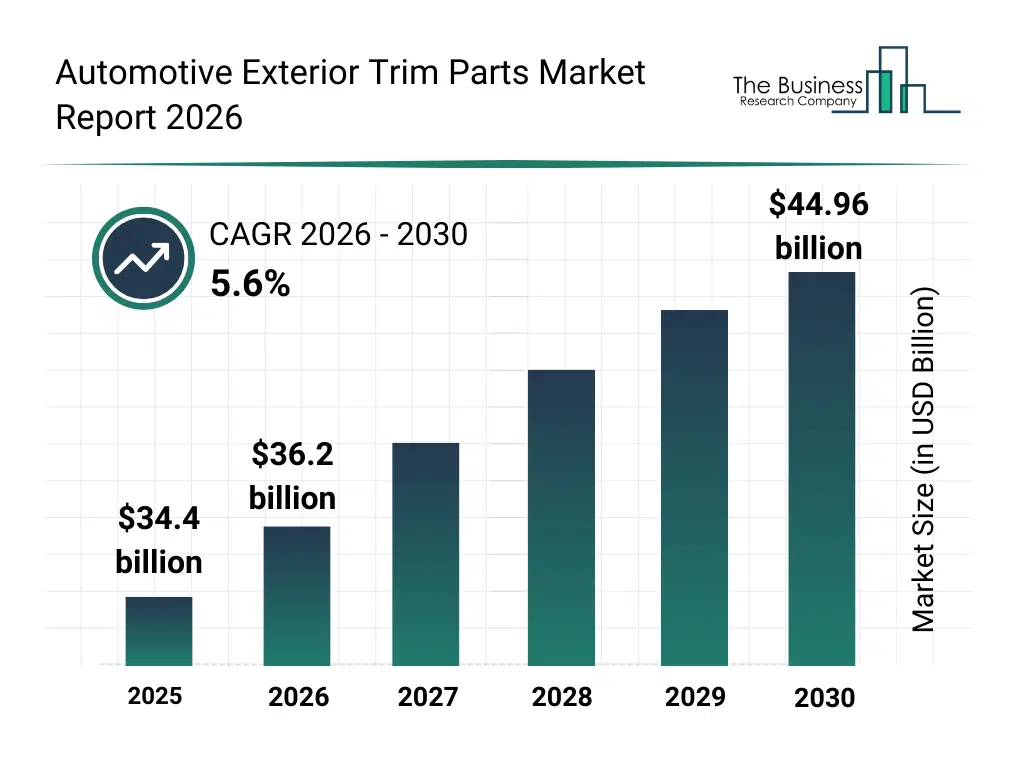
What Is The Automotive Exterior Trim Parts Market Size and Share 2026?
The automotive exterior trim parts market size has grown strongly in recent years. It will grow from $34.4 billion in 2025 to $36.2 billion in 2026 at a compound annual growth rate (CAGR) of 5.2%. The growth in the historic period can be attributed to expansion of passenger and luxury vehicle production, increasing consumer focus on vehicle aesthetics, availability of cost-effective plastic and composite materials, growth in automotive customization culture, rising demand for exterior protection components.What Is The Automotive Exterior Trim Parts Market Growth Forecast?
The automotive exterior trim parts market size is expected to see strong growth in the next few years. It will grow to $44.96 billion in 2030 at a compound annual growth rate (CAGR) of 5.6%. The growth in the forecast period can be attributed to increasing adoption of electric vehicles, rising use of sustainable and recyclable materials, expansion of premium vehicle segments, growing focus on aerodynamic efficiency, increasing integration of smart exterior components. Major trends in the forecast period include growing use of lightweight exterior trim materials, rising demand for aerodynamic design components, expansion of custom styling and aesthetic enhancements, increasing adoption of advanced manufacturing techniques, enhanced focus on vehicle branding.
Global Automotive Exterior Trim Parts Market Segmentation
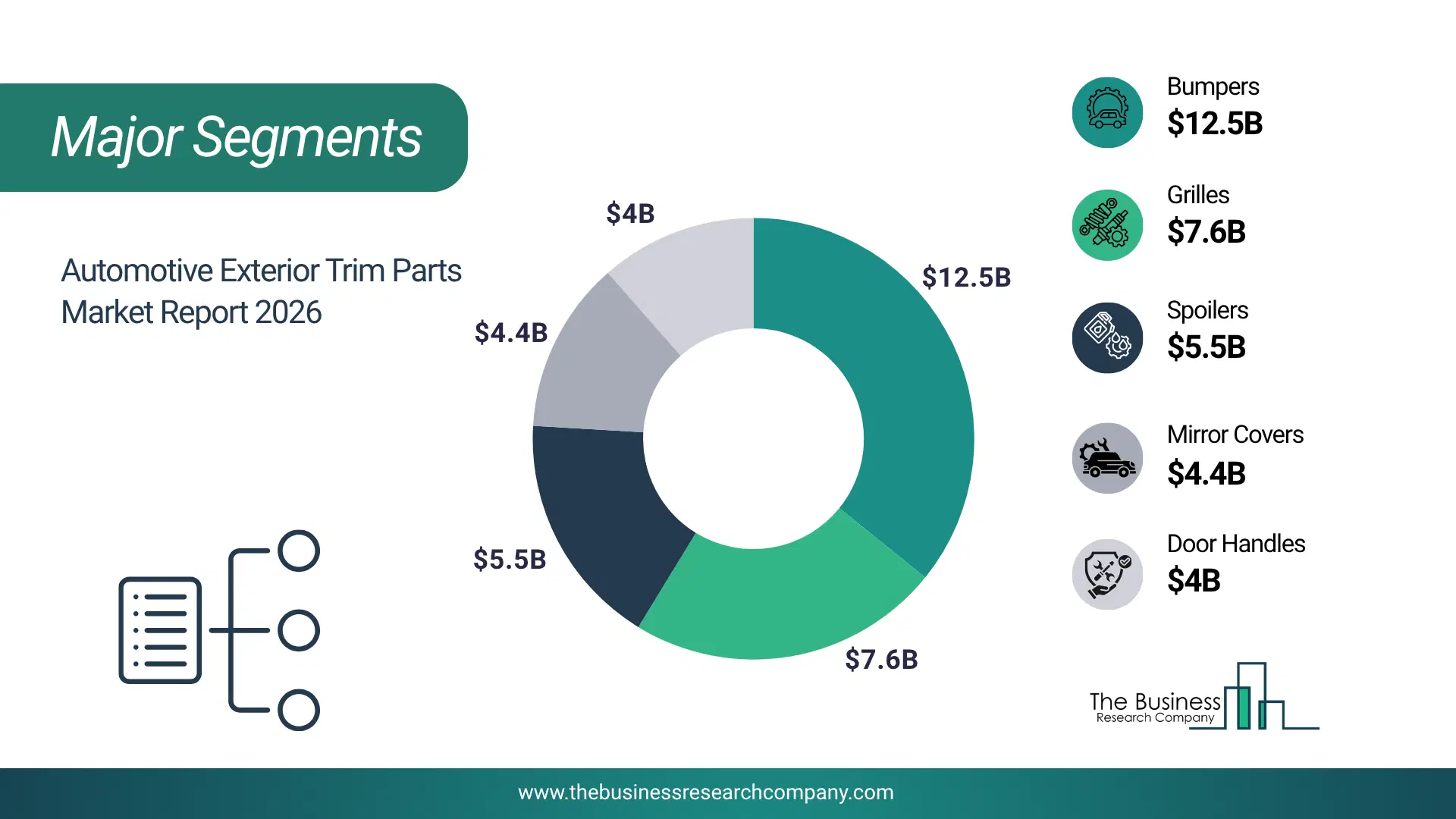
1) By Type: Bumpers, Grilles, Spoilers, Mirror Covers, Door Handles, Fender Flares, Mud Flaps, Side Skirts, Window Trims 2) By Material Type: Plastic, Aluminum, Carbon Fiber, Stainless Steel, Rubber, Composite Materials 3) By Technology: Injection Molding, Thermoforming, 3D Printing, Extrusion, Lamination 4) By Application: Passenger Vehicles, Commercial Vehicles, Electric Vehicles, Luxury Vehicles, Off-Road Vehicles 5) By End User: Automotive Manufacturers, Automotive Repair Shops, Car Enthusiasts, Fleet Operators Subsegments: 1) By Bumpers: Front Bumpers, Rear Bumpers, Custom Bumpers, Reinforced Bumpers 2) By Grilles: Front Grilles, Chrome Grilles, Mesh Grilles, Sport Grilles 3) By Spoilers: Roof Spoilers, Trunk Spoilers, Lip Spoilers, Rear Wing Spoilers 4) By Mirror Covers: Side Mirror Covers, Chrome Mirror Covers, Painted Mirror Covers, Carbon Fiber Mirror Covers 5) By Door Handles: Exterior Door Handles, Chrome Door Handles, Keyless Door Handles, Smart Door Handles 6) By Fender Flares: Front Fender Flares, Rear Fender Flares, Wide Fender Flares, Custom Fender Flares 7) By Mud Flaps: Front Mud Flaps, Rear Mud Flaps, Rubber Mud Flaps, Plastic Mud Flaps 8) By Side Skirts: Standard Side Skirts, Sport Side Skirts, Custom Side Skirts, Painted Side Skirts 9) By Window Trims: Chrome Window Trims, Black Window Trims, Aluminum Window Trims, Painted Window Trims The top segments in the automotive exterior trim parts market will be: • Bumpers will reach $12.42 billion by 2030. • Grilles will reach $7.59 billion by 2030. • Spoilers will reach $5.49 billion by 2030. • Mirror Covers will reach $4.4 billion by 2030. • Door Handles will reach $3.91 billion by 2030.What Is The Driver Of The Automotive Exterior Trim Parts Market?
Stricter environmental and safety regulations are expected to propel the growth of the automotive exterior trim parts market going forward. Stricter environmental and safety regulations refer to government-mandated rules and standards aimed at reducing pollution, enhancing vehicle safety, and promoting sustainable and responsible manufacturing practices. The growing emphasis on stricter environmental and safety regulations is due to increasing concerns over pollution, vehicle emissions, and occupant safety, prompting manufacturers to adopt cleaner technologies, safer materials, and compliant designs rather than relying on outdated practices. Automotive exterior trim parts support the growing emphasis on stricter environmental and safety regulations by incorporating sustainable, lightweight, and impact-resistant materials that help vehicles meet emission standards, improve safety performance, and comply with regulatory requirements. For instance, in March 2024, the U.S. Environmental Protection Agency (EPA), a US-based federal agency, finalized national pollution standards for passenger cars, light-duty trucks, and medium-duty vehicles for model years 2027 through 2032 and beyond, which are projected to prevent over 7 billion tons of carbon emissions and generate nearly $100 billion in annual net societal benefits, including $13 billion from improved public health due to cleaner air and $62 billion in reduced fuel, maintenance, and repair costs for drivers. Therefore, the stricter environmental and safety regulations are driving the growth of the automotive exterior trim parts industry.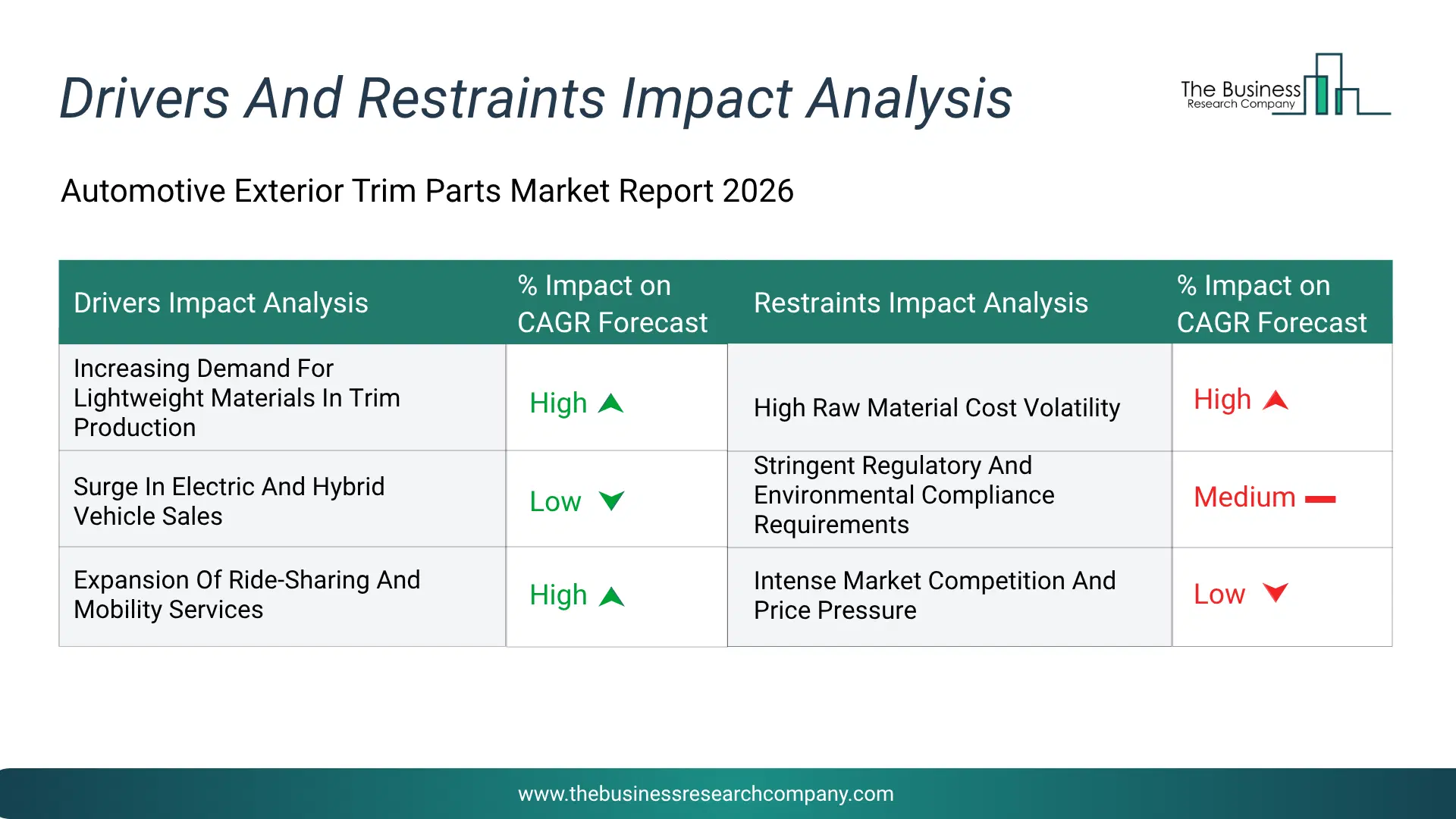
Infographic Chart Showing Key Market Drivers Analysis And Restraints For Automotive Exterior Trim Parts Market
The chart presents an impact analysis of key drivers and restraints, quantifying their relative influence on the market's growth rate and helping assess the balance between growth enablers and limiting factors. This chart offers a high-level perspective; the full report contains more detailed insights.
How Will The Drivers Impact Growth In The Global Automotive Exterior Trim Parts Market?
• Increasing Demand For Lightweight Materials In Trim Production (High) – During the forecast period, the increasing demand for lightweight materials in trim production is expected to become a key growth driver for the automotive exterior trim parts market by 2030. Automakers are prioritizing lightweight materials such as advanced plastics, composites, and aluminum to reduce overall vehicle weight and improve fuel efficiency. Lighter exterior trim components contribute to lower emissions and better performance, particularly in electric and hybrid vehicles where weight directly affects driving range. Manufacturers are therefore investing in innovative material technologies that maintain strength, durability, and aesthetic appeal while minimizing mass. This transition toward lightweight trim solutions is reinforcing steady market expansion. • Surge In Electric And Hybrid Vehicle Sales (Low) – During the forecast period, the surge in electric and hybrid vehicle sales is expected to emerge as a major factor driving the expansion of the automotive exterior trim parts market by 2030. The rapid growth of ev and hybrid production is encouraging redesign of exterior components to accommodate aerodynamic structures, battery cooling systems, and integrated lighting elements. Electric vehicles often feature unique front-end designs, enclosed grilles, and specialized bumper systems, increasing demand for innovative trim parts. Government incentives and stricter emission regulations are further accelerating ev adoption, thereby expanding the need for advanced exterior components. • Expansion Of Ride-Sharing And Mobility Services (High) – During the forecast period, the expansion of ride-sharing and mobility services is expected to act as a key growth catalyst for the automotive exterior trim parts market by 2030. The growth of shared mobility fleets increases vehicle utilization rates, leading to higher wear and tear on exterior components such as bumpers, trims, and mirror covers. Fleet operators prioritize durable, easily replaceable, and cost-effective exterior parts to maintain vehicle appearance and safety standards. Additionally, branding and customization needs in ride-sharing services further drive demand for specialized trim designs. As mobility services expand globally, replacement cycles and procurement of exterior components are expected to rise.How Will The Restraints Impact Growth In The Global Automotive Exterior Trim Parts Market?
• High Raw Material Cost Volatility (High) – During the forecast period, the trim production depends heavily on plastics, polymers, resins, metals, and coatings, all of which are subject to frequent price fluctuations due to crude oil price changes, supply shortages, and global trade disruptions. These cost swings directly impact manufacturers’ profit margins, especially since trims are high-volume but relatively low-margin components. Oems also push for cost reductions, leaving suppliers with limited room to absorb rising expenses. • Stringent Regulatory And Environmental Compliance Requirements (Medium) – During the forecast period, the governments worldwide are tightening rules on vehicle emissions, recyclability, and sustainable material use, forcing automakers and suppliers to adopt greener solutions. Exterior trims must not only meet lightweighting and durability standards but also comply with strict recyclability and chemical safety regulations. This drives up costs, testing expenses, and certification timelines, making product development longer and more expensive. • Intense Market Competition And Price Pressure (Low) – During the forecast period, the intense market competition and price pressure act as a significant restraint in the automotive exterior trim parts market, as a large number of global and regional suppliers compete to secure contracts from oems. This highly competitive environment forces manufacturers to offer lower prices while maintaining high quality and design standards. Oems often leverage this competition to negotiate aggressively, further compressing supplier margins. Additionally, the presence of low-cost manufacturers in emerging markets increases pricing pressure across the industry. As a result, reduced profitability limits reinvestment capacity and slows overall market expansion.Key Players In The Global Automotive Exterior Trim Parts Market
Major companies operating in the automotive exterior trim parts market are Magna International, Plastic Omnium, Flex N Gate, Samvardhana Motherson Group, Forvia SA (Faurecia), AISIN Group, Toyoda Gosei, Valeo SA, Grupo Antolin, Martinrea International Inc., CIE Automotive, DURA Automotive Systems, IAC Group, Toyota Boshoku Corporation, KIRCHHOFF Automotive, Novares, Tong Yang Group, Hayashi Telempu Corporation, Inoac Corporation, GEDIA Automotive Group, Kasai Kogyo Co.,Ltd., Ficosa Internacional SA, IDEAL Automotive, Eissmann Automotive Deutschland GmbH, SAMBO Automotive, Montaplast GmbH, Gronbach, Yanfeng Technology.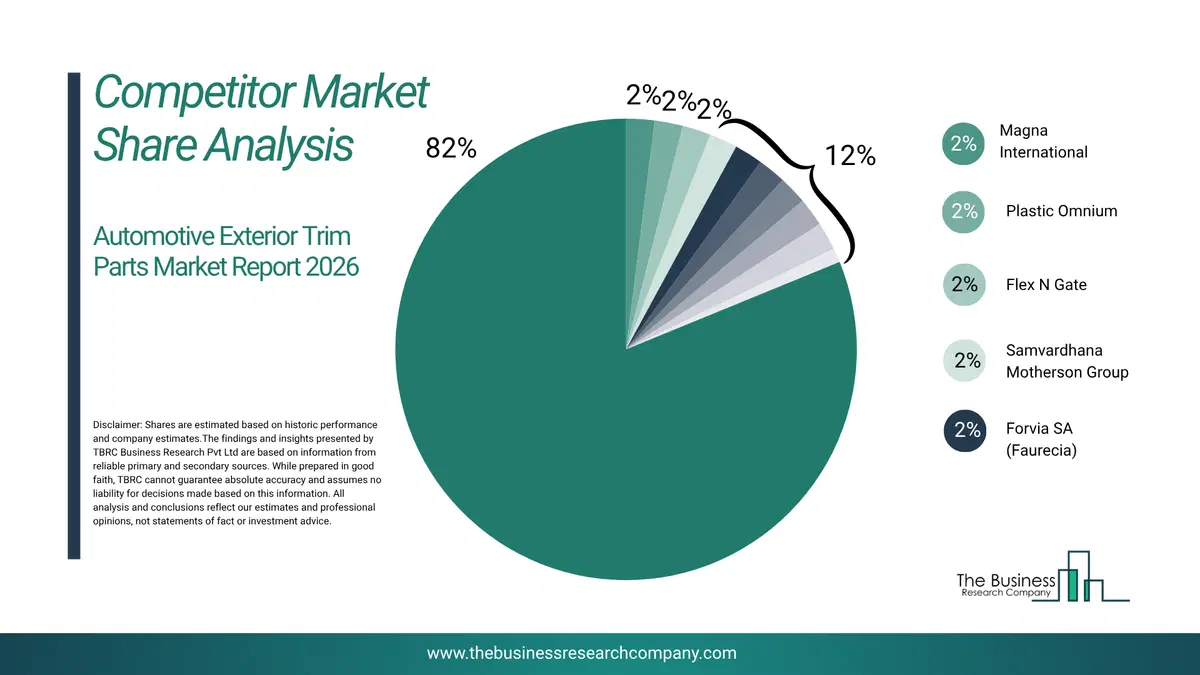
This chart is for illustrative purposes; the full report includes a detailed competitor analysis and comprehensive overview of the top 10 companies in the market.
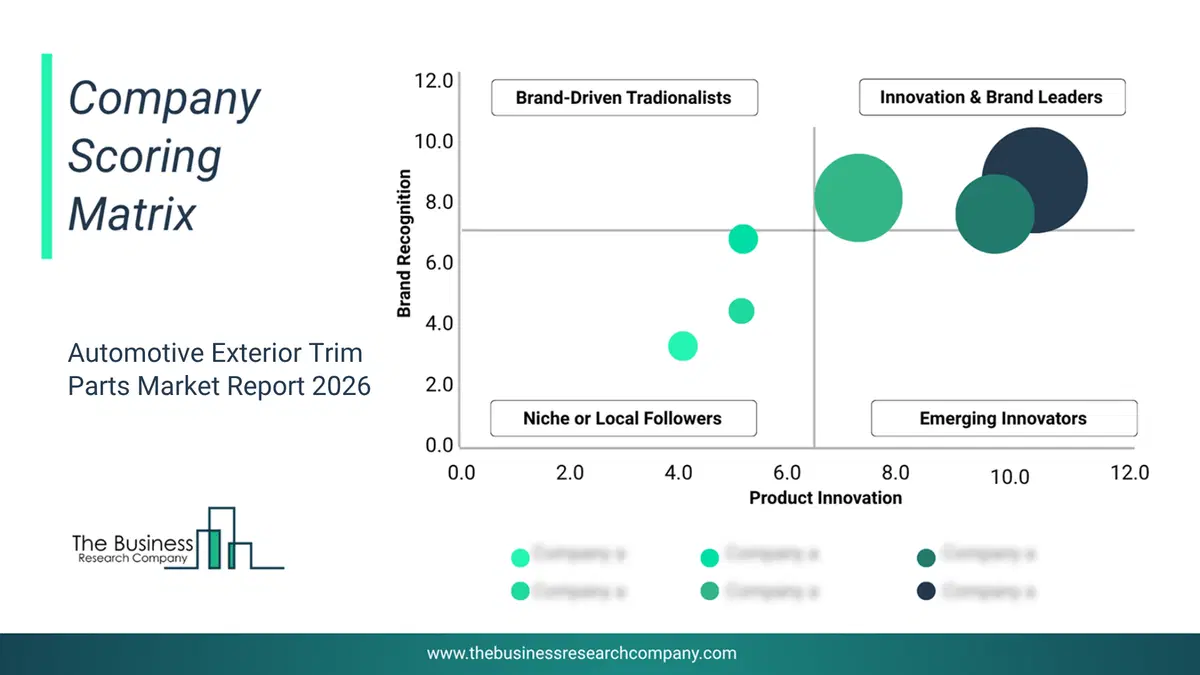
This chart maps companies by product innovation and brand strength, with bubble size indicating relative revenue, helping identify market leaders, challengers, and niche players. This is an illustrative chart; the full report provides a complete and accurate competitive analysis.
Global Automotive Exterior Trim Parts Market Trends and Insights
Major companies operating in the automotive exterior trim parts market are focusing on technological advancements, such as Propylat PET technology, to develop fully recyclable, lightweight, and sound-absorbing trim components that enhance sustainability, reduce environmental impact, and meet evolving regulatory requirements for a circular economy. Propylat PET technology is a fully recyclable monomaterial polyester solution that uses high proportions of recycled fibers, enabling waste-free production and closed-loop recycling for automotive components. For example, in June 2024, Autoneum Holding AG, a Switzerland-based automotive supplier, launched a fully recyclable 100% polyester trunk side trim. The new component is designed to support a circular economy by offering excellent durability, material stiffness, geometrical adaptability, and appealing aesthetics, while enabling waste-free manufacturing, high-value recycling of production cut-offs, and customization for tailgate and other trunk trim parts, ultimately reducing the need for virgin raw materials and enhancing both environmental performance and functional quality of the vehicle’s rear section.What Are Latest Mergers And Acquisitions In The Automotive Exterior Trim Parts Market?
In April 2025, Global Technologies Ltd., a US-based automotive parts manufacturing company, acquired Novares Group for an undisclosed amount. With this acquisition, Global Technologies aims to build an agile, innovative, and high-performing industrial platform to accelerate research and development, expand its global presence, and drive sustainable innovation for the future of mobility. Novares Group is a France-based automotive company specializing in exterior parts and trim components.
Regional Outlook
North America was the largest region in the automotive exterior trim parts market in 2025. Asia-Pacific is expected to be the fastest-growing region in the forecast period. The regions covered in this market report are Asia-Pacific, South East Asia, Western Europe, Eastern Europe, North America, South America, Middle East, Africa The countries covered in this market report are Australia, Brazil, China, France, Germany, India, Indonesia, Japan, Taiwan, Russia, South Korea, UK, USA, Canada, Italy, Spain.What Defines the Automotive Exterior Trim Parts Market?
The automotive exterior trim parts market consists of sales of wheel arch moldings, body side moldings, front and rear valances, fuel door covers, fender trims, and mirror housings. Values in this market are ‘factory gate’ values, that is, the value of goods sold by the manufacturers or creators of the goods, whether to other entities (including downstream manufacturers, wholesalers, distributors, and retailers) or directly to end customers. The value of goods in this market includes related services sold by the creators of the goods.How is Market Value Defined and Measured?
The market value is defined as the revenues that enterprises gain from the sale of goods and/or services within the specified market and geography through sales, grants, or donations in terms of the currency (in USD unless otherwise specified). The revenues for a specified geography are consumption values that are revenues generated by organizations in the specified geography within the market, irrespective of where they are produced. It does not include revenues from resales along the supply chain, either further along the supply chain or as part of other products.
This chart presents market attractiveness based on a quantitative evaluation of growth, competition, strategic alignment, and risk, offering a clear view of opportunity areas for decision-making. This chart is for illustrative purposes; the full report contains the complete analysis.

This chart highlights the Total Addressable Market (TAM) by estimating the maximum revenue opportunity using an assumption-driven approach, supporting strategic planning and opportunity sizing across markets. The chart is illustrative; the full report provides a more comprehensive analysis.
What Key Data and Analysis Are Included in the Automotive Exterior Trim Parts Market Report 2026?
The automotive exterior trim parts market research report is one of a series of new reports from The Business Research Company that provides market statistics, including industry global market size, regional shares, competitors with the market share, detailed market segments, market trends and opportunities, and any further data you may need to thrive in the automotive exterior trim parts industry. The market research report delivers a complete perspective of everything you need, with an in-depth analysis of the current and future state of the industry.Automotive Exterior Trim Parts Market Report Forecast Analysis
| Report Attribute | Details |
|---|---|
| Market Size Value In 2026 | $36.2 billion |
| Revenue Forecast In 2030 | $44.96 billion |
| Growth Rate | CAGR of 5.6% from 2026 to 2030 |
| Base Year For Estimation | 2025 |
| Actual Estimates/Historical Data | 2020-2025 |
| Forecast Period | 2026 - 2030 |
| Market Representation | Revenue in USD Billion and CAGR from 2026 to 2030 |
| Segments Covered | Type, Material Type, Technology, Application, End User |
| Regional Scope | Asia-Pacific, Western Europe, Eastern Europe, North America, South America, Middle East, Africa |
| Country Scope | The countries covered in the report are Australia, Brazil, China, France, Germany, India, ... |
| Key Companies Profiled | Magna International, Plastic Omnium, Flex N Gate, Samvardhana Motherson Group, Forvia SA (Faurecia), AISIN Group, Toyoda Gosei, Valeo SA, Grupo Antolin, Martinrea International Inc., CIE Automotive, DURA Automotive Systems, IAC Group, Toyota Boshoku Corporation, KIRCHHOFF Automotive, Novares, Tong Yang Group, Hayashi Telempu Corporation, Inoac Corporation, GEDIA Automotive Group, Kasai Kogyo Co.,Ltd., Ficosa Internacional SA, IDEAL Automotive, Eissmann Automotive Deutschland GmbH, SAMBO Automotive, Montaplast GmbH, Gronbach, Yanfeng Technology. |
| Customization Scope | Request for Customization |
| Pricing And Purchase Options | Explore Purchase Options |