
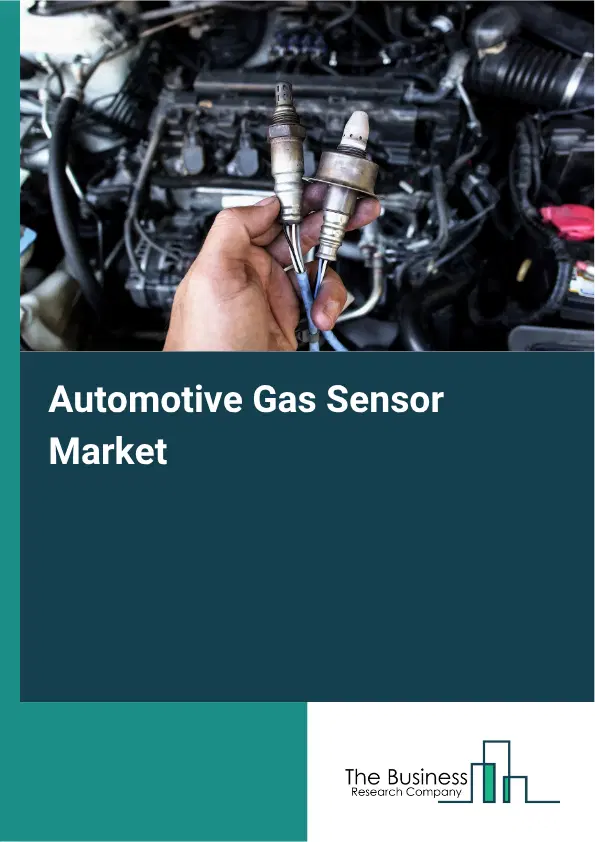
Automotive Gas Sensor Market Report 2026
Global Outlook – By Sensor Type (Oxygen Sensors, Nitrogen Oxide Sensors, Carbon Monoxide Sensors, Carbon Dioxide Sensors, Hydrocarbon Sensors, Ammonia Sensors, Hydrogen Sensors, Particulate Matter Sensors, Other Sensor Types), By Technology Type (Electrochemical Sensors, Metal Oxide Semiconductor Sensors, Non Dispersive Infrared Sensors, Catalytic Sensors, Photoionization Sensors, Solid State Sensors, Other Technologies), By Application Type (Exhaust Gas Monitoring, Cabin Air Quality Monitoring, Emission Control Systems, Battery Safety Monitoring, Fuel Cell Monitoring, Leak Detection, Engine Management Systems, Other Applications), By End User (Automotive Manufacturers, Automotive Component Manufacturers, Fleet Operators, Automotive Service Centers, Research And Testing Organizations) – Market Size, Trends, Strategies, and Forecast to 2030
Automotive Gas Sensor Market Overview
• Automotive Gas Sensor market size has reached to $2.48 billion in 2025 • Expected to grow to $3.92 billion in 2030 at a compound annual growth rate (CAGR) of 9.5% • Growth Driver: Rising Electric Vehicle Adoption Driving The Market Growth Due To Increasing Demand For Efficient Power Conversion And Energy Management • Market Trend: Next-Generation Gas Sensors Enable Early Detection Of EV Battery Thermal Runaway • North America was the largest region in 2025 and Asia-Pacific is the fastest growing region.What Is Covered Under Automotive Gas Sensor Market?
Automotive gas sensors refer to electronic sensing devices designed to detect and measure the presence and concentration of gases within vehicles or vehicle-related systems. These sensors use advanced sensing technologies to monitor gas levels, analyze environmental conditions, and provide data for vehicle control systems. They support functions such as emission management, safety monitoring, and optimization of vehicle performance by enabling accurate and real-time gas detection. The main sensor types of automotive gas sensors include oxygen sensors, nitrogen oxide sensors, carbon monoxide sensors, carbon dioxide sensors, hydrocarbon sensors, ammonia sensors, hydrogen sensors, particulate matter sensors, and other sensor types. Oxygen sensors refer to devices that measure the concentration of oxygen in exhaust gases to support engine control and emissions management. These sensors use electrochemical sensors, metal oxide semiconductor sensors, non dispersive infrared sensors, catalytic sensors, photoionization sensors, solid state sensors, and other technologies. The various applications involved are exhaust gas monitoring, cabin air quality monitoring, emission control systems, battery safety monitoring, fuel cell monitoring, leak detection, engine management systems, and others and they are utilized by end users including automotive manufacturers, automotive component manufacturers, fleet operators, automotive service centers, and research and testing organizations.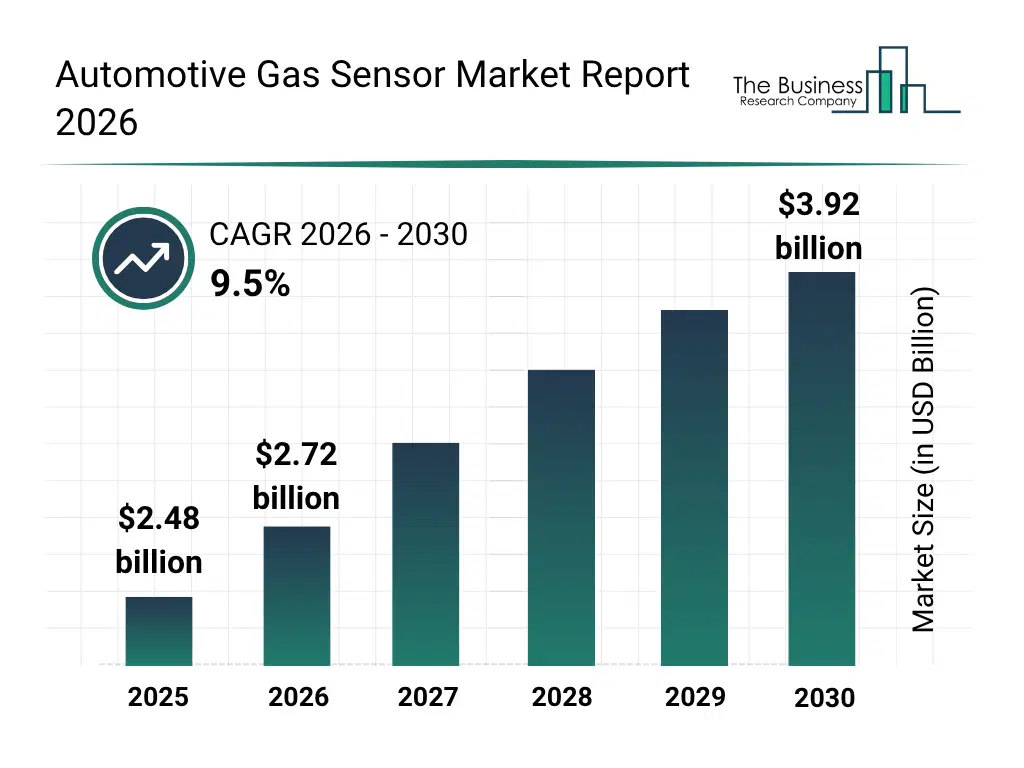
What Is The Automotive Gas Sensor Market Size and Share 2026?
The automotive gas sensor market size has grown strongly in recent years. It will grow from $2.48 billion in 2025 to $2.72 billion in 2026 at a compound annual growth rate (CAGR) of 9.9%. The growth in the historic period can be attributed to increasing vehicle production and sales, rising regulatory focus on vehicle emissions, growing demand for emission control systems, increasing adoption of exhaust gas monitoring systems, rising need for vehicle safety monitoring.What Is The Automotive Gas Sensor Market Growth Forecast?
The automotive gas sensor market size is expected to see strong growth in the next few years. It will grow to $3.92 billion in 2030 at a compound annual growth rate (CAGR) of 9.5%. The growth in the forecast period can be attributed to increasing demand for real-time emission detection, rising adoption of gas sensors in electric and hybrid vehicles, growing demand for advanced cabin air quality monitoring, increasing need for accurate gas concentration measurement, rising demand for integrated automotive sensing systems. Major trends in the forecast period include increasing adoption of real-time automotive gas detection, rising demand for emission monitoring sensors, growing demand for compact automotive gas sensors, increasing adoption of multi-gas sensing capabilities, rising demand for high-temperature and harsh-environment gas sensors.
Global Automotive Gas Sensor Market Segmentation
1) By Sensor Type: Oxygen Sensors, Nitrogen Oxide Sensors, Carbon Monoxide Sensors, Carbon Dioxide Sensors, Hydrocarbon Sensors, Ammonia Sensors, Hydrogen Sensors, Particulate Matter Sensors, Other Sensor Types 2) By Technology Type: Electrochemical Sensors, Metal Oxide Semiconductor Sensors, Non Dispersive Infrared Sensors, Catalytic Sensors, Photoionization Sensors, Solid State Sensors, Other Technologies 3) By Application Type: Exhaust Gas Monitoring, Cabin Air Quality Monitoring, Emission Control Systems, Battery Safety Monitoring, Fuel Cell Monitoring, Leak Detection, Engine Management Systems, Other Applications 4) By End User: Automotive Manufacturers, Automotive Component Manufacturers, Fleet Operators, Automotive Service Centers, Research And Testing Organizations Subsegments: 1) By Oxygen Sensors: Zirconia Oxygen Sensors, Titania Oxygen Sensors, Wideband Oxygen Sensors, Narrowband Oxygen Sensors, Heated Oxygen Sensors 2) By Nitrogen Oxide Sensors: Electrochemical Nitrogen Oxide Sensors, Amperometric Nitrogen Oxide Sensors, Solid State Nitrogen Oxide Sensors, Wide Range Nitrogen Oxide Sensors, High Temperature Nitrogen Oxide Sensors 3) By Carbon Monoxide Sensors: Electrochemical Carbon Monoxide Sensors, Semiconductor Carbon Monoxide Sensors, Infrared Carbon Monoxide Sensors, Catalytic Carbon Monoxide Sensors, Portable Carbon Monoxide Sensors 4) By Carbon Dioxide Sensors: Non Dispersive Infrared Carbon Dioxide Sensors, Electrochemical Carbon Dioxide Sensors, Solid State Carbon Dioxide Sensors, Photoacoustic Carbon Dioxide Sensors, Miniature Carbon Dioxide Sensors 5) By Hydrocarbon Sensors: Flame Ionization Hydrocarbon Sensors, Infrared Hydrocarbon Sensors, Semiconductor Hydrocarbon Sensors, Catalytic Hydrocarbon Sensors, Electrochemical Hydrocarbon Sensors 6) By Ammonia Sensors: Electrochemical Ammonia Sensors, Metal Oxide Ammonia Sensors, Optical Ammonia Sensors, Conductometric Ammonia Sensors, Solid State Ammonia Sensors 7) By Hydrogen Sensors: Metal Oxide Hydrogen Sensors, Electrochemical Hydrogen Sensors, Optical Hydrogen Sensors, Thermal Conductivity Hydrogen Sensors, Palladium Based Hydrogen Sensors 8) By Particulate Matter Sensors: Laser Based Particulate Matter Sensors, Optical Particulate Matter Sensors, Capacitive Particulate Matter Sensors, Scattering Based Particulate Matter Sensors, Solid State Particulate Matter Sensors 9) By Other Sensor Types: Temperature Sensors, Pressure Sensors, Humidity Sensors, Fuel Quality Sensors, Exhaust Gas SensorsWhat Is The Driver Of The Automotive Gas Sensor Market?
The rising adoption of electric vehicles (EVs) is expected to propel the growth of the automotive gas sensor market going forward. Electric vehicles are automobiles powered wholly or partially by electric motors using energy stored in rechargeable battery systems. The adoption of electric vehicles is increasing due to growing environmental concerns, as people are choosing cleaner transportation options to reduce air pollution, lower greenhouse gas emissions, and help protect the environment. Electric vehicles support automotive gas sensors by enabling advanced monitoring of battery conditions, air quality, and safety parameters, helping improve vehicle efficiency, reliability, and the development of smarter, cleaner transportation technologies. For instance, in January 2025, according to the Cox Automotive, a US-based system software company, new electric vehicle sales totaled 102,243 units, marking a 29.9% increase compared to the same period last year. Therefore, the rising adoption of electric vehicles is driving the growth of the automotive gas sensor industry.Key Players In The Global Automotive Gas Sensor Market
Major companies operating in the automotive gas sensor market are Robert Bosch GmbH, Denso Corporation, Continental AG, Analog Devices Inc, Texas Instruments Incorporated, NXP Semiconductors NV, STMicroelectronics NV, Honeywell International Inc, Mitsubishi Electric Corporation, TDK Corporation, FORVIA SE, Valeo SE, Amphenol Corporation, Infineon Technologies AG, Sensata Technologies Holding plc, Kyocera Corporation, NGK Insulators Ltd, Niterra Co Ltd, Sensirion AG, Hitachi Ltd, Nissha Co Ltd, New Cosmos Electric Co Ltd, Figaro Engineering Inc, ScioSense BV
This chart is for illustrative purposes; the full report includes a detailed competitor analysis and comprehensive overview of the top 10 companies in the market.
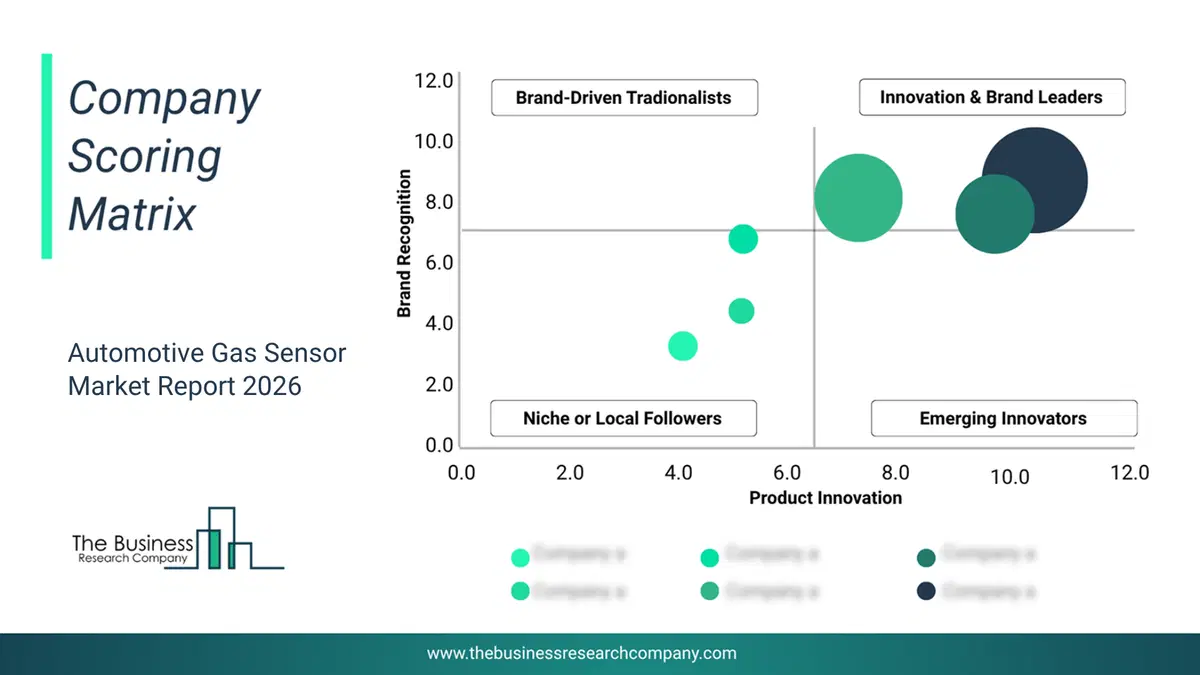
This chart maps companies by product innovation and brand strength, with bubble size indicating relative revenue, helping identify market leaders, challengers, and niche players. This is an illustrative chart; the full report provides a complete and accurate competitive analysis.
Global Automotive Gas Sensor Market Trends and Insights
Major companies operating in the automotive gas sensor market are focusing on developing innovative solutions such as, hydrogen detection sensors for electric vehicle battery management systems (BMS) to enhance battery safety, thermal runaway prevention, and early warning capabilities in electric vehicles. Hydrogen detection sensors are advanced gas sensing devices that monitor hydrogen concentration released during abnormal battery reactions, enabling early identification of potential thermal runaway events compared with conventional battery monitoring systems that primarily rely on temperature and voltage measurements. For instance, in June 2026, Sensirion AG, a Switzerland-based sensor technology company, launched the STC42A digital thermal conductivity hydrogen sensor for automotive applications. The sensor is designed for integration into electric vehicle battery management systems to detect hydrogen emissions generated during the early stages of battery failure and provide advance warning signals to improve occupant safety. The device measures hydrogen concentration through changes in thermal conductivity and integrates temperature and humidity compensation technology using Sensirion’s SHT41A sensor to improve measurement accuracy under varying environmental conditions. The STC42A supports a digital I2C interface, complies with the AEC-Q100 Grade 2 automotive semiconductor reliability standard, and operates across a wide temperature range from -40°C to 105°C, making it suitable for demanding automotive environments.What Are Latest Mergers And Acquisitions In The Automotive Gas Sensor Market?
In January 2026, Teledyne Technologies Incorporated, a US-based technology and instrumentation company, acquired DD-Scientific Holdings Limited for an undisclosed amount. With this acquisition, Teledyne Technologies Incorporated aimed to strengthen its environmental and industrial instrumentation portfolio by integrating DD-Scientific’s high-performance electrochemical gas sensor technologies, expanding its capabilities in gas detection solutions, and enhancing its offerings for industrial safety, healthcare, semiconductor, petrochemical, and environmental monitoring applications. DD-Scientific Holdings Limited is a UK-based gas sensor technology company that specializes in developing and manufacturing high-performance electrochemical gas sensors for toxic gas detection.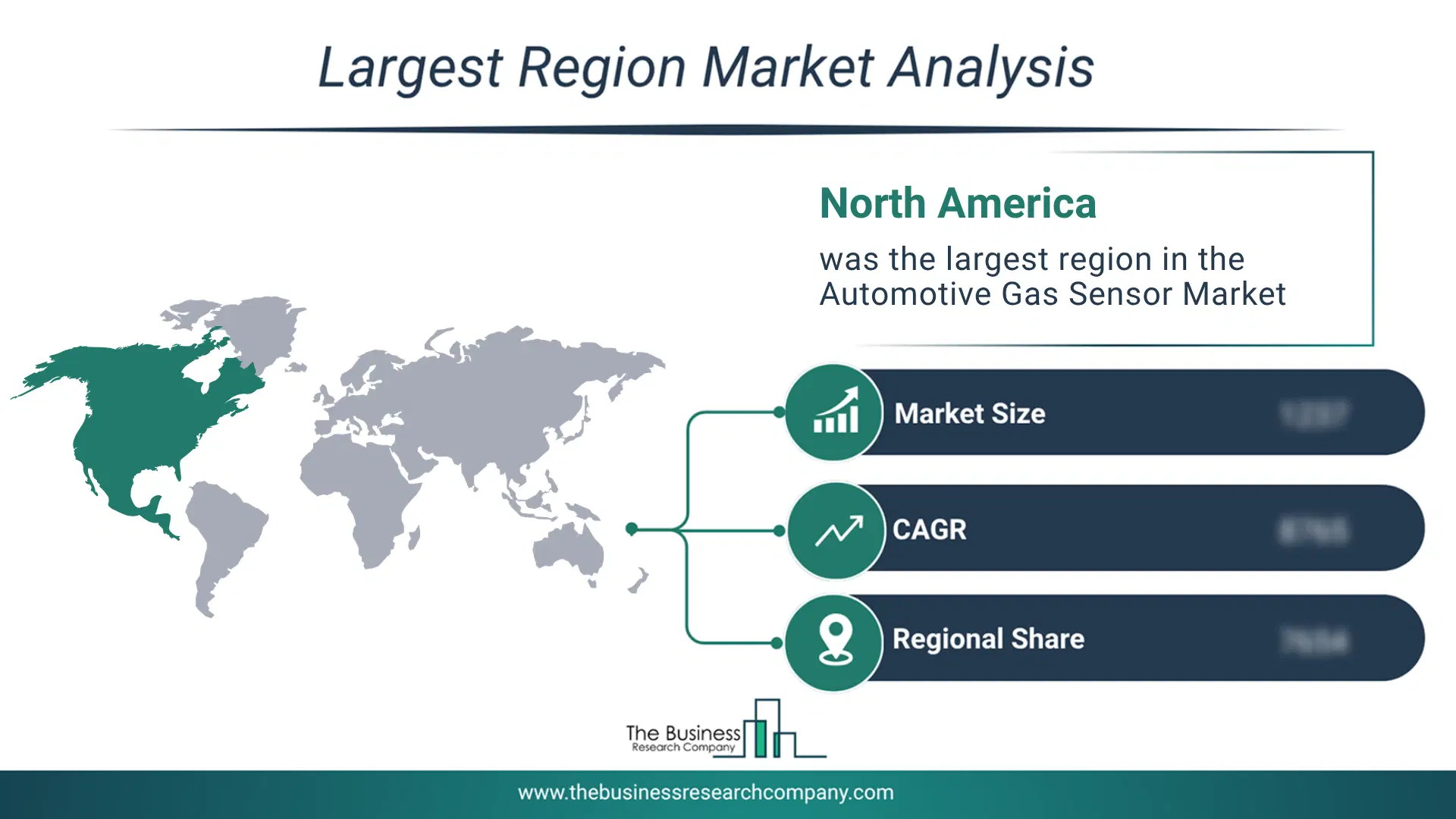
Regional Insights
North America was the largest region in the automotive gas sensor market in 2025. Asia-Pacific is expected to be the fastest-growing region in the forecast period. The regions covered in this market report are Asia-Pacific, South East Asia, Western Europe, Eastern Europe, North America, South America, Middle East, Africa. The countries covered in this market report are Australia, Brazil, China, France, Germany, India, Indonesia, Japan, Taiwan, Russia, South Korea, UK, USA, Canada, Italy, Spain.What Defines the Automotive Gas Sensor Market?
The automotive gas sensor market consists of sales of automotive gas sensing devices, gas detection modules, sensor assemblies, sensing elements, and other related gas sensor products used in vehicles. Values in this market are ‘factory gate’ values, that is, the value of goods sold by the manufacturers or creators of the goods, whether to other entities (including downstream manufacturers, wholesalers, distributors, and retailers) or directly to end customers. The value of goods in this market includes related services sold by the creators of the goods.How is Market Value Defined and Measured?
The market value is defined as the revenues that enterprises gain from the sale of goods and/or services within the specified market and geography through sales, grants, or donations in terms of the currency (in USD unless otherwise specified). The revenues for a specified geography are consumption values that are revenues generated by organizations in the specified geography within the market, irrespective of where they are produced. It does not include revenues from resales along the supply chain, either further along the supply chain or as part of other products.
This chart presents market attractiveness based on a quantitative evaluation of growth, competition, strategic alignment, and risk, offering a clear view of opportunity areas for decision-making. This chart is for illustrative purposes; the full report contains the complete analysis.

This chart highlights the Total Addressable Market (TAM) by estimating the maximum revenue opportunity using an assumption-driven approach, supporting strategic planning and opportunity sizing across markets. The chart is illustrative; the full report provides a more comprehensive analysis.
What Key Data and Analysis Are Included in the Automotive Gas Sensor Market Report 2026?
The automotive gas sensor market research report is one of a series of new reports from The Business Research Company that provides market statistics, including industry global market size, regional shares, competitors with the market share, detailed market segments, market trends and opportunities, and any further data you may need to thrive in the automotive gas sensor industry. The market research report delivers a complete perspective of everything you need, with an in-depth analysis of the current and future state of the industry.Automotive Gas Sensor Market Report Forecast Analysis
| Report Attribute | Details |
|---|---|
| Market Size Value In 2026 | $2.72 billion |
| Revenue Forecast In 2030 | $3.92 billion |
| Growth Rate | CAGR of 9.5% from 2026 to 2030 |
| Base Year For Estimation | 2025 |
| Actual Estimates/Historical Data | 2020-2025 |
| Forecast Period | 2026 - 2030 |
| Market Representation | Revenue in USD Billion and CAGR from 2026 to 2030 |
| Segments Covered | Sensor Type, Technology Type, Application Type, End User |
| Regional Scope | Asia-Pacific, Western Europe, Eastern Europe, North America, South America, Middle East, Africa |
| Country Scope | The countries covered in the report are Australia, Brazil, China, France, Germany, India, Indonesia, Japan, Taiwan, Russia, South Korea, UK, USA, Canada, Italy, Spain. |
| Key Companies Profiled | Robert Bosch GmbH, Denso Corporation, Continental AG, Analog Devices Inc, Texas Instruments Incorporated, NXP Semiconductors NV, STMicroelectronics NV, Honeywell International Inc, Mitsubishi Electric Corporation, TDK Corporation, FORVIA SE, Valeo SE, Amphenol Corporation, Infineon Technologies AG, Sensata Technologies Holding plc, Kyocera Corporation, NGK Insulators Ltd, Niterra Co Ltd, Sensirion AG, Hitachi Ltd, Nissha Co Ltd, New Cosmos Electric Co Ltd, Figaro Engineering Inc, ScioSense BV |
| Customization Scope | Request for Customization |
| Pricing And Purchase Options | Explore Purchase Options |