

Automotive Gesture Recognition Systems Market Report 2026
Global Outlook – By Component (Touch-Based Systems, Touchless Systems), By Sensing Technology (Camera-Based Gesture Recognition, Infrared (IR)-Based Gesture Recognition, Radar-Based Gesture Recognition, Ultrasonic Gesture Recognition, Optical Sensor-Based Gesture Recognition), By Vehicle Type (Passenger Cars, Commercial Vehicles), By Application (Multimedia, Infotainment And Navigation, Lighting Systems, Other Applications) – Market Size, Trends, Strategies, and Forecast to 2030
Automotive Gesture Recognition Systems Market Overview
• Automotive Gesture Recognition Systems market size has reached to $2.46 billion in 2025 • Expected to grow to $6.34 billion in 2030 at a compound annual growth rate (CAGR) of 20.9% • Growth Driver: Growing Automotive Gesture Recognition Systems Market Driven By Increasing Road Accidents And Safety Needs • Market Trend: Advanced Edge Processing Innovations Strengthen Growth Prospects In The Automotive Gesture Recognition Systems Market • Europe was the largest region in 2025.What Is Covered Under Automotive Gesture Recognition Systems Market?
Automotive gesture recognition systems are advanced driver assistance technologies that enable drivers and passengers to interact with a vehicle's infotainment and control systems through intuitive hand movements or gestures without physical touch. These systems utilize sensors, cameras, and software algorithms to detect, interpret, and respond to specific gestures. Automotive gesture recognition systems represent a significant step towards more interactive, user-friendly, and safer vehicle environments. The main components of automotive gesture recognition systems are touch-based systems and touchless systems. Touch-based automotive gesture recognition systems require the user to physically touch a sensor or surface to register a gesture and control vehicle functions. The various authentication include hand, fingerprint, and leg recognition, facial recognition, vision and iris recognition, and others. These are used in various vehicle types such as passenger cars, and commercial vehicles, and in various applications such as multimedia, infotainment and navigation, lighting systems, and others.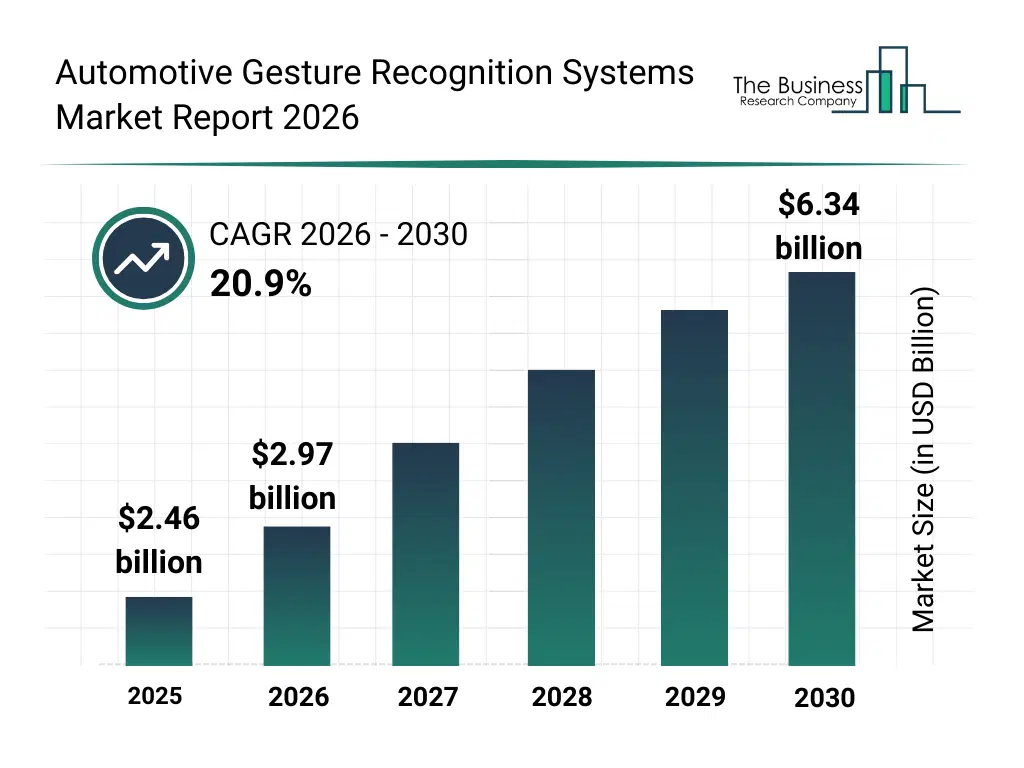
What Is The Automotive Gesture Recognition Systems Market Size and Share 2026?
The automotive gesture recognition systems market size has grown exponentially in recent years. It will grow from $2.46 billion in 2025 to $2.97 billion in 2026 at a compound annual growth rate (CAGR) of 20.7%. The growth in the historic period can be attributed to infotainment system growth, camera sensor adoption, focus on driver distraction reduction, luxury vehicle demand, digital cockpit evolution.What Is The Automotive Gesture Recognition Systems Market Growth Forecast?
The automotive gesture recognition systems market size is expected to see exponential growth in the next few years. It will grow to $6.34 billion in 2030 at a compound annual growth rate (CAGR) of 20.9%. The growth in the forecast period can be attributed to AI-based interaction demand, autonomous vehicle development, advanced HMI adoption, smart cabin integration, connected car growth. Major trends in the forecast period include integration of touchless interfaces, adoption of camera-based recognition, growth of in-cabin ux systems, demand for driver safety features, expansion of smart infotainment.
Global Automotive Gesture Recognition Systems Market Segmentation
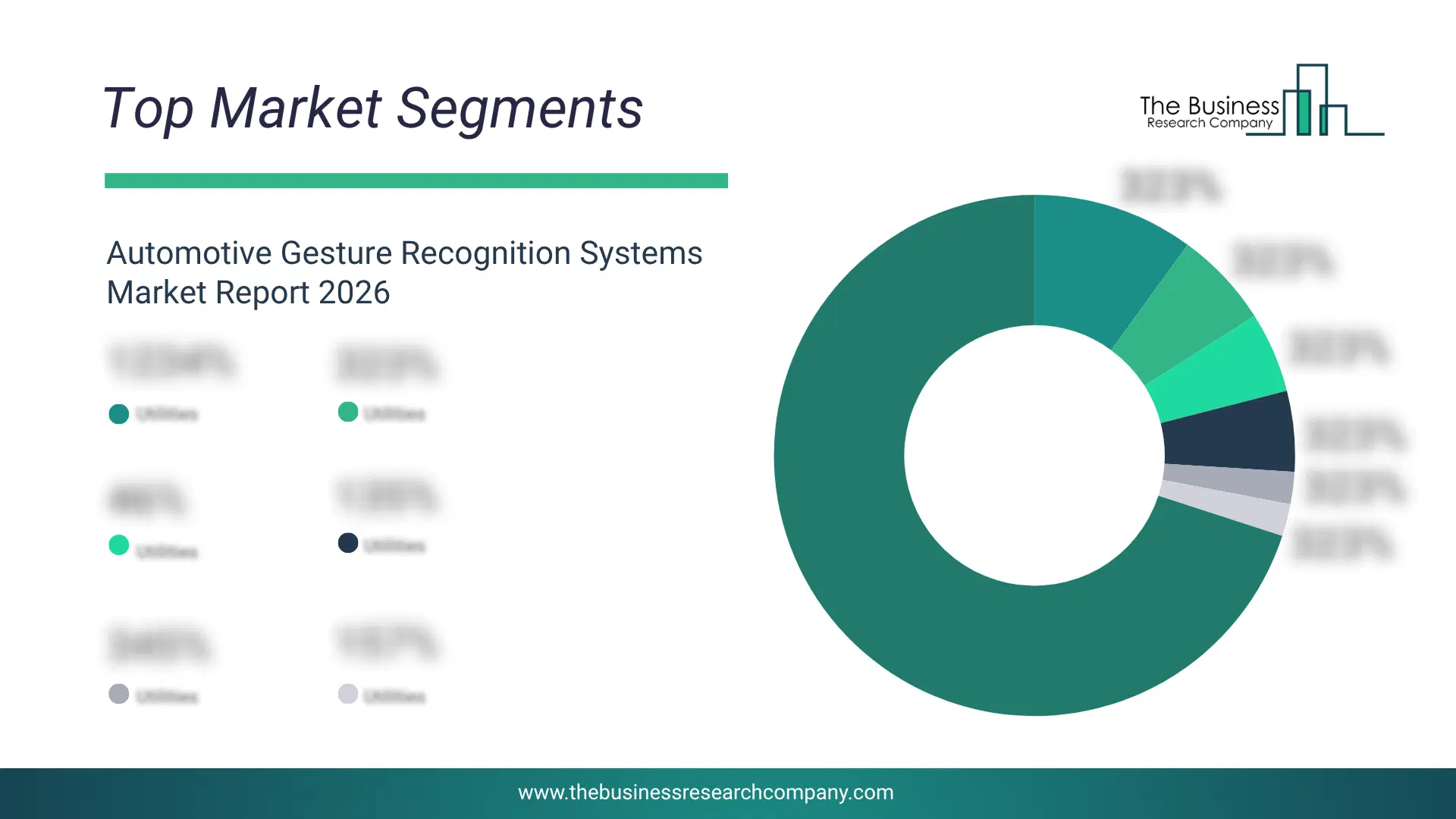
1) By Component: Touch-Based Systems, Touchless Systems 2) By Sensing Technology: Camera-Based Gesture Recognition, Infrared (IR)-Based Gesture Recognition, Radar-Based Gesture Recognition, Ultrasonic Gesture Recognition, Optical Sensor-Based Gesture Recognition 3) By Vehicle Type: Passenger Cars, Commercial Vehicles 4) By Application: Multimedia, Infotainment And Navigation, Lighting Systems, Other Applications Subsegments: 1) By Touch-Based Systems: Touchscreen Displays with Gesture Recognition, Capacitive Multi-Touch Gesture Sensors, Haptic-Enabled Touch Gesture Interfaces 2) By Touchless Systems: Infrared Gesture Recognition, Ultrasonic Gesture Recognition, 3D Imaging And Camera-Based Systems, Radar-Based Gesture Sensors, Optical Sensing Gesture SystemsWhat Is The Driver Of The Automotive Gesture Recognition Systems Market?
The increasing number of road accidents is expected to propel the growth of the automotive gesture recognition systems market going forward. The growing number of road accidents is due to a lack of proper signage and insufficient lighting, a rise in vehicle ownership, and human errors such as speeding and reckless driving. Automotive gesture recognition systems help reduce the number of road accidents by allowing drivers to control in-car functions without taking their eyes off the road or hands off the wheel, improve driver safety, and minimize distractions caused by fiddling with touchscreens, buttons, or dials. For instance, in 2023, according to the Transport Accident Commission, an Australia-based government agency, in 2023 a total of 295 people lost their lives on Victorian roads, marking a 22.4% increase (54 more fatalities) compared to 2022. Additionally, there were 261 fatal crashes, up by 22 (9%) from the 239 recorded in the previous year. Therefore, increasing road accidents drive the automotive gesture recognition systems industry.Key Players In The Global Automotive Gesture Recognition Systems Market
Major companies operating in the automotive gesture recognition systems market report include Robert Bosch GmbH, Continental AG, Valeo S.A., Aptiv PLC, Visteon Corporation, Panasonic Corporation, Hyundai Mobis Co. Ltd., Magna International Inc., ZF Friedrichshafen AG, NVIDIA Corporation, NXP Semiconductors N.V., Renesas Electronics Corporation, STMicroelectronics N.V., Melexis NV, Synaptics Incorporated, Ambarella Inc., Eyesight Technologies Ltd., Vayyar Imaging Ltd., UltraLeap Ltd., GestureTek Inc.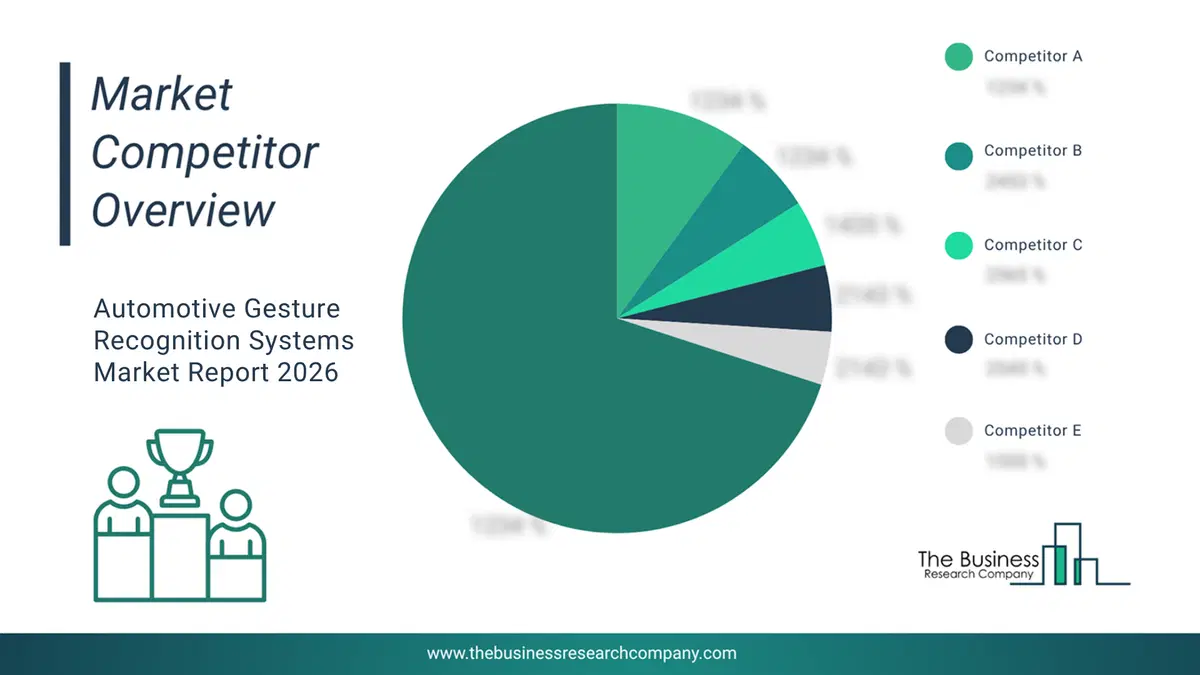
This chart is for illustrative purposes; the full report includes a detailed competitor analysis and comprehensive overview of the top 10 companies in the market.
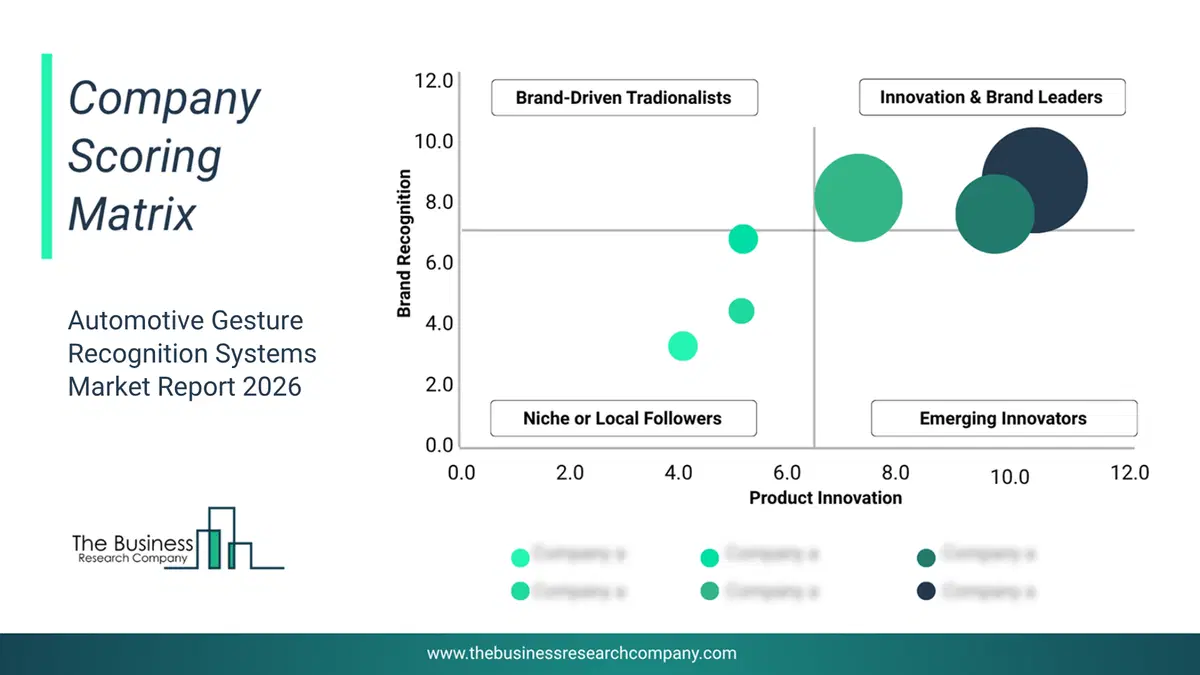
This chart maps companies by product innovation and brand strength, with bubble size indicating relative revenue, helping identify market leaders, challengers, and niche players. This is an illustrative chart; the full report provides a complete and accurate competitive analysis.
Global Automotive Gesture Recognition Systems Market Trends and Insights
Major companies operating in the automotive gesture recognition systems market are focusing on developing advanced solutions, such as edge-level machine-learning acceleration, to enhance real-time responsiveness and sensor-data processing capability. Edge-level machine-learning acceleration refers to the ability to run complex algorithms directly on the vehicle’s hardware, processing sensor inputs in real time without relying on cloud connectivity, thereby improving responsiveness, reliability, and data privacy. For instance, in March 2025, NXP Semiconductors, a Netherlands-based semiconductor company, launched the S32K5 microcontroller family featuring such on-chip machine learning acceleration. The S32K5 MCUs combine up to 800 MHz Arm Cortex CPU cores built on 16 nm FinFET process for power-efficient performance and include a dedicated eIQ Neutron neural processing unit (NPU) that enables power-efficient, real-time processing of sensor data at the vehicle’s edge. The S32K5 also integrates embedded MRAM memory for faster ECU programming and over-the-air updates, an Ethernet switch core for streamlined network design, optimized accelerators for network translation, security, and digital signal processing, and a hardware-enforced isolation architecture enabling functional safety up to ASIL-D. This integration helps automakers consolidate electronic control units without compromising latency or efficiency while supporting scalable software-defined vehicle architectures.What Are Latest Mergers And Acquisitions In The Automotive Gesture Recognition Systems Market?
In August 2023, PreAct Technologies, a US-based provider of near-field software-definable flash LiDAR technology, acquired Gestoos for an undisclosed amount. Through this acquisition, PreAct aims to strengthen its AI algorithm development for faster and more efficient sensor data processing, enabling improved in-cabin monitoring, gesture-based device control, and spatial awareness solutions in automotive and other industries. Gestoos is a Spain-based company that provides automotive gesture recognition technology.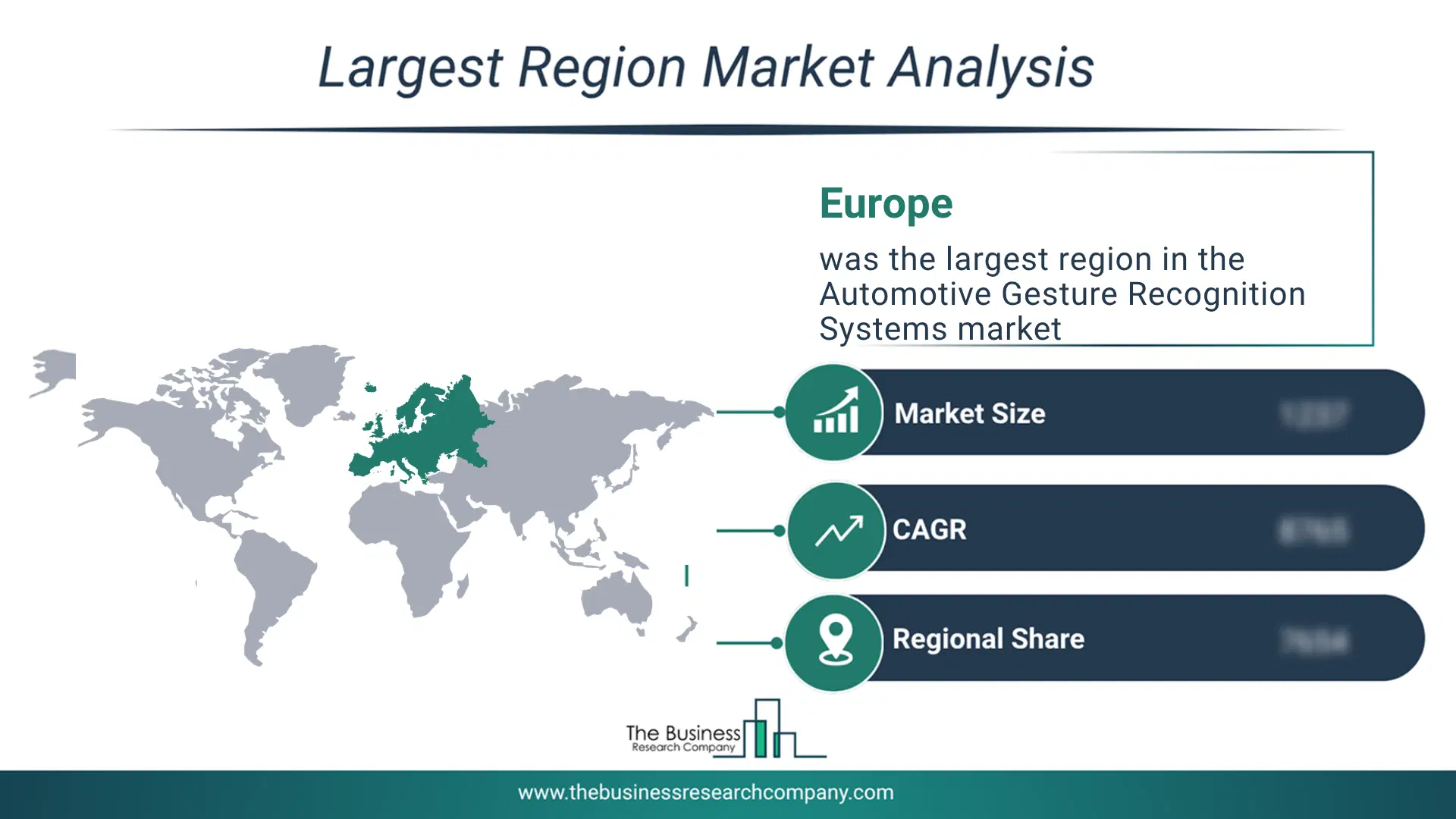
Regional Outlook
Europe was the largest region in the automotive gesture recognition systems market in 2025. The regions covered in this market report include Asia-Pacific, South East Asia, Western Europe, Eastern Europe, North America, South America, Middle East, Africa. The countries covered in this market report include Australia, Brazil, China, France, Germany, India, Indonesia, Japan, Taiwan, Russia, South Korea, UK, USA, Canada, Italy, SpainWhat Defines the Automotive Gesture Recognition Systems Market?
The automotive gesture recognition systems market consists of revenues earned by entities by providing infotainment control systems, navigation control systems, driver assistance systems, smart home integration, and dashboard controls. The market value includes the value of related goods sold by the service provider or included within the service offering. The automotive gesture recognition systems market also includes sales of infrared sensors, time-of-flight (ToF) cameras, optical cameras, ultrasonic sensors, and display screens. Values in this market are ‘factory gate’ values, that is the value of goods sold by the manufacturers or creators of the goods, whether to other entities (including downstream manufacturers, wholesalers, distributors, and retailers) or directly to end customers. The value of goods in this market includes related services sold by the creators of the goods.How is Market Value Defined and Measured?
The market value is defined as the revenues that enterprises gain from the sale of goods and/or services within the specified market and geography through sales, grants, or donations in terms of the currency (in USD unless otherwise specified). The revenues for a specified geography are consumption values that are revenues generated by organizations in the specified geography within the market, irrespective of where they are produced. It does not include revenues from resales along the supply chain, either further along the supply chain or as part of other products.
This chart presents market attractiveness based on a quantitative evaluation of growth, competition, strategic alignment, and risk, offering a clear view of opportunity areas for decision-making. This chart is for illustrative purposes; the full report contains the complete analysis.

This chart highlights the Total Addressable Market (TAM) by estimating the maximum revenue opportunity using an assumption-driven approach, supporting strategic planning and opportunity sizing across markets. The chart is illustrative; the full report provides a more comprehensive analysis.
What Key Data and Analysis Are Included in the Automotive Gesture Recognition Systems Market Report 2026?
The automotive gesture recognition systems market research report is one of a series of new reports from The Business Research Company that provides market statistics, including industry global market size, regional shares, competitors with the market share, detailed market segments, market trends and opportunities, and any further data you may need to thrive in the automotive gesture recognition systems industry. The market research report delivers a complete perspective of everything you need, with an in-depth analysis of the current and future state of the industry.Automotive Gesture Recognition Systems Market Report Forecast Analysis
| Report Attribute | Details |
|---|---|
| Market Size Value In 2026 | $2.97 billion |
| Revenue Forecast In 2030 | $6.34 billion |
| Growth Rate | CAGR of 20.7% from 2026 to 2030 |
| Base Year For Estimation | 2025 |
| Actual Estimates/Historical Data | 2020-2025 |
| Forecast Period | 2026 - 2030 - 2030 |
| Market Representation | Revenue in USD Billion and CAGR from 2026 to 2030 |
| Segments Covered | Component, Sensing Technology, Vehicle Type, Application |
| Regional Scope | Asia-Pacific, Western Europe, Eastern Europe, North America, South America, Middle East, Africa |
| Country Scope | The countries covered in the report are Australia, Brazil, China, France, Germany, India, Indonesia, Japan, Taiwan, Russia, South Korea, UK, USA, Canada, Italy, Spain. |
| Key Companies Profiled | Robert Bosch GmbH, Continental AG, Valeo S.A., Aptiv PLC, Visteon Corporation, Panasonic Corporation, Hyundai Mobis Co. Ltd., Magna International Inc., ZF Friedrichshafen AG, NVIDIA Corporation, NXP Semiconductors N.V., Renesas Electronics Corporation, STMicroelectronics N.V., Melexis NV, Synaptics Incorporated, Ambarella Inc., Eyesight Technologies Ltd., Vayyar Imaging Ltd., UltraLeap Ltd., GestureTek Inc. |
| Customization Scope | Request for Customization |
| Pricing And Purchase Options | Explore Purchase Options |