

Automotive Heat Exchanger Market Report 2026
Global Outlook – By Design Type (Tube Fin, Plate Bar), By Vehicle Type (Passenger Car, Light Commercial Vehicle, Heavy Commercial Vehicle), By Electric Vehicle (Battery Electric Vehicle (BEV), Hybrid Electric Vehicle (HEV), Plug-In Hybrid Electric Vehicle (PHEV)), By Application (Radiators, Oil Coolers, Intercoolers, Air Conditioning Systems, Exhaust Gas Heat Exchangers, Other Applications) – Market Size, Trends, Strategies, and Forecast to 2030
Automotive Heat Exchanger Market Overview
• Automotive Heat Exchanger market size has reached to $29.79 billion in 2025 • Expected to grow to $43.74 billion in 2030 at a compound annual growth rate (CAGR) of 8% • Growth Driver: Rising Vehicle Production Fuels Growth In Automotive Heat Exchanger Market • Market Trend: Use Of Braze Plate Heat Exchangers (BPHE) In The Automotive Industry • Asia-Pacific was the largest region and fastest growing region.What Is Covered Under Automotive Heat Exchanger Market?
An automotive heat exchanger is a device designed for the automobile industry that allows heat to be transferred between two mediums at different temperatures. The medium consists of fluids that are separated by a material such as metals with heat transfer properties and flow close to each other. The automotive heat exchanger is used to remove heat from automotive mechanical systems. The main types of designs in automotive heat exchangers are tube fin, plate bar, and others. Fin tubes are the main component of a heat exchanger system. Primarily, the efficiency of a heat exchanger depends on the heat transfer capabilities of fined tubes. The different types of vehicles include passenger cars, light commercial vehicles, and heavy commercial vehicles and involve various electric vehicles such as battery electric vehicles (BEV), hybrid electric vehicles (HEV), and plug-in hybrid electric vehicles (PHEV). It is used in several applications, including radiators, oil coolers, intercoolers, air conditioning systems, exhaust gas heat exchangers, and others.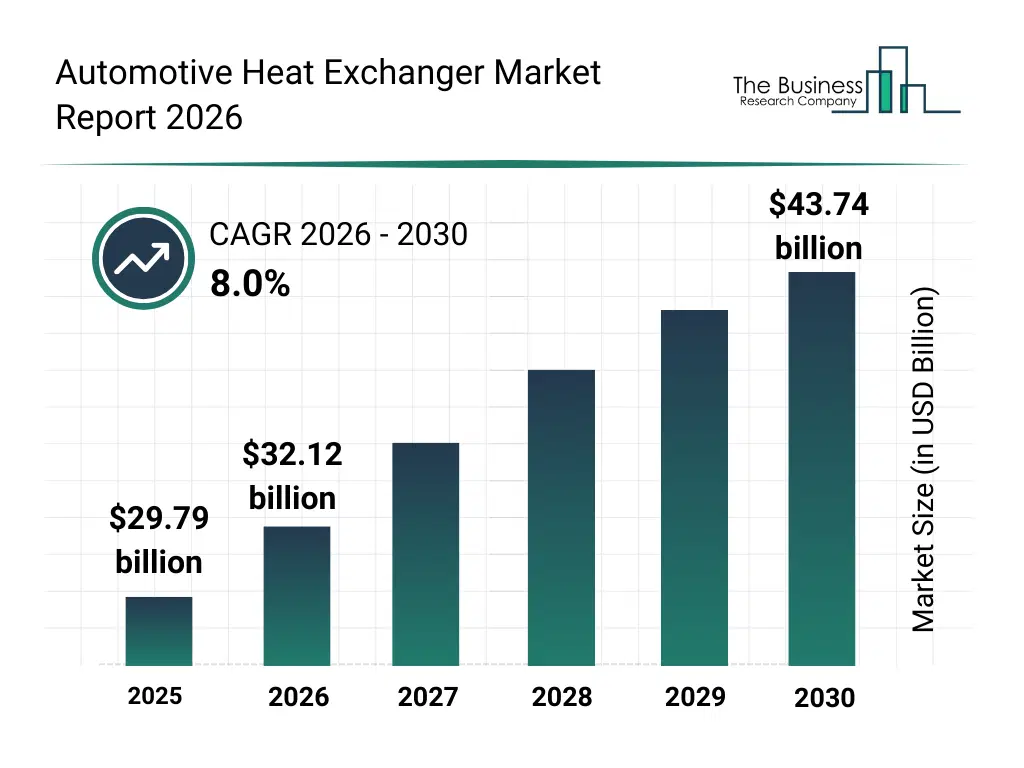
What Is The Automotive Heat Exchanger Market Size and Share 2026?
The automotive heat exchanger market size has grown strongly in recent years. It will grow from $29.79 billion in 2025 to $32.12 billion in 2026 at a compound annual growth rate (CAGR) of 7.8%. The growth in the historic period can be attributed to engine downsizing trends, growth in vehicle production, adoption of aluminum radiators, demand for engine cooling, fuel efficiency improvements.What Is The Automotive Heat Exchanger Market Growth Forecast?
The automotive heat exchanger market size is expected to see strong growth in the next few years. It will grow to $43.74 billion in 2030 at a compound annual growth rate (CAGR) of 8.0%. The growth in the forecast period can be attributed to ev penetration growth, battery thermal management demand, stricter emission norms, lightweight vehicle design focus, advanced materials innovation. Major trends in the forecast period include demand for advanced thermal management, growth of ev cooling systems, lightweight heat exchanger designs, integration of multi-functional heat exchangers, use of aluminum and advanced alloys.
Global Automotive Heat Exchanger Market Segmentation
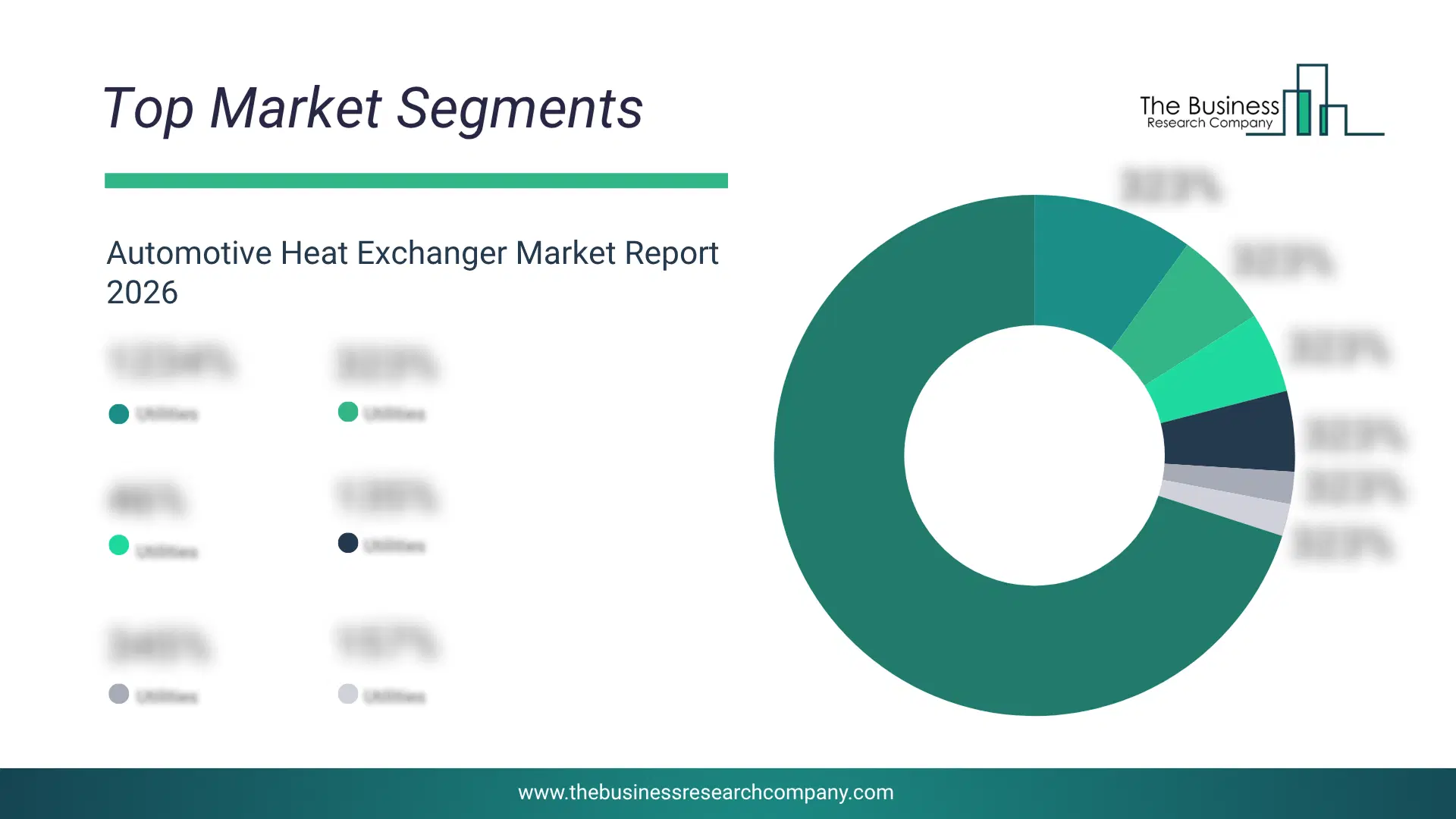
1) By Design Type: Tube Fin, Plate Bar 2) By Vehicle Type: Passenger Car, Light Commercial Vehicle, Heavy Commercial Vehicle 3) By Electric Vehicle: Battery Electric Vehicle (BEV), Hybrid Electric Vehicle (HEV), Plug-In Hybrid Electric Vehicle (PHEV) 4) By Application: Radiators, Oil Coolers, Intercoolers, Air Conditioning Systems, Exhaust Gas Heat Exchangers, Other Applications Subsegments: 1) By Tube Fin: Round Tube Fin Heat Exchangers, Flat Tube Fin Heat Exchangers 2) By Plate Bar: Brazed Plate Heat Exchangers, Gasketed Plate Heat ExchangersWhat Is The Driver Of The Automotive Heat Exchanger Market?
The increasing production of commercial and passenger vehicles is significantly contributing to the growth of the automotive heat exchanger market. Passenger vehicles are automobiles that are used to transport passengers, whereas commercial vehicles transport a larger number of people for business purposes. The high production of automobiles requires a large number of automotive parts, including automotive heat exchangers, to be installed in the new vehicle, thereby promoting the automotive heat exchanger market's growth. For instance, in August 2024, according to the European Automobile Manufacturers' Association, a Belgium-based organization, Seven months into 2024, new car registrations rose by 3.9%, exceeding 6.5 million units. The largest markets in the bloc demonstrated positive yet modest growth, with Spain (+5.6%), Italy (+5.2%), Germany (+4.3%), and France (+2.2%) all reporting increases. Therefore, the increasing production of commercial and passenger vehicles is expected to propel the growth of the automative heat exchanger market going forward.Key Players In The Global Automotive Heat Exchanger Market
Major companies operating in the automotive heat exchanger market report include Denso Corporation, MAHLE GmbH, Valeo SA, Hanon Systems, Dana Incorporated, Modine Manufacturing Company, T RAD Co Ltd, Sanden Holdings Corporation, Banco Products Ltd, Tata AutoComp Systems Ltd, Adrad Pty Ltd, AKG Group, Keihin Corporation, Marelli Corporation, Nippon Light Metal Company Ltd, Calsonic Kansei Corporation, Behr GmbH, Vitesco Technologies, Pranav Vikas India Pvt Ltd, Senior plc, Aisan Industry Co Ltd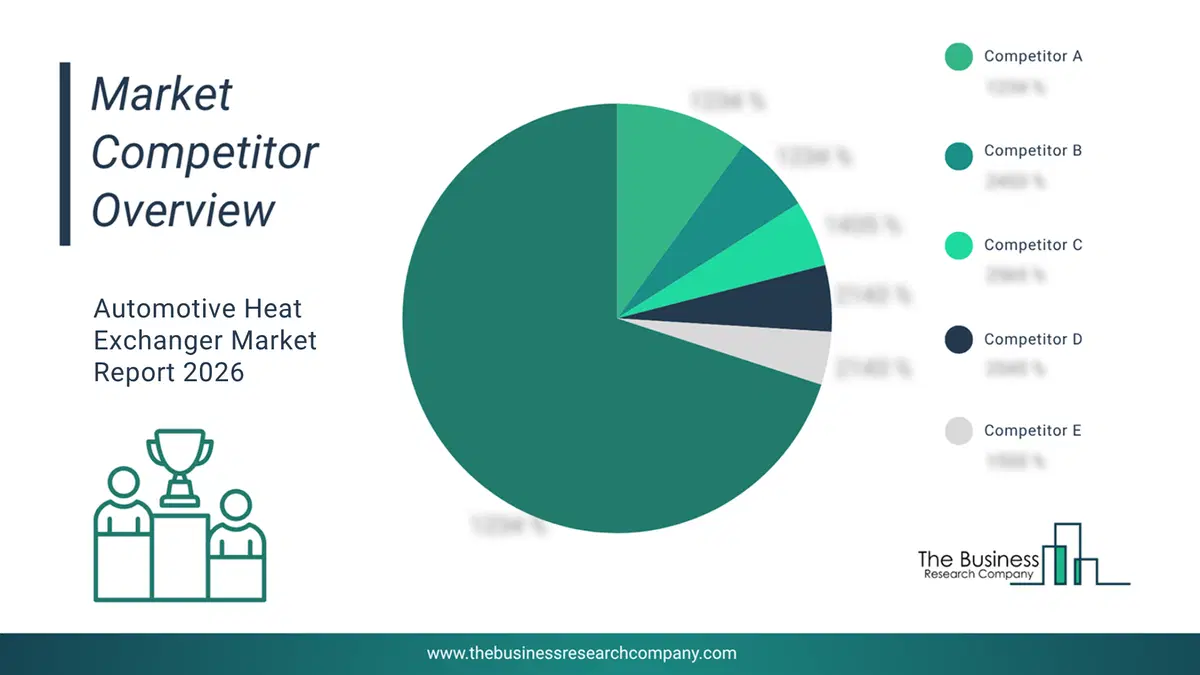
This chart is for illustrative purposes; the full report includes a detailed competitor analysis and comprehensive overview of the top 10 companies in the market.
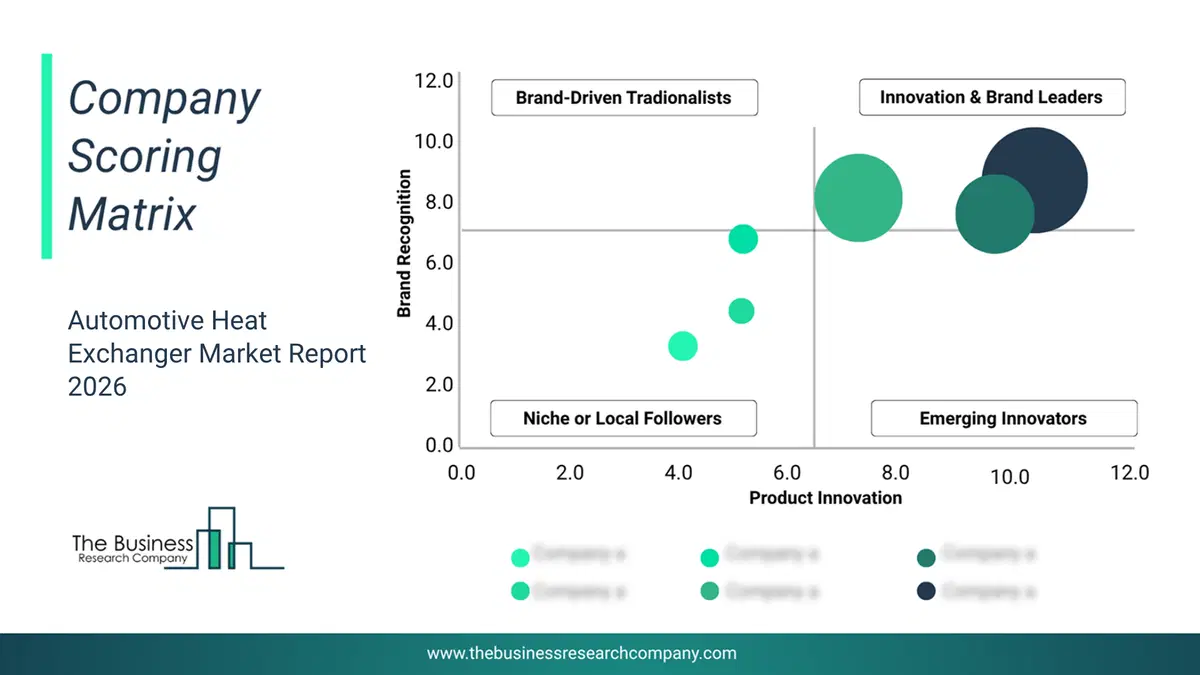
This chart maps companies by product innovation and brand strength, with bubble size indicating relative revenue, helping identify market leaders, challengers, and niche players. This is an illustrative chart; the full report provides a complete and accurate competitive analysis.
Global Automotive Heat Exchanger Market Trends and Insights
Major companies operating in the automotive heat exchanger market are focusing on innovating products with technology, such as Braze Plate Heat Exchangers (BPHE), to gain a competitive edge in the market. Braze Plate Heat Exchangers (BPHE) are a type of heat exchanger technology used in various automotive applications, such as engine cooling, air conditioning, and heat recovery units. For instance, in October 2023, Sanhua Holding Group Co., Ltd., a China-based manufacturer of controls and components for automotive air conditioning and thermal management industries, launched Braze Plate Heat Exchangers (BPHE). Braze Plate Heat Exchangers (BPHE) consist of several corrugated plates with a brazing material between each plate, forming the channel in which the fluids flow.What Are Latest Mergers And Acquisitions In The Automotive Heat Exchanger Market?
In October 2024, Wieland Group, a Germany-based manufacturer of semi-finished products, acquired Onda S.p.A for an undisclosed amount. The acquisition is intended to enhance Wieland's air-conditioning and refrigeration business while expanding its presence in the rapidly growing heat exchanger and data center cooling markets. Onda S.p.A. is an Italy-based manufacturer of automotive heat exchangers.
Regional Outlook
Asia-Pacific was the largest region in the automotive heat exchanger market in 2025.Asia-Pacific is expected to be the fastest growing region in the forecast period. The regions covered in this market report include Asia-Pacific, South East Asia, Western Europe, Eastern Europe, North America, South America, Middle East, Africa. The countries covered in this market report include Australia, Brazil, China, France, Germany, India, Indonesia, Japan, Taiwan, Russia, South Korea, UK, USA, Canada, Italy, SpainWhat Defines the Automotive Heat Exchanger Market?
The automotive heat exchanger market consists of sales of double-pipe heat exchanger, shell-and-tube heat exchanger, plate heat exchanger and condensers and boilers heat exchangers. Values in this market are ‘factory gate’ values, that is the value of goods sold by the manufacturers or creators of the goods, whether to other entities (including downstream manufacturers, wholesalers, distributors and retailers) or directly to end customers. The value of goods in this market includes related services sold by the creators of the goods.How is Market Value Defined and Measured?
The market value is defined as the revenues that enterprises gain from the sale of goods and/or services within the specified market and geography through sales, grants, or donations in terms of the currency (in USD unless otherwise specified). The revenues for a specified geography are consumption values that are revenues generated by organizations in the specified geography within the market, irrespective of where they are produced. It does not include revenues from resales along the supply chain, either further along the supply chain or as part of other products.
This chart presents market attractiveness based on a quantitative evaluation of growth, competition, strategic alignment, and risk, offering a clear view of opportunity areas for decision-making. This chart is for illustrative purposes; the full report contains the complete analysis.

This chart highlights the Total Addressable Market (TAM) by estimating the maximum revenue opportunity using an assumption-driven approach, supporting strategic planning and opportunity sizing across markets. The chart is illustrative; the full report provides a more comprehensive analysis.
What Key Data and Analysis Are Included in the Automotive Heat Exchanger Market Report 2026?
The automotive heat exchanger market research report is one of a series of new reports from The Business Research Company that provides market statistics, including industry global market size, regional shares, competitors with the market share, detailed market segments, market trends and opportunities, and any further data you may need to thrive in the automotive heat exchanger industry. The market research report delivers a complete perspective of everything you need, with an in-depth analysis of the current and future state of the industry.Automotive Heat Exchanger Market Report Forecast Analysis
| Report Attribute | Details |
|---|---|
| Market Size Value In 2026 | $32.12 billion |
| Revenue Forecast In 2030 | $43.74 billion |
| Growth Rate | CAGR of 7.8% from 2026 to 2030 |
| Base Year For Estimation | 2025 |
| Actual Estimates/Historical Data | 2020-2025 |
| Forecast Period | 2026 - 2030 - 2030 |
| Market Representation | Revenue in USD Billion and CAGR from 2026 to 2030 |
| Segments Covered | Design Type, Vehicle Type, Electric Vehicle, Application |
| Regional Scope | Asia-Pacific, Western Europe, Eastern Europe, North America, South America, Middle East, Africa |
| Country Scope | The countries covered in the report are Australia, Brazil, China, France, Germany, India, Indonesia, Japan, Taiwan, Russia, South Korea, UK, USA, Canada, Italy, Spain. |
| Key Companies Profiled | Denso Corporation, MAHLE GmbH, Valeo SA, Hanon Systems, Dana Incorporated, Modine Manufacturing Company, T RAD Co Ltd, Sanden Holdings Corporation, Banco Products Ltd, Tata AutoComp Systems Ltd, Adrad Pty Ltd, AKG Group, Keihin Corporation, Marelli Corporation, Nippon Light Metal Company Ltd, Calsonic Kansei Corporation, Behr GmbH, Vitesco Technologies, Pranav Vikas India Pvt Ltd, Senior plc, Aisan Industry Co Ltd |
| Customization Scope | Request for Customization |
| Pricing And Purchase Options | Explore Purchase Options |