
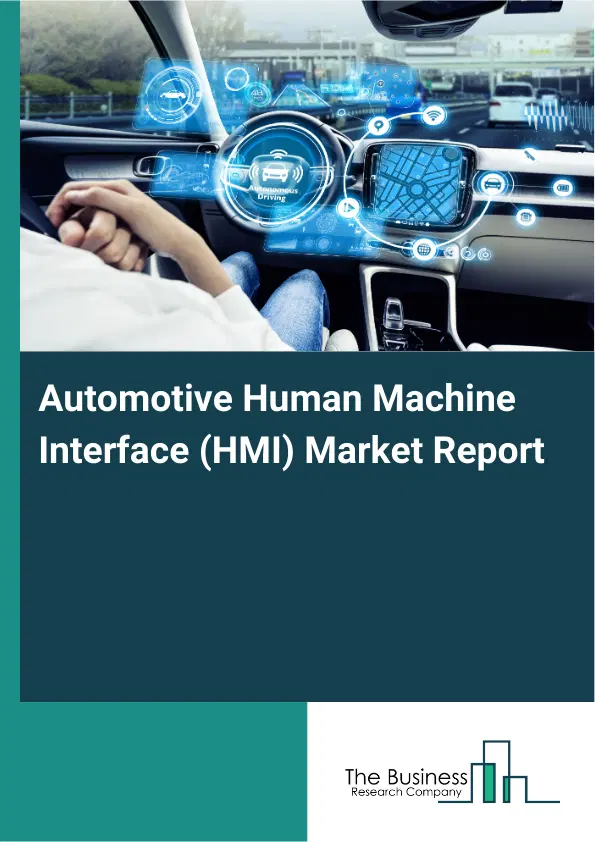
Automotive Human Machine Interface (HMI) Market Report 2026
Global Outlook – By Product Type (Voice Control, Central Display, Instrument Cluster, Steering Mounted Control, Rear-Seat Entertainment (RSE) Display, Heads-Up Display (HUD)), By Technology (Visual Interface, Acoustic, Mechanical, Other Technologies), By Access Type (Standard, Multimodal), By Vehicle Type (Passenger Cars, Commercial Vehicle) – Market Size, Trends, Strategies, and Forecast to 2030
Automotive Human Machine Interface (HMI) Market Overview
• Automotive Human Machine Interface (HMI) market size has reached to $25.9 billion in 2025 • Expected to grow to $42.13 billion in 2030 at a compound annual growth rate (CAGR) of 10% • Growth Driver: Autonomous Vehicles Drive Growth In Automotive HMI Market • Market Trend: Advancements In Mixed Reality Interfaces Enhance Immersive Interaction In Automotive Human-Machine Interface (HMI) Systems • North America was the largest region in 2025.What Is Covered Under Automotive Human Machine Interface (HMI) Market?
Automotive human-machine interfaces (HMI) refer to the technology and systems that enable interaction between humans (drivers and passengers) and the various electronic and mechanical components of a vehicle. It is used for a variety of purposes aimed at enhancing the interaction between drivers, passengers, and vehicle systems. The main product types of automotive HMI are voice control, central display, instrument cluster, steering mounted control, rear-seat entertainment (RSE) display, and heads-up display (HUD). The voice control interface in automotive HMI enables users to operate vehicle systems and access features using spoken commands, offering hands-free operation and improving driver safety and convenience. The various technologies involved visual interface, acoustic, mechanical, and other technologies used in various access types including standard and multimodal used for different vehicle types such as passenger cars, and commercial vehicles.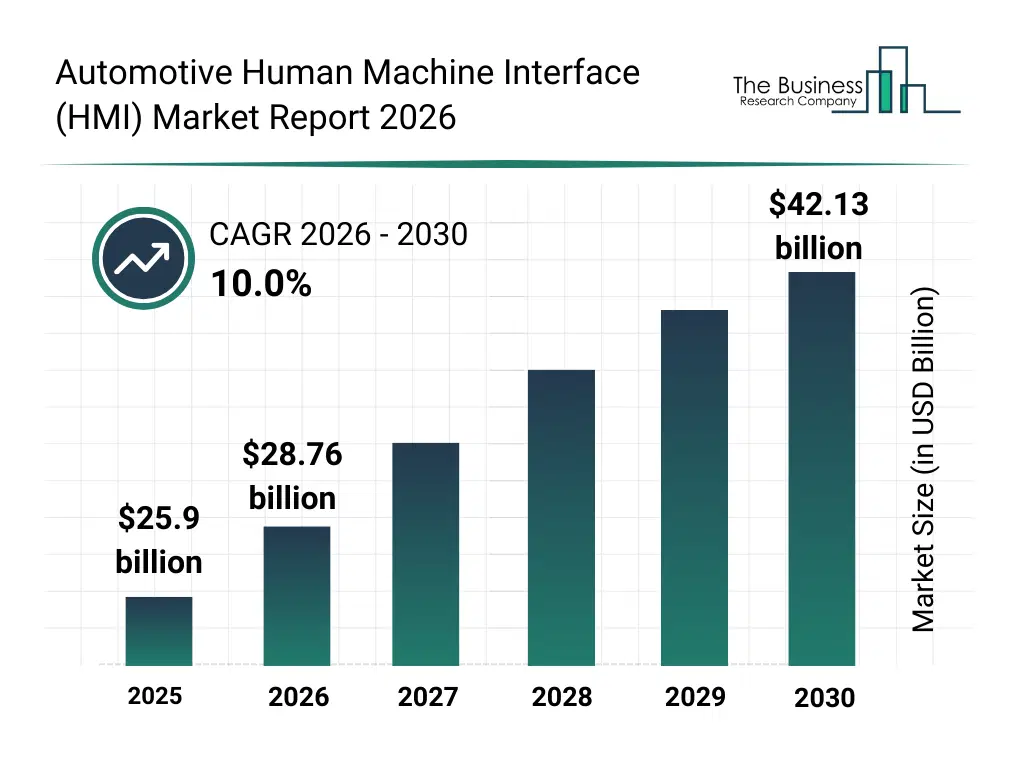
What Is The Automotive Human Machine Interface (HMI) Market Size and Share 2026?
The automotive human machine interface (hmi) market size has grown rapidly in recent years. It will grow from $25.9 billion in 2025 to $28.76 billion in 2026 at a compound annual growth rate (CAGR) of 11.0%. The growth in the historic period can be attributed to increasing vehicle electrification, infotainment system adoption, demand for enhanced driver experience, growth in passenger car production, integration of digital clusters.What Is The Automotive Human Machine Interface (HMI) Market Growth Forecast?
The automotive human machine interface (hmi) market size is expected to see rapid growth in the next few years. It will grow to $42.13 billion in 2030 at a compound annual growth rate (CAGR) of 10.0%. The growth in the forecast period can be attributed to autonomous vehicle development, demand for intuitive interfaces, software-defined vehicles, connectivity integration, advanced driver assistance systems. Major trends in the forecast period include expansion of touchscreen and digital displays, growing adoption of voice-based interfaces, integration of augmented reality huds, rising demand for multimodal hmi systems, enhanced focus on driver safety interfaces.
Global Automotive Human Machine Interface (HMI) Market Segmentation
1) By Product Type: Voice Control, Central Display, Instrument Cluster, Steering Mounted Control, Rear-Seat Entertainment (RSE) Display, Heads-Up Display (HUD) 2) By Technology: Visual Interface, Acoustic, Mechanical, Other Technologies 3) By Access Type: Standard, Multimodal 4) By Vehicle Type: Passenger Cars, Commercial Vehicle Subsegments: 1) By Voice Control: Voice-Activated Infotainment Systems, Voice-Controlled Navigation And Maps, Voice Assistance For Climate Control, Speech Recognition For Safety Features (Emergency Calls) 2) By Central Display: Touchscreen Displays, Multi-Functional Display Units (Mfd), Infotainment And Navigation Screens, Gesture-Controlled Displays 3) By Instrument Cluster: Analog Instrument Clusters, Digital Instrument Clusters, Virtual Instrument Clusters, Combined Digital And Analog Clusters, Tft-Icd Instrument Panels 4) By Steering Mounted Control: Steering Wheel Buttons For Infotainment Control, Multi-Function Steering Wheel Controls, Audio And Call Control Buttons, Driver Assistance And Cruise Control Buttons 5) By Rear-Seat Entertainment (Rse) Display: Video Displays For Rear Passengers, Interactive Entertainment Systems For Rear Seats, Touchscreen Rse Systems, Wireless Rse Systems (Wi-Fi Enabled) 6) By Heads-Up Display (Hud): Windshield Projection Hud Systems, Augmented Reality (Ar) Hud Systems, Full-Screen Huds, Navigation And Safety Information Huds, Multi-Layered Display HudsWhat Is The Driver Of The Automotive Human Machine Interface (HMI) Market?
The increasing number of autonomous vehicles is expected to propel the growth of the automotive human-machine interface (HMI) market going forward. Autonomous vehicles are self-driving vehicles that employ advanced sensor technologies, computer systems, and artificial intelligence to operate and navigate without constant human intervention or monitoring. The increasing number of autonomous vehicles is due to advancements in artificial intelligence and sensor technology, along with substantial investment and support from private companies and governments to enhance safety and efficiency in transportation. Automotive human-machine interfaces (HMIs) play a crucial role in autonomous vehicles by facilitating communication and interaction between the vehicle's systems and its occupants (drivers and passengers). For instance, in December 2024, according to the National Highway Traffic Safety Administration, a US-based government agency, by 2030, an estimated 4.5 million self-driving vehicles will operate on U.S. roads. Therefore, the increasing number of autonomous vehicles drives the growth of the automotive human-machine interface (HMI) market.Key Players In The Global Automotive Human Machine Interface (HMI) Market
Major companies operating in the automotive human machine interface (hmi) market report include Volkswagen AG, Toyota Motor Corporation, Luxoft Holding Inc., Ford Motor Company, General Motors Company, Honda Motor Co. Ltd., Hyundai Motor Group, Robert Bosch GmbH, Tesla Inc., Nissan Motor Co. Ltd., Kia Corporation, Panasonic Corporation, Denso Corporation, Continental AG, Valeo S.A., Mitsubishi Motors Corporation, Aptiv PLC, HARMAN International Industries Incorporated, Alpine Electronics Inc., Visteon Corporation, Synaptics Incorporated, Nuance Communications Inc., Clarion Co. Ltd., Tata Elxsi Limited, Magneti Marelli S.p.A.
This chart is for illustrative purposes; the full report includes a detailed competitor analysis and comprehensive overview of the top 10 companies in the market.
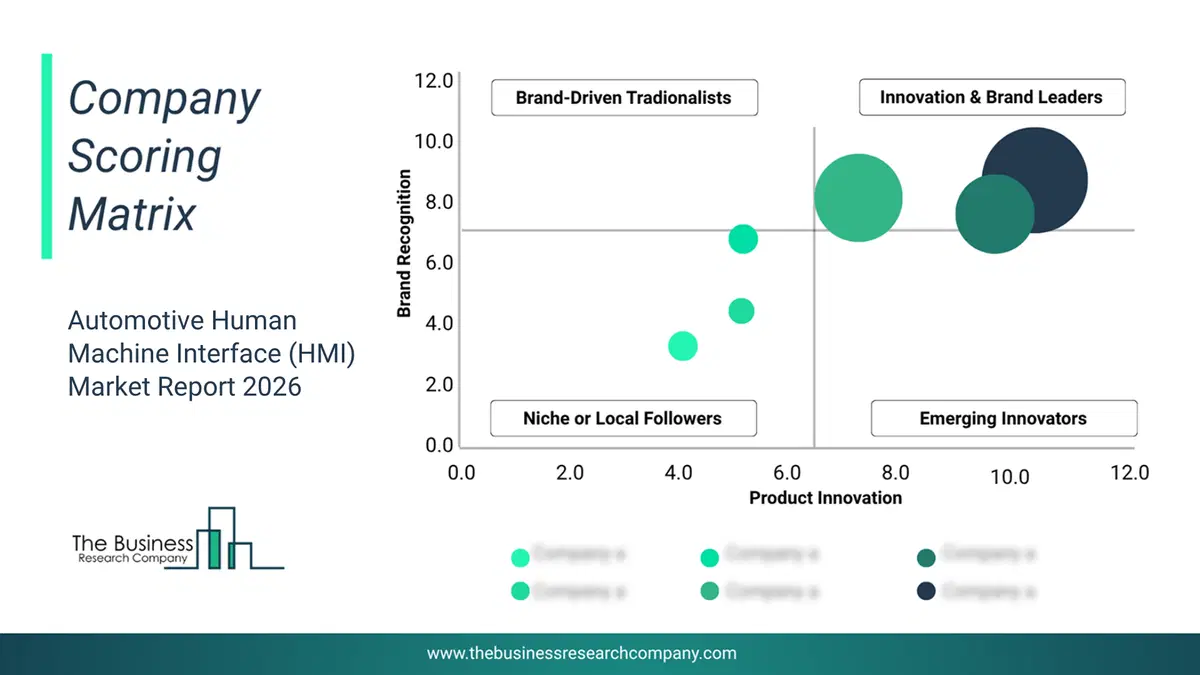
This chart maps companies by product innovation and brand strength, with bubble size indicating relative revenue, helping identify market leaders, challengers, and niche players. This is an illustrative chart; the full report provides a complete and accurate competitive analysis.
Global Automotive Human Machine Interface (HMI) Market Trends and Insights
Major companies operating in the automotive human-machine interface (HMI) market are focusing on developing advanced solutions, such as mixed reality interfaces, to enhance user engagement, improve driving interaction, and deliver a more intuitive in-vehicle experience. Mixed reality interfaces merge physical and digital elements to create immersive interaction environments for drivers and passengers. For instance, in January 2023, BMW, a Germany-based automotive manufacturer, unveiled the I Vision Dee concept, a next-generation HMI innovation featuring a full-width head-up display that replaces traditional touchscreens. The concept integrates a mixed reality slider embedded within the dashboard fabric, enabling users to adjust levels of digital content, along with touch-sensitive controls seamlessly incorporated into the doors and center console. Its minimalist interior uses sustainable materials and monotone styling, while the exterior showcases color-changing e-ink panels, digital LED headlights with expressive animations, and personalized welcome projections. The i Vision Dee previews BMW’s upcoming Neue Klasse models expected to enter production in 2025, setting a new benchmark for immersive, adaptive automotive HMI technologies.What Are Latest Mergers And Acquisitions In The Automotive Human Machine Interface (HMI) Market?
In June 2023, Magna International Inc., a Canada-based automotive parts manufacturer, acquired Veoneer Active Safety Business from SSW Partners for an undisclosed sum. With this acquisition, Magna aims to strengthen its position as a leading supplier of advanced driver assistance systems (ADAS) and autonomous driving technologies by integrating Veoneer's active safety business to enhance its capabilities, improve its technological portfolio, and accelerate the innovation and deployment of advanced safety and automation features in vehicles. Veoneer AB is a Sweden-based company that develops advanced driver assistance systems (ADAS).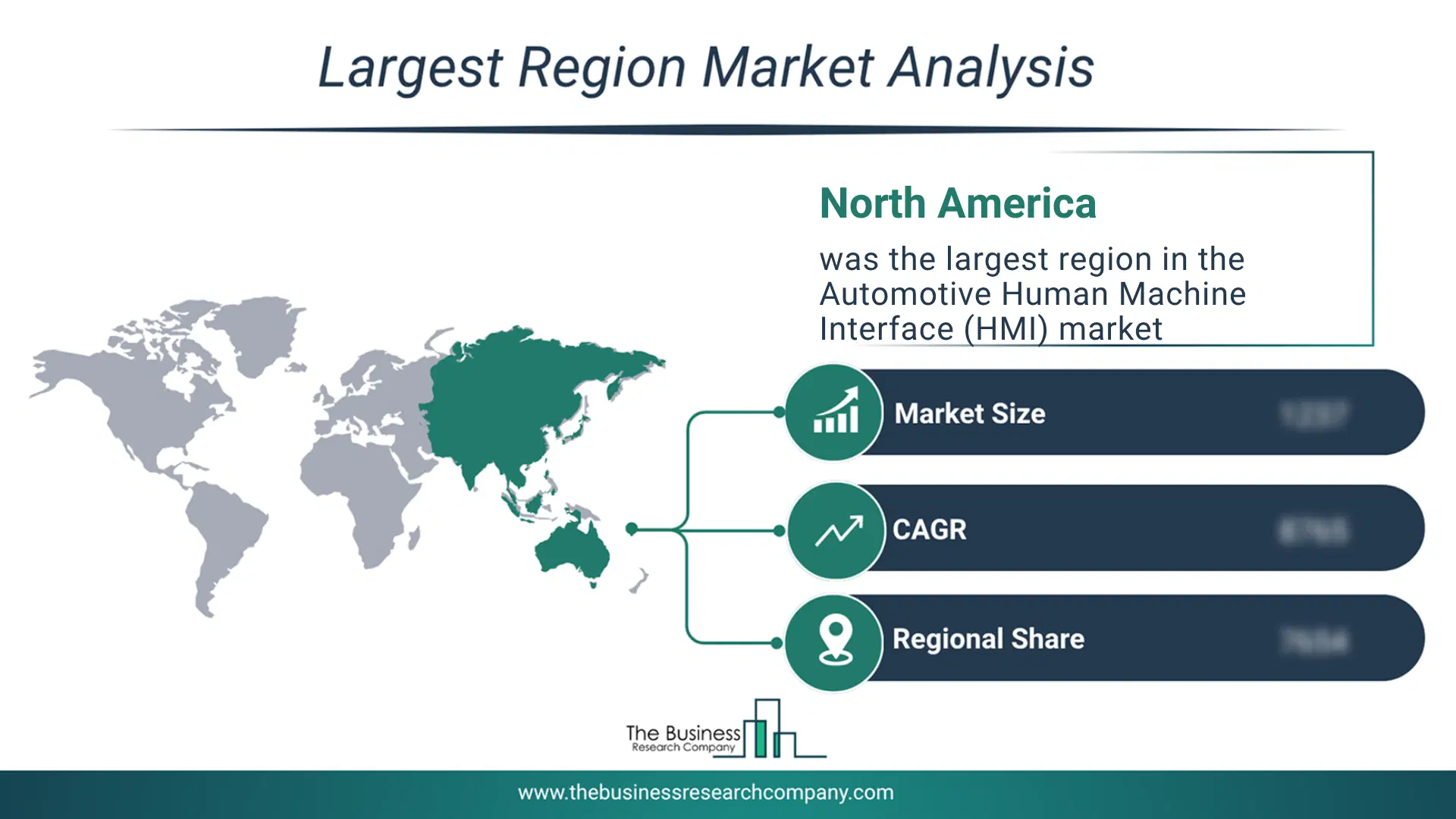
Regional Outlook
North America was the largest region in the automotive human machine interface (HMI) market in 2025. The regions covered in this market report include Asia-Pacific, South East Asia, Western Europe, Eastern Europe, North America, South America, Middle East, Africa. The countries covered in this market report include Australia, Brazil, China, France, Germany, India, Indonesia, Japan, Taiwan, Russia, South Korea, UK, USA, Canada, Italy, SpainWhat Defines the Automotive Human Machine Interface (HMI) Market?
The automotive human-machine interfaces (HMI) market includes revenues earned by entities by providing services such as voice recognition systems, gesture recognition, touchscreen displays, steering-mounted controls, and head-up displays. The market value includes the value of related goods sold by the service provider or included within the service offering. The automotive human-machine interfaces (HMI) market consists of sales of infotainment systems, instrument clusters, steering wheel controls, window and door controls, and advanced driver assistance systems (ADAS). Values in this market are ‘factory gate’ values, that is the value of goods sold by the manufacturers or creators of the goods, whether to other entities (including downstream manufacturers, wholesalers, distributors and retailers) or directly to end customers. The value of goods in this market includes related services sold by the creators of the goods.How is Market Value Defined and Measured?
The market value is defined as the revenues that enterprises gain from the sale of goods and/or services within the specified market and geography through sales, grants, or donations in terms of the currency (in USD unless otherwise specified). The revenues for a specified geography are consumption values that are revenues generated by organizations in the specified geography within the market, irrespective of where they are produced. It does not include revenues from resales along the supply chain, either further along the supply chain or as part of other products.
This chart presents market attractiveness based on a quantitative evaluation of growth, competition, strategic alignment, and risk, offering a clear view of opportunity areas for decision-making. This chart is for illustrative purposes; the full report contains the complete analysis.

This chart highlights the Total Addressable Market (TAM) by estimating the maximum revenue opportunity using an assumption-driven approach, supporting strategic planning and opportunity sizing across markets. The chart is illustrative; the full report provides a more comprehensive analysis.
What Key Data and Analysis Are Included in the Automotive Human Machine Interface (HMI) Market Report 2026?
The automotive human machine interface (hmi) market research report is one of a series of new reports from The Business Research Company that provides market statistics, including industry global market size, regional shares, competitors with the market share, detailed market segments, market trends and opportunities, and any further data you may need to thrive in the automotive human machine interface (hmi) industry. The market research report delivers a complete perspective of everything you need, with an in-depth analysis of the current and future state of the industry.Automotive Human Machine Interface (HMI) Market Report Forecast Analysis
| Report Attribute | Details |
|---|---|
| Market Size Value In 2026 | $28.76 billion |
| Revenue Forecast In 2030 | $42.13 billion |
| Growth Rate | CAGR of 11.0% from 2026 to 2030 |
| Base Year For Estimation | 2025 |
| Actual Estimates/Historical Data | 2020-2025 |
| Forecast Period | 2026 - 2030 - 2030 |
| Market Representation | Revenue in USD Billion and CAGR from 2026 to 2030 |
| Segments Covered | Product Type, Technology, Access Type, Vehicle Type |
| Regional Scope | Asia-Pacific, Western Europe, Eastern Europe, North America, South America, Middle East, Africa |
| Country Scope | The countries covered in the report are Australia, Brazil, China, France, Germany, India, Indonesia, Japan, Taiwan, Russia, South Korea, UK, USA, Canada, Italy, Spain. |
| Key Companies Profiled | Volkswagen AG, Toyota Motor Corporation, Luxoft Holding Inc., Ford Motor Company, General Motors Company, Honda Motor Co. Ltd., Hyundai Motor Group, Robert Bosch GmbH, Tesla Inc., Nissan Motor Co. Ltd., Kia Corporation, Panasonic Corporation, Denso Corporation, Continental AG, Valeo S.A., Mitsubishi Motors Corporation, Aptiv PLC, HARMAN International Industries Incorporated, Alpine Electronics Inc., Visteon Corporation, Synaptics Incorporated, Nuance Communications Inc., Clarion Co. Ltd., Tata Elxsi Limited, Magneti Marelli S.p.A. |
| Customization Scope | Request for Customization |
| Pricing And Purchase Options | Explore Purchase Options |