
Automotive Human-Machine Interfaces Market Report 2026
Global Outlook – By Product (Central Display, Voice Control System, Steering Mounted Control, Instrument Cluster, Head-Up Display, Rear Seat Entertainment, Multifunction Switch), By Technology (Visual Interface, Acoustic Interface, Other Technologies), By Access (Standard HMI, Multimodal HMI), By Function type (Primary, Secondary), By End User (Passenger Vehicle, Commercial Vehicle) – Market Size, Trends, Strategies, and Forecast to 2030
Automotive Human-Machine Interfaces Market Overview
• Automotive Human-Machine Interfaces market size has reached to $25.37 billion in 2025 • Expected to grow to $43.39 billion in 2030 at a compound annual growth rate (CAGR) of 11.3% • Growth Driver: Rising Passenger Car Demand Driving Automotive Human-Machine Interfaces Market • Market Trend: Advancing Next-Generation Vehicle Interaction Through Smart Digital Platforms • North America was the largest region in 2025 and Asia-Pacific is the fastest growing region.What Is Covered Under Automotive Human-Machine Interfaces Market?
The automotive human-machine interfaces refer to functions and elements of hardware and software, or a dashboard used in automobiles, that enable occupants to interact with the vehicle and the outside environment. The automotive human-machine interfaces help consumers comprehend in-car technology, safely drive their vehicles, and feel at ease and in control as self-driving technology becomes more accessible. It includes voice-activated navigation system touchscreens, steering wheel buttons, displays, and driving assistance tools. The main products of automotive human-machine interfaces are the central display, voice control system, steering-mounted control, instrument cluster, head-up display, rear seat entertainment, and multifunction switch. The central display refers to an infotainment display system that includes various interactive content, such as navigation, cabin temperature controls, music, or entertainment information. The interfaces are visual interfaces, acoustic interfaces, and other technologies that have standard HMI and multimodal HMI access that have primary and secondary functions and are suitable for passenger vehicles and commercial vehicles.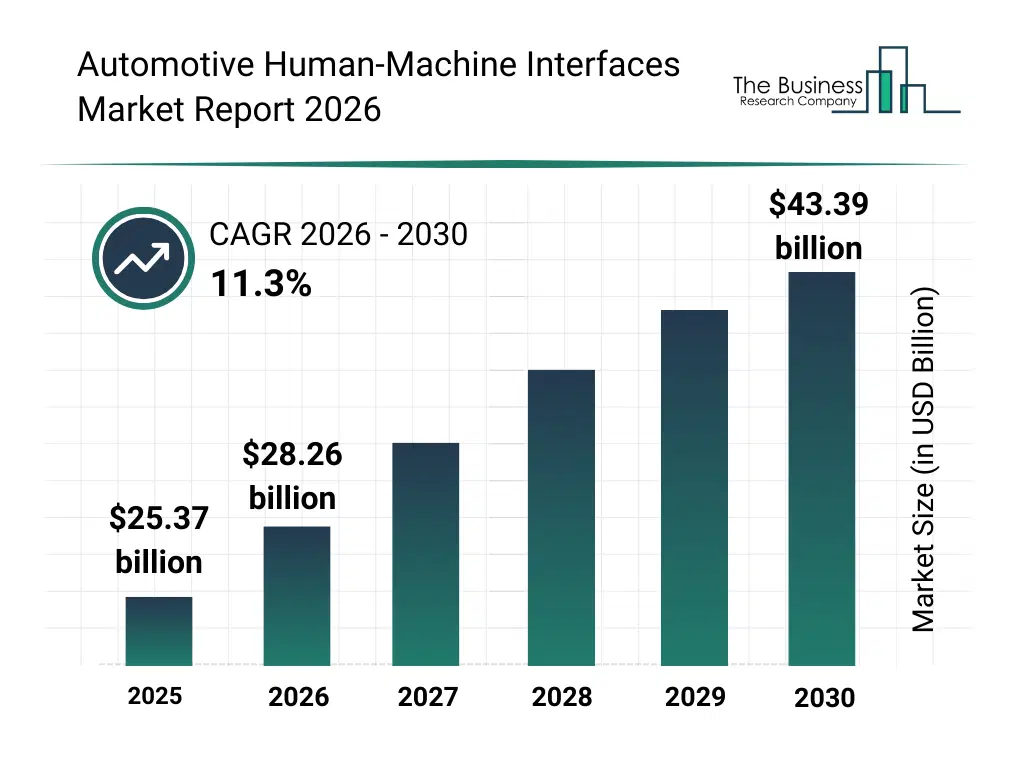
What Is The Automotive Human-Machine Interfaces Market Size and Share 2026?
The automotive human-machine interfaces market size has grown rapidly in recent years. It will grow from $25.37 billion in 2025 to $28.26 billion in 2026 at a compound annual growth rate (CAGR) of 11.4%. The growth in the historic period can be attributed to infotainment evolution, touchscreen penetration, consumer demand for connectivity, advanced driver assistance adoption, cockpit digitization.What Is The Automotive Human-Machine Interfaces Market Growth Forecast?
The automotive human-machine interfaces market size is expected to see rapid growth in the next few years. It will grow to $43.39 billion in 2030 at a compound annual growth rate (CAGR) of 11.3%. The growth in the forecast period can be attributed to autonomous vehicle readiness, ai-driven interfaces, ev interior innovation, immersive display demand, software-defined vehicles. Major trends in the forecast period include adoption of digital cockpits, growth of voice-based interfaces, integration of touch and gesture controls, demand for enhanced driver experience, expansion of hud systems.
Global Automotive Human-Machine Interfaces Market Segmentation
1) By Product: Central Display, Voice Control System, Steering Mounted Control, Instrument Cluster, Head-Up Display, Rear Seat Entertainment, Multifunction Switch 2) By Technology: Visual Interface, Acoustic Interface, Other Technologies 3) By Access: Standard HMI, Multimodal HMI 4) By Function type: Primary, Secondary 5) By End User: Passenger Vehicle, Commercial Vehicle Subsegments: 1) By Central Display: Touchscreen Displays, Multi-Functional Displays 2) By Voice Control System: Voice Recognition Systems, Natural Language Processing Interfaces 3) By Steering Mounted Control: Audio Control Buttons, Cruise Control Functions 4) By Instrument Cluster: Analog Instrument Clusters, Digital Instrument Clusters, Head-Up Display Integration 5) By Head-Up Display (HUD): Combiner HUD, Windshield HUD 6) By Rear Seat Entertainment: Individual Screen Systems, Streaming Services Integration 7) By Multifunction Switch: Turn Signal Switches, Wiper Control Switches, Lighting Control SwitchesWhat Is The Driver Of The Automotive Human-Machine Interfaces Market?
Increasing demand for passenger cars is expected to propel the growth of the automotive human-machine interfaces market going forward. Passenger cars are vehicles designed primarily for the transportation of passengers and typically carry a small number of people, ranging from one to five. Automotive human-machine interfaces in passenger cars enhance the driving experience by providing intuitive controls, seamless connectivity, and advanced infotainment features, contributing to both convenience and safety for passengers. For instance, in July 2023, according to the Society of Motor Manufacturers and Traders, a UK-based trade association, Honda Motor Co., Ltd. sales increased from 1,678 units in 2022 to 1,925 units in 2023, representing a growth of 14.75%. Additionally, Nissan Motor Co. Ltd.'s car sales rose to 6,087 units in 2023, compared to 4,662 in 2022, an increase of 30.57%. Therefore, the increasing demand for passenger cars is driving the growth of the automotive human-machine interfaces industry.Key Players In The Global Automotive Human-Machine Interfaces Market
Major companies operating in the automotive human-machine interfaces market report include Continental AG, Visteon Corporation, Valeo India Pvt. Ltd., Panasonic Corporation, Denso Corporation, YAZAKI Corporation, Harman International, Robert Bosch GmbH, Clarion Company Limited, Alpine Electronics Inc., Magneti Marelli SPA, Nuance Communications Inc, Socionext Inc., Tata Group, Synaptics Incorporated, Nippon Seiki Company Limited, Luxoft Holding Inc., Aptiv PLC, Delphi Technologies PLC, Elektrobit Automotive GmbH, Valeo S.A., EAO AG, Alpine Electronics Inc., Altran Technologies SA, Pioneer Corporation, Garmin Ltd., TomTom International BV, Yazaki Corporation, Faurecia S.A.
This chart is for illustrative purposes; the full report includes a detailed competitor analysis and comprehensive overview of the top 10 companies in the market.
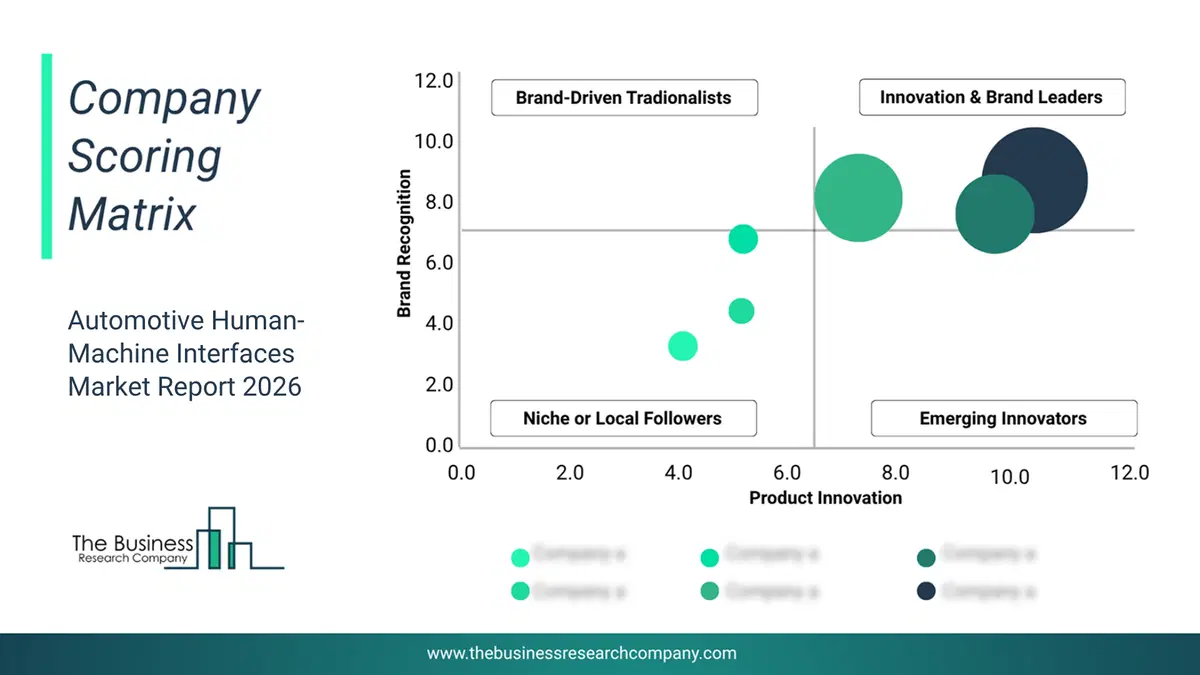
This chart maps companies by product innovation and brand strength, with bubble size indicating relative revenue, helping identify market leaders, challengers, and niche players. This is an illustrative chart; the full report provides a complete and accurate competitive analysis.
Global Automotive Human-Machine Interfaces Market Trends and Insights
Major companies operating in the automotive human-machine interfaces market are focusing on developing advanced digital cockpit solutions, such as portable integrated HMI platforms, to enhance driver interaction, streamline vehicle system management, and support software-defined vehicle development. A portable integrated HMI platform is a system that combines hardware and software to provide an interactive interface for vehicle occupants, enabling seamless integration with ADAS, infotainment, and connected vehicle systems. For instance, in November 2023, Intellias, a Ukraine-based software engineering company, launched IntelliKit, a next-generation portable digital cockpit integrating Qualcomm’s Snapdragon Automotive Cockpit Platform, Rightware’s Kanzi One HMI kit, and Blackberry IVY Connected Vehicle Data Platform. Designed to assist automakers and mobility solution providers in creating a modern, software-defined driving experience, IntelliKit enables efficient orchestration of diverse automotive IT components, supports real-time data integration, and demonstrates scalable HMI solutions for the next generation of connected vehicles.What Are Latest Mergers And Acquisitions In The Automotive Human-Machine Interfaces Market?
In April 2024, AUO Corporation, a Taiwan-based display technology company, acquired Behr-Hella Thermocontrol GmbH (BHTC) for approximately $651 million (NT$20.4 billion). Through this acquisition, AUO aims to enhance its automotive human-machine interface (HMI) offerings by integrating BHTC’s HMI and climate control systems into its smart cockpit solutions and expanding its portfolio of advanced automotive display and interaction technologies. Behr-Hella Thermocontrol GmbH (BHTC) is a Germany-based company that provides automotive HMI products and climate control systems, serving global automakers with innovative solutions for smart and autonomous vehicles.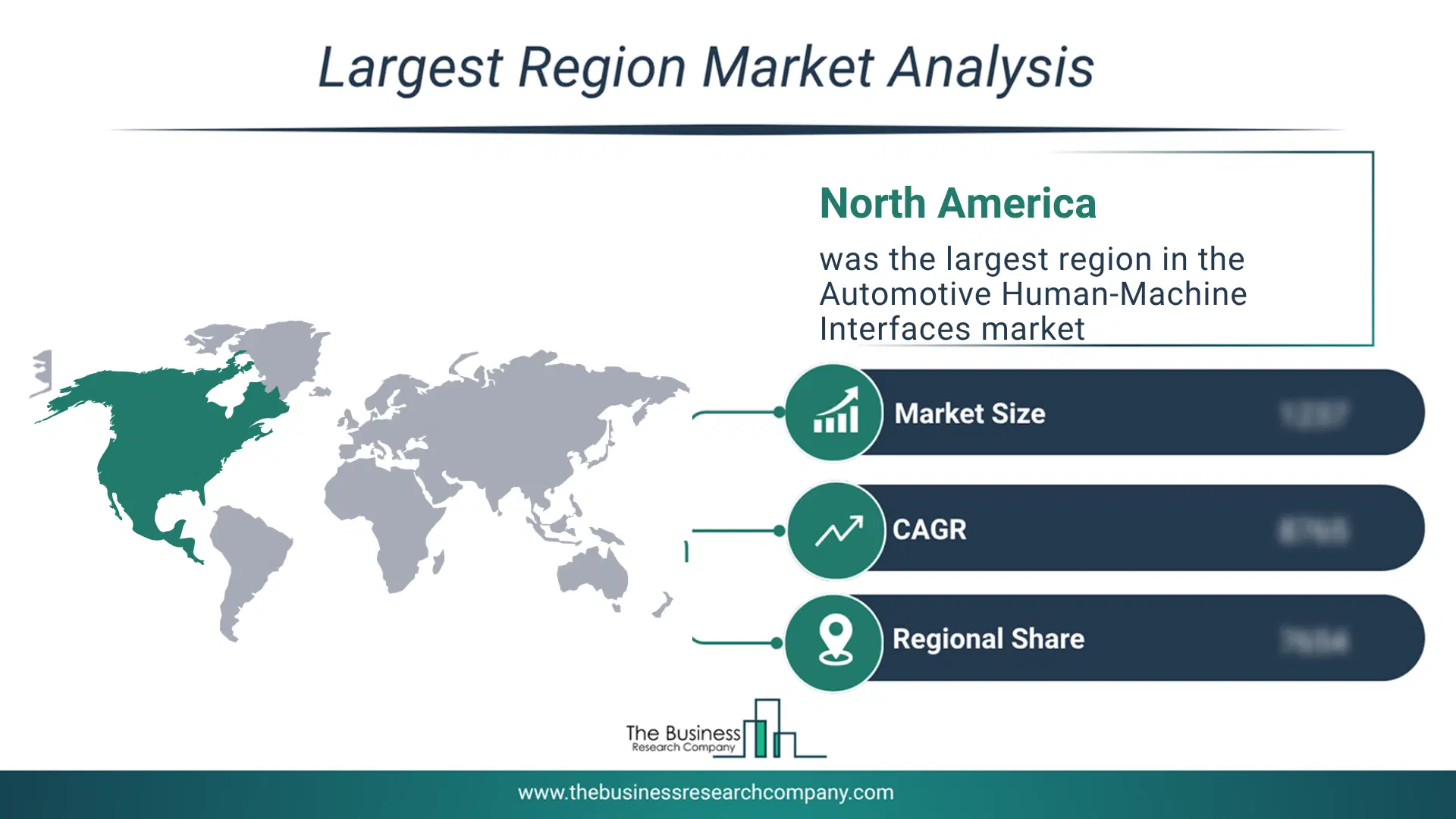
Regional Outlook
North America was the largest region in the automotive human-machine interfaces market in 2025. Asia-Pacific is expected to be the fastest-growing region in the forecast period. The regions covered in this market report include Asia-Pacific, South East Asia, Western Europe, Eastern Europe, North America, South America, Middle East, Africa. The countries covered in this market report include Australia, Brazil, China, France, Germany, India, Indonesia, Japan, Taiwan, Russia, South Korea, UK, USA, Canada, Italy, SpainWhat Defines the Automotive Human-Machine Interfaces Market?
The automotive human-machine interfaces market consists of sales of touch-screen displays and central controllers. Values in this market are ‘factory gate’ values, that is, the value of goods sold by the manufacturers or creators of the goods, whether to other entities (including downstream manufacturers, wholesalers, distributors, and retailers) or directly to end customers. The value of goods in this market includes related services sold by the creators of the goods.How is Market Value Defined and Measured?
The market value is defined as the revenues that enterprises gain from the sale of goods and/or services within the specified market and geography through sales, grants, or donations in terms of the currency (in USD unless otherwise specified). The revenues for a specified geography are consumption values that are revenues generated by organizations in the specified geography within the market, irrespective of where they are produced. It does not include revenues from resales along the supply chain, either further along the supply chain or as part of other products.
This chart presents market attractiveness based on a quantitative evaluation of growth, competition, strategic alignment, and risk, offering a clear view of opportunity areas for decision-making. This chart is for illustrative purposes; the full report contains the complete analysis.

This chart highlights the Total Addressable Market (TAM) by estimating the maximum revenue opportunity using an assumption-driven approach, supporting strategic planning and opportunity sizing across markets. The chart is illustrative; the full report provides a more comprehensive analysis.
What Key Data and Analysis Are Included in the Automotive Human-Machine Interfaces Market Report 2026?
The automotive human-machine interfaces market research report is one of a series of new reports from The Business Research Company that provides market statistics, including industry global market size, regional shares, competitors with the market share, detailed market segments, market trends and opportunities, and any further data you may need to thrive in the automotive human-machine interfaces industry. The market research report delivers a complete perspective of everything you need, with an in-depth analysis of the current and future state of the industry.Automotive Human-Machine Interfaces Market Report Forecast Analysis
| Report Attribute | Details |
|---|---|
| Market Size Value In 2026 | $28.26 billion |
| Revenue Forecast In 2030 | $43.39 billion |
| Growth Rate | CAGR of 11.4% from 2026 to 2030 |
| Base Year For Estimation | 2025 |
| Actual Estimates/Historical Data | 2020-2025 |
| Forecast Period | 2026 - 2030 - 2030 |
| Market Representation | Revenue in USD Billion and CAGR from 2026 to 2030 |
| Segments Covered | Product, Technology, Access, Function type, End User |
| Regional Scope | Asia-Pacific, Western Europe, Eastern Europe, North America, South America, Middle East, Africa |
| Country Scope | The countries covered in the report are Australia, Brazil, China, France, Germany, India, Indonesia, Japan, Taiwan, Russia, South Korea, UK, USA, Canada, Italy, Spain. |
| Key Companies Profiled | Continental AG, Visteon Corporation, Valeo India Pvt. Ltd., Panasonic Corporation, Denso Corporation, YAZAKI Corporation, Harman International, Robert Bosch GmbH, Clarion Company Limited, Alpine Electronics Inc., Magneti Marelli SPA, Nuance Communications Inc, Socionext Inc., Tata Group, Synaptics Incorporated, Nippon Seiki Company Limited, Luxoft Holding Inc., Aptiv PLC, Delphi Technologies PLC, Elektrobit Automotive GmbH, Valeo S.A., EAO AG, Alpine Electronics Inc., Altran Technologies SA, Pioneer Corporation, Garmin Ltd., TomTom International BV, Yazaki Corporation, Faurecia S.A. |
| Customization Scope | Request for Customization |
| Pricing And Purchase Options | Explore Purchase Options |