

Automotive Inner Fenders Market Report 2026
Global Outlook – By Product Type (Front Inner Fender, Rear Inner Fender, Wheel Arch Liner, Splash Shield Or Mud Guard Components), By Material (Polypropylene, Polyethylene, Thermoplastic Olefin, Acrylonitrile Butadiene Styrene Plastic, Composite Materials), By Vehicle Type (Passenger Cars, Light Commercial Vehicles, Heavy Commercial Vehicles, Electric Vehicles), By Manufacturing Process (Injection Molding, Thermoforming, Blow Molding), By End User (Original Equipment Manufacturers, Automotive Repair And Service Centers, Independent Aftermarket Suppliers) – Market Size, Trends, Strategies, and Forecast to 2035
Automotive Inner Fenders Market Overview
• Automotive Inner Fenders market size has reached to $2.58 billion in 2025 • Expected to grow to $3.56 billion in 2030 at a compound annual growth rate (CAGR) of 6.7% • Growth Driver: Growing Vehicle Production Driving The Market Growth Due To Increasing Demand For Durable And Protective Wheel Housing Components • Market Trend: Innovations In Sustainable Polyester Materials Enhance Lightweighting And Environmental Performance Of Automotive Inner Fenders • Asia-Pacific was the largest region and fastest growing region.What Is Covered Under Automotive Inner Fenders Market?
Automotive inner fenders are protective components installed within vehicle wheel wells to shield the body, suspension, braking components, and other adjacent systems from water, mud, stones, road debris, and contaminants. They help protect vehicle components from environmental exposure and can contribute to noise and vibration reduction. Inner fenders are typically manufactured from lightweight, impact-resistant materials to provide durability and long-term protection. The main product types of automotive inner fenders include front inner fenders, rear inner fenders, wheel arch liners, and splash shield or mud guard components. Front inner fenders refer to protective panels fitted inside the wheel well to shield vehicle body components from water, mud, road debris, and other contaminants. These products are made from polypropylene, polyethylene, thermoplastic olefin, acrylonitrile butadiene styrene plastic, and composite materials and are used in passenger cars, light commercial vehicles, heavy commercial vehicles, and electric vehicles. They are manufactured through injection molding, thermoforming, and blow molding processes and are used end users by original equipment manufacturers, automotive repair and service centers, and independent aftermarket suppliers.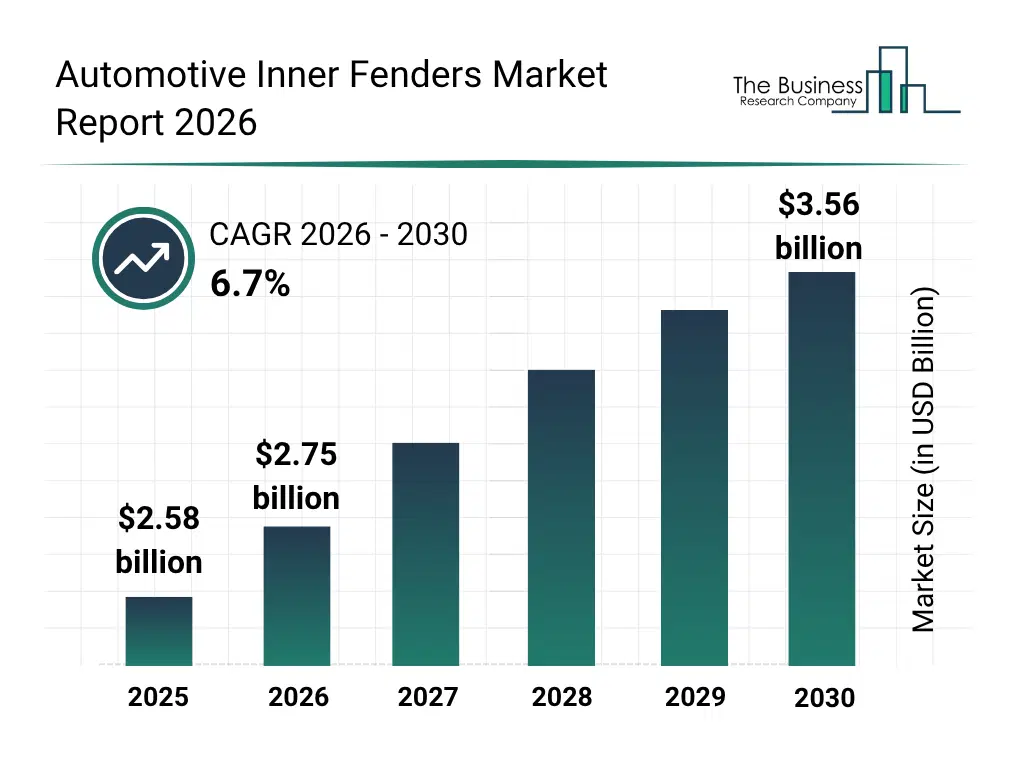
What Is The Automotive Inner Fenders Market Size and Share 2026?
The automotive inner fenders market size has grown strongly in recent years. It will grow from $2.58 billion in 2025 to $2.75 billion in 2026 at a compound annual growth rate (CAGR) of 6.5%. The growth in the historic period can be attributed to increasing vehicle production and sales, rising demand for protection against road debris, growing vehicle usage across diverse road conditions, increasing adoption of lightweight automotive body components, rising demand for improved vehicle durability.What Is The Automotive Inner Fenders Market Growth Forecast?
The automotive inner fenders market size is expected to see strong growth in the next few years. It will grow to $3.56 billion in 2030 at a compound annual growth rate (CAGR) of 6.7%. The growth in the forecast period can be attributed to increasing demand for advanced impact-resistant inner fenders, rising adoption of lightweight thermoplastic materials, growing demand for improved wheel well noise insulation, increasing demand for enhanced protection of electric vehicle components, expanding aftermarket replacement activities. Major trends in the forecast period include increasing demand for lightweight inner fender components, rising demand for impact-resistant wheel well protection, growing adoption of noise-reduction inner fender designs, increasing demand for enhanced underbody component protection, rising preference for durable and corrosion-resistant inner fender materials.Tariff Impact On Automotive Inner Fenders Market
Tariffs are impacting the automotive inner fenders market by increasing the cost of imported polypropylene, polyethylene, thermoplastic olefin, acrylonitrile butadiene styrene plastic, composite materials, and manufacturing components required for inner fender production. This is increasing production costs and creating supply chain pressure, particularly in major automotive manufacturing regions such as Asia-Pacific, North America, and Europe. Material-intensive segments such as plastic and composite inner fenders, along with injection molding and thermoforming applications, are most affected due to their dependence on imported raw materials and equipment. However, tariffs are also encouraging local material sourcing, regional manufacturing, supplier diversification, and increased domestic production of automotive protective components, strengthening long-term supply chain resilience.
Global Automotive Inner Fenders Market Segmentation
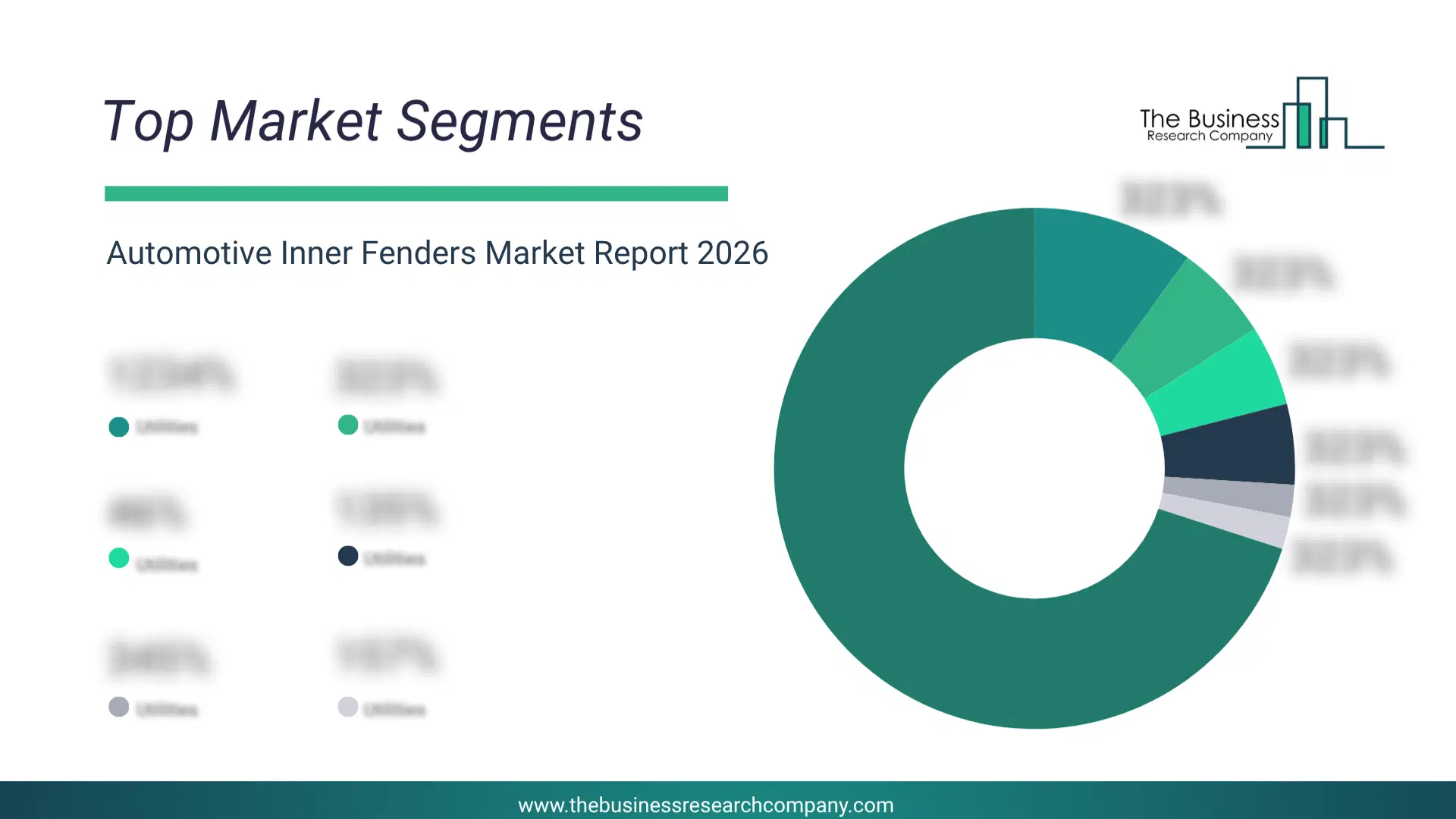
2) By Material: Polypropylene, Polyethylene, Thermoplastic Olefin, Acrylonitrile Butadiene Styrene Plastic, Composite Materials 3) By Vehicle Type: Passenger Cars, Light Commercial Vehicles, Heavy Commercial Vehicles, Electric Vehicles 4) By Manufacturing Process: Injection Molding, Thermoforming, Blow Molding 5) By End User: Original Equipment Manufacturers, Automotive Repair And Service Centers, Independent Aftermarket Suppliers Subsegments: 1) By Front Inner Fender: Engine Compartment Front Inner Fender, Structural Front Inner Fender, Lightweight Front Inner Fender, Noise Reduction Front Inner Fender, Replacement Front Inner Fender 2) By Rear Inner Fender: Rear Wheel Housing Inner Fender, Structural Rear Inner Fender, Lightweight Rear Inner Fender, Noise Reduction Rear Inner Fender, Replacement Rear Inner Fender 3) By Wheel Arch Liner: Full Coverage Wheel Arch Liner, Partial Coverage Wheel Arch Liner, Noise Insulation Wheel Arch Liner, Aerodynamic Wheel Arch Liner, Heavy Duty Wheel Arch Liner 4) By Splash Shield Or Mud Guard Components: Engine Splash Shields, Wheel Splash Shields, Underbody Mud Guards, Rear Mud Guard Components, Protective Splash Shield ComponentsWhat Is The Driver Of The Automotive Inner Fenders Market?
The growing production of vehicles is expected to propel the growth of the automotive inner fenders market going forward. Vehicle production refers to the manufacturing and assembly of automobiles, including passenger cars, commercial vehicles, and electric vehicles, to meet rising transportation demand and consumer preferences. Vehicle production is rising due to growing consumer demand for personal mobility, as increasing urbanization, rising disposable incomes, and expanding transportation needs encourage higher vehicle purchases. Rising vehicle production drives demand for automotive inner fenders by increasing the need for durable body components that provide protection against road debris, improve wheel housing integrity, and enhance overall vehicle structural performance. For instance, in April 2026, according to the International Organization of Motor Vehicle Manufacturers (OICA), a France-based automotive association, global vehicle production increased from 92.7 million units in 2024 to 96.4 million units in 2025, marking a 3.9% rise compared to the previous year. Therefore, the growing vehicle production is driving the growth of the automotive inner fenders industry.Key Players In The Global Automotive Inner Fenders Market
Major companies operating in the automotive inner fenders market are Magna International Inc, Samvardhana Motherson International Limited, Yanfeng International Automotive Technology Co Ltd, OPmobility SE, Röchling SE & Co KG, Flex-N-Gate Corporation, Toyoda Gosei Co Ltd, Minth Group Limited, Gestamp Automoción SA, Hyundai Mobis Co Ltd, Marelli Holdings Co Ltd, ABC Technologies Holdings Inc, Novares Group, Kasai Kogyo Co Ltd, Seoyon E-Hwa Co Ltd, Donghee Industrial Co Ltd, Ningbo Huaxiang Electronic Co Ltd, Toyoda Iron Works Co Ltd, DaikyoNishikawa Corporation, Kyoraku Co Ltd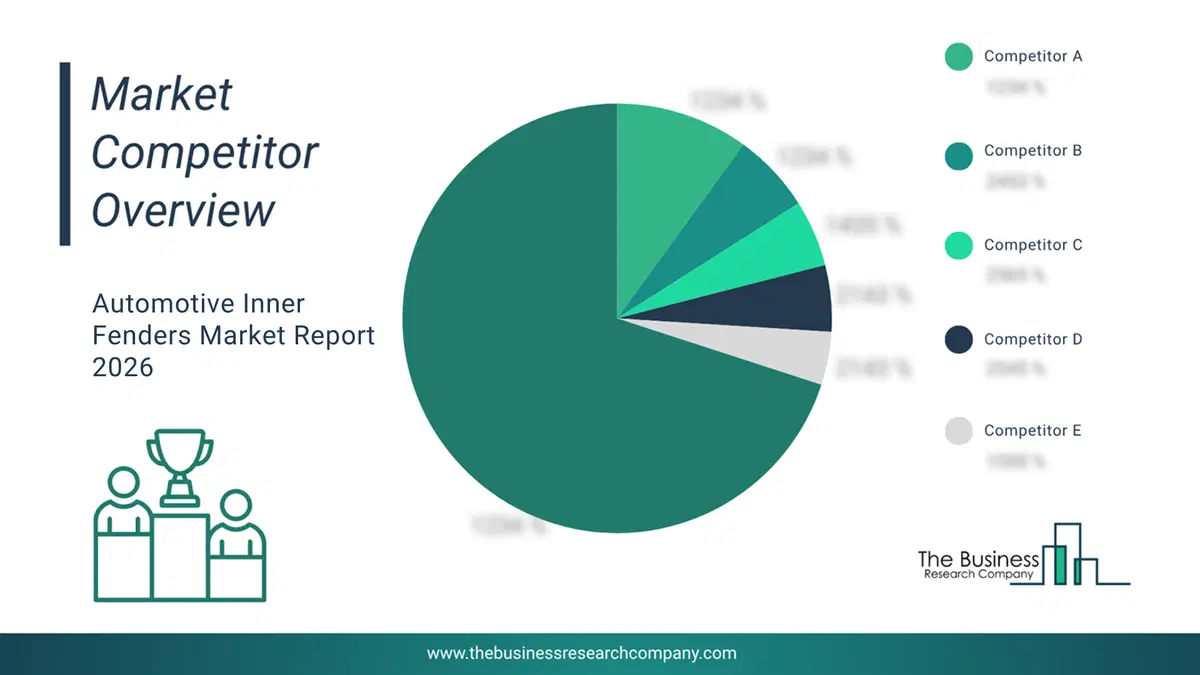
This chart is for illustrative purposes; the full report includes a detailed competitor analysis and comprehensive overview of the top 10 companies in the market.
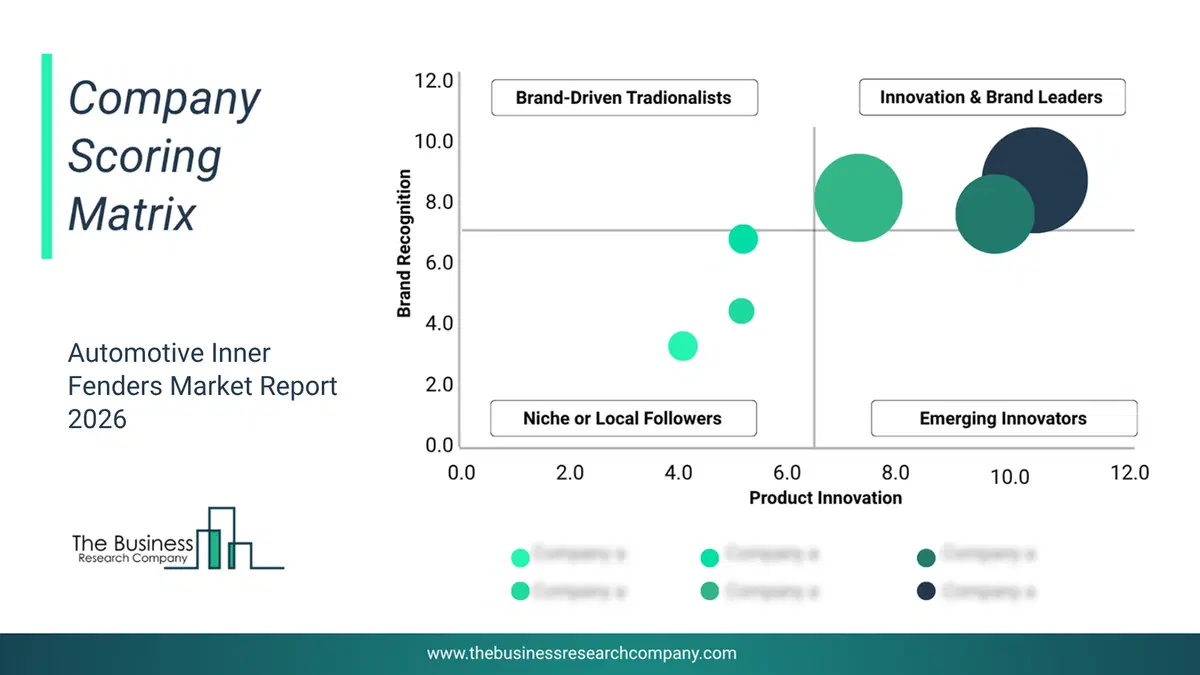
This chart maps companies by product innovation and brand strength, with bubble size indicating relative revenue, helping identify market leaders, challengers, and niche players. This is an illustrative chart; the full report provides a complete and accurate competitive analysis.
Global Automotive Inner Fenders Market Trends and Insights
Major companies operating in the automotive inner fenders market are focusing on lightweight and sustainable materials such as high-recycled-content monomaterial polyester, to reduce vehicle weight and environmental impact. High-recycled-content monomaterial polyester refers to a polyester-based material made primarily from recycled polyester and designed using a single material type, enabling lightweight and recyclable inner-fender liner components. For instance, in April 2025, Autoneum Holding AG, a Switzerland-based automotive component manufacturer, developed and supplied wheelhouse liners for Renault’s Emblème demonstration vehicle using monomaterial polyester with high recycled content, offering up to 25% weight reduction and approximately 70% lower CO₂ footprint per component. These wheelhouse liners were among approximately 30 fiber-based components supplied by Autoneum for the vehicle, supporting efforts to reduce vehicle weight and environmental impact. These advancements aim to enable lightweight and sustainable inner-fender liner solutions for next-generation vehicles.What Are Latest Mergers And Acquisitions In The Automotive Inner Fenders Market?
In February 2025, Autoneum, a Switzerland-based manufacturer of automotive acoustic and thermal management solutions, acquired a 70% stake in Jiangsu Huanyu Group, for $92.39 million (CHF 75 million). With this acquisition, Autoneum aimed to expand its portfolio of automotive components by integrating Jiangsu Huanyu Group’s wheelhouse outer liner capabilities, strengthening its presence in wheelhouse and inner-fender applications and expanding its automotive component manufacturing footprint in China. Jiangsu Huanyu Group is a China-based automotive components manufacturer, including wheelhouse outer liners.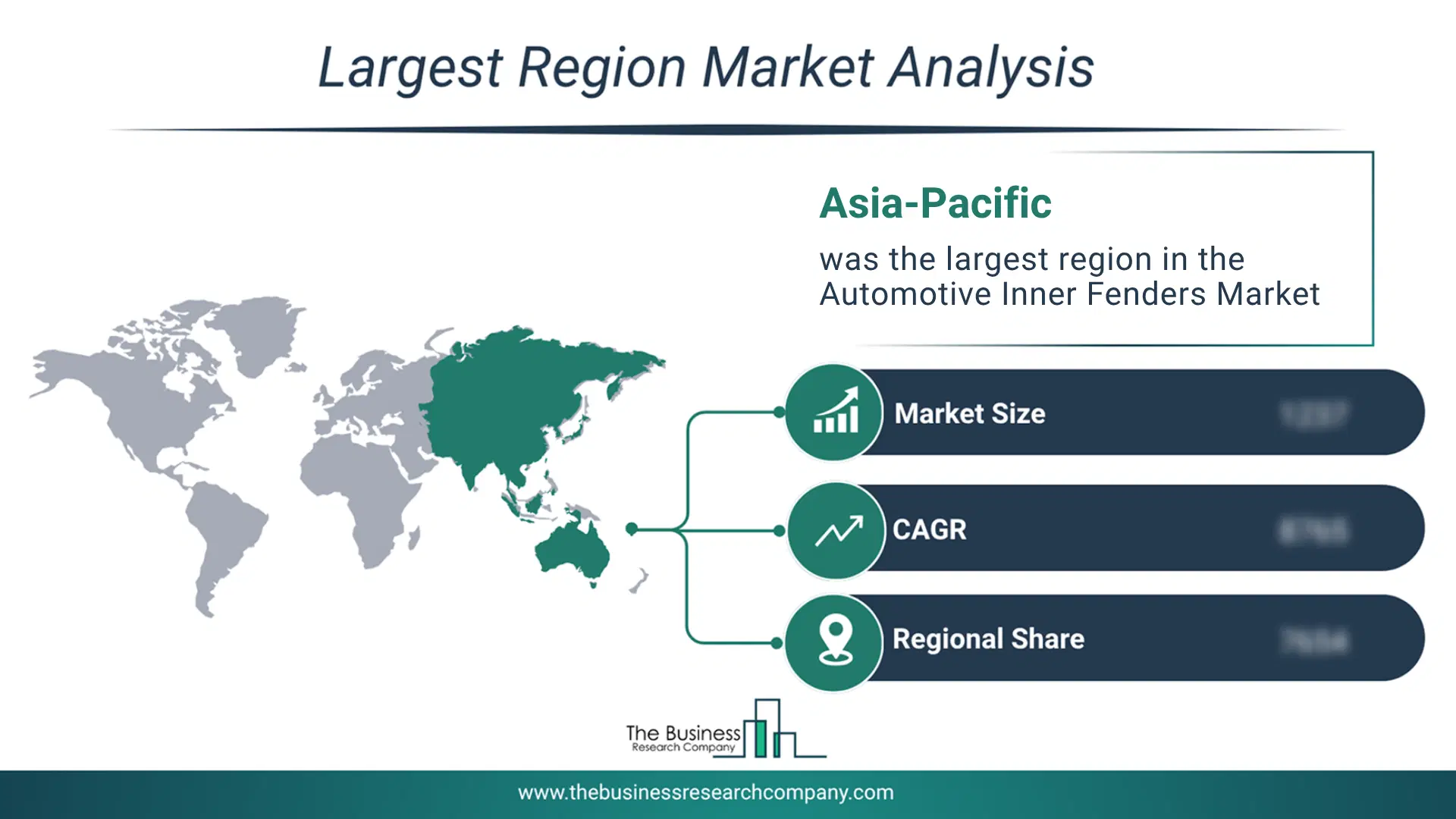
Regional Outlook/Insights
Asia-Pacific was the largest region in the automotive inner Fenders market in 2025. Asia-Pacific is expected to be the fastest-growing region during the forecast period. The regions covered in this market report are Asia-Pacific, South East Asia, Western Europe, Eastern Europe, North America, South America, Middle East, Africa. The countries covered in this market report are Australia, Brazil, China, France, Germany, India, Indonesia, Japan, Taiwan, Russia, South Korea, UK, USA, Canada, Italy, Spain.What Defines the Automotive Inner Fenders Market?
The automotive inner fenders market consists of sales of inner fender panels, wheel well liners, splash shields, fender liners, and underbody wheel arch liners. Values in this market are ‘factory gate’ values, that is, the value of goods sold by the manufacturers or creators of the goods, whether to other entities (including downstream manufacturers, wholesalers, distributors, and retailers) or directly to end customers. The value of goods in this market includes related services sold by the creators of the goods.How is Market Value Defined and Measured?
The market value is defined as the revenues that enterprises gain from the sale of goods and/or services within the specified market and geography through sales, grants, or donations in terms of the currency (in USD unless otherwise specified). The revenues for a specified geography are consumption values that are revenues generated by organizations in the specified geography within the market, irrespective of where they are produced. It does not include revenues from resales along the supply chain, either further along the supply chain or as part of other products.
This chart presents market attractiveness based on a quantitative evaluation of growth, competition, strategic alignment, and risk, offering a clear view of opportunity areas for decision-making. This chart is for illustrative purposes; the full report contains the complete analysis.

This chart highlights the Total Addressable Market (TAM) by estimating the maximum revenue opportunity using an assumption-driven approach, supporting strategic planning and opportunity sizing across markets. The chart is illustrative; the full report provides a more comprehensive analysis.
What Key Data and Analysis Are Included in the Automotive Inner Fenders Market Report 2026?
The automotive inner fenders market research report is one of a series of new reports from The Business Research Company that provides market statistics, including industry global market size, regional shares, competitors with the market share, detailed market segments, market trends and opportunities, and any further data you may need to thrive in the automotive inner fenders industry. The market research report delivers a complete perspective of everything you need, with an in-depth analysis of the current and future state of the industry.Automotive Inner Fenders Market Report Forecast Analysis
| Report Attribute | Details |
|---|---|
| Market Size Value In 2026 | $2.75 billion |
| Revenue Forecast In 2030 | $3.56 billion |
| Growth Rate | CAGR of 6.7% from 2026 to 2035 |
| Base Year For Estimation | 2025 |
| Actual Estimates/Historical Data | 2020-2025 |
| Forecast Period | 2026 - 2030 |
| Market Representation | Revenue in USD Billion and CAGR from 2026 to 2030 |
| Segments Covered | Product Type, Material, Vehicle Type, Manufacturing Process, End User |
| Regional Scope | Asia-Pacific, Western Europe, Eastern Europe, North America, South America, Middle East, Africa |
| Country Scope | The countries covered in the report are Australia, Brazil, China, France, Germany, India, Indonesia, Japan, Taiwan, Russia, South Korea, UK, USA, Canada, Italy, Spain. |
| Customization Scope | Request for Customization |
| Pricing And Purchase Options | Explore Purchase Options |