
Automotive Interior Surface Materials Market Report 2026
Global Outlook – By Material Type (Plastics, Fabrics, Composites, Leather, Synthetic Leather, Metals, Vegan Leather), By Vehicle Type (Passenger Cars, Light Commercial Vehicles, Heavy Commercial Vehicles), By Surface Type (Soft Touch Surfaces, Hard Touch Surfaces, Decorative Surfaces, Smart Surfaces), By Application Type (Consoles And Dashboards, Seats, Door Panels, Steering Wheels, Floor Carpets And Flooring, Headliners And Roof Linings, Airbags And Seatbelts, Interior Trim Panels), By End User (Automotive Original Equipment Manufacturers, Aftermarkets) – Market Size, Trends, Strategies, and Forecast to 2030
Automotive Interior Surface Materials Market Report 2026 Market Overview
• Automotive Interior Surface Materials Market Report 2026 market size has reached to $44.25 billion in 2025 • Expected to grow to $56.29 billion in 2030 at a compound annual growth rate (CAGR) of 4.8% • Growth Driver: Increasing Demand For Electric Vehicles (Evs) Driving The Market Growth Due To Rising Electrification Trends • Market Trend: Next-Generation Breathable Formed Trim Technologies Transform Premium Seating Design • Asia-Pacific was the largest region in 2025 and Asia-Pacific is the fastest growing region.What Is Covered Under Automotive Interior Surface Materials Market?
Automotive interior surface materials refer to the materials used to cover and finish the interior visible surfaces of a vehicle, contributing to its overall look, feel, comfort, and durability. These materials are engineered to meet automotive requirements such as wear resistance, thermal stability, safety compliance, and long-term aesthetic performance without degrading under regular use. The main material types of automotive interior surface materials include plastics, fabrics, composites, leather, synthetic leather, metals, and vegan leather. Plastics refer to lightweight and versatile materials used in vehicle interiors for components requiring durability, design flexibility, and cost efficiency. These materials are designed for vehicle types including passenger cars, light commercial vehicles, and heavy commercial vehicles and are available in surface types such as soft touch surfaces, hard touch surfaces, decorative surfaces, and smart surfaces. They find applications including consoles and dashboards, seats, door panels, steering wheels, floor carpets and flooring, headliners and roof linings, airbags and seatbelts, and interior trim panels, serving end users such as automotive original equipment manufacturers and aftermarkets.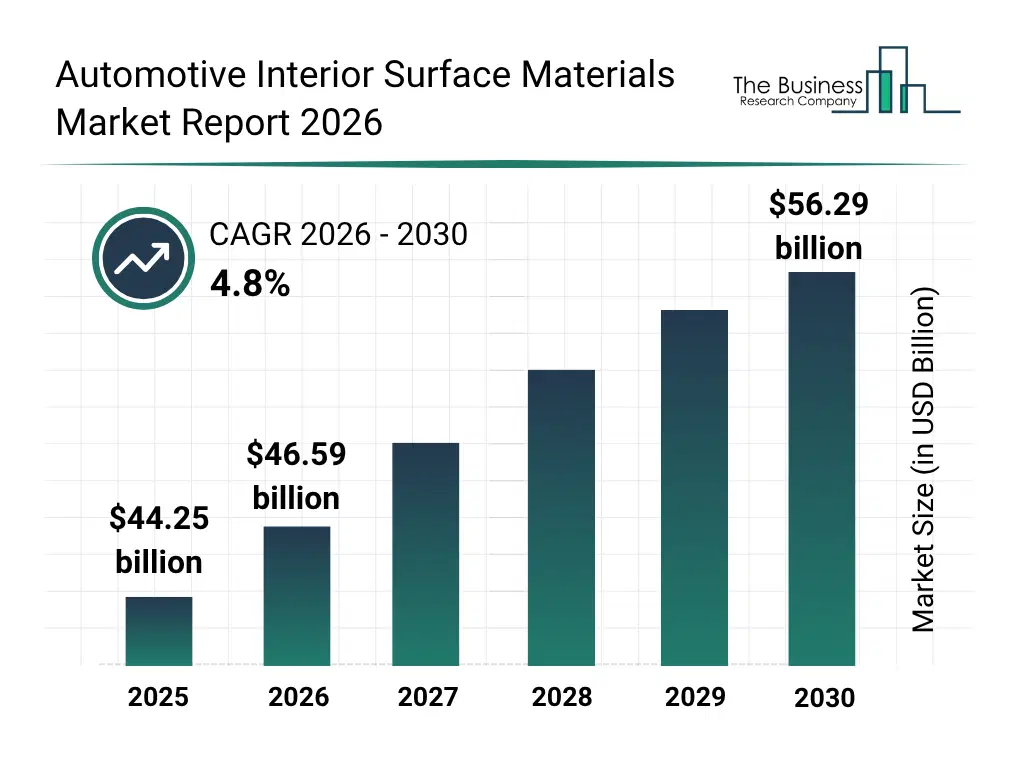
What Is The Automotive Interior Surface Materials Market Size and Share 2026?
The automotive interior surface materials market size has grown strongly in recent years. It will grow from $44.25 billion in 2025 to $46.59 billion in 2026 at a compound annual growth rate (CAGR) of 5.3%. The growth in the historic period can be attributed to growth in automotive production volumes, increasing consumer preference for premium vehicle interiors, rising demand for durable interior materials, expansion of passenger vehicle sales, advancements in material engineering technologies.What Is The Automotive Interior Surface Materials Market Growth Forecast?
The automotive interior surface materials market size is expected to see steady growth in the next few years. It will grow to $56.29 billion in 2030 at a compound annual growth rate (CAGR) of 4.8%. The growth in the forecast period can be attributed to growing demand for sustainable interior materials, increasing adoption of smart surface technologies, rising demand for lightweight automotive components, expansion of electric vehicle production, increasing investments in advanced material innovations. Major trends in the forecast period include increasing demand for lightweight interior surface materials, rising adoption of premium and customized interior finishes, growing preference for wear-resistant and durable materials, expansion of soft touch and comfort-focused interior surfaces, increasing use of advanced decorative and aesthetic surface designs.
Global Automotive Interior Surface Materials Market Segmentation
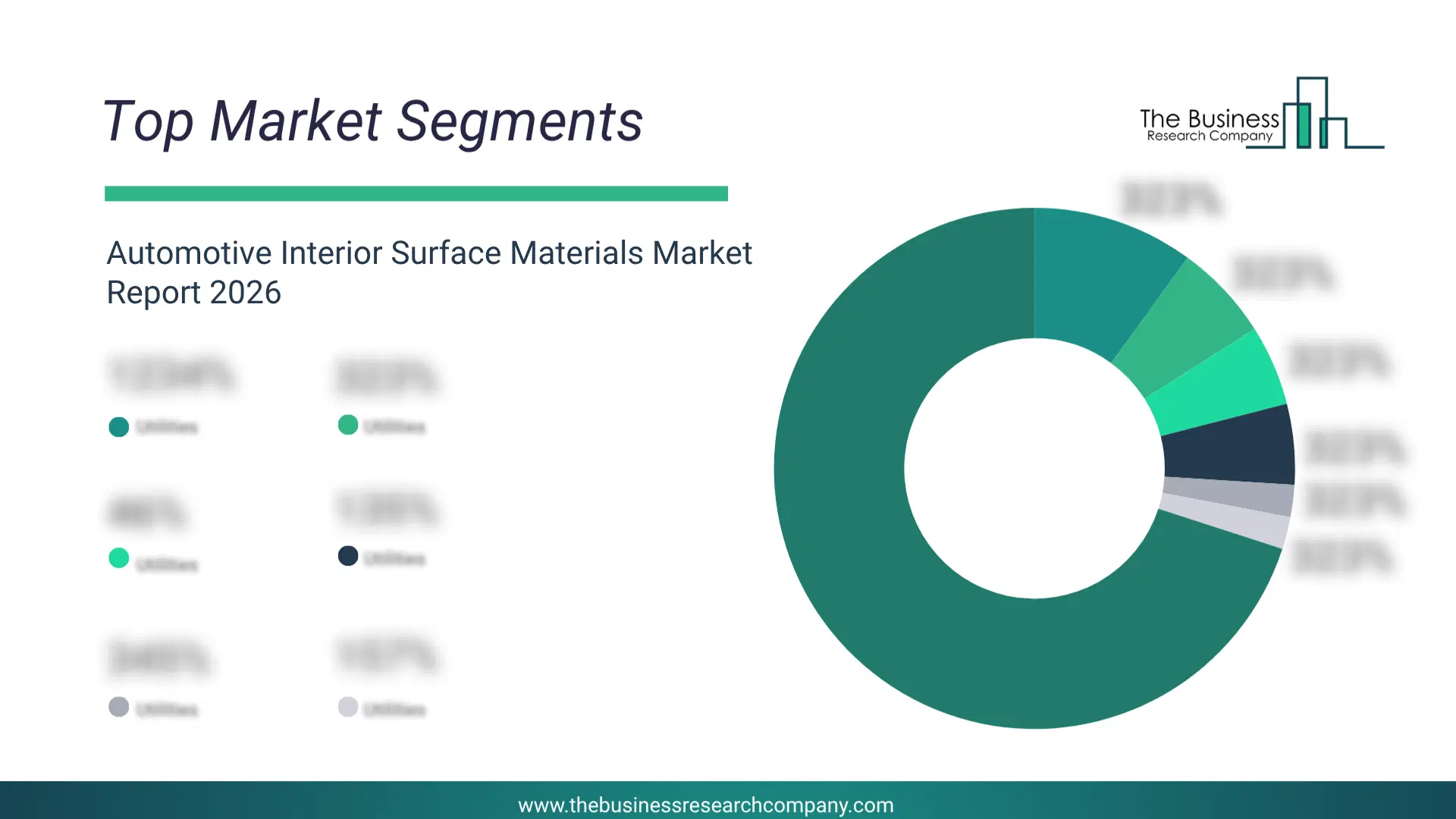
1) By Material Type: Plastics, Fabrics, Composites, Leather, Synthetic Leather, Metals, Vegan Leather 2) By Vehicle Type: Passenger Cars, Light Commercial Vehicles, Heavy Commercial Vehicles 3) By Surface Type: Soft Touch Surfaces, Hard Touch Surfaces, Decorative Surfaces, Smart Surfaces 4) By Application Type: Consoles And Dashboards, Seats, Door Panels, Steering Wheels, Floor Carpets And Flooring, Headliners And Roof Linings, Airbags And Seatbelts, Interior Trim Panels 5) By End User: Automotive Original Equipment Manufacturers, Aftermarkets Subsegments: 1) By Plastics: Polypropylene, Polyurethane, Polyvinyl Chloride, Acrylonitrile Butadiene Styrene, Polycarbonate, Thermoplastic Elastomers 2) By Fabrics: Woven Fabrics, Non Woven Fabrics, Knitted Fabrics, Polyester Fabrics, Nylon Fabrics 3) By Composites: Fiber Reinforced Composites, Glass Fiber Composites, Carbon Fiber Composites, Natural Fiber Composites, Hybrid Composites 4) By Leather: Genuine Leather, Full Grain Leather, Top Grain Leather, Split Leather, Bonded Leather 5) By Synthetic Leather: Polyurethane Leather, Polyvinyl Chloride Leather, Microfiber Leather, Silicone Leather, Bio Based Synthetic Leather 6) By Metals: Aluminum, Steel, Magnesium, Stainless Steel, Decorative Metal Finishes 7) By Vegan Leather: Plant Based Leather, Mushroom Leather, Cork Leather, Apple Leather, Pineapple LeatherWhat Is The Driver Of The Automotive Interior Surface Materials Market?
The increasing demand for electric vehicles (EVs) is expected to propel the growth of the automotive interior surface materials market going forward. Electric vehicles are automobiles powered by electric motors using energy stored in rechargeable batteries instead of internal combustion engines. The demand for EVs is rising due to stringent emission regulations, as governments are enforcing stricter carbon reduction targets to combat climate change. Automotive interior surface materials help electric vehicles by enhancing lightweight design, improving thermal and acoustic comfort, enabling sustainable and low-emission cabin solutions, and supporting overall energy efficiency that contributes to extended driving range. For instance, in January 2025, according to the Cox Automotive, a US-based system software company, in 2024, full-year electric vehicle sales totaled 1.3 million, marking a 7.3% rise compared to the revised figures for 2023. Therefore, the increasing demand for electric vehicles (EVs) is driving the growth of the automotive interior surface materials industryKey Players In The Global Automotive Interior Surface Materials Market
Major companies operating in the automotive interior surface materials market report are BASF SE, Continental AG, Magna International Incorporated, FORVIA SE, Lear Corporation, Adient PLC, Aunde Group, DRÄXLMAIER Group, Grupo Antolin, Toyobo Company Limited, Inteva Products Limited Liability Company, Mayco International Limited Liability Company, Tachi-S Company Limited, Seiren Company Limited, Nihon Plast Company Limited, Bader GmbH, Gen Phoenix, Toyota Boshoku Corporation, Yanfeng Automotive Interiors, Sage Automotive Interiors, The Woodbridge Group, GST AutoLeather Incorporated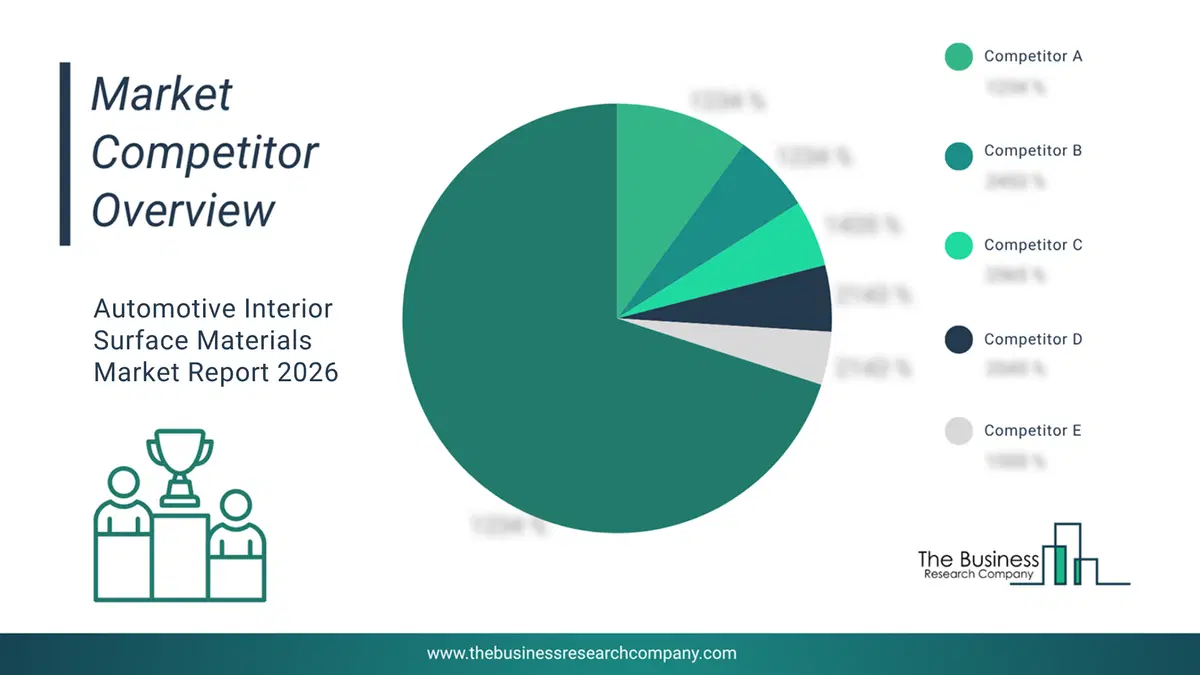
This chart is for illustrative purposes; the full report includes a detailed competitor analysis and comprehensive overview of the top 10 companies in the market.
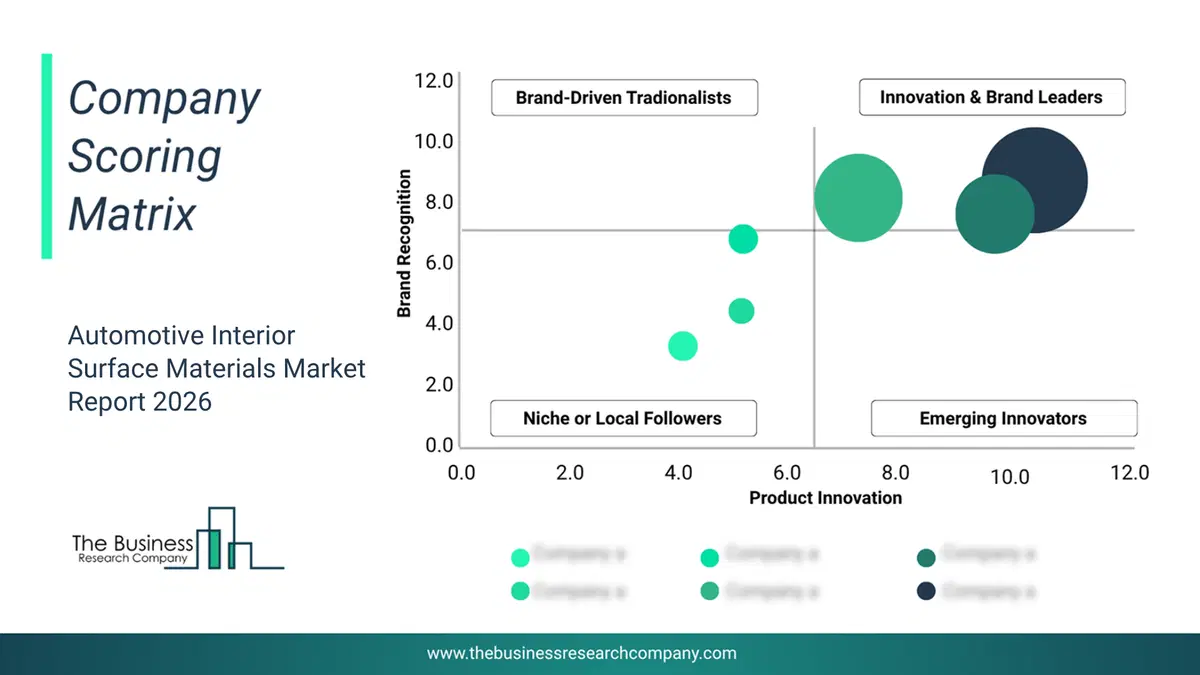
This chart maps companies by product innovation and brand strength, with bubble size indicating relative revenue, helping identify market leaders, challengers, and niche players. This is an illustrative chart; the full report provides a complete and accurate competitive analysis.
Global Automotive Interior Surface Materials Market Trends and Insights
Major companies operating in the automotive interior surface materials market are focusing on developing innovative solutions, such as breathable formed trim solutions, to optimize premium aesthetic capabilities, lower interior assembly complexity, and improve material application yields during manufacturing. Breathable formed trim solutions refer to advanced, multi-dimensional seating surface layers that leverage automated thermodynamic shaping rather than traditional multi-piece fabric stitching to form complex shapes and concavities without altering texturing or surface grain. For instance, in February 2026, Adient plc, an Ireland-based automotive seating and interior components company, launched Sculpted Soft Trim, its latest breakthrough surface engineering technology designed for premium global vehicle seating. The product introduces a single, unified surface pattern that can directly replace up to twelve separate traditional cut-and-sew patterns, reduces production cycle times by approximately 50% compared to legacy hot-forming techniques, and allows manufacturers to easily emboss, deboss, or customize textural graphics directly into the tooling without washing out vinyl or fabric grain details.What Are Latest Mergers And Acquisitions In The Automotive Interior Surface Materials Market?
In June 2025, Mutares SE And Co. KGaA, a Germany-based investment holding company, acquired NBHX Trim Europe from Ningbo Lawrence Automotive Interiors Co. Ltd for an undisclosed amount. With this acquisition, Mutares aims to strengthen its automotive segment portfolio and expand its footprint in the European automotive interior supply chain through the turnaround and integration of a specialised trim manufacturer. NBHX Trim Europe is a Germany-based company specialising in the development and supply of automotive interior surface materials.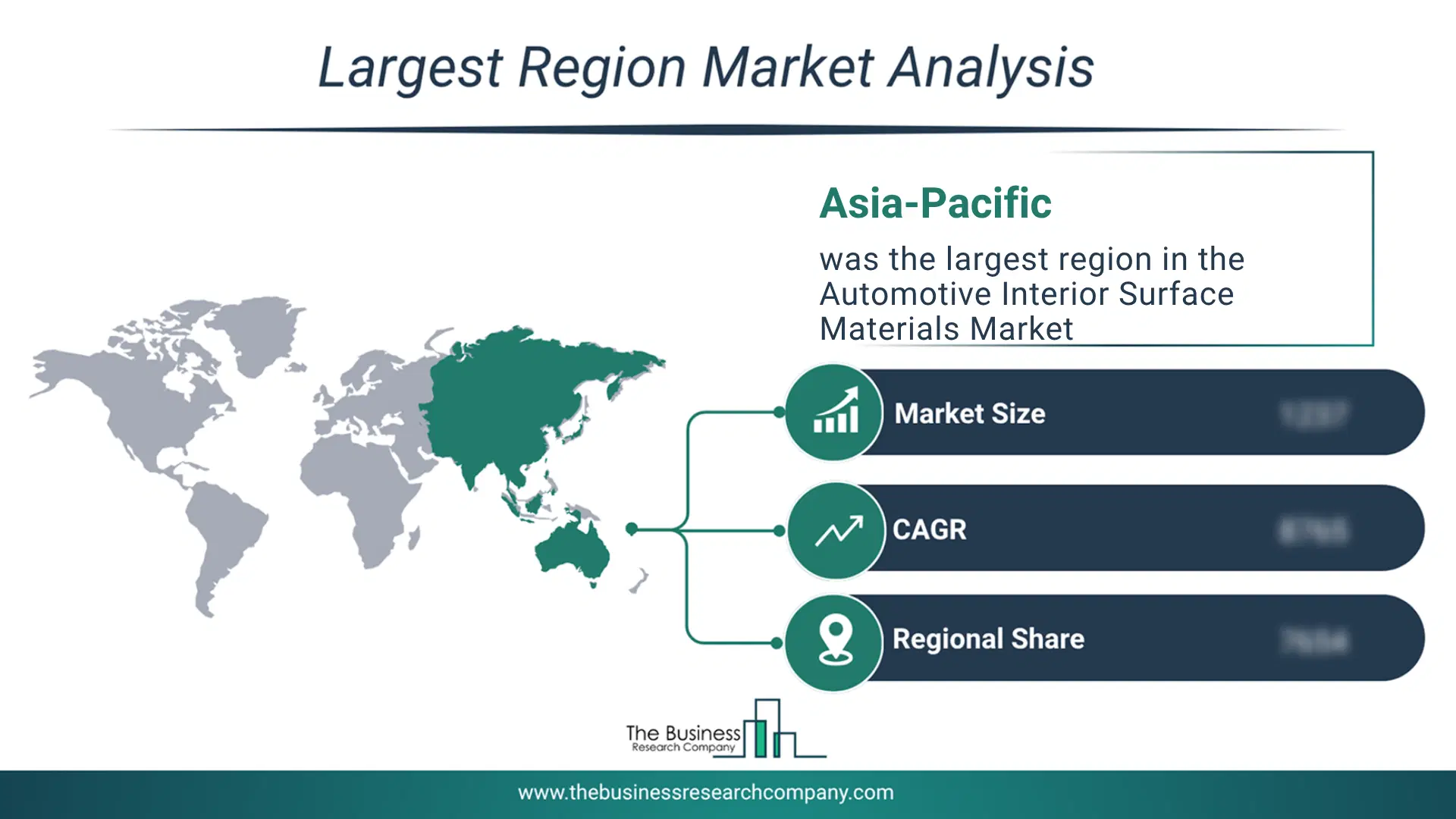
Regional Outlook
Asia-Pacific was the largest region in the automotive interior surface materials market in 2025. Asia-Pacific is expected to be the fastest-growing region in the forecast period. The regions covered in this market report are Asia-Pacific, South East Asia, Western Europe, Eastern Europe, North America, South America, Middle East, Africa. The countries covered in this market report are Australia, Brazil, China, France, Germany, India, Indonesia, Japan, Taiwan, Russia, South Korea, UK, USA, Canada, Italy, Spain.What Defines the Automotive Interior Surface Materials Market?
The automotive interior surface materials market consists of sales of wood trim materials, carbon fiber decorative panels, glass-based interior surfaces, and ceramic-coated interior finish materials. Values in this market are ‘factory gate’ values, that is, the value of goods sold by the manufacturers or creators of the goods, whether to other entities (including downstream manufacturers, wholesalers, distributors, and retailers) or directly to end customers. The value of goods in this market includes related services sold by the creators of the goods.How is Market Value Defined and Measured?
The market value is defined as the revenues that enterprises gain from the sale of goods and/or services within the specified market and geography through sales, grants, or donations in terms of the currency (in USD unless otherwise specified). The revenues for a specified geography are consumption values that are revenues generated by organizations in the specified geography within the market, irrespective of where they are produced. It does not include revenues from resales along the supply chain, either further along the supply chain or as part of other products.
This chart presents market attractiveness based on a quantitative evaluation of growth, competition, strategic alignment, and risk, offering a clear view of opportunity areas for decision-making. This chart is for illustrative purposes; the full report contains the complete analysis.

This chart highlights the Total Addressable Market (TAM) by estimating the maximum revenue opportunity using an assumption-driven approach, supporting strategic planning and opportunity sizing across markets. The chart is illustrative; the full report provides a more comprehensive analysis.
What Key Data and Analysis Are Included in the Automotive Interior Surface Materials Market Report 2026?
The automotive interior surface materials market research report is one of a series of new reports from The Business Research Company that provides market statistics, including industry global market size, regional shares, competitors with the market share, detailed market segments, market trends and opportunities, and any further data you may need to thrive in the automotive interior surface materials industry. The market research report delivers a complete perspective of everything you need, with an in-depth analysis of the current and future state of the industry.Automotive Interior Surface Materials Market Report Forecast Analysis
| Report Attribute | Details |
|---|---|
| Market Size Value In 2026 | $46.59 billion |
| Revenue Forecast In 2030 | $56.29 billion |
| Growth Rate | CAGR of 4.8% from 2026 to 2030 |
| Base Year For Estimation | 2025 |
| Actual Estimates/Historical Data | 2020-2025 |
| Forecast Period | 2026 - 2030 |
| Market Representation | Revenue in USD Billion and CAGR from 2026 to 2030 |
| Segments Covered | Material Type, Vehicle Type, Surface Type, Application Type, End User |
| Regional Scope | Asia-Pacific, Western Europe, Eastern Europe, North America, South America, Middle East, Africa |
| Country Scope | The countries covered in the report are Australia, Brazil, China, France, Germany, India, Indonesia, Japan, Taiwan, Russia, South Korea, UK, USA, Canada, Italy, Spain. |
| Key Companies Profiled | BASF SE, Continental AG, Magna International Incorporated, FORVIA SE, Lear Corporation, Adient PLC, Aunde Group, DRÄXLMAIER Group, Grupo Antolin, Toyobo Company Limited, Inteva Products Limited Liability Company, Mayco International Limited Liability Company, Tachi-S Company Limited, Seiren Company Limited, Nihon Plast Company Limited, Bader GmbH, Gen Phoenix, Toyota Boshoku Corporation, Yanfeng Automotive Interiors, Sage Automotive Interiors, The Woodbridge Group, GST AutoLeather Incorporated |
| Customization Scope | Request for Customization |
| Pricing And Purchase Options | Explore Purchase Options |