
Automotive Light Detection And Ranging (LiDAR) Sensors Market Report 2026
Global Outlook – By Type (Long Range Light Detection And Ranging, Short Range Light Detection And Ranging, Mid Range Light Detection And Ranging), By Technology (Solid State Light Detection And Ranging, Mechanical Light Detection And Ranging, Frequency Modulated Continuous Wave Light Detection And Ranging), By Sales Channel (Original Equipment Manufacturers, Aftermarket), By Application (Advanced Driver Assistance Systems, Autonomous Driving, Traffic Monitoring, Mapping And Surveying), By End Use (Passenger Vehicles, Commercial Vehicles, Public Transport) – Market Size, Trends, Strategies, and Forecast to 2030
Automotive Light Detection And Ranging (LiDAR) Sensors Market Overview
• Automotive Light Detection And Ranging (LiDAR) Sensors market size has reached to $1.95 billion in 2025 • Expected to grow to $4.32 billion in 2030 at a compound annual growth rate (CAGR) of 17.3% • Growth Driver: Increasing Use Of Advanced Driver-Assistance Systems (ADAS) Driving The Market Growth Due To Rising Demand For Real-Time Thermal Monitoring And Vehicle Safety Optimization • Market Trend: Innovation In Long-Range Perception Technologies Strengthening Autonomous Transportation Systems • Asia-Pacific was the largest region and fastest growing region.What Is Covered Under Automotive Light Detection And Ranging (LiDAR) Sensors Market?
Automotive light detection and ranging (LiDAR) sensors are advanced optical sensing devices that use laser pulses to measure distances and create high-resolution, three-dimensional representations of surrounding environments. These sensors generate spatial data by detecting reflected light signals, enabling precise depth perception, object recognition, and environmental modeling in vehicles. They are designed to improve sensing accuracy, spatial awareness, and real-time data processing in automotive electronic systems. The main types of automotive light detection and ranging (LiDAR) sensors include long range light detection and ranging, short range light detection and ranging, and mid range light detection and ranging. Long range light detection and ranging refers to LiDAR sensors designed to detect and measure distant objects with high precision, enabling enhanced perception and safety for advanced vehicle systems. These sensors utilize technologies such as solid state light detection and ranging, mechanical light detection and ranging, and frequency modulated continuous wave light detection and ranging and are supplied through original equipment manufacturers and aftermarket channels. The various applications involved are advanced driver assistance systems, autonomous driving, traffic monitoring, and mapping and surveying and they are utilized by end uses including passenger vehicles, commercial vehicles, and public transport.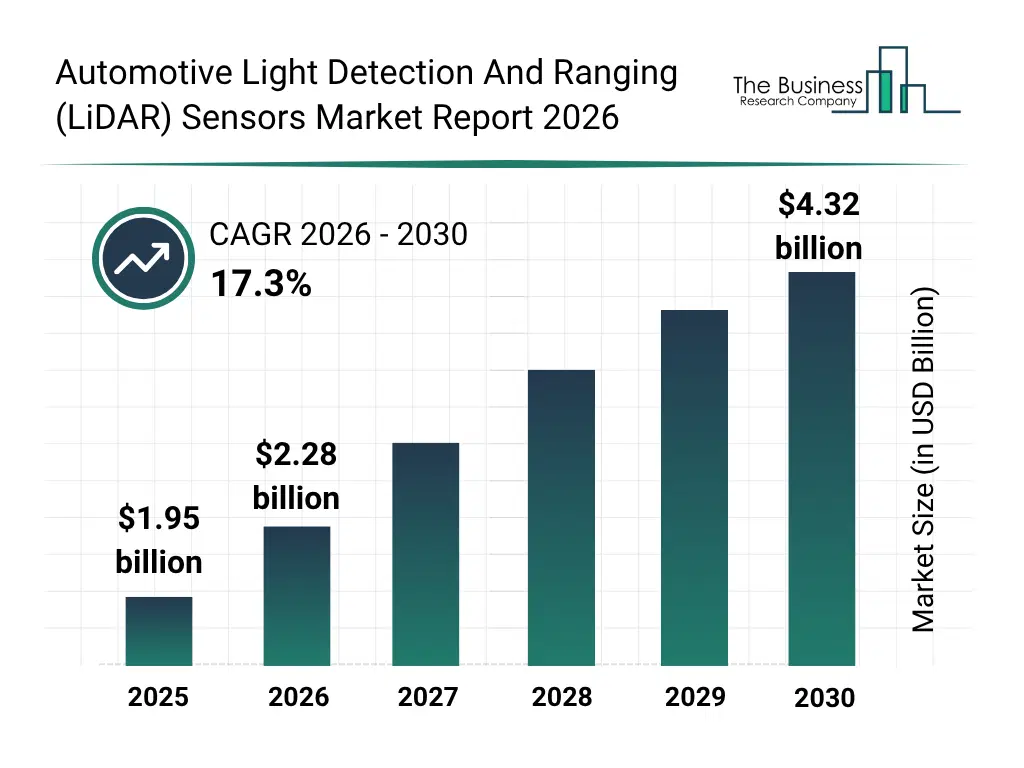
What Is The Automotive Light Detection And Ranging (LiDAR) Sensors Market Size and Share 2026?
The automotive light detection and ranging (LiDAR) sensors market size has grown rapidly in recent years. It will grow from $1.95 billion in 2025 to $2.28 billion in 2026 at a compound annual growth rate (CAGR) of 17.1%. The growth in the historic period can be attributed to increasing adoption of advanced driver assistance systems, growing demand for vehicle safety technologies, rising investments in automotive sensor development, expanding deployment of autonomous vehicle testing, strengthening automotive safety regulations.What Is The Automotive Light Detection And Ranging (LiDAR) Sensors Market Growth Forecast?
The automotive light detection and ranging (LiDAR) sensors market size is expected to see rapid growth in the next few years. It will grow to $4.32 billion in 2030 at a compound annual growth rate (CAGR) of 17.3%.The growth in the forecast period can be attributed to growing commercialization of autonomous vehicles, increasing demand for high precision environmental perception, rising investments in next generation sensing technologies, expanding deployment of smart mobility solutions, increasing integration of advanced sensing systems in commercial vehicles. Major trends in the forecast period include increasing adoption of high resolution three dimensional sensing solutions, growing demand for solid state light detection and ranging sensors, rising integration of multi range environmental perception systems, expansion of compact automotive light detection and ranging sensor designs, increasing development of high precision object detection sensors.
Global Automotive Light Detection And Ranging (LiDAR) Sensors Market Segmentation
2) By Technology: Solid State Light Detection And Ranging, Mechanical Light Detection And Ranging, Frequency Modulated Continuous Wave Light Detection And Ranging 3) By Sales Channel: Original Equipment Manufacturers, Aftermarket 4) By Application: Advanced Driver Assistance Systems, Autonomous Driving, Traffic Monitoring, Mapping And Surveying 5) By End Use: Passenger Vehicles, Commercial Vehicles, Public Transport Subsegments: 1) By Long Range Light Detection And Ranging: High Resolution Long Range Light Detection And Ranging Sensors, High Speed Long Range Light Detection And Ranging Sensors, Highway Autonomous Driving Light Detection And Ranging Sensors, 360° Long Range Light Detection And Ranging Sensors 2) By Short Range Light Detection And Ranging: Parking Assistance Short Range Light Detection And Ranging Sensors, Blind Spot Detection Short Range Light Detection And Ranging Sensors, Urban Mobility Short Range Light Detection And Ranging Sensors, Compact Short Range Light Detection And Ranging Sensors 3) By Mid Range Light Detection And Ranging: Advanced Driver Assistance Systems Mid Range Light Detection And Ranging Sensors, Object Detection Mid Range Light Detection And Ranging Sensors, Medium Distance Perception Light Detection And Ranging Sensors, Multi Purpose Mid Range Light Detection And Ranging SensorsWhat Is The Driver Of The Automotive Light Detection And Ranging (LiDAR) Sensors Market?
The increasing use of advanced driver-assistance systems (ADAS) is expected to propel the growth of the automotive light detection and ranging (LiDAR) sensors market going forward. ADAS refers to electronic systems in vehicles that use sensors, cameras, and control units to assist drivers in driving and parking functions, improving safety and reducing human error. The adoption of ADAS is rising due to growing demand for enhanced road safety, automation, and reduced accident rates, which require highly reliable and real-time monitoring of vehicle operating conditions. Automotive LiDAR sensors enable advanced driver-assistance systems (ADAS) by generating precise real-time 3D environmental maps through laser scanning, allowing accurate object detection, distance measurement, and obstacle tracking that improve features such as adaptive cruise control, lane keeping, and automatic emergency braking for safer driving. For instance, in October 2024, according to the MITRE Corporation, a US-based not-for-profit organization, by the 2023 model year, 10 of the 14 Advanced Driver Assistance Systems (ADAS) features achieved over 50% market penetration, with five features surpassing 90%. In comparison, none of the ADAS features had reached 75% penetration. Therefore, the increasing use of advanced driver-assistance systems (ADAS) is driving the growth of the automotive light detection and ranging (LiDAR) sensors industry.Key Players In The Global Automotive Light Detection And Ranging (LiDAR) Sensors Market
Major companies operating in the automotive light detection and ranging (lidar) sensors market are Robert Bosch GmbH, DENSO Corporation, Continental AG, ZF Friedrichshafen AG, Valeo SE, Hesai Group, Shenzhen Leishen Intelligent System Co. Ltd., Ouster Inc., Innoviz Technologies Ltd., Livox Technology Company Limited, Beijing Benewake Co. Ltd., AEye Inc., RoboSense Technology Co. Ltd., Seyond Inc., XenomatiX NV, MicroVision Inc., Aeva Technologies Inc., Baraja Pty Ltd.
This chart is for illustrative purposes; the full report includes a detailed competitor analysis and comprehensive overview of the top 10 companies in the market.
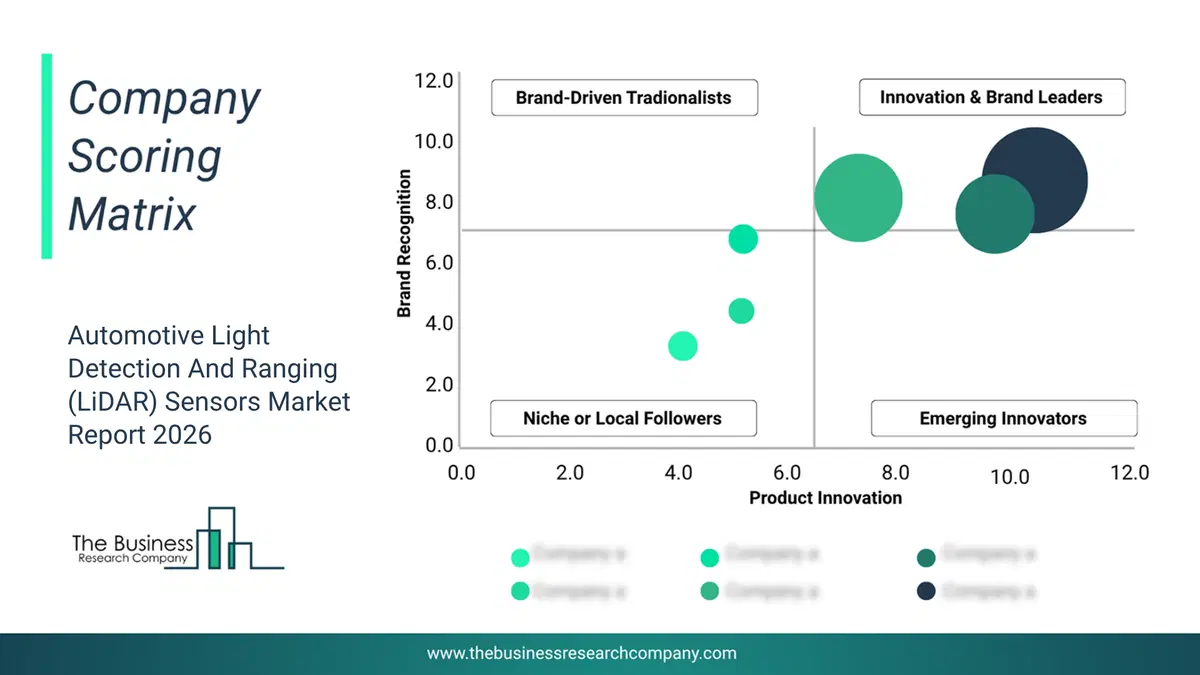
This chart maps companies by product innovation and brand strength, with bubble size indicating relative revenue, helping identify market leaders, challengers, and niche players. This is an illustrative chart; the full report provides a complete and accurate competitive analysis.
Global Automotive Light Detection And Ranging (LiDAR) Sensors Market Trends and Insights
Major companies operating in the automotive light detection and ranging (LiDAR) sensors market are focusing on developing innovative solutions, such as ultra-long-range sensing technologies to improve vehicle perception, enhance road safety, and support advanced autonomous driving applications. Ultra-long-range sensing technologies are advanced detection systems capable of identifying and measuring objects at very large distances using high-resolution sensors, helping autonomous vehicles and intelligent systems improve safety, enhance situational awareness, detect hazards earlier, and make more accurate real-time decisions in complex operating environments. For instance, in April 2026, Innoviz Technologies, an Israel-based manufacturing company, launched the InnovizTwo Ultra Long-Range (ULR) LiDAR sensor designed for automotive use cases, offering a detection range of up to 1 km. The sensor delivers high-resolution 3D point cloud imaging, supports a wide field of view, and is engineered for applications such as robotaxis, heavy trucks, highway autonomy, and infrastructure-level sensing. Built using existing production tools for faster scalability, the system also integrates Power-over-Ethernet connectivity for broader deployment flexibility beyond automotive applications. This innovation reflects the growing demand for high-performance LiDAR solutions that enable long-distance perception, enhance highway safety for high-inertia vehicles, and support emerging applications such as digital twins, traffic prediction, and smart infrastructure monitoring.What Are Latest Mergers And Acquisitions In The Automotive Light Detection And Ranging (LiDAR) Sensors Market?
In February 2023, Ouster Inc., a US-based lidar technology company, merged with Velodyne Lidar Inc. to accelerate lidar adoption by combining their technologies, product portfolios, and market reach across automotive, industrial, robotics, and smart infrastructure applications. Through this merger, Ouster Inc. and Velodyne Lidar Inc. aim to accelerate the adoption of lidar technology by combining their product portfolios, engineering capabilities, customer bases, industry partnerships, and distribution channels across the automotive, industrial, robotics, and smart infrastructure sectors. Velodyne Lidar Inc. is a US-based lidar technology company that specializes in providing automotive LiDAR sensors.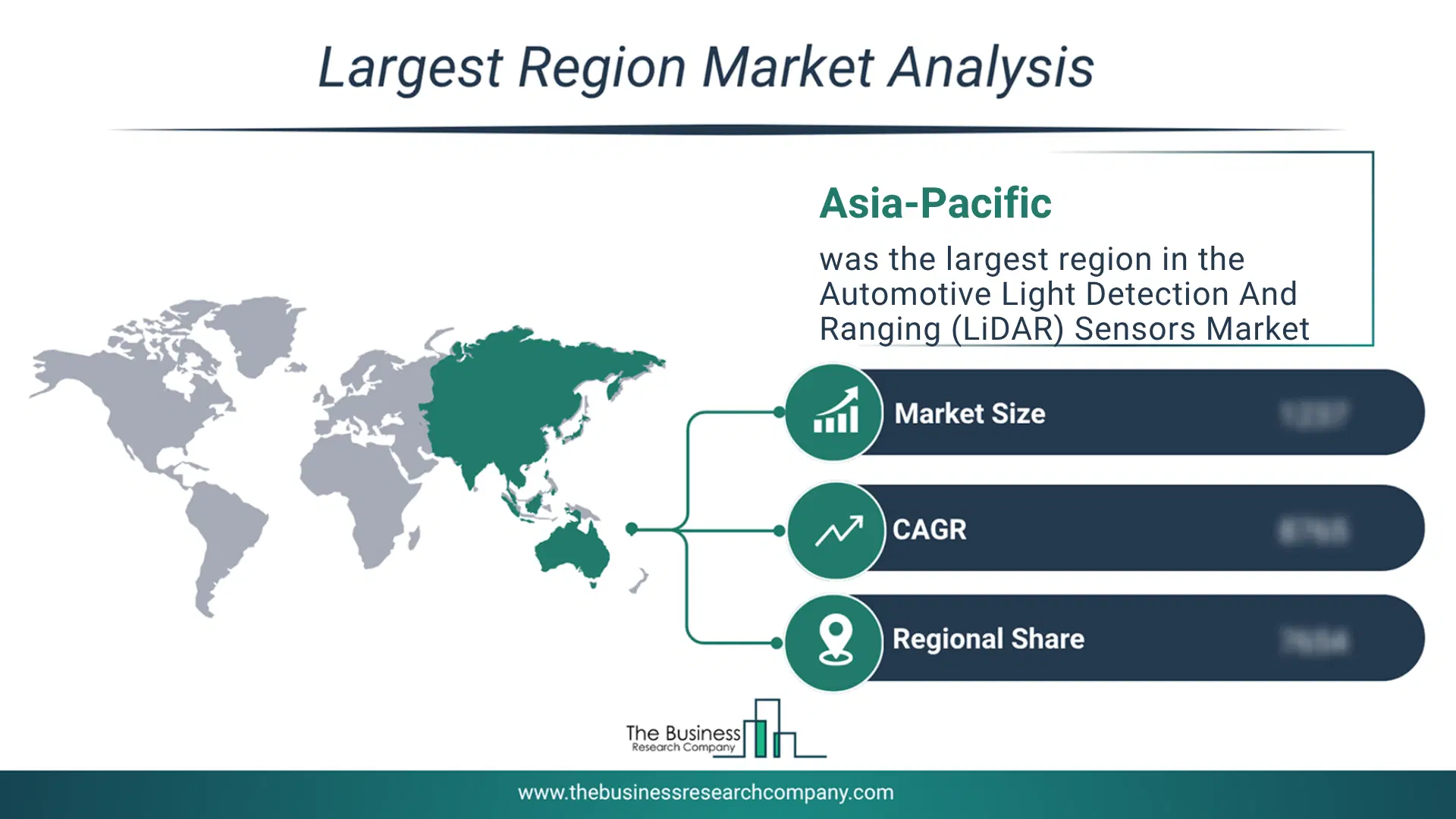
Regional Outlook/Insights
Asia-Pacific was the largest region in the automotive light detection and ranging (LiDAR) sensors market in 2025. Asia-Pacific is expected to be the fastest-growing region in the forecast period. The regions covered in this market report are Asia-Pacific, South East Asia, Western Europe, Eastern Europe, North America, South America, Middle East, Africa. The countries covered in this market report are Australia, Brazil, China, France, Germany, India, Indonesia, Japan, Taiwan, Russia, South Korea, UK, USA, Canada, Italy, Spain.What Defines the Automotive Light Detection And Ranging (LiDAR) Sensors Market?
The automotive light detection and ranging (LiDAR) sensors market consists of revenues earned by entities by providing services such as design, development, manufacturing, and integration of LiDAR systems used in vehicles. The market value includes the value of related goods sold by the service provider or included within the service offering. The automotive light detection and ranging (LiDAR) sensors market also includes sales of laser emitters, photodetectors, signal processing units, optical scanning modules, perception software components, calibration systems, and integration hardware used in vehicle sensing solutions. Values in this market are ‘factory gate’ values, that is, the value of goods sold by the manufacturers or creators of the goods, whether to other entities (including downstream manufacturers, suppliers, and integrators) or directly to end customers. The value of goods in this market includes related services sold by the creators of the goods.How is Market Value Defined and Measured?
The market value is defined as the revenues that enterprises gain from the sale of goods and/or services within the specified market and geography through sales, grants, or donations in terms of the currency (in USD unless otherwise specified). The revenues for a specified geography are consumption values that are revenues generated by organizations in the specified geography within the market, irrespective of where they are produced. It does not include revenues from resales along the supply chain, either further along the supply chain or as part of other products.
This chart presents market attractiveness based on a quantitative evaluation of growth, competition, strategic alignment, and risk, offering a clear view of opportunity areas for decision-making. This chart is for illustrative purposes; the full report contains the complete analysis.

This chart highlights the Total Addressable Market (TAM) by estimating the maximum revenue opportunity using an assumption-driven approach, supporting strategic planning and opportunity sizing across markets. The chart is illustrative; the full report provides a more comprehensive analysis.
What Key Data and Analysis Are Included in the Automotive Light Detection And Ranging (LiDAR) Sensors Market Report 2026?
The automotive light detection and ranging (lidar) sensors market research report is one of a series of new reports from The Business Research Company that provides automotive light detection and ranging (lidar) sensors market statistics, including automotive light detection and ranging (lidar) sensors industry global market size, regional shares, competitors with a automotive light detection and ranging (lidar) sensors market share, detailed automotive light detection and ranging (lidar) sensors market segments, market trends and opportunities, and any further data you may need to thrive in the automotive light detection and ranging (lidar) sensors industry. This automotive light detection and ranging (lidar) sensors market research report delivers a complete perspective of everything you need, with an in-depth analysis of the current and future scenario of the industry.Automotive Light Detection And Ranging (LiDAR) Sensors Market Report Forecast Analysis
| Report Attribute | Details |
|---|---|
| Market Size Value In 2026 | $2.28 billion |
| Revenue Forecast In 2030 | $4.32 billion |
| Growth Rate | CAGR of 17.3% from 2026 to 2030 |
| Base Year For Estimation | 2025 |
| Actual Estimates/Historical Data | 2020-2025 |
| Forecast Period | 2026 - 2030 |
| Market Representation | Revenue in USD Billion and CAGR from 2026 to 2030 |
| Segments Covered | Type, Technology, Sales Channel, Application, End Use |
| Regional Scope | Asia-Pacific, Western Europe, Eastern Europe, North America, South America, Middle East, Africa |
| Country Scope | The countries covered in the report are Australia, Brazil, China, France, Germany, India, Indonesia, Japan, Taiwan, Russia, South Korea, UK, USA, Canada, Italy, Spain. |
| Key Companies Profiled | Robert Bosch GmbH, DENSO Corporation, Continental AG, ZF Friedrichshafen AG, Valeo SE, Hesai Group, Shenzhen Leishen Intelligent System Co. Ltd., Ouster Inc., Innoviz Technologies Ltd., Livox Technology Company Limited, Beijing Benewake Co. Ltd., AEye Inc., RoboSense Technology Co. Ltd., Seyond Inc., XenomatiX NV, MicroVision Inc., Aeva Technologies Inc., Baraja Pty Ltd. |
| Customization Scope | Request for Customization |
| Pricing And Purchase Options | Explore Purchase Options |