
Automotive Load Floor Market Report 2026
Global Outlook – By Material Type (Hardboard, Fluted Polypropylene, Honeycomb Polypropylene), By Operation (Fixed, Sliding), By Vehicle Type (Compact, Mid-Size, Luxury, SUV), By Sales Channel (Original Equipment Manufacturer (OEM), Aftermarket), By Application (Cargo Systems, Load Floor Systems) – Market Size, Trends, Strategies, and Forecast to 2030
Automotive Load Floor Market Overview
• Automotive Load Floor market size has reached to $2.52 billion in 2025 • Expected to grow to $3.34 billion in 2030 at a compound annual growth rate (CAGR) of 5.7% • Growth Driver: Rising Electric Vehicles Demand Boost Automotive Load Floor Market Growth • Market Trend: Lightweight Reversible Load Floors Improve Cargo Protection And Vehicle Efficiency • North America was the largest region in 2025 and Asia-Pacific is the fastest growing region.What Is Covered Under Automotive Load Floor Market?
An automotive load floor is the flat surface in the cargo area of a vehicle, designed to support and distribute the weight of cargo. It is typically made from durable materials and can be adjustable or removable for versatile use. The purpose of the automotive load floor is to provide a stable, durable platform for carrying goods, optimizing storage space, and protecting the vehicle's interior from damage. The main types of material types for automotive load floors are hardboard, fluted polypropylene, honeycomb polypropylene, and composites. Hardboard load floors are made from compressed wood fibers, creating a dense, smooth, and durable surface. The various operations include fixed, and sliding with various vehicle types such as compact, mid-size, luxury, and SUV. These are sold through original equipment manufacturer (OEM), and aftermarket. These are used in various applications such as interior systems, cargo systems, and load floor systems.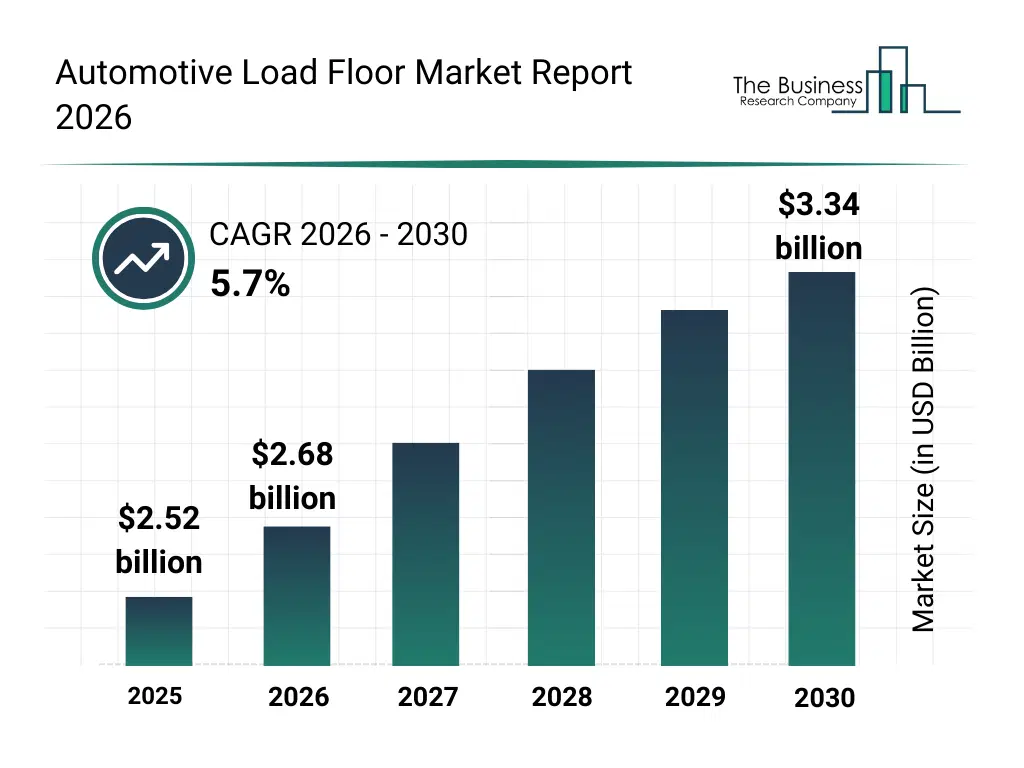
What Is The Automotive Load Floor Market Size and Share 2026?
The automotive load floor market size has grown strongly in recent years. It will grow from $2.52 billion in 2025 to $2.68 billion in 2026 at a compound annual growth rate (CAGR) of 6.2%. The growth in the historic period can be attributed to growth of passenger vehicle production, adoption of hardboard load floors, demand for cargo management, interior design evolution, automotive material innovation.What Is The Automotive Load Floor Market Growth Forecast?
The automotive load floor market size is expected to see strong growth in the next few years. It will grow to $3.34 billion in 2030 at a compound annual growth rate (CAGR) of 5.7%. The growth in the forecast period can be attributed to lightweighting initiatives, electric vehicle range optimization, demand for premium interiors, use of recyclable materials, modular vehicle platforms. Major trends in the forecast period include shift toward lightweight load floor materials, growing use of composite structures, demand for modular cargo solutions, expansion of suv and ev production, customization of interior systems.
Global Automotive Load Floor Market Segmentation
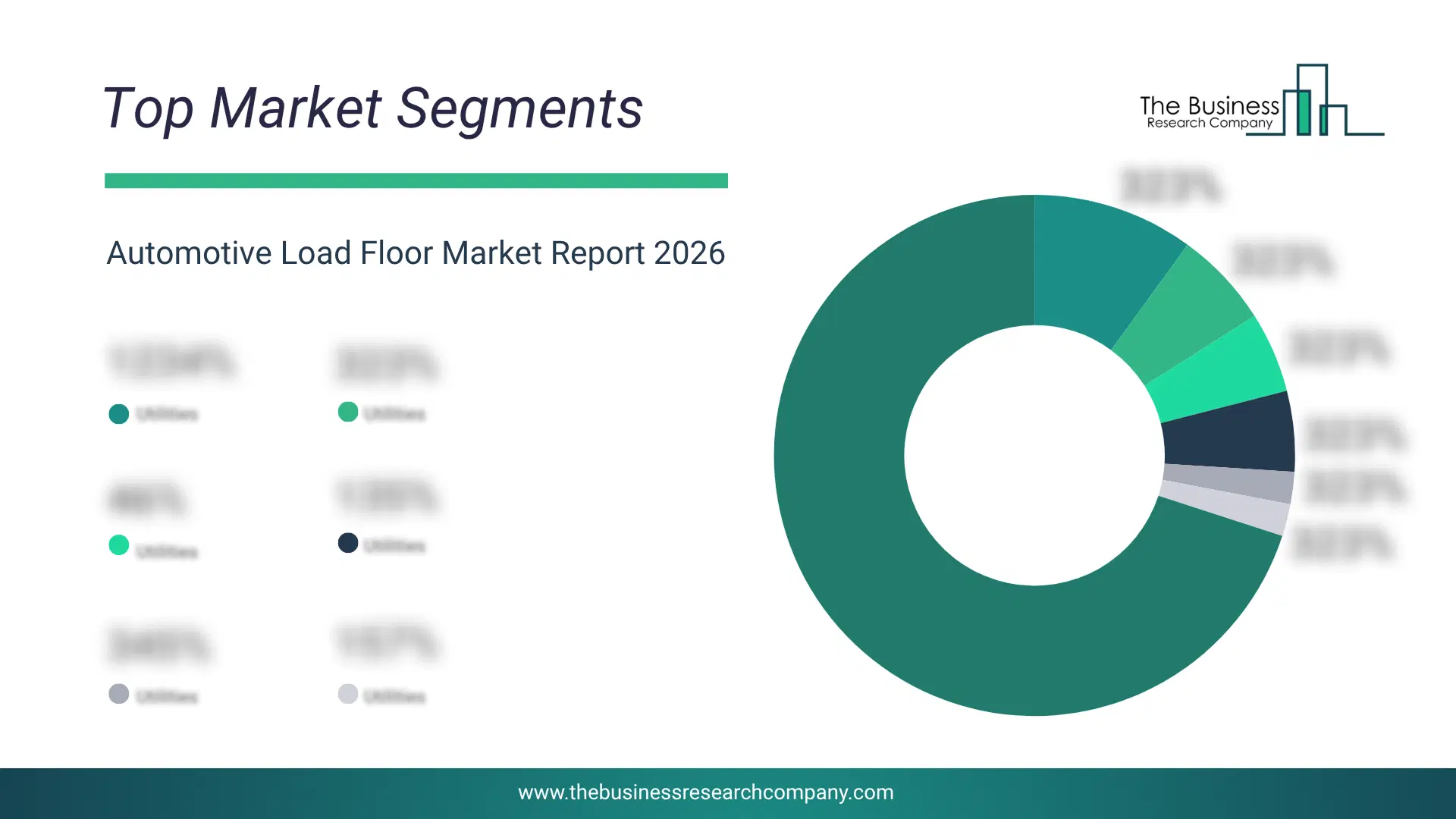
1) By Material Type: Hardboard, Fluted Polypropylene, Honeycomb Polypropylene 2) By Operation: Fixed, Sliding 3) By Vehicle Type: Compact, Mid-Size, Luxury, SUV 4) By Sales Channel: Original Equipment Manufacturer (OEM), Aftermarket 5) By Application: Cargo Systems, Load Floor Systems Subsegments: 1) By Hardboard: Standard Hardboard Load Floors, Water-Resistant Hardboard Load Floors, Reinforced Hardboard For Heavy Loads, Lightweight Hardboard Solutions 2) By Fluted Polypropylene: Single-Walled Fluted Polypropylene, Double-Walled Fluted Polypropylene, Custom-Printed Fluted Polypropylene, Lightweight And Impact-Resistant Fluted Polypropylene 3) By Honeycomb Polypropylene: Single-Layer Honeycomb Polypropylene, Double-Layer Honeycomb Polypropylene, High-Density Honeycomb Polypropylene, Honeycomb Polypropylene With Enhanced Strength And DurabilityWhat Is The Driver Of The Automotive Load Floor Market?
The increasing demand for electric vehicles is expected to propel the growth of the automotive load floor market going forward. Electric vehicles refer to automobiles powered by electricity stored in rechargeable batteries or other onboard energy-storage systems designed to reduce emissions and improve energy efficiency. This demand is rising due to environmental concerns, technological advancements, infrastructure expansion, and strong automaker investment in EV platforms. Automotive load floors support this rise by reducing road noise and vibration, enhancing cabin comfort, and meeting the unique modularity, design flexibility, and performance needs of EV architectures. For instance, in January 2024, according to Kelley Blue Book, a US-based Cox Automotive company, in 2023, a record 1.2 million car buyers in the United States chose electric vehicles, accounting for 7.6% of the total U.S. vehicle market, up from 5.9% in 2022. Therefore, the increasing demand for electric vehicles is driving the growth of the automotive load floor industry.Key Players In The Global Automotive Load Floor Market
Major companies operating in the automotive load floor market report include Adient PLC, Grupo Antolin, IDEAL Automotive GmbH, CIE Automotive, ABC Technologies, Gemini Group Inc., Woodbridge Group, Borgers SE & Co. KGaA, Flex-N-Gate LLC, International Automotive Components Group, Toyota Boshoku Corporation, Faurecia SE, Magna International Inc., SMP Automotive Systems, TS TECH Co. Ltd., Lear Corporation, Yanfeng Automotive Interiors, Brose Fahrzeugteile SE & Co. KG, Ningbo Huaxiang Electronic, Kasai Kogyo Co. Ltd., Calsonic Kansei Corporation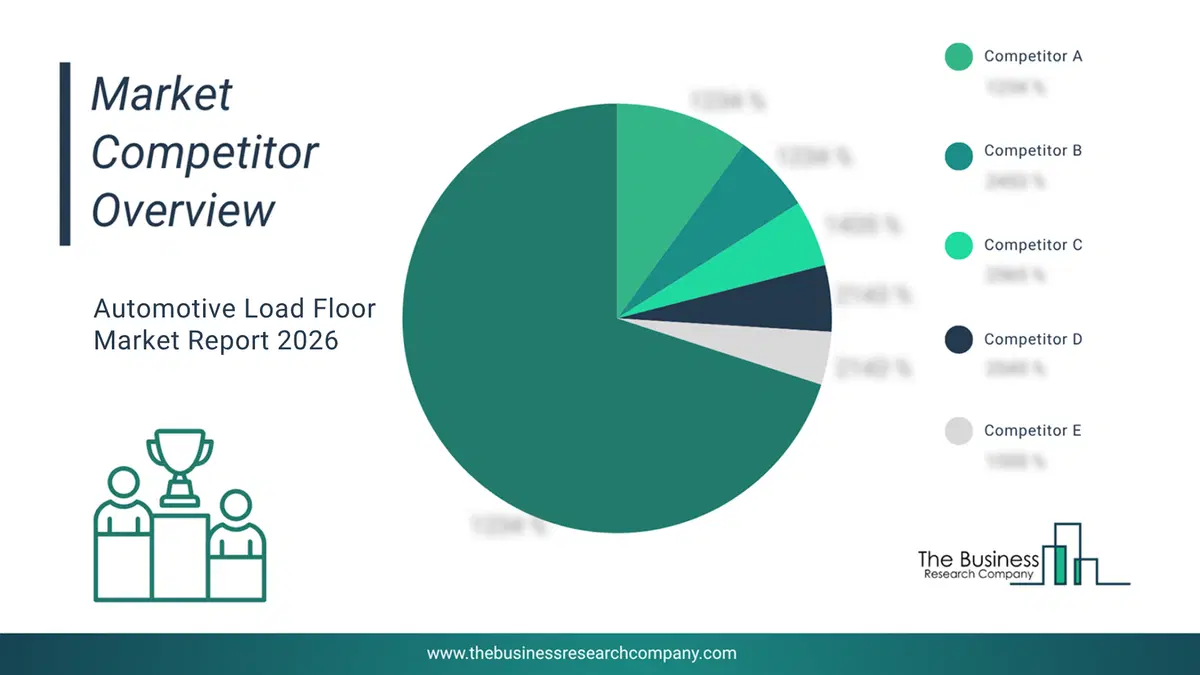
This chart is for illustrative purposes; the full report includes a detailed competitor analysis and comprehensive overview of the top 10 companies in the market.
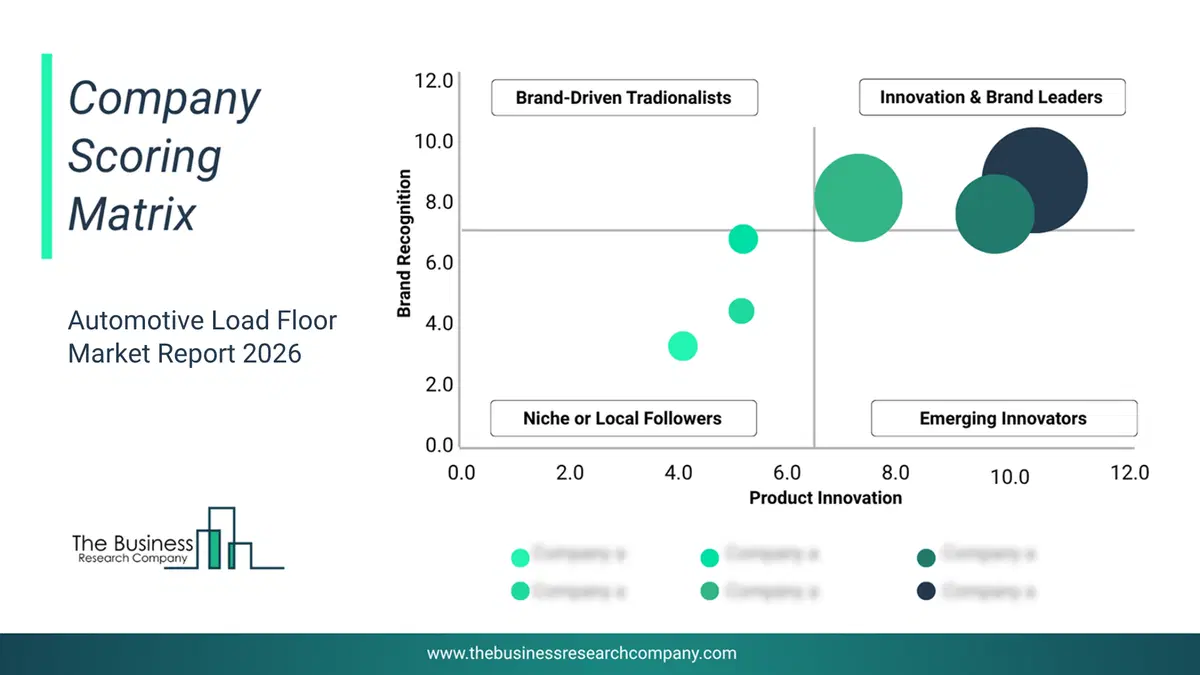
This chart maps companies by product innovation and brand strength, with bubble size indicating relative revenue, helping identify market leaders, challengers, and niche players. This is an illustrative chart; the full report provides a complete and accurate competitive analysis.
Global Automotive Load Floor Market Trends and Insights
Major companies operating in the automotive load floor market are focusing on developing lightweight reversible load floor systems, such as composite load floor panels with integrated slip-resistant thermoplastic polyurethane (TPU) film surfaces, to enhance cargo protection, reduce load shifting, and support overall vehicle weight reduction. Composite load floor panels with integrated slip-resistant TPU film use a lightweight polyurethane (PUR) composite structure typically a honeycomb core with glass fiber skins laminated with a foamed TPU surface layer, creating a reversible panel that offers a carpeted or decorative side and a durable, grippy, easy-to-clean side for the cargo area or spare-tire cover. For instance, in 2023, Covestro AG, a Germany-based specialty chemicals company, introduced an automotive load floor solution that combines its Platilon® F foamed TPU film with Baypreg® PUR composite technology to create a reversible load floor and spare-tire cover panel, offering features such as a slip-resistant surface that reduces cargo movement, a lightweight but rigid PUR composite structure that supports better fuel economy, and an easily cleanable, impact- and abrasion-resistant surface that can eliminate the need for separate aftermarket cargo covers.What Are Latest Mergers And Acquisitions In The Automotive Load Floor Market?
In September 2023, ABC Technologies Holdings Inc., a Canada-based company that offers automotive interior systems, exterior systems, and fluid management systems acquired Plastikon Automotive for an undisclosed amount. This acquisition allows ABC Technologies to further strengthen its capabilities in automotive interiors, exteriors, and electric vehicle components, while also expanding its workforce and footprint in the North American automotive industry. Plastikon Automotive is a US-based company that manufactures automotive load floors.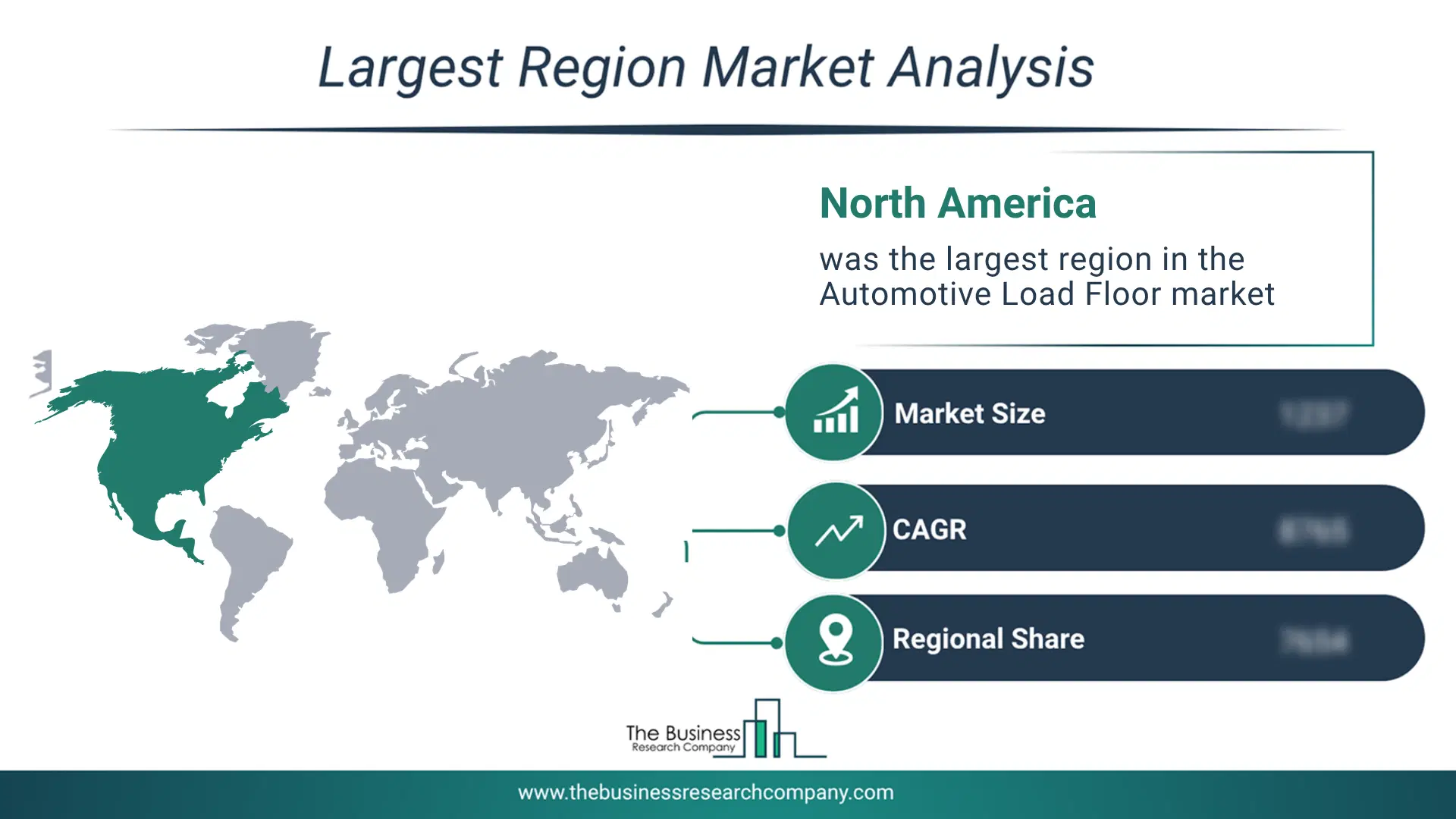
Regional Outlook
North America was the largest region in the automotive load floor market in 2025. Asia-Pacific is expected to be the Highest-growing region in the forecast period. The regions covered in this market report include Asia-Pacific, South East Asia, Western Europe, Eastern Europe, North America, South America, Middle East, Africa. The countries covered in this market report include Australia, Brazil, China, France, Germany, India, Indonesia, Japan, Taiwan, Russia, South Korea, UK, USA, Canada, Italy, SpainWhat Defines the Automotive Load Floor Market?
The automotive load floor market consists of sales of modular cargo systems, underfloor storage, foldable load floors, cargo management systems, and convertible load floors. Values in this market are ‘factory gate’ values, that is, the value of goods sold by the manufacturers or creators of the goods, whether to other entities (including downstream manufacturers, wholesalers, distributors, and retailers) or directly to end customers. The value of goods in this market includes related services sold by the creators of the goods.How is Market Value Defined and Measured?
The market value is defined as the revenues that enterprises gain from the sale of goods and/or services within the specified market and geography through sales, grants, or donations in terms of the currency (in USD unless otherwise specified). The revenues for a specified geography are consumption values that are revenues generated by organizations in the specified geography within the market, irrespective of where they are produced. It does not include revenues from resales along the supply chain, either further along the supply chain or as part of other products.
This chart presents market attractiveness based on a quantitative evaluation of growth, competition, strategic alignment, and risk, offering a clear view of opportunity areas for decision-making. This chart is for illustrative purposes; the full report contains the complete analysis.

This chart highlights the Total Addressable Market (TAM) by estimating the maximum revenue opportunity using an assumption-driven approach, supporting strategic planning and opportunity sizing across markets. The chart is illustrative; the full report provides a more comprehensive analysis.
What Key Data and Analysis Are Included in the Automotive Load Floor Market Report 2026?
The automotive load floor market research report is one of a series of new reports from The Business Research Company that provides market statistics, including industry global market size, regional shares, competitors with the market share, detailed market segments, market trends and opportunities, and any further data you may need to thrive in the automotive load floor industry. The market research report delivers a complete perspective of everything you need, with an in-depth analysis of the current and future state of the industry.Automotive Load Floor Market Report Forecast Analysis
| Report Attribute | Details |
|---|---|
| Market Size Value In 2026 | $2.68 billion |
| Revenue Forecast In 2030 | $3.34 billion |
| Growth Rate | CAGR of 6.2% from 2026 to 2030 |
| Base Year For Estimation | 2025 |
| Actual Estimates/Historical Data | 2020-2025 |
| Forecast Period | 2026 - 2030 - 2030 |
| Market Representation | Revenue in USD Billion and CAGR from 2026 to 2030 |
| Segments Covered | Material Type, Operation, Vehicle Type, Sales Channel, Application |
| Regional Scope | Asia-Pacific, Western Europe, Eastern Europe, North America, South America, Middle East, Africa |
| Country Scope | The countries covered in the report are Australia, Brazil, China, France, Germany, India, Indonesia, Japan, Taiwan, Russia, South Korea, UK, USA, Canada, Italy, Spain. |
| Key Companies Profiled | Adient PLC, Grupo Antolin, IDEAL Automotive GmbH, CIE Automotive, ABC Technologies, Gemini Group Inc., Woodbridge Group, Borgers SE & Co. KGaA, Flex-N-Gate LLC, International Automotive Components Group, Toyota Boshoku Corporation, Faurecia SE, Magna International Inc., SMP Automotive Systems, TS TECH Co. Ltd., Lear Corporation, Yanfeng Automotive Interiors, Brose Fahrzeugteile SE & Co. KG, Ningbo Huaxiang Electronic, Kasai Kogyo Co. Ltd., Calsonic Kansei Corporation |
| Customization Scope | Request for Customization |
| Pricing And Purchase Options | Explore Purchase Options |