
Automotive Natural Gas Vehicle Market Report 2026
Global Outlook – By Vehicle Type (Light-Duty Vehicle, Medium-Duty Vehicle, High-Duty Vehicle), By Fuel Type (CNG, LNG), By Application (Commercial Vehicles, Passenger Cars) – Market Size, Trends, Strategies, and Forecast to 2030
Automotive Natural Gas Vehicle Market Overview
• Automotive Natural Gas Vehicle market size has reached to $12.85 billion in 2025 • Expected to grow to $17.86 billion in 2030 at a compound annual growth rate (CAGR) of 6.9% • Growth Driver: Stringent Air Pollution Regulations Boost Demand For Automotive Natural Gas Vehicles • Market Trend: Strategic Collaborations To Expand Offerings • Asia-Pacific was the largest region in 2025.What Is Covered Under Automotive Natural Gas Vehicle Market?
An automotive natural gas vehicle refers to an alternative fuel vehicle that operates with natural gas as the fuel rather than gasoline or diesel. These are lower-cost vehicles than gasoline and diesel and provide a long-lasting and secure fuel supply. The automotive natural gas vehicle provides high mileage and comfort with low emissions. The main types of vehicles in automotive natural gas vehicles are light-duty vehicles, medium-duty vehicles, and high-duty vehicles. The light-duty vehicle carries people and has no more than eight seats in total. Light-duty vehicles are autos with at least four wheels that are used to transport cargo. The different fuel types include CNG and LNG that are used in several applications, such as commercial vehicles and passenger cars.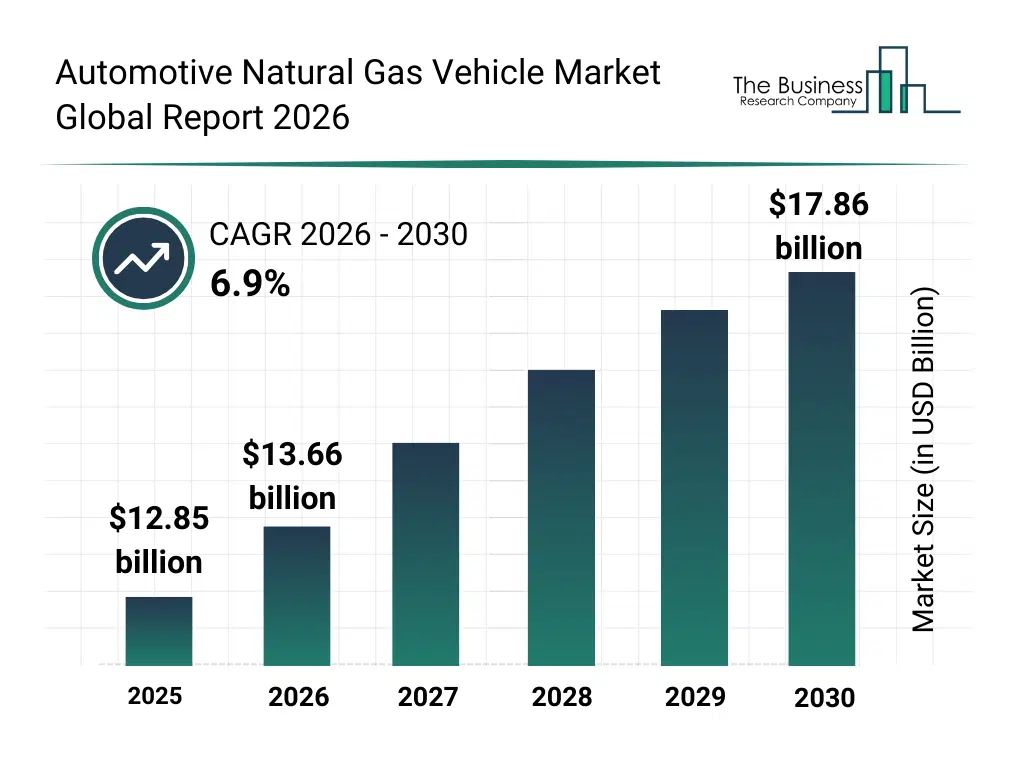
What Is The Automotive Natural Gas Vehicle Market Size and Share 2026?
The automotive natural gas vehicle market size has grown strongly in recent years. It will grow from $12.85 billion in 2025 to $13.66 billion in 2026 at a compound annual growth rate (CAGR) of 6.4%. The growth in the historic period can be attributed to fuel cost volatility, emission reduction needs, commercial fleet adoption, availability of natural gas, urban air quality regulations.What Is The Automotive Natural Gas Vehicle Market Growth Forecast?
The automotive natural gas vehicle market size is expected to see strong growth in the next few years. It will grow to $17.86 billion in 2030 at a compound annual growth rate (CAGR) of 6.9%. The growth in the forecast period can be attributed to decarbonization targets, clean fuel policies, public transport electrification alternatives, infrastructure expansion, fleet conversion initiatives. Major trends in the forecast period include adoption of cng and lng powertrains, expansion of commercial ngv fleets, growth of refueling infrastructure, demand for low-emission vehicles, government incentive programs.
Global Automotive Natural Gas Vehicle Market Segmentation
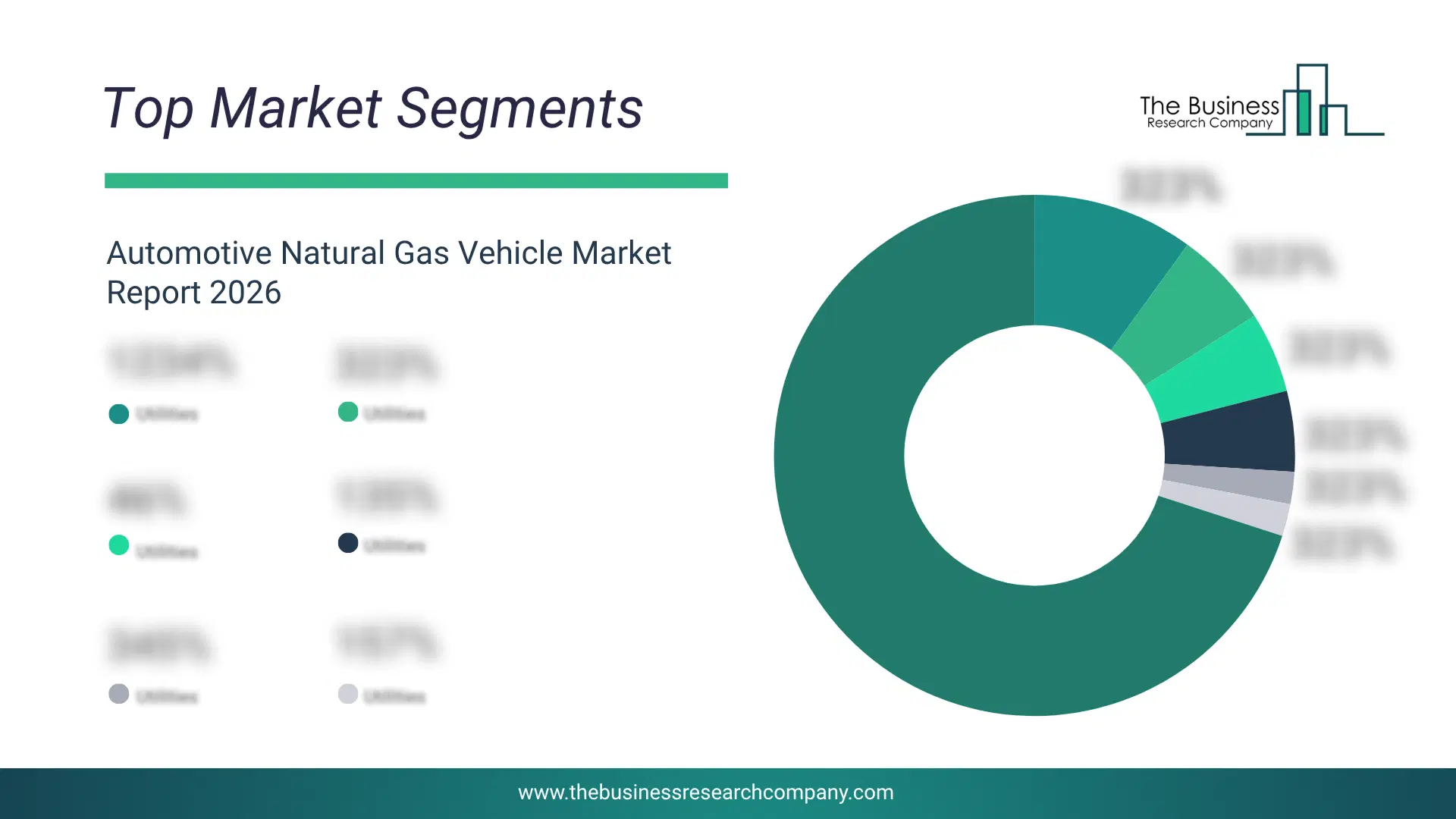
1) By Vehicle Type: Light-Duty Vehicle, Medium-Duty Vehicle, High-Duty Vehicle 2) By Fuel Type: CNG, LNG 3) By Application: Commercial Vehicles, Passenger Cars Subsegments: 1) By Light-Duty Vehicle: Passenger Cars, Light Trucks, Vans 2) By Medium-Duty Vehicle: Delivery Trucks, Buses, Service Vehicles 3) By High-Duty Vehicle: Freight Trucks, Long-Haul Trucks, Heavy-Duty BusesWhat Is The Driver Of The Automotive Natural Gas Vehicle Market?
The stricter vehicle-emission standards are expected to propel the growth of the automotive natural gas vehicle market going forward. Vehicle-emission standards are legally enforced limits that regulate the maximum allowable pollutants such as nitrogen oxides, particulates, and carbon emissions released by vehicles to protect public health and reduce environmental harm. These standards are tightening globally as governments work to cut transport-sector emissions and accelerate the shift toward cleaner, lower-carbon fuels. Automotive natural gas vehicles support compliance with these stricter standards by producing significantly lower particulate matter and nitrogen oxide emissions than conventional gasoline or diesel engines. For instance, in February 2024, according to the European Commission, a Belgium-based executive body of the European Union, the EU formally adopted new Euro 7 emission standards, reducing allowable NOx emissions from cars and vans by 35% compared to Euro 6 limits, with mandatory implementation beginning in 2025, marking the most stringent vehicle-emission requirements introduced to date. Therefore, stricter vehicle-emission standards are driving the growth of the automotive natural gas vehicle industry.Key Players In The Global Automotive Natural Gas Vehicle Market
Major companies operating in the automotive natural gas vehicle market report include Hexagon Composites ASA, AB Volvo, Beiqi Foton Motor Co. Ltd., CNH Industrial NV, Cummins Engine Company Inc., PACCAR International Inc., Navistar International Corp., Quantum Fuel Systems LLC, Westport Fuel Systems Inc., General Motors Company, Maruti Suzuki India Ltd., Ford Motor Company, Volkswagenwerk GmbH, Hyundai Motor Company, Iran Khodro Industrial Group, Tata Engineering & Locomotive Company Ltd., Fiat SpA, Régie Nationale Des Usines Renault SAS, Mercedes-Benz Group AG, Toyota Motor Corporation, Stellantis N. V., Iveco SpA, Alexander Dennis Limited, Shaanxi Automobile Group Co. Ltd.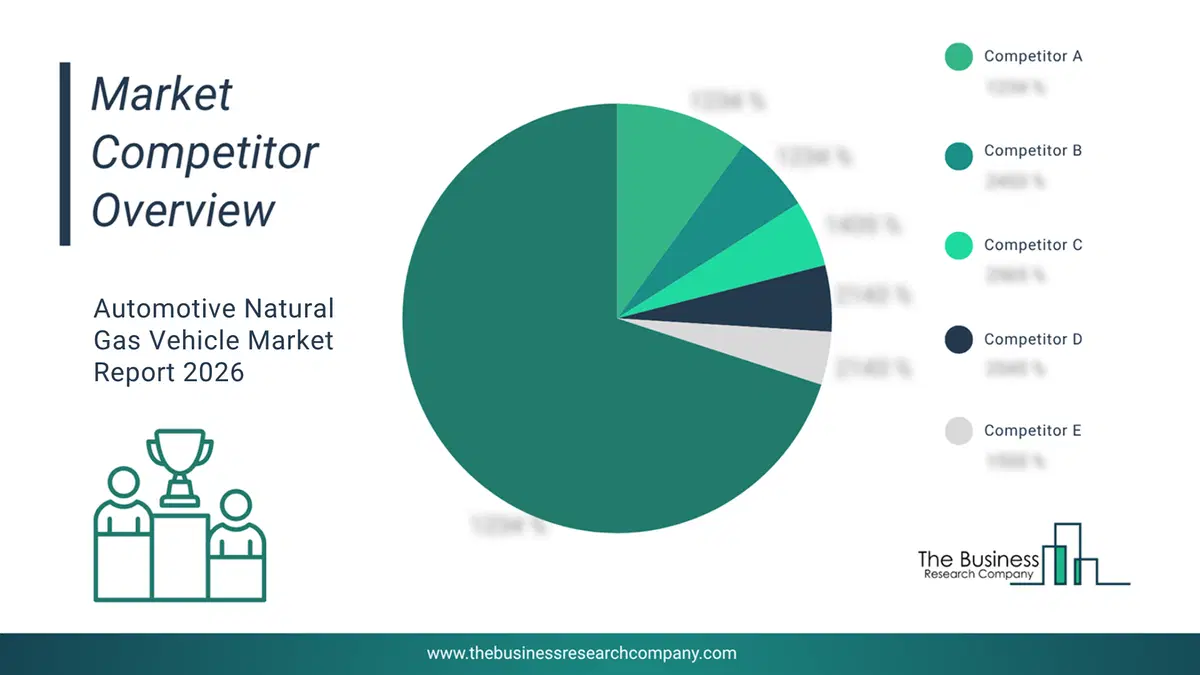
This chart is for illustrative purposes; the full report includes a detailed competitor analysis and comprehensive overview of the top 10 companies in the market.
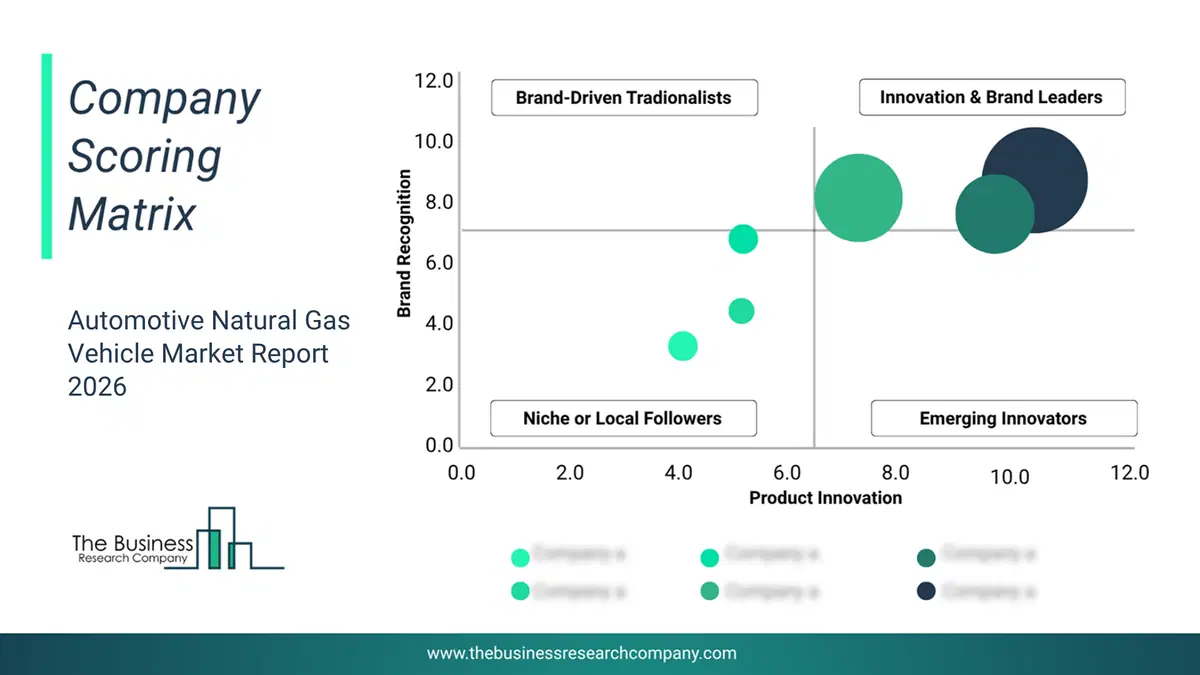
This chart maps companies by product innovation and brand strength, with bubble size indicating relative revenue, helping identify market leaders, challengers, and niche players. This is an illustrative chart; the full report provides a complete and accurate competitive analysis.
Global Automotive Natural Gas Vehicle Market Trends and Insights
Major companies operating in the automotive natural gas vehicle market are developing strategic collaborations to expand their offerings. Strategic partnerships refer to a process in which companies leverage each other's strengths and resources to achieve mutual benefits and success. For instance, in May 2023, Walmart, an American multinational retail corporation, partnered with Cummins, a US-based manufacturer of engines, filtration, and power generation products, to lower greenhouse gas emissions in the transportation business by demonstrating that natural gas engines may be a viable alternative to diesel engines. The collaboration has unveiled the first of five new tractors driven by a Cummins-built compressed natural gas (CNG) engine, which is expected to deliver equal performance and range to a diesel engine while running quieter and costing less to maintain.What Are Latest Mergers And Acquisitions In The Automotive Natural Gas Vehicle Market?
In September 2024, Apollo Global Management Inc, the US-based asset management firm acquired Freedom CNG, for an undisclosed amount. Through this acquisition, Apollo aims to accelerate the expansion of Freedom CNG’s high-capacity fueling-station network and increase investment in dedicated CNG and RNG sites that support logistics fleets, municipal buses, school transportation, and commercial operators relying on natural gas vehicles. Freedom CNG is a US-based company that provide automotive natural gas vehicles.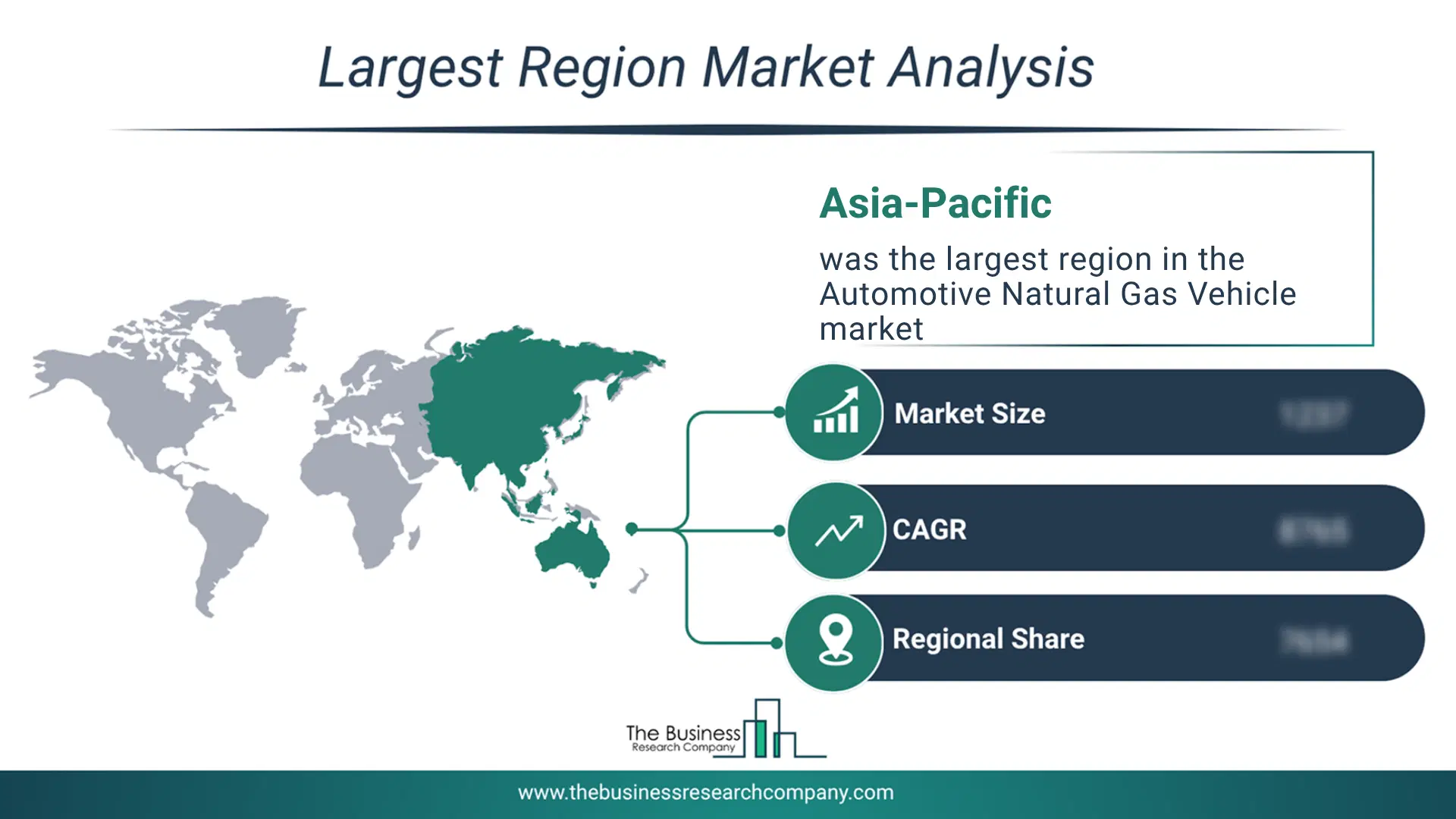
Regional Outlook
Asia-Pacific was the largest region in the automotive natural gas vehicle market in 2025. The regions covered in this market report include Asia-Pacific, South East Asia, Western Europe, Eastern Europe, North America, South America, Middle East, Africa. The countries covered in this market report include Australia, Brazil, China, France, Germany, India, Indonesia, Japan, Taiwan, Russia, South Korea, UK, USA, Canada, Italy, SpainWhat Defines the Automotive Natural Gas Vehicle Market?
The automotive natural gas vehicle market consists of sales of gasoline-powered vehicles. Values in this market are ‘factory gate’ values, that is the value of goods sold by the manufacturers or creators of the goods, whether to other entities (including downstream manufacturers, wholesalers, distributors and retailers) or directly to end customers. The value of goods in this market includes related services sold by the creators of the goods.How is Market Value Defined and Measured?
The market value is defined as the revenues that enterprises gain from the sale of goods and/or services within the specified market and geography through sales, grants, or donations in terms of the currency (in USD unless otherwise specified). The revenues for a specified geography are consumption values that are revenues generated by organizations in the specified geography within the market, irrespective of where they are produced. It does not include revenues from resales along the supply chain, either further along the supply chain or as part of other products.
This chart presents market attractiveness based on a quantitative evaluation of growth, competition, strategic alignment, and risk, offering a clear view of opportunity areas for decision-making. This chart is for illustrative purposes; the full report contains the complete analysis.

This chart highlights the Total Addressable Market (TAM) by estimating the maximum revenue opportunity using an assumption-driven approach, supporting strategic planning and opportunity sizing across markets. The chart is illustrative; the full report provides a more comprehensive analysis.
What Key Data and Analysis Are Included in the Automotive Natural Gas Vehicle Market Report 2026?
The automotive natural gas vehicle market research report is one of a series of new reports from The Business Research Company that provides market statistics, including industry global market size, regional shares, competitors with the market share, detailed market segments, market trends and opportunities, and any further data you may need to thrive in the automotive natural gas vehicle industry. The market research report delivers a complete perspective of everything you need, with an in-depth analysis of the current and future state of the industry.Automotive Natural Gas Vehicle Market Report Forecast Analysis
| Report Attribute | Details |
|---|---|
| Market Size Value In 2026 | $13.66 billion |
| Revenue Forecast In 2030 | $17.86 billion |
| Growth Rate | CAGR of 6.4% from 2026 to 2030 |
| Base Year For Estimation | 2025 |
| Actual Estimates/Historical Data | 2020-2025 |
| Forecast Period | 2026 - 2030 - 2030 |
| Market Representation | Revenue in USD Billion and CAGR from 2026 to 2030 |
| Segments Covered | Vehicle Type, Fuel Type, Application |
| Regional Scope | Asia-Pacific, Western Europe, Eastern Europe, North America, South America, Middle East, Africa |
| Country Scope | The countries covered in the report are Australia, Brazil, China, France, Germany, India, Indonesia, Japan, Taiwan, Russia, South Korea, UK, USA, Canada, Italy, Spain. |
| Key Companies Profiled | Hexagon Composites ASA, AB Volvo, Beiqi Foton Motor Co. Ltd., CNH Industrial NV, Cummins Engine Company Inc., PACCAR International Inc., Navistar International Corp., Quantum Fuel Systems LLC, Westport Fuel Systems Inc., General Motors Company, Maruti Suzuki India Ltd., Ford Motor Company, Volkswagenwerk GmbH, Hyundai Motor Company, Iran Khodro Industrial Group, Tata Engineering & Locomotive Company Ltd., Fiat SpA, Régie Nationale Des Usines Renault SAS, Mercedes-Benz Group AG, Toyota Motor Corporation, Stellantis N. V., Iveco SpA, Alexander Dennis Limited, Shaanxi Automobile Group Co. Ltd. |
| Customization Scope | Request for Customization |
| Pricing And Purchase Options | Explore Purchase Options |