

Automotive Night Vision System Market Report 2026
Global Outlook – By Component Type ( Night Vision Camera, Sensor, Display Unit, Controlling Unit, Other Components), By Technology ( Far Infrared (FIR), Near-Infrared (NIR)), By Display Type ( Instrument Cluster, Navigation System, Heads-Up Display (HUD)), By Application ( Original Equipment Manufacturers (OEMs), Aftermarket) – Market Size, Trends, Strategies, and Forecast to 2030
Automotive Night Vision System Market Overview
• Automotive Night Vision System market size has reached to $4.24 billion in 2025 • Expected to grow to $7.24 billion in 2030 at a compound annual growth rate (CAGR) of 11.3% • Growth Driver: Increase In The Number Of Road Accidents Drives The Automotive Night Vision System Market • Market Trend: Peterbilt Motors Launches Advanced Digital Vision System-Mirrors for Enhanced Nighttime Safety • Asia-Pacific was the largest region in 2025.What Is Covered Under Automotive Night Vision System Market?
Automotive Night Vision System (ANVS) is a device to improve a vehicle’s visibility and safety in low-light or night-time driving conditions using a thermographic camera, sensor system when vision is obstructed by darkness, smoke, or fog. These systems include collision avoidance and audio or visual alert systems. The system can identify pedestrians, animals, and other perils the driver might have overlooked. The main components of automotive night vision system are night vision camera, sensor, display unit, controlling unit, and others. Night vision camera is used to capture images in low-light conditions, such as at night. It uses infrared light to illuminate the scene and can be seen by the camera. It works by using far infrared (FIR) and near-infrared (NIR) technologies for instrument cluster, navigation system, head-up display (HUD). These are applied by original equipment manufacturers (OEMs) and aftermarket.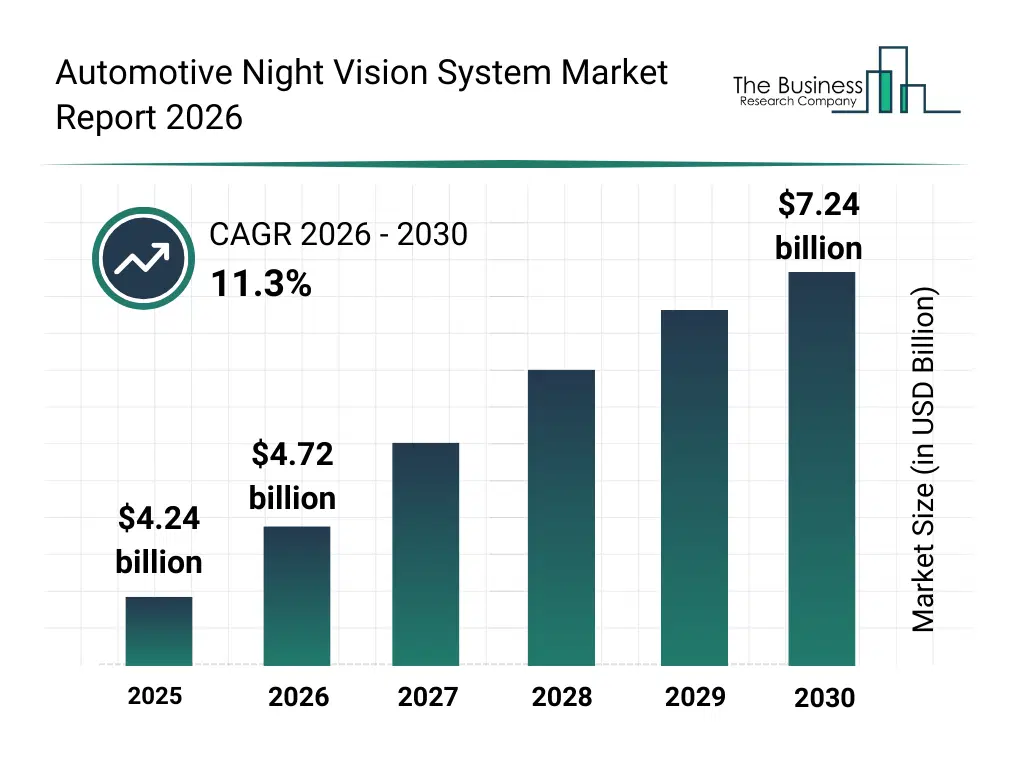
What Is The Automotive Night Vision System Market Size 2026 And Growth Rate?
The automotive night vision system market size has grown rapidly in recent years. It will grow from $4.24 billion in 2025 to $4.72 billion in 2026 at a compound annual growth rate (CAGR) of 11.5%. The growth in the historic period can be attributed to early adoption in premium vehicles, reliance on basic thermal imaging, growth in initial collision avoidance systems, early deployment in luxury sedans, use in aftermarket night driving aids.What Is The Automotive Night Vision System Market Growth Forecast?
The automotive night vision system market size is expected to see rapid growth in the next few years. It will grow to $7.24 billion in 2030 at a compound annual growth rate (CAGR) of 11.3%. The growth in the forecast period can be attributed to rising adoption across mid-range vehicles, increasing demand for advanced thermal sensors, expansion of autonomous driving safety features, development of smart hud-integrated night displays, rising vehicle safety regulations worldwide. Major trends in the forecast period include adoption of AI-enhanced night vision detection systems, expansion of autonomous vehicle night safety platforms, integration of IoT-connected night vision modules, advancement of data-driven thermal imaging technologies, development of ev-compatible night vision solutions.
Global Automotive Night Vision System Market Segmentation
1) By Component Type: Night Vision Camera, Sensor, Display Unit, Controlling Unit, Other Components 2) By Technology: Far Infrared (FIR), Near-Infrared (NIR) 3) By Display Type: Instrument Cluster, Navigation System, Heads-Up Display (HUD) 4) By Application: Original Equipment Manufacturers (OEMs), Aftermarket Subsegments: 1) By Night Vision Camera: Infrared Cameras, Thermal Imaging Cameras 2) By Sensor: Infrared Sensors, Image Sensors 3) By Display Unit: Head-Up Displays (HUD), Dashboard Displays 4) By Controlling Unit: Central Processing Unit (CPU), Control Algorithms And Software 5) By Other Components: Wiring Harnesses, Mounting Hardware, ConnectorsWhat Is The Driver Of The Automotive Night Vision System Market?
The increase in the number of road accidents is expected to propel the growth of the automotive night vision system market going forward. Road accidents remain a significant concern globally, there is a growing emphasis on integrating advanced safety features into vehicles. Automotive night vision systems, which use infrared technology to enhance visibility in low-light conditions, can play a crucial role in preventing accidents, especially during nighttime driving. For instance, in 2023, according to the Transport Accident Commission, an Australia-based government agency, in 2023 a total of 295 people lost their lives on Victorian roads, marking a 22.4% increase (54 more fatalities) compared to 2022. Additionally, there were 261 fatal crashes, up by 22 (9%) from the 239 recorded in the previous year. Therefore, the increase in the number of road accidents is driving the growth of the automotive night vision system industry during the forecast period.Key Players In The Global Automotive Night Vision System Market
Major companies operating in the automotive night vision system market are Continental AG, Delphi Technologies plc, Denso Corporation, Teledyne FLIR LLC / FLIR Systems Inc., Magna International Inc., Omnivision Technologies Inc., Omron Corporation, Robert Bosch GmbH, Valeo SA, Hella KGaA Hueck & Co., L3 Technologies Inc., Aisin Seiki Co. Ltd., Melexis NV, Protruly Electronics Co. Ltd. / Shenzhen Protruly Electronics Co. Ltd., Mobileye Global Inc., Veoneer Inc., OSRAM Licht AG, Visteon Corporation, Ford Motor Company, Audi AG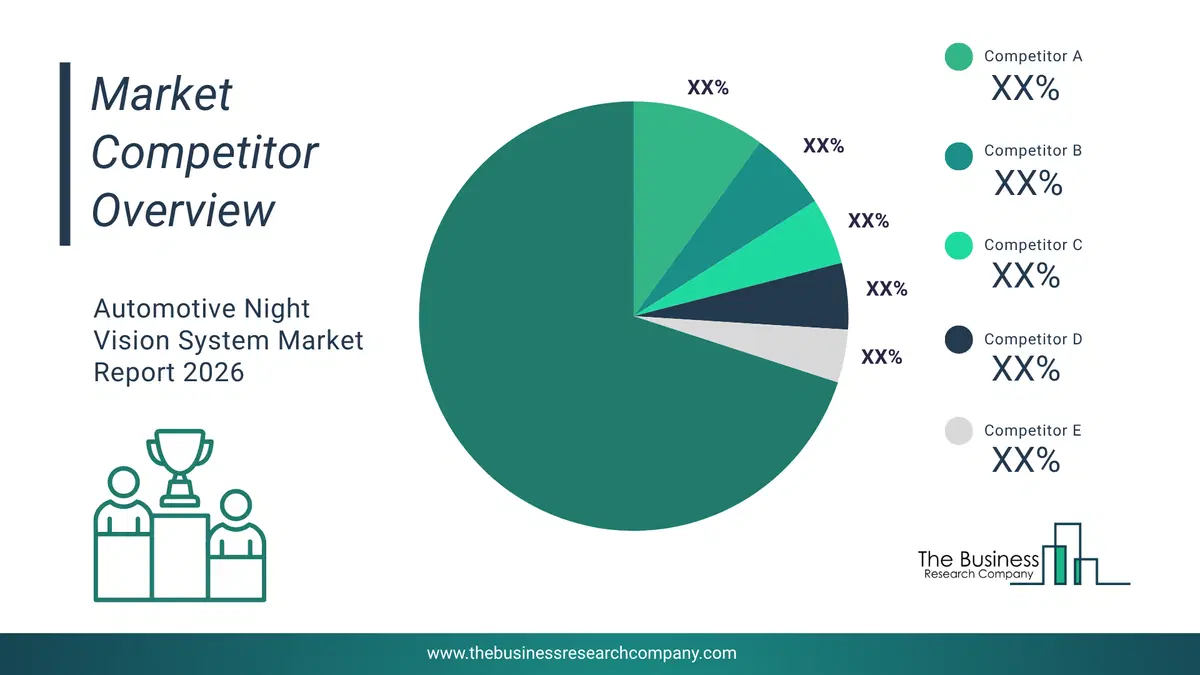
This chart is for illustrative purposes; the full report includes a detailed competitor analysis and comprehensive overview of the top 10 companies in the market.
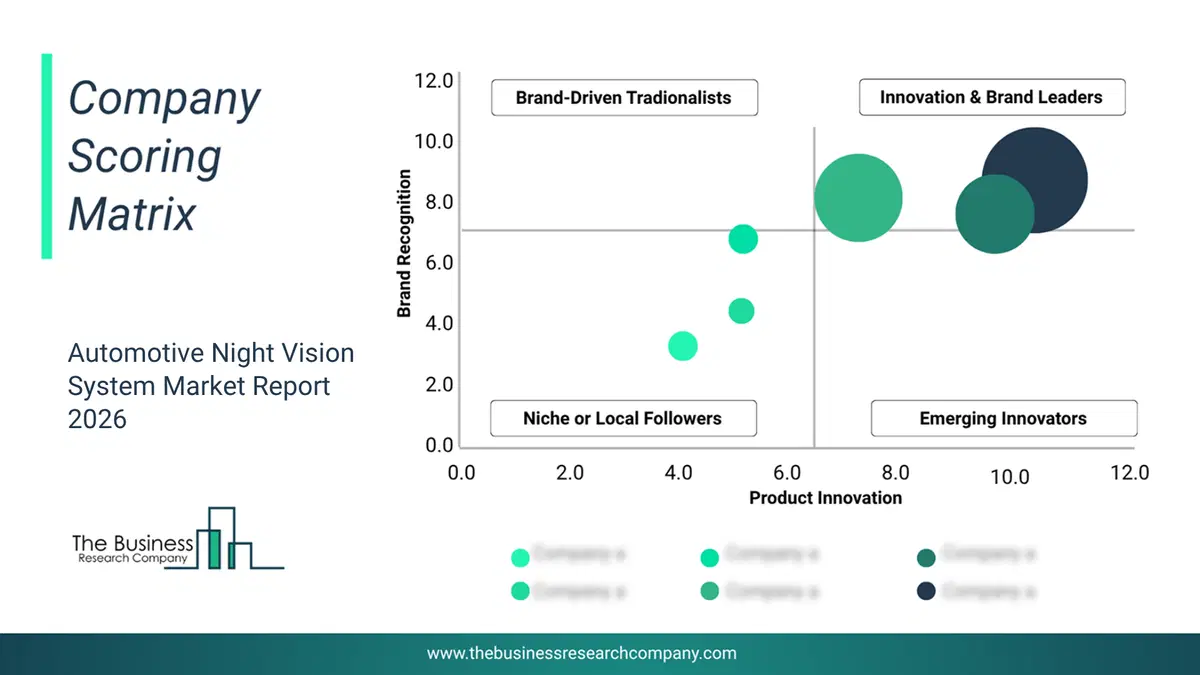
This chart maps companies by product innovation and brand strength, with bubble size indicating relative revenue, helping identify market leaders, challengers, and niche players. This is an illustrative chart; the full report provides a complete and accurate competitive analysis.
Global Automotive Night Vision System Market Trends and Insights
Major companies in the automotive night vision system market are focused on developing advanced infrared technology solutions such as the Digital Vision System-Mirrors to enhance nighttime visibility and reduce accidents. Digital Vision System mirrors improve driver awareness by delivering high-definition visuals and crucial information in low-light conditions. For instance, in June 2024, Peterbilt Motors, a US-based manufacturing company, launched digital vision system-mirrors. The DVS-M system from Peterbilt utilizes three High Dynamic Range (HDR) cameras with hydrophobic lenses for optimal visibility in harsh weather, controlled via a joystick, and displayed on two high-definition monitors. These monitors, designed to minimize visibility disruption, offer three viewing layouts and include enhancements like automatic trailer tracking and infrared night vision. Additionally, the DVS-M improves driver safety by reducing blind spots and glare, while also achieving fuel savings of up to 1.5% and featuring automatic camera defrost at low temperatures.What Are Latest Mergers And Acquisitions In The Automotive Night Vision System Market?
In June 2023, Magna International, a Canada-based manufacturing company, acquired Veoneer US Safety Systems LLC for an undisclosed amount. Through this acquisition, Magna International aims to establish itself as one of the select suppliers equipped to handle the rising complexities of advanced software, systems, and integration by offering a full suite of solutions to customers. Veoneer US Safety Systems LLC is a US-based firm dedicated to enhancing vehicle safety through cutting-edge technologies, including automotive night vision systems.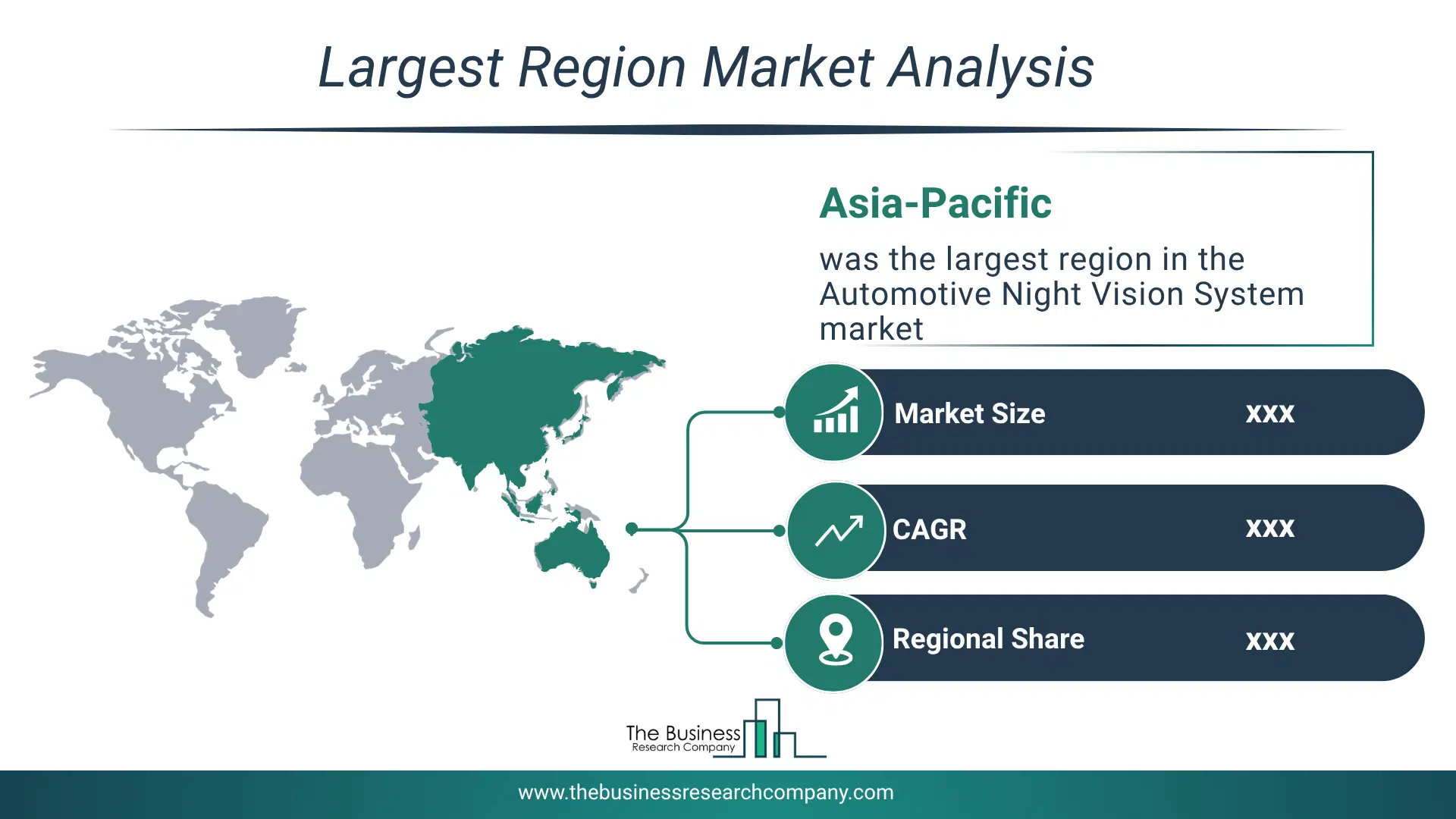
Regional Outlook
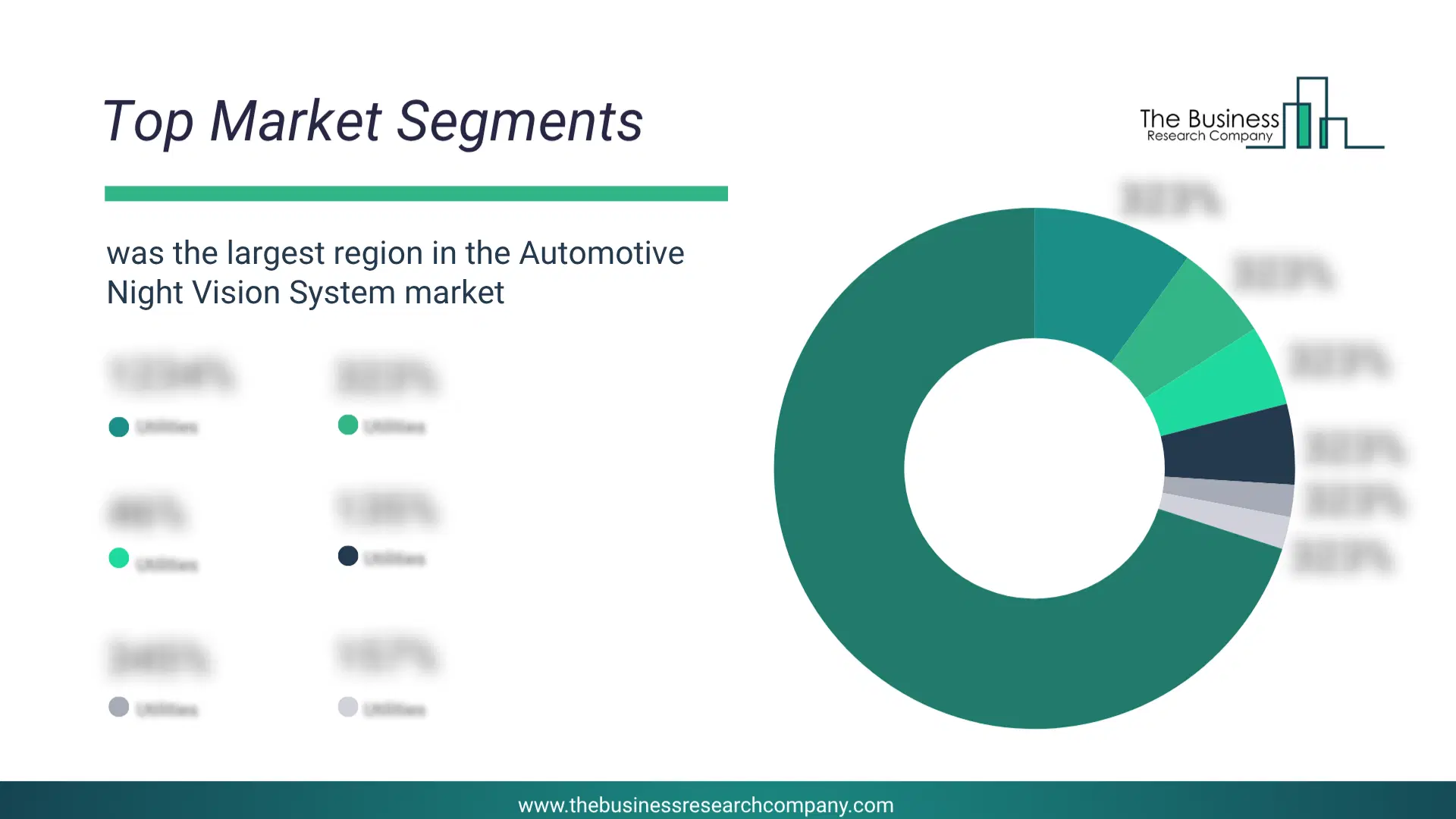
Asia-Pacific was the largest region in the automotive night vision system market in 2025. The regions covered in this market report are Asia-Pacific, South East Asia, Western Europe, Eastern Europe, North America, South America, Middle East, Africa. The countries covered in this market report are Australia, Brazil, China, France, Germany, India, Indonesia, Japan, Taiwan, Russia, South Korea, UK, USA, Canada, Italy, Spain.What Defines the Automotive Night Vision System Market?
The automotive night vision system market consists of sale of lidar sensors, cameras, processing units and display screens. Values in this market are ‘factory gate’ values, that is the value of goods sold by the manufacturers or creators of the goods, whether to other entities (including downstream manufacturers, wholesalers, distributors and retailers) or directly to end customers. The value of goods in this market includes related services sold by the creators of the goods.How is Market Value Defined and Measured?
The market value is defined as the revenues that enterprises gain from the sale of goods and/or services within the specified market and geography through sales, grants, or donations in terms of the currency (in USD unless otherwise specified). The revenues for a specified geography are consumption values that are revenues generated by organizations in the specified geography within the market, irrespective of where they are produced. It does not include revenues from resales along the supply chain, either further along the supply chain or as part of other products.
This chart presents market attractiveness based on a quantitative evaluation of growth, competition, strategic alignment, and risk, offering a clear view of opportunity areas for decision-making. This chart is for illustrative purposes; the full report contains the complete analysis.

This chart highlights the Total Addressable Market (TAM) by estimating the maximum revenue opportunity using an assumption-driven approach, supporting strategic planning and opportunity sizing across markets. The chart is illustrative; the full report provides a more comprehensive analysis.
What Key Data and Analysis Are Included in the Automotive Night Vision System Market Report 2026?
The automotive night vision system market research report is one of a series of new reports from The Business Research Company that provides market statistics, including industry global market size, regional shares, competitors with the market share, detailed market segments, market trends and opportunities, and any further data you may need to thrive in the automotive night vision system industry. The market research report delivers a complete perspective of everything you need, with an in-depth analysis of the current and future state of the industry.Automotive Night Vision System Market Report Forecast Analysis
| Report Attribute | Details |
|---|---|
| Market Size Value In 2026 | $4.72 billion |
| Revenue Forecast In 2030 | $7.24 billion |
| Growth Rate | CAGR of 11.3% from 2026 to 2030 |
| Base Year For Estimation | 2025 |
| Actual Estimates/Historical Data | 2020-2025 |
| Forecast Period | 2026 - 2030 |
| Market Representation | Revenue in USD Billion and CAGR from 2026 to 2030 |
| Segments Covered | Component Type, Technology, Display Type, Application |
| Regional Scope | Asia-Pacific, Western Europe, Eastern Europe, North America, South America, Middle East, Africa |
| Country Scope | The countries covered in the report are Australia, Brazil, China, France, Germany, India, Indonesia, Japan, Taiwan, Russia, South Korea, UK, USA, Canada, Italy, Spain. |
| Key Companies Profiled | Major companies operating in the automotive night vision system market are <b> Continental AG, Delphi Technologies plc, Denso Corporation, Teledyne FLIR LLC / FLIR Systems Inc., Magna International Inc., Omnivision Technologies Inc., Omron Corporation, Robert Bosch GmbH, Valeo SA, Hella KGaA Hueck & Co., L3 Technologies Inc., Aisin Seiki Co. Ltd., Melexis NV, Protruly Electronics Co. Ltd. / Shenzhen Protruly Electronics Co. Ltd., Mobileye Global Inc., Veoneer Inc., OSRAM Licht AG, Visteon Corporation, Ford Motor Company, Audi AG </b> |
| Customization Scope | Request for Customization |
| Pricing And Purchase Options | Explore Purchase Options |