
Automotive Optoelectronics Market Report 2026
Global Outlook – By Component Type (Light-Emitting Diodes, Image Sensors, Infrared Components, Laser Diodes, Optocouplers), By Vehicle Type (Passenger Cars, Commercial Vehicles, Electric Vehicles, Luxury Vehicles), By Sales Channel (Original Equipment Manufacturers, Aftermarket), By Application (Advanced Driver Assistance Systems, Automotive Lighting Systems, Interior And Cabin Lighting, Display And Infotainment Systems, Parking Assistance Systems, Autonomous Driving Systems) – Market Size, Trends, Strategies, and Forecast to 2030
Automotive Optoelectronics Market Overview
• Automotive Optoelectronics market size has reached to $6.7 billion in 2025 • Expected to grow to $10.64 billion in 2030 at a compound annual growth rate (CAGR) of 9.6% • Growth Driver: Increasing Vehicle Production Fueling The Growth Of The Market Due To Rising Demand For Advanced Optical Sensors, LED Lighting, And Vehicle Electronics • Market Trend: Innovations In Automotive Camera And Sensing Technologies Transform Vehicle Safety And Intelligent Mobility • Asia-Pacific was the largest region and fastest growing region.What Is Covered Under Automotive Optoelectronics Market?
Automotive optoelectronics are electronic components that convert electrical signals into light or light into electrical signals for use in vehicles. They combine optical and semiconductor technologies to support vehicle lighting, sensing, display, and communication functions. These components enhance vehicle safety, visibility, energy efficiency, and user interaction by enabling advanced light-based systems and optical detection capabilities. The main component types of automotive optoelectronics include light-emitting diodes, image sensors, infrared components, laser diodes, and optocouplers. Light-emitting diodes refer to semiconductor devices that convert electrical energy into light and are widely used for vehicle lighting, displays, signaling, and other optical functions. These components are used in passenger cars, commercial vehicles, electric vehicles, and luxury vehicles and are distributed through original equipment manufacturers and aftermarket channels. They find application in advanced driver assistance systems, automotive lighting systems, interior and cabin lighting, display and infotainment systems, parking assistance systems, and autonomous driving systems.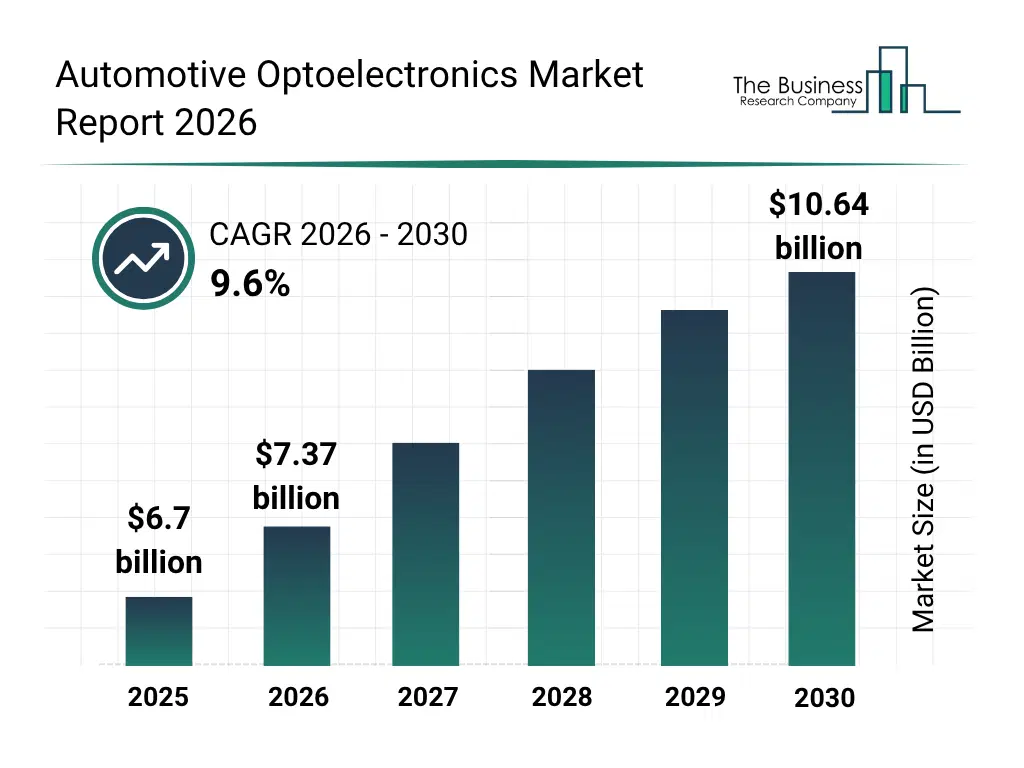
What Is The Automotive Optoelectronics Market Size and Share 2026?
The automotive optoelectronics market size has grown rapidly in recent years. It will grow from $6.7 billion in 2025 to $7.37 billion in 2026 at a compound annual growth rate (CAGR) of 10.0%. The growth in the historic period can be attributed to increasing adoption of LED automotive lighting, rising demand for vehicle safety systems, growing deployment of camera-based vehicle systems, increasing demand for improved vehicle visibility, rising production of premium and luxury vehicles.What Is The Automotive Optoelectronics Market Growth Forecast?
The automotive optoelectronics market size is expected to see strong growth in the next few years. It will grow to $10.64 billion in 2030 at a compound annual growth rate (CAGR) of 9.6%. The growth in the forecast period can be attributed to increasing demand for advanced optical sensing components, rising adoption of laser-based automotive sensing, growing integration of optoelectronics in electric vehicles, increasing demand for high-performance image sensors, rising deployment of advanced vehicle lighting systems. Major trends in the forecast period include increasing adoption of high-efficiency automotive leds, rising integration of advanced image sensing components, growing use of infrared sensing components for vehicle monitoring, increasing adoption of laser-based automotive sensing systems, rising demand for compact and high-reliability optoelectronic components.
Global Automotive Optoelectronics Market Segmentation
1) By Component Type: Light-Emitting Diodes, Image Sensors, Infrared Components, Laser Diodes, Optocouplers 2) By Vehicle Type: Passenger Cars, Commercial Vehicles, Electric Vehicles, Luxury Vehicles 3) By Sales Channel: Original Equipment Manufacturers, Aftermarket 4) By Application: Advanced Driver Assistance Systems, Automotive Lighting Systems, Interior And Cabin Lighting, Display And Infotainment Systems, Parking Assistance Systems, Autonomous Driving Systems Subsegments: 1) By Light-Emitting Diodes: Automotive Exterior Lighting, Automotive Interior Lighting, Adaptive Front Lighting Systems, Daytime Running Lighting Systems, Ambient Lighting Systems 2) By Image Sensors: Rear-View Camera Systems, Surround-View Monitoring Systems, Driver Monitoring Systems, Parking Assistance Camera Systems, Advanced Driver Assistance Camera Systems 3) By Infrared Components: Driver Fatigue Monitoring Systems, Night Vision Assistance Systems, Occupant Detection Systems, Gesture Recognition Systems, Cabin Monitoring Systems 4) By Laser Diodes: Light Detection And Ranging Systems, Adaptive Headlight Systems, Long-Range Sensing Systems, Obstacle Detection Systems, Autonomous Navigation Systems 5) By Optocouplers: Battery Management Systems Isolation Units, Electric Vehicle Powertrain Control Systems, High-Voltage Safety Isolation Systems, Power Electronics Protection Systems, Automotive Control Unit Signal Isolation SystemsWhat Is The Driver Of The Automotive Optoelectronics Market?
The increasing vehicle production is expected to propel the growth of the automotive optoelectronics market going forward. Vehicle production refers to the manufacturing and assembly of passenger cars, commercial vehicles, and other motor vehicles equipped with mechanical, electrical, and electronic systems. Vehicle production and sales are increasing due to rising demand for transportation, as more people and businesses require vehicles for commuting, goods movement, and other transportation needs. Vehicle production supports the growth of automotive optoelectronics by driving demand for advanced lighting systems, optical sensors, camera modules, display technologies, and safety features that enhance vehicle performance, energy efficiency, connectivity, and intelligent driving capabilities. For instance, in March 2024, according to the European Automobile Manufacturers’ Association (ACEA), a Belgium-based automotive association, global car production reached 76 million units in 2023, representing a 10.2% increase compared with 2022, while global new car sales increased by almost 10% in 2023 compared with 2022. Therefore, the increasing vehicle production is driving the growth of the automotive optoelectronics industry.Key Players In The Global Automotive Optoelectronics Market
Major companies operating in the automotive optoelectronics market are Samsung Electronics Co. Ltd., Sony Group Corporation, Broadcom Inc., Panasonic Holdings Corporation, Valeo SE, Continental AG, Texas Instruments Incorporated, Infineon Technologies AG, NXP Semiconductors N.V., STMicroelectronics N.V., Renesas Electronics Corporation, KOITO MANUFACTURING CO. LTD., ON Semiconductor Corporation, ams-OSRAM AG, Vishay Intertechnology Inc., ROHM Co. Ltd., Seoul Semiconductor Co. Ltd., LITE-ON Technology Corporation, NICHIA CORPORATION, STANLEY ELECTRIC CO. LTD.
This chart is for illustrative purposes; the full report includes a detailed competitor analysis and comprehensive overview of the top 10 companies in the market.
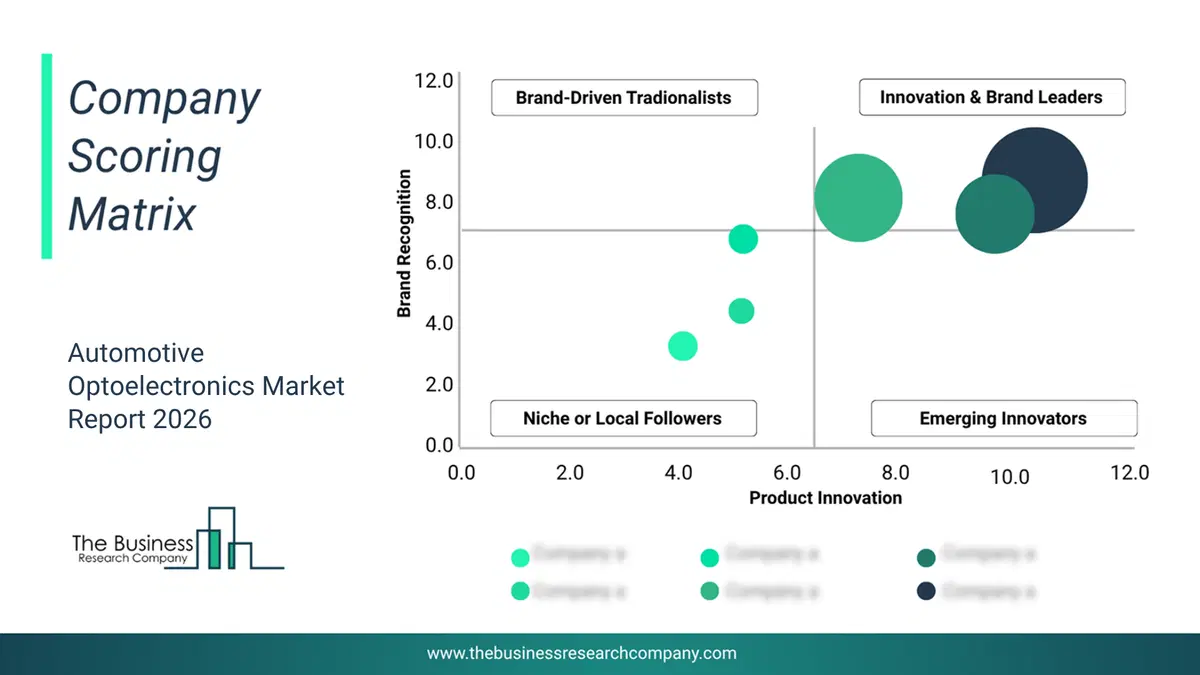
This chart maps companies by product innovation and brand strength, with bubble size indicating relative revenue, helping identify market leaders, challengers, and niche players. This is an illustrative chart; the full report provides a complete and accurate competitive analysis.
Global Automotive Optoelectronics Market Trends and Insights
Major companies operating in the automotive optoelectronics market are focusing on developing advanced products such as, high-resolution CMOS image sensors for automotive cameras to enhance advanced driver assistance systems (ADAS), automated driving capabilities, object recognition accuracy, and vehicle safety. High-resolution CMOS image sensors are semiconductor-based imaging devices that convert light into digital signals, enabling automotive cameras to capture detailed images of road environments, vehicles, pedestrians, and other objects with improved clarity and accuracy compared with conventional imaging sensors. For instance, in September 2023, Sony Semiconductor Solutions Corporation, a Japan-based semiconductor solutions company, launched the IMX735, a 17.42-effective-megapixel CMOS image sensor designed for automotive camera systems. The sensor features the industry’s highest pixel count among automotive camera CMOS image sensors at the time of launch, enabling high-definition image capture and improved recognition of distant objects to support safer automated driving systems. It incorporates advanced pixel structures and exposure technologies that provide a wide dynamic range of up to 106 dB with HDR imaging and LED flicker mitigation, allowing accurate object detection in challenging lighting conditions such as tunnel entrances and exits. The sensor also supports horizontal signal readout, enabling better synchronization with mechanical scanning LiDAR systems and improving overall sensing performance in autonomous vehicles.What Are Latest Mergers And Acquisitions In The Automotive Optoelectronics Market?
In May 2024, onsemi, a US-based semiconductor company, partnered with Innoviz Technologies Ltd. to supply silicon photomultiplier (SiPM) arrays for Innoviz's automotive LiDAR platforms. Through this partnership, onsemi and Innoviz aim to enhance next-generation automotive LiDAR systems by integrating high-performance SiPM arrays, improving sensing accuracy, reliability, and long-range detection capabilities for advanced driver assistance systems (ADAS) and autonomous vehicles. Innoviz Technologies Ltd. is an Israel-based automotive LiDAR company specializing in high-performance LiDAR sensors and perception software for advanced driver assistance systems and autonomous driving applications.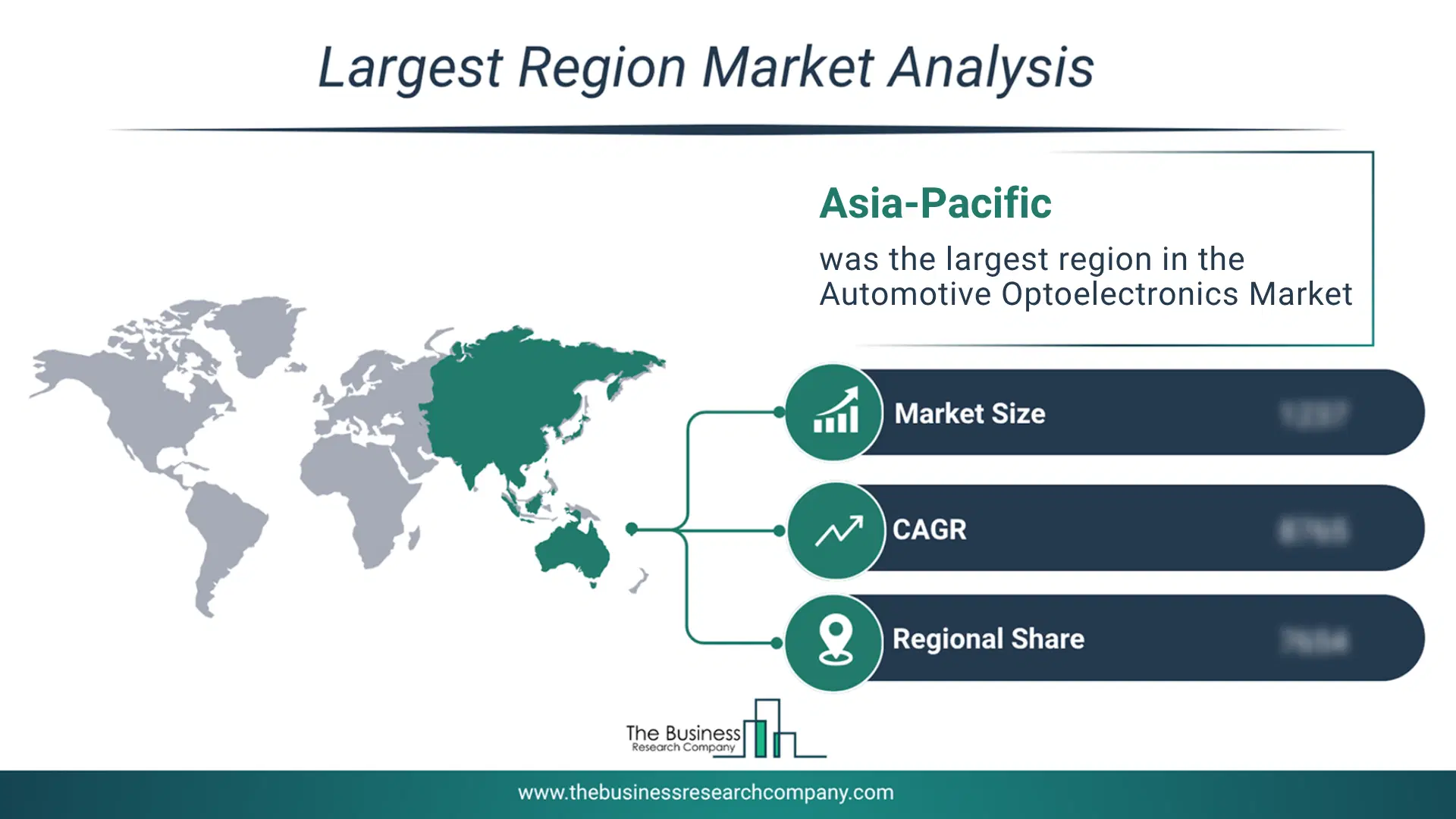
Regional Outlook
Asia-Pacific was the largest region in the automotive optoelectronics market in 2025. Asia-Pacific is expected to be the fastest-growing region in the forecast period. The regions covered in this market report are Asia-Pacific, South East Asia, Western Europe, Eastern Europe, North America, South America, Middle East, Africa. The countries covered in this market report are Australia, Brazil, China, France, Germany, India, Indonesia, Japan, Taiwan, Russia, South Korea, UK, USA, Canada, Italy, Spain.What Defines the Automotive Optoelectronics Market?
The automotive optoelectronics market consists of sales of automotive lighting systems, optical sensing systems, display technologies, visual communication systems, and other optoelectronic products. Values in this market are ‘factory gate’ values, that is, the value of goods sold by the manufacturers or creators of the goods, whether to other entities (including downstream manufacturers, wholesalers, distributors, and retailers) or directly to end customers. The value of goods in this market includes related services sold by the creators of the goods.How is Market Value Defined and Measured?
The market value is defined as the revenues that enterprises gain from the sale of goods and/or services within the specified market and geography through sales, grants, or donations in terms of the currency (in USD unless otherwise specified). The revenues for a specified geography are consumption values that are revenues generated by organizations in the specified geography within the market, irrespective of where they are produced. It does not include revenues from resales along the supply chain, either further along the supply chain or as part of other products.
This chart presents market attractiveness based on a quantitative evaluation of growth, competition, strategic alignment, and risk, offering a clear view of opportunity areas for decision-making. This chart is for illustrative purposes; the full report contains the complete analysis.

This chart highlights the Total Addressable Market (TAM) by estimating the maximum revenue opportunity using an assumption-driven approach, supporting strategic planning and opportunity sizing across markets. The chart is illustrative; the full report provides a more comprehensive analysis.
What Key Data and Analysis Are Included in the Automotive Optoelectronics Market Report 2026?
The automotive optoelectronics market research report is one of a series of new reports from The Business Research Company that provides market statistics, including industry global market size, regional shares, competitors with the market share, detailed market segments, market trends and opportunities, and any further data you may need to thrive in the automotive optoelectronics industry. The market research report delivers a complete perspective of everything you need, with an in-depth analysis of the current and future state of the industry.Automotive Optoelectronics Market Report Forecast Analysis
| Report Attribute | Details |
|---|---|
| Market Size Value In 2026 | $7.37 billion |
| Revenue Forecast In 2030 | $10.64 billion |
| Growth Rate | CAGR of 9.6% from 2026 to 2030 |
| Base Year For Estimation | 2025 |
| Actual Estimates/Historical Data | 2020-2025 |
| Forecast Period | 2026 - 2030 |
| Market Representation | Revenue in USD Billion and CAGR from 2026 to 2030 |
| Segments Covered | Component Type, Vehicle Type, Sales Channel, Application |
| Regional Scope | Asia-Pacific, Western Europe, Eastern Europe, North America, South America, Middle East, Africa |
| Country Scope | The countries covered in the report are Australia, Brazil, China, France, Germany, India, Indonesia, Japan, Taiwan, Russia, South Korea, UK, USA, Canada, Italy, Spain. |
| Key Companies Profiled | Samsung Electronics Co. Ltd., Sony Group Corporation, Broadcom Inc., Panasonic Holdings Corporation, Valeo SE, Continental AG, Texas Instruments Incorporated, Infineon Technologies AG, NXP Semiconductors N.V., STMicroelectronics N.V., Renesas Electronics Corporation, KOITO MANUFACTURING CO. LTD., ON Semiconductor Corporation, ams-OSRAM AG, Vishay Intertechnology Inc., ROHM Co. Ltd., Seoul Semiconductor Co. Ltd., LITE-ON Technology Corporation, NICHIA CORPORATION, STANLEY ELECTRIC CO. LTD. |
| Customization Scope | Request for Customization |
| Pricing And Purchase Options | Explore Purchase Options |