
Automotive Oxygen Sensor Market Report 2026
Global Outlook – By Product Type (Binary Exhaust Gas Oxygen Sensors, Universal Exhaust Gas Oxygen Sensors), By Sales Channel (Original Equipment Supplier (OES), Independent Automotive Supplier (IAS)), By Application (Gasoline-Fueled Vehicle, Diesel-Fueled Vehicle), By End Use (Passenger Vehicle, Light Commercial Vehicle, Heavy Commercial Vehicle) – Market Size, Trends, Strategies, and Forecast to 2030
Automotive Oxygen Sensor Market Overview
• Automotive Oxygen Sensor market size has reached to $8.99 billion in 2025 • Expected to grow to $12.36 billion in 2030 at a compound annual growth rate (CAGR) of 6.5% • Growth Driver: Rising Vehicle Production Fuels Growth In The Automotive Oxygen Sensor Market • Market Trend: Advancements In Wideband Oxygen Sensors Transforming The Automotive Oxygen Sensor Market • North America was the largest region in 2025 and Asia Pacific is the fastest growing region.What Is Covered Under Automotive Oxygen Sensor Market?
An automotive oxygen sensor is a device located in the exhaust system of a vehicle that monitors the oxygen levels in the exhaust gases. This information is sent to the engine control unit (ECU), allowing it to adjust the air-fuel mixture for optimal combustion efficiency, reduced emissions, and improved fuel economy. The main product types of automotive oxygen sensors are binary exhaust gas oxygen sensors and universal exhaust gas oxygen sensors. Binary exhaust gas oxygen sensors, also known as narrowband O2 sensors, operate by switching between two states rich and lean. These sensors are commonly used in older vehicle models and are essential for maintaining basic engine efficiency and emissions control. Various designs include ginger and planar and are sold through various sales channels, including original equipment manufacturers (OEM), original equipment suppliers (OES), and independent automotive suppliers (IAS). These sensors have a wide application in gasoline-fueled vehicles and diesel-fueled vehicles and are used by several end users, such as passenger vehicles, light commercial vehicles, and heavy commercial vehicles.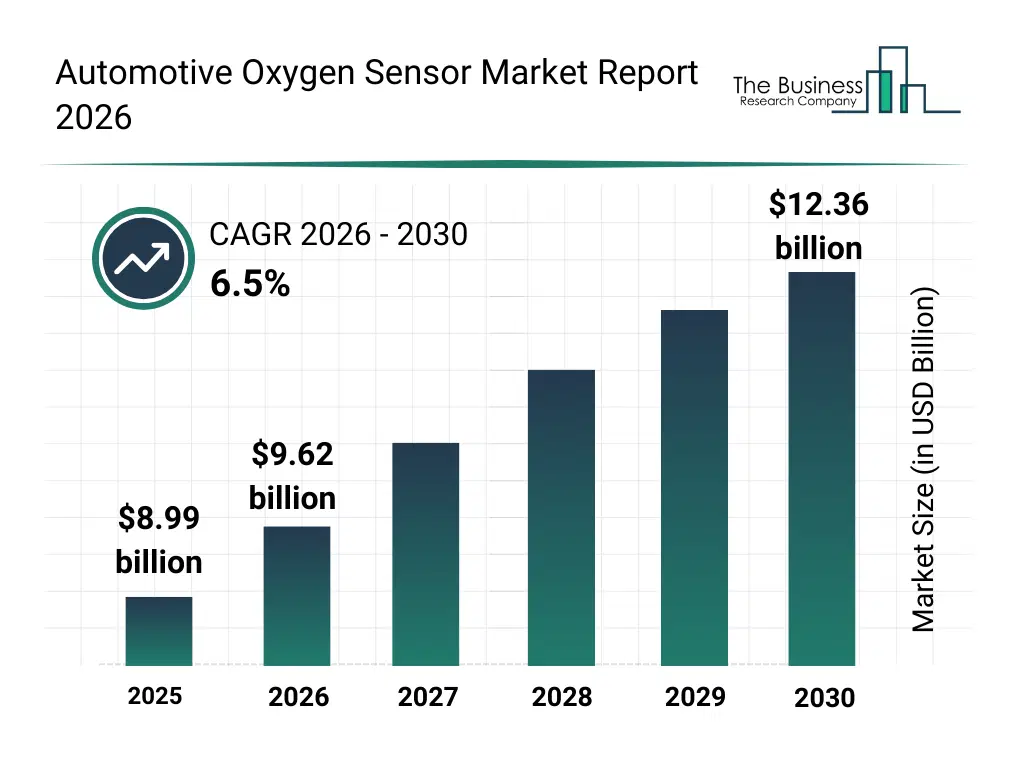
What Is The Automotive Oxygen Sensor Market Size and Share 2026?
The automotive oxygen sensor market size has grown strongly in recent years. It will grow from $8.99 billion in 2025 to $9.62 billion in 2026 at a compound annual growth rate (CAGR) of 7.0%. The growth in the historic period can be attributed to stricter emission regulations, growth of gasoline vehicles, expansion of vehicle parc, oem adoption of oxygen sensors, engine efficiency requirements.What Is The Automotive Oxygen Sensor Market Growth Forecast?
The automotive oxygen sensor market size is expected to see strong growth in the next few years. It will grow to $12.36 billion in 2030 at a compound annual growth rate (CAGR) of 6.5%. The growth in the forecast period can be attributed to emission norm tightening, hybrid vehicle penetration, demand for advanced diagnostics, sensor durability improvements, aftermarket growth. Major trends in the forecast period include rising adoption of wideband oxygen sensors, increasing integration with engine control units, growth in aftermarket sensor replacement, demand for emission-compliant sensors, advancements in sensor miniaturization.
Global Automotive Oxygen Sensor Market Segmentation
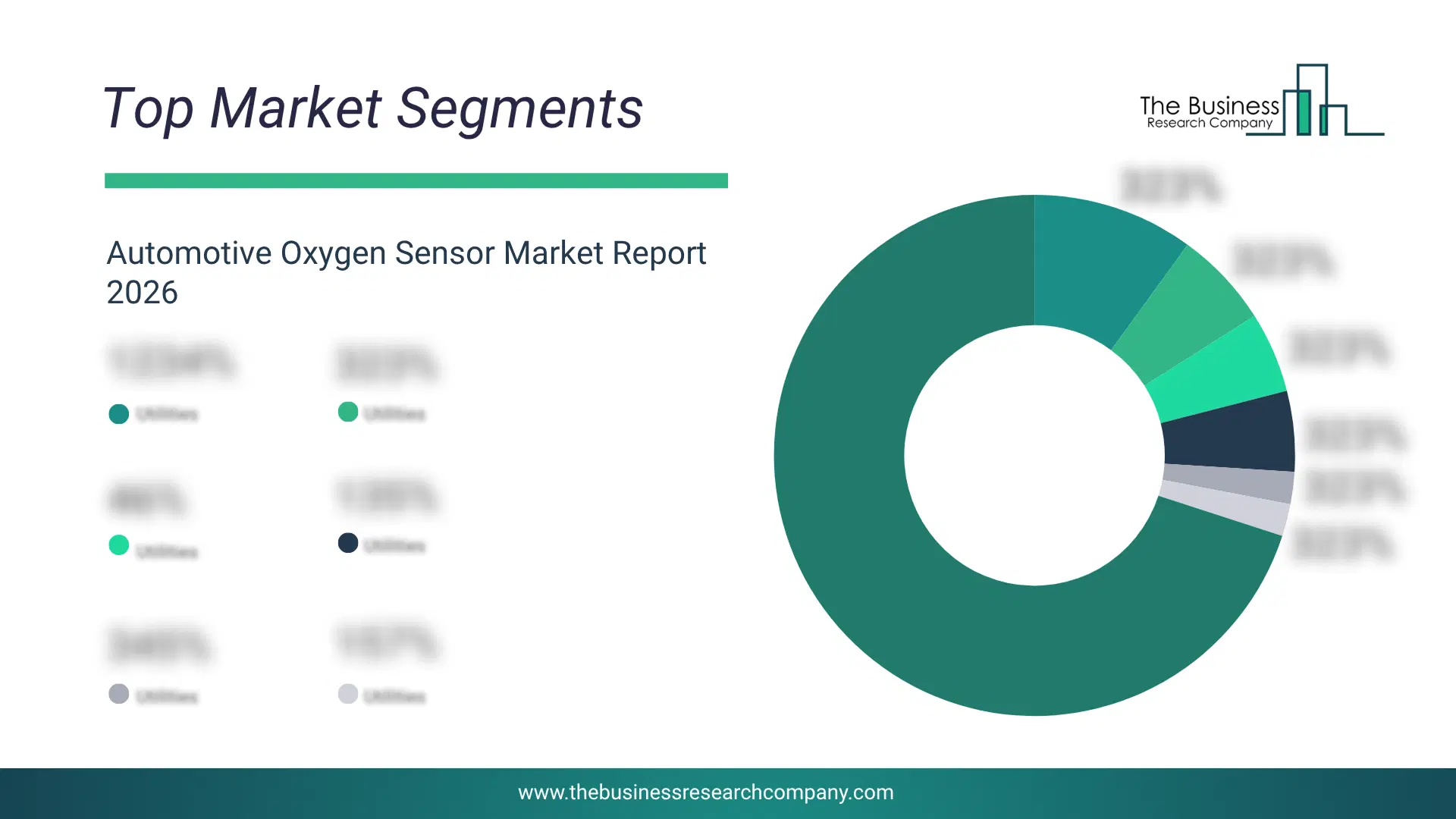
1) By Product Type: Binary Exhaust Gas Oxygen Sensors, Universal Exhaust Gas Oxygen Sensors 2) By Sales Channel: Original Equipment Supplier (OES), Independent Automotive Supplier (IAS) 3) By Application: Gasoline-Fueled Vehicle, Diesel-Fueled Vehicle 4) By End Use: Passenger Vehicle, Light Commercial Vehicle, Heavy Commercial Vehicle Subsegments: 1) By Binary Exhaust Gas Oxygen Sensors: Zirconia-Based Binary Oxygen Sensors, Titania-Based Binary Oxygen Sensors, Narrowband Binary Oxygen Sensors, Pre-Catalytic And Post-Catalytic Oxygen Sensors 2) By Universal Exhaust Gas Oxygen Sensors: Universal Fit O2 Sensors, Heated Universal Oxygen Sensors, Non-Heated Universal Oxygen SensorsWhat Is The Driver Of The Automotive Oxygen Sensor Market?
The rising global vehicle production is expected to propel the growth of the automotive oxygen sensor market going forward. Global vehicle production refers to the large-scale manufacturing of passenger and commercial vehicles driven by recovering supply chains, expanding transportation demand, and increased automaker investment in 2024–2025. This rise is supported by strong production momentum across Asia, Europe, and North America as manufacturers scale output to meet growing global mobility needs. Automotive oxygen sensors support this expansion by providing precise fuel–air mixture monitoring essential for emissions control, fuel efficiency, and compliance with increasingly stringent environmental regulations. For instance, in May 2024, according to the International Organization of Motor Vehicle Manufacturers (OICA), a France-based intergovernmental automotive body, global motor-vehicle production increased to 0.0935 billion units in 2023, reflecting continued manufacturing growth entering 2024 and strengthening demand across major automotive markets. Therefore, the rising global vehicle production is driving the growth of the automotive oxygen sensor industry.Key Players In The Global Automotive Oxygen Sensor Market
Major companies operating in the automotive oxygen sensor market report include Bosch Group, DENSO Corporation, Hitachi Ltd., Niterra Co. Ltd., Continental AG, BorgWarner Inc., Valeo S.A., HELLA GmbH & Co. KGaA, Hyundai Kefico Corporation, NGK Spark Plug Co., Ltd. (Niterra), Walker Products Inc., Standard Motor Products Inc., Facet S.r.l., United Automotive Electronic Systems (UAES), SJG Sejong Co. Ltd., Fujikura Ltd., Horiba Ltd., AMETEK Inc., Teledyne Technologies Incorporated, Cubic Sensor and Instrument Co., Ltd., City Technology Ltd.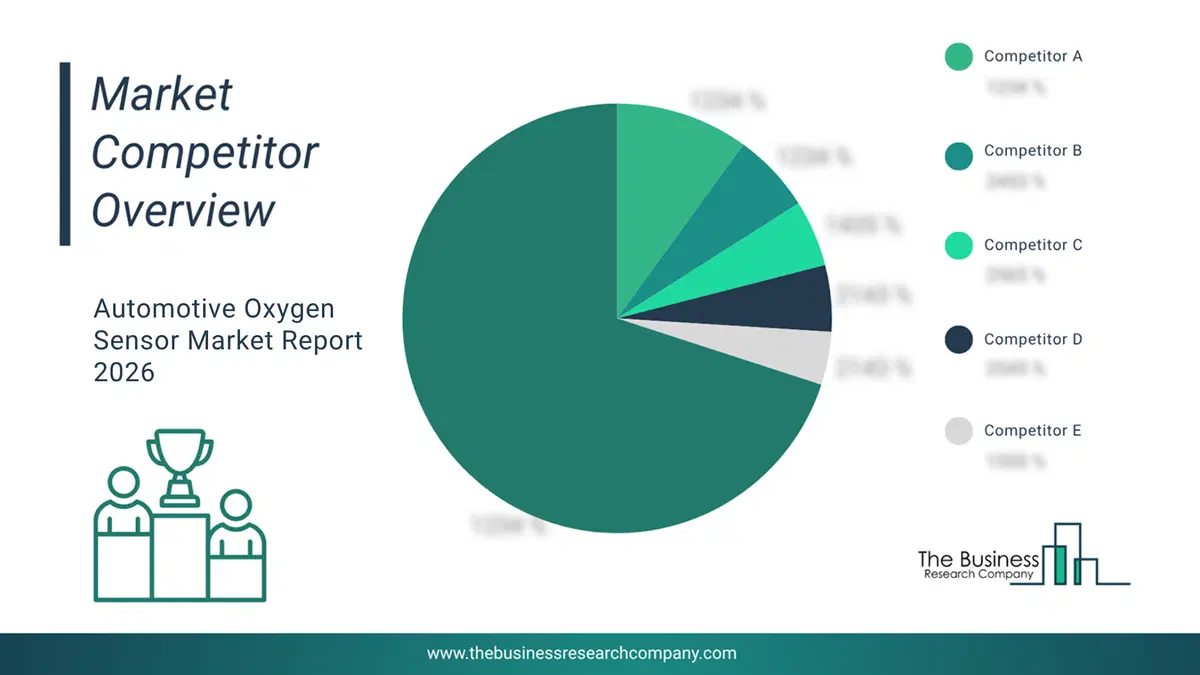
This chart is for illustrative purposes; the full report includes a detailed competitor analysis and comprehensive overview of the top 10 companies in the market.
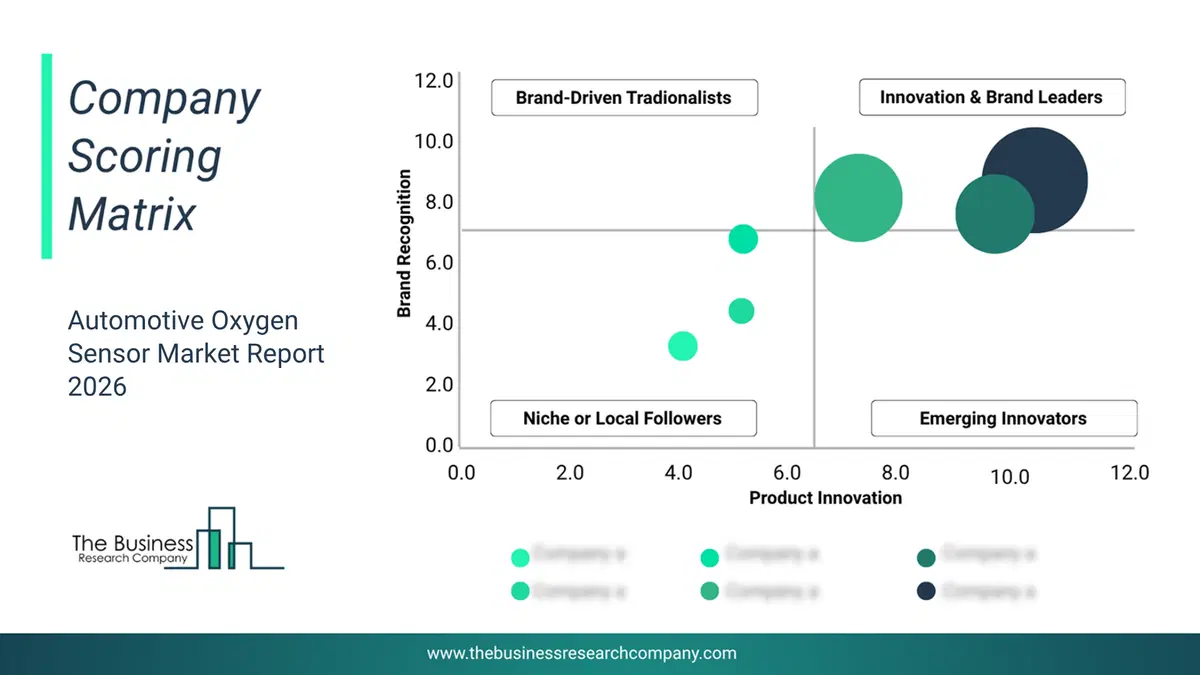
This chart maps companies by product innovation and brand strength, with bubble size indicating relative revenue, helping identify market leaders, challengers, and niche players. This is an illustrative chart; the full report provides a complete and accurate competitive analysis.
Global Automotive Oxygen Sensor Market Trends and Insights
Major Companies operating in the automotive oxygen sensor market are focusing on technology advancements such as wideband oxygen sensors to gain competitive edge. Wideband oxygen sensors are advanced automotive devices that measure a broad range of oxygen content in exhaust gases, providing essential feedback to the engine control unit (ECU) for optimal air-fuel ratio management and accurately detecting mixtures from 10:1 to 20:1, thereby improving fuel efficiency and reducing emissions. For instance, in December 2023, Niterra Co., Ltd., a Japan-based automotive components company, introduced the addition of 35 new cutting-edge oxygen sensors to its NTK Vehicle Electronics brand, enhancing its product lineup aimed at improving vehicle emissions control and performance. These new cutting-edge oxygen sensors come equipped with several key features designed to enhance vehicle performance and emissions control. They utilize an advanced zirconia sensing element that generates voltage output in response to oxygen concentration, ensuring precise air-fuel ratio monitoring.What Are Latest Mergers And Acquisitions In The Automotive Oxygen Sensor Market?
In July 2023, Niterra Co. Ltd., a Japan-based automotive company, acquired the business operations of spark plug and exhaust gas sensor products (oxygen sensor and air-fuel ratio sensor) from DENSO Corporation for an undisclosed amount. The acquisition will allow Niterra to expand its product offerings in the spark plug and exhaust gas sensor markets, potentially increasing its market share and revenue. DENSO Corporation is a Japan-based company that manufactures automotive components.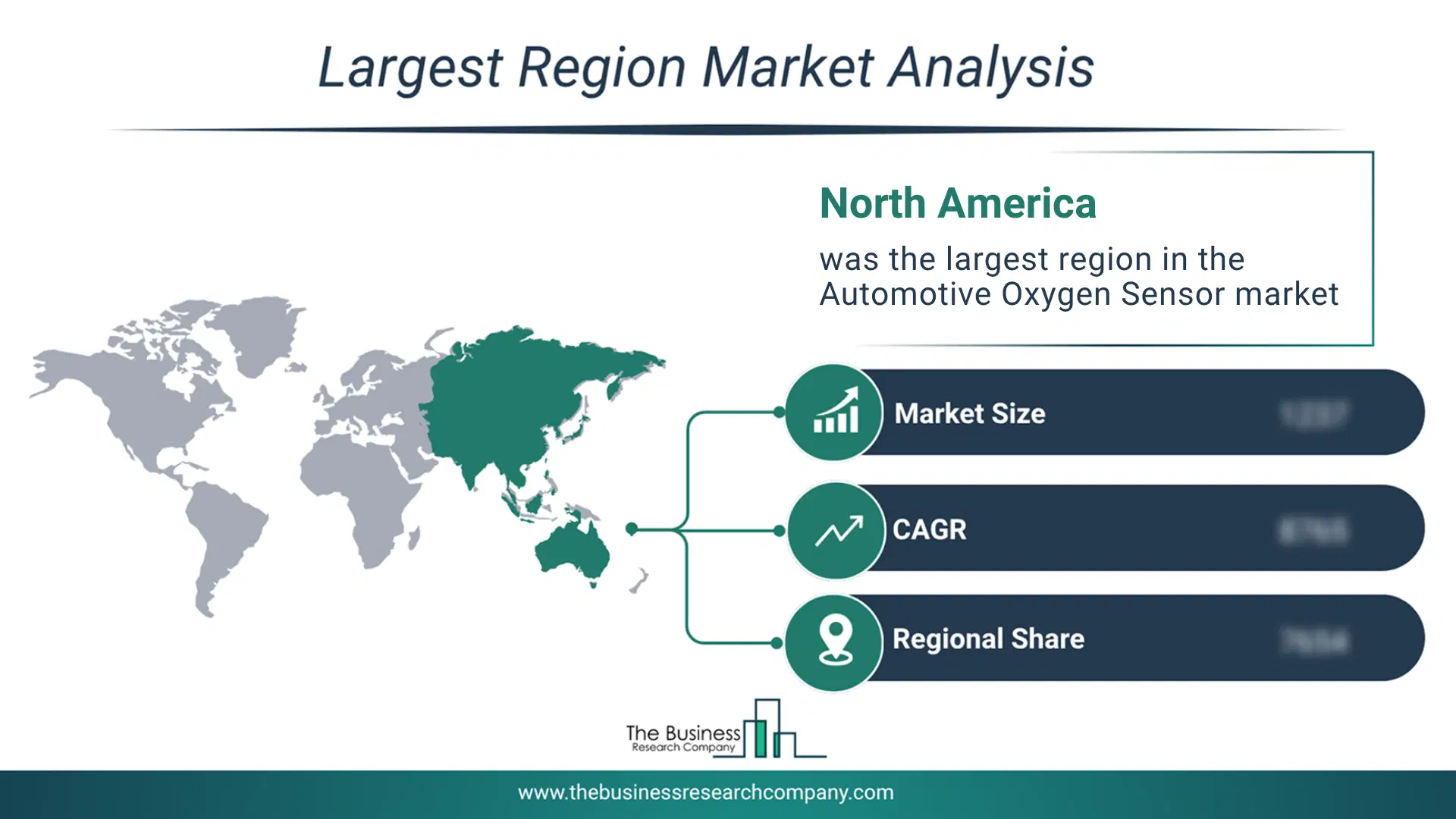
Regional Outlook
North America was the largest region in the automotive oxygen sensor market in 2025. Asia Pacific is expected to be the fastest-growing region in the forecast period. The regions covered in this market report include Asia-Pacific, South East Asia, Western Europe, Eastern Europe, North America, South America, Middle East, Africa. The countries covered in this market report include Australia, Brazil, China, France, Germany, India, Indonesia, Japan, Taiwan, Russia, South Korea, UK, USA, Canada, Italy, SpainWhat Defines the Automotive Oxygen Sensor Market?
The automotive oxygen sensor market consists of sales of dual-cell oxygen sensors, heated oxygen sensors (HO2S), and thimble-type oxygen sensors. Values in this market are ‘factory gate’ values, that is, the value of goods sold by the manufacturers or creators of the goods, whether to other entities (including downstream manufacturers, wholesalers, distributors, and retailers) or directly to end customers. The value of goods in this market includes related services sold by the creators of the goods.How is Market Value Defined and Measured?
The market value is defined as the revenues that enterprises gain from the sale of goods and/or services within the specified market and geography through sales, grants, or donations in terms of the currency (in USD unless otherwise specified). The revenues for a specified geography are consumption values that are revenues generated by organizations in the specified geography within the market, irrespective of where they are produced. It does not include revenues from resales along the supply chain, either further along the supply chain or as part of other products.
This chart presents market attractiveness based on a quantitative evaluation of growth, competition, strategic alignment, and risk, offering a clear view of opportunity areas for decision-making. This chart is for illustrative purposes; the full report contains the complete analysis.

This chart highlights the Total Addressable Market (TAM) by estimating the maximum revenue opportunity using an assumption-driven approach, supporting strategic planning and opportunity sizing across markets. The chart is illustrative; the full report provides a more comprehensive analysis.
What Key Data and Analysis Are Included in the Automotive Oxygen Sensor Market Report 2026?
The automotive oxygen sensor market research report is one of a series of new reports from The Business Research Company that provides market statistics, including industry global market size, regional shares, competitors with the market share, detailed market segments, market trends and opportunities, and any further data you may need to thrive in the automotive oxygen sensor industry. The market research report delivers a complete perspective of everything you need, with an in-depth analysis of the current and future state of the industry.Automotive Oxygen Sensor Market Report Forecast Analysis
| Report Attribute | Details |
|---|---|
| Market Size Value In 2026 | $9.62 billion |
| Revenue Forecast In 2030 | $12.36 billion |
| Growth Rate | CAGR of 7.0% from 2026 to 2030 |
| Base Year For Estimation | 2025 |
| Actual Estimates/Historical Data | 2020-2025 |
| Forecast Period | 2026 - 2030 - 2030 |
| Market Representation | Revenue in USD Billion and CAGR from 2026 to 2030 |
| Segments Covered | Product Type, Sales Channel, Application, End Use |
| Regional Scope | Asia-Pacific, Western Europe, Eastern Europe, North America, South America, Middle East, Africa |
| Country Scope | The countries covered in the report are Australia, Brazil, China, France, Germany, India, Indonesia, Japan, Taiwan, Russia, South Korea, UK, USA, Canada, Italy, Spain. |
| Key Companies Profiled | Bosch Group, DENSO Corporation, Hitachi Ltd., Niterra Co. Ltd., Continental AG, BorgWarner Inc., Valeo S.A., HELLA GmbH & Co. KGaA, Hyundai Kefico Corporation, NGK Spark Plug Co., Ltd. (Niterra), Walker Products Inc., Standard Motor Products Inc., Facet S.r.l., United Automotive Electronic Systems (UAES), SJG Sejong Co. Ltd., Fujikura Ltd., Horiba Ltd., AMETEK Inc., Teledyne Technologies Incorporated, Cubic Sensor and Instrument Co., Ltd., City Technology Ltd. |
| Customization Scope | Request for Customization |
| Pricing And Purchase Options | Explore Purchase Options |