
Automotive Plastic Materials Market Report 2026
Global Outlook – By Product Type (Polypropylene, Polyurethane, Polyvinyl Chloride, Acrylonitrile Butadiene Styrene, Polycarbonate, Other Product Types), By Vehicle Type (Passenger Cars, Light Commercial Vehicles, Heavy Commercial Vehicles, Electric Vehicles), By Process Technology (Injection Molding, Extrusion, Blow Molding), By Application (Interior Components, Exterior Components, Under The Hood Components, Electrical And Electronic Components, Chassis And Structural Parts, Other Applications), By End Use Industry (Original Equipment Manufacturers, Aftermarket) – Market Size, Trends, Strategies, and Forecast to 2030
Automotive Plastic Materials Market Overview
• Automotive Plastic Materials market size has reached to $34.78 billion in 2025 • Expected to grow to $49.59 billion in 2030 at a compound annual growth rate (CAGR) of 7.2% • Growth Driver: Growth Of Electric Vehicles (EVs) Driving The Market Growth Due To Increasing Demand For Sustainable Transportation And Government Incentives • Market Trend: Innovation In Ocean-Recycled Plastics Driving Circular Economy And Sustainable Vehicle Manufacturing • Asia-Pacific was the largest region and fastest growing region.What Is Covered Under Automotive Plastic Materials Market?
Automotive plastic materials refer to engineered polymer-based materials used in vehicle manufacturing to replace or complement traditional metal components, enabling reduced vehicle weight, improved fuel efficiency, enhanced design flexibility, and improved durability and safety performance. Automotive plastic materials are designed to withstand mechanical stress, thermal variations, chemical exposure, and long-term operational conditions while supporting efficient mass production and modern automotive design requirements. The main product types of automotive plastic materials include polypropylene, polyurethane, polyvinyl chloride, acrylonitrile butadiene styrene, polycarbonate, and other product types. Polypropylene refers to a lightweight thermoplastic polymer widely used in automotive manufacturing for its excellent chemical resistance, durability, impact strength, and cost-effectiveness. These materials are used in passenger cars, light commercial vehicles, heavy commercial vehicles, and electric vehicles and are manufactured using injection molding, extrusion, and blow molding processes. The key applications of interior components, exterior components, under the hood components, electrical and electronic components, chassis and structural parts, and others, while the end-use industries original equipment manufacturers and aftermarket.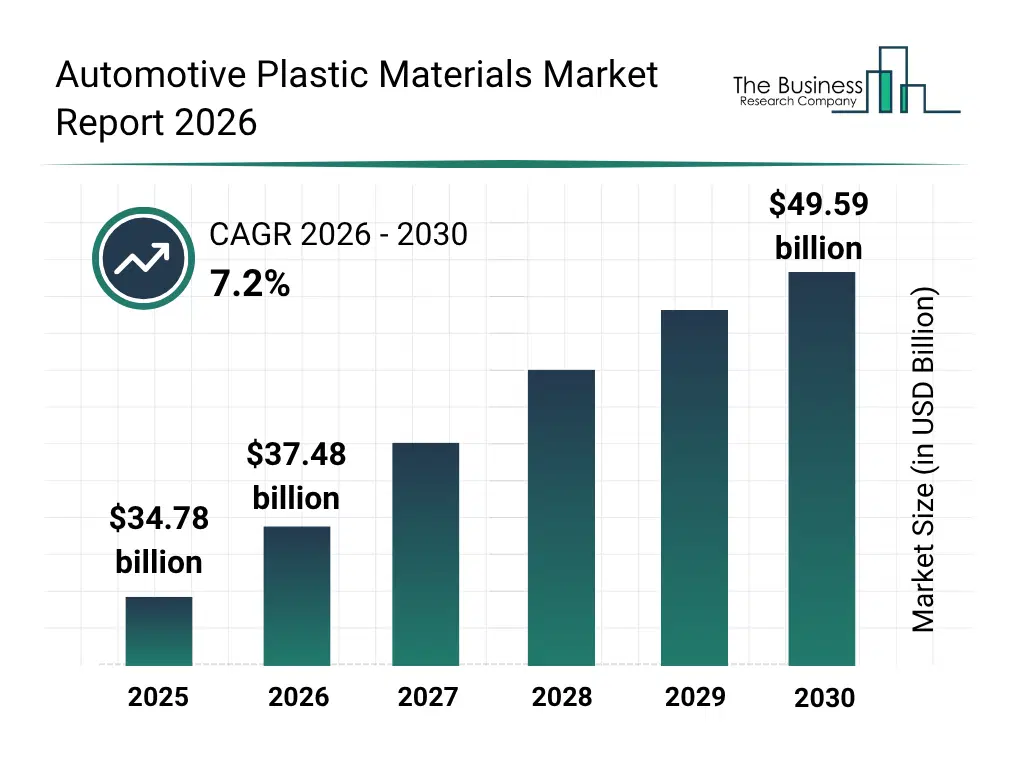
What Is The Automotive Plastic Materials Market Size and Share 2026?
The automotive plastic materials market size has grown strongly in recent years. It will grow from $34.78 billion in 2025 to $37.48 billion in 2026 at a compound annual growth rate (CAGR) of 7.8%. The growth in the historic period can be attributed to lightweight vehicle design adoption, rising passenger vehicle production, increasing demand for fuel-efficient vehicles, growing replacement of metal components with plastics, expansion of automotive component manufacturing.What Is The Automotive Plastic Materials Market Growth Forecast?
The automotive plastic materials market size is expected to see strong growth in the next few years. It will grow to $49.59 billion in 2030 at a compound annual growth rate (CAGR) of 7.2%. The growth in the forecast period can be attributed to growing electric vehicle production, increasing demand for sustainable polymer materials, rising adoption of high-performance engineering plastics, expansion of advanced automotive manufacturing, increasing focus on circular material utilization. Major trends in the forecast period include increasing adoption of lightweight engineering plastics, growing demand for high performance polymer composites, rising integration of heat resistant plastic materials, expansion of multi material plastic component designs, increasing focus on recyclable automotive plastic materials.
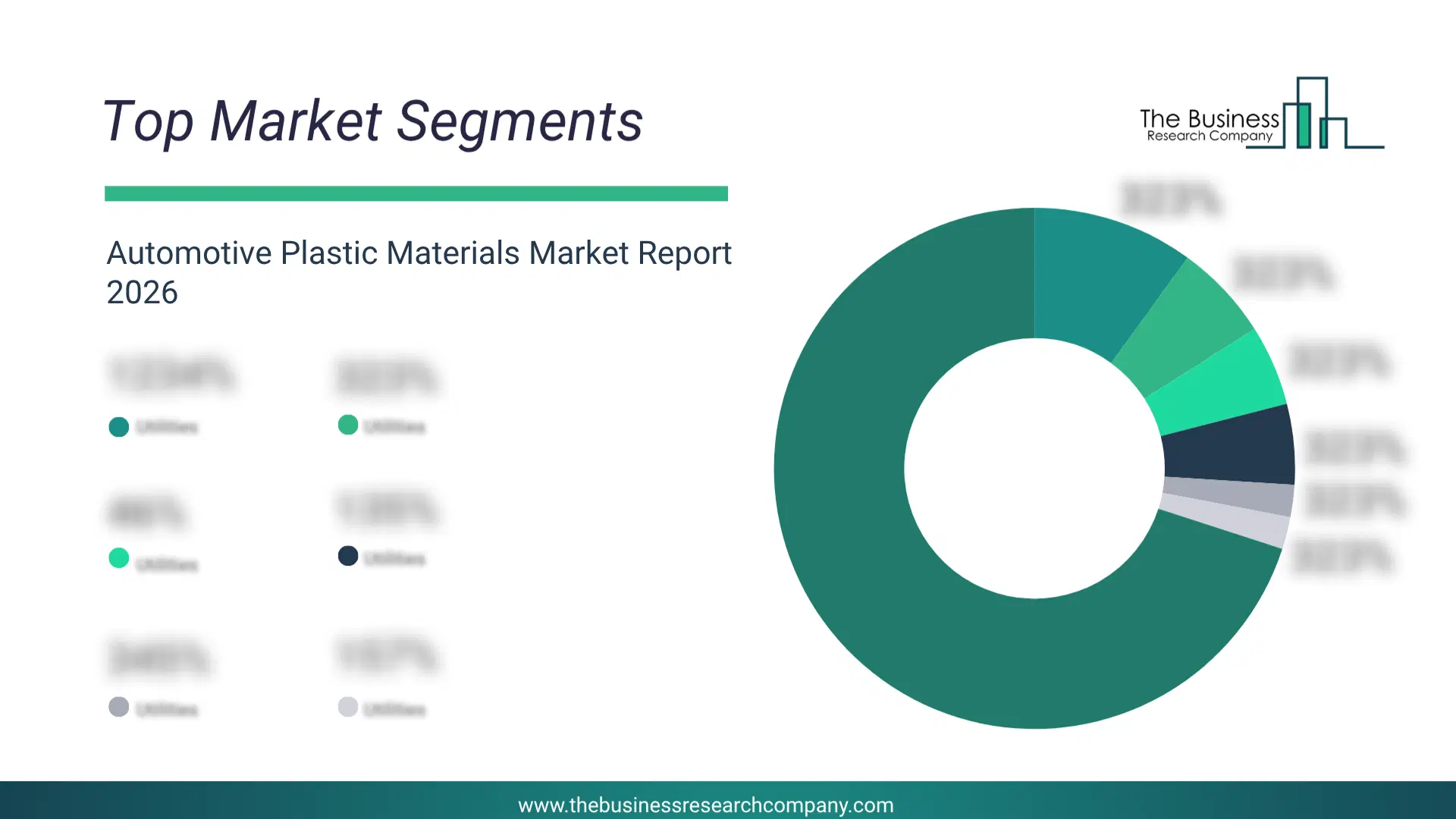
Global Automotive Plastic Materials Market Segmentation
2) By Vehicle Type: Passenger Cars, Light Commercial Vehicles, Heavy Commercial Vehicles, Electric Vehicles 3) By Process Technology: Injection Molding, Extrusion, Blow Molding 4) By Application: Interior Components, Exterior Components, Under The Hood Components, Electrical And Electronic Components, Chassis And Structural Parts, Other Applications 5) By End Use Industry: Original Equipment Manufacturers, Aftermarket Subsegments: 1) By Polypropylene: Homopolymer Polypropylene Automotive Plastics, Copolymer Polypropylene Automotive Plastics, Glass Fiber Reinforced Polypropylene Plastics, Impact Modified Polypropylene Plastics 2) By Polyurethane: Flexible Polyurethane Foams, Rigid Polyurethane Foams, Thermoplastic Polyurethane Elastomers, Coating Grade Polyurethane Materials 3) By Polyvinyl Chloride: Rigid Polyvinyl Chloride Automotive Plastics, Flexible Polyvinyl Chloride Automotive Plastics, Plasticized Polyvinyl Chloride Compounds, High Impact Polyvinyl Chloride Materials 4) By Acrylonitrile Butadiene Styrene: General Purpose Acrylonitrile Butadiene Styrene Plastics, High Heat Resistant Acrylonitrile Butadiene Styrene Plastics, Electroplated Acrylonitrile Butadiene Styrene Materials, Flame Retardant Acrylonitrile Butadiene Styrene Compounds 5) By Polycarbonate: Transparent Polycarbonate Automotive Plastics, Glass Reinforced Polycarbonate Materials, Ultraviolet Stabilized Polycarbonate Plastics, Impact Resistant Polycarbonate Grades 6) By Other Product Types: Polyamide Automotive Plastics, Polyethylene Automotive Plastics, Polybutylene Terephthalate Plastics, Thermoplastic Elastomer Automotive MaterialsWhat Is The Driver Of The Automotive Plastic Materials Market?
The growth of electric vehicles (EVs) is expected to propel the growth of the automotive plastic materials market going forward. Electric vehicles are vehicles powered primarily by electric motors using energy stored in batteries, and their rising adoption is driven by sustainability goals, lower emissions, and advancements in battery technology. Electric vehicle adoption is increasing due to lower running costs, mainly from cheaper electricity compared to fuel and reduced maintenance needs from fewer moving parts. Automotive plastic materials enable electric vehicles by reducing vehicle weight to improve driving range, increasing energy efficiency through lower mass, and allowing design flexibility for battery housings and interior components while contributing to safety, durability, and in-cabin comfort. For instance, in January 2025, according to Cox Automotive, a US-based system software company, electric vehicle (EV) sales were revised to 1,212,758 units in 2023, marking a 49% increase from 2022, and continued their upward trend in 2024, growing by 7.3% to reach 1,301,411 units. Therefore, the growth of electric vehicles (EVs) is driving the growth of the automotive plastic materials industry.Key Players In The Global Automotive Plastic Materials Market
Major companies operating in the automotive plastic materials market are BASF SE, Saudi Basic Industries Corporation, LG Chem Ltd., LyondellBasell Industries N.V., Mitsubishi Chemical Group Corporation, Syensqo SA, Celanese Corporation, Asahi Kasei Corporation, Evonik Industries AG, Toray Industries Inc., Borealis AG, Envalior, INEOS Group Limited, Arkema SA, Sumitomo Chemical Co. Ltd., Teijin Limited, UBE Corporation, EMS-CHEMIE HOLDING AG, Kuraray Co. Ltd., Avient Corporation, Teknor Apex Company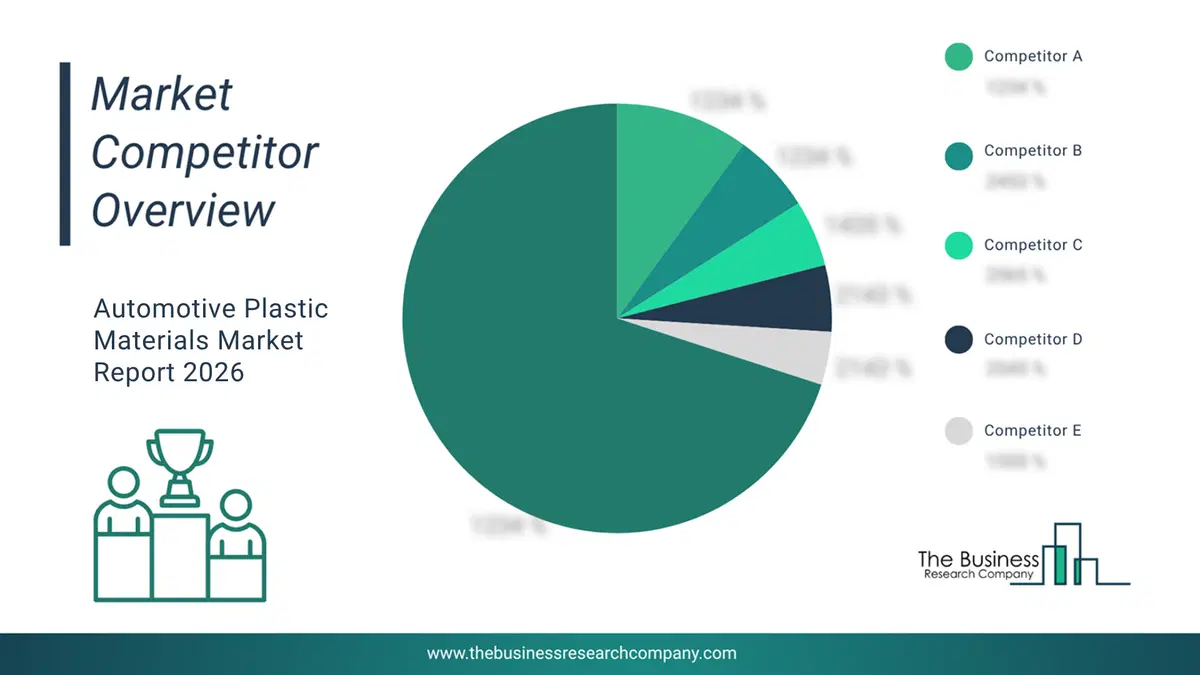
This chart is for illustrative purposes; the full report includes a detailed competitor analysis and comprehensive overview of the top 10 companies in the market.
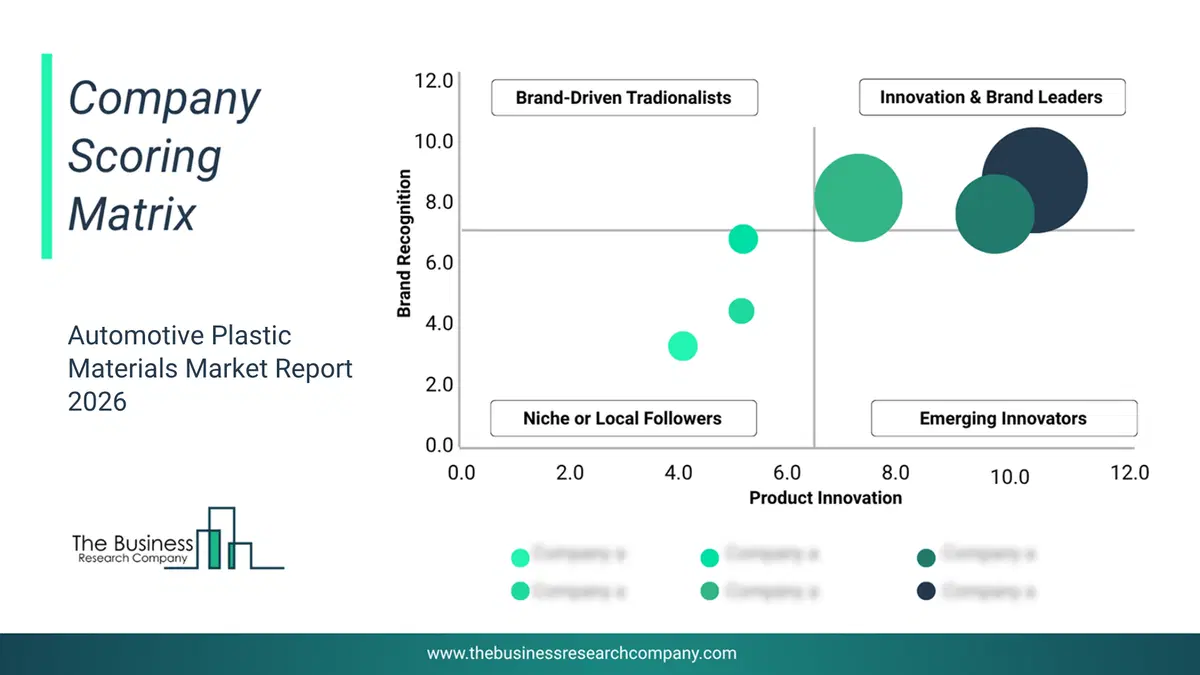
This chart maps companies by product innovation and brand strength, with bubble size indicating relative revenue, helping identify market leaders, challengers, and niche players. This is an illustrative chart; the full report provides a complete and accurate competitive analysis.
Global Automotive Plastic Materials Market Trends and Insights
Major companies operating in the automotive plastic materials market are focusing on developing innovative products such as ocean-recycled automotive plastics to enhance sustainability, circular economy adoption, and reduction of lifecycle carbon emissions in vehicle manufacturing. Ocean-recycled automotive plastics are engineered polymer materials derived from plastic waste collected from marine environments, which are then sorted, processed, and re-engineered into high-performance automotive-grade components that offer durability, lightweight properties, and functional equivalence to conventional virgin plastics while significantly reducing environmental impact. For instance, in October 2024, Kia Corporation, a South Korea-based automotive manufacturer, introduced a limited-edition trunk liner for the Kia EV3 made using plastic recovered from the Great Pacific Garbage Patch in collaboration with The Ocean Cleanup. The accessory incorporates approximately 40% recycled ocean plastic and undergoes rigorous sorting, recycling, and traceability verification processes to ensure material integrity and automotive-grade quality, demonstrating comparable durability and functionality to conventional trunk liners while supporting circular resource utilization in automotive production. This development reflects the growing integration of recycled and sustainable plastic materials in the automotive industry to advance eco-friendly mobility solutions.What Are Latest Mergers And Acquisitions In The Automotive Plastic Materials Market?
In July 2024, OKE Group GmbH, a Germany-based plastic fabrication company, acquired Global Enterprises LLC for an undisclosed amount. With this acquisition, OKE Group GmbH aims to expand its manufacturing footprint in North America and Eastern Europe, increase production capacity for automotive components, and strengthen its market position with automotive OEM customers across both regions. Global Enterprises LLC is a US-based company that manufactures extruded, die-cut, and formed interior parts for automotive applications.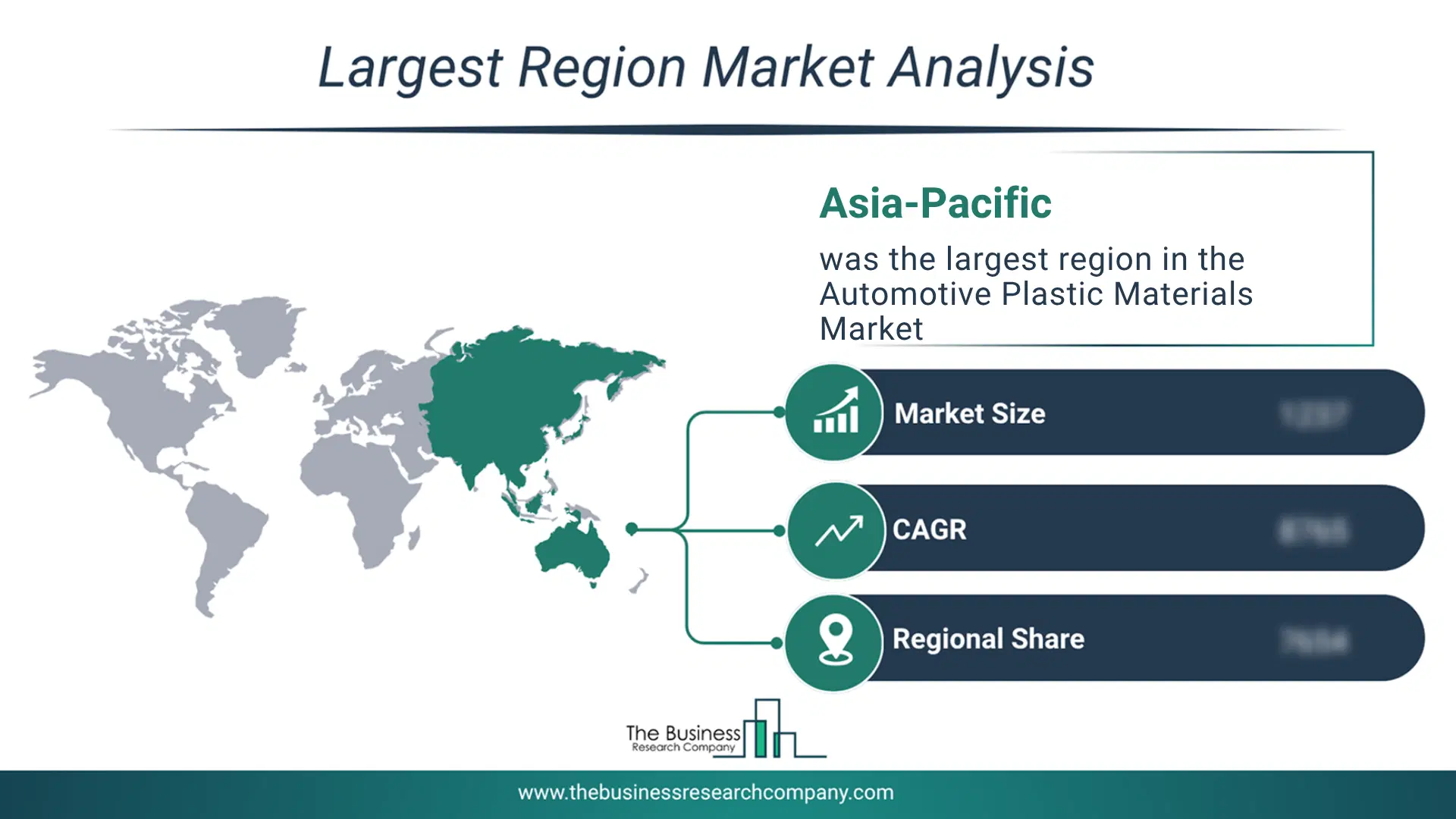
Regional Outlook/Insights
Asia-Pacific was the largest region in the automotive plastic materials market in 2025. Asia-Pacific is expected to be the fastest-growing region in the forecast period. The regions covered in this market report are Asia-Pacific, South East Asia, Western Europe, Eastern Europe, North America, South America, Middle East, Africa. The countries covered in this market report are Australia, Brazil, China, France, Germany, India, Indonesia, Japan, Taiwan, Russia, South Korea, UK, USA, Canada, Italy, Spain.What Defines the Automotive Plastic Materials Market?
The automotive plastic materials market consists of sales of engineering thermoplastics, thermosets, elastomers, composite polymers, reinforced plastics, foam-based plastics, and interior and exterior automotive plastic components. Values in this market are ‘factory gate’ values, that is, the value of goods sold by the manufacturers or creators of the goods, whether to other entities (including downstream manufacturers, wholesalers, distributors, and retailers) or directly to end customers. The value of goods in this market includes related services sold by the creators of the goods.How is Market Value Defined and Measured?
The market value is defined as the revenues that enterprises gain from the sale of goods and/or services within the specified market and geography through sales, grants, or donations in terms of the currency (in USD unless otherwise specified). The revenues for a specified geography are consumption values that are revenues generated by organizations in the specified geography within the market, irrespective of where they are produced. It does not include revenues from resales along the supply chain, either further along the supply chain or as part of other products.
This chart presents market attractiveness based on a quantitative evaluation of growth, competition, strategic alignment, and risk, offering a clear view of opportunity areas for decision-making. This chart is for illustrative purposes; the full report contains the complete analysis.

This chart highlights the Total Addressable Market (TAM) by estimating the maximum revenue opportunity using an assumption-driven approach, supporting strategic planning and opportunity sizing across markets. The chart is illustrative; the full report provides a more comprehensive analysis.
What Key Data and Analysis Are Included in the Automotive Plastic Materials Market Report 2026?
The automotive plastic materials market research report is one of a series of new reports from The Business Research Company that provides automotive plastic materials market statistics, including automotive plastic materials industry global market size, regional shares, competitors with a automotive plastic materials market share, detailed automotive plastic materials market segments, market trends and opportunities, and any further data you may need to thrive in the automotive plastic materials industry. This automotive plastic materials market research report delivers a complete perspective of everything you need, with an in-depth analysis of the current and future scenario of the industry.Automotive Plastic Materials Market Report Forecast Analysis
| Report Attribute | Details |
|---|---|
| Market Size Value In 2026 | $37.48 billion |
| Revenue Forecast In 2030 | $49.59 billion |
| Growth Rate | CAGR of 7.2% from 2026 to 2030 |
| Base Year For Estimation | 2025 |
| Actual Estimates/Historical Data | 2020-2025 |
| Forecast Period | 2026 - 2030 |
| Market Representation | Revenue in USD Billion and CAGR from 2026 to 2030 |
| Segments Covered | Product Type, Vehicle Type, Process Technology, Application, End Use Industry |
| Regional Scope | Asia-Pacific, Western Europe, Eastern Europe, North America, South America, Middle East, Africa |
| Country Scope | The countries covered in the report are Australia, Brazil, China, France, Germany, India, Indonesia, Japan, Taiwan, Russia, South Korea, UK, USA, Canada, Italy, Spain. |
| Key Companies Profiled | BASF SE, Saudi Basic Industries Corporation, LG Chem Ltd., LyondellBasell Industries N.V., Mitsubishi Chemical Group Corporation, Syensqo SA, Celanese Corporation, Asahi Kasei Corporation, Evonik Industries AG, Toray Industries Inc., Borealis AG, Envalior, INEOS Group Limited, Arkema SA, Sumitomo Chemical Co. Ltd., Teijin Limited, UBE Corporation, EMS-CHEMIE HOLDING AG, Kuraray Co. Ltd., Avient Corporation, Teknor Apex Company |
| Customization Scope | Request for Customization |
| Pricing And Purchase Options | Explore Purchase Options |