

Automotive Polymer Composites Market Report 2026
Global Outlook – By Type (Thermoset Composites, Thermoplastic Composites), By Manufacturing Process (Injection Molding, Compression Molding, Resin Transfer Molding, Pultrusion, Filament Winding), By Material Type (Epoxy, Polyurethane, Polyamide, Polypropylene, Polyethylene, Polyester, Vinyl Ester, Other Material Types), By Application (Interior Components, Exterior Components, Structural Components, Powertrain Components), By End User (Passenger Cars, Commercial Vehicles, Electric Vehicles, Off Highway Vehicles) – Market Size, Trends, Strategies, and Forecast to 2030
Automotive Polymer Composites Market Overview
• Automotive Polymer Composites market size has reached to $7.21 billion in 2025 • Expected to grow to $10.75 billion in 2030 at a compound annual growth rate (CAGR) of 8.2% • Growth Driver: Electric Vehicle Adoption Accelerating Demand For The Market Due To Lightweighting And Efficiency Requirements • Market Trend: Advancements In Thermoplastic Composites For Automotive Lightweighting And Sustainability • Europe was the largest region in 2025 and Asia-Pacific is the fastest growing region.What Is Covered Under Automotive Polymer Composites Market?
Automotive polymer composites are advanced materials made by combining a polymer matrix with reinforcing fibers such as glass or carbon to create lightweight, high-strength components used in vehicles. They are widely used to replace metal parts in automobiles to improve fuel efficiency, reduce weight, enhance durability, and enable more flexible vehicle design. The main types of automotive polymer composites include thermoset composites and thermoplastic composites. Thermoset composites refer to polymer composite materials that undergo irreversible curing to form rigid, heat-resistant structures with high mechanical strength for automotive applications. These composites are manufactured using injection molding, compression molding, resin transfer molding, pultrusion, and filament winding processes and are produced from materials including epoxy, polyurethane, polyamide, polypropylene, polyethylene, polyester, vinyl ester, and other material types. The various applications involved are interior components, exterior components, structural components, and powertrain components, and they are used by several end users such as passenger cars, commercial vehicles, electric vehicles, and off highway vehicles.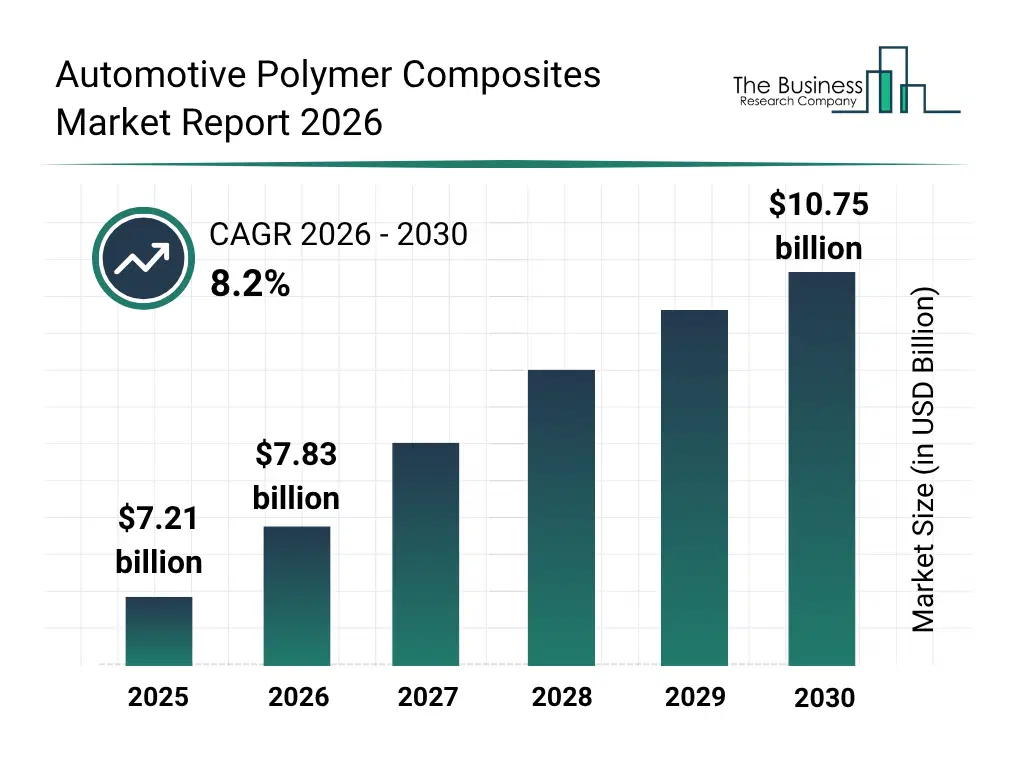
What Is The Automotive Polymer Composites Market Size and Share 2026?
The automotive polymer composites market size has grown strongly in recent years. It will grow from $7.21 billion in 2025 to $7.83 billion in 2026 at a compound annual growth rate (CAGR) of 8.7%. The growth in the historic period can be attributed to increasing demand for lightweight automotive components, rising automotive production across global markets, growing need for improved fuel efficiency, expanding replacement of metal parts with polymer materials, increasing adoption of durable composite materials in vehicle manufacturing.What Is The Automotive Polymer Composites Market Growth Forecast?
The automotive polymer composites market size is expected to see strong growth in the next few years. It will grow to $10.75 billion in 2030 at a compound annual growth rate (CAGR) of 8.2%. The growth in the forecast period can be attributed to rising demand for lightweight materials in electric vehicles, increasing development of sustainable automotive composite solutions, growing adoption of advanced manufacturing processes for composites, expanding use of polymer composites in structural vehicle applications, increasing demand for high-performance materials in next-generation vehicles. Major trends in the forecast period include increasing adoption of lightweight polymer composite materials for vehicle weight reduction, rising demand for high-strength composite components in automotive design, growing development of recyclable and sustainable automotive composite materials, increasing utilization of advanced polymer composites for electric vehicle applications, rising integration of customized composite solutions for improved vehicle performance.
Global Automotive Polymer Composites Market Segmentation
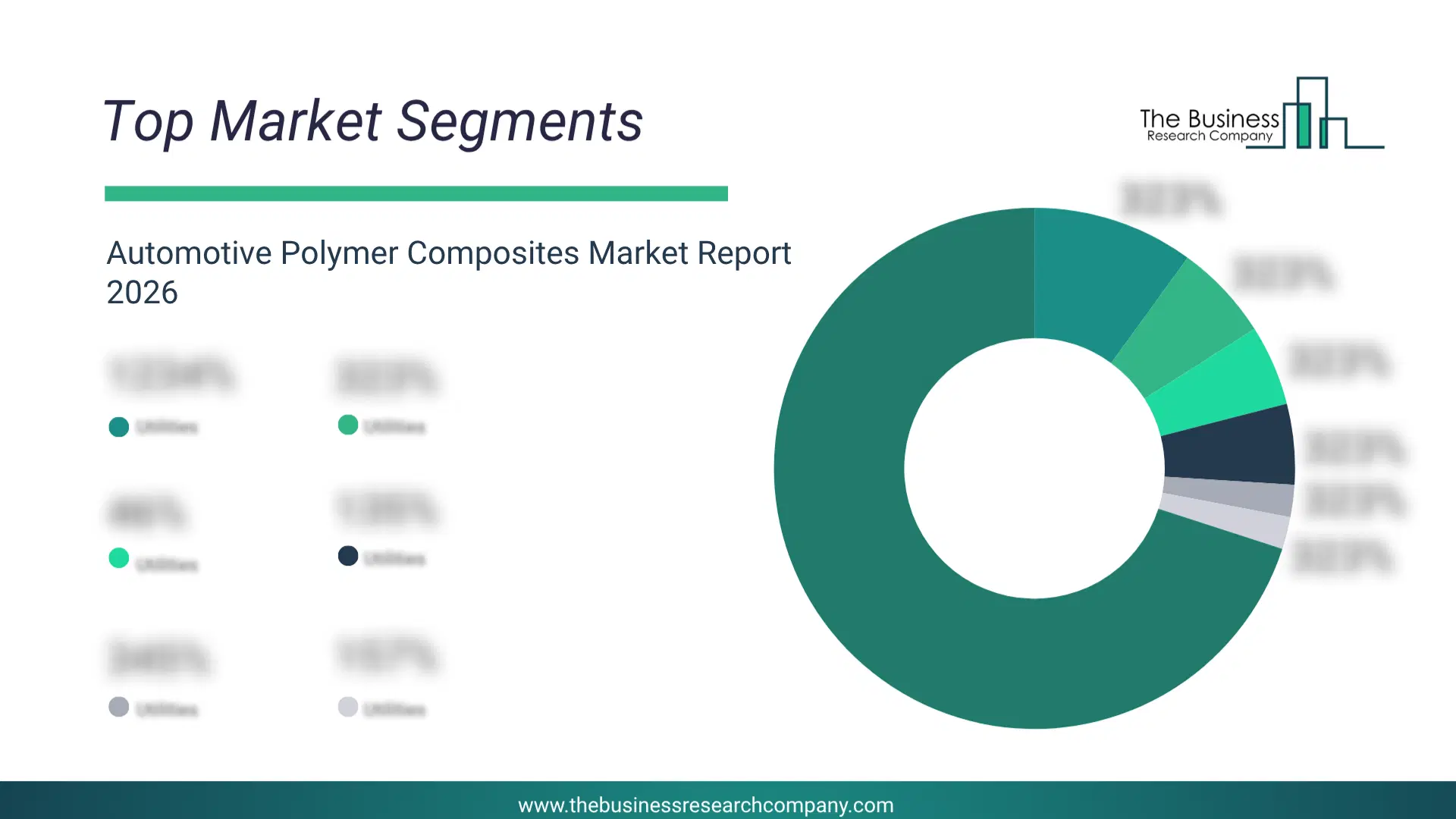
2) By Manufacturing Process: Injection Molding, Compression Molding, Resin Transfer Molding, Pultrusion, Filament Winding 3) By Material Type: Epoxy, Polyurethane, Polyamide, Polypropylene, Polyethylene, Polyester, Vinyl Ester, Other Material Types 4) By Application: Interior Components, Exterior Components, Structural Components, Powertrain Components 5) By End User: Passenger Cars, Commercial Vehicles, Electric Vehicles, Off Highway Vehicles Subsegments: 1) By Thermoset Composites: Epoxy Based Composites, Polyester Based Composites, Vinyl Ester Composites 2) By Thermoplastic Composites: Polypropylene Composites, Polyamide Composites, Polyether Ether Ketone CompositesWhat Is The Driver Of The Automotive Polymer Composites Market?
The growing adoption of electric vehicles (EVs) is expected to propel the growth of the automotive polymer composites market going forward. Electric vehicles (EVs) are vehicles that use electric motors powered by rechargeable batteries instead of internal combustion engines to move. Electric vehicles are increasing mainly due to growing environmental concerns, as they produce zero tailpipe emissions, helping reduce air pollution and greenhouse gas emissions compared to conventional fuel-based vehicles. Automotive polymer composites help electric vehicles by reducing overall vehicle weight while maintaining strength, which improves battery efficiency and increases driving range. For instance, in January 2024, according to a report published by Kelley Blue Book, a US-based Cox Automotive company, in 2023, a record 1.2 million car buyers in the United States chose electric vehicles, which accounted for 7.6% of the entire U.S. vehicle market, up from 5.9% in 2022. Therefore, the growing adoption of electric vehicles (EVs) is driving the growth of the automotive polymer composites industry.Key Players In The Global Automotive Polymer Composites Market
Major companies operating in the automotive polymer composites market are BASF SE, Saudi Basic Industries Corporation, LyondellBasell Industries N.V., Mitsubishi Chemical Group Corporation, DuPont de Nemours Inc., Toray Industries Inc., Covestro AG, Celanese Corporation, Teijin Limited, Owens Corning, Hexcel Corporation, Henkel AG & Co. KGaA, SGL Carbon SE, Arkema S.A., Gurit Holding AG, Evonik Industries AG, Johns Manville Corporation, Kolon Industries Inc., Tata AutoComp Systems Limited, IDI Composites International Inc., TPI Composites Inc., UFP Technologies Inc., Plasan Sasa Ltd., GMS Composites Ltd., Revchem Composites Inc.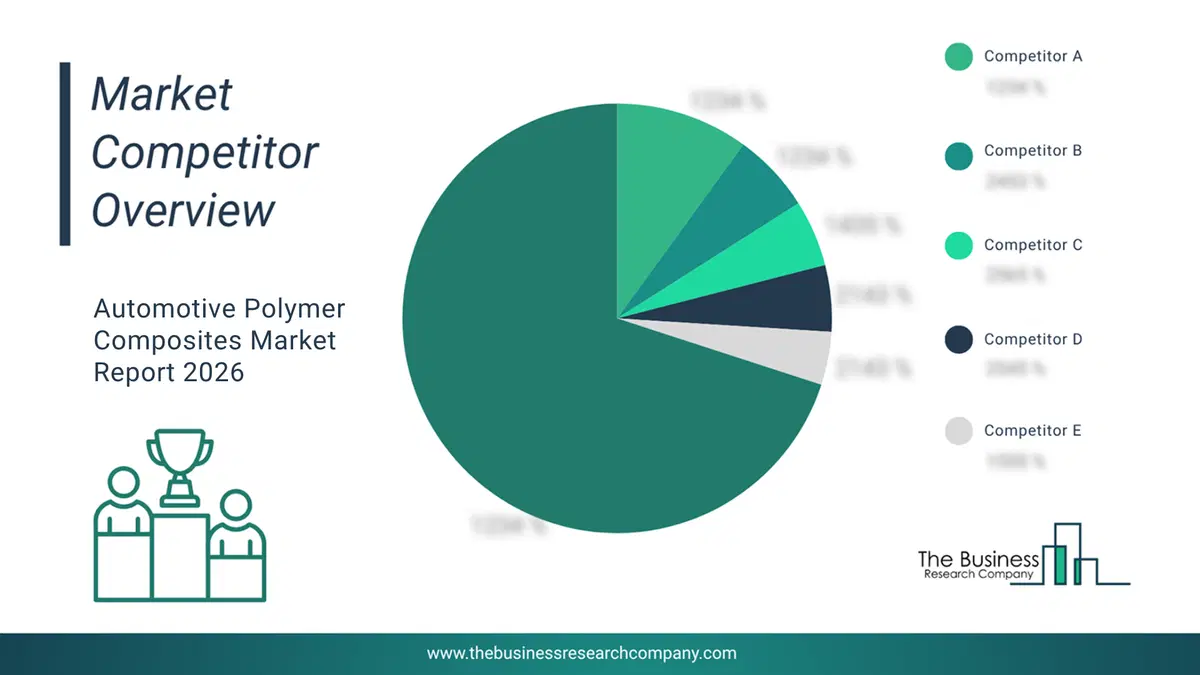
This chart is for illustrative purposes; the full report includes a detailed competitor analysis and comprehensive overview of the top 10 companies in the market.
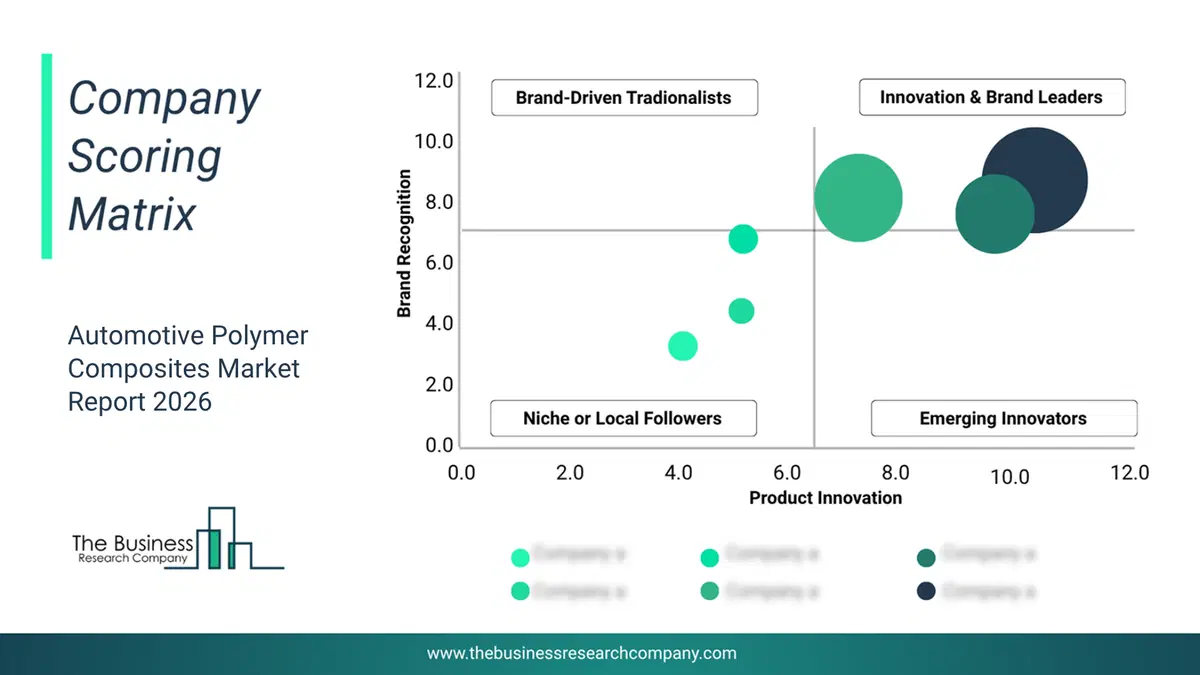
This chart maps companies by product innovation and brand strength, with bubble size indicating relative revenue, helping identify market leaders, challengers, and niche players. This is an illustrative chart; the full report provides a complete and accurate competitive analysis.
Global Automotive Polymer Composites Market Trends and Insights
Major companies operating in the automotive polymer composites market are focusing on developing innovative solutions, such as thermoplastic composites, to enhance vehicle lightweighting, improve fuel efficiency and EV range, and deliver higher strength-to-weight performance with greater design flexibility. A thermoplastic composite is a lightweight, recyclable material made by reinforcing a heat-moldable plastic with fibers to improve strength and performance. For instance, in May 2026, Hanwha Azdel Inc., a US-based provider of high-performance thermoplastic technologies for the automotive industry, launched a SuperLite S25, a new thermoplastic composite containing 25% post-consumer recycled polypropylene (rPP) designed specifically for automotive parts. This lightweight reinforced thermoplastic (LWRT) composite combines recycled polypropylene with long chopped glass fibers, offering automotive manufacturers a sustainable solution for parts such as headliners, door panels, sun visors, and underbody components while maintaining a high strength-to-weight ratio and excellent noise, vibration, and harshness (NVH) performance. It advances the automotive sector's adoption of recycled materials, supporting vehicle lightweighting goals while reducing environmental impact through substantial recycled content incorporation.What Are Latest Mergers And Acquisitions In The Automotive Polymer Composites Market?
In October 2023, Mitsubishi Chemical Group, a Japan-based chemicals company, acquired CPC Srl for an undisclosed amount. With this acquisition, Mitsubishi Chemical Group aimed to strengthen its vertically integrated carbon fiber composites value chain and accelerate the adoption of carbon fiber-reinforced plastic (CFRP) components in the automotive industry by leveraging CPC's design, molding, and manufacturing expertise. CPC S.R.L. is an Italy-based company that is involved in automotive polymer composites, particularly in the design, engineering, and manufacturing of carbon fiber reinforced polymer (CFRP) automotive components.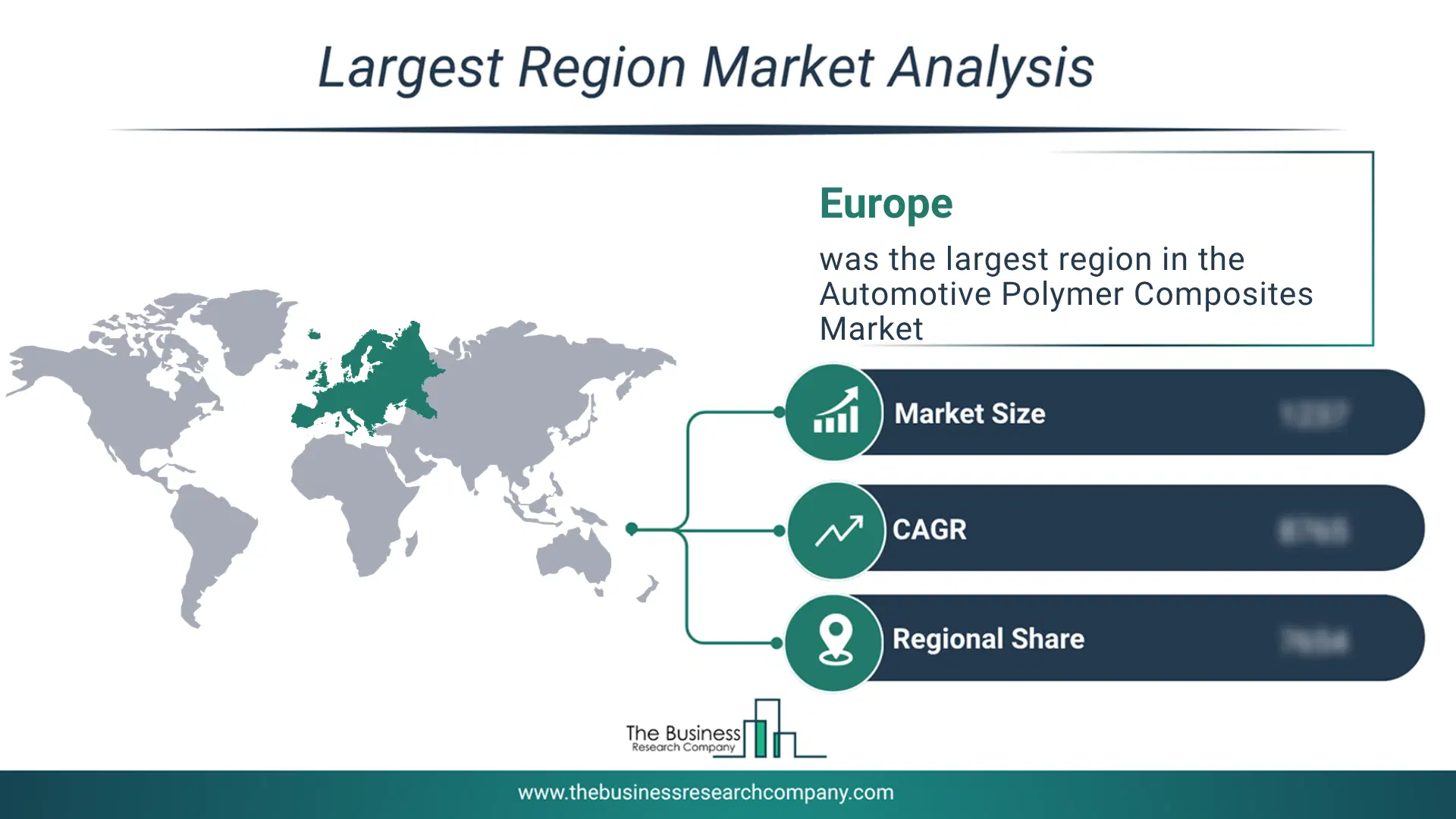
Regional Outlook/Insights
Europe was the largest region in the automotive polymer composites market in 2025. Asia-Pacific is expected to be the fastest-growing region in the forecast period. The regions covered in this market report are Asia-Pacific, South East Asia, Western Europe, Eastern Europe, North America, South America, Middle East, Africa. The countries covered in this market report are Australia, Brazil, China, France, Germany, India, Indonesia, Japan, Taiwan, Russia, South Korea, UK, USA, Canada, Italy, Spain.What Defines the Automotive Polymer Composites Market?
The automotive polymer composites market consists of sales of sheet molding compounds, bulk molding compounds, and fiber-molded composites. Values in this market are ‘factory gate’ values, that is, the value of goods sold by the manufacturers or creators of the goods, whether to other entities (including downstream manufacturers, wholesalers, distributors, and retailers) or directly to end customers. The value of goods in this market includes related services sold by the creators of the goods.How is Market Value Defined and Measured?
The market value is defined as the revenues that enterprises gain from the sale of goods and/or services within the specified market and geography through sales, grants, or donations in terms of the currency (in USD unless otherwise specified). The revenues for a specified geography are consumption values that are revenues generated by organizations in the specified geography within the market, irrespective of where they are produced. It does not include revenues from resales along the supply chain, either further along the supply chain or as part of other products.
This chart presents market attractiveness based on a quantitative evaluation of growth, competition, strategic alignment, and risk, offering a clear view of opportunity areas for decision-making. This chart is for illustrative purposes; the full report contains the complete analysis.

This chart highlights the Total Addressable Market (TAM) by estimating the maximum revenue opportunity using an assumption-driven approach, supporting strategic planning and opportunity sizing across markets. The chart is illustrative; the full report provides a more comprehensive analysis.
What Key Data and Analysis Are Included in the Automotive Polymer Composites Market Report 2026?
The automotive polymer composites market research report is one of a series of new reports from The Business Research Company that provides automotive polymer composites market statistics, including automotive polymer composites industry global market size, regional shares, competitors with a automotive polymer composites market share, detailed automotive polymer composites market segments, market trends and opportunities, and any further data you may need to thrive in the automotive polymer composites industry. This automotive polymer composites market research report delivers a complete perspective of everything you need, with an in-depth analysis of the current and future scenario of the industry.Automotive Polymer Composites Market Report Forecast Analysis
| Report Attribute | Details |
|---|---|
| Market Size Value In 2026 | $7.83 billion |
| Revenue Forecast In 2030 | $10.75 billion |
| Growth Rate | CAGR of 8.2% from 2026 to 2030 |
| Base Year For Estimation | 2025 |
| Actual Estimates/Historical Data | 2020-2025 |
| Forecast Period | 2026 - 2030 |
| Market Representation | Revenue in USD Billion and CAGR from 2026 to 2030 |
| Segments Covered | Type, Manufacturing Process, Material Type, Application, End User |
| Regional Scope | Asia-Pacific, Western Europe, Eastern Europe, North America, South America, Middle East, Africa |
| Country Scope | The countries covered in the report are Australia, Brazil, China, France, Germany, India, Indonesia, Japan, Taiwan, Russia, South Korea, UK, USA, Canada, Italy, Spain. |
| Key Companies Profiled | BASF SE, Saudi Basic Industries Corporation, LyondellBasell Industries N.V., Mitsubishi Chemical Group Corporation, DuPont de Nemours Inc., Toray Industries Inc., Covestro AG, Celanese Corporation, Teijin Limited, Owens Corning, Hexcel Corporation, Henkel AG & Co. KGaA, SGL Carbon SE, Arkema S.A., Gurit Holding AG, Evonik Industries AG, Johns Manville Corporation, Kolon Industries Inc., Tata AutoComp Systems Limited, IDI Composites International Inc., TPI Composites Inc., UFP Technologies Inc., Plasan Sasa Ltd., GMS Composites Ltd., Revchem Composites Inc. |
| Customization Scope | Request for Customization |
| Pricing And Purchase Options | Explore Purchase Options |