

Automotive Polyvinyl Chloride (PVC) And Polyurethane (PU) Leather Market Report 2026
Global Outlook – By Product Type (Polyvinyl Chloride Leather, Polyurethane Leather, Hybrid Leather, Other Product Types), By Vehicle Type (Passenger Cars, Commercial Vehicles, Two-Wheelers, Electric Vehicles, Other Vehicle Types), By Application (Seating, Door Panels, Consoles, Instrument Panels, Other Applications), By End-User Industry (Original Equipment Manufacturer, Aftermarket, Other End-User Industries) – Market Size, Trends, Strategies, and Forecast to 2030
Automotive Polyvinyl Chloride (PVC) And Polyurethane (PU) Leather Market Overview
• Automotive Polyvinyl Chloride (PVC) And Polyurethane (PU) Leather market size has reached to $17.57 billion in 2025 • Expected to grow to $24.63 billion in 2030 at a compound annual growth rate (CAGR) of 6.9% • Growth Driver: Increasing Demand For Passenger Cars Is Fueling The Growth Of The Market Due To Rising Adoption Of Premium Vehicle Interior Materials • Market Trend: Recycled Polyurethane Solutions Advancing Sustainable Automotive Leather Materials • Asia-Pacific was the largest region and fastest growing region.What Is Covered Under Automotive Polyvinyl Chloride (PVC) And Polyurethane (PU) Leather Market?
Automotive polyvinyl chloride (PVC) and polyurethane (PU) leather refer to synthetic leather materials designed to replicate the appearance and feel of natural leather while offering durability, flexibility, and cost efficiency. These materials are produced by coating polymer layers onto fabric substrates, providing resistance to wear, moisture, stains, and environmental conditions. Automotive polyvinyl chloride (PVC) and polyurethane (PU) leather are widely used as an alternative to genuine leather due to their consistent quality, design versatility, and easier maintenance. The main product types of automotive polyvinyl chloride (PVC) and polyurethane (PU) leather include polyvinyl chloride leather, polyurethane leather, hybrid leather, and other product types. Polyvinyl chloride leather refers to synthetic automotive upholstery material made by applying a polyvinyl chloride coating to a fabric or backing, providing durability, ease of maintenance, and resistance to wear. These materials are used in passenger cars, commercial vehicles, two-wheelers, electric vehicles, and other vehicle types. The various applications involved are seating, door panels, consoles, instrument panels, and others and they are utilized by end users industries including original equipment manufacturer, aftermarket, and others.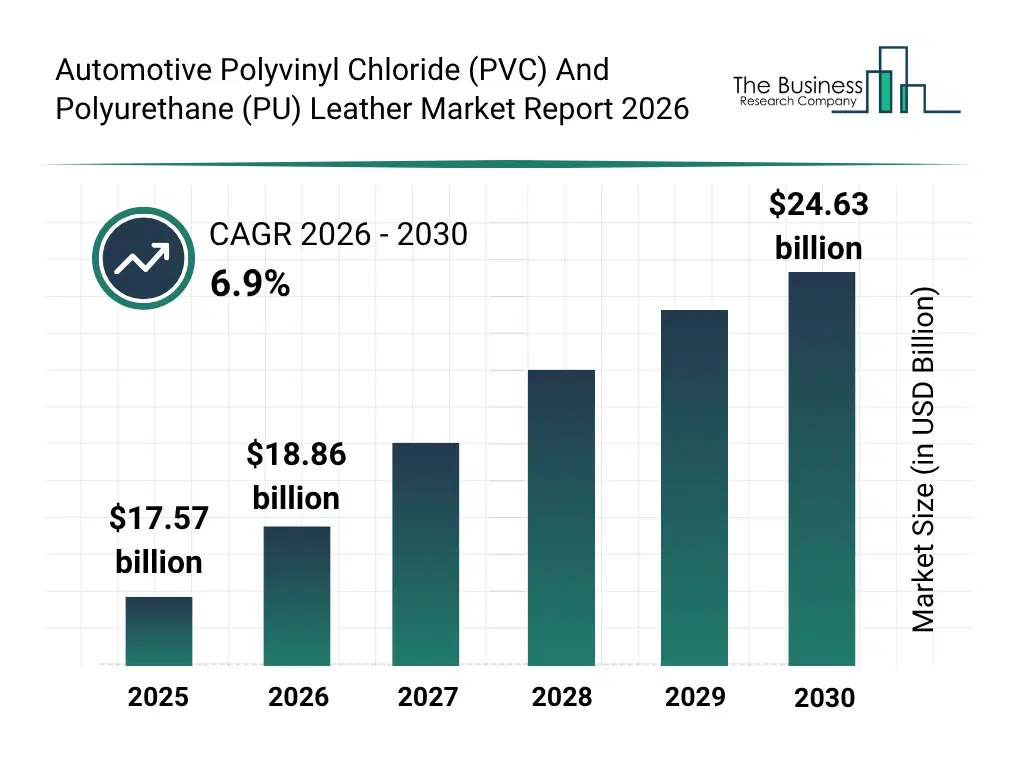
What Is The Automotive Polyvinyl Chloride (PVC) And Polyurethane (PU) Leather Market Size and Share 2026?
The automotive polyvinyl chloride (PVC) and polyurethane (PU) leather market size has grown strongly in recent years. It will grow from $17.57 billion in 2025 to $18.86 billion in 2026 at a compound annual growth rate (CAGR) of 7.3%. The growth in the historic period can be attributed to increasing demand for cost-effective automotive upholstery, rising vehicle production volumes, growing replacement of genuine leather with synthetic alternatives, increasing demand for durable interior materials, rising use of synthetic leather in vehicle seating.What Is The Automotive Polyvinyl Chloride (PVC) And Polyurethane (PU) Leather Market Growth Forecast?
The automotive polyvinyl chloride (PVC) and polyurethane (PU) leather market size is expected to see strong growth in the next few years. It will grow to $24.63 billion in 2030 at a compound annual growth rate (CAGR) of 6.9%. The growth in the forecast period can be attributed to increasing demand for bio-based polyurethane leather, rising adoption of water-based synthetic leather production, growing demand for lightweight automotive upholstery materials, increasing use of premium synthetic leather finishes, rising demand for recyclable and lower-impact leather alternatives. Major trends in the forecast period include increasing adoption of water-based polyurethane leather, rising demand for bio-based synthetic leather materials, growing use of microfiber polyurethane leather, increasing demand for lightweight and flexible synthetic leather, rising adoption of premium-textured synthetic leather finishes.
Global Automotive Polyvinyl Chloride (PVC) And Polyurethane (PU) Leather Market Segmentation
1) By Product Type: Polyvinyl Chloride Leather, Polyurethane Leather, Hybrid Leather, Other Product Types 2) By Vehicle Type: Passenger Cars, Commercial Vehicles, Two-Wheelers, Electric Vehicles, Other Vehicle Types 3) By Application: Seating, Door Panels, Consoles, Instrument Panels, Other Applications 4) By End-User Industry: Original Equipment Manufacturer, Aftermarket, Other End-User Industries Subsegments: 1) By Polyvinyl Chloride Leather: Standard Polyvinyl Chloride Leather, Expanded Polyvinyl Chloride Leather, Calendered Polyvinyl Chloride Leather, Cast Polyvinyl Chloride Leather 2) By Polyurethane Leather: Solvent-Based Polyurethane Leather, Water-Based Polyurethane Leather, Microfiber Polyurethane Leather, Bio-Based Polyurethane Leather 3) By Hybrid Leather: Polyvinyl Chloride Polyurethane Composite Leather, Polyurethane Microfiber Hybrid Leather, Textile-Reinforced Hybrid Leather, Multi-Layer Hybrid Leather 4) By Other Product Types: Silicone Synthetic Leather, Thermoplastic Polyolefin Leather, Thermoplastic Polyurethane Leather, Olefin-Based Synthetic LeatherWhat Are The Drivers Of The Automotive Polyvinyl Chloride (PVC) And Polyurethane (PU) Leather Market?
The increasing demand for passenger cars is expected to propel the growth of the automotive polyvinyl chloride (PVC) and polyurethane (PU) leather market going forward. Passenger cars are motor vehicles designed primarily for the transportation of people, typically seating up to eight persons and used on public roads. The demand for passenger cars is largely rising due to rapid urbanization, as expanding urban populations drive higher personal mobility needs, prompting more individuals to seek private vehicles as a convenient and reliable mode of daily transportation. The growing number of passenger vehicles on roads directly boosts the need for interior materials such as PVC and PU leather, which are widely used in seat covers, dashboards, door panels, and other cabin surfaces. For instance, in March 2024, according to a report published by the European Automobile Manufacturers' Association (ACEA), a Belgium-based standards group of the automobile industry in the European Union, over 76 million passenger cars were produced globally in 2023, up 10.2% from the previous year. Therefore, the increasing demand for passenger cars is driving the growth of the automotive polyvinyl chloride (PVC) and polyurethane (PU) leather industry. The increasing adoption of electric vehicles is expected to propel the growth of the automotive polyvinyl chloride (PVC) and polyurethane (PU) leather market going forward. Electric vehicles (EVs) are automobiles powered by electric motors using energy stored in rechargeable batteries, offering a cleaner alternative to conventional fuel-powered vehicles. The increasing adoption of electric vehicles is driven by growing environmental concerns and stricter emission regulations, as EVs help reduce greenhouse gas emissions and provide a cleaner alternative to conventional internal combustion engine vehicles. The increasing adoption of electric vehicles supports the automotive polyvinyl chloride (PVC) and polyurethane (PU) leather by driving demand for lightweight, durable, and premium interior materials that enhance vehicle comfort, aesthetics, and energy efficiency. For instance, in January 2024, according to the US Department of Energy, a US-based government department, in 2023, electric vehicle sales in the United States surpassed 1.4 million units, marking a 50% year-over-year increase. Therefore, increasing adoption of electric vehicles is driving the growth of the automotive polyvinyl chloride (PVC) and polyurethane (PU) leather industry.Key Players In The Global Automotive Polyvinyl Chloride (PVC) And Polyurethane (PU) Leather Market
Major companies operating in the automotive polyvinyl chloride (pvc) and polyurethane (pu) leather market are Seiren Co. Ltd., Kyowa Leather Cloth Co. Ltd., Responsive Industries Limited, Natroyal Industries Private Limited, Mayur Uniquoters Limited, Achilles Corporation, Marvel Vinyls Limited, Polynova Industries Limited, Jasch Craft Limited, Vulcaflex S.p.A., Fenoplast Limited, Canadian General-Tower Limited, Zhejiang Longyue Leather Co. Ltd., Premier Polyfilm Limited, Ultrafabrics Holdings Co. Ltd., Winner Nippon Leatherette Private Limited, Manish Vinyls Private Limited, Lamicoats Private Limited, Lextile Leather LLP, Arkom Leather LLP, Veeaar Leathers Private Limited, Samarth Rexines Private Limited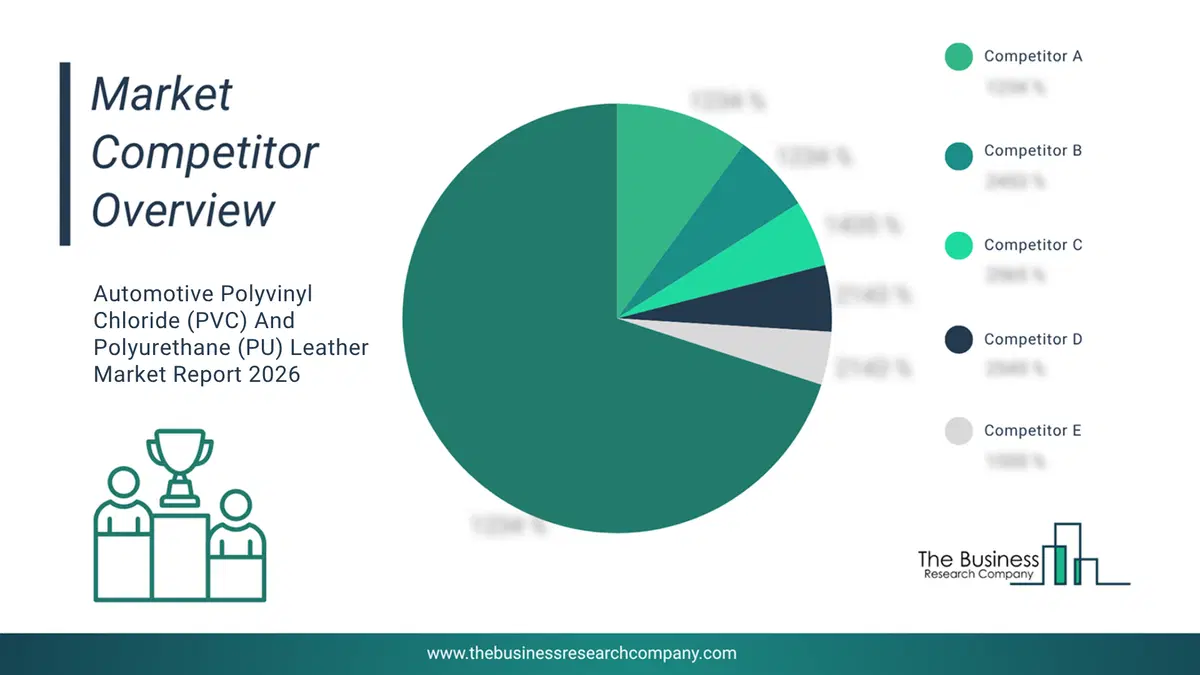
This chart is for illustrative purposes; the full report includes a detailed competitor analysis and comprehensive overview of the top 10 companies in the market.
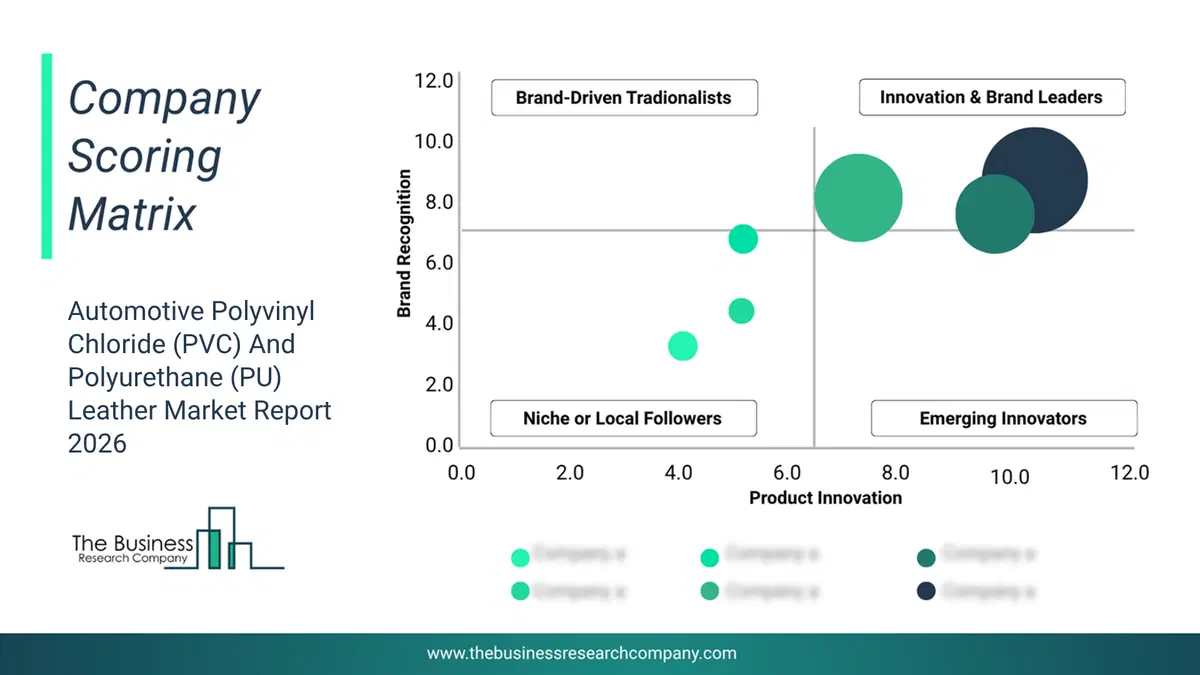
This chart maps companies by product innovation and brand strength, with bubble size indicating relative revenue, helping identify market leaders, challengers, and niche players. This is an illustrative chart; the full report provides a complete and accurate competitive analysis.
Global Automotive Polyvinyl Chloride (PVC) And Polyurethane (PU) Leather Market Trends and Insights
Major companies operating in the automotive polyvinyl chloride (PVC) and polyurethane (PU) leather market are increasingly prioritizing recycled polyurethane technologies, circular material solutions, and recycled-content formulations to reduce material waste, support resource efficiency, and improve the sustainability of automotive and synthetic leather applications. Recycled PU solutions refer to polyurethane materials produced using recovered and recycled PU waste, enabling manufacturers to reduce reliance on virgin raw materials while maintaining material quality and commercial viability. For instance, in March 2025, BASF, a Germany-based chemical company, introduced its Loop portfolio of PU solutions incorporating recycled content for the automotive and synthetic leather industries in China. The portfolio includes recyclable PU systems that use advanced liquefaction techniques to convert PU waste into high-quality recycled materials, which are subsequently used to produce new PU solutions. It is integrating recycled content and advanced PU recycling technologies, BASF’s Loop portfolio enables automotive and synthetic leather manufacturers to improve circularity, reduce dependence on virgin materials, and support more sustainable material production while maintaining the performance requirements of end-use applications.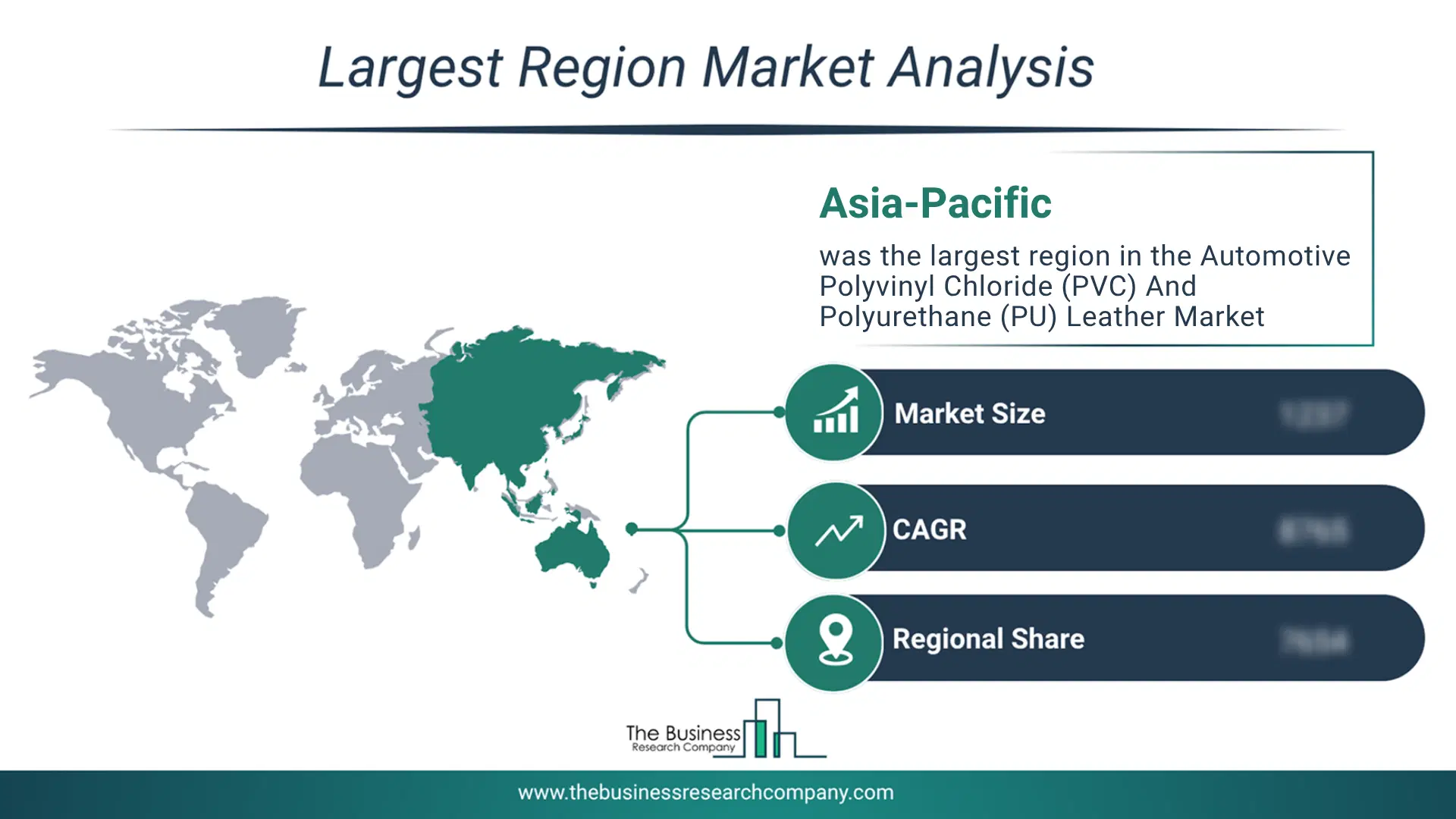
Regional Insights
Asia-Pacific was the largest region in the automotive polyvinyl chloride (PVC) and polyurethane (PU) leather market in 2025. Asia-Pacific is expected to be the fastest-growing region in the forecast period. The regions covered in this market report are Asia-Pacific, South East Asia, Western Europe, Eastern Europe, North America, South America, Middle East, Africa. The countries covered in this market report are Australia, Brazil, China, France, Germany, India, Indonesia, Japan, Taiwan, Russia, South Korea, UK, USA, Canada, Italy, Spain.What Defines the Automotive Polyvinyl Chloride (PVC) And Polyurethane (PU) Leather Market?
The automotive polyvinyl chloride (PVC) and polyurethane (PU) leather market consists of sales of laminated leather fabrics, embossed leather materials, and perforated leather materials. Values in this market are ‘factory gate’ values, that is, the value of goods sold by the manufacturers or creators of the goods, whether to other entities (including downstream manufacturers, wholesalers, distributors, and retailers) or directly to end customers. The value of goods in this market includes related services sold by the creators of the goods.How is Market Value Defined and Measured?
The market value is defined as the revenues that enterprises gain from the sale of goods and/or services within the specified market and geography through sales, grants, or donations in terms of the currency (in USD unless otherwise specified). The revenues for a specified geography are consumption values that are revenues generated by organizations in the specified geography within the market, irrespective of where they are produced. It does not include revenues from resales along the supply chain, either further along the supply chain or as part of other products.
This chart presents market attractiveness based on a quantitative evaluation of growth, competition, strategic alignment, and risk, offering a clear view of opportunity areas for decision-making. This chart is for illustrative purposes; the full report contains the complete analysis.

This chart highlights the Total Addressable Market (TAM) by estimating the maximum revenue opportunity using an assumption-driven approach, supporting strategic planning and opportunity sizing across markets. The chart is illustrative; the full report provides a more comprehensive analysis.
What Key Data and Analysis Are Included in the Automotive Polyvinyl Chloride (PVC) And Polyurethane (PU) Leather Market Report 2026?
The automotive polyvinyl chloride (pvc) and polyurethane (pu) leather market research report is one of a series of new reports from The Business Research Company that provides market statistics, including industry global market size, regional shares, competitors with the market share, detailed market segments, market trends and opportunities, and any further data you may need to thrive in the automotive polyvinyl chloride (pvc) and polyurethane (pu) leather industry. The market research report delivers a complete perspective of everything you need, with an in-depth analysis of the current and future state of the industry.Automotive Polyvinyl Chloride (PVC) And Polyurethane (PU) Leather Market Report Forecast Analysis
| Report Attribute | Details |
|---|---|
| Market Size Value In 2026 | $18.86 billion |
| Revenue Forecast In 2030 | $24.63 billion |
| Growth Rate | CAGR of 6.9% from 2026 to 2030 |
| Base Year For Estimation | 2025 |
| Actual Estimates/Historical Data | 2020-2025 |
| Forecast Period | 2026 - 2030 |
| Market Representation | Revenue in USD Billion and CAGR from 2026 to 2030 |
| Segments Covered | Product Type, Vehicle Type, Application, End-User Industry |
| Regional Scope | Asia-Pacific, Western Europe, Eastern Europe, North America, South America, Middle East, Africa |
| Country Scope | The countries covered in the report are Australia, Brazil, China, France, Germany, India, Indonesia, Japan, Taiwan, Russia, South Korea, UK, USA, Canada, Italy, Spain. |
| Key Companies Profiled | Seiren Co. Ltd., Kyowa Leather Cloth Co. Ltd., Responsive Industries Limited, Natroyal Industries Private Limited, Mayur Uniquoters Limited, Achilles Corporation, Marvel Vinyls Limited, Polynova Industries Limited, Jasch Craft Limited, Vulcaflex S.p.A., Fenoplast Limited, Canadian General-Tower Limited, Zhejiang Longyue Leather Co. Ltd., Premier Polyfilm Limited, Ultrafabrics Holdings Co. Ltd., Winner Nippon Leatherette Private Limited, Manish Vinyls Private Limited, Lamicoats Private Limited, Lextile Leather LLP, Arkom Leather LLP, Veeaar Leathers Private Limited, Samarth Rexines Private Limited |
| Customization Scope | Request for Customization |
| Pricing And Purchase Options | Explore Purchase Options |