
Automotive Polyvinyl Chloride (PVC) Synthetic Leather Market Report 2026
Global Outlook – By Type (Standard Grade Polyvinyl Chloride (PVC) Synthetic Leather, Premium Grade Polyvinyl Chloride (PVC) Synthetic Leather, Eco Friendly Polyvinyl Chloride (PVC) Synthetic Leather, Flame Retardant Polyvinyl Chloride (PVC) Synthetic Leather), By Vehicle Type (Passenger Vehicles, Commercial Vehicles, Electric Vehicles, Luxury Vehicles, Off Road Vehicles), By Application (Seating Upholstery, Door Panels And Trim, Dashboard Covers, Steering Wheel Covers, Headliners And Roof Lining), By End User (Original Equipment Manufacturers, Aftermarket Automotive Upholstery, Automotive Interior Component Suppliers) – Market Size, Trends, Strategies, and Forecast to 2030
Automotive Polyvinyl Chloride (PVC) Synthetic Leather Market Overview
• Automotive Polyvinyl Chloride (PVC) Synthetic Leather market size has reached to $1.63 billion in 2025 • Expected to grow to $2.31 billion in 2030 at a compound annual growth rate (CAGR) of 7.2% • Growth Driver: Rising Production Of Electric Vehicles Fueling The Growth Of The Market Due To Increasing Demand For Lightweight And Sustainable Interior Materials • Market Trend: Strategic Manufacturing Investments Strengthen Automotive Synthetic Leather Production Capacity • North America was the largest region in 2025 and Asia-Pacific is the fastest growing region.What Is Covered Under Automotive Polyvinyl Chloride (PVC) Synthetic Leather Market?
Automotive polyvinyl chloride (PVC) synthetic leather is a durable, polymer-based artificial leather manufactured by coating or laminating polyvinyl chloride (PVC) onto a textile backing to replicate the appearance and texture of natural leather. It offers good abrasion resistance, water resistance, and design flexibility, making it suitable for vehicle interior applications. Automotive polyvinyl chloride (PVC) synthetic leather provides a cost-effective, easy-to-maintain, and consistent alternative to genuine leather while supporting high-volume automotive production. The main types in the automotive polyvinyl chloride (PVC) synthetic leather market include standard grade polyvinyl chloride (PVC) synthetic leather, premium grade polyvinyl chloride (PVC) synthetic leather, eco friendly polyvinyl chloride (PVC) synthetic leather, and flame retardant polyvinyl chloride (PVC) synthetic leather. Standard grade polyvinyl chloride (PVC) synthetic leather refers to a cost-effective synthetic leather material made using PVC polymers and designed to provide durability, flexibility, and ease of maintenance for automotive interiors. These materials are used across passenger vehicles, commercial vehicles, electric vehicles, luxury vehicles, and off-road vehicles. The key applications include seating upholstery, door panels and trim, dashboard covers, steering wheel covers, and headliners and roof lining and end users include original equipment manufacturers, aftermarket automotive upholstery, and automotive interior component suppliers.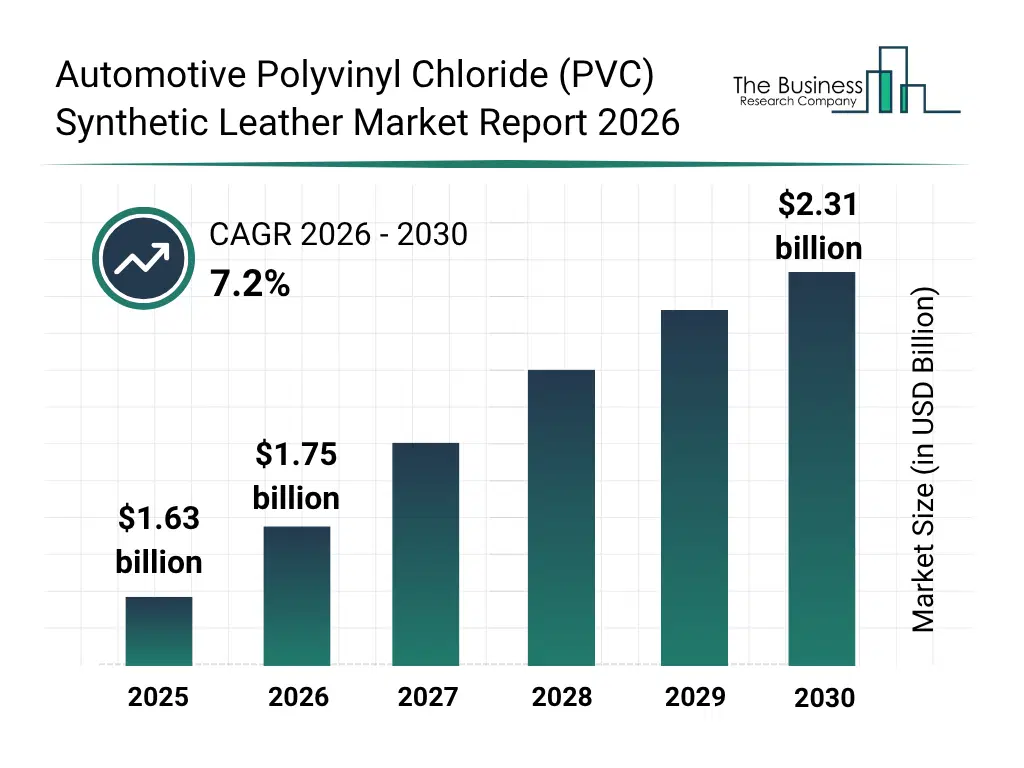
What Is The Automotive Polyvinyl Chloride (PVC) Synthetic Leather Market Size and Share 2026?
The automotive polyvinyl chloride (pvc) synthetic leather market size has grown strongly in recent years. It will grow from $1.63 billion in 2025 to $1.75 billion in 2026 at a compound annual growth rate (CAGR) of 7.6%. The growth in the historic period can be attributed to growth in global vehicle production, increasing adoption of synthetic leather in vehicle interiors, cost advantages over genuine leather, rising demand for durable automotive upholstery, expansion of automotive interior component manufacturing.What Is The Automotive Polyvinyl Chloride (PVC) Synthetic Leather Market Growth Forecast?
The automotive polyvinyl chloride (pvc) synthetic leather market size is expected to see strong growth in the next few years. It will grow to $2.31 billion in 2030 at a compound annual growth rate (CAGR) of 7.2%. The growth in the forecast period can be attributed to increasing production of electric vehicles, rising demand for sustainable interior materials, growing adoption of premium interior finishes, increasing demand for low-VOC automotive materials, expansion of customized automotive interior designs. Major trends in the forecast period include increasing demand for cost-effective automotive interior materials, growing adoption of abrasion-resistant synthetic leather, rising preference for water-resistant interior upholstery materials, increasing use of customized textures and surface finishes, growing demand for durable and easy-to-maintain vehicle interior coverings.Tariff Impact On Automotive Polyvinyl Chloride (PVC) Synthetic Leather Market
Tariffs are impacting the automotive polyvinyl chloride (PVC) synthetic leather market by increasing the cost of imported PVC resins, textile backings, plasticizers, coatings, additives, and finished synthetic leather materials used in automotive interiors. This is raising production costs for seating upholstery, door panels and trim, dashboard covers, steering wheel covers, and headliners, particularly in regions dependent on imported raw materials such as Asia-Pacific, North America, and Europe. Standard grade, premium grade, and specialty flame-retardant and eco-friendly PVC synthetic leather segments are most affected due to their dependence on international chemical and material supply chains. However, tariffs are encouraging local material production, regional supplier diversification, domestic sourcing, and investment in localized automotive interior manufacturing, supporting greater long-term supply-chain resilience.
Global Automotive Polyvinyl Chloride PVC Synthetic Leather Market Segmentation
1) By Type: Standard Grade Polyvinyl Chloride (PVC) Synthetic Leather, Premium Grade Polyvinyl Chloride (PVC) Synthetic Leather, Eco Friendly Polyvinyl Chloride (PVC) Synthetic Leather, Flame Retardant Polyvinyl Chloride (PVC) Synthetic Leather 2) By Vehicle Type: Passenger Vehicles, Commercial Vehicles, Electric Vehicles, Luxury Vehicles, Off Road Vehicles 3) By Application: Seating Upholstery, Door Panels And Trim, Dashboard Covers, Steering Wheel Covers, Headliners And Roof Lining 4) By End User: Original Equipment Manufacturers, Aftermarket Automotive Upholstery, Automotive Interior Component Suppliers Subsegments: 1) By Standard Grade Polyvinyl Chloride (PVC) Synthetic Leather: Coated PVC Synthetic Leather, Embossed PVC Synthetic Leather, Perforated PVC Synthetic Leather, Foam-Backed PVC Synthetic Leather 2) By Premium Grade Polyvinyl Chloride (PVC) Synthetic Leather: Luxury Grain PVC Synthetic Leather, Soft Touch PVC Synthetic Leather, High Durability PVC Synthetic Leather, Designer Finish PVC Synthetic Leather 3) By Eco Friendly Polyvinyl Chloride (PVC) Synthetic Leather: Recycled PVC Synthetic Leather, Low Volatile Organic Compound PVC Synthetic Leather, Phthalate-Free PVC Synthetic Leather, Bio-Based PVC Synthetic Leather 4) By Flame Retardant Polyvinyl Chloride (PVC) Synthetic Leather: Halogen-Free Flame Retardant PVC Synthetic Leather, Antimony-Based Flame Retardant PVC Synthetic Leather, Phosphorus-Based Flame Retardant PVC Synthetic Leather, Mineral-Based Flame Retardant PVC Synthetic LeatherWhat Are The Drivers Of The Automotive Polyvinyl Chloride (PVC) Synthetic Leather Market?
The rising production of electric vehicles is expected to propel the growth of the automotive polyvinyl chloride (PVC) synthetic leather market going forward. Electric vehicle production refers to the manufacturing of battery electric, plug-in hybrid, and hybrid electric vehicles that use electric powertrains fully or partially instead of traditional internal combustion engines. Electric vehicle production is increasing due to rising government incentives and supportive policies that encourage manufacturers to expand production and accelerate electric vehicle adoption. The increasing production of electric vehicles supports the automotive polyvinyl chloride (PVC) synthetic leather by increasing demand for lightweight, durable, and sustainable interior materials that enhance vehicle aesthetics, comfort, and energy efficiency. For instance, in July 2026, according to the U.S. Energy Information Administration, a US-based government agency, the combined sales of hybrid, plug-in hybrid, and battery electric vehicles (BEVs) accounted for 24% of total new light-duty vehicle sales in the second quarter of 2026 (2Q26), up from 22% in the same quarter of 2025 (2Q25). Therefore, the rising production of electric vehicles is driving the growth of the automotive polyvinyl chloride (PVC) synthetic leather industry. The increasing consumer preference for premium vehicle interiors is expected to propel the growth of the automotive polyvinyl chloride (PVC) synthetic leather market going forward. Premium vehicle interiors are high-quality cabin environments that combine advanced materials, superior craftsmanship, and enhanced comfort to deliver an elevated driving experience. This preference is primarily driven by rising disposable incomes in developed economies, which are enabling a larger base of consumers to afford vehicles in higher trim levels and luxury segments that feature premium interior materials as standard or optional upgrades. The growing demand for premium interiors directly increases the adoption of automotive PVC synthetic leather, as manufacturers integrate it across a wider range of vehicle models to meet evolving buyer expectations for comfort, aesthetics, and perceived value. For instance, in April 2026, according to Mazda North American Operations, a US-based automobile manufacturer, 81% of recent U.S. car buyers stated that the overall in-cabin experience, including comfort, interior quality, and technology, is the primary factor that makes a vehicle feel premium. Therefore, the increasing consumer preference for premium vehicle interiors is driving the growth of the automotive polyvinyl chloride (PVC) synthetic leather industry.Key Players In The Global Automotive Polyvinyl Chloride (PVC) Synthetic Leather Market
Major companies operating in the automotive polyvinyl chloride (pvc) synthetic leather market are Continental AG, Toray Industries Inc, Kuraray Co Ltd, Seiren Co Ltd, Kolon Industries Inc, Canadian General Tower Limited, Kyowa Leather Cloth Co Ltd, Mayur Uniquoters Limited, Vulcaflex SpA, Xiefu Group Co Ltd, Jiangsu Zhongtong Auto Interior Material Co Ltd, Achilles USA Inc, HR Polycoats Private Limited, Marvel Vinyls Limited, Premier Polyfilms Limited, RMG Polyvinyl India Limited, Longyue Leather Co Ltd, Veekay Polycoats Limited, Vortex Flex Private Limited, Fujian Polytech Group Co Ltd, Wise Star Industrial Limited
This chart is for illustrative purposes; the full report includes a detailed competitor analysis and comprehensive overview of the top 10 companies in the market.
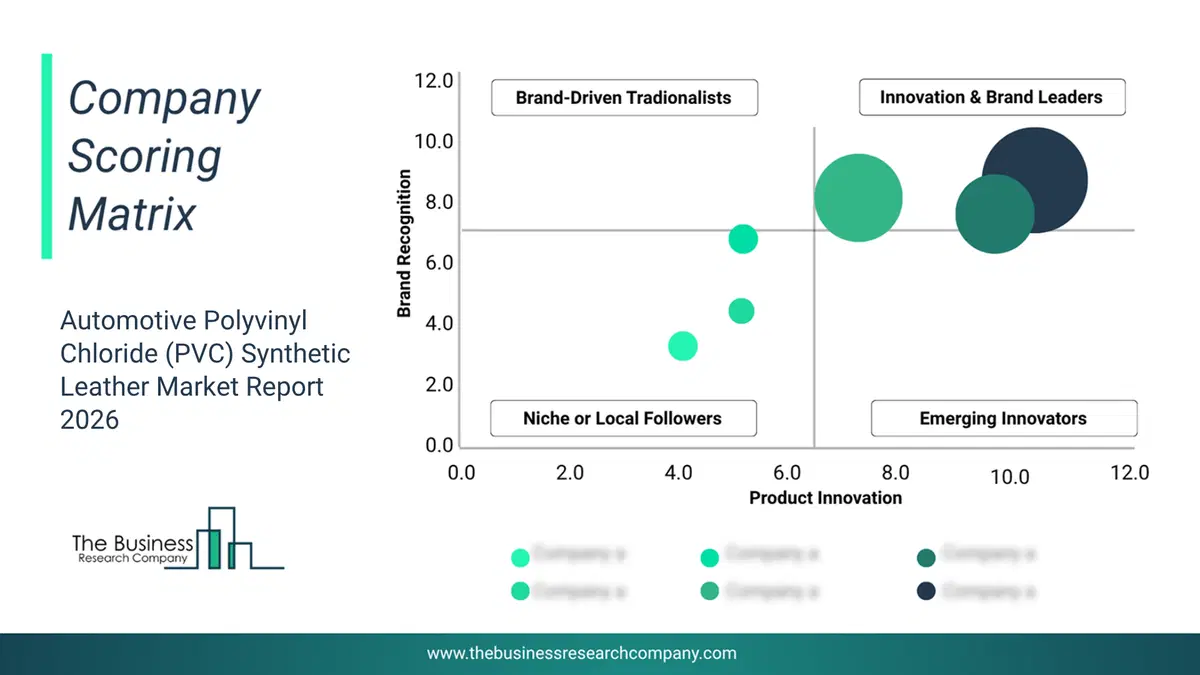
This chart maps companies by product innovation and brand strength, with bubble size indicating relative revenue, helping identify market leaders, challengers, and niche players. This is an illustrative chart; the full report provides a complete and accurate competitive analysis.
Global Automotive Polyvinyl Chloride (PVC) Synthetic Leather Market Trends and Insights
Major companies operating in the automotive polyvinyl chloride (PVC) synthetic leather market are focusing on strategic manufacturing investments and partnerships to expand production capacity and strengthen local supply chains for automotive interior materials. These investments support the development of manufacturing facilities for synthetic leather used in automotive applications, including seat covers and interior components. For instance, in October 2025, Kyowa Leather Cloth Co., a Japan-based manufacturer of automotive PVC synthetic leather products, partnered with Krishna Group, an India-based automotive components manufacturer, to establish a new manufacturing facility in India with an investment of approximately $46.7 million (₹400 crore). The facility is expected to manufacture synthetic leather for automotive seat covers and interiors, strengthening local production capabilities for automotive interior materials and supporting the expansion of Japanese automotive manufacturing companies in India. Krishna Kyowa Private Limited, a joint venture between Krishna Group and Kyowa Leather Cloth Co. Ltd., manufactures automotive PVC synthetic leather for applications including seat covers and interior components.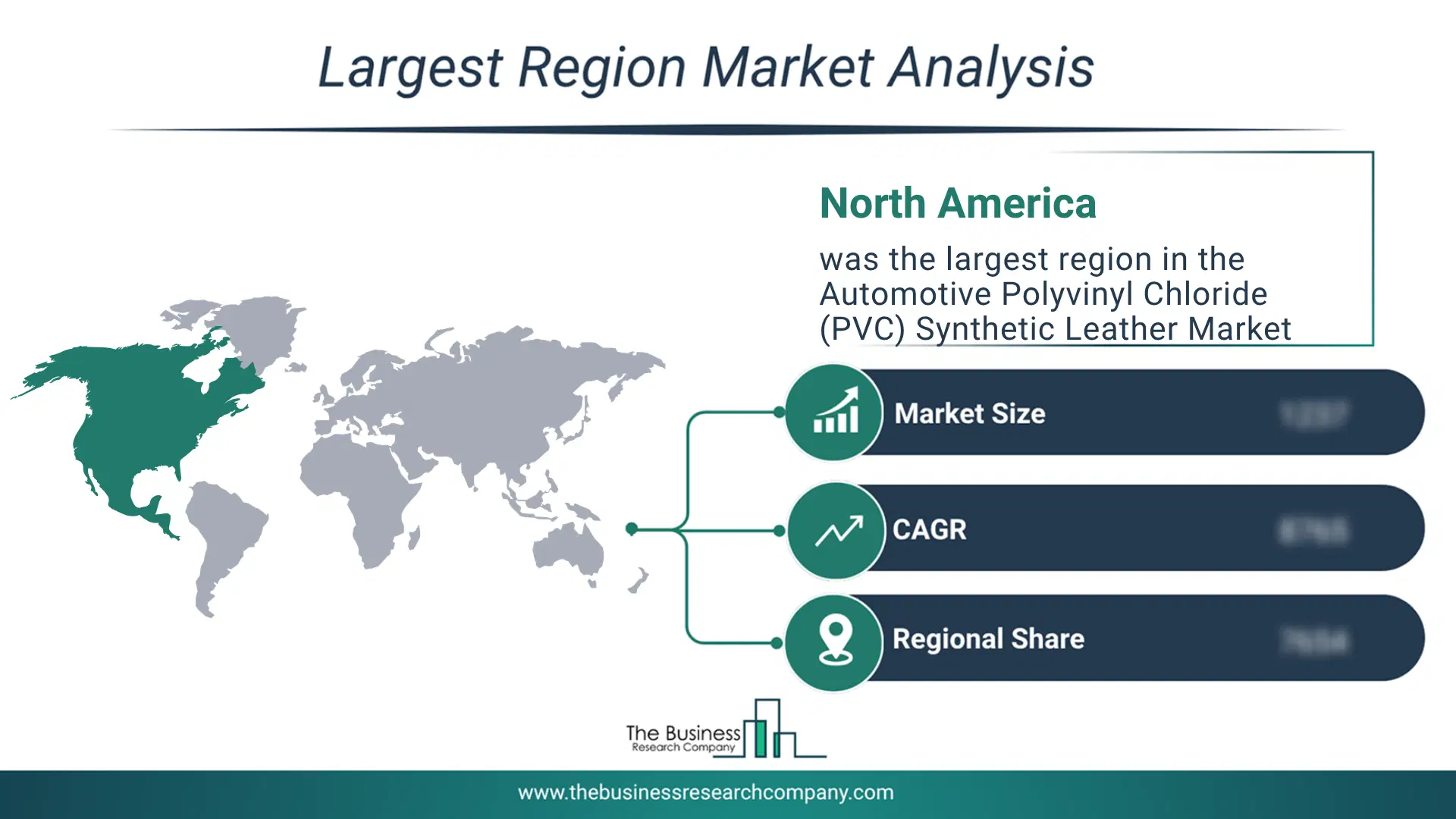
Regional Outlook
North America was the largest region in the automotive polyvinyl chloride (pvc) synthetic leather market in 2025. Asia-Pacific is expected to be the fastest-growing region in the forecast period. The regions covered in this market report are Asia-Pacific, South East Asia, Western Europe, Eastern Europe, North America, South America, Middle East, Africa. The countries covered in this market report are Australia, Brazil, China, France, Germany, India, Indonesia, Japan, Taiwan, Russia, South Korea, UK, USA, Canada, Italy, Spain.What Defines the Automotive Polyvinyl Chloride (PVC) Synthetic Leather Market?
The automotive polyvinyl chloride (PVC) synthetic leather market consists of sales of coated polyvinyl chloride (PVC) synthetic leather, embossed polyvinyl chloride (PVC) synthetic leather, perforated polyvinyl chloride (PVC) synthetic leather, foam-backed polyvinyl chloride (PVC) synthetic leather. Values in this market are ‘factory gate’ values, that is, the value of goods sold by the manufacturers or creators of the goods, whether to other entities (including automotive original equipment manufacturers, component manufacturers, wholesalers, distributors, and retailers) or directly to end customers. The value of goods in this market includes related services sold by the creators of the goods.How is Market Value Defined and Measured?
The market value is defined as the revenues that enterprises gain from the sale of goods and/or services within the specified market and geography through sales, grants, or donations in terms of the currency (in USD unless otherwise specified). The revenues for a specified geography are consumption values that are revenues generated by organizations in the specified geography within the market, irrespective of where they are produced. It does not include revenues from resales along the supply chain, either further along the supply chain or as part of other products.
This chart presents market attractiveness based on a quantitative evaluation of growth, competition, strategic alignment, and risk, offering a clear view of opportunity areas for decision-making. This chart is for illustrative purposes; the full report contains the complete analysis.

This chart highlights the Total Addressable Market (TAM) by estimating the maximum revenue opportunity using an assumption-driven approach, supporting strategic planning and opportunity sizing across markets. The chart is illustrative; the full report provides a more comprehensive analysis.
What Key Data and Analysis Are Included in the Automotive Polyvinyl Chloride (PVC) Synthetic Leather Market Report 2026?
The automotive polyvinyl chloride (pvc) synthetic leather market research report is one of a series of new reports from The Business Research Company that provides market statistics, including industry global market size, regional shares, competitors with the market share, detailed market segments, market trends and opportunities, and any further data you may need to thrive in the automotive polyvinyl chloride (pvc) synthetic leather industry. The market research report delivers a complete perspective of everything you need, with an in-depth analysis of the current and future state of the industry.Automotive Polyvinyl Chloride (PVC) Synthetic Leather Market Report Forecast Analysis
| Report Attribute | Details |
|---|---|
| Market Size Value In 2026 | $1.75 billion |
| Revenue Forecast In 2030 | $2.31 billion |
| Growth Rate | CAGR of 7.2% from 2026 to 2030 |
| Base Year For Estimation | 2025 |
| Actual Estimates/Historical Data | 2020-2025 |
| Forecast Period | 2026 - 2030 |
| Market Representation | Revenue in USD Billion and CAGR from 2026 to 2030 |
| Segments Covered | Type, Vehicle Type, Application, End User |
| Regional Scope | Asia-Pacific, Western Europe, Eastern Europe, North America, South America, Middle East, Africa |
| Country Scope | The countries covered in the report are Australia, Brazil, China, France, Germany, India, Indonesia, Japan, Taiwan, Russia, South Korea, UK, USA, Canada, Italy, Spain. |
| Key Companies Profiled | Continental AG, Toray Industries Inc, Kuraray Co Ltd, Seiren Co Ltd, Kolon Industries Inc, Canadian General Tower Limited, Kyowa Leather Cloth Co Ltd, Mayur Uniquoters Limited, Vulcaflex SpA, Xiefu Group Co Ltd, Jiangsu Zhongtong Auto Interior Material Co Ltd, Achilles USA Inc, HR Polycoats Private Limited, Marvel Vinyls Limited, Premier Polyfilms Limited, RMG Polyvinyl India Limited, Longyue Leather Co Ltd, Veekay Polycoats Limited, Vortex Flex Private Limited, Fujian Polytech Group Co Ltd, Wise Star Industrial Limited |
| Customization Scope | Request for Customization |
| Pricing And Purchase Options | Explore Purchase Options |