

Automotive Powertrain Market Report 2026
Global Outlook – By Powertrain Type (Internal Combustion Engine Powertrain Gasoline, Internal Combustion Engine Powertrain Diesel, Hybrid Powertrain, Plug-In Hybrid Powertrain, Electric Powertrain, Fuel Cell Electric Powertrain), By Vehicle Type (Passenger Cars, Light Commercial Vehicles, Heavy Commercial Vehicles), By Component (Engine, Transmission, Driveshaft, Differentials, Other Components), By Drive Type (Front-Wheel Drive, Rear-Wheel Drive, All-Wheel Drive, Four-Wheel Drive), By Sales Channel (Original Equipment Manufacturer, Aftermarket) – Market Size, Trends, Strategies, and Forecast to 2030
Automotive Powertrain Market Overview
• Automotive Powertrain market size has reached to $460.67 billion in 2025 • Expected to grow to $629.42 billion in 2030 at a compound annual growth rate (CAGR) of 6.0% • Growth Driver: Growing Vehicle Electrification Driving The Market Growth Due To Increasing Adoption Of Electric Powertrains • Market Trend: Expansion Of Electric Powertrain Manufacturing Strengthens Electric Vehicle Production Capabilities • North America was the largest region in 2025 and Asia-Pacific is the fastest growing region.What Is Covered Under Automotive Powertrain Market?
An automotive powertrain refers to the system responsible for generating, managing, and transmitting power to propel a vehicle. It is a fundamental aspect of vehicle engineering that influences overall performance, energy efficiency, operational reliability, and compliance with evolving automotive standards. The main powertrain types of automotive powertrain include internal combustion engine powertrain gasoline, internal combustion engine powertrain diesel, hybrid powertrain, plug-in hybrid powertrain, electric powertrain, and fuel cell electric powertrain. Internal combustion engine powertrain gasoline refers to vehicle propulsion systems that use gasoline-powered engines to generate mechanical power and transfer it to the wheels through the drivetrain. These powertrains are used in passenger cars, light commercial vehicles, and heavy commercial vehicles and include components such as engine, transmission, driveshaft, differentials, and other components. They are configured with front-wheel drive, rear-wheel drive, all-wheel drive, and four-wheel drive systems and are supplied through original equipment manufacturer and aftermarket channels.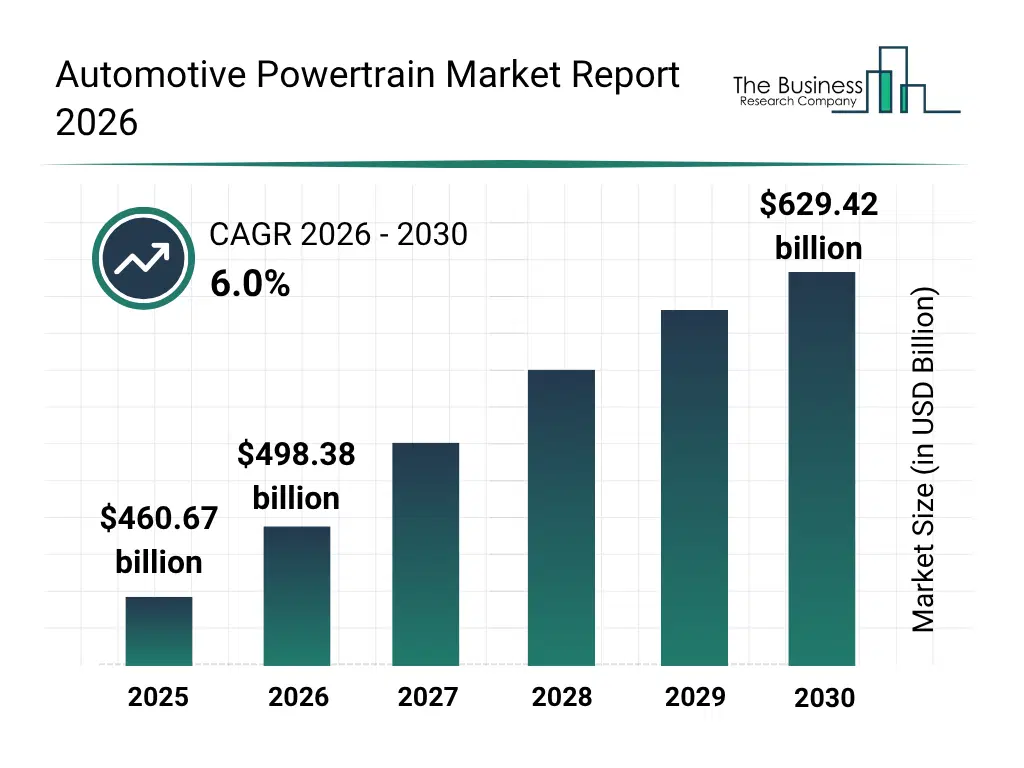
What Is The Automotive Powertrain Market Size and Share 2026?
The automotive powertrain market size has grown strongly in recent years. It will grow from $460.67 billion in 2025 to $498.38 billion in 2026 at a compound annual growth rate (CAGR) of 8.2%. The growth in the historic period can be attributed to increasing vehicle production volumes, rising demand for improved fuel efficiency, growing adoption of advanced transmission systems, increasing demand for reliable powertrain components, expanding automotive aftermarket activities.What Is The Automotive Powertrain Market Growth Forecast?
The automotive powertrain market size is expected to see strong growth in the next few years. It will grow to $629.42 billion in 2030 at a compound annual growth rate (CAGR) of 6.0%. The growth in the forecast period can be attributed to rising demand for high-performance powertrain systems, increasing vehicle electrification, growing demand for lightweight powertrain components, expanding use of advanced thermal management, increasing demand for integrated powertrain architectures. Major trends in the forecast period include increasing adoption of advanced transmission technologies, rising demand for high-efficiency powertrain systems, growing integration of advanced thermal management systems, increasing use of lightweight powertrain components, rising demand for enhanced powertrain reliability and durability.
Global Automotive Powertrain Market Segmentation
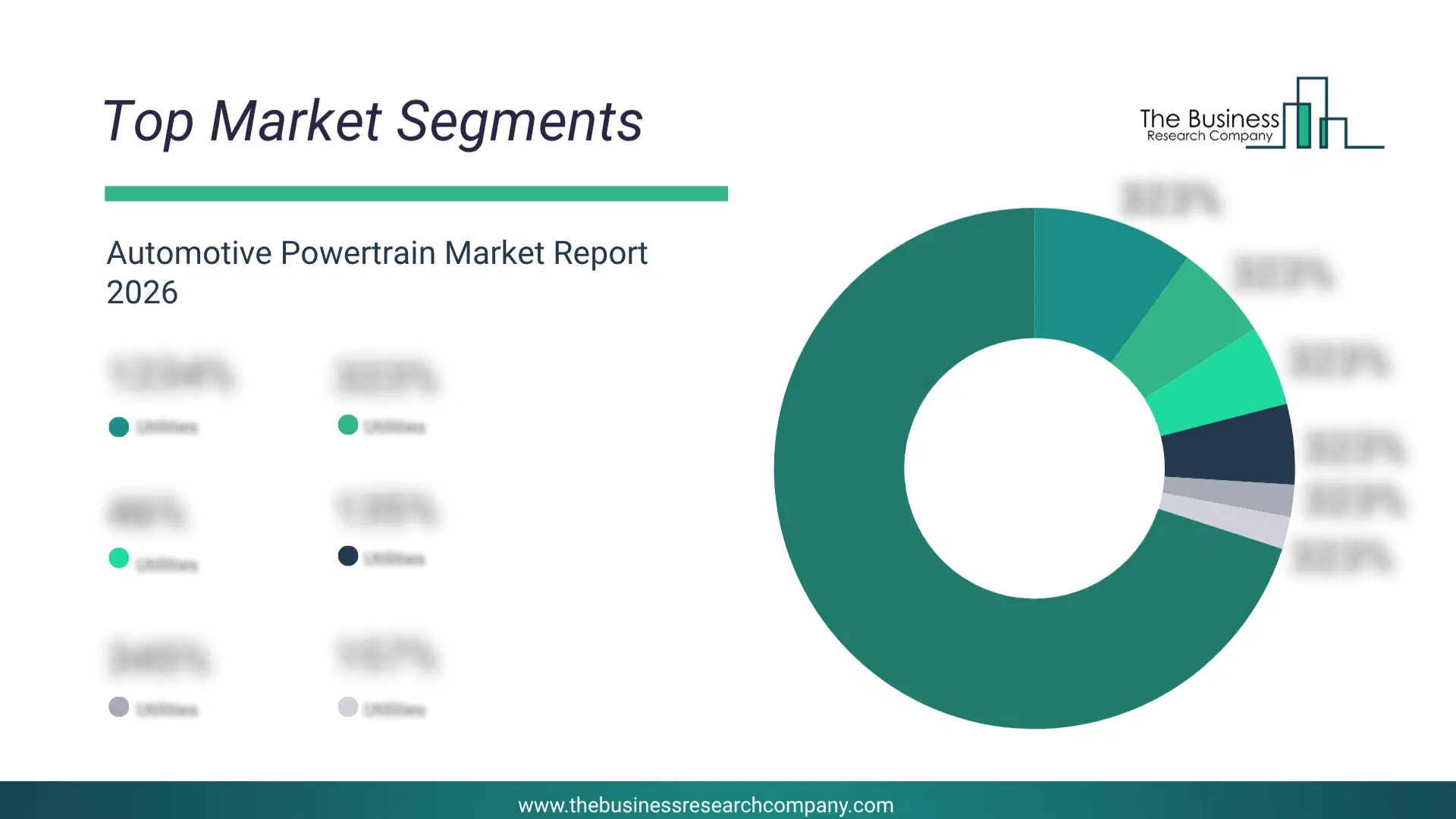
1) By Powertrain Type: Internal Combustion Engine Powertrain Gasoline, Internal Combustion Engine Powertrain Diesel, Hybrid Powertrain, Plug-In Hybrid Powertrain, Electric Powertrain, Fuel Cell Electric Powertrain 2) By Vehicle Type: Passenger Cars, Light Commercial Vehicles, Heavy Commercial Vehicles 3) By Component: Engine, Transmission, Driveshaft, Differentials, Other Components 4) By Drive Type: Front-Wheel Drive, Rear-Wheel Drive, All-Wheel Drive, Four-Wheel Drive 5) By Sales Channel: Original Equipment Manufacturer, Aftermarket Subsegments: 1) By Internal Combustion Engine Powertrain Gasoline: Naturally Aspirated Gasoline Powertrain, Turbocharged Gasoline Powertrain, Direct Injection Gasoline Powertrain, Multi-Point Fuel Injection Gasoline Powertrain 2) By Internal Combustion Engine Powertrain Diesel: Naturally Aspirated Diesel Powertrain, Turbocharged Diesel Powertrain, Common Rail Diesel Powertrain, Direct Injection Diesel Powertrain 3) By Hybrid Powertrain: Series Hybrid, Parallel Hybrid, Series-Parallel Hybrid, Mild Hybrid 4) By Plug-In Hybrid Powertrain: Series Plug-In Hybrid, Parallel Plug-In Hybrid, Series-Parallel Plug-In Hybrid, Range-Extended Electric Vehicle 5) By Electric Powertrain: Battery Electric Vehicle Powertrain, Single-Motor Electric Powertrain, Dual-Motor Electric Powertrain, All-Wheel Drive Electric Powertrain 6) By Fuel Cell Electric Powertrain: Proton Exchange Membrane Fuel Cell Powertrain, Solid Oxide Fuel Cell Powertrain, Single-Stack Fuel Cell Powertrain, Multi-Stack Fuel Cell PowertrainWhat Is The Driver Of The Automotive Powertrain Market?
The growing vehicle electrification is expected to propel the growth of the automotive powertrain market going forward. Vehicle electrification refers to the transition from internal combustion engine-based drivetrains to electric powertrains that rely on electric motors and battery systems for vehicle propulsion. This shift is primarily driven by increasingly stringent government emission regulations and decarbonization targets across major economies, which are compelling automakers to accelerate investments in electrified powertrain technologies and phase out conventional combustion-based systems. The rising adoption of electric vehicles directly expands demand for advanced electric powertrain components, which are the core building blocks of modern EV architectures. For instance, in June 2024, according to the International Council on Clean Transportation, a US-based non-profit organization, in 2023, new electric light-duty vehicle sales in the United States climbed to approximately 1.4 million, an increase from nearly 1 million in 2022, bringing their market share to around 9%. Therefore, growing vehicle electrification is driving the growth of the automotive powertrain industry.Key Players In The Global Automotive Powertrain Market
Major companies operating in the automotive powertrain market are Volkswagen AG, Toyota Motor Corporation, Ford Motor Company, General Motors Company, Bayerische Motoren Werke AG, Honda Motor Co. Ltd., Hyundai Motor Company, BYD Company Limited, Robert Bosch GmbH, Nissan Motor Co. Ltd., DENSO Corporation, ZF Friedrichshafen AG, Magna International Inc., Mitsubishi Electric Corporation, Aisin Corporation, Valeo SE, Schaeffler AG, Nidec Corporation, BorgWarner Inc., JTEKT Corporation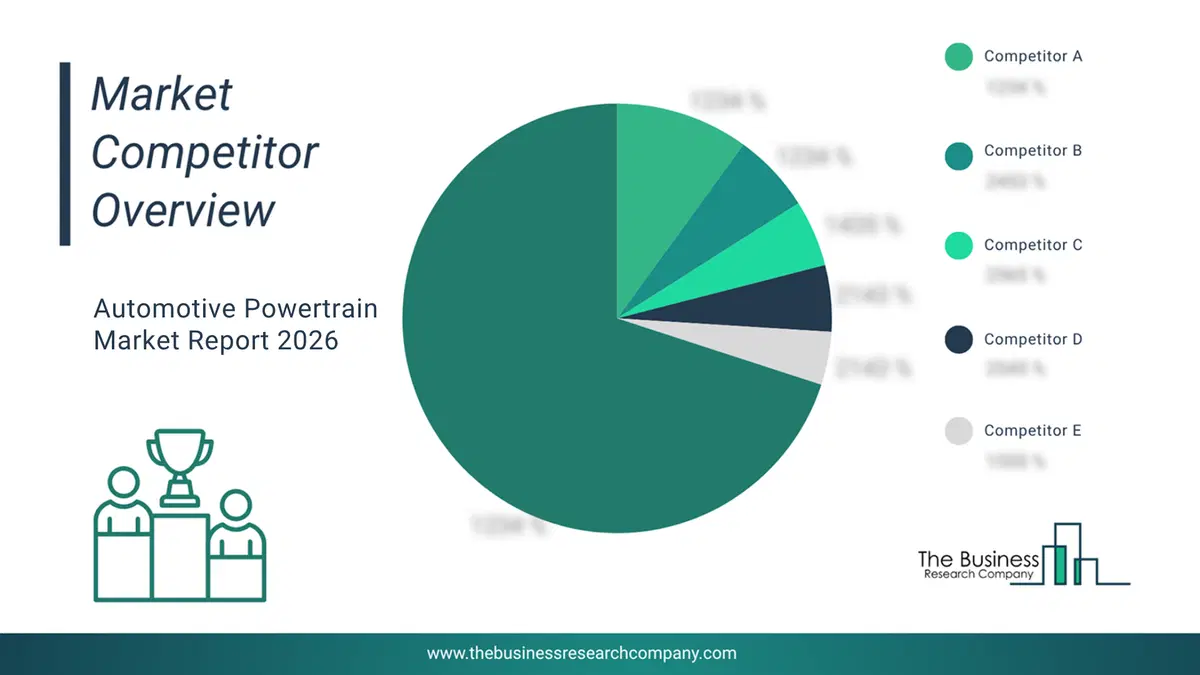
This chart is for illustrative purposes; the full report includes a detailed competitor analysis and comprehensive overview of the top 10 companies in the market.
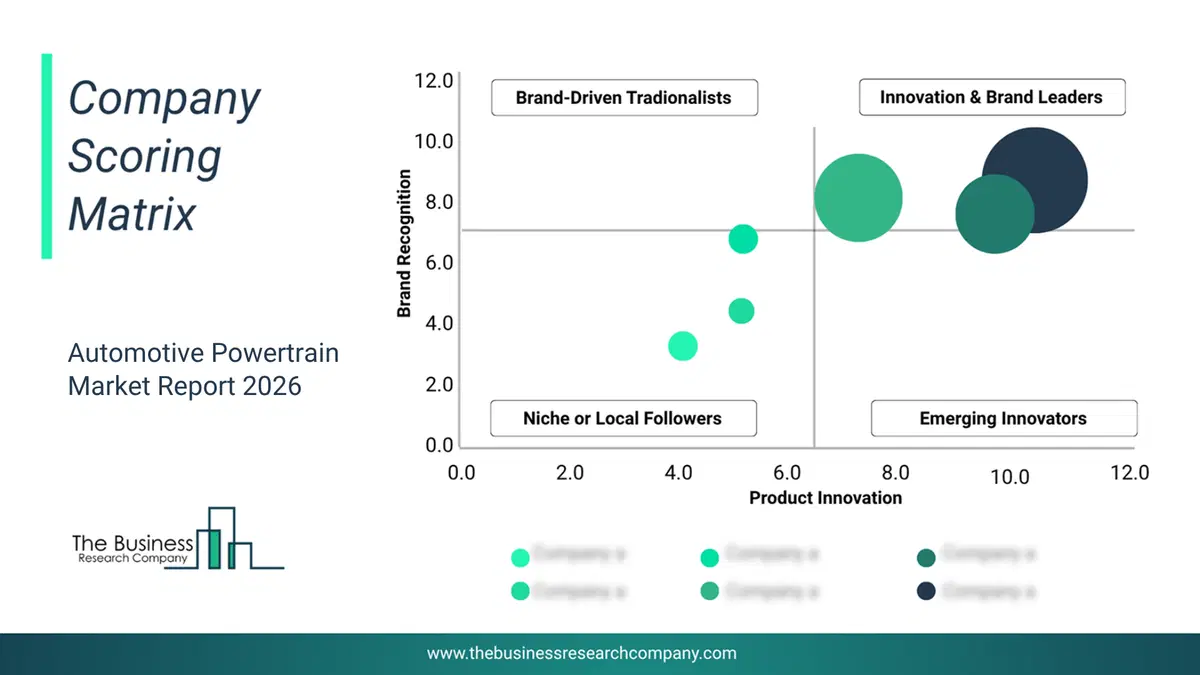
This chart maps companies by product innovation and brand strength, with bubble size indicating relative revenue, helping identify market leaders, challengers, and niche players. This is an illustrative chart; the full report provides a complete and accurate competitive analysis.
Global Automotive Powertrain Market Trends and Insights
Major companies operating in the automotive powertrain market are focusing on developing innovative solutions such as 3-in-1 electric e-axles to improve vehicle efficiency, enhance powertrain integration, and support the transition toward sustainable electric mobility. 3-in-1 electric e-axles refer to highly integrated electric drive systems that combine the electric motor, inverter, and reducer into a single compact unit, delivering efficient power transmission while reducing weight and space requirements. For instance, in March 2026, Valeo SA, a France-based automotive technology company, inaugurated a new electric powertrain manufacturing line at its Pune facility, dedicated to producing 3-in-1 e-Axles. The manufacturing line is designed to produce highly integrated electric powertrain systems for next-generation electric vehicles. It offers benefits such as high energy efficiency, optimized vehicle performance, and enhanced system reliability. The initiative aims to help automotive manufacturers accelerate electric vehicle production through localized manufacturing while supporting electrification, advanced manufacturing, and the growth of India's electric mobility ecosystem.What Are Latest Mergers And Acquisitions In The Automotive Powertrain Market?
In October 2024, Valeo SA, a France-based automotive technology company, partnered with MAHLE GmbH to expand its portfolio of magnet-free electric motors by jointly developing the iBEE (Inner Brushless Electrical Excitation) technology for upper-segment electric vehicles. The collaboration aims to develop an innovative magnet-free electric axle system delivering 220 kW to 350 kW of peak power, combining Valeo's expertise in electric motors, inverters, and motor control software with MAHLE's magnet-free rotor design and MAHLE Contactless Transmitter (MCT) technology. MAHLE GmbH is a Germany-based company that develops and manufactures a broad range of powertrain systems and components for passenger cars, commercial vehicles, and electrified vehicles.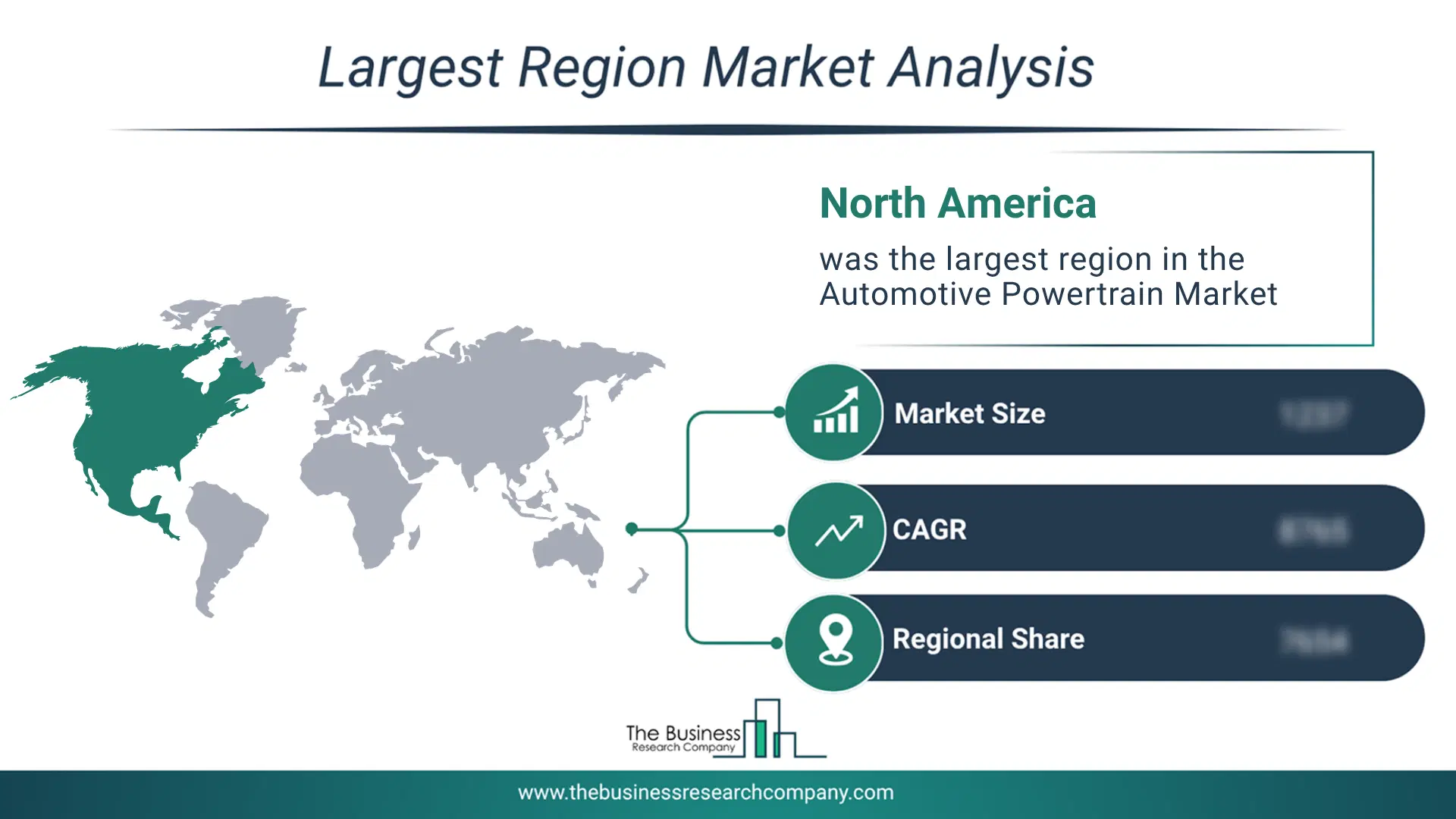
Regional Insights
North America was the largest region in the automotive powertrain market in 2025. Asia-Pacific is expected to be the fastest-growing region in the forecast period. The regions covered in this market report are Asia-Pacific, South East Asia, Western Europe, Eastern Europe, North America, South America, Middle East, Africa. The countries covered in this market report are Australia, Brazil, China, France, Germany, India, Indonesia, Japan, Taiwan, Russia, South Korea, UK, USA, Canada, Italy, Spain.What Defines the Automotive Powertrain Market?
The automotive powertrain market consists of sales of clutch, gearbox, axle, and transfer case. Values in this market are ‘factory gate’ values, that is, the value of goods sold by the manufacturers or creators of the goods, whether to other entities (including downstream manufacturers, wholesalers, distributors, and retailers) or directly to end customers. The value of goods in this market includes related services sold by the creators of the goods.How is Market Value Defined and Measured?
The market value is defined as the revenues that enterprises gain from the sale of goods and/or services within the specified market and geography through sales, grants, or donations in terms of the currency (in USD unless otherwise specified). The revenues for a specified geography are consumption values that are revenues generated by organizations in the specified geography within the market, irrespective of where they are produced. It does not include revenues from resales along the supply chain, either further along the supply chain or as part of other products.
This chart presents market attractiveness based on a quantitative evaluation of growth, competition, strategic alignment, and risk, offering a clear view of opportunity areas for decision-making. This chart is for illustrative purposes; the full report contains the complete analysis.

This chart highlights the Total Addressable Market (TAM) by estimating the maximum revenue opportunity using an assumption-driven approach, supporting strategic planning and opportunity sizing across markets. The chart is illustrative; the full report provides a more comprehensive analysis.
What Key Data and Analysis Are Included in the Automotive Powertrain Market Report 2026?
The automotive powertrain market research report is one of a series of new reports from The Business Research Company that provides market statistics, including industry global market size, regional shares, competitors with the market share, detailed market segments, market trends and opportunities, and any further data you may need to thrive in the automotive powertrain industry. The market research report delivers a complete perspective of everything you need, with an in-depth analysis of the current and future state of the industry.Automotive Powertrain Market Report Forecast Analysis
| Report Attribute | Details |
|---|---|
| Market Size Value In 2026 | $498.38 billion |
| Revenue Forecast In 2030 | $629.42 billion |
| Growth Rate | CAGR of 6.0% from 2026 to 2030 |
| Base Year For Estimation | 2025 |
| Actual Estimates/Historical Data | 2020-2025 |
| Forecast Period | 2026 - 2030 |
| Market Representation | Revenue in USD Billion and CAGR from 2026 to 2030 |
| Segments Covered | Powertrain Type, Vehicle Type, Component, Drive Type, Sales Channel |
| Regional Scope | Asia-Pacific, Western Europe, Eastern Europe, North America, South America, Middle East, Africa |
| Country Scope | The countries covered in the report are Australia, Brazil, China, France, Germany, India, Indonesia, Japan, Taiwan, Russia, South Korea, UK, USA, Canada, Italy, Spain. |
| Key Companies Profiled | Volkswagen AG, Toyota Motor Corporation, Ford Motor Company, General Motors Company, Bayerische Motoren Werke AG, Honda Motor Co. Ltd., Hyundai Motor Company, BYD Company Limited, Robert Bosch GmbH, Nissan Motor Co. Ltd., DENSO Corporation, ZF Friedrichshafen AG, Magna International Inc., Mitsubishi Electric Corporation, Aisin Corporation, Valeo SE, Schaeffler AG, Nidec Corporation, BorgWarner Inc., JTEKT Corporation |
| Customization Scope | Request for Customization |
| Pricing And Purchase Options | Explore Purchase Options |