
Automotive Powertrain Systems Market Report 2026
Global Outlook – By Powertrain Type ( Internal Combustion Engine, Hybrid Electric Vehicle, Plug In Hybrid Electric Vehicle, Battery Electric Vehicle, Fuel Cell Electric Vehicle), By Component Type ( Engine, Transmission, Drivetrain, Exhaust System, Battery Systems), By Vehicle Type ( Passenger Vehicles, Commercial Vehicles, Two Wheelers, Heavy Duty Vehicles), By Fuel Type ( Gasoline, Diesel, Electric, Hydrogen), By End User ( Original Equipment Manufacturers, Fleet Operators, Aftermarket, Logistics And Transportation Companies, Construction Equipment Manufacturers) – Market Size, Trends, Strategies, and Forecast to 2030
Automotive Powertrain Systems Market Report 2026 Market Overview
• Automotive Powertrain Systems Market Report 2026 market size has reached to $76.18 billion in 2025 • Expected to grow to $102.76 billion in 2030 at a compound annual growth rate (CAGR) of 6.1% • Growth Driver: Increasing Demand For Electric Vehicles (Evs) Driving The Market Growth Due To Rising Electrification Trends • Market Trend: Advanced Integrated Electric Powertrain Architecture Boosts Efficiency, Thermal Management, And Torque Delivery In Electric Three-Wheelers • Asia-Pacific was the largest region and fastest growing region.What Is Covered Under Automotive Powertrain Systems Market?
Automotive powertrain systems refer to the collection of components in a vehicle that generate power and deliver it to the wheels. These systems typically include the engine or motor, transmission, driveshaft, differential, and related components that work together to enable vehicle movement and performance. The main powertrain types of automotive powertrain systems include internal combustion engine, hybrid electric vehicle, plug in hybrid electric vehicle, battery electric vehicle, and fuel cell electric vehicle. Internal combustion engine refers to a propulsion system that generates power through the combustion of fuel within an engine to drive vehicles. These systems consist of component types such as engine, transmission, drivetrain, exhaust system, and battery systems and are designed for vehicle types including passenger vehicles, commercial vehicles, two wheelers, and heavy duty vehicles. They operate on fuel types such as gasoline, diesel, electric, and hydrogen and are utilized by end users including original equipment manufacturers, fleet operators, aftermarket, logistics and transportation companies, and construction equipment manufacturers.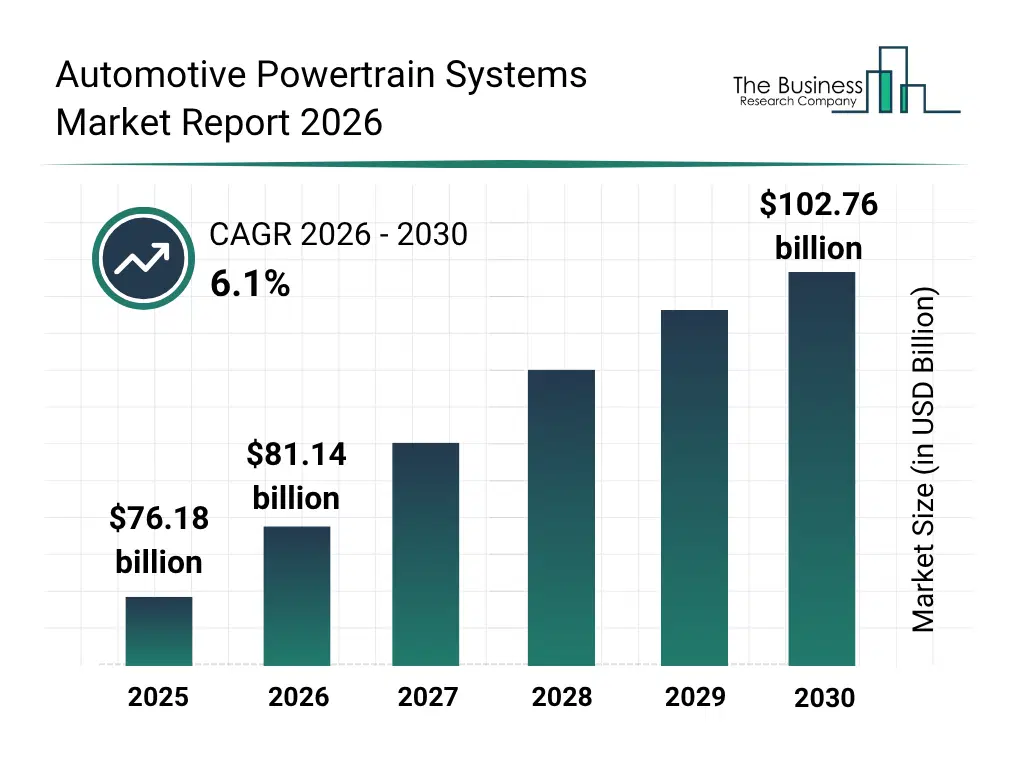
What Is The Automotive Powertrain Systems Market Size and Share 2026?
The automotive powertrain systems market size has grown strongly in recent years. It will grow from $76.18 billion in 2025 to $81.14 billion in 2026 at a compound annual growth rate (CAGR) of 6.5%. The growth in the historic period can be attributed to increasing global vehicle production volumes, growing demand for fuel efficiency improvements, rising adoption of advanced transmission technologies, expansion of passenger and commercial vehicle markets, increasing investments in automotive powertrain innovations.What Is The Automotive Powertrain Systems Market Growth Forecast?
The automotive powertrain systems market size is expected to see strong growth in the next few years. It will grow to $102.76 billion in 2030 at a compound annual growth rate (CAGR) of 6.1%. The growth in the forecast period can be attributed to rising penetration of electric vehicle platforms, increasing demand for hybrid vehicle systems, growing focus on emission reduction targets, increasing investments in next-generation battery technologies, expanding demand for high-performance mobility solutions. Major trends in the forecast period include increasing adoption of lightweight powertrain components, rising demand for fuel-efficient powertrain systems, growing integration of multi-speed transmission technologies, increasing development of high-performance drivetrain systems, expansion of modular powertrain platform designs.
Global Automotive Powertrain Systems Market Segmentation
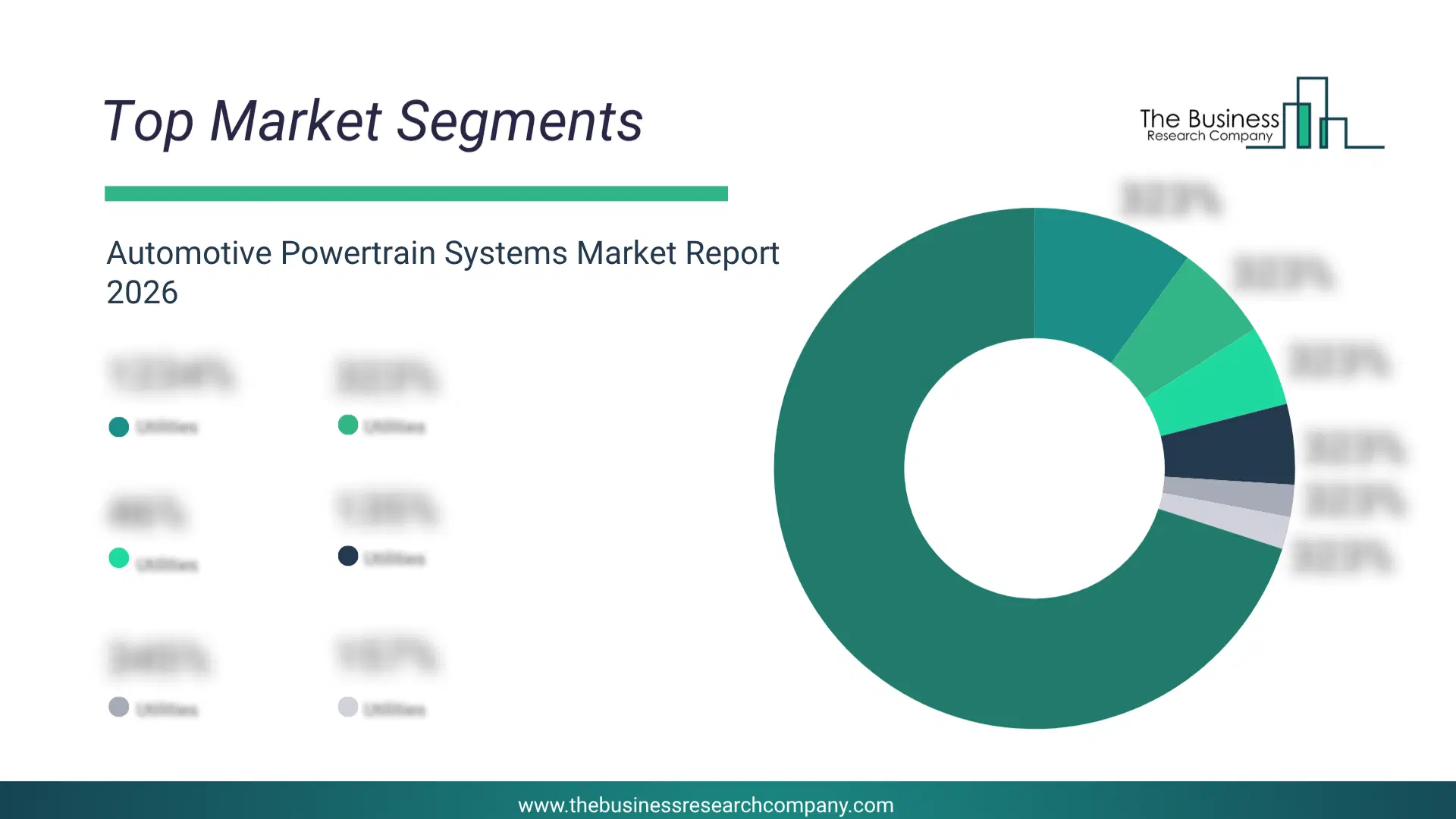
1) By Powertrain Type: Internal Combustion Engine, Hybrid Electric Vehicle, Plug In Hybrid Electric Vehicle, Battery Electric Vehicle, Fuel Cell Electric Vehicle 2) By Component Type: Engine, Transmission, Drivetrain, Exhaust System, Battery Systems 3) By Vehicle Type: Passenger Vehicles, Commercial Vehicles, Two Wheelers, Heavy Duty Vehicles 4) By Fuel Type: Gasoline, Diesel, Electric, Hydrogen 5) By End User: Original Equipment Manufacturers, Fleet Operators, Aftermarket, Logistics And Transportation Companies, Construction Equipment Manufacturers Subsegments: 1) By Internal Combustion Engine: Gasoline Powertrain, Diesel Powertrain, Natural Gas Powertrain, Flex Fuel Powertrain 2) By Hybrid Electric Vehicle: Mild Hybrid, Full Hybrid, Series Hybrid, Parallel Hybrid 3) By Plug In Hybrid Electric Vehicle: Series Plug In Hybrid, Parallel Plug In Hybrid, Range Extended Plug In Hybrid 4) By Battery Electric Vehicle: Single Motor Battery Electric Vehicle, Dual Motor Battery Electric Vehicle, All Wheel Drive Battery Electric Vehicle, High Performance Battery Electric Vehicle 5) By Fuel Cell Electric Vehicle: Hydrogen Fuel Cell Passenger Vehicles, Hydrogen Fuel Cell Commercial Vehicles, Heavy Duty Fuel Cell Vehicles, Fuel Cell BusesWhat Is The Driver Of The Automotive Powertrain Systems Market?
The increasing demand for electric vehicles (EVs) is expected to propel the growth of the automotive powertrain systems market going forward. Electric vehicles are automobiles powered by electric motors using energy stored in rechargeable batteries instead of internal combustion engines. The demand for EVs is rising due to stringent emission regulations, as governments are enforcing stricter carbon reduction targets to combat climate change. Automotive powertrain systems enable electric vehicles by integrating and optimizing the motor, inverter, transmission, and control units to efficiently convert electrical energy into motion while maximizing performance, range, and energy efficiency. For instance, in January 2025, according to the Cox Automotive, a US-based system software company, in 2024, full-year electric vehicle sales totaled 1.3 million, marking a 7.3% rise compared to the revised figures for 2023. Therefore, the increasing demand for electric vehicles (EVs) is driving the growth of the automotive powertrain systems industryKey Players In The Global Automotive Powertrain Systems Market
Major companies operating in the automotive powertrain systems market report are Robert Bosch GmbH, Magna International Inc., Mitsubishi Electric Corporation, Cummins Inc., Valeo S.A., Eaton Corporation plc, Schaeffler AG, Nidec Corporation, BorgWarner Inc., Marelli Holdings Co Ltd., Dana Incorporated, Dauch Corporation, Garrett Motion Inc., AVL List GmbH, Lucid Group Inc., Punch Powertrain N.V., Hofer Powertrain GmbH, Mahle GmbH, Hyundai Mobis Co. Ltd., Aisin Corporation, Denso Corporation, ZF Friedrichshafen AG, JTEKT Corporation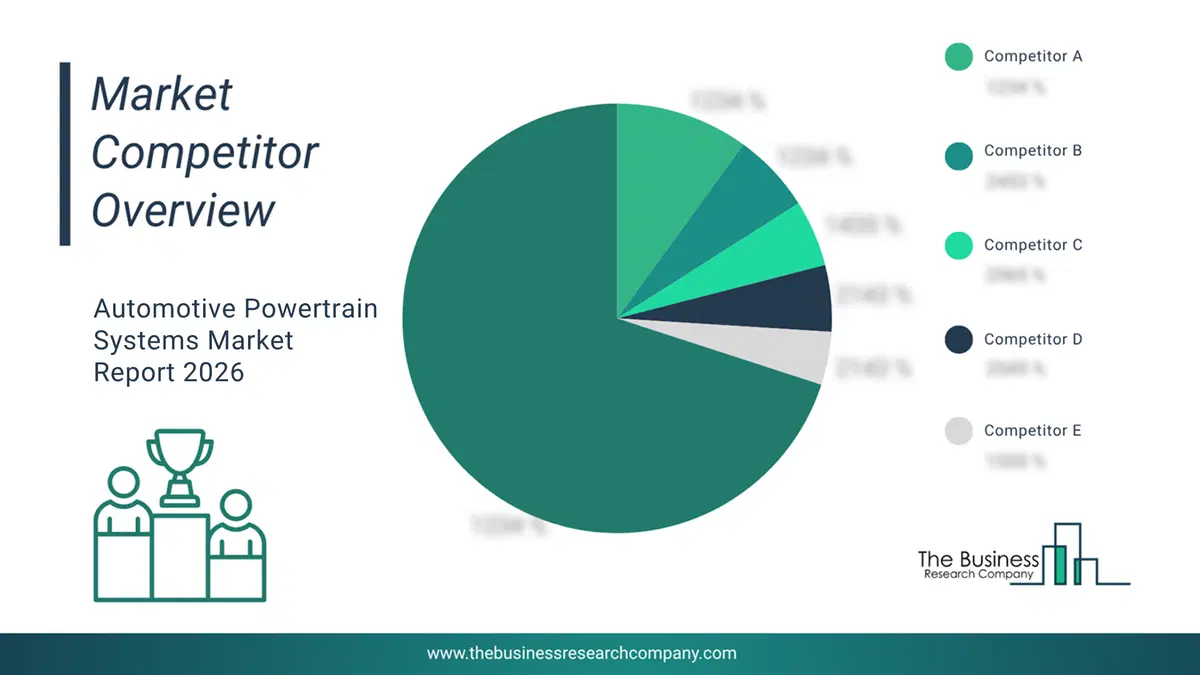
This chart is for illustrative purposes; the full report includes a detailed competitor analysis and comprehensive overview of the top 10 companies in the market.
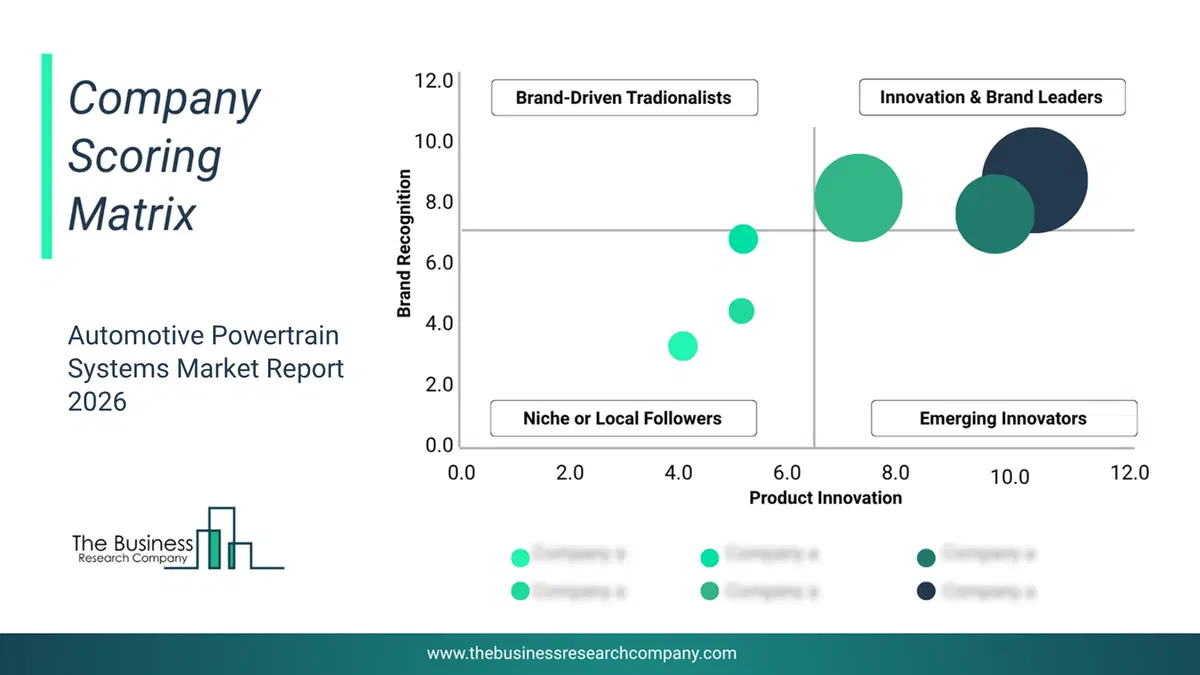
This chart maps companies by product innovation and brand strength, with bubble size indicating relative revenue, helping identify market leaders, challengers, and niche players. This is an illustrative chart; the full report provides a complete and accurate competitive analysis.
Global Automotive Powertrain Systems Market Trends and Insights
Major companies operating in the automotive powertrain systems market are focusing on developing innovative solutions such as integrated electric powertrain architectures to enhance vehicle efficiency, improve thermal management, and increase torque delivery in electric and hybrid mobility applications. Integrated electric powertrain architectures are advanced drivetrain systems that combine electric motor, controller, and transmission elements into a unified, highly efficient module, enabling better energy utilization, reduced mechanical losses, and improved system compactness compared to conventional multi-component powertrain setups. For instance, in February 2026, TSUYO Manufacturing Pvt Ltd, an India-based electric vehicle powertrain solutions company, launched its Gen 3.0 IPM motor and controller architecture for electric three-wheelers in New Delhi, introducing a next-generation integrated powertrain system designed to improve performance and efficiency in commercial EVs. The system features an interior permanent magnet (IPM) motor with external hall sensor placement and split-phase cabling to improve heat dissipation and operational stability under high load conditions. It also includes an aluminum controller housing that enhances thermal performance and supports LED-based fault diagnostics for real-time monitoring.What Are Latest Mergers And Acquisitions In The Automotive Powertrain Systems Market?
In August 2023, TREMEC Corporation, a US-based motor vehicle manufacturing company, acquired Electric GT for an undisclosed amount. With this acquisition, TREMEC aims to expand its capabilities in the turnkey ICE-to-BEV conversion market and strengthen its electric mobility product portfolio. Electric GT LLC is a US-based company that provides automotive powertrain systems, specifically electric vehicle (EV) powertrain systems.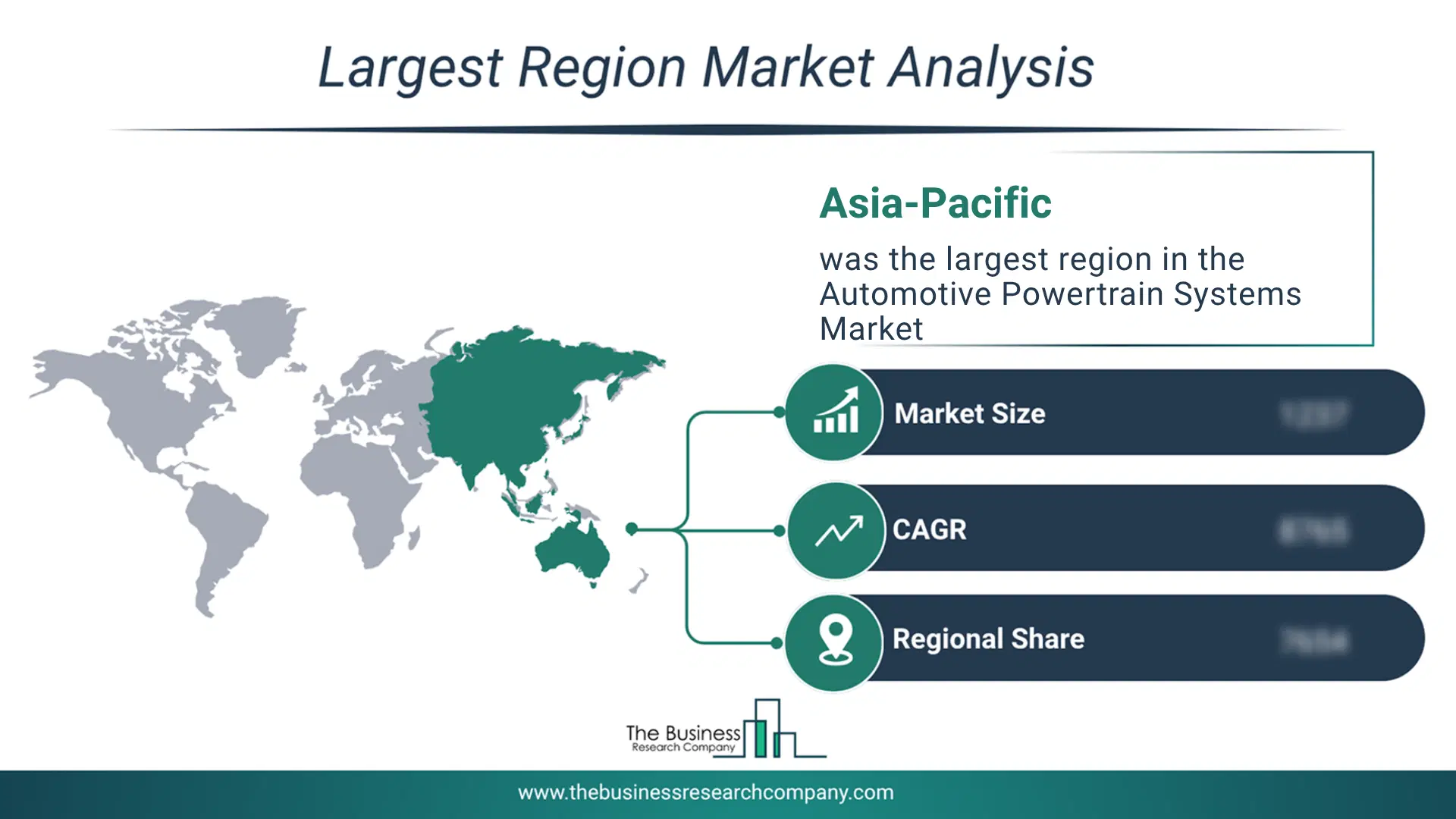
Regional Outlook
Asia-Pacific was the largest region in the automotive powertrain systems market in 2025. Asia-Pacific is expected to be the fastest-growing region in the forecast period. The regions covered in this market report are Asia-Pacific, South East Asia, Western Europe, Eastern Europe, North America, South America, Middle East, Africa. The countries covered in this market report are Australia, Brazil, China, France, Germany, India, Indonesia, Japan, Taiwan, Russia, South Korea, UK, USA, Canada, Italy, Spain.What Defines the Automotive Powertrain Systems Market?
The automotive powertrain systems market consists of sales of torque converter, differential assembly, clutch system, driveshaft, and power electronics inverter. Values in this market are ‘factory gate’ values, that is, the value of goods sold by the manufacturers or creators of the goods, whether to other entities (including downstream manufacturers, wholesalers, distributors, and retailers) or directly to end customers. The value of goods in this market includes related services sold by the creators of the goods.How is Market Value Defined and Measured?
The market value is defined as the revenues that enterprises gain from the sale of goods and/or services within the specified market and geography through sales, grants, or donations in terms of the currency (in USD unless otherwise specified). The revenues for a specified geography are consumption values that are revenues generated by organizations in the specified geography within the market, irrespective of where they are produced. It does not include revenues from resales along the supply chain, either further along the supply chain or as part of other products.
This chart presents market attractiveness based on a quantitative evaluation of growth, competition, strategic alignment, and risk, offering a clear view of opportunity areas for decision-making. This chart is for illustrative purposes; the full report contains the complete analysis.

This chart highlights the Total Addressable Market (TAM) by estimating the maximum revenue opportunity using an assumption-driven approach, supporting strategic planning and opportunity sizing across markets. The chart is illustrative; the full report provides a more comprehensive analysis.
What Key Data and Analysis Are Included in the Automotive Powertrain Systems Market Report 2026?
The automotive powertrain systems market research report is one of a series of new reports from The Business Research Company that provides market statistics, including industry global market size, regional shares, competitors with the market share, detailed market segments, market trends and opportunities, and any further data you may need to thrive in the automotive powertrain systems industry. The market research report delivers a complete perspective of everything you need, with an in-depth analysis of the current and future state of the industry.Automotive Powertrain Systems Market Report Forecast Analysis
| Report Attribute | Details |
|---|---|
| Market Size Value In 2026 | $81.14 billion |
| Revenue Forecast In 2030 | $102.76 billion |
| Growth Rate | CAGR of 6.1% from 2026 to 2030 |
| Base Year For Estimation | 2025 |
| Actual Estimates/Historical Data | 2020-2025 |
| Forecast Period | 2026 - 2030 |
| Market Representation | Revenue in USD Billion and CAGR from 2026 to 2030 |
| Segments Covered | Powertrain Type, Component Type, Vehicle Type, Fuel Type, End User |
| Regional Scope | Asia-Pacific, Western Europe, Eastern Europe, North America, South America, Middle East, Africa |
| Country Scope | The countries covered in the report are Australia, Brazil, China, France, Germany, India, Indonesia, Japan, Taiwan, Russia, South Korea, UK, USA, Canada, Italy, Spain. |
| Key Companies Profiled | Robert Bosch GmbH, Magna International Inc., Mitsubishi Electric Corporation, Cummins Inc., Valeo S.A., Eaton Corporation plc, Schaeffler AG, Nidec Corporation, BorgWarner Inc., Marelli Holdings Co Ltd., Dana Incorporated, Dauch Corporation, Garrett Motion Inc., AVL List GmbH, Lucid Group Inc., Punch Powertrain N.V., Hofer Powertrain GmbH, Mahle GmbH, Hyundai Mobis Co. Ltd., Aisin Corporation, Denso Corporation, ZF Friedrichshafen AG, JTEKT Corporation |
| Customization Scope | Request for Customization |
| Pricing And Purchase Options | Explore Purchase Options |