
Automotive Regenerative Braking Market Report 2026
Global Outlook – By Type (Electric Regenerative Braking System, Hydraulic Regenerative Braking System, Kinetic Regenerative Braking System), By Propulsion (Battery Electric Vehicle (BEV), Plug-In Hybrid Electric Vehicle (PHEV), Hybrid Electric Vehicle (HEV)), By Application (Two Wheelers, Passenger Cars, Commercial Vehicles, Other Applications) – Market Size, Trends, Strategies, and Forecast to 2030
Automotive Regenerative Braking Market Overview
• Automotive Regenerative Braking market size has reached to $7.59 billion in 2025 • Expected to grow to $15.36 billion in 2030 at a compound annual growth rate (CAGR) of 15.1% • Growth Driver: Surge In Electric Vehicle Sales And Its Impact On The Automotive Regenerative Braking Market • Market Trend: Technological Advancements Shaping The Future Of Automotive Regenerative Braking Systems • North America was the largest region in 2025 and Asia-Pacific is the fastest growing region.What Is Covered Under Automotive Regenerative Braking Market?
Automotive regenerative braking refers to a type of kinetic energy recovery system, designed to transfer the kinetic energy of an object in motion into stored energy to slow the vehicle down and increase fuel efficiency. This electric energy is stored in the energy storage unit of the vehicle and utilized in various applications of the vehicle such as headlights, start-stop function and to power the vehicle's interior electronics. The automotive regenerative braking devices are used to increase fuel efficiency and the range of the vehicle. The main types of automotive regenerative braking systems include electric regenerative braking systems, hydraulic regenerative braking systems, and kinetic regenerative braking systems. Electric regenerative braking refers to automotive regenerative systems which are driven by an electric motor. The system consists of an electric motor, which acts both as a generator and motor. They are used in battery vehicles, hybrid electric vehicles, plug-in hybrid electric vehicles, in two-wheelers, passenger cars, commercial vehicles, and others.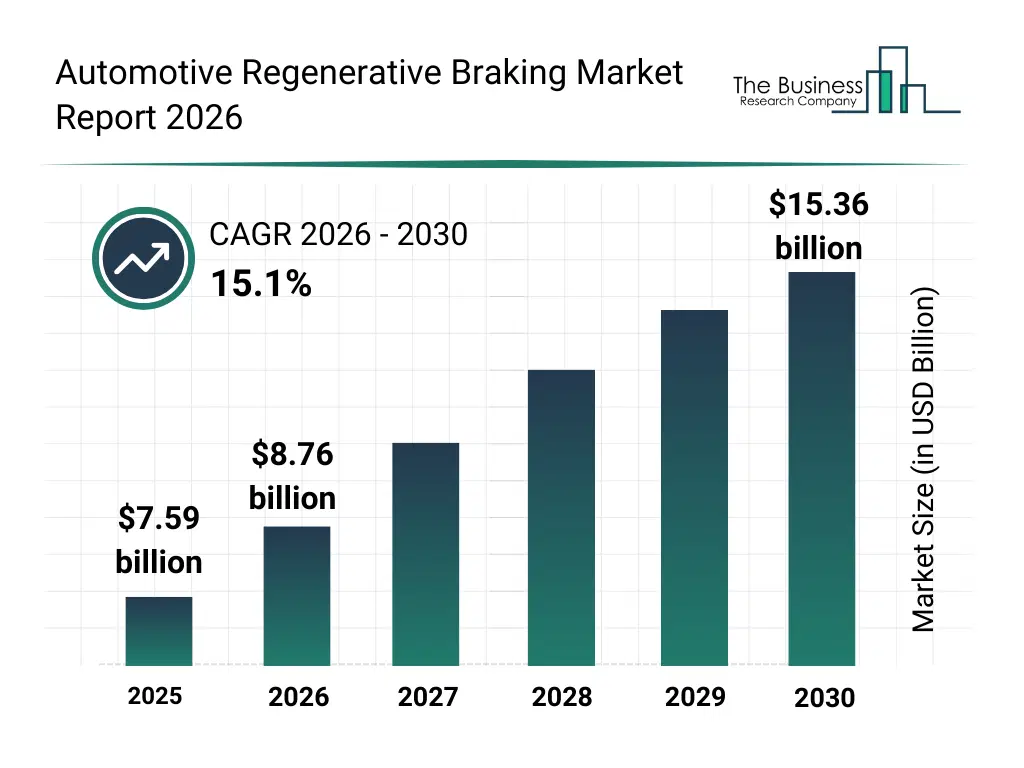
What Is The Automotive Regenerative Braking Market Size and Share 2026?
The automotive regenerative braking market size has grown rapidly in recent years. It will grow from $7.59 billion in 2025 to $8.76 billion in 2026 at a compound annual growth rate (CAGR) of 15.4%. The growth in the historic period can be attributed to growth of hybrid vehicles, fuel efficiency regulations, early adoption in electric vehicles, demand for energy recovery systems, automotive electrification.What Is The Automotive Regenerative Braking Market Growth Forecast?
The automotive regenerative braking market size is expected to see rapid growth in the next few years. It will grow to $15.36 billion in 2030 at a compound annual growth rate (CAGR) of 15.1%. The growth in the forecast period can be attributed to push for extended ev range, advancement in power electronics, adoption in commercial fleets, stricter emission norms, integration with smart vehicle systems. Major trends in the forecast period include integration of regenerative braking in ev platforms, adoption in two and three wheelers, optimization of energy recovery efficiency, integration with advanced brake systems, expansion across commercial vehicles.
Global Automotive Regenerative Braking Market Segmentation
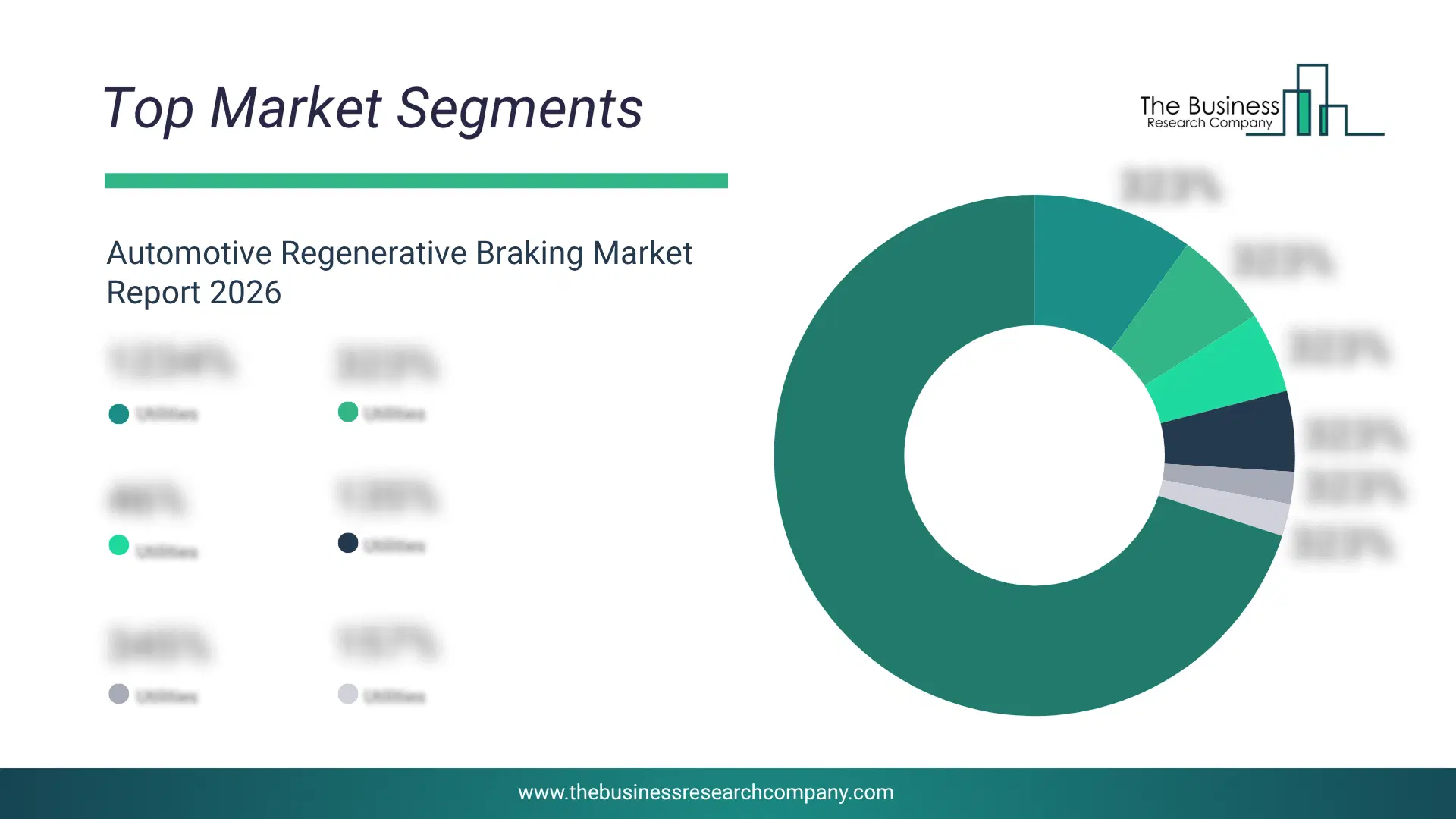
1) By Type: Electric Regenerative Braking System, Hydraulic Regenerative Braking System, Kinetic Regenerative Braking System 2) By Propulsion: Battery Electric Vehicle (BEV), Plug-In Hybrid Electric Vehicle (PHEV), Hybrid Electric Vehicle (HEV) 3) By Application: Two Wheelers, Passenger Cars, Commercial Vehicles, Other Applications Subsegments: 1) By Electric Regenerative Braking System: Battery Electric Vehicles (BEVs), Hybrid Electric Vehicles (HEVs) 2) By Hydraulic Regenerative Braking System: Hydraulic Brake Boosters, Accumulator-Based Systems 3) By Kinetic Regenerative Braking System: Flywheel Energy Storage Systems, Mechanical Kinetic SystemsWhat Is The Driver Of The Automotive Regenerative Braking Market?
The increase in sales of electric vehicles across the globe is contributing to the growth of the automotive regenerative braking market. A regenerative braking system is found in both electric vehicles and plug-in hybrid electric vehicles and recharges the battery during braking. This technology is used in electric vehicles to mitigate energy loss during braking. The increase in the acquisition of electric vehicles by customers across the globe is expected to increase the demand for new and innovative regenerative braking systems. For example, in July 2023, according to International Energy Agency (IEA), a France-based provider of policy recommendations, analysis and data on the entire global energy sector, over 2.3 million electric cars were sold in the first quarter of 2023, about 25% more than in the same period last year. Under the IEA Stated Policies Scenario (STEPS), the global outlook for the share of electric car sales based on existing policies and firm objectives has increased to 35% in 2030, up from less than 25% in the previous outlook. Therefore, an increase in sales of electric vehicles across the globe is expected to boost the automotive regenerative braking industry during the forecast period.Key Players In The Global Automotive Regenerative Braking Market
Major companies operating in the automotive regenerative braking market report include Toyota Motor Corporation, Tesla, Inc., Nissan Motor Co., Ltd., BMW AG, Ford Motor Company, General Motors Company, Volkswagen AG, Hyundai Motor Company, Kia Corporation, Volvo Car Corporation, Renault Group, Stellantis N.V., Mercedes-Benz Group AG, BYD Company Ltd, Mahindra & Mahindra Ltd, Tata Motors Limited, Torotrak PLC, Skeleton Technologies, Adgero SAS, Williams Advanced Engineering, Ioxus Corporation, Torus Energy Limited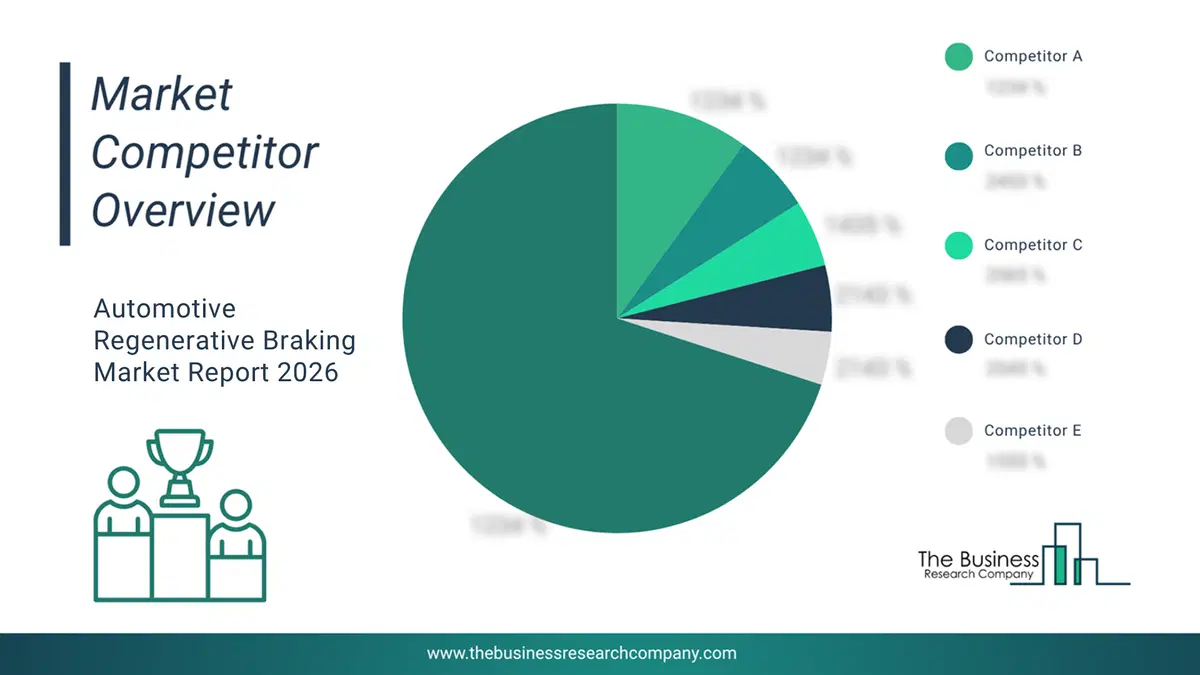
This chart is for illustrative purposes; the full report includes a detailed competitor analysis and comprehensive overview of the top 10 companies in the market.
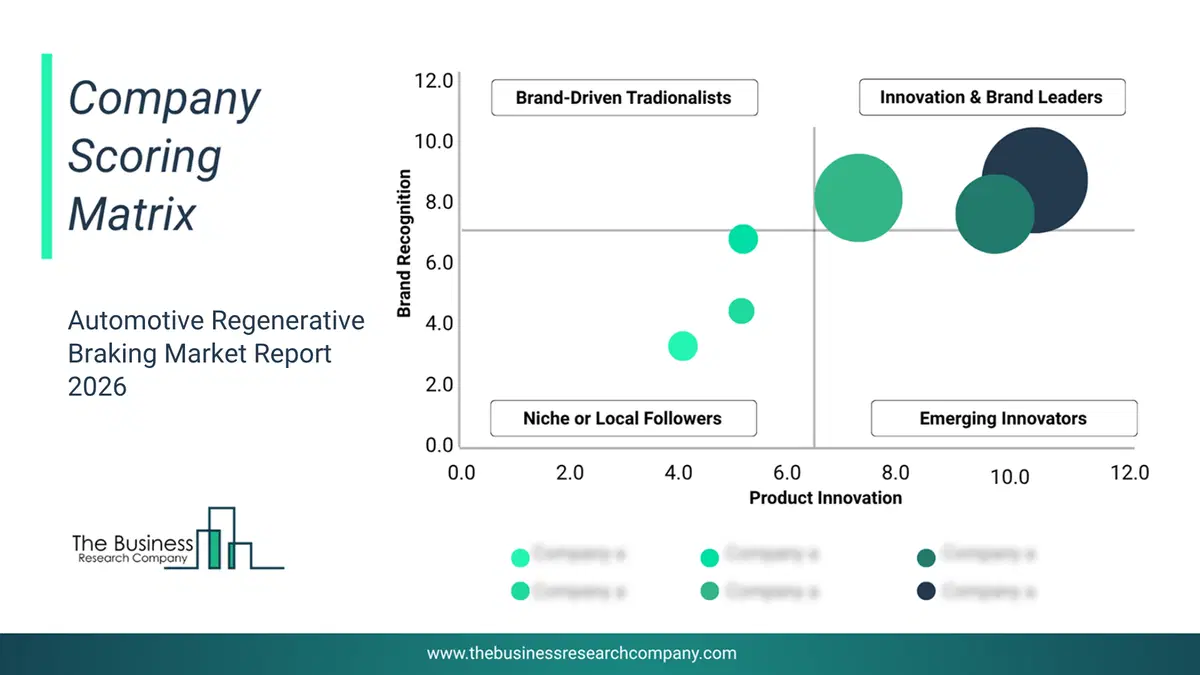
This chart maps companies by product innovation and brand strength, with bubble size indicating relative revenue, helping identify market leaders, challengers, and niche players. This is an illustrative chart; the full report provides a complete and accurate competitive analysis.
Global Automotive Regenerative Braking Market Trends and Insights
Major companies are operating in the Automotive Regenerative Braking market, focusing on Technological advancement such as electro-mechanical braking system (EMBS) to enhance software-defined vehicle control and enable fully electric, brake-by-wire functionality. Electro-mechanical braking system (EMBS) refers to a fully electric braking solution that replaces traditional hydraulic linkages with electronic controls, enabling precise, software-defined braking responses. For instance, in November 2023, ZF Friedrichshafen AG, a Germany-based technology company, launched the electric brake system. This innovative dry brake-by-wire system eliminates the need for hydraulic fluids entirely, using electric motors to generate braking force at each wheel. This design not only enhances braking efficiency but also reduces maintenance costs.What Are Latest Mergers And Acquisitions In The Automotive Regenerative Braking Market?
In February 2024, AEQUITA, a Germany-based investment group, has acquired the Brake Components business from Bosch for an undisclosed amount. This strategic move strengthens AEQUITA's position in the automotive industry and supports the development of advanced regenerative braking systems for electric vehicles. Bosch is a Germany-based manufacturer of automotive regenerative braking.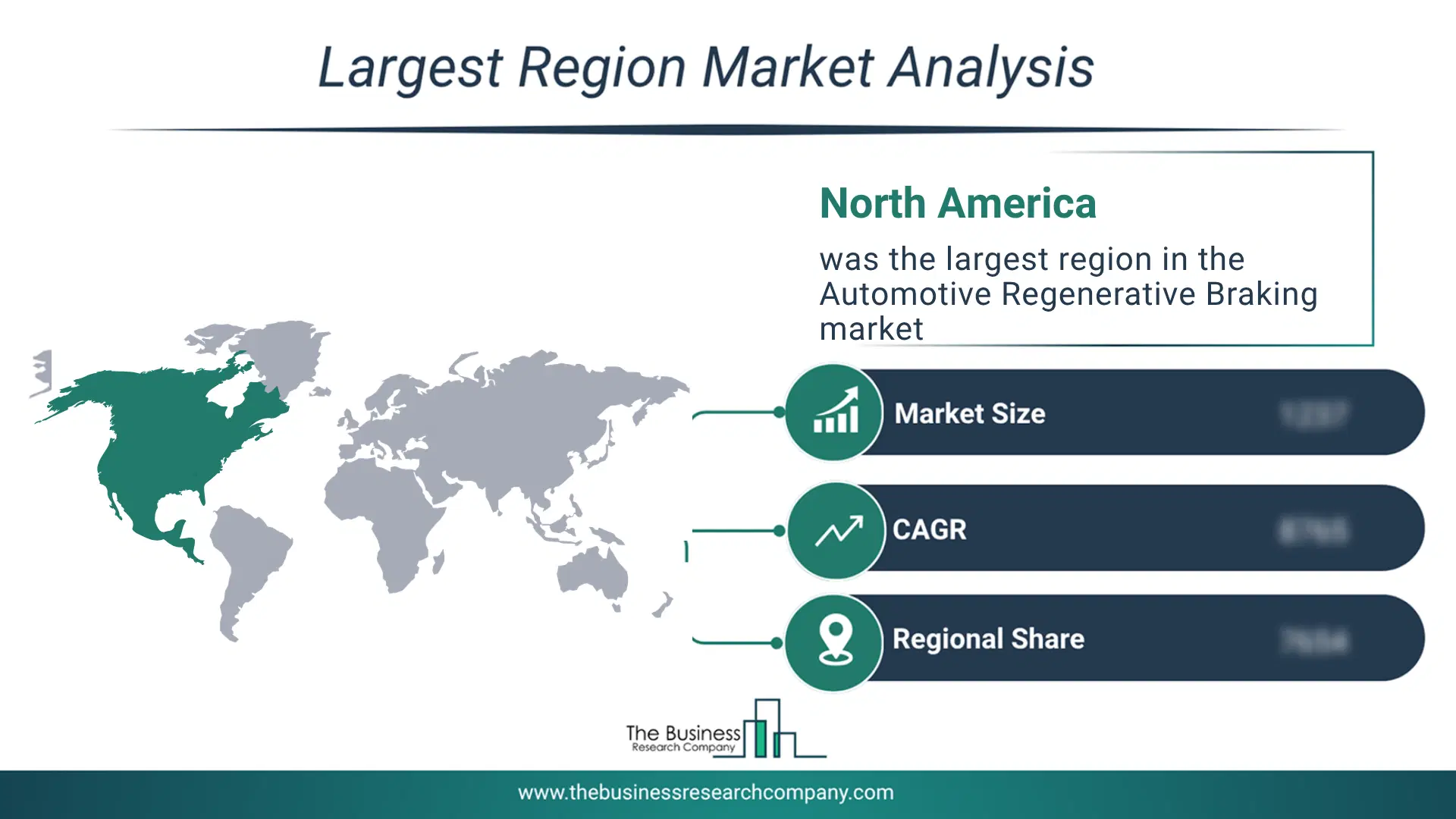
Regional Outlook
North America was the largest region in the automotive regenerative braking market in 2025. Asia-Pacific is expected to be the fastest-growing region in the forecast period. The regions covered in this market report include Asia-Pacific, South East Asia, Western Europe, Eastern Europe, North America, South America, Middle East, Africa. The countries covered in this market report include Australia, Brazil, China, France, Germany, India, Indonesia, Japan, Taiwan, Russia, South Korea, UK, USA, Canada, Italy, SpainWhat Defines the Automotive Regenerative Braking Market?
The automotive regenerative braking market includes revenues earned by entities by electromagnetic, flywheel, spring, and hydraulic brakes. The market value includes the value of related goods sold by the service provider or included within the service offering. Only goods and services traded between entities or sold to end consumers are included.How is Market Value Defined and Measured?
The market value is defined as the revenues that enterprises gain from the sale of goods and/or services within the specified market and geography through sales, grants, or donations in terms of the currency (in USD unless otherwise specified). The revenues for a specified geography are consumption values that are revenues generated by organizations in the specified geography within the market, irrespective of where they are produced. It does not include revenues from resales along the supply chain, either further along the supply chain or as part of other products.
This chart presents market attractiveness based on a quantitative evaluation of growth, competition, strategic alignment, and risk, offering a clear view of opportunity areas for decision-making. This chart is for illustrative purposes; the full report contains the complete analysis.

This chart highlights the Total Addressable Market (TAM) by estimating the maximum revenue opportunity using an assumption-driven approach, supporting strategic planning and opportunity sizing across markets. The chart is illustrative; the full report provides a more comprehensive analysis.
What Key Data and Analysis Are Included in the Automotive Regenerative Braking Market Report 2026?
The automotive regenerative braking market research report is one of a series of new reports from The Business Research Company that provides market statistics, including industry global market size, regional shares, competitors with the market share, detailed market segments, market trends and opportunities, and any further data you may need to thrive in the automotive regenerative braking industry. The market research report delivers a complete perspective of everything you need, with an in-depth analysis of the current and future state of the industry.Automotive Regenerative Braking Market Report Forecast Analysis
| Report Attribute | Details |
|---|---|
| Market Size Value In 2026 | $8.76 billion |
| Revenue Forecast In 2030 | $15.36 billion |
| Growth Rate | CAGR of 15.4% from 2026 to 2030 |
| Base Year For Estimation | 2025 |
| Actual Estimates/Historical Data | 2020-2025 |
| Forecast Period | 2026 - 2030 - 2030 |
| Market Representation | Revenue in USD Billion and CAGR from 2026 to 2030 |
| Segments Covered | Type, Propulsion, Application |
| Regional Scope | Asia-Pacific, Western Europe, Eastern Europe, North America, South America, Middle East, Africa |
| Country Scope | The countries covered in the report are Australia, Brazil, China, France, Germany, India, Indonesia, Japan, Taiwan, Russia, South Korea, UK, USA, Canada, Italy, Spain. |
| Key Companies Profiled | Toyota Motor Corporation, Tesla, Inc., Nissan Motor Co., Ltd., BMW AG, Ford Motor Company, General Motors Company, Volkswagen AG, Hyundai Motor Company, Kia Corporation, Volvo Car Corporation, Renault Group, Stellantis N.V., Mercedes-Benz Group AG, BYD Company Ltd, Mahindra & Mahindra Ltd, Tata Motors Limited, Torotrak PLC, Skeleton Technologies, Adgero SAS, Williams Advanced Engineering, Ioxus Corporation, Torus Energy Limited |
| Customization Scope | Request for Customization |
| Pricing And Purchase Options | Explore Purchase Options |