
Automotive Seat Climate Systems Market Report 2026
Global Outlook – By Component (Heating Elements, Ventilation Fans, Temperature Sensors, Electronic Control Units, Climate Control Software, Air Distribution Channels, Wiring Harnesses, Seat Control Switches), By Technology (Seat Heating Systems, Seat Ventilation Systems, Active Seat Cooling Systems, Integrated Seat Climate Control Systems, Intelligent Temperature Management Systems), By Vehicle Type (Passenger Cars, Commercial Vehicles, Electric Vehicles, Hybrid Vehicles, Luxury Vehicles), By Seat Type (Driver Seats, Passenger Seats), By End User (Individual Consumers, Fleet Operators, Commercial Transportation Providers) – Market Size, Trends, Strategies, and Forecast to 2035
Automotive Seat Climate Systems Market Overview
• Automotive Seat Climate Systems market size has reached to $3.45 billion in 2025 • Expected to grow to $4.83 billion in 2030 at a compound annual growth rate (CAGR) of 6.9% • Growth Driver: Rise In Luxury Vehicle Sales Driving The Growth Of The Market Due To Increasing Demand For Advanced Manufacturing Automation • Market Trend: Advancements In Intelligent Microclimate Thermal Management Technologies For Personalized Vehicle Comfort • North America was the largest region in 2025 and Asia-Pacific is the fastest growing region.What Is Covered Under Automotive Seat Climate Systems Market?
Automotive seat climate systems refer to integrated vehicle seat technologies that regulate the temperature of the seating surface by providing heating, ventilation, cooling, or a combination of these functions. These systems use components such as heating elements, ventilation fans, air ducts, and temperature sensors to enhance occupant thermal comfort under different driving and environmental conditions. The main components of automotive seat climate systems include heating elements, ventilation fans, temperature sensors, electronic control units, climate control software, air distribution channels, wiring harnesses, and seat control switches. Heating elements refer to components that generate and distribute heat within vehicle seats to provide warmth and improve occupant comfort in cold conditions. These systems incorporate seat heating systems, seat ventilation systems, active seat cooling systems, integrated seat climate control systems, and intelligent temperature management systems and are used in passenger cars, commercial vehicles, electric vehicles, hybrid vehicles, and luxury vehicles. They are available for driver seats, and passenger seats and are used end users by individual consumers, fleet operators, and commercial transportation providers.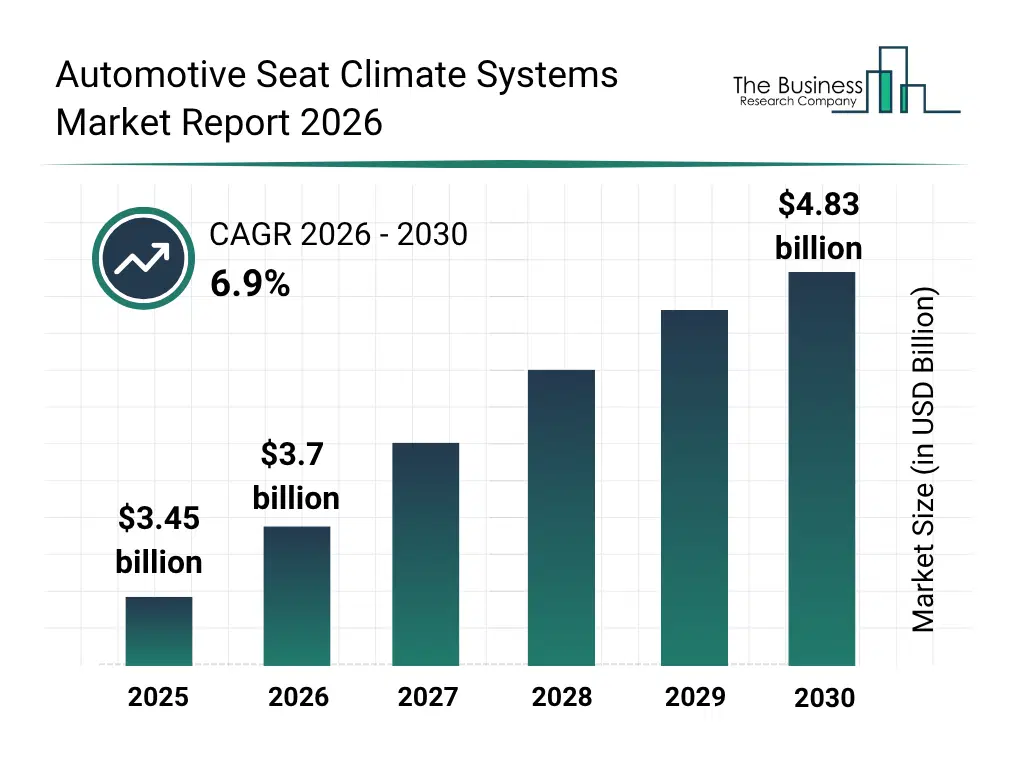
What Is The Automotive Seat Climate Systems Market Size and Share 2026?
The automotive seat climate systems market size has grown strongly in recent years. It will grow from $3.45 billion in 2025 to $3.7 billion in 2026 at a compound annual growth rate (CAGR) of 7.3%. The growth in the historic period can be attributed to increasing demand for enhanced passenger comfort, rising adoption of heated automotive seats, growing consumer preference for premium seating features, increasing demand for improved thermal comfort during extreme weather, expanding adoption of seat ventilation systems.What Is The Automotive Seat Climate Systems Market Growth Forecast?
The automotive seat climate systems market size is expected to see strong growth in the next few years. It will grow to $4.83 billion in 2030 at a compound annual growth rate (CAGR) of 6.9%. The growth in the forecast period can be attributed to increasing demand for personalized occupant temperature control, rising adoption of active seat cooling systems, growing demand for intelligent temperature management, increasing preference for low-energy seat climate systems, expanding integration of predictive thermal regulation. Major trends in the forecast period include increasing demand for personalized seat temperature settings, rising adoption of multi-zone seat climate control, growing preference for energy-efficient seat heating and cooling systems, increasing integration of lightweight seat climate components, rising demand for rapid-response seat temperature adjustment systems.Tariff Impact On Automotive Seat Climate Systems Market
Tariffs are impacting the automotive seat climate systems market by increasing the cost of imported heating elements, ventilation fans, temperature sensors, electronic control units, and other components required for seat climate systems. This is increasing production costs and potentially slowing adoption across passenger cars, electric vehicles, hybrid vehicles, and luxury vehicles, particularly in regions dependent on imported automotive components such as Asia-Pacific, Europe, and North America. Component-intensive segments such as electronic control units, temperature sensors, and heating and ventilation systems are most affected due to global supply chain dependencies. However, tariffs are also encouraging local manufacturing, regional supplier diversification, and increased investment in domestic automotive component ecosystems, creating long-term resilience in the market.
Global Automotive Seat Climate Systems Market Segmentation
2) By Technology: Seat Heating Systems, Seat Ventilation Systems, Active Seat Cooling Systems, Integrated Seat Climate Control Systems, Intelligent Temperature Management Systems 3) By Vehicle Type: Passenger Cars, Commercial Vehicles, Electric Vehicles, Hybrid Vehicles, Luxury Vehicles 4) By Seat Type: Driver Seats, Passenger Seats 5) By End User: Individual Consumers, Fleet Operators, Commercial Transportation Providers Subsegments: 1) By Heating Elements: Carbon Fiber Heating Elements, Wire Based Heating Elements, Flexible Heating Mats, Resistive Heating Elements 2) By Ventilation Fans: Axial Ventilation Fans, Centrifugal Ventilation Fans, Brushless Direct Current Ventilation Fans, Micro Ventilation Fans 3) By Temperature Sensors: Thermistor Sensors, Infrared Temperature Sensors, Digital Temperature Sensors, Contact Temperature Sensors 4) By Electronic Control Units: Seat Climate Control Modules, Thermal Management Control Units, Microcontroller Based Control Units, Integrated Control Systems 5) By Climate Control Software: Thermal Regulation Software, Temperature Management Algorithms, Occupant Comfort Control Software, Predictive Climate Control Software 6) By Air Distribution Channels: Seat Air Ducts, Air Flow Distribution Paths, Cooling Air Channels, Ventilation Air Passages 7) By Wiring Harnesses: Power Distribution Harnesses, Signal Transmission Harnesses, Sensor Wiring Harnesses, Integrated Seat Wiring Systems 8) By Seat Control Switches: Manual Climate Control Switches, Touch Based Control Switches, Digital Seat Control Interfaces, Multifunction Seat Control PanelsWhat Is The Driver Of The Automotive Seat Climate Systems Market?
The increasing sales of luxury vehicles are expected to propel the growth of the automotive seat climate systems market going forward. Luxury vehicles refer to high-end automobiles that offer superior comfort, advanced technology, premium materials, and enhanced performance compared to standard cars. Sales of luxury vehicles are increasing due to rising disposable incomes allowing more consumers to afford premium and high-end cars. Increasing sales of luxury vehicles are driving demand for advanced automotive seat climate systems, as premium vehicles increasingly feature heated, ventilated, and multi-zone climate-controlled seats to enhance passenger comfort and differentiate the driving experience. For instance, in January 2026, according to the BMW Group, a Germany-based automotive manufacturer, the company sold 18,001 cars in calendar year 2025, representing a 14% year-on-year (YoY) increase. Therefore, the increasing sales of luxury vehicles are driving the growth of the automotive seat climate systems industry.Key Players In The Global Automotive Seat Climate Systems Market
Major companies operating in the automotive seat climate systems market are Robert Bosch GmbH, Continental AG, Denso Corporation, Magna International Inc., Forvia SE, Valeo SA, MAHLE GmbH, Lear Corporation, Adient plc, Yanfeng Global Automotive Interior Systems Co. Ltd., Toyota Boshoku Corporation, Brose Fahrzeugteile SE & Co. KG, Eberspächer Group, Hyundai Transys Inc., TS Tech Co. Ltd., Grammer AG, Kongsberg Automotive ASA, Gentherm Incorporated, NHK Spring Co. Ltd., Isringhausen GmbH & Co. KG, DBK David + Baader GmbH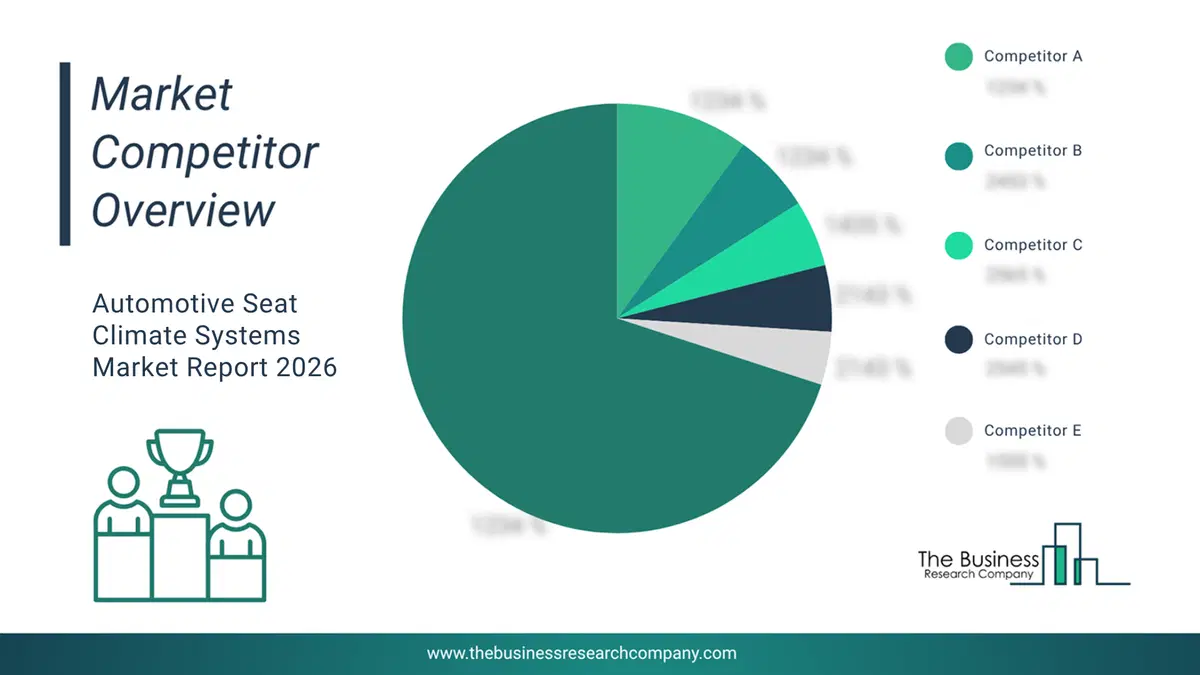
This chart is for illustrative purposes; the full report includes a detailed competitor analysis and comprehensive overview of the top 10 companies in the market.
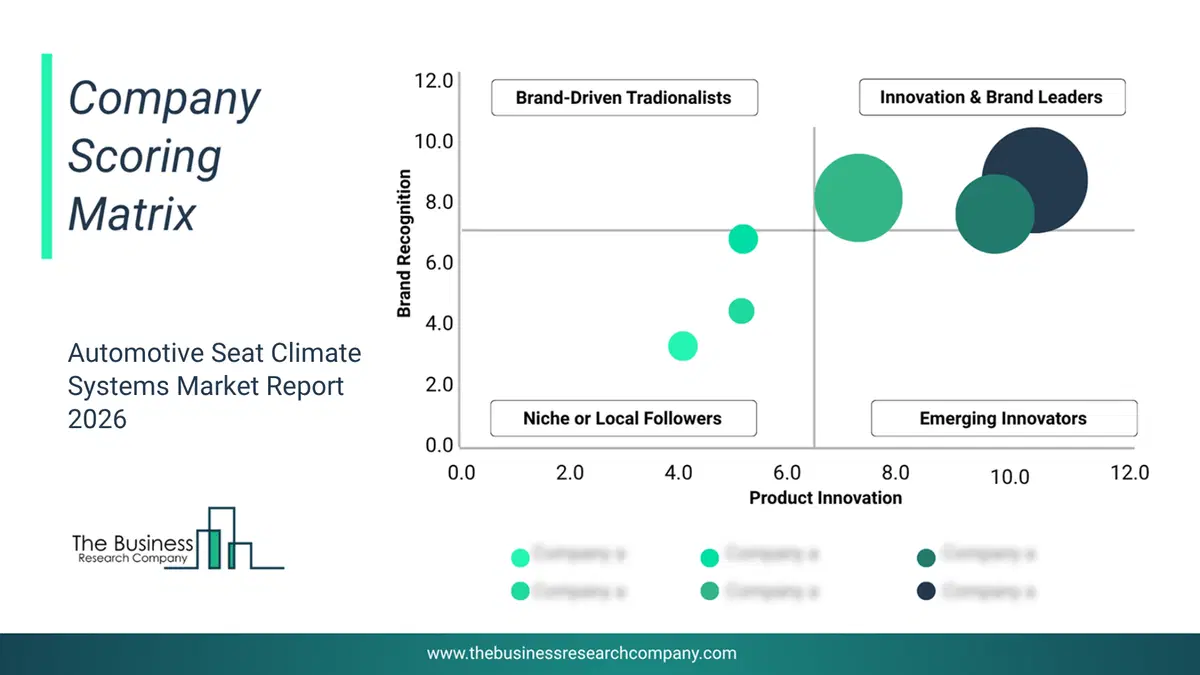
This chart maps companies by product innovation and brand strength, with bubble size indicating relative revenue, helping identify market leaders, challengers, and niche players. This is an illustrative chart; the full report provides a complete and accurate competitive analysis.
Global Automotive Seat Climate Systems Market Trends and Insights
Major companies operating in the automotive seat climate systems market are focusing on developing integrated thermal comfort solutions, such as seat-integrated heating and ventilation technologies, to enhance personalized occupant comfort, improve thermal response, reduce component complexity, and support energy-efficient vehicle climate management. Seat-integrated thermal comfort systems incorporate heating and ventilation functions directly into the seat trim cover, enabling localized thermal conditioning around the occupant rather than relying solely on cabin-wide HVAC systems. For instance, in February 2025, Lear Corporation, a US-based automotive seating and electrical systems company, announced the engineering integration of its ComfortMax Seat technology with General Motors, with the integration beginning in the second quarter of 2025. The ComfortMax Seat integrates thermal-comfort technologies directly into the seat trim covers to provide heating and ventilation, enabling up to 40% faster time-to-sensation while reducing the number of seat components by up to 50%. By integrating climate-control functionality into the seat structure, the technology enhances occupant thermal comfort, improves response time, simplifies seat architecture, and supports more efficient thermal management in modern vehicles.What Are Latest Mergers And Acquisitions In The Automotive Seat Climate Systems Market?
In June 2025, JVIS-USA, a US-based automotive interior technology company, partnered with Fergas Group to jointly develop and market a modular seat ventilation solution by combining JVIS’ CoreVent technology with Fergas’ AirBlaster technology. Through this partnership, the companies aim to enhance automotive seat ventilation by integrating JVIS’ expertise in automotive interiors, heated surfaces, air ducts and seat systems with Fergas’ air-movement and blower technology, helping automakers meet growing demand for enhanced thermal comfort and advanced seat climate systems. Fergas Group is a Germany-based manufacturer of air-moving and blower technologies.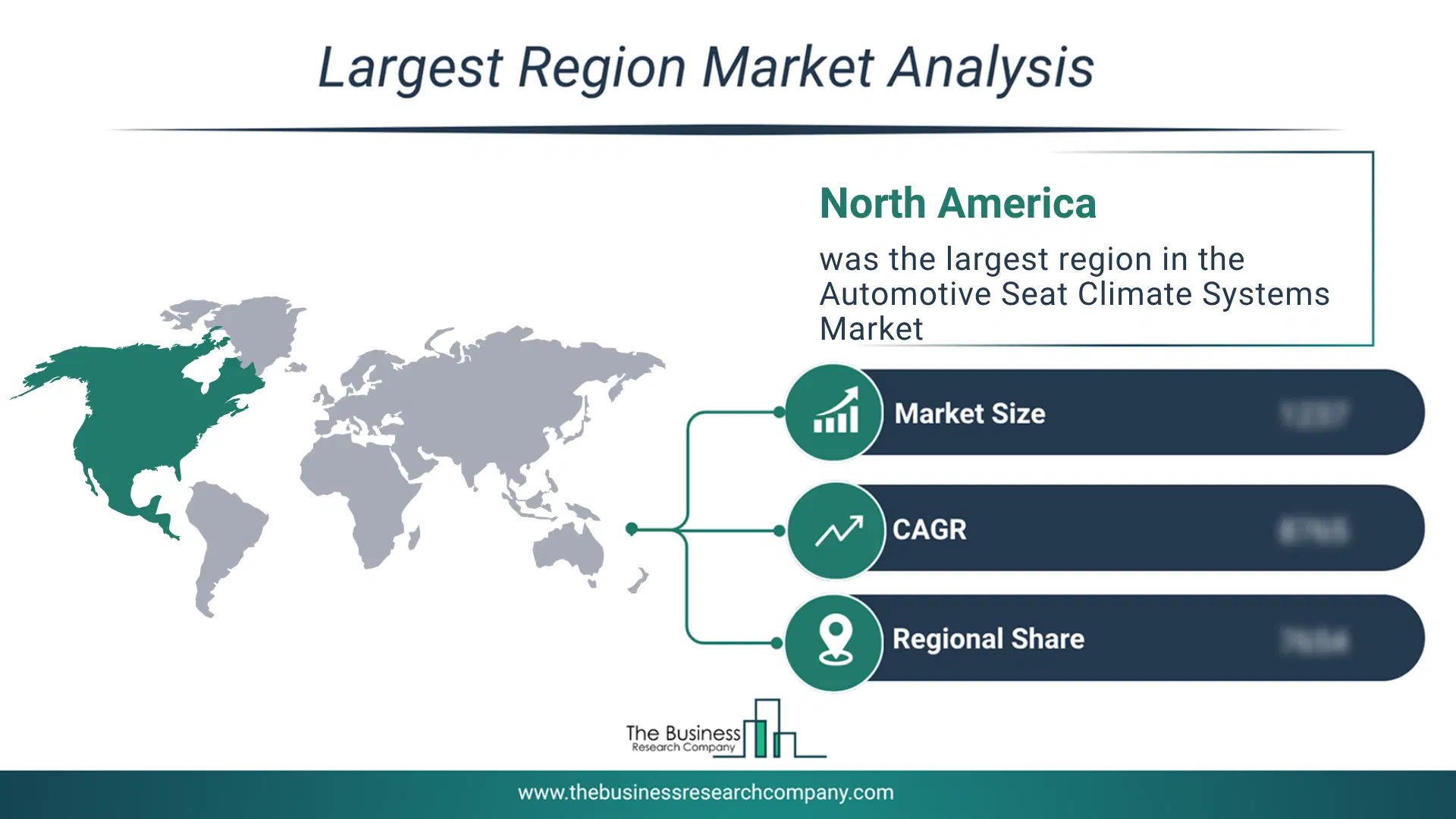
Regional Outlook/Insights
North America was the largest region in the automotive seat climate systems market in 2025. Asia-Pacific is expected to be the fastest-growing region in the forecast period. The regions covered in this market report are Asia-Pacific, South East Asia, Western Europe, Eastern Europe, North America, South America, Middle East, Africa. The countries covered in this market report are Australia, Brazil, China, France, Germany, India, Indonesia, Japan, Taiwan, Russia, South Korea, UK, USA, Canada, Italy, Spain.What Defines the Automotive Seat Climate Systems Market?
The automotive seat climate systems market consists of sales of seat climate control modules, thermoelectric seat cooling units, seat climate control panels, seat temperature sensors, seat air ducts, and seat climate system control units. Values in this market are ‘factory gate’ values, that is the value of goods sold by the manufacturers or creators of the goods, whether to other entities (including downstream manufacturers, wholesalers, distributors and retailers) or directly to end customers. The value of goods in this market includes related services sold by the creators of the goods.How is Market Value Defined and Measured?
The market value is defined as the revenues that enterprises gain from the sale of goods and/or services within the specified market and geography through sales, grants, or donations in terms of the currency (in USD unless otherwise specified). The revenues for a specified geography are consumption values that are revenues generated by organizations in the specified geography within the market, irrespective of where they are produced. It does not include revenues from resales along the supply chain, either further along the supply chain or as part of other products.
This chart presents market attractiveness based on a quantitative evaluation of growth, competition, strategic alignment, and risk, offering a clear view of opportunity areas for decision-making. This chart is for illustrative purposes; the full report contains the complete analysis.

This chart highlights the Total Addressable Market (TAM) by estimating the maximum revenue opportunity using an assumption-driven approach, supporting strategic planning and opportunity sizing across markets. The chart is illustrative; the full report provides a more comprehensive analysis.
What Key Data and Analysis Are Included in the Automotive Seat Climate Systems Market Report 2026?
The automotive seat climate systems market research report is one of a series of new reports from The Business Research Company that provides market statistics, including industry global market size, regional shares, competitors with the market share, detailed market segments, market trends and opportunities, and any further data you may need to thrive in the automotive seat climate systems industry. The market research report delivers a complete perspective of everything you need, with an in-depth analysis of the current and future state of the industry.Automotive Seat Climate Systems Market Report Forecast Analysis
| Report Attribute | Details |
|---|---|
| Market Size Value In 2026 | $3.7 billion |
| Revenue Forecast In 2030 | $4.83 billion |
| Growth Rate | CAGR of 6.9% from 2026 to 2035 |
| Base Year For Estimation | 2025 |
| Actual Estimates/Historical Data | 2020-2025 |
| Forecast Period | 2026 - 2030 |
| Market Representation | Revenue in USD Billion and CAGR from 2026 to 2030 |
| Segments Covered | Component, Technology, Vehicle Type, Seat Type, End User |
| Regional Scope | Asia-Pacific, Western Europe, Eastern Europe, North America, South America, Middle East, Africa |
| Country Scope | The countries covered in the report are Australia, Brazil, China, France, Germany, India, Indonesia, Japan, Taiwan, Russia, South Korea, UK, USA, Canada, Italy, Spain. |
| Customization Scope | Request for Customization |
| Pricing And Purchase Options | Explore Purchase Options |