

Automotive Shift-By-Wire (SBW) Systems Market Report 2026
Global Outlook – By Component (Electronic Control Unit (ECU), Sensors, Actuators, Wiring Harness, Other Components), By Vehicle (Passenger Vehicles, Commercial Vehicles, Electric Vehicles), By Design Type (Joystick, Rotatory, Lever, Buttons, Other Design Types), By Technology (Electro-Mechanical, Fully electronic) – Market Size, Trends, Strategies, and Forecast to 2030
Automotive Shift-By-Wire (SBW) Systems Market Overview
• Automotive Shift-By-Wire (SBW) Systems market size has reached to $1.85 billion in 2025 • Expected to grow to $2.88 billion in 2030 at a compound annual growth rate (CAGR) of 9.3% • Growth Driver: Surge In Electric Vehicle Production Fueling The Growth Of The Market Due To Government Incentives And Emission Regulations • Market Trend: Launch Of Electric Vehicle With Innovative Column-Type Shift-By-Wire System For Enhanced Interior Design And User Experience • Europe was the largest region in 2025.What Is Covered Under Automotive Shift-By-Wire (SBW) Systems Market?
Automotive shift-by-wire systems refer to advanced transmission control technology that replaces traditional mechanical gear shifting with electronic controls. These systems use sensors, actuators, and control units to transmit driver input to the transmission electronically, improving precision and reducing mechanical complexity. SBW technology enhances vehicle safety, design flexibility, and efficiency, making it increasingly common in modern and electric vehicles. The main types of components in automotive shift-by-wire (SBW) systems are electronic control units (ECUs), sensors, actuators, wiring harnesses, and others. The electronic control unit (ECU) is a central component in automotive electronics that manages various vehicle functions by processing input data and controlling actuators accordingly. It includes various vehicle types such as passenger vehicles, commercial vehicles, and electric vehicles, and designs such as joysticks, rotatory levers, buttons, and others. It is operated through various technologies, such as electromechanical and fully electronic.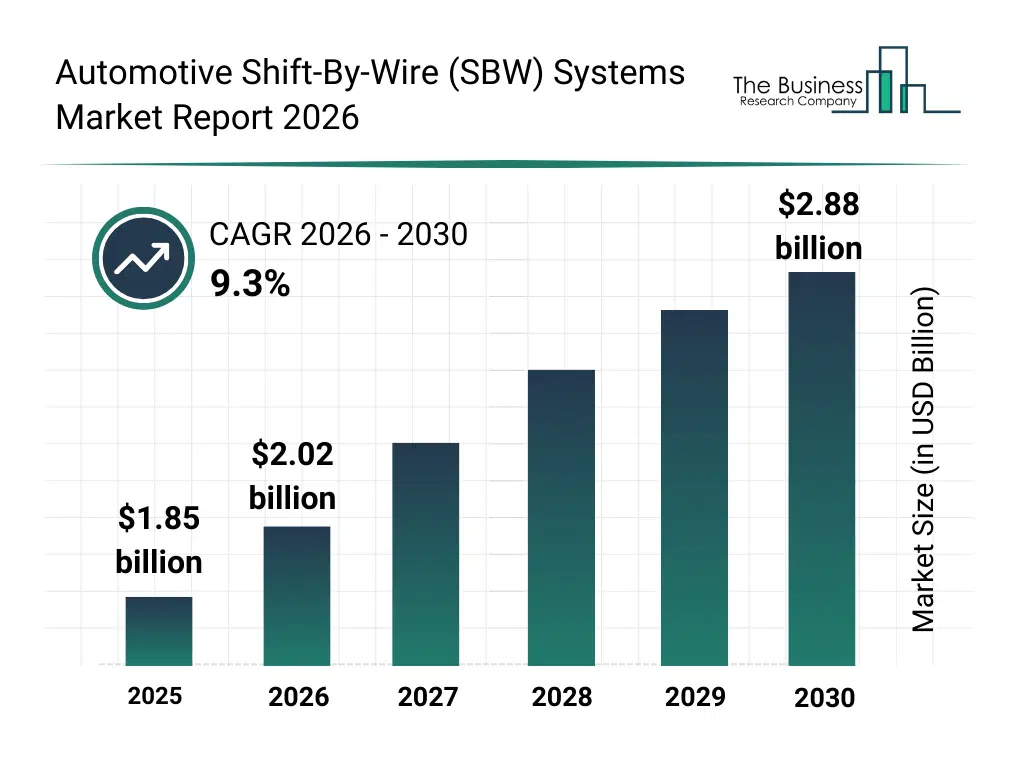
What Is The Automotive Shift-By-Wire (SBW) Systems Market Size and Share 2026?
The automotive shift-by-wire (sbw) systems market size has grown strongly in recent years. It will grow from $1.85 billion in 2025 to $2.02 billion in 2026 at a compound annual growth rate (CAGR) of 9.2%. The growth in the historic period can be attributed to adoption of automatic transmissions, drive-by-wire evolution, vehicle electronics growth, demand for smoother shifting, cockpit design changes.What Is The Automotive Shift-By-Wire (SBW) Systems Market Growth Forecast?
The automotive shift-by-wire (sbw) systems market size is expected to see strong growth in the next few years. It will grow to $2.88 billion in 2030 at a compound annual growth rate (CAGR) of 9.3%. The growth in the forecast period can be attributed to electric vehicle growth, autonomous driving development, software-defined vehicles, demand for space-efficient interiors, functional safety advancements. Major trends in the forecast period include shift toward electronic gear shifting, integration with advanced driver assistance systems, growth of ev-compatible sbw systems, adoption of compact control interfaces, focus on interior design flexibility.
Global Automotive Shift-By-Wire (SBW) Systems Market Segmentation
1) By Component: Electronic Control Unit (ECU), Sensors, Actuators, Wiring Harness, Other Components 2) By Vehicle: Passenger Vehicles, Commercial Vehicles, Electric Vehicles 3) By Design Type: Joystick, Rotatory, Lever, Buttons, Other Design Types 4) By Technology: Electro-Mechanical, Fully electronic Subsegments: 1) By Electronic Control Unit (ECU): Shift Control Unit (SCU), Transmission Interface Control Unit 2) By Sensors: Gear Position Sensors, Hall-Effect Sensors, Contactless Position Sensors 3) By Actuators: Electric Linear Actuators, Electric Rotary Actuators, Dual-Redundant Electric Actuators 4) By Wiring Harness: Low-Voltage Signal Wiring Harness, Redundant Signal Wiring Harness 5) By Other Components: Connectors, Relay Modules, SwitchesWhat Are The Drivers Of The Automotive Shift-By-Wire (SBW) Systems Market?
Rising production of electric vehicles is expected to propel the growth of the automotive shift-by-wire (SBW) systems market going forward. An electric vehicle (EV) is a vehicle powered entirely or partially by electric motors using energy stored in rechargeable batteries instead of internal combustion engines. The rise in electric vehicle production is largely driven by government incentives and stricter emissions regulations, encouraging automakers to shift towards more sustainable options. Shift-by-wire (SBW) systems are useful for electric vehicles as they replace traditional mechanical linkages with electronic controls, reducing weight, optimizing space, and enhancing design flexibility while improving overall vehicle efficiency. For instance, in December 2024, according to the U.S. Energy Information Administration, a US-based non-profit organization, sales of battery electric vehicles (BEVs) continued to rise, with their market share increasing from 7.4% of the U.S. light-duty vehicle (LDV) market in the second quarter of 2024 to 8.9% in the third quarter. Similarly, the market share of hybrid vehicle sales also grew, reaching 10.6% of the U.S. LDV market in the third quarter of 2024. Therefore, the rising production of electric vehicles is driving the growth of the automotive shift-by-wire (SBW) systems industry. The rising demand for advanced driver assistance systems (ADAS) is expected to propel the growth of the automotive shift-by-wire (SBW) systems market going forward. Advanced driver assistance systems (ADAS) are technologies designed to enhance vehicle safety and driving comfort by helping drivers with tasks such as braking, steering, and parking. The demand for advanced driver assistance systems (ADAS) is rising as consumers increasingly prioritize vehicle safety features, driven by a growing awareness of road safety and the desire for enhanced driving convenience. Automotive shift-by-wire systems enhance advanced driver assistance systems (ADAS) by enabling electronic control of gear shifting, which allows smoother integration with autonomous driving functions such as automated parking and adaptive cruise control. For instance, in April 2023, according to the National Safety Council (NSC), a US-based organization focused on eliminating preventable deaths and injuries, by 2027, advanced driver-assistance systems (ADAS) are expected to be present in at least half of all registered vehicles. Around 73% of vehicles will feature rearview cameras, 63% will be equipped with rear parking sensors, and 51% will include front crash prevention systems. Therefore, the rising demand for advanced driver assistance systems (ADAS) is driving the growth of the automotive shift-by-wire (SBW) systems industry.Key Players In The Global Automotive Shift-By-Wire (SBW) Systems Market
Major companies operating in the automotive shift-by-wire (sbw) systems market report include ZF Friedrichshafen AG, BorgWarner Inc., Eaton Corporation plc, Mitsubishi Electric Corporation, Leopold Kostal GmbH & Co. KG, Kongsberg Automotive ASA, GHSP Inc., JOPP Holding GmbH, Orscheln Products LLC, Dura Automotive Systems LLC, Stoneridge Inc., Sila Group S.p.A., Robert Bosch GmbH, Continental AG, Valeo S.A., Aptiv PLC, Schaeffler AG, Magna International Inc., NSK Ltd., Nidec Corporation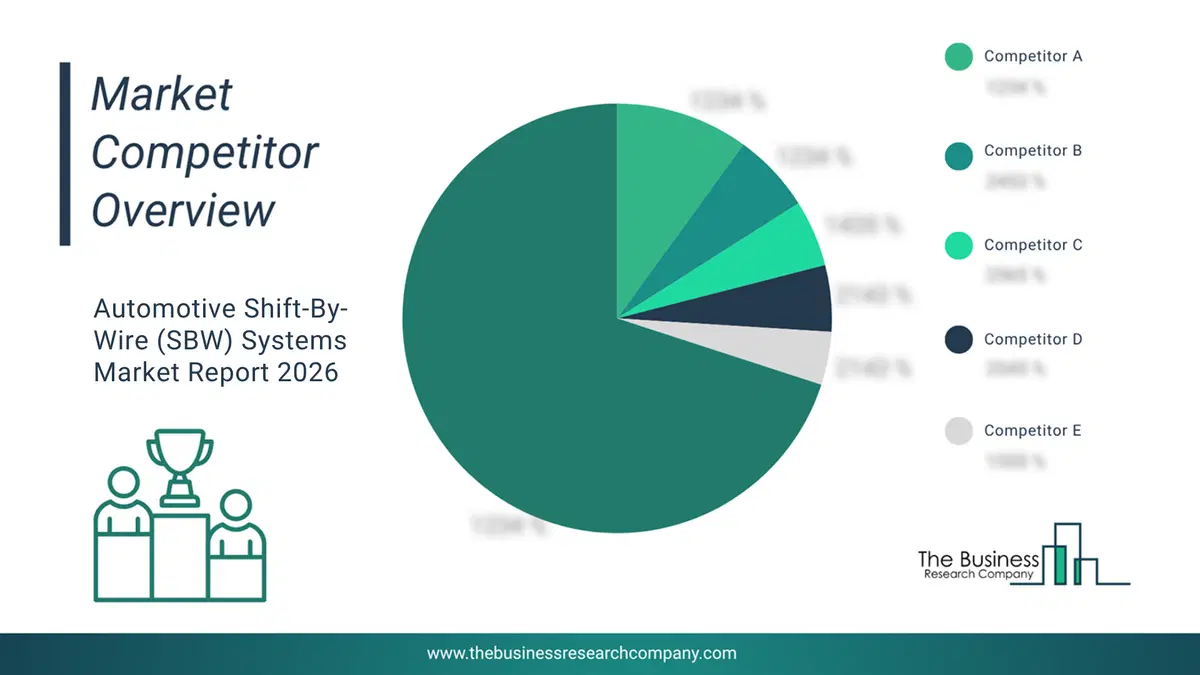
This chart is for illustrative purposes; the full report includes a detailed competitor analysis and comprehensive overview of the top 10 companies in the market.
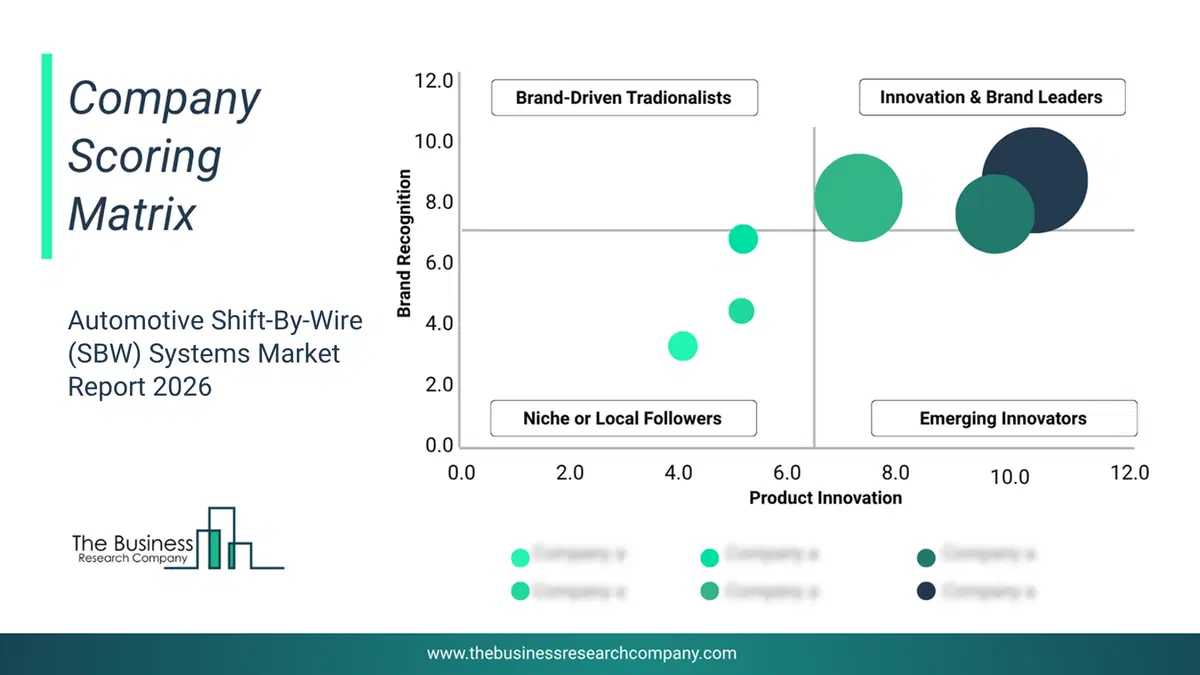
This chart maps companies by product innovation and brand strength, with bubble size indicating relative revenue, helping identify market leaders, challengers, and niche players. This is an illustrative chart; the full report provides a complete and accurate competitive analysis.
Global Automotive Shift-By-Wire (SBW) Systems Market Trends and Insights
Major companies operating in the automotive shift-by-wire (SBW) systems market are focusing on developing technologically advanced solutions, such as column-type shift-by-wire (SBW) systems, to improve vehicle interior design flexibility, enhance user experience, and increase operational efficiency. Column-type shift-by-wire (SBW) systems refer to a type of electronic gear-shifting technology in vehicles that replaces traditional mechanical linkages with electronic controls. For instance, in January 2025, Hyundai Motor, a South Korea-based automobile manufacturer, launched the Hyundai Creta Electric, equipped with a column-type shift-by-wire (SBW) system. This advanced system replaces traditional mechanical gear linkages with electronic controls, operated via a stalk positioned on the right side of the steering column. The design frees up space on the center console, making room for cup holders and drive mode buttons while enhancing driver convenience and offering a more intuitive, futuristic driving experience. By removing the mechanical connection, the SBW system enables smoother gear shifts and contributes to the Creta Electric’s modern, user-friendly interior.
Regional Outlook
Europe was the largest region in the automotive shift-by-wire (SBW) systems market in 2025. The regions covered in this market report include Asia-Pacific, South East Asia, Western Europe, Eastern Europe, North America, South America, Middle East, Africa. The countries covered in this market report include Australia, Brazil, China, France, Germany, India, Indonesia, Japan, Taiwan, Russia, South Korea, UK, USA, Canada, Italy, SpainWhat Defines the Automotive Shift-By-Wire (SBW) Systems Market?
The automotive shift-by-wire (SBW) systems market consists of sales of position sensors, connectors, electronic gear selector modules, and transmission control modules (TCM). Values in this market are ‘factory gate’ values, that is, the value of goods sold by the manufacturers or creators of the goods, whether to other entities (including downstream manufacturers, wholesalers, distributors, and retailers) or directly to end customers. The value of goods in this market includes related services sold by the creators of the goods.How is Market Value Defined and Measured?
The market value is defined as the revenues that enterprises gain from the sale of goods and/or services within the specified market and geography through sales, grants, or donations in terms of the currency (in USD unless otherwise specified). The revenues for a specified geography are consumption values that are revenues generated by organizations in the specified geography within the market, irrespective of where they are produced. It does not include revenues from resales along the supply chain, either further along the supply chain or as part of other products.
This chart presents market attractiveness based on a quantitative evaluation of growth, competition, strategic alignment, and risk, offering a clear view of opportunity areas for decision-making. This chart is for illustrative purposes; the full report contains the complete analysis.

This chart highlights the Total Addressable Market (TAM) by estimating the maximum revenue opportunity using an assumption-driven approach, supporting strategic planning and opportunity sizing across markets. The chart is illustrative; the full report provides a more comprehensive analysis.
What Key Data and Analysis Are Included in the Automotive Shift-By-Wire (SBW) Systems Market Report 2026?
The automotive shift-by-wire (sbw) systems market research report is one of a series of new reports from The Business Research Company that provides market statistics, including industry global market size, regional shares, competitors with the market share, detailed market segments, market trends and opportunities, and any further data you may need to thrive in the automotive shift-by-wire (sbw) systems industry. The market research report delivers a complete perspective of everything you need, with an in-depth analysis of the current and future state of the industry.Automotive Shift-By-Wire (SBW) Systems Market Report Forecast Analysis
| Report Attribute | Details |
|---|---|
| Market Size Value In 2026 | $2.02 billion |
| Revenue Forecast In 2030 | $2.88 billion |
| Growth Rate | CAGR of 9.2% from 2026 to 2030 |
| Base Year For Estimation | 2025 |
| Actual Estimates/Historical Data | 2020-2025 |
| Forecast Period | 2026 - 2030 - 2030 |
| Market Representation | Revenue in USD Billion and CAGR from 2026 to 2030 |
| Segments Covered | Component, Vehicle, Design Type, Technology |
| Regional Scope | Asia-Pacific, Western Europe, Eastern Europe, North America, South America, Middle East, Africa |
| Country Scope | The countries covered in the report are Australia, Brazil, China, France, Germany, India, Indonesia, Japan, Taiwan, Russia, South Korea, UK, USA, Canada, Italy, Spain. |
| Key Companies Profiled | ZF Friedrichshafen AG, BorgWarner Inc., Eaton Corporation plc, Mitsubishi Electric Corporation, Leopold Kostal GmbH & Co. KG, Kongsberg Automotive ASA, GHSP Inc., JOPP Holding GmbH, Orscheln Products LLC, Dura Automotive Systems LLC, Stoneridge Inc., Sila Group S.p.A., Robert Bosch GmbH, Continental AG, Valeo S.A., Aptiv PLC, Schaeffler AG, Magna International Inc., NSK Ltd., Nidec Corporation |
| Customization Scope | Request for Customization |
| Pricing And Purchase Options | Explore Purchase Options |