
Automotive Smart Antenna Market Report 2026
Global Outlook – By Component Type (Transceiver, Electronic Control Unit (ECU), Other Component Types), By Frequency (High, Very High, Ultra High), By Vehicle Type (Passenger Car, Light Commercial Vehicles, Heavy Commercial Vehicles), By Sales Channel (Original Equipment Manufacturer (OEM), Aftermarket) – Market Size, Trends, Strategies, and Forecast to 2030
Automotive Smart Antenna Market Overview
• Automotive Smart Antenna market size has reached to $3.05 billion in 2025 • Expected to grow to $4.24 billion in 2030 at a compound annual growth rate (CAGR) of 6.6% • Growth Driver: Growth Of Automotive Smart Antenna Market Driven By Increasing Demand For Connected Vehicles • Market Trend: Transparent Antenna Revolutionizing Connectivity • Europe was the largest region in 2025 and Asia-Pacific is the fastest growing region.What Is Covered Under Automotive Smart Antenna Market?
Automotive smart antenna refers to advanced antenna systems designed for vehicles aimed at enhancing communication, connectivity, and safety features within the automotive industry. These smart antennas utilize technologies such as beamforming and multiple-input multiple-output (MIMO) to improve signal quality, ensuring reliable connectivity in various environments, and are especially optimized for 5G networks to provide high-speed, low-latency communication. The main types of components in an automotive smart antenna are the transmitter, the electronic control unit (ECU), and others. A transceiver refers to a device capable of both transmitting and receiving signals, often used in telecommunications and radio communication systems in automotive smart antennas to enable the reception and transmission of signals for functions such as GPS, Wi-Fi, and cellular connectivity. The frequency types include high, very high, and ultra-high, which are used in vehicle types such as passenger cars, light commercial vehicles, and heavy commercial vehicles. The sales channels include original equipment manufacturer (OEM) and aftermarket.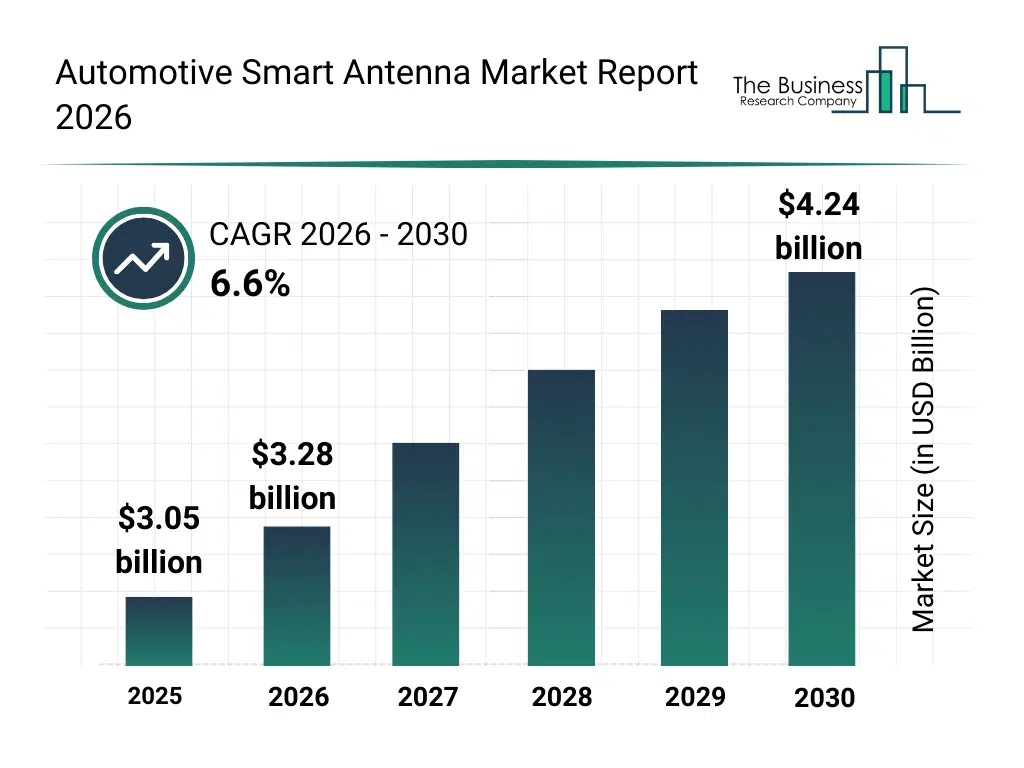
What Is The Automotive Smart Antenna Market Size and Share 2026?
The automotive smart antenna market size has grown strongly in recent years. It will grow from $3.05 billion in 2025 to $3.28 billion in 2026 at a compound annual growth rate (CAGR) of 7.6%. The growth in the historic period can be attributed to infotainment system growth, vehicle connectivity demand, gps navigation adoption, rise of telematics services, automotive electronics expansion.What Is The Automotive Smart Antenna Market Growth Forecast?
The automotive smart antenna market size is expected to see strong growth in the next few years. It will grow to $4.24 billion in 2030 at a compound annual growth rate (CAGR) of 6.6%. The growth in the forecast period can be attributed to 5g vehicle rollout, autonomous driving development, connected mobility ecosystems, vehicle-to-everything communication, smart antenna miniaturization. Major trends in the forecast period include integration of 5g connectivity, growth of connected vehicles, adoption of mimo and beamforming, demand for telematics antennas, expansion of adas communication.
Global Automotive Smart Antenna Market Segmentation
1) By Component Type: Transceiver, Electronic Control Unit (ECU), Other Component Types 2) By Frequency: High, Very High, Ultra High 3) By Vehicle Type: Passenger Car, Light Commercial Vehicles, Heavy Commercial Vehicles 4) By Sales Channel: Original Equipment Manufacturer (OEM), Aftermarket Subsegments: 1) By Transceiver: Radio Frequency Transceiver, GPS Transceiver, Bluetooth Transceiver, Cellular Transceiver, Wi-Fi Transceiver 2) By Electronic Control Unit: Antenna Control Unit (ACU), Signal Processing ECU, Connectivity ECU 3) By Other Component Types: Amplifiers, Filters, Antennas, ConnectorsWhat Is The Driver Of The Automotive Smart Antenna Market?
The increasing demand for connected vehicles is expected to propel the growth of the automotive smart antenna market going forward. Connected vehicles refer to vehicles equipped with technology that enables them to communicate with each other, infrastructure, and other devices. The demand for connected vehicles is rising due to their ability to provide enhanced convenience, safety, and efficiency through features including real-time navigation and remote diagnostics. Smart antennas enhance connected vehicles' connectivity and communication capabilities. These antennas utilize advanced technologies to improve signal quality, increase data transmission speeds, and enable more reliable wireless communication between vehicles and external networks. For instance, in December 2024, according to the National Association of Insurance Commissioners, a US-based non-profit organization the Insurance Institute for Highway Safety anticipates that 4.5 million self-driving vehicles will be on U.S. roads by 2030. Therefore, the increasing demand for connected vehicles is driving the growth of the automotive smart antenna industry.Key Players In The Global Automotive Smart Antenna Market
Major companies operating in the automotive smart antenna market report include Samsung Electronics Co. Ltd, Robert Bosch GmbH, Panasonic Corporation, Denso Corporation, Continental AG, Ericsson, TE Connectivity Ltd, NXP Semiconductors NV, Harman International Industries Incorporated, Hella GmbH & Co. KGaA, Ficosa International SA, Kathrein SE, MD ELEKTRONIK GmbH, Yokowo Co. Ltd, Calearo Antenne SpA, WISI Automotive GmbH & Co. KG, INPAQ Technology Co. Ltd, Airgain Inc, Huf Hülsbeck & Fürst GmbH & Co. KG, Laird Connectivity, Hirschmann Car Communication GmbH, Ace Technologies Corp, Antenova M2M Ltd
This chart is for illustrative purposes; the full report includes a detailed competitor analysis and comprehensive overview of the top 10 companies in the market.
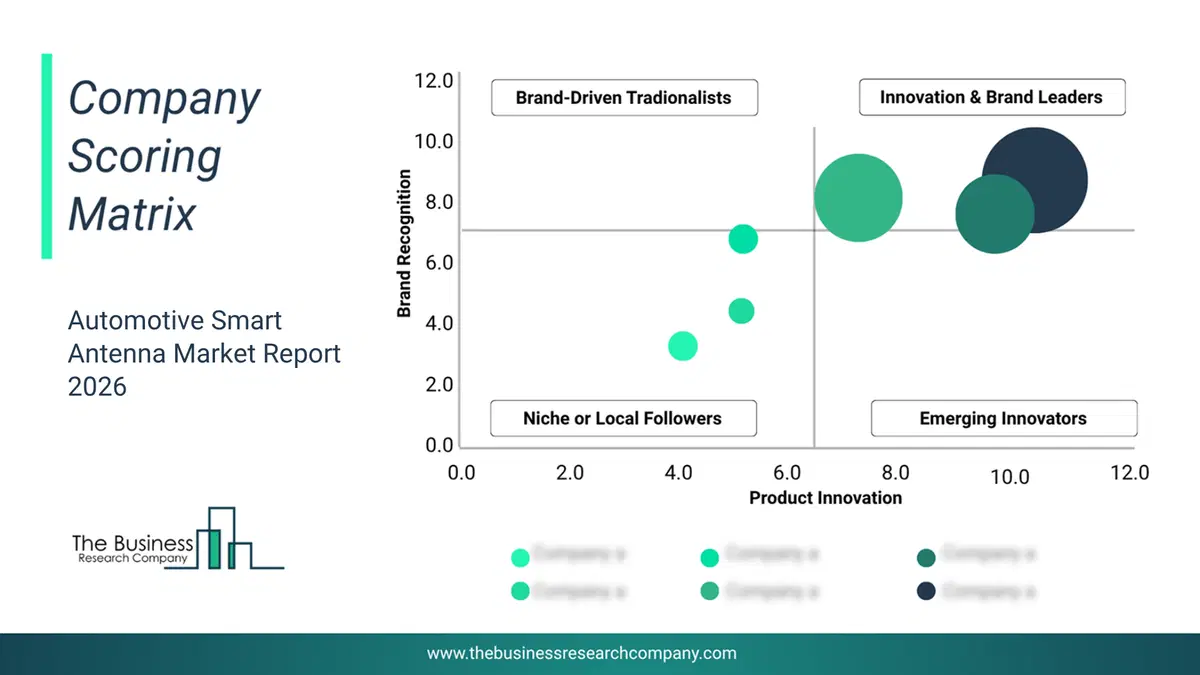
This chart maps companies by product innovation and brand strength, with bubble size indicating relative revenue, helping identify market leaders, challengers, and niche players. This is an illustrative chart; the full report provides a complete and accurate competitive analysis.
Global Automotive Smart Antenna Market Trends and Insights
Major companies operating in the automotive smart antenna market are developing innovative technology, such as transparent antennas, to enhance their offerings further and stay ahead in the competitive landscape. These antennas are integrated directly into the vehicle's glass surfaces, offering improved reception for various communication systems, including GPS, Wi-Fi, and cellular signals. For instance, in December 2023, LG Electronics (LG), a South Korea-based electronics company, in collaboration with Saint-Gobain Sekurit, a France-based glass manufacturer, launched a transparent antenna for automobiles. LG's innovative film-type antenna is directly applied to vehicle glass. This advanced telecommunications solution is poised to revolutionize the evolving mobility sector and bolster LG's position within the automotive solutions market. LG's transparent antenna, compatible with various glass types and vehicle designs, offers both on-glass and in-glass solutions. Its expansive surface application ensures reliable telecommunications performance and scalability, accommodating increasing network demands. LG's latest telematics innovation is notably adaptable and supports enhanced connectivity through 5G, GNSS (Global Navigation Satellite System), and Wi-Fi technologies.What Are Latest Mergers And Acquisitions In The Automotive Smart Antenna Market?
In October 2023, Universal Scientific Industrial (Shanghai) Co., Ltd. (USI), a China-based electronics manufacturing and solutions company, acquired the TE Automotive Wireless Business from TE Connectivity Ltd for an undisclosed amount. Through this acquisition, USI aims to strengthen its automotive connectivity solutions and expand its presence in advanced in-vehicle wireless technologies. TE Connectivity Ltd is a Switzerland-based company that provides automotive smart antenna solutions.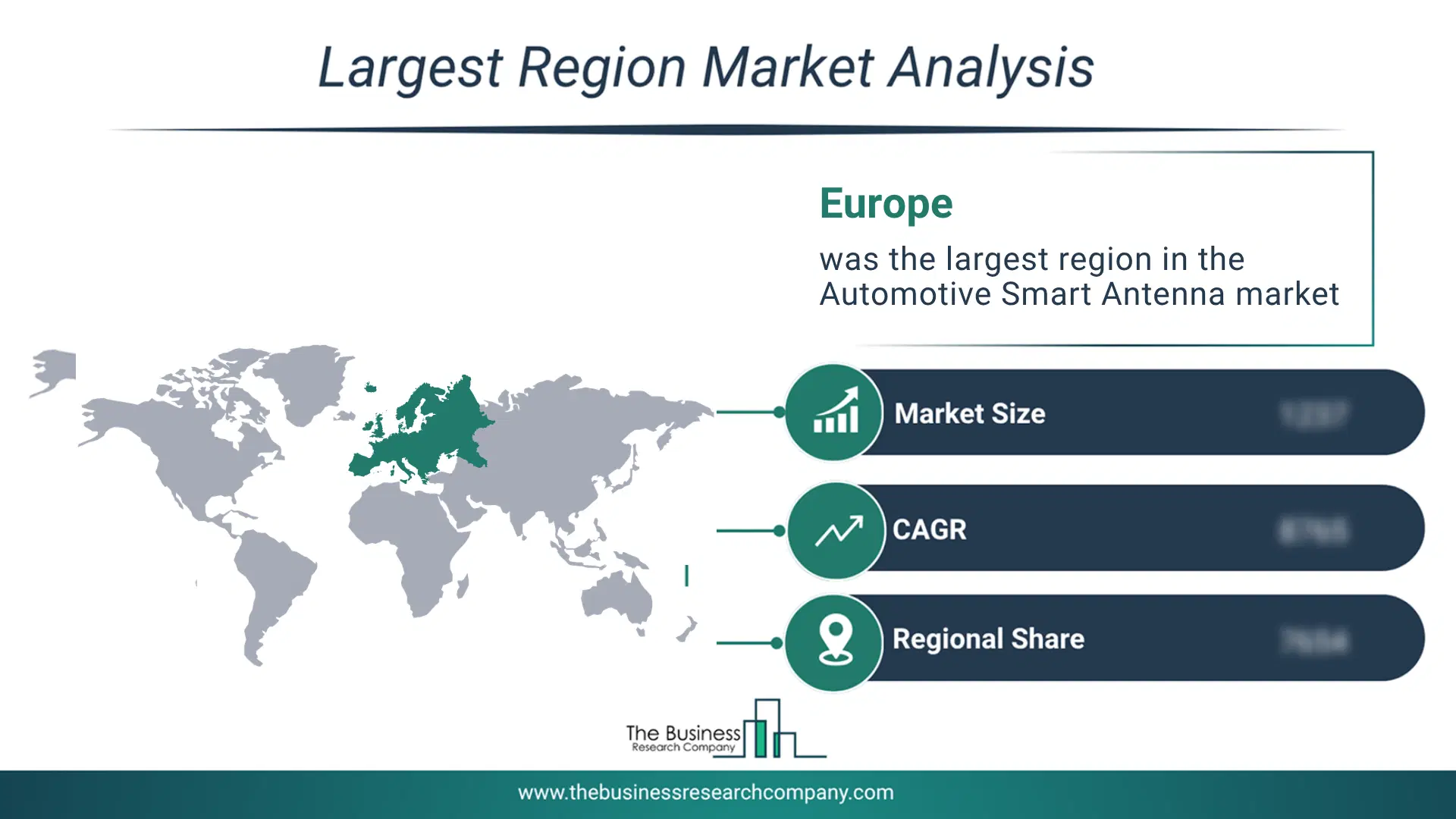
Regional Outlook
Europe was the largest region in the automotive smart antenna market in 2025. Asia-Pacific is expected to be the fastest-growing region in the forecast period. The regions covered in this market report include Asia-Pacific, South East Asia, Western Europe, Eastern Europe, North America, South America, Middle East, Africa. The countries covered in this market report include Australia, Brazil, China, France, Germany, India, Indonesia, Japan, Taiwan, Russia, South Korea, UK, USA, Canada, Italy, SpainWhat Defines the Automotive Smart Antenna Market?
The automotive smart antenna market consists of revenues earned by entities by providing services such as telematics services, entertainment, and emergency services. The market value includes the value of related goods sold by the service provider or included within the service offering. The automotive smart antenna market also includes sales of connectors and cables, amplifiers and filters, and GPS receivers. Values in this market are ‘factory gate’ values, that is, the value of goods sold by the manufacturers or creators of the goods, whether to other entities (including downstream manufacturers, wholesalers, distributors, and retailers) or directly to end customers. The value of goods in this market includes related services sold by the creators of the goods.How is Market Value Defined and Measured?
The market value is defined as the revenues that enterprises gain from the sale of goods and/or services within the specified market and geography through sales, grants, or donations in terms of the currency (in USD unless otherwise specified). The revenues for a specified geography are consumption values that are revenues generated by organizations in the specified geography within the market, irrespective of where they are produced. It does not include revenues from resales along the supply chain, either further along the supply chain or as part of other products.
This chart presents market attractiveness based on a quantitative evaluation of growth, competition, strategic alignment, and risk, offering a clear view of opportunity areas for decision-making. This chart is for illustrative purposes; the full report contains the complete analysis.

This chart highlights the Total Addressable Market (TAM) by estimating the maximum revenue opportunity using an assumption-driven approach, supporting strategic planning and opportunity sizing across markets. The chart is illustrative; the full report provides a more comprehensive analysis.
What Key Data and Analysis Are Included in the Automotive Smart Antenna Market Report 2026?
The automotive smart antenna market research report is one of a series of new reports from The Business Research Company that provides market statistics, including industry global market size, regional shares, competitors with the market share, detailed market segments, market trends and opportunities, and any further data you may need to thrive in the automotive smart antenna industry. The market research report delivers a complete perspective of everything you need, with an in-depth analysis of the current and future state of the industry.Automotive Smart Antenna Market Report Forecast Analysis
| Report Attribute | Details |
|---|---|
| Market Size Value In 2026 | $3.28 billion |
| Revenue Forecast In 2030 | $4.24 billion |
| Growth Rate | CAGR of 7.6% from 2026 to 2030 |
| Base Year For Estimation | 2025 |
| Actual Estimates/Historical Data | 2020-2025 |
| Forecast Period | 2026 - 2030 - 2030 |
| Market Representation | Revenue in USD Billion and CAGR from 2026 to 2030 |
| Segments Covered | Component Type, Frequency, Vehicle Type, Sales Channel |
| Regional Scope | Asia-Pacific, Western Europe, Eastern Europe, North America, South America, Middle East, Africa |
| Country Scope | The countries covered in the report are Australia, Brazil, China, France, Germany, India, Indonesia, Japan, Taiwan, Russia, South Korea, UK, USA, Canada, Italy, Spain. |
| Key Companies Profiled | Samsung Electronics Co. Ltd, Robert Bosch GmbH, Panasonic Corporation, Denso Corporation, Continental AG, Ericsson, TE Connectivity Ltd, NXP Semiconductors NV, Harman International Industries Incorporated, Hella GmbH & Co. KGaA, Ficosa International SA, Kathrein SE, MD ELEKTRONIK GmbH, Yokowo Co. Ltd, Calearo Antenne SpA, WISI Automotive GmbH & Co. KG, INPAQ Technology Co. Ltd, Airgain Inc, Huf Hülsbeck & Fürst GmbH & Co. KG, Laird Connectivity, Hirschmann Car Communication GmbH, Ace Technologies Corp, Antenova M2M Ltd |
| Customization Scope | Request for Customization |
| Pricing And Purchase Options | Explore Purchase Options |