
Automotive Smart Seating Systems Market Report 2026
Global Outlook – By Type (Power Adjustable Seating Systems, Heated Seating Systems, Ventilated Seating Systems, Massage Seating Systems, Memory Seating Systems, Occupant Monitoring Seating Systems, Biometric Smart Seating Systems, Integrated Multifunction Smart Seating Systems), By Component (Sensors, Electronic Control Units, Actuators And Motors, Heating And Ventilation Modules, Control Switches, Wiring Harnesses, Software And Control Platforms), By Technology (Occupant Detection Technology, Posture Monitoring Technology, Biometric Recognition Technology, Artificial Intelligence Enabled Seating Technology, Connected Seating Technology, Human Machine Interface Technology), By Vehicle Type (Passenger Cars, Light Commercial Vehicles, Heavy Commercial Vehicles, Electric Vehicles), By End User (Individual Consumers, Fleet Operators, Commercial Transportation Providers) – Market Size, Trends, Strategies, and Forecast to 2035
Automotive Smart Seating Systems Market Overview
• Automotive Smart Seating Systems market size has reached to $28.16 billion in 2025 • Expected to grow to $42.18 billion in 2030 at a compound annual growth rate (CAGR) of 8.3% • Growth Driver: Rising Electric Vehicle Adoption Driving The Market Growth Due To Increasing Demand For Efficient Power Conversion And Energy Management • Market Trend: Intelligent Seating Systems Advance With Real-Time Seat Adjustment • North America was the largest region in 2025 and Asia-Pacific is the fastest growing region.What Is Covered Under Automotive Smart Seating Systems Market?
Automotive smart seating systems refer to advanced seating technologies designed to improve the comfort, convenience, and safety of vehicle occupants through intelligent and automated seat functionalities. These systems integrate smart technologies to enable adaptive and responsive seating solutions that enhance the overall in-vehicle experience. They are increasingly adopted in modern vehicles as manufacturers focus on personalized mobility and next-generation automotive interiors. The main types of automotive smart seating systems include power adjustable seating systems, heated seating systems, ventilated seating systems, massage seating systems, memory seating systems, occupant monitoring seating systems, biometric smart seating systems, and integrated multifunction smart seating systems. Power adjustable seating systems refer to electrically controlled seating systems that allow occupants to adjust seat position, height, angle, and other settings for improved comfort and ergonomics. These systems incorporate sensors, electronic control units, actuators and motors, heating and ventilation modules, control switches, wiring harnesses, and software and control platforms and use occupant detection technology, posture monitoring technology, biometric recognition technology, artificial intelligence enabled seating technology, connected seating technology, and human machine interface technology. They are used in passenger cars, light commercial vehicles, heavy commercial vehicles, and electric vehicles, and are used by several end users such as individual consumers, fleet operators, and commercial transportation providers.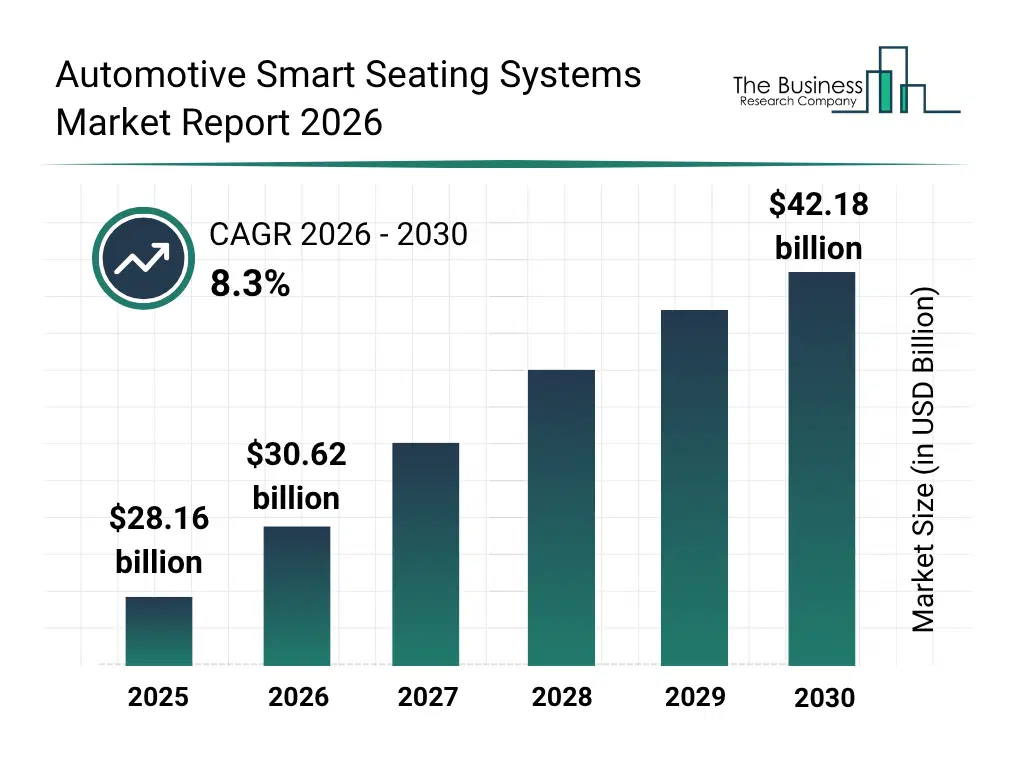
What Is The Automotive Smart Seating Systems Market Size and Share 2026?
The automotive smart seating systems market size has grown strongly in recent years. It will grow from $28.16 billion in 2025 to $30.62 billion in 2026 at a compound annual growth rate (CAGR) of 8.8%. The growth in the historic period can be attributed to increasing demand for enhanced occupant comfort, rising adoption of power adjustable seating systems, growing consumer preference for premium vehicle interiors, increasing demand for heated and ventilated seating, expanding adoption of automated seat adjustment features.What Is The Automotive Smart Seating Systems Market Growth Forecast?
The automotive smart seating systems market size is expected to see strong growth in the next few years. It will grow to $42.18 billion in 2030 at a compound annual growth rate (CAGR) of 8.3%. The growth in the forecast period can be attributed to increasing demand for personalized smart seating experiences, rising adoption of multifunctional seating systems, growing demand for integrated occupant monitoring, increasing preference for adaptive seating configurations, expanding demand for biometric occupant recognition. Major trends in the forecast period include increasing adoption of personalized seat adjustment functions, rising demand for multifunctional smart seating systems, growing integration of automated occupant monitoring features, increasing demand for adaptive seat comfort and positioning, rising preference for memory-based seat configuration systems.Tariff Impact On Automotive Smart Seating Systems Market
Tariffs are impacting the automotive smart seating systems market by increasing the cost of imported sensors, electronic control units, actuators and motors, heating and ventilation modules, wiring harnesses, and other components required for intelligent seating systems. This is raising production costs and potentially slowing adoption across passenger cars, commercial vehicles, and electric vehicles, particularly in regions dependent on imported automotive components such as Asia-Pacific, Europe, and North America. Component-intensive segments such as sensors, electronic control units, actuators, and smart seating control platforms are most affected due to global supply chain dependencies. However, tariffs are also encouraging local manufacturing, regional supplier diversification, and increased investment in domestic automotive component ecosystems, creating long-term resilience in the market.
Global Automotive Smart Seating Systems Market Segmentation
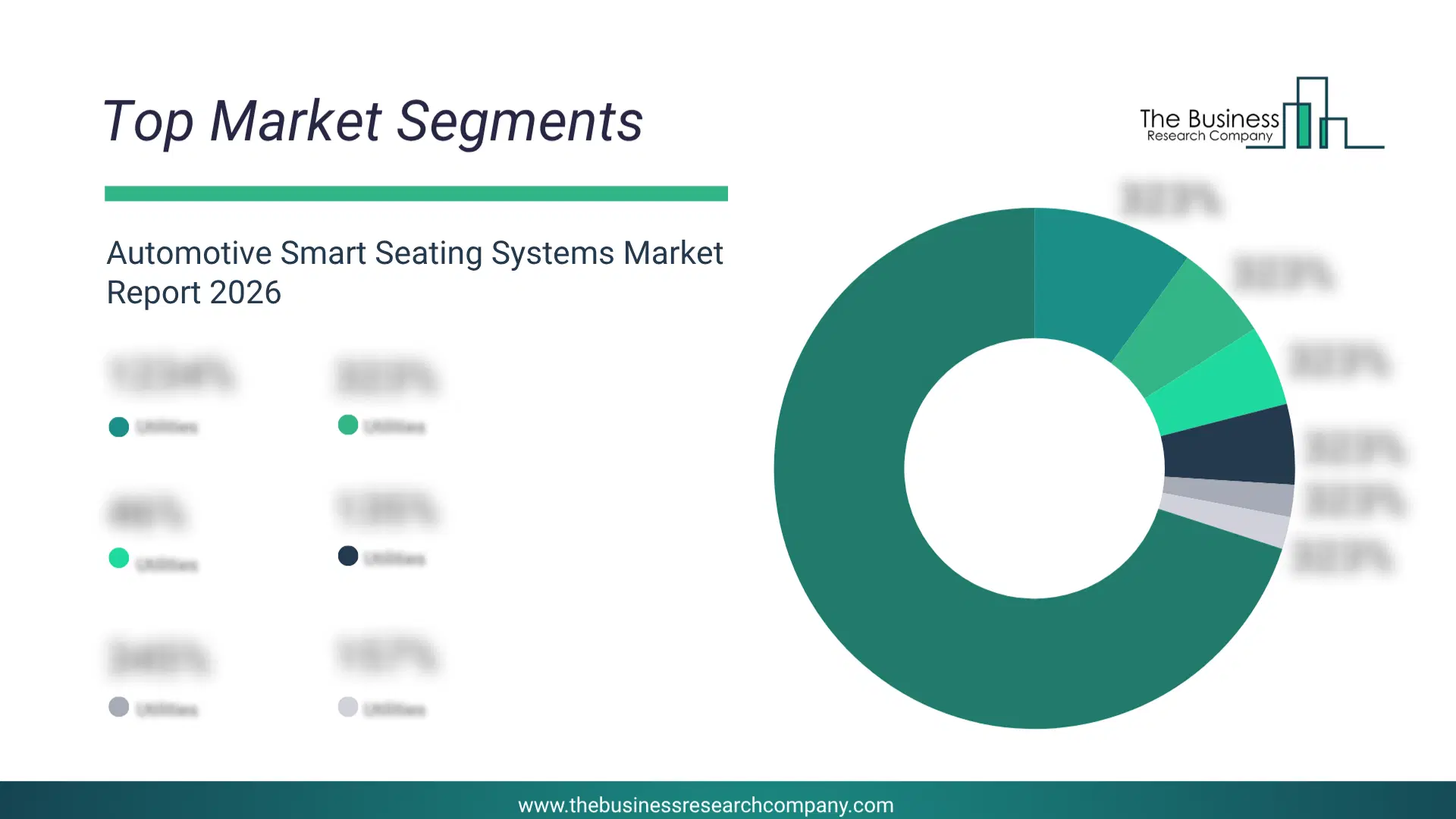
2) By Component: Sensors, Electronic Control Units, Actuators And Motors, Heating And Ventilation Modules, Control Switches, Wiring Harnesses, Software And Control Platforms 3) By Technology: Occupant Detection Technology, Posture Monitoring Technology, Biometric Recognition Technology, Artificial Intelligence Enabled Seating Technology, Connected Seating Technology, Human Machine Interface Technology 4) By Vehicle Type: Passenger Cars, Light Commercial Vehicles, Heavy Commercial Vehicles, Electric Vehicles 5) By End User: Individual Consumers, Fleet Operators, Commercial Transportation Providers Subsegments: 1) By Power Adjustable Seating Systems: Electric Seat Adjustment Systems, Motorized Seat Positioning Systems, Automatic Recline Systems, Power Lumbar Support Systems, Power Headrest Adjustment Systems 2) By Heated Seating Systems: Resistive Heating Systems, Carbon Fiber Heating Systems, Infrared Heating Systems, Multi Zone Heating Systems, Rapid Heating Systems 3) By Ventilated Seating Systems: Active Ventilation Systems, Air Circulation Systems, Cooling Fan Integrated Systems, Perforated Seat Ventilation Systems, Climate Controlled Seating Systems 4) By Massage Seating Systems: Pneumatic Massage Systems, Vibration Massage Systems, Rolling Massage Systems, Pressure Point Massage Systems, Multi Mode Massage Systems 5) By Memory Seating Systems: Driver Profile Memory Systems, Passenger Profile Memory Systems, Automatic Seat Position Recall Systems, Personalized Comfort Memory Systems, Smart Seat Configuration Systems 6) By Occupant Monitoring Seating Systems: Occupant Detection Systems, Posture Monitoring Systems, Seat Occupancy Monitoring Systems, Driver Behavior Monitoring Systems, Health Condition Monitoring Systems 7) By Biometric Smart Seating Systems: Heart Rate Monitoring Systems, Body Temperature Monitoring Systems, Biometric Identification Systems, Stress Level Monitoring Systems, Vital Sign Tracking Systems 8) By Integrated Multifunction Smart Seating Systems: Combined Comfort Management Systems, Intelligent Seat Control Systems, Connected Seating Systems, Adaptive Seating Systems, Personalized Smart Seating PlatformsWhat Is The Driver Of The Automotive Smart Seating Systems Market?
The rising adoption of electric vehicles (EVs) is expected to propel the growth of the automotive smart seating systems market going forward. Electric vehicles are automobiles powered wholly or partially by electric motors using energy stored in rechargeable battery systems. The adoption of electric vehicles is increasing due to growing environmental concerns, as consumers, businesses, and governments seek to reduce greenhouse gas emissions, improve air quality, and decrease dependence on fossil fuels through cleaner and more sustainable transportation solutions. The adoption of electric vehicles is accelerating the integration of automotive smart seating systems by enabling advanced in-cabin experiences, optimizing space utilization through flexible seat designs, and increasing demand for personalized comfort, connectivity, and occupant monitoring features. For instance, in May 2026, according to the International Energy Agency (IEA), a France-based intergovernmental organization, electric car sales in Europe increased by more than 30% in 2025. Therefore, the rising adoption of electric vehicles is driving the growth of the automotive smart seating systems industry.Key Players In The Global Automotive Smart Seating Systems Market
Major companies operating in the automotive smart seating systems market are Robert Bosch GmbH, Continental AG, DENSO Corporation, Magna International Inc., Infineon Technologies AG, Panasonic Automotive Systems Co. Ltd., FORVIA SE, Aptiv PLC, TE Connectivity Ltd., Lear Corporation, Adient plc, TDK Corporation, Nidec Corporation, Toyota Boshoku Corporation, Brose Fahrzeugteile SE & Co. KG, ams-OSRAM AG, Johnson Electric Holdings Limited, Hyundai Transys Inc., TS TECH Co. Ltd., TACHI-S Co. Ltd., Grammer AG, Gentherm Incorporated, Melexis NV, NHK Spring Co. Ltd., CTS Corporation, Stoneridge Inc., Ningbo Joyson Electronic Corporation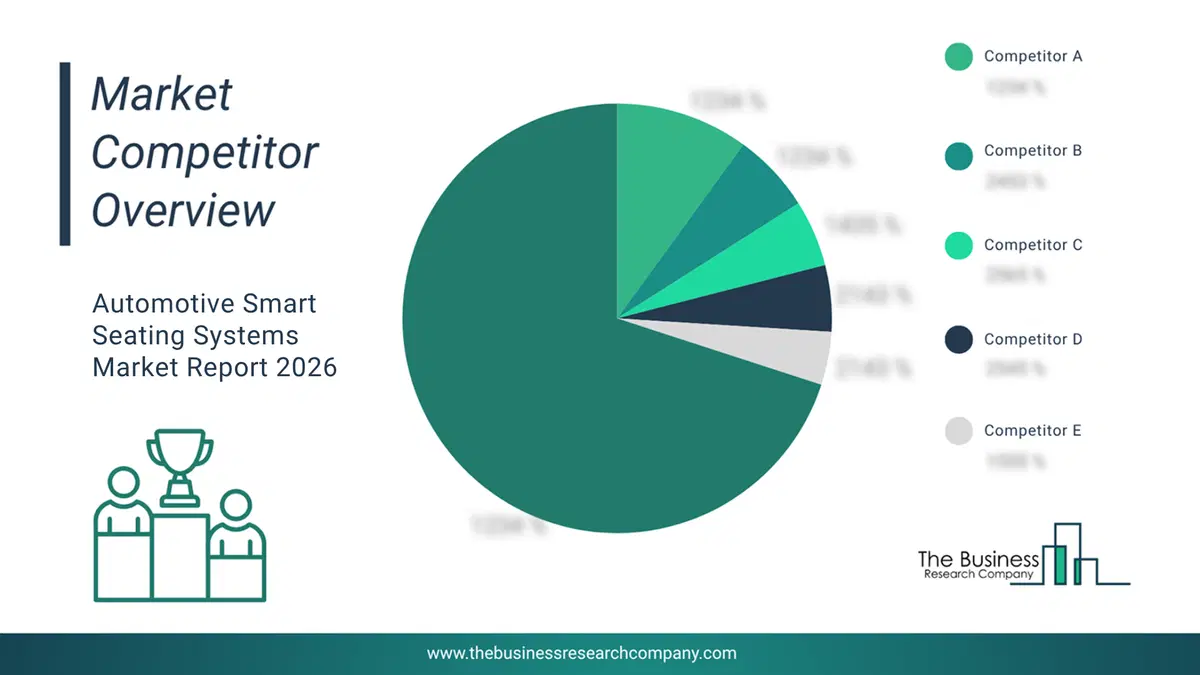
This chart is for illustrative purposes; the full report includes a detailed competitor analysis and comprehensive overview of the top 10 companies in the market.
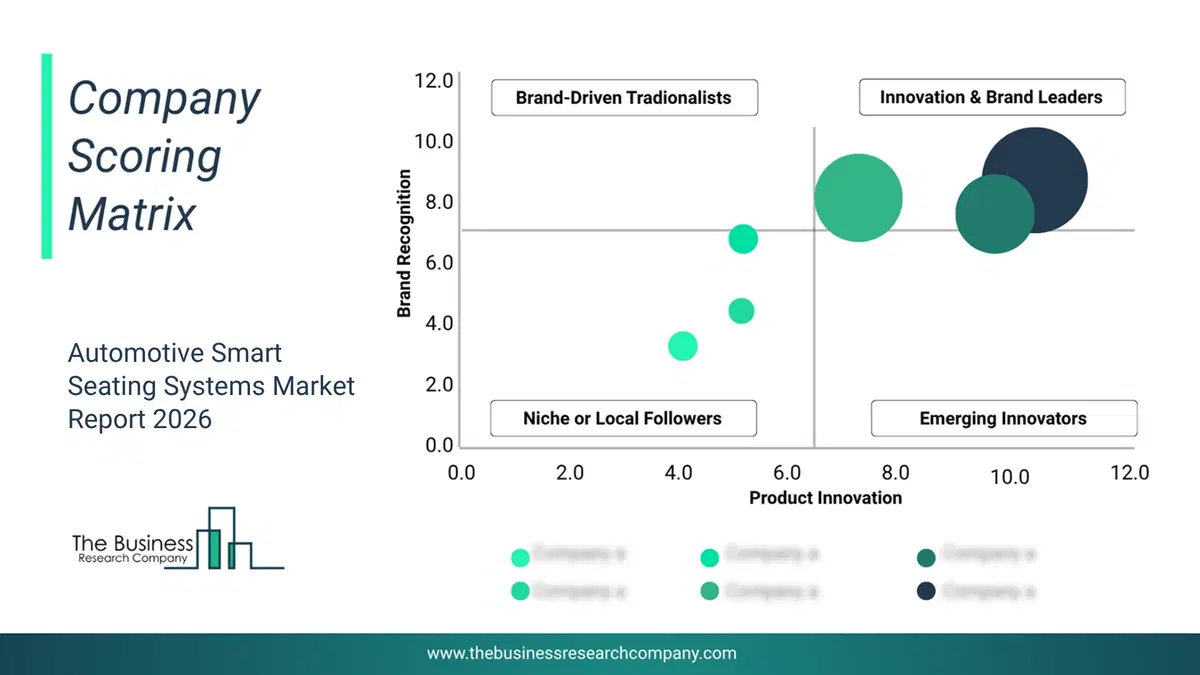
This chart maps companies by product innovation and brand strength, with bubble size indicating relative revenue, helping identify market leaders, challengers, and niche players. This is an illustrative chart; the full report provides a complete and accurate competitive analysis.
Global Automotive Smart Seating Systems Market Trends and Insights
Major companies operating in the automotive smart seating systems market are focusing on developing innovative solutions, such as intelligent and adaptive smart seating systems, to enhance personalized occupant comfort, safety, wellness, and in-cabin experience. Intelligent and adaptive smart seating systems are advanced automotive seats that integrate sensors, software algorithms, electronic adjustment mechanisms, lightweight seat structures, and zero-gravity positioning to automatically optimize seating configurations according to occupant characteristics and driving conditions, compared with conventional seats that primarily rely on manually controlled mechanical adjustments. For instance, in February 2026, FORVIA, a France-based automotive technology company, won a multi-year project with Luxeed, a premium Chinese electric vehicle brand owned by Chery, to supply several hundred thousand complete seat sets in a deal worth several hundred million euros. The seating systems will incorporate technologies featured in FORVIA’s Transformer Seat, including automatic real-time seat adjustments based on occupant morphology and vehicle driving conditions, enabled by dedicated algorithms. The seats will also feature lightweight metal frames and zero-gravity seating that reclines to an almost horizontal position, distributing occupant weight more evenly across the body to reduce spinal pressure and joint stress.What Are Latest Mergers And Acquisitions In The Automotive Smart Seating Systems Market?
In December 2025, Adient plc, a US-based automotive seating technology company, acquired a 49% equity stake in SCI (Zhangjiakou) Automotive Technology Co., Ltd., a subsidiary of Zhejiang Yoening Technology Group, and established a strategic joint venture to develop and manufacture innovative automotive seating solutions for Chinese original equipment manufacturers (OEMs). With this acquisition and partnership, Adient strengthened its automotive seating capabilities in China by combining its global seating technologies with SCI’s local manufacturing and engineering expertise to accelerate the development and production of advanced seating solutions. SCI (Zhangjiakou) is a China-based automotive seating technology provider specializing in automotive seat systems and related seating components for vehicle manufacturers.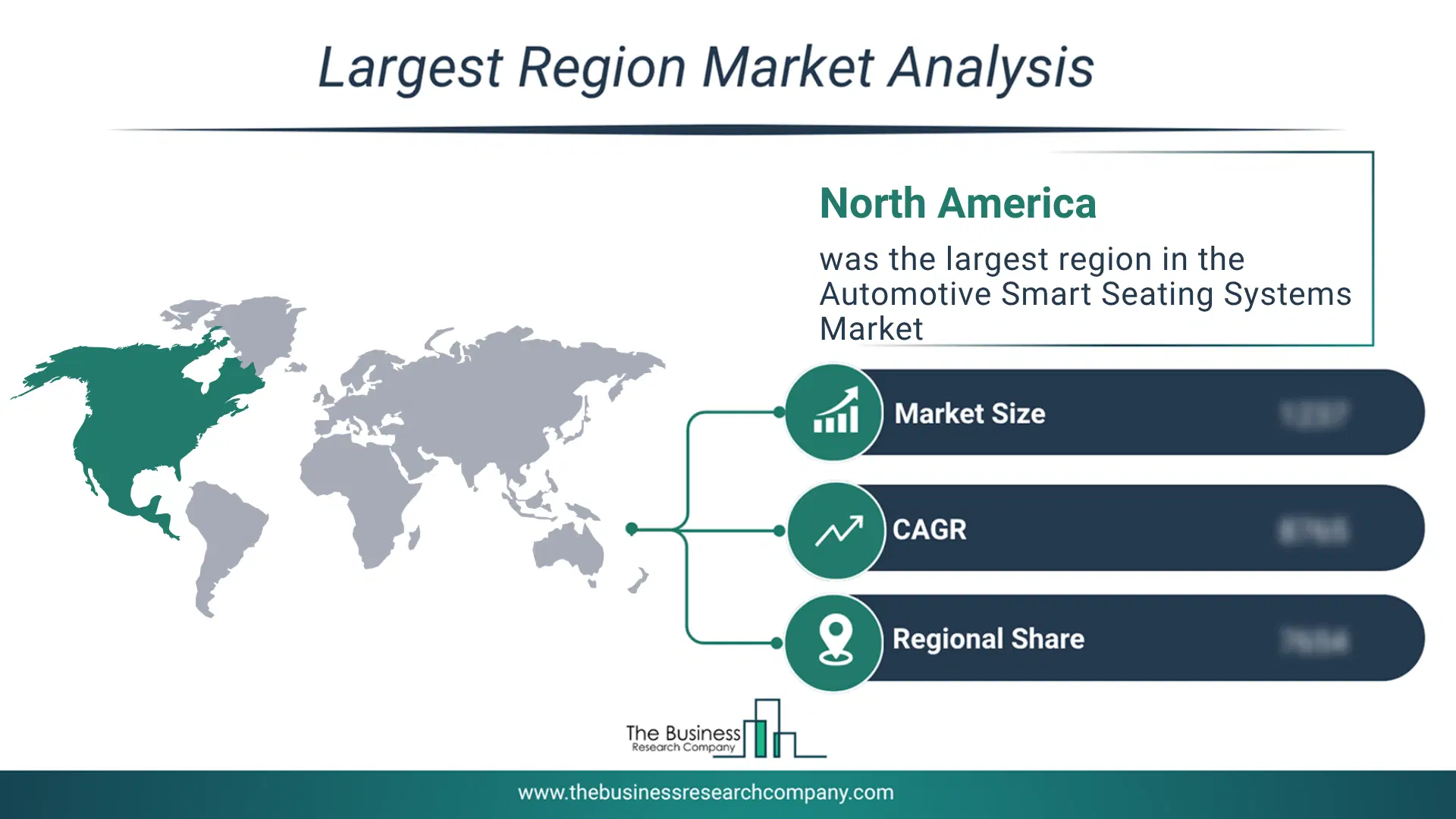
Regional Outlook/Insights
North America was the largest region in the automotive smart seating systems market in 2025. Asia-Pacific is expected to be the fastest-growing region in the forecast period. The regions covered in this market report are Asia-Pacific, South East Asia, Western Europe, Eastern Europe, North America, South America, Middle East, Africa. The countries covered in this market report are Australia, Brazil, China, France, Germany, India, Indonesia, Japan, Taiwan, Russia, South Korea, UK, USA, Canada, Italy, Spain.What Defines the Automotive Smart Seating Systems Market?
The automotive smart seating systems market consists of sales of seat position memory modules, occupant detection sensors, seat occupancy sensors, seat massage modules, seat adjustment control modules, and smart seat control panels. Values in this market are ‘factory gate’ values, that is, the value of goods sold by the manufacturers or creators of the goods, whether to other entities (including downstream manufacturers, wholesalers, distributors, and retailers) or directly to end customers. The value of goods in this market includes related services sold by the creators of the goods.How is Market Value Defined and Measured?
The market value is defined as the revenues that enterprises gain from the sale of goods and/or services within the specified market and geography through sales, grants, or donations in terms of the currency (in USD unless otherwise specified). The revenues for a specified geography are consumption values that are revenues generated by organizations in the specified geography within the market, irrespective of where they are produced. It does not include revenues from resales along the supply chain, either further along the supply chain or as part of other products.
This chart presents market attractiveness based on a quantitative evaluation of growth, competition, strategic alignment, and risk, offering a clear view of opportunity areas for decision-making. This chart is for illustrative purposes; the full report contains the complete analysis.

This chart highlights the Total Addressable Market (TAM) by estimating the maximum revenue opportunity using an assumption-driven approach, supporting strategic planning and opportunity sizing across markets. The chart is illustrative; the full report provides a more comprehensive analysis.
What Key Data and Analysis Are Included in the Automotive Smart Seating Systems Market Report 2026?
The automotive smart seating systems market research report is one of a series of new reports from The Business Research Company that provides market statistics, including industry global market size, regional shares, competitors with the market share, detailed market segments, market trends and opportunities, and any further data you may need to thrive in the automotive smart seating systems industry. The market research report delivers a complete perspective of everything you need, with an in-depth analysis of the current and future state of the industry.Automotive Smart Seating Systems Market Report Forecast Analysis
| Report Attribute | Details |
|---|---|
| Market Size Value In 2026 | $30.62 billion |
| Revenue Forecast In 2030 | $42.18 billion |
| Growth Rate | CAGR of 8.3% from 2026 to 2035 |
| Base Year For Estimation | 2025 |
| Actual Estimates/Historical Data | 2020-2025 |
| Forecast Period | 2026 - 2030 |
| Market Representation | Revenue in USD Billion and CAGR from 2026 to 2030 |
| Segments Covered | Type, Component, Technology, Vehicle Type, End User |
| Regional Scope | Asia-Pacific, Western Europe, Eastern Europe, North America, South America, Middle East, Africa |
| Country Scope | The countries covered in the report are Australia, Brazil, China, France, Germany, India, Indonesia, Japan, Taiwan, Russia, South Korea, UK, USA, Canada, Italy, Spain. |
| Customization Scope | Request for Customization |
| Pricing And Purchase Options | Explore Purchase Options |