

Automotive Solid State Drive Market Report 2026
Global Outlook – By Type (256 Gigabyte (GB), 500 Gigabyte (GB), 1 Terabyte (TB), Above 1 Terabyte (TB)), By Technology (Serial Advanced Technology Attachment (SATA), Peripheral Component Interconnect Express (PCIe), Other Technologies), By Vehicle Type (Light Commercial Vehicles (LCV), Heavy Commercial Vehicles (HCV), Passenger Cars), By Application (Infotainment Systems, Advanced Driver Assistance Systems (ADAS), Autonomous Driving Systems, Telematics) – Market Size, Trends, Strategies, and Forecast to 2030
Automotive Solid State Drive Market Overview
• Automotive Solid State Drive market size has reached to $2.18 billion in 2025 • Expected to grow to $3.38 billion in 2030 at a compound annual growth rate (CAGR) of 9.1% • Growth Driver: Rise In Autonomous Vehicles Driving The Growth Of The Market Due To AI-Driven Safety And Data Processing Needs • Market Trend: Technological Advancements In V-NAND Technology Driving Growth In ADAS And Autonomous Driving Systems • North America was the largest region in 2025.What Is Covered Under Automotive Solid State Drive Market?
Automotive solid-state drives (SSDs) are specialized solid-state drives designed to meet the unique demands of modern vehicles. These SSDs are used in infotainment systems, advanced driver-assistance systems (ADAS), telematics, navigation, and data logging for autonomous driving. They offer high performance, reliability, and durability under harsh environmental conditions. The main types of automotive solid state drive are 256 gigabytes (GB), 500 gigabytes (GB), 1 terabyte (TB), and above 1 terabyte (TB). A 256 GB automotive SSD is typically used in vehicles that need moderate data storage capacity. This size is ideal for applications such as infotainment systems, basic navigation, and telematics, providing enough space for smaller datasets while ensuring quick access to key vehicle information. Technologies include serial advanced technology attachment (SATA), peripheral component interconnect express (PCIe), and others for vehicles ranging from light commercial vehicles (LCV), heavy commercial vehicles (HCV), and passenger cars. Applications include infotainment systems, advanced driver assistance systems (ADAS), autonomous driving systems, and telematics.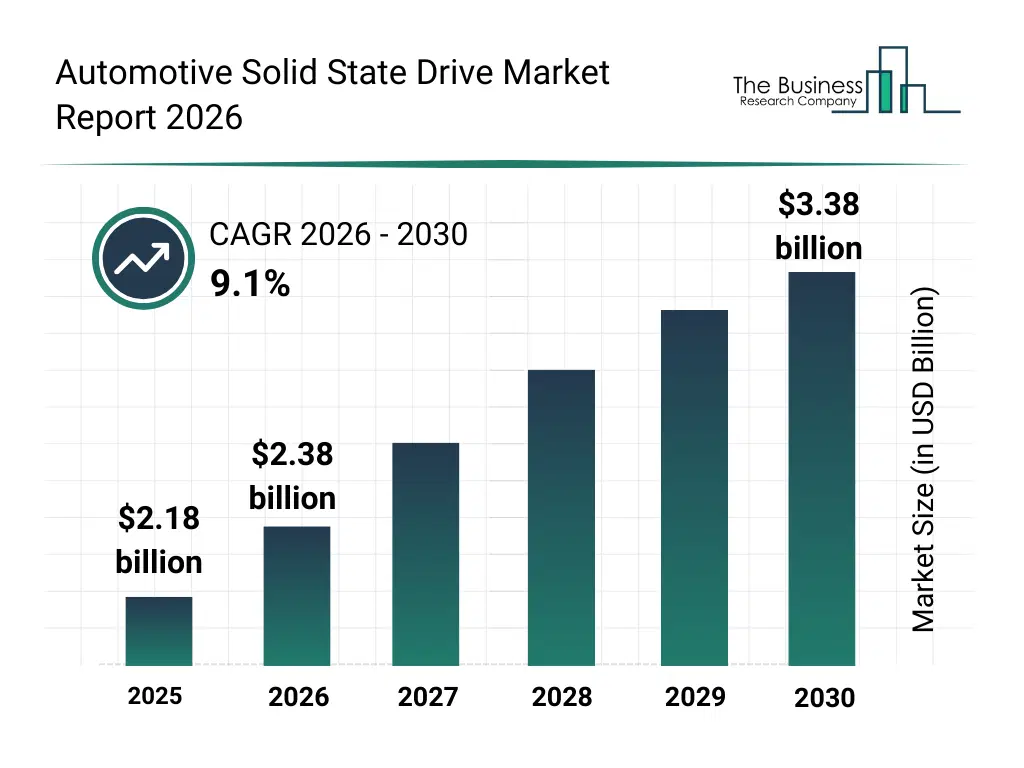
What Is The Automotive Solid State Drive Market Size and Share 2026?
The automotive solid state drive market size has grown strongly in recent years. It will grow from $2.18 billion in 2025 to $2.38 billion in 2026 at a compound annual growth rate (CAGR) of 9.1%. The growth in the historic period can be attributed to infotainment system expansion, navigation data growth, early adas adoption, flash memory cost reduction, vehicle digitization.What Is The Automotive Solid State Drive Market Growth Forecast?
The automotive solid state drive market size is expected to see strong growth in the next few years. It will grow to $3.38 billion in 2030 at a compound annual growth rate (CAGR) of 9.1%. The growth in the forecast period can be attributed to autonomous driving development, edge ai processing, high-resolution mapping demand, connected vehicle ecosystems, over-the-air updates. Major trends in the forecast period include increasing data storage requirements, growth of autonomous driving data, adoption of high-capacity ssds, expansion of adas and infotainment storage, focus on reliability and durability.
Global Automotive Solid State Drive Market Segmentation
1) By Type: 256 Gigabyte (GB), 500 Gigabyte (GB), 1 Terabyte (TB), Above 1 Terabyte (TB) 2) By Technology: Serial Advanced Technology Attachment (SATA), Peripheral Component Interconnect Express (PCIe), Other Technologies 3) By Vehicle Type: Light Commercial Vehicles (LCV), Heavy Commercial Vehicles (HCV), Passenger Cars 4) By Application: Infotainment Systems, Advanced Driver Assistance Systems (ADAS), Autonomous Driving Systems, Telematics Subsegments: 1) By 256 Gigabyte (GB): Infotainment Systems Storage, Navigation Data Storage, Telematics And Connectivity Storage 2) By 500 Gigabytes (GB): Advanced Driver Assistance Systems (ADAS) Storage, In-Vehicle Entertainment Storage, Vehicle Data Logging 3) By 1 Terabyte (TB): High-Resolution Mapping And Autonomous Driving Data Storage, AI-Based Predictive Maintenance Storage, Event Data Recorder (EDR) Storage 4) By Above 1 Terabyte (TB): Full Autonomous Driving System Data Storage, Edge AI Processing Storage, Cloud-Connected Vehicle Data BackupWhat Are The Drivers Of The Automotive Solid State Drive Market?
The growing autonomous vehicles are expected to propel the growth of the automotive solid-state drive market going forward. Autonomous vehicles are self-driving cars equipped with advanced sensors, cameras, and artificial intelligence to navigate without human intervention. Autonomous vehicle adoption is growing due to advancements in artificial intelligence (AI)-driven safety systems that reduce accidents. Automotive solid-state drives enable autonomous vehicles to quickly process and store large amounts of data from sensors, ensuring efficient real-time navigation and decision-making. For instance, in December 2024, according to the National Association of Insurance Commissioners, a US-based non-profit organization the Insurance Institute for Highway Safety anticipates that 4.5 million self-driving vehicles will be on U.S. roads by 2030. Therefore, the growing autonomous vehicles are driving the growth of the automotive solid-state drive market. The growing popularity of electric vehicles (EVs) is expected to propel the growth of the automotive solid-state drive market going forward. Electric vehicles (EVs) are vehicles powered by electric motors, using electricity stored in rechargeable batteries instead of gasoline or diesel. The popularity of electric vehicles (EVs) is rising due to advancements in battery technology, enabling longer ranges and faster charging. Governments worldwide are implementing incentives and stricter emission regulations, encouraging EV adoption. Automotive solid-state drives (SSDs) enhance electric vehicles (EVs) by providing faster data processing, greater reliability, and improved efficiency for systems such as battery management, autonomous driving, and infotainment. For instance, in April 2024, according to the International Energy Agency (IEA), a France-based intergovernmental organization, in 2023, global electric car registrations reached 14 million, bringing the total on the road to 40 million, a 35% increase from 2022. Therefore, the growing popularity of electric vehicles (EVs) is driving the growth of the automotive solid-state drive market.Key Players In The Global Automotive Solid State Drive Market
Major companies operating in the automotive solid state drive market report include Samsung Electronics Co. Ltd., Micron Technology Inc., SK hynix Inc., Kioxia Corporation, Western Digital Corporation, Intel Corporation, Toshiba Corporation, Phison Electronics Corporation, Innodisk Corporation, Transcend Information Inc., ADATA Technology Co. Ltd., BIWIN Storage Technology, Longsys Electronics Co. Ltd., Silicon Power Computer & Communications Inc., Netac Technology, Team Group Inc., Apacer Technology Inc., Swissbit AG, ATP Electronics Inc., Exascend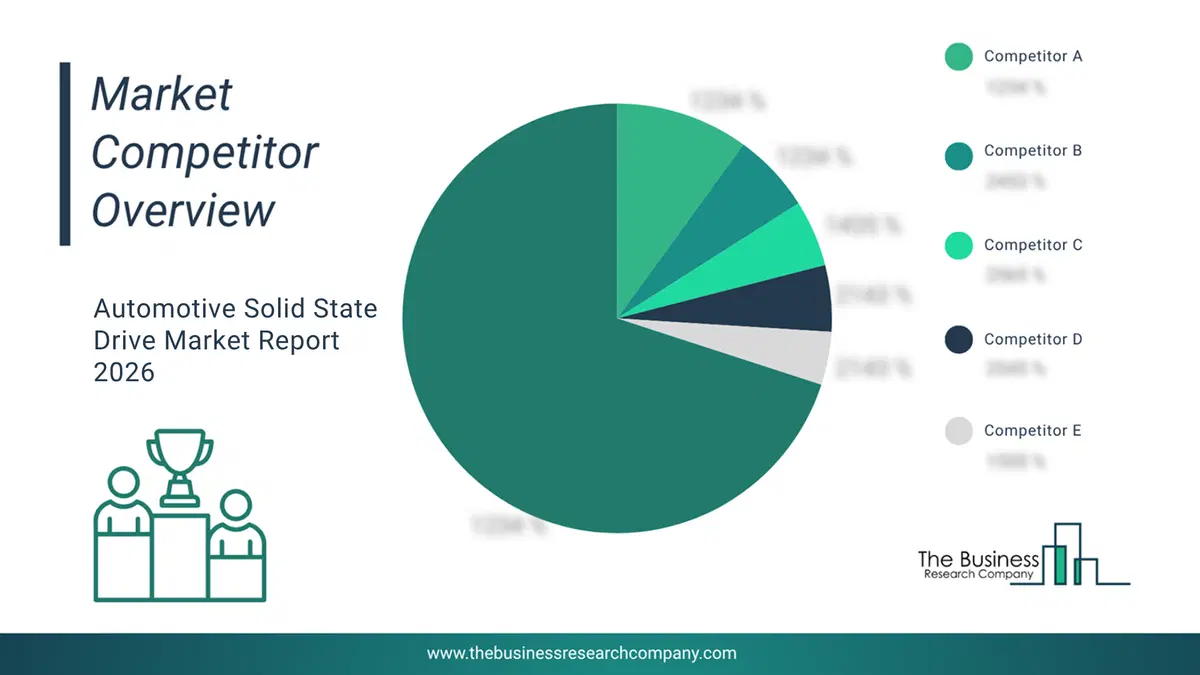
This chart is for illustrative purposes; the full report includes a detailed competitor analysis and comprehensive overview of the top 10 companies in the market.
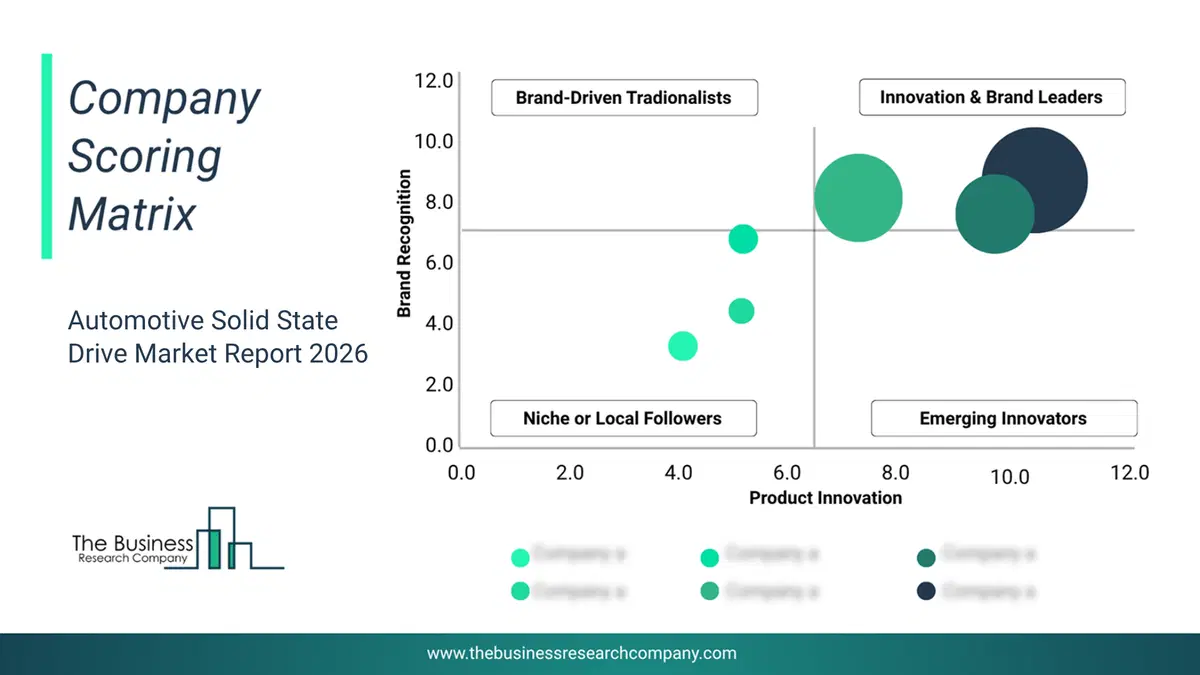
This chart maps companies by product innovation and brand strength, with bubble size indicating relative revenue, helping identify market leaders, challengers, and niche players. This is an illustrative chart; the full report provides a complete and accurate competitive analysis.
Global Automotive Solid State Drive Market Trends and Insights
Major companies operating in the automotive solid-state drive market are focusing on technological innovations such as V-NAND technology to improve storage capacity, data processing speeds, and reliability. V-NAND (Vertical NAND) is a type of flash memory technology where memory cells are stacked vertically in multiple layers to increase storage capacity, performance, and efficiency. For instance, in September 2024, Samsung Electronics Co. Ltd., a South Korea-based technology company, launched the first automotive SSD utilizing 8th-generation V-NAND technology. This new SSD is engineered to support advanced driver assistance systems (ADAS), in-vehicle infotainment (IVI), and autonomous driving applications. It offers high reliability, durability, and fast data processing. With its low power consumption, extended lifespan, and superior performance, this innovation reinforces Samsung's position in the rapidly growing automotive memory market.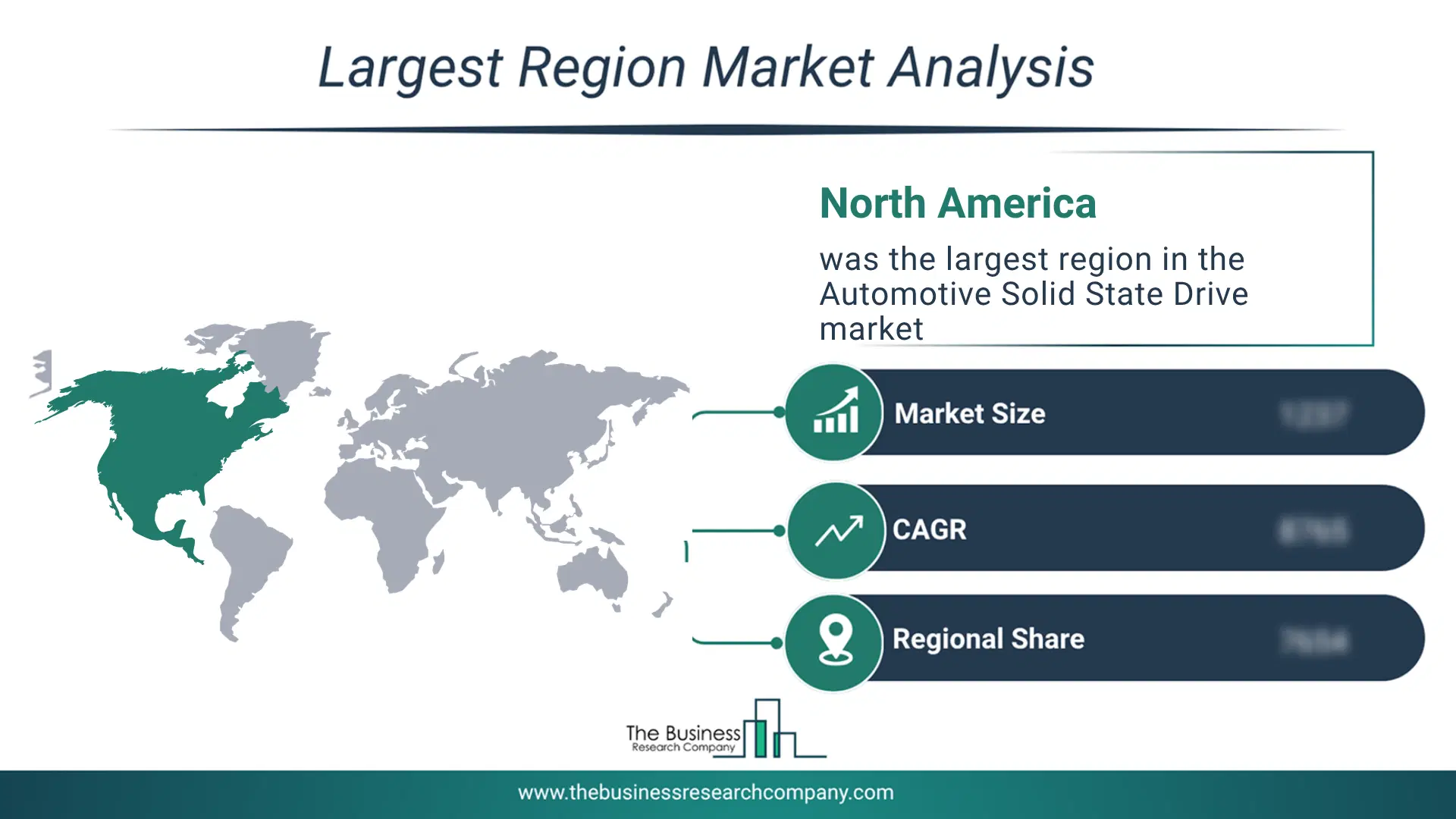
Regional Outlook
North America was the largest region in the automotive solid state drive market in 2025. The regions covered in this market report include Asia-Pacific, South East Asia, Western Europe, Eastern Europe, North America, South America, Middle East, Africa. The countries covered in this market report include Australia, Brazil, China, France, Germany, India, Indonesia, Japan, Taiwan, Russia, South Korea, UK, USA, Canada, Italy, SpainWhat Defines the Automotive Solid State Drive Market?
The automotive solid-state drive market consists of sales of embedded storage solutions, automotive-grade memory chips, controllers and firmware, and connectivity modules. Values in this market are ‘factory gate’ values, that is, the value of goods sold by the manufacturers or creators of the goods, whether to other entities (including downstream manufacturers, wholesalers, distributors, and retailers) or directly to end customers. The value of goods in this market includes related services sold by the creators of the goods.How is Market Value Defined and Measured?
The market value is defined as the revenues that enterprises gain from the sale of goods and/or services within the specified market and geography through sales, grants, or donations in terms of the currency (in USD unless otherwise specified). The revenues for a specified geography are consumption values that are revenues generated by organizations in the specified geography within the market, irrespective of where they are produced. It does not include revenues from resales along the supply chain, either further along the supply chain or as part of other products.
This chart presents market attractiveness based on a quantitative evaluation of growth, competition, strategic alignment, and risk, offering a clear view of opportunity areas for decision-making. This chart is for illustrative purposes; the full report contains the complete analysis.

This chart highlights the Total Addressable Market (TAM) by estimating the maximum revenue opportunity using an assumption-driven approach, supporting strategic planning and opportunity sizing across markets. The chart is illustrative; the full report provides a more comprehensive analysis.
What Key Data and Analysis Are Included in the Automotive Solid State Drive Market Report 2026?
The automotive solid state drive market research report is one of a series of new reports from The Business Research Company that provides market statistics, including industry global market size, regional shares, competitors with the market share, detailed market segments, market trends and opportunities, and any further data you may need to thrive in the automotive solid state drive industry. The market research report delivers a complete perspective of everything you need, with an in-depth analysis of the current and future state of the industry.Automotive Solid State Drive Market Report Forecast Analysis
| Report Attribute | Details |
|---|---|
| Market Size Value In 2026 | $2.38 billion |
| Revenue Forecast In 2030 | $3.38 billion |
| Growth Rate | CAGR of 9.1% from 2026 to 2030 |
| Base Year For Estimation | 2025 |
| Actual Estimates/Historical Data | 2020-2025 |
| Forecast Period | 2026 - 2030 - 2030 |
| Market Representation | Revenue in USD Billion and CAGR from 2026 to 2030 |
| Segments Covered | Type, Technology, Vehicle Type, Application |
| Regional Scope | Asia-Pacific, Western Europe, Eastern Europe, North America, South America, Middle East, Africa |
| Country Scope | The countries covered in the report are Australia, Brazil, China, France, Germany, India, Indonesia, Japan, Taiwan, Russia, South Korea, UK, USA, Canada, Italy, Spain. |
| Key Companies Profiled | Samsung Electronics Co. Ltd., Micron Technology Inc., SK hynix Inc., Kioxia Corporation, Western Digital Corporation, Intel Corporation, Toshiba Corporation, Phison Electronics Corporation, Innodisk Corporation, Transcend Information Inc., ADATA Technology Co. Ltd., BIWIN Storage Technology, Longsys Electronics Co. Ltd., Silicon Power Computer & Communications Inc., Netac Technology, Team Group Inc., Apacer Technology Inc., Swissbit AG, ATP Electronics Inc., Exascend |
| Customization Scope | Request for Customization |
| Pricing And Purchase Options | Explore Purchase Options |