

Automotive Turbocharger Hose Market Report 2026
Global Outlook – By Product (Extruded Charge Air Hoses, Suction Blow Molded Plastic Hoses, Wrapped Charge Air Hoses), By Vehicle Type (Passenger Vehicle, Light Commercial Vehicle, Heavy Commercial Vehicle, Other Vehicle Types), By Fuel (Gasoline, Diesel), By Distribution Channel (Original Equipment Manufacturer (OEM), Aftermarket) – Market Size, Trends, Strategies, and Forecast to 2030
Automotive Turbocharger Hose Market Overview
• Automotive Turbocharger Hose market size has reached to $16.35 billion in 2025 • Expected to grow to $27.38 billion in 2030 at a compound annual growth rate (CAGR) of 11.1% • Growth Driver: Surge In Light Commercial Vehicle Production Fuels Growth In The Automotive Turbocharger Hose Market • Market Trend: Elevating Performance In The Automotive Turbocharger Hose Market • Europe was the largest region in 2025 and Asia-Pacific is the fastest growing region.What Is Covered Under Automotive Turbocharger Hose Market?
Automotive turbocharger Hose refers to the flexible tubing that connects the turbocharger to the engine intake and intercooler, allowing for the flow of air under pressure. It is used to withstand high temperatures and boost pressures while maintaining optimal airflow for improved engine performance. The main products of automotive turbocharger hoses are extruded charge air hoses, suction blow molded plastic hoses, wrapped charge air hoses, and others. The extruded charge air hose is an extruded piece of equipment that enables the movement of heated and pressurized air from the turbine to the charge air cooler. They are used in vehicles such as passenger vehicles, light commercial vehicles, heavy commercial vehicles, and others that are powered by gasoline and diesel fuel. These products are typically distributed through channels such as original equipment manufacturers (OEM) and aftermarket.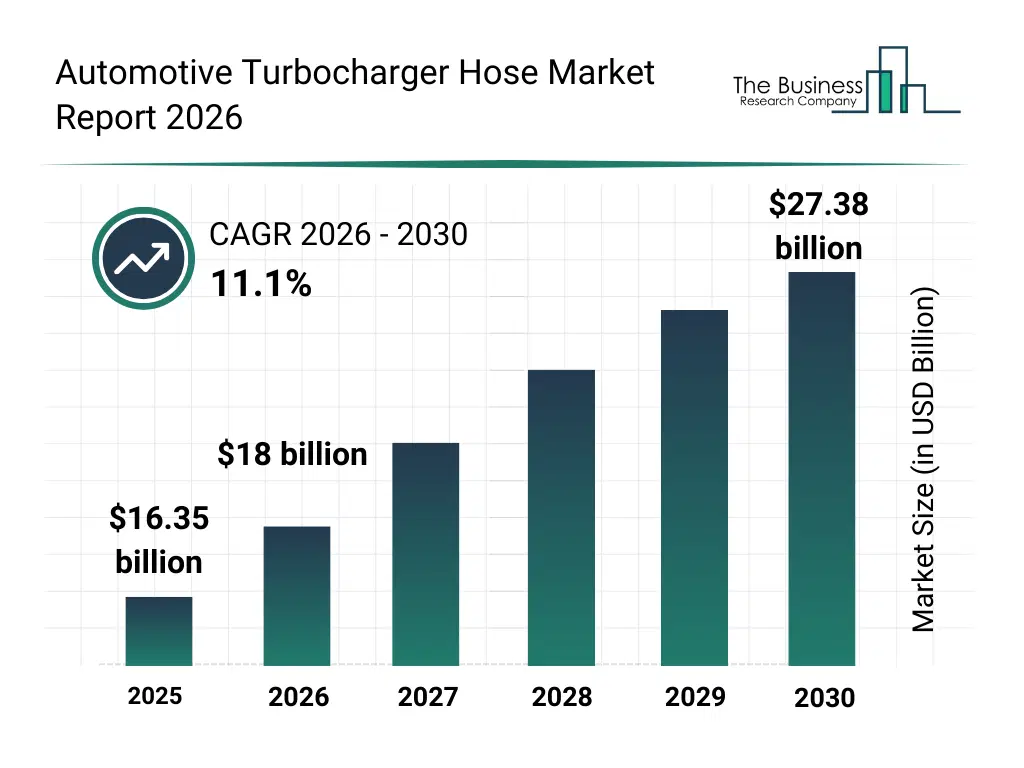
What Is The Automotive Turbocharger Hose Market Size and Share 2026?
The automotive turbocharger hose market size has grown rapidly in recent years. It will grow from $16.35 billion in 2025 to $18 billion in 2026 at a compound annual growth rate (CAGR) of 10.1%. The growth in the historic period can be attributed to engine downsizing trends, adoption of turbochargers in ic engines, growth of diesel vehicles, durability requirements, performance enhancement demand.What Is The Automotive Turbocharger Hose Market Growth Forecast?
The automotive turbocharger hose market size is expected to see rapid growth in the next few years. It will grow to $27.38 billion in 2030 at a compound annual growth rate (CAGR) of 11.1%. The growth in the forecast period can be attributed to turbocharged gasoline engine growth, hybrid vehicle integration, material innovation, demand for emission compliance, aftermarket expansion. Major trends in the forecast period include demand for high-temperature resistant hoses, shift toward lightweight materials, growth of turbocharged engines, expansion of aftermarket replacement, customization for performance vehicles.
Global Automotive Turbocharger Hose Market Segmentation
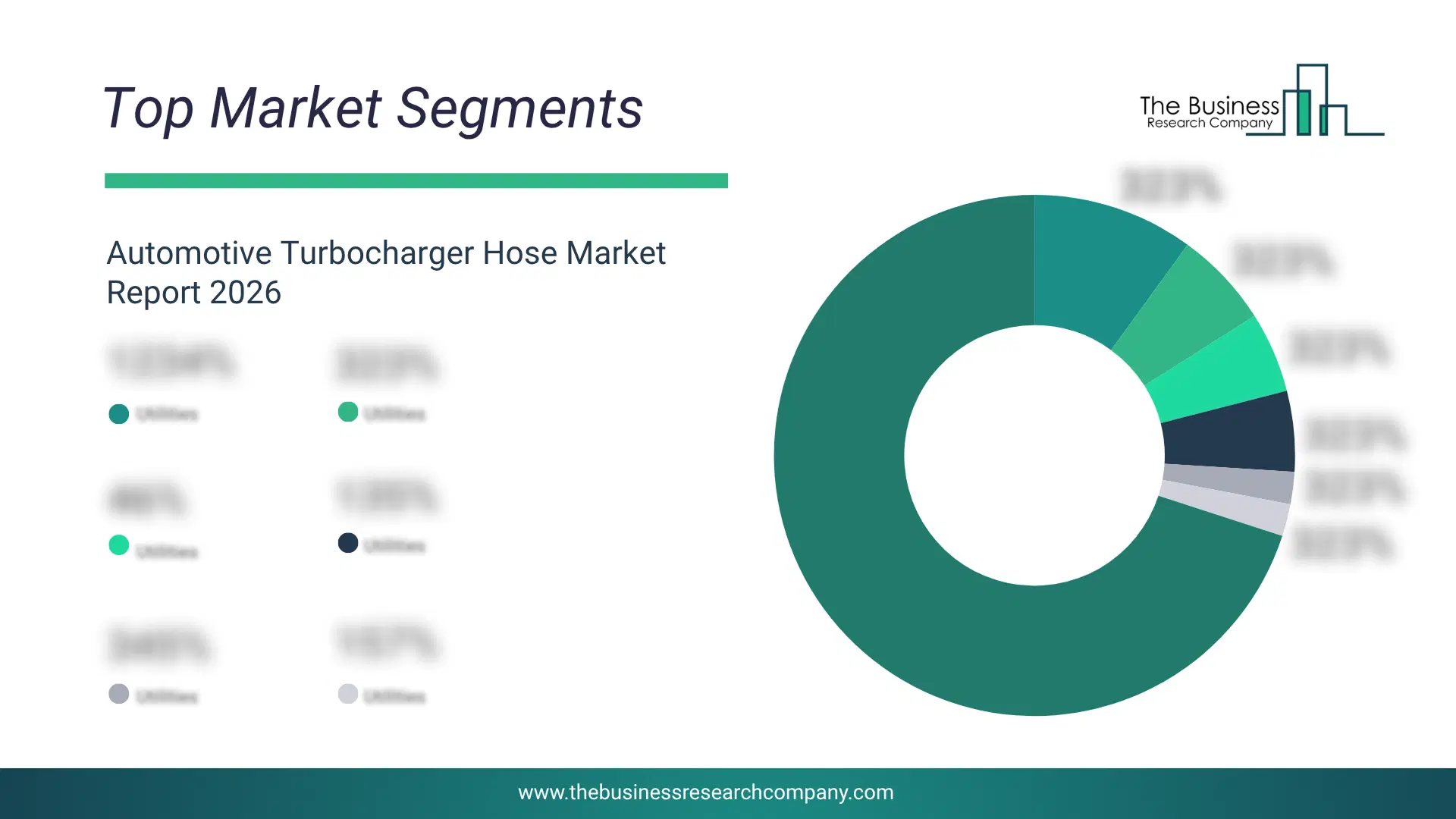
1) By Product: Extruded Charge Air Hoses, Suction Blow Molded Plastic Hoses, Wrapped Charge Air Hoses 2) By Vehicle Type: Passenger Vehicle, Light Commercial Vehicle, Heavy Commercial Vehicle, Other Vehicle Types 3) By Fuel: Gasoline, Diesel 4) By Distribution Channel: Original Equipment Manufacturer (OEM), Aftermarket Subsegments: 1) By Extruded Charge Air Hoses: Silicone Extruded Charge Air Hoses, EPDM Extruded Charge Air Hoses, Reinforced Extruded Charge Air Hoses 2) By Suction Blow Molded Plastic Hoses: Polypropylene (PP) Blow Molded Hoses, Polyethylene (PE) Blow Molded Hoses, Custom Blow Molded Plastic Hoses 3) By Wrapped Charge Air Hoses: Textile-Wrapped Charge Air Hoses, Fiberglass-Wrapped Charge Air Hoses, Rubber-Wrapped Charge Air HosesWhat Are The Drivers Of The Automotive Turbocharger Hose Market?
The growing production of light commercial vehicles is expected to propel the growth of the automotive turbocharger hose market going forward. A light commercial vehicle (LCV) is any cargo truck with an operational weight under 7.5 tons. In LCVs, turbocharger hoses transfer air to the vehicle's turbocharger, ensuring optimal engine operation. For instance, in June 2023, according to the Federal Reserve Board, a US-based central banking system, the industrial production of light trucks in the US increased from 8.16 million units in December 2022 to 9.35 million units in May 2023. Therefore, the growing production of light commercial vehicles is driving the growth of the automotive turbocharger hose industry. The growing demand for fuel efficiency is expected to boost the growth of the automotive turbocharger hose market going forward. Fuel efficiency refers to the ability of a vehicle or system to utilize fuel effectively and economically, achieving optimal performance in terms of distance traveled or work done per unit of fuel consumed. The turbochargers, supported by hoses, boost engine efficiency by augmenting air intake, facilitating improved fuel combustion and overall enhanced fuel economy. For instance, in March 2024, according to the International Energy Agency, a France-based intergovernmental organization, reported that the updated standards became stricter, targeting an annual fuel-efficiency improvement of 8% for model years 2024–2025 and 10% for model year 2026. Therefore, growing demand for fuel efficiency is driving the growth of the automotive turbocharger hose industry.Key Players In The Global Automotive Turbocharger Hose Market
Major companies operating in the automotive turbocharger hose market report include Continental AG, Gates Industrial Corporation plc, Cooper Standard Automotive Inc., Toyoda Gosei Co. Ltd., Flexfab Horizons International Inc., Semperit Group, Marugo Rubber Industries Ltd., Viper Performance Hoses Ltd., Silflex Ltd., Bugiad GmbH, Turbo Ideal d.o.o., Federal Hose, Mega Flex Plastics Limited, Goodyou Elastomer Technology Solution Co. Ltd., NORMA Group, Hutchinson SA, Mackay Rubber Company, TI Fluid Systems, Codan Rubber A/S, Sumitomo Riko Company Limited, Tristone Flowtech Group
This chart is for illustrative purposes; the full report includes a detailed competitor analysis and comprehensive overview of the top 10 companies in the market.
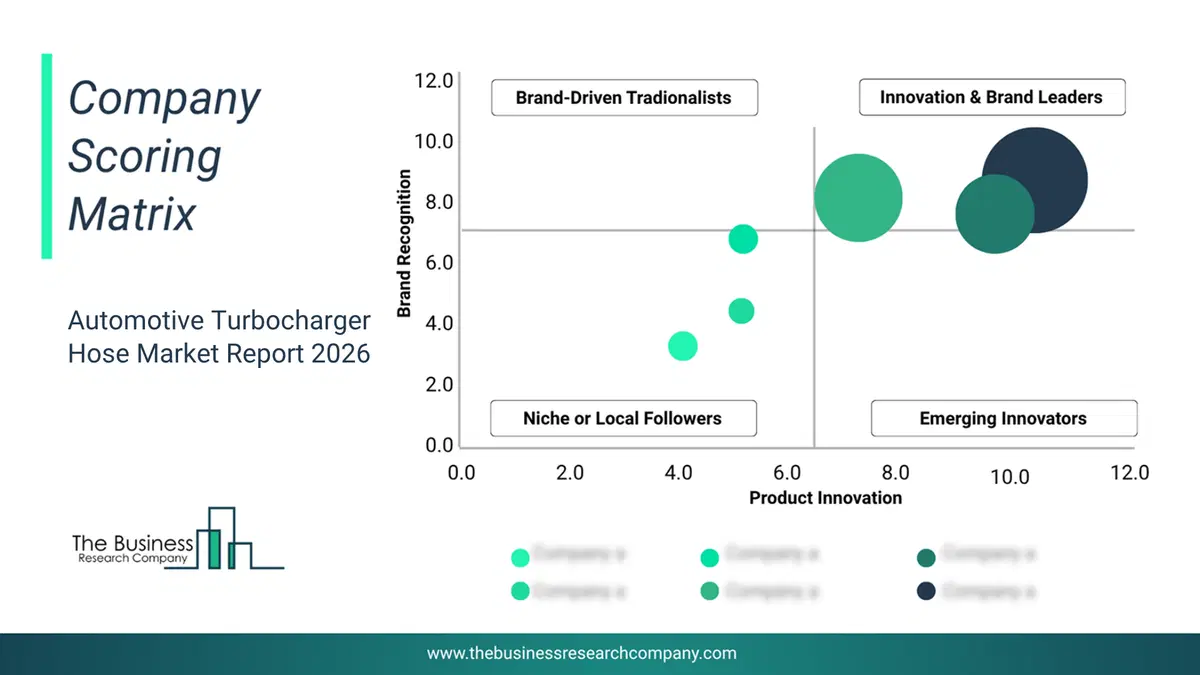
This chart maps companies by product innovation and brand strength, with bubble size indicating relative revenue, helping identify market leaders, challengers, and niche players. This is an illustrative chart; the full report provides a complete and accurate competitive analysis.
Global Automotive Turbocharger Hose Market Trends and Insights
Major companies operating in the automotive turbocharger hose market are developing innovative products, such as turbo intake hoses, to meet larger customer bases, increase sales, and increase revenue. Turbo intake hoses are components of a vehicle's air intake system designed specifically for turbocharged engines. For instance, in May 2023, AIRTEC Motorsport, a UK-based provider of performance-enhancing cooling products and solutions, launched the Stinger GT turbo hose kit. Crafted in-house at AIRTEC HQ in the UK, the Stinger GT turbo hose kit serves as a distinctive upgrade, replacing the stock intake hoses connecting the air boxes to the turbos. Constructed from premium-grade silicone, this innovatively redesigned kit not only enhances capacity but also ensures smoother internal airflow. Versatility is a key attribute, allowing compatibility with both the original air boxes and the AIRTEC Motorsport induction kit. The outcome is an elevated throttle response, intensified induction noise, and an aesthetically pleasing transformation to the engine bay, making the Stinger GT turbo hose kit a unique and desirable feature for automotive enthusiasts.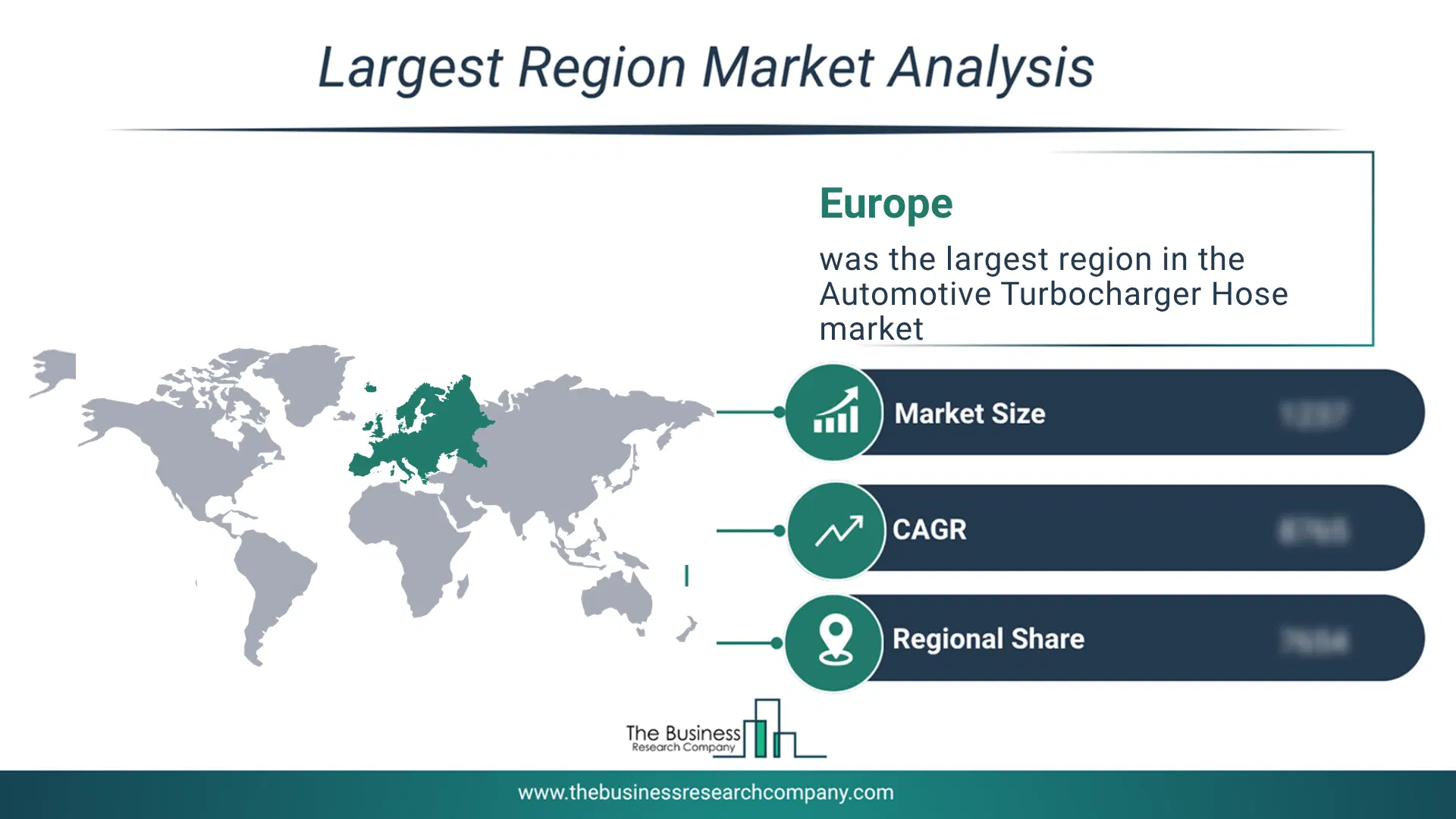
Regional Outlook
Europe was the largest region in the automotive turbocharger hose market in 2025. Asia-Pacific is expected to be the fastest-growing region in the forecast period. The regions covered in this market report include Asia-Pacific, South East Asia, Western Europe, Eastern Europe, North America, South America, Middle East, Africa. The countries covered in this market report include Australia, Brazil, China, France, Germany, India, Indonesia, Japan, Taiwan, Russia, South Korea, UK, USA, Canada, Italy, SpainWhat Defines the Automotive Turbocharger Hose Market?
The automotive turbocharger hose market consists of sales of orange silicone turbocharger hoses, vista turbocharger hoses, and rubber Volvo 210 turbocharger hoses. Values in this market are ‘factory gate’ values, that is, the value of goods sold by the manufacturers or creators of the goods, whether to other entities (including downstream manufacturers, wholesalers, distributors, and retailers) or directly to end customers. The value of goods in this market includes related services sold by the creators of the goods.How is Market Value Defined and Measured?
The market value is defined as the revenues that enterprises gain from the sale of goods and/or services within the specified market and geography through sales, grants, or donations in terms of the currency (in USD unless otherwise specified). The revenues for a specified geography are consumption values that are revenues generated by organizations in the specified geography within the market, irrespective of where they are produced. It does not include revenues from resales along the supply chain, either further along the supply chain or as part of other products.
This chart presents market attractiveness based on a quantitative evaluation of growth, competition, strategic alignment, and risk, offering a clear view of opportunity areas for decision-making. This chart is for illustrative purposes; the full report contains the complete analysis.

This chart highlights the Total Addressable Market (TAM) by estimating the maximum revenue opportunity using an assumption-driven approach, supporting strategic planning and opportunity sizing across markets. The chart is illustrative; the full report provides a more comprehensive analysis.
What Key Data and Analysis Are Included in the Automotive Turbocharger Hose Market Report 2026?
The automotive turbocharger hose market research report is one of a series of new reports from The Business Research Company that provides market statistics, including industry global market size, regional shares, competitors with the market share, detailed market segments, market trends and opportunities, and any further data you may need to thrive in the automotive turbocharger hose industry. The market research report delivers a complete perspective of everything you need, with an in-depth analysis of the current and future state of the industry.Automotive Turbocharger Hose Market Report Forecast Analysis
| Report Attribute | Details |
|---|---|
| Market Size Value In 2026 | $18 billion |
| Revenue Forecast In 2030 | $27.38 billion |
| Growth Rate | CAGR of 10.1% from 2026 to 2030 |
| Base Year For Estimation | 2025 |
| Actual Estimates/Historical Data | 2020-2025 |
| Forecast Period | 2026 - 2030 - 2030 |
| Market Representation | Revenue in USD Billion and CAGR from 2026 to 2030 |
| Segments Covered | Product, Vehicle Type, Fuel, Distribution Channel |
| Regional Scope | Asia-Pacific, Western Europe, Eastern Europe, North America, South America, Middle East, Africa |
| Country Scope | The countries covered in the report are Australia, Brazil, China, France, Germany, India, Indonesia, Japan, Taiwan, Russia, South Korea, UK, USA, Canada, Italy, Spain. |
| Key Companies Profiled | Continental AG, Gates Industrial Corporation plc, Cooper Standard Automotive Inc., Toyoda Gosei Co. Ltd., Flexfab Horizons International Inc., Semperit Group, Marugo Rubber Industries Ltd., Viper Performance Hoses Ltd., Silflex Ltd., Bugiad GmbH, Turbo Ideal d.o.o., Federal Hose, Mega Flex Plastics Limited, Goodyou Elastomer Technology Solution Co. Ltd., NORMA Group, Hutchinson SA, Mackay Rubber Company, TI Fluid Systems, Codan Rubber A/S, Sumitomo Riko Company Limited, Tristone Flowtech Group |
| Customization Scope | Request for Customization |
| Pricing And Purchase Options | Explore Purchase Options |