
Autonomous AI And Autonomous Agents Market Report 2026
Global Outlook – By Offering (Hardware, Software, Services), By Technology (Machine Learning, Natural Language Processing, Context Awareness, Computer Vision), By Vertical (Banking, Financial Services And Insurance (BFSI), Retail And Ecommerce, Telecommunications, Manufacturing, Healthcare And Life Sciences, Energy And Utilities, Automotive, Transportations And Logistics, Government And Defense, Media And Entertainment, Other Verticals) – Market Size, Trends, Strategies, and Forecast to 2030
Autonomous AI And Autonomous Agents Market Overview
• Autonomous AI And Autonomous Agents market size has reached to $9.97 billion in 2025 • Expected to grow to $59.09 billion in 2030 at a compound annual growth rate (CAGR) of 42.7% • Growth Driver: The Expanding Use of AI Across Enterprises Fueling Growth of the Autonomous AI And Autonomous Agents Market Due to Rising AI Deployment Across Industries • Market Trend: Autonomous Control AI Service For Edge Controllers Transforming The Market • North America was the largest region in 2025 and Asia-Pacific is the fastest growing region.Market Gains By 2030 – Top Opportunities By Segment
Market Gain identifies the most promising market opportunities by highlighting the segments or products expected to generate the highest incremental revenue growth over the next five years.
What Is Covered Under Autonomous AI And Autonomous Agents Market?
Autonomous AI and autonomous agents refer to systems or software entities that can operate and make decisions independently without direct human intervention. These systems leverage AI technologies and algorithms to analyse data, perceive their environment, learn from experience, and act in pursuit of specific goals. The main types of offerings in autonomous AI and autonomous agents are hardware, software, and services. Hardware refers to the physical components, devices, and equipment that make up a computer system or electronic device. It includes various technologies such as machine learning, natural language processing, context awareness, and computer vision. These are used for several verticals, including banking, financial services and insurance (BFSI), retail and e-commerce, telecommunications, manufacturing, healthcare and life sciences, energy, and utilities, automotive, transportation, and logistics, government and defense, media and entertainment, and others.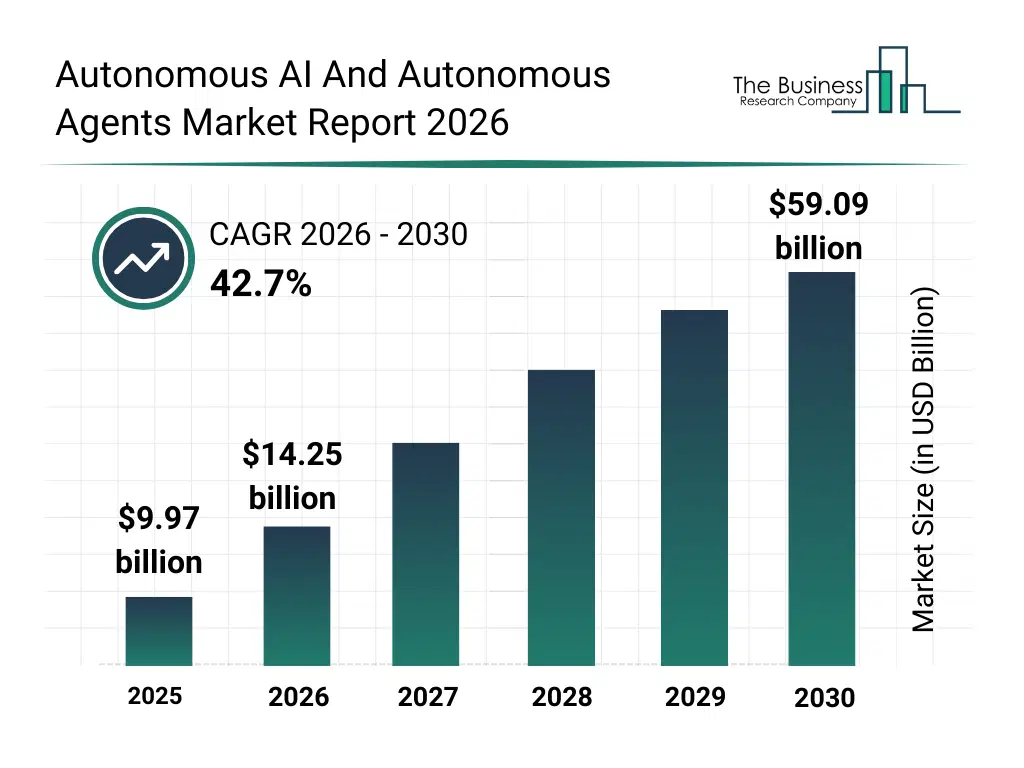
What Is The Autonomous AI And Autonomous Agents Market Size and Share 2026?
The autonomous AI and autonomous agents market size has grown exponentially in recent years. It will grow from $9.97 billion in 2025 to $14.25 billion in 2026 at a compound annual growth rate (CAGR) of 42.9%. The growth in the historic period can be attributed to growth of machine learning research, expansion of automation initiatives, early adoption of AI decision systems, increased availability of big data, cloud computing expansion.What Is The Autonomous AI And Autonomous Agents Market Growth Forecast?
The autonomous AI and autonomous agents market size is expected to see exponential growth in the next few years. It will grow to $59.09 billion in 2030 at a compound annual growth rate (CAGR) of 42.7%. The growth in the forecast period can be attributed to enterprise scale autonomous operations, rising adoption of agent based automation, integration with robotics platforms, demand for real time decision intelligence, expansion of autonomous digital workflows. Major trends in the forecast period include self learning autonomous software agents, decision making without human intervention, context aware intelligent systems, multi agent collaboration frameworks, real time autonomous task execution.
Global Autonomous AI And Autonomous Agents Market Segmentation
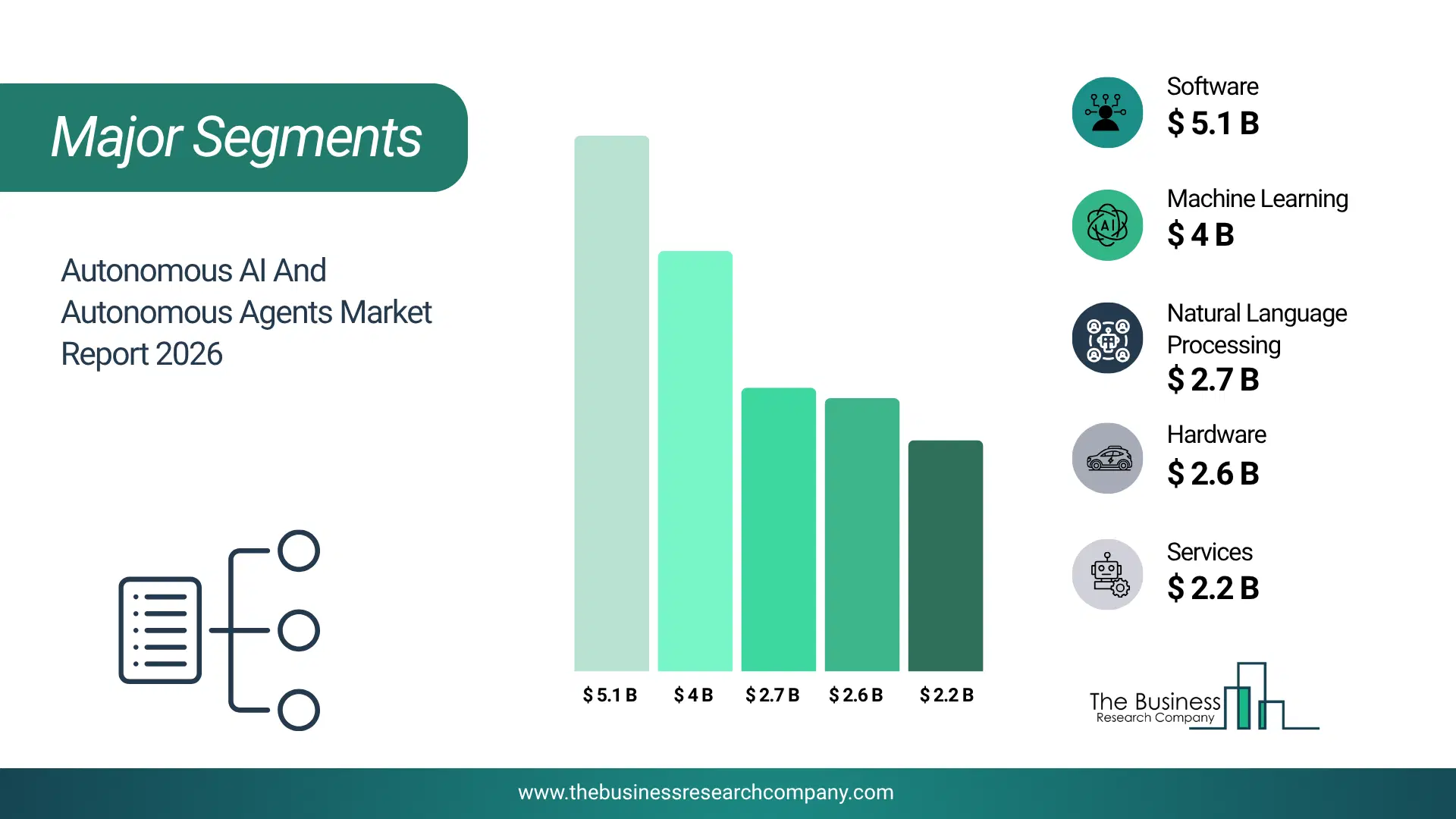
1) By Offering: Hardware, Software, Services 2) By Technology: Machine Learning, Natural Language Processing, Context Awareness, Computer Vision 3) By Vertical: Banking, Financial Services And Insurance (BFSI), Retail And Ecommerce, Telecommunications, Manufacturing, Healthcare And Life Sciences, Energy And Utilities, Automotive, Transportations And Logistics, Government And Defense, Media And Entertainment, Other Verticals Subsegments: 1) By Hardware: Sensors, Actuators, Computing Units, Robotics Platforms 2) By Software: Machine Learning Algorithms, Natural Language Processing (NLP) Software, Computer Vision Software, Simulation Software, Autonomous Navigation Software 3) By Service: Consulting Services, Integration Services, Maintenance And Support Services, Training And Development Services The top segments in the autonomous ai and autonomous agents market will be: • Software will reach $5107.67 Million by 2025. • Machine Learning will reach $4099.33 Million by 2025. • Natural Language Processing will reach $2720.79 Million by 2025. • Hardware will reach $2652.12 Million by 2025. • Services will reach $2210.99 Million by 2025.What Is The Driver Of The Autonomous AI And Autonomous Agents Market?
The increasing artificial intelligence (AI) applications are expected to propel the growth of the autonomous AI and autonomous agents market going forward. Artificial intelligence (AI) applications refer to practically implementing and utilisation of artificial intelligence (AI) technologies in various domains and sectors. The growing use of artificial intelligence (AI) applications is due to organisations seeking smarter, faster, and more efficient processes that reduce manual effort, enhance accuracy, and deliver seamless, data-driven decision-making. Autonomous AI and autonomous agents use artificial intelligence (AI) for enhanced efficiency, improved decision-making, risk reduction, and cost savings. For instance, in January 2025, according to Eurostat, an EU-based government statistics agency, in 2024, the share of enterprises that used artificial intelligence technologies rose from 8.0% in 2023 to 13.5% in 2024. Therefore, the increasing artificial intelligence (AI) applications are driving the growth of the autonomous AI and autonomous agents industry.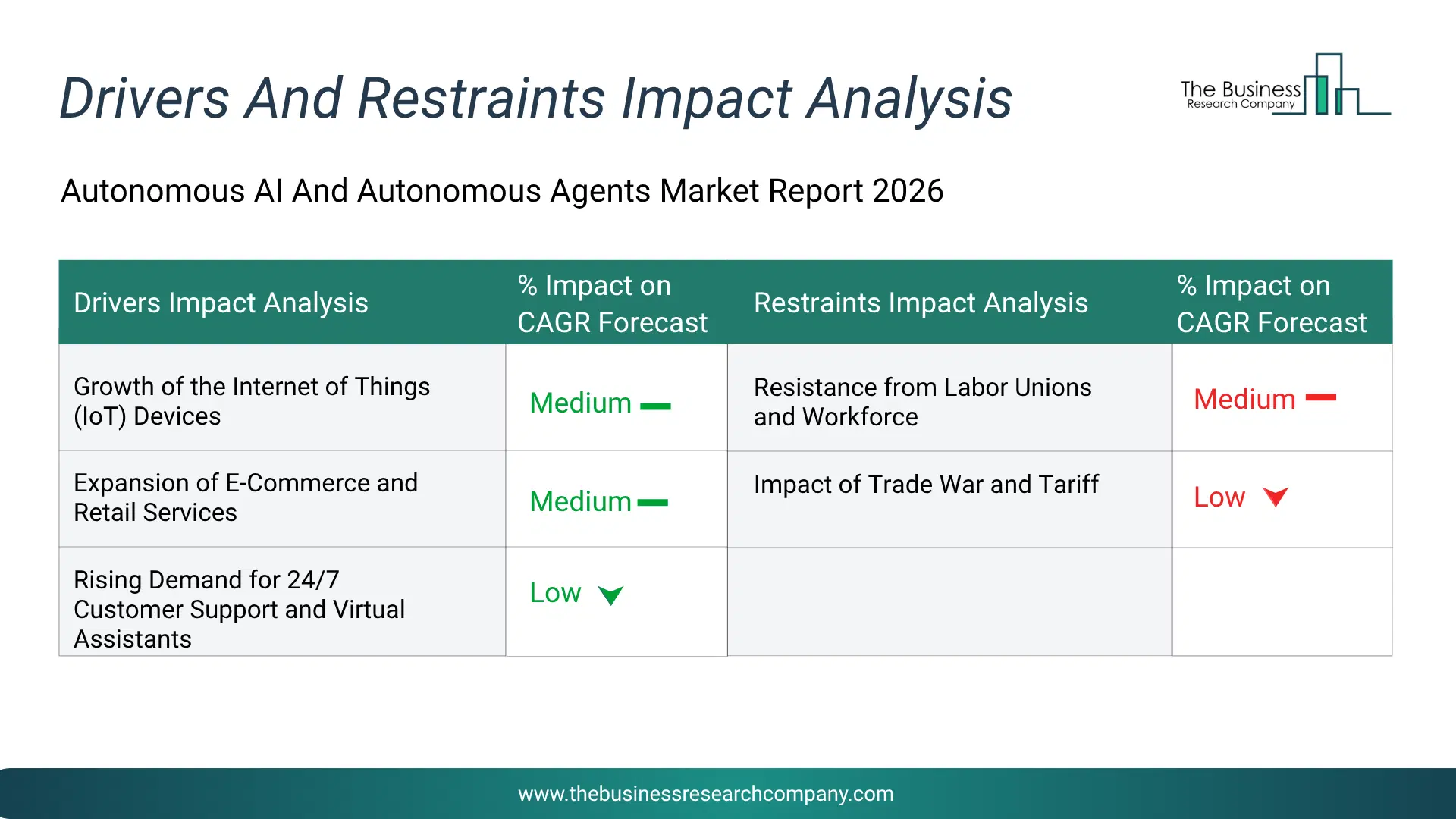
Infographic Chart Showing Key Market Drivers Analysis And Restraints For Autonomous Ai And Autonomous Agents Market
The chart presents an impact analysis of key drivers and restraints, quantifying their relative influence on the market's growth rate and helping assess the balance between growth enablers and limiting factors. This chart offers a high-level perspective; the full report contains more detailed insights.
How Will The Drivers Impact Growth In The Global Autonomous AI And Autonomous Agents Market?
• Growth of the Internet of Things (IoT) Devices (Medium) – The growth of the internet of things (IoT) devices will become a key driver of growth in the autonomous AI and autonomous agents’ market by 2030. IoT devices generate continuous streams of real-time data from sensors, machinery and various environments. This wealth of information serves as critical input for autonomous AI systems, enabling them to enhance learning capabilities, refine decision-making processes and boost overall performance. By enabling seamless connectivity, IoT allows these systems to coordinate actions and adapt autonomously across industries like manufacturing, healthcare and transportation. Additionally, embedded sensors help monitor equipment health, predict failures and optimize maintenance, resulting in reduced downtime and cost savings. As a result, the growth of the internet of things (IoT) devices is anticipated to contributing to a 1.2% annual growth in the market. • Expansion of E-Commerce and Retail Services (Medium) – The expansion of e-commerce and retail services will emerge as a major factor driving the expansion of the autonomous AI and autonomous agents market by 2030. Autonomous AI agents provide real-time analysis of customer behaviour, enabling personalized recommendations, dynamic pricing and targeted marketing that boost customer satisfaction and sales. They also optimize supply chain functions such as inventory management, demand forecasting and logistics, reducing costs and improving delivery speed. AI-powered chatbots deliver round-the-clock customer support, efficiently resolving queries and processing returns without human intervention, enhancing operational efficiency. Additionally, autonomous robots streamline warehouse tasks like sorting and packaging, increasing accuracy and throughput while lowering labour costs and errors. Together, these technologies drive greater efficiency and competitive advantage across e-commerce operations. Consequently, the accelerating expansion of e-commerce and retail services capabilities is projected to contributing to a 1.0% annual growth in the market. • Rising Demand for 24/7 Customer Support and Virtual Assistants (Low) – The rising demand for 24/7 customer support and virtual assistants processes will serve as a key growth catalyst for the autonomous AI and autonomous agents market by 2030. Autonomous AI-driven virtual assistants and chatbots ensure uninterrupted service by providing immediate responses across all time zones and holidays, significantly enhancing customer satisfaction and fostering loyalty. By automating routine tasks, they reduce the need for large support teams, cutting operational costs while maintaining service quality. These solutions also offer excellent scalability, efficiently handling high volumes of inquiries during peak periods without delays. Additionally, advanced AI analyzes customer preferences and history to offer personalized interactions and recommendations, driving stronger engagement and repeat business. Therefore, this rising demand for 24/7 customer support and virtual assistants operations is projected to supporting to a 0.8% annual growth in the market. • Growing Automation in Industries (Low) – The growing automation in industries will become a significant driver contributing to the growth of the autonomous AI and autonomous agents market by 2030. Automation reduces manual effort in repetitive and complex tasks, enabling industries to enhance productivity and accuracy. Autonomous AI agents streamline processes like manufacturing, quality control and logistics, driving faster and more cost-effective operations. In high-risk environments, these agents improve safety by performing hazardous tasks and minimizing human exposure. Continuous monitoring and predictive maintenance help detect equipment issues early, reducing downtime and costs. Additionally, automated systems offer the flexibility to quickly adapt to changing demands and scale operations efficiently without large increases in labour or infrastructure. Consequently, the growing automation in industries strategies is projected to contributing to a 0.5% annual growth in the market.How Will The Restraints Impact Growth In The Global Autonomous AI And Autonomous Agents Market?
• Complex Integration with Legacy Systems (Medium) – Complex Integration with Legacy Systems will restrict the growth of the Autonomous AI And Autonomous Agents market during the forecast period. Integrating autonomous AI agents with existing legacy systems presents significant technical challenges, including compatibility issues and data silos. The complexity of integrating AI capabilities with established workflows can lead to implementation delays and increased costs. Legacy system constraints may limit the effectiveness of autonomous AI solutions and slow market adoption. • Resistance from Labor Unions and Workforce (Low) – Resistance from Labor Unions and Workforce will restrict the growth of the Autonomous AI And Autonomous Agents market during the forecast period. The deployment of autonomous AI agents raises concerns about job displacement and automation replacing human workers. Labor union resistance and employee fears about job security can slow the adoption of autonomous AI solutions. Workforce opposition may lead to regulatory restrictions and limit market growth in certain sectors. • Impact of Trade War and Tariff (Low) – Impact of Trade War and Tariff will restrict the growth of the Autonomous AI And Autonomous Agents market during the forecast period. Trade tensions and economic uncertainty can affect technology investment and AI adoption across industries. Reduced business spending during economic uncertainty may limit the deployment of autonomous AI solutions. Trade barriers may also impact the availability of AI technologies and expertise.Key Players In The Global Autonomous AI And Autonomous Agents Market
Major companies operating in the autonomous AI and autonomous agents market are Alphabet Inc.; Microsoft Corporation; Amazon Web Services Inc.; Siemens AG; Intel Corporation; Accenture PLC; International Business Machines (IBM) Corporation; Oracle Corporation; Schneider Electric; NVIDIA Corporation; Salesforce Inc.; Cognizant Technology Solutions Corp.; Infosys Limited; Wipro Limited; SAS Institute Inc.; Waymo LLC; Fair Isaac Corporation (FICO); UiPath; DeepMind Technologies Limited; Nuance Communications Inc.; Blue River Technology; OpenAI; Fetch.ai; Affectiva Inc.; Cognitivescale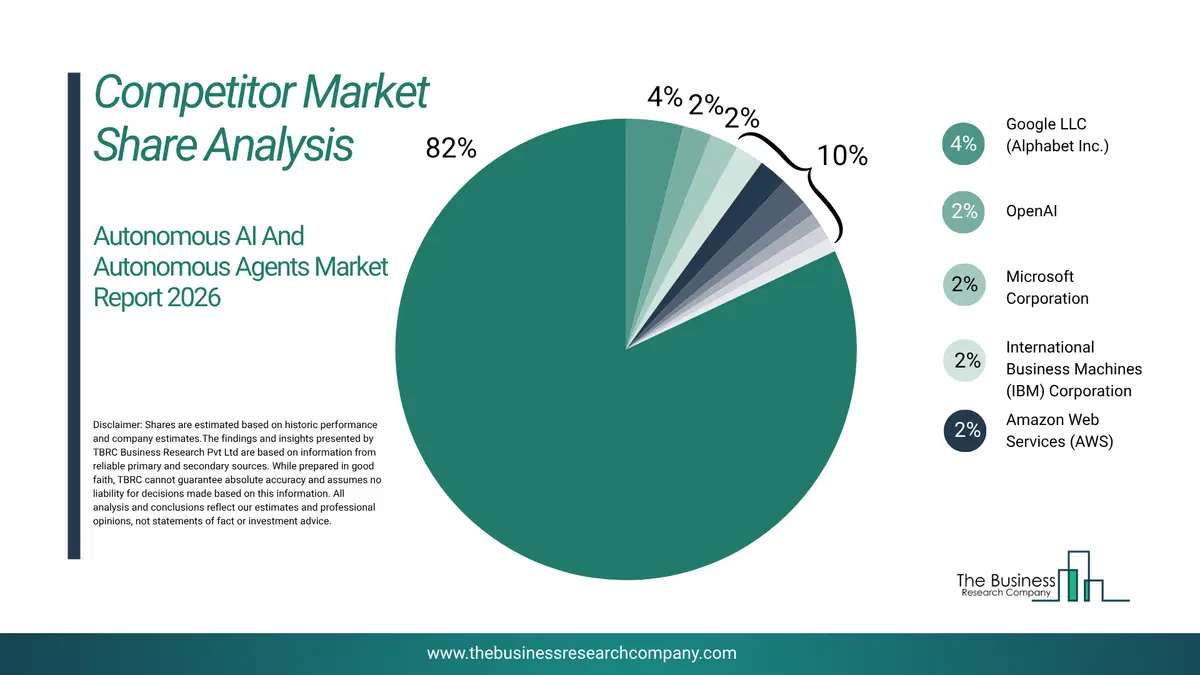
This chart is for illustrative purposes; the full report includes a detailed competitor analysis and comprehensive overview of the top 10 companies in the market.
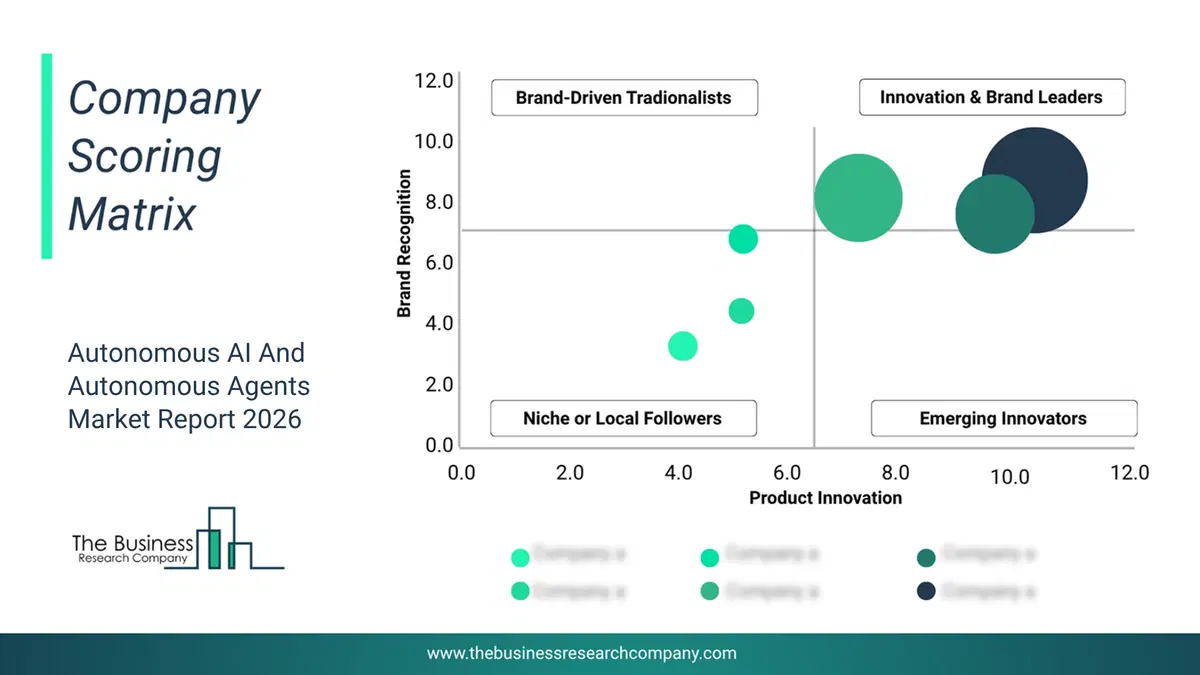
This chart maps companies by product innovation and brand strength, with bubble size indicating relative revenue, helping identify market leaders, challengers, and niche players. This is an illustrative chart; the full report provides a complete and accurate competitive analysis.
Global Autonomous AI And Autonomous Agents Market Trends and Insights
Major companies operating in the autonomous AI and autonomous agent market are developing new products, such as an autonomous control AI service for edge controllers to gain a competitive edge in the market. Edge controllers are devices designed to manage and control processes or operations at the edge of a network, closer to the data source or endpoint, rather than relying solely on centralised cloud or data centre processing. For instance, in February 2023, Yokogawa Electric Corporation, a Japan-based information technology company, launched an autonomous control AI service for its OpreX Realtime OS-based Machine Controllers (e-RT3 Plus). The service, utilising the Factorial Kernel Dynamic Policy Programming (FKDPP) reinforcement learning AI algorithm, allows for the creation of AI control models for edge controllers, enabling autonomous control in areas beyond the capabilities of conventional methods. The FKDPP technology demonstrated its effectiveness in autonomously controlling a chemical plant during a 35-day field test, showcasing its potential to enhance productivity, reduce energy consumption, and stabilise control in complex processes.What Are Latest Mergers And Acquisitions In The Autonomous AI And Autonomous Agents Market?
In March 2024, Zendesk, a US-based software-as-a-service company, acquired Ultimate for an undisclosed amount. Through this acquisition, Zendesk aims to enhance customer experience capabilities by integrating advanced AI agents that can automate up to 80% of support requests, allowing businesses to deliver proactive, personalised support and enabling human agents to focus on more complex challenges, ultimately transforming CX into a competitive advantage. Ultimate is a US-based automation company and a Finnish service automation provider that specialises in AI-driven customer support solutions.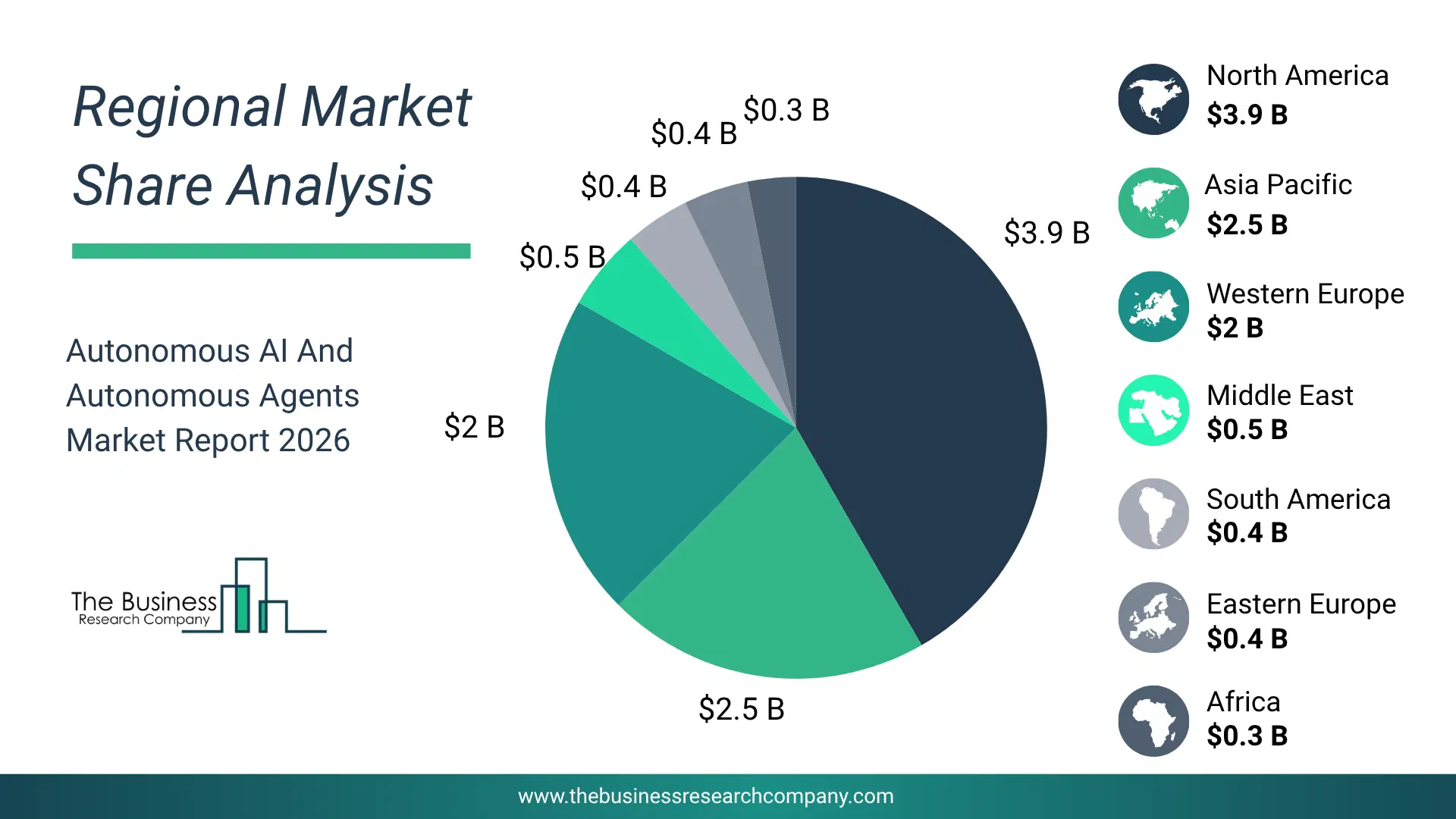
Regional Insights
North America was the largest region in the autonomous AI and autonomous agents market in 2025. Asia-Pacific is expected to be the fastest-growing region in the forecast period. The regions covered in this market report are Asia-Pacific, South East Asia, Western Europe, Eastern Europe, North America, South America, Middle East, Africa. The countries covered in this market report are Australia, Brazil, China, France, Germany, India, Indonesia, Japan, Taiwan, Russia, South Korea, UK, USA, Canada, Italy, SpainWhat Defines the Autonomous AI And Autonomous Agents Market?
The autonomous AI and autonomous agents market consists of revenues earned by entities by providing industrial automation services, autonomous vehicle services, virtual assistant services, smart home services, financial services, and customer support services. The market value includes the value of related goods sold by the service provider or included within the service offering. The autonomous AI and autonomous agent market also includes sales of robotics systems, smart home systems, financial trading systems, and virtual assistants that are used in providing autonomous AI and autonomous agent services. Values in this market are ‘factory gate’ values, that is, the value of goods sold by the manufacturers or creators of the goods, whether to other entities (including downstream manufacturers, wholesalers, distributors, and retailers) or directly to end customers. The value of goods in this market includes related services sold by the creators of the goods.How is Market Value Defined and Measured?
The market value is defined as the revenues that enterprises gain from the sale of goods and/or services within the specified market and geography through sales, grants, or donations in terms of the currency (in USD unless otherwise specified). The revenues for a specified geography are consumption values that are revenues generated by organizations in the specified geography within the market, irrespective of where they are produced. It does not include revenues from resales along the supply chain, either further along the supply chain or as part of other products.
This chart presents market attractiveness based on a quantitative evaluation of growth, competition, strategic alignment, and risk, offering a clear view of opportunity areas for decision-making. This chart is for illustrative purposes; the full report contains the complete analysis.

This chart highlights the Total Addressable Market (TAM) by estimating the maximum revenue opportunity using an assumption-driven approach, supporting strategic planning and opportunity sizing across markets. The chart is illustrative; the full report provides a more comprehensive analysis.
What Key Data and Analysis Are Included in the Autonomous AI And Autonomous Agents Market Report 2026?
The autonomous ai and autonomous agents market research report is one of a series of new reports from The Business Research Company that provides market statistics, including industry global market size, regional shares, competitors with the market share, detailed market segments, market trends and opportunities, and any further data you may need to thrive in the autonomous ai and autonomous agents industry. The market research report delivers a complete perspective of everything you need, with an in-depth analysis of the current and future state of the industry.Autonomous AI And Autonomous Agents Market Report Forecast Analysis
| Report Attribute | Details |
|---|---|
| Market Size Value In 2026 | $14.25 billion |
| Revenue Forecast In 2030 | $59.09 billion |
| Growth Rate | CAGR of 42.9% from 2026 to 2030 |
| Base Year For Estimation | 2025 |
| Actual Estimates/Historical Data | 2020-2025 |
| Forecast Period | 2026 - 2030 |
| Market Representation | Revenue in USD Billion and CAGR from 2026 to 2030 |
| Segments Covered | Offering, Technology, Vertical |
| Regional Scope | Asia-Pacific, Western Europe, Eastern Europe, North America, South America, Middle East, Africa |
| Country Scope | The countries covered in the report are Australia, Brazil, China, France, Germany, India, Indonesia, Japan, Taiwan, Russia, South Korea, UK, USA, Canada, Italy, Spain. |
| Key Companies Profiled | Alphabet Inc.; Microsoft Corporation; Amazon Web Services Inc.; Siemens AG; Intel Corporation; Accenture PLC; International Business Machines (IBM) Corporation; Oracle Corporation; Schneider Electric; NVIDIA Corporation; Salesforce Inc.; Cognizant Technology Solutions Corp.; Infosys Limited; Wipro Limited; SAS Institute Inc.; Waymo LLC; Fair Isaac Corporation (FICO); UiPath; DeepMind Technologies Limited; Nuance Communications Inc.; Blue River Technology; OpenAI; Fetch.ai; Affectiva Inc.; Cognitivescale |
| Customization Scope | Request for Customization |
| Pricing And Purchase Options | Explore Purchase Options |