
Autonomous Cars Market Report 2026
Global Outlook – By Product Type (Semi-Autonomous Vehicles, Fully-Autonomous Vehicles), By Deployment Model (Private Ownership, Shared Mobility Fleets, Subscription & Fleet-as-a-Service (FaaS)), By Application (Robo Taxi, Ride Hail And Ride Sharing) – Market Size, Trends, Strategies, and Forecast to 2030
Autonomous Cars Market Overview
• Autonomous Cars market size has reached to $1304.49 billion in 2025 • Expected to grow to $2274.04 billion in 2030 at a compound annual growth rate (CAGR) of 11.9% • Growth Driver: Rising Traffic Congestion Accelerates The Autonomous Cars Market • Market Trend: Advancements In Full-Automation Vehicles Revolutionizing Urban Mobility • Asia-Pacific was the largest region in 2025 and Western Europe is the fastest growing region.What Is Covered Under Autonomous Cars Market?
An autonomous car means navigating a vehicle without human input from passengers using sensing equipment (LIDAR), environmentally sensitive control equipment, and navigation equipment. The main product types in the autonomous cars market are semi-autonomous vehicles and fully autonomous vehicles. Semi-autonomous vehicles are cars that will accelerate, decelerate, and stop without human intervention. The applications involved are civil, robot taxis, ride-hail, ride-share, and others. The types involved are battery electric vehicles (BEV), internal combustion engines (ICE), and hybrid electric vehicles (HEV).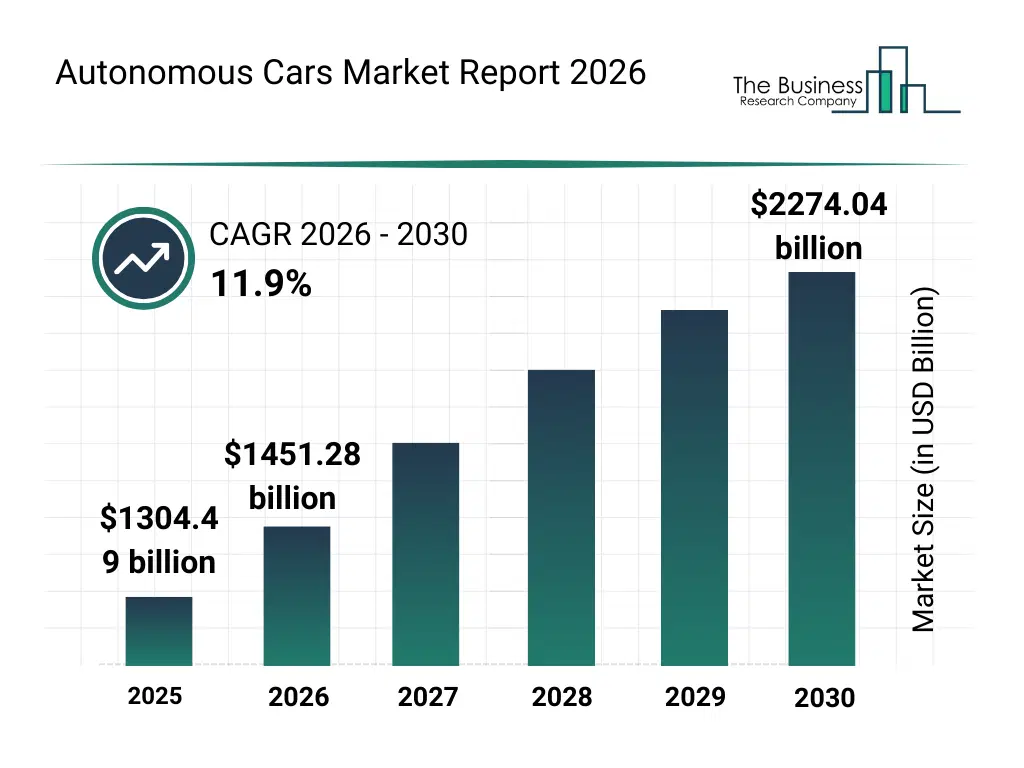
What Is The Autonomous Cars Market Size and Share 2026?
The autonomous cars market size has grown rapidly in recent years. It will grow from $1304.49 billion in 2025 to $1451.28 billion in 2026 at a compound annual growth rate (CAGR) of 11.3%. The growth in the historic period can be attributed to driver assistance regulations, automotive safety improvements, early semi-autonomous adoption, sensor cost reduction, connected vehicle infrastructure.What Is The Autonomous Cars Market Growth Forecast?
The autonomous cars market size is expected to see rapid growth in the next few years. It will grow to $2274.04 billion in 2030 at a compound annual growth rate (CAGR) of 11.9%. The growth in the forecast period can be attributed to full autonomy commercialization, ai algorithm advancements, electric autonomous vehicle rollout, smart city integration, shared mobility growth. Major trends in the forecast period include development of advanced driver assistance systems, integration of lidar and sensor fusion, growth of robo-taxi programs, expansion of autonomous software platforms, increased testing of level 4 vehicles.
Global Autonomous Cars Market Segmentation
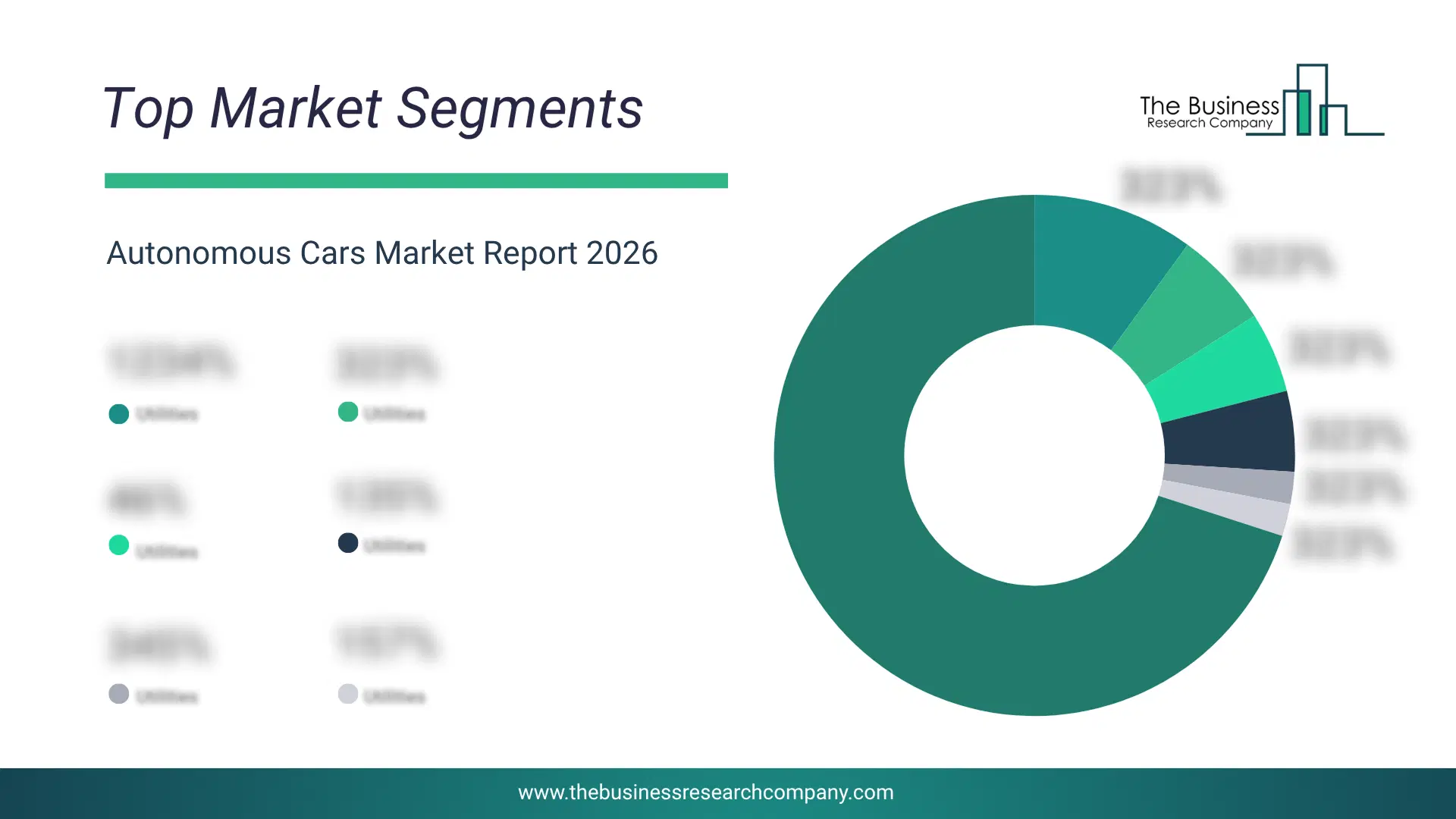
1) By Product Type: Semi-Autonomous Vehicles, Fully-Autonomous Vehicles 2) By Deployment Model: Private Ownership, Shared Mobility Fleets, Subscription & Fleet-as-a-Service (FaaS) 3) By Application: Robo Taxi, Ride Hail And Ride Sharing Subsegments: 1) By Semi-Autonomous Vehicles: Level 1 (Driver Assistance), Level 2 (Partial Automation), Level 3 (Conditional Automation) 2) By Fully-Autonomous Vehicles: Level 4 (High Automation), Level 5 (Full Automation)What Is The Driver Of The Autonomous Cars Market?
The rising traffic congestion is expected to boost the growth of the autonomous cars market going forward. Traffic congestion refers to a situation in which more vehicles are queuing up on the road, slower speeds, and longer travel times. Autonomous cars can communicate with each other and with traffic infrastructure, enabling coordinated and efficient traffic flow. They can anticipate traffic patterns and make real-time adjustments to optimize the use of roadways. For instance, in January 2025, according to the Highways News, a UK-based daily news service, the UK experienced a significant increase in traffic congestion in 2024, with average congestion levels rising to 20.4%, a 9% year-on-year increase compared to 18.7% in 2023. Therefore, the rising traffic congestion is driving the growth of the autonomous cars industry.Key Players In The Global Autonomous Cars Market
Major companies operating in the autonomous cars market report include Toyota Motor Corporation, Volkswagen AG, The Mercedes-Benz Group AG, Ford Motor Company, General Motors Company, BMW AG, Honda Motor Co. Ltd., Nissan Motor Co. Ltd., Volvo Car Group, Tesla Inc., Hyundai Motor Company, Audi AG, PSA Group, Renault, Jaguar Land Rover, NIO, Kia, Haval, Chevrolet, Fiat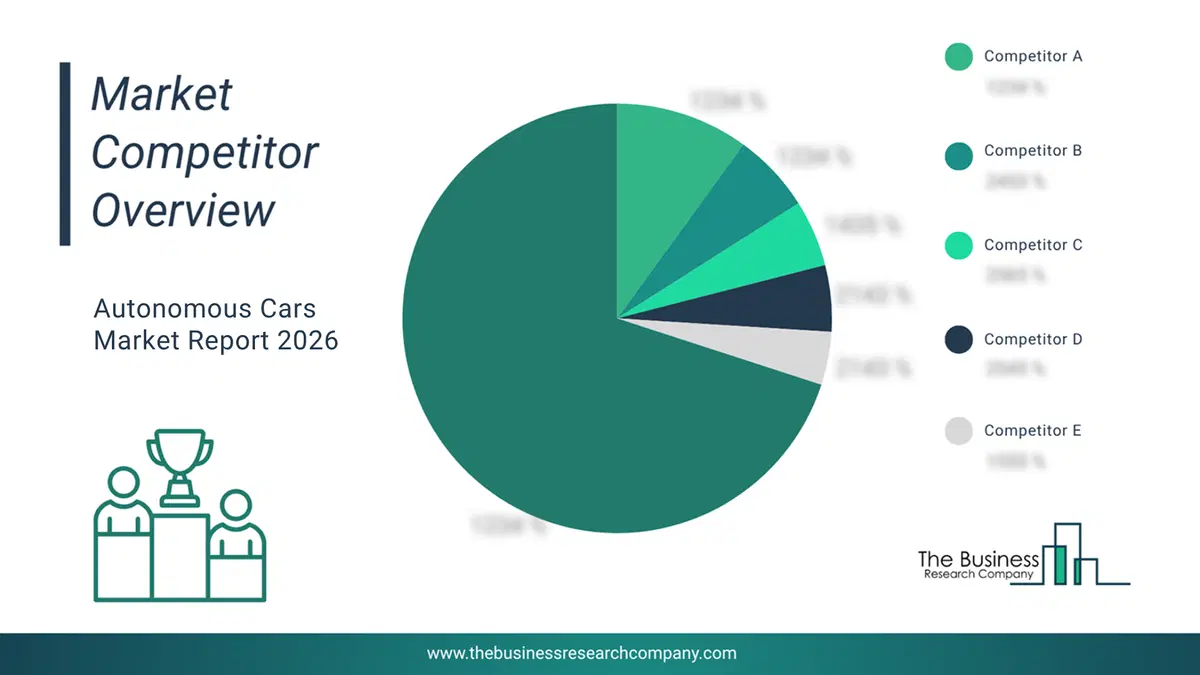
This chart is for illustrative purposes; the full report includes a detailed competitor analysis and comprehensive overview of the top 10 companies in the market.
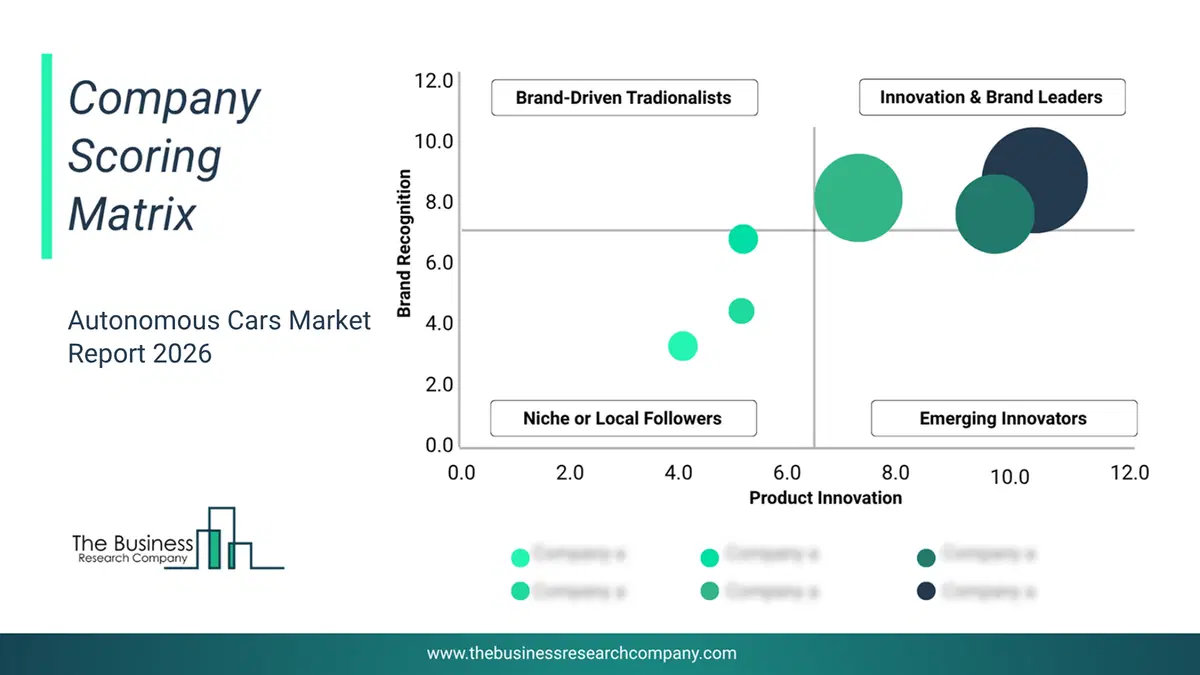
This chart maps companies by product innovation and brand strength, with bubble size indicating relative revenue, helping identify market leaders, challengers, and niche players. This is an illustrative chart; the full report provides a complete and accurate competitive analysis.
Global Autonomous Cars Market Trends and Insights
Major companies operating in the autonomous car market are focusing on developing full-automation vehicles capable of performing all driving functions without human intervention to enhance safety, efficiency, and urban mobility. These fully autonomous vehicles are being designed for applications such as Robo-taxis and next-generation public transportation, where advanced AI systems, high-definition mapping, and sensor technologies enable seamless navigation in complex environments. For instance, in May 2024, Renault Group, a France-based automobile manufacturer, prepared to introduce Level 4 autonomous vehicles for public transportation. These shuttles are designed to operate autonomously within designated areas and integrate smoothly with existing public transport networks. Leveraging cutting-edge hardware and software, the vehicles will independently navigate urban environments while prioritizing safety and reliability. This initiative is expected to enhance mobility in crowded cities and support future applications such as cargo transportation and emergency medical services.What Are Latest Mergers And Acquisitions In The Autonomous Cars Market?
In April 2025, Toyota Motor Corporation, a Japan-based manufacturer of automobiles and advanced mobility technologies, partnered with Waymo to enhance its autonomous driving capabilities by integrating Waymo’s self-driving technology into future vehicle platforms, accelerating development of next-generation personally owned vehicles and supporting its long-term zero-accident mobility vision. Waymo, a US-based developer of autonomous driving software and commercial robotaxi services.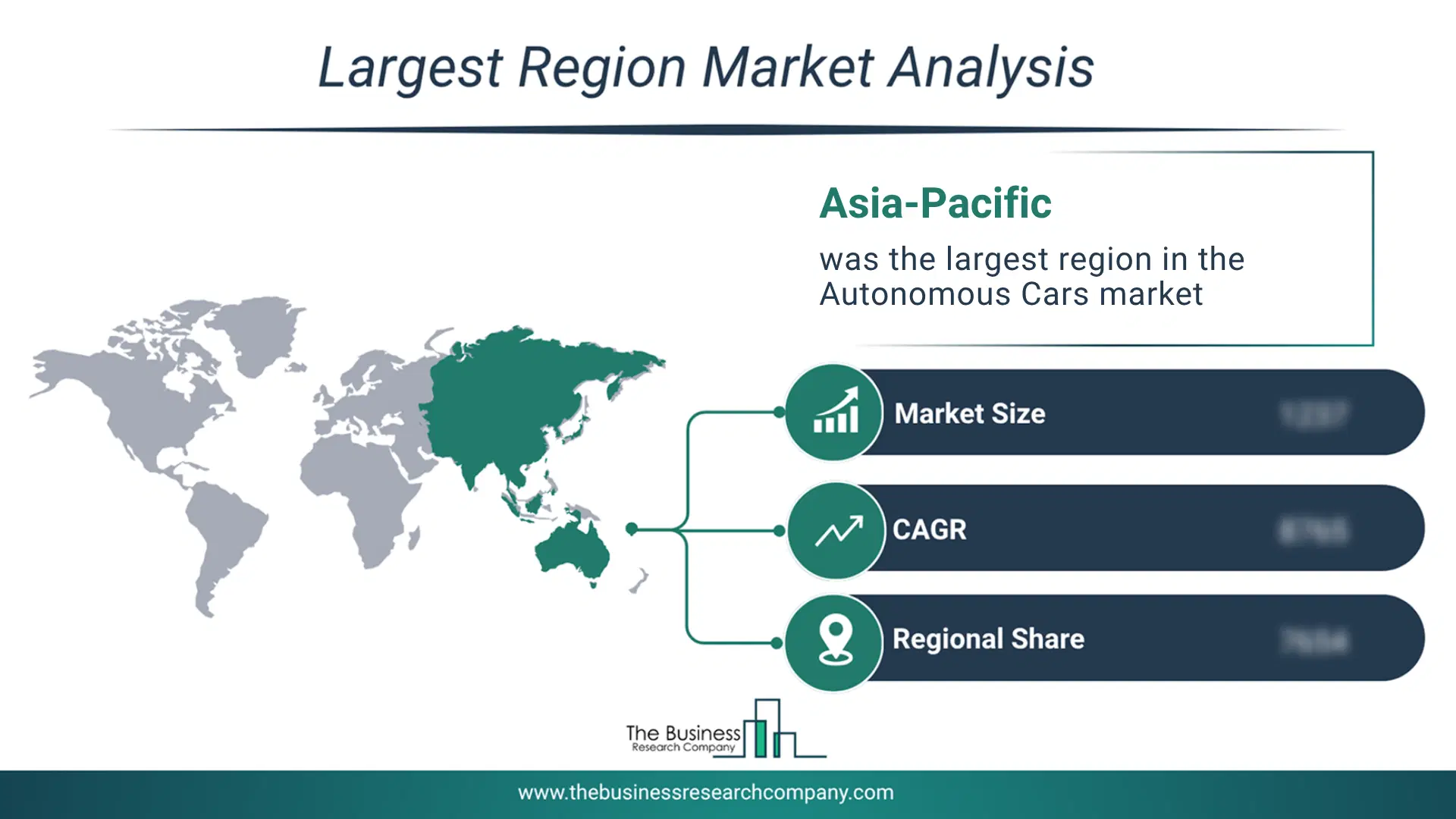
Regional Outlook
Asia-Pacific was the largest region in the autonomous cars market in 2025. Western Europe was the second largest region in the autonomous cars market share. The regions covered in this market report include Asia-Pacific, South East Asia, Western Europe, Eastern Europe, North America, South America, Middle East, Africa. The countries covered in this market report include Australia, Brazil, China, France, Germany, India, Indonesia, Japan, Taiwan, Russia, South Korea, UK, USA, Canada, Italy, SpainWhat Defines the Autonomous Cars Market?
The autonomous cars market consists of sales of driver assistance cars, partial automation cars, conditional automation cars and high automation cars. Values in this market are factory gate values, that is the value of goods sold by the manufacturers or creators of the goods, whether to other entities (including downstream manufacturers, wholesalers, distributors and retailers) or directly to end customers. The value of goods in this market includes related services sold by the creators of the goods.How is Market Value Defined and Measured?
The market value is defined as the revenues that enterprises gain from the sale of goods and/or services within the specified market and geography through sales, grants, or donations in terms of the currency (in USD unless otherwise specified). The revenues for a specified geography are consumption values that are revenues generated by organizations in the specified geography within the market, irrespective of where they are produced. It does not include revenues from resales along the supply chain, either further along the supply chain or as part of other products.
This chart presents market attractiveness based on a quantitative evaluation of growth, competition, strategic alignment, and risk, offering a clear view of opportunity areas for decision-making. This chart is for illustrative purposes; the full report contains the complete analysis.

This chart highlights the Total Addressable Market (TAM) by estimating the maximum revenue opportunity using an assumption-driven approach, supporting strategic planning and opportunity sizing across markets. The chart is illustrative; the full report provides a more comprehensive analysis.
What Key Data and Analysis Are Included in the Autonomous Cars Market Report 2026?
The autonomous cars market research report is one of a series of new reports from The Business Research Company that provides market statistics, including industry global market size, regional shares, competitors with the market share, detailed market segments, market trends and opportunities, and any further data you may need to thrive in the autonomous cars industry. The market research report delivers a complete perspective of everything you need, with an in-depth analysis of the current and future state of the industry.Autonomous Cars Market Report Forecast Analysis
| Report Attribute | Details |
|---|---|
| Market Size Value In 2026 | $1451.28 billion |
| Revenue Forecast In 2030 | $2274.04 billion |
| Growth Rate | CAGR of 11.3% from 2026 to 2030 |
| Base Year For Estimation | 2025 |
| Actual Estimates/Historical Data | 2020-2025 |
| Forecast Period | 2026 - 2030 - 2030 |
| Market Representation | Revenue in USD Billion and CAGR from 2026 to 2030 |
| Segments Covered | Product Type, Deployment Model, Application |
| Regional Scope | Asia-Pacific, Western Europe, Eastern Europe, North America, South America, Middle East, Africa |
| Country Scope | The countries covered in the report are Australia, Brazil, China, France, Germany, India, Indonesia, Japan, Taiwan, Russia, South Korea, UK, USA, Canada, Italy, Spain. |
| Key Companies Profiled | Toyota Motor Corporation, Volkswagen AG, The Mercedes-Benz Group AG, Ford Motor Company, General Motors Company, BMW AG, Honda Motor Co. Ltd., Nissan Motor Co. Ltd., Volvo Car Group, Tesla Inc., Hyundai Motor Company, Audi AG, PSA Group, Renault, Jaguar Land Rover, NIO, Kia, Haval, Chevrolet, Fiat |
| Customization Scope | Request for Customization |
| Pricing And Purchase Options | Explore Purchase Options |