
Autonomous Commercial Vehicle Market Report 2026
Global Outlook – By Vehicle (Truck, Trailer, Bus, Other Vehicle Types ), By Automation Level (Driver Assistance, Partial Automation, Conditional Automation, High Automation, Full Automation ), By Fuel Type (Conventional, Hybrid Vehicle, Electric Vehicle ) – Market Size, Trends, Strategies, and Forecast to 2030
Autonomous Commercial Vehicle Market Overview
• Autonomous Commercial Vehicle market size has reached to $11.48 billion in 2025 • Expected to grow to $26.22 billion in 2030 at a compound annual growth rate (CAGR) of 18.1% • Growth Driver: Increasing Demand For Efficient Transportation Drives Autonomous Commercial Vehicle Market Expansion • Market Trend: AI-Driven Autonomous Driving Innovations Accelerating The Transformation Of Commercial Freight Transport • Asia-Pacific was the largest region in 2025 and North America is the fastest growing region.Market Gains By 2030 – Top Opportunities By Segment
Market Gain identifies the most promising market opportunities by highlighting the segments or products expected to generate the highest incremental revenue growth over the next five years.
What Is Covered Under Autonomous Commercial Vehicle Market?
Autonomous commercial vehicle is a vehicle used for commercial purposes and has hardware and software that can perform the dynamic driving task without the active physical control or supervision of a human being. The main types of vehicles in autonomous commercial vehicles are trucks, trailers, buses, and others. The truck is a wheeled vehicle for moving heavy articles. The automation levels involved are driver assistance, partial automation, conditional automation, high automation, and full automation. The fuel types involved are conventional, hybrid vehicles, and electric vehicles.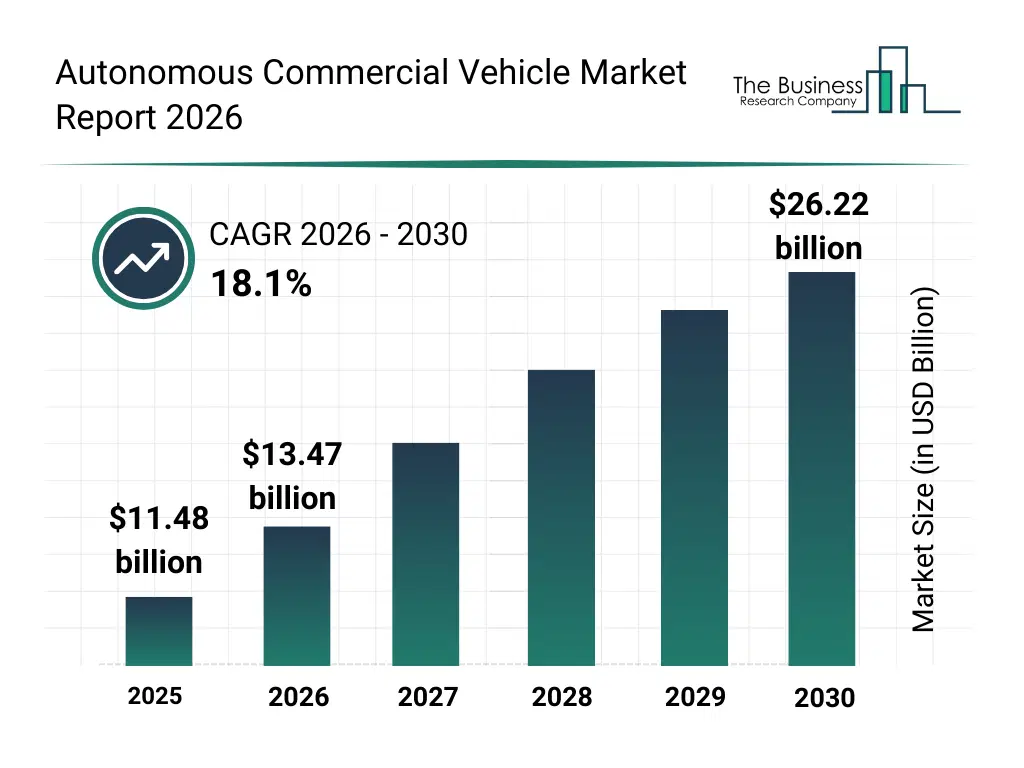
What Is The Autonomous Commercial Vehicle Market Size and Share 2026?
The autonomous commercial vehicle market size has grown rapidly in recent years. It will grow from $11.48 billion in 2025 to $13.47 billion in 2026 at a compound annual growth rate (CAGR) of 17.3%. The growth in the historic period can be attributed to logistics efficiency demand, driver shortage issues, early autonomous trucking pilots, fleet digitization, fuel cost optimization.What Is The Autonomous Commercial Vehicle Market Growth Forecast?
The autonomous commercial vehicle market size is expected to see rapid growth in the next few years. It will grow to $26.22 billion in 2030 at a compound annual growth rate (CAGR) of 18.1%. The growth in the forecast period can be attributed to autonomous logistics scalability, electric commercial vehicle adoption, AI-driven fleet optimization, regulatory approvals, smart highway infrastructure. Major trends in the forecast period include deployment of autonomous freight trucks, adoption of platooning technologies, integration of autonomous fleet management, expansion of last-mile automation, growth of electric autonomous commercial vehicles.
Global Autonomous Commercial Vehicle Market Segmentation
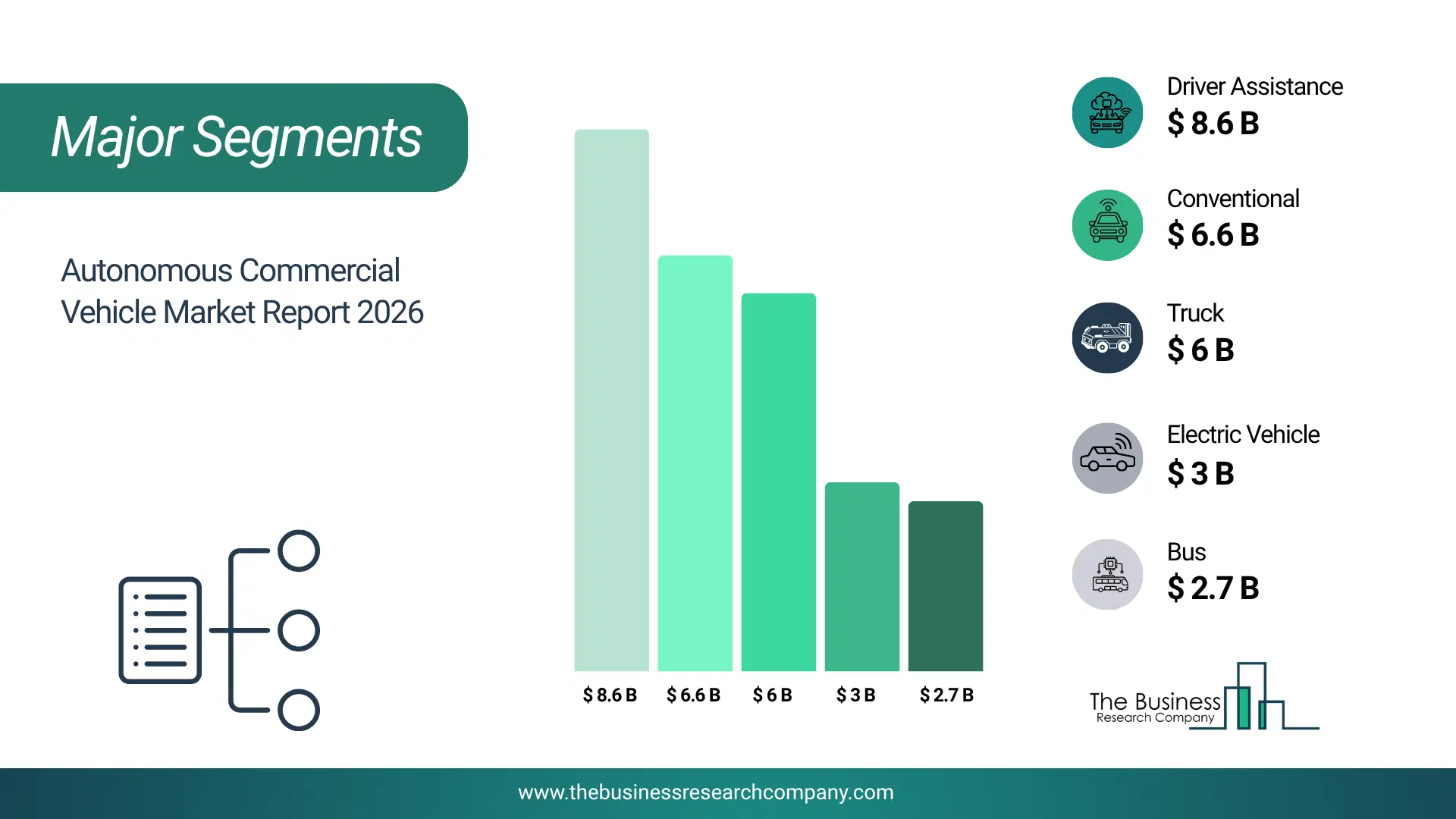
1) By Vehicle: Truck, Trailer, Bus, Other Vehicle Types 2) By Automation Level: Driver Assistance, Partial Automation, Conditional Automation, High Automation, Full Automation 3) By Fuel Type: Conventional, Hybrid Vehicle, Electric Vehicle Subsegments: 1) By Truck: Light Duty Trucks, Medium Duty Trucks, Heavy Duty Trucks 2) By Trailer: Flatbed Trailers, Refrigerated Trailers, Tanker Trailers, Container Trailers 3) By Bus: Autonomous Passenger Buses, Autonomous Shuttle Buses 4) By Other Vehicle Types: Autonomous Delivery Vans, Autonomous Service Vehicles, Autonomous Construction Vehicles The top segments in the autonomous commercial vehicle market will be: • Driver Assistance will reach $8696.41 Million by 2025. • Conventional will reach $6677.01 Million by 2025. • Truck will reach $6085.62 Million by 2025. • Electric Vehicle will reach $3032.3 Million by 2025. • Bus will reach $2728.16 Million by 2025.What Is The Driver Of The Autonomous Commercial Vehicle Market?
The increasing demand for efficient transportation is expected to boost the growth of the autonomous commercial vehicle market going forward. Transportation, also known as transport, refers to the intentional movement of people, animals, and goods from one location to another. Autonomous commercial vehicles can optimize their routes, speeds, and driving behaviors to minimize fuel consumption. This efficiency is not only cost-effective for fleet operators but also aligns with environmental regulations and sustainability goals. Lower fuel costs make autonomous vehicles an ideal option for transportation companies. For instance, in June 2025, according to the Official statistics, a UK-based government agencies, total motor‑vehicle traffic in Great Britain rose in 2024 compared with 2023 vehicle miles travelled increased by 1.6%, to 336.2 billion vehicle‑miles in 2024. Therefore, the increasing demand for efficient transportation is driving the growth of the autonomous commercial vehicle industry.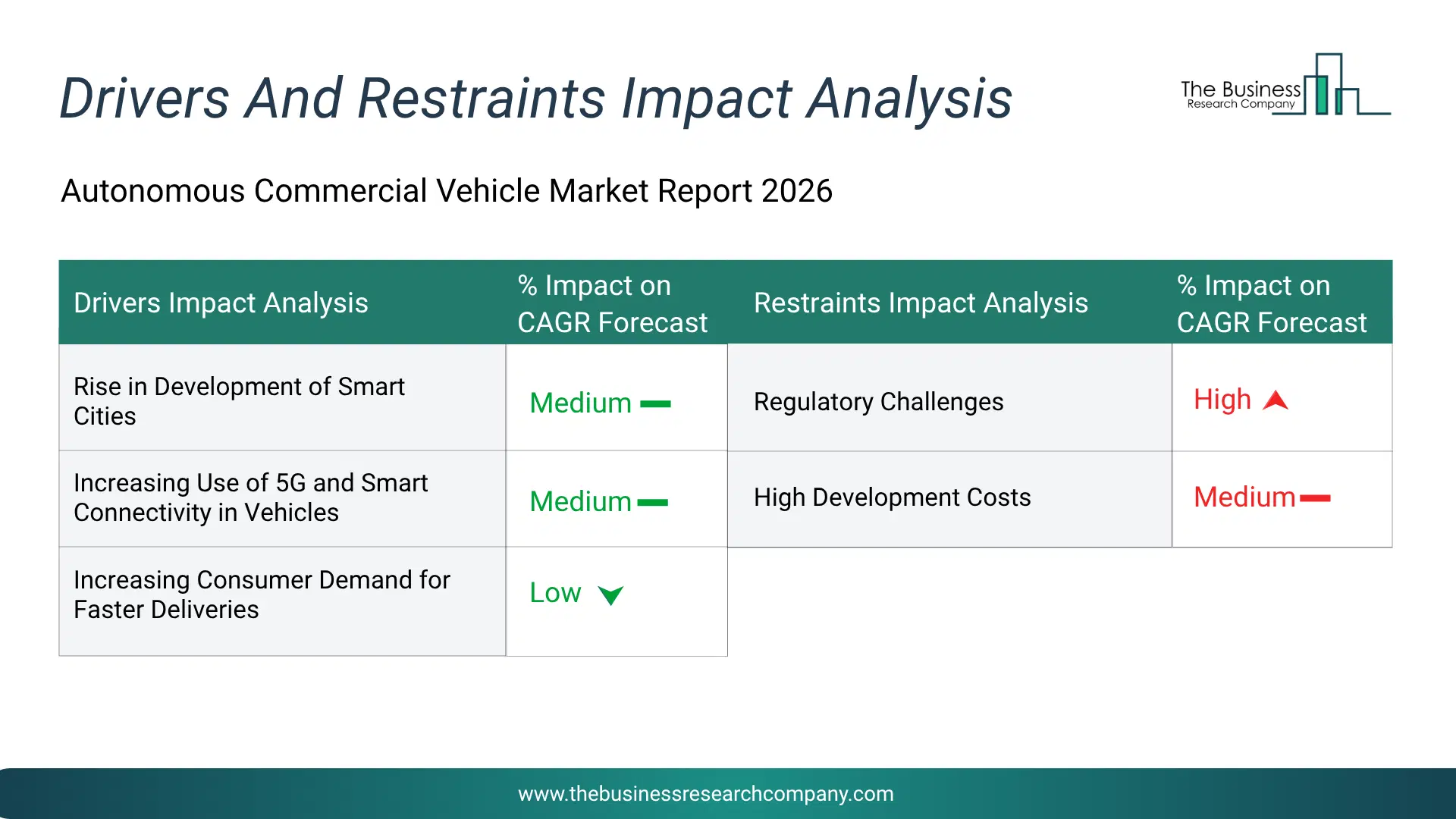
Infographic Chart Showing Key Market Drivers Analysis And Restraints For Autonomous Commercial Vehicle Market
The chart presents an impact analysis of key drivers and restraints, quantifying their relative influence on the market's growth rate and helping assess the balance between growth enablers and limiting factors. This chart offers a high-level perspective; the full report contains more detailed insights.
How Will The Drivers Impact Growth In The Global Autonomous Commercial Vehicle Market?
• Rise in Development of Smart Cities (Medium) – The rise in development of smart cities will become a key driver of growth in the autonomous commercial vehicle market by 2030. As smart cities grow, so does the demand for automated, on-demand deliveries and services from e-commerce to waste collection, which autonomous commercial vehicles are well-suited to handle. Smart cities feature advanced infrastructure like 5G, smart traffic systems and connected roads that enable safe and efficient use of autonomous vehicles. These cities also emphasize sustainability, making electric autonomous vehicles ideal for reducing emissions and improving energy efficiency. As a result, the rise in development of smart cities is anticipated to contributing to a 2.0% annual growth in the market. • Increasing Use of 5G and Smart Connectivity in Vehicles (Medium) – The increasing use of 5G and smart connectivity in vehicles will emerge as a major factor driving the expansion of the autonomous commercial vehicle market by 2030. 5G enables ultra-fast, low-latency communication between vehicles, infrastructure and control centers, allowing real-time updates essential for autonomous navigation and safety. It supports vehicle-to-everything (V2X) connectivity, including communication with other vehicles, traffic systems and pedestrians, enhancing coordination and accident prevention. This smart connectivity improves the efficiency, responsiveness and reliability of autonomous commercial vehicles. Consequently, the increasing use of 5G and smart connectivity in vehicles is projected to contributing to a 1.3% annual growth in the market. • Increasing Consumer Demand for Faster Deliveries (Low) – The increasing consumer demand for faster deliveries will serve as a key growth catalyst for the autonomous commercial vehicle market by 2030. Autonomous commercial vehicles help meet rising demand for faster deliveries by operating 24/7 without breaks, eliminating delays from driver fatigue or shift limits. They use AI and real-time data to optimize routes, ensuring quicker and more reliable transit. Additionally, they streamline logistics by coordinating with warehouses, reducing bottlenecks and improving inventory turnover. Therefore, this increasing consumer demand for faster deliveries is projected to supporting to a 1.0% annual growth in the market. • Growth in E-Commerce and Logistics (Low) – The growth in e-commerce and logistics will become a significant driver contributing to the growth of the autonomous commercial vehicle market by 2030 The rise of online shopping has increased demand for both last-mile and long-haul deliveries, prompting logistics firms to adopt autonomous vehicles for scalable, driver-independent transport. These vehicles can operate 24/7, enhancing delivery speed and supply chain efficiency. They also enable smarter fleet management and route optimization using AI and real-time data, especially during high-demand periods. Consequently, growth in e-commerce and logistics is projected to contributing to a 0.3% annual growth in the market.How Will The Restraints Impact Growth In The Global Autonomous Commercial Vehicle Market?
• Regulatory Challenges (Medium) – Regulatory Challenges will restrict the growth of the Autonomous Commercial Vehicle market during the forecast period. The deployment of autonomous commercial vehicles faces significant regulatory hurdles including safety certification, liability frameworks, and operational permits. Different regulatory approaches across countries create fragmentation and complicate international operations. Delays in establishing regulatory frameworks for autonomous vehicles can slow deployment and create uncertainty for manufacturers and fleet operators, limiting market growth. • High Development Costs (Medium) – High Development Costs will restrict the growth of the Autonomous Commercial Vehicle market during the forecast period. The development of autonomous commercial vehicles requires significant investment in sensor technology, artificial intelligence, and software development. Costs for research and development, testing, and validation are substantial and often exceed initial projections. The high development costs create barriers for new entrants and can delay profitability for manufacturers, potentially slowing innovation and market expansion.Key Players In The Global Autonomous Commercial Vehicle Market
Major companies operating in the autonomous commercial vehicle market report include Volkswagen AG, Daimler AG, Tesla Inc., Denso Corporation, Continental AG, Waymo LLC, Bayerische Motoren Werke Aktiengesellschaft, Isuzu Motors Limited, General Motors Company, AB Volvo, Beiqi Foton Motor Co. Ltd., Skywell New Energy Vehicles Group Co. Ltd., Dongfeng Motor Corporation, China National Heavy Duty Truck Group Co. Ltd. (SINOTRUK), FAW Jiefang Automobile Co. Ltd., Shaanxi Automobile Group Co. Ltd. (China Shaanqi), Beiben Trucks Group Co. Ltd. (Beiben Trucks), SAIC Iveco Hongyan Commercial Vehicle Co. Ltd. (SAIC Hongyan), Jiangling Motors Corporation Group (JMC), Zhengzhou Yutong Bus Co. Ltd. (Zhengzhou Yutong Bus), Xiamen King Long United Automotive Industry Co. Ltd. (King Long Bus), CRRC Electric Vehicle Co. Ltd. (CRRC Electric Vehicle), Xiamen Golden Dragon Bus Co. Ltd. (Xiamen Golden Dragon Bus), Anhui Ankai Automobile Co. Ltd. (Anhui Ankai Automobile), Plus.ai Inc. (Plus.ai), Embark Trucks Inc. (Embark Trucks), Daimler Trucks North America LLC (Daimler Trucks), NVIDIA Corporation, Zoox Inc., Luminar Technologies Inc.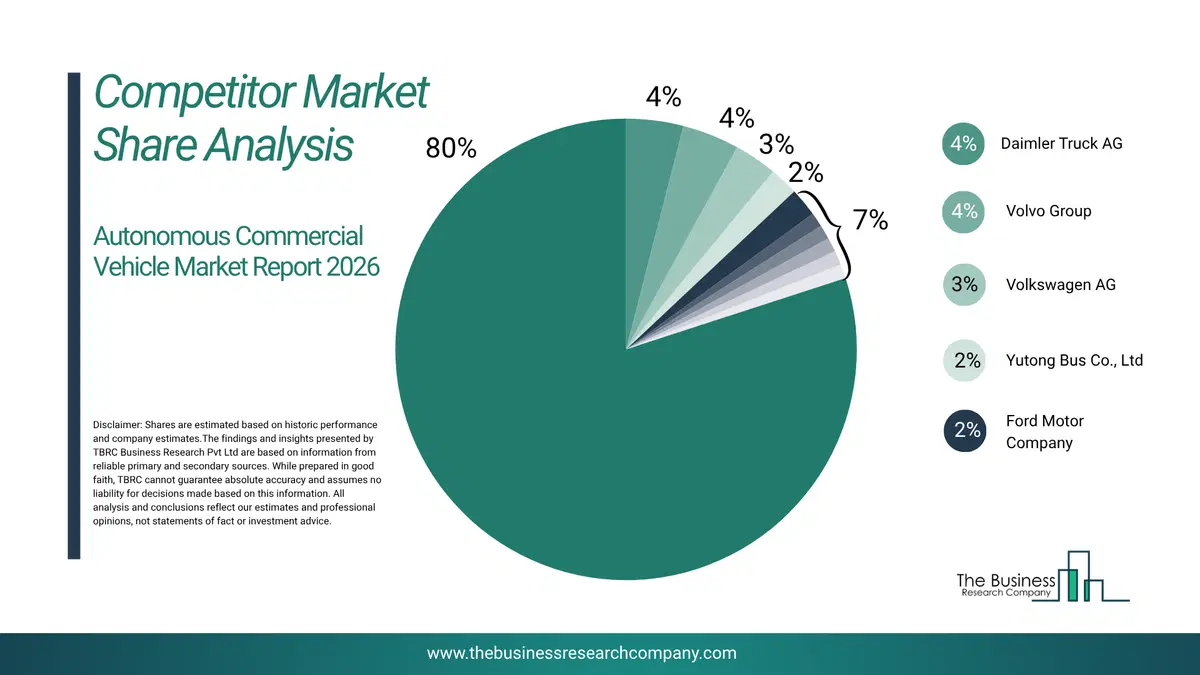
This chart is for illustrative purposes; the full report includes a detailed competitor analysis and comprehensive overview of the top 10 companies in the market.
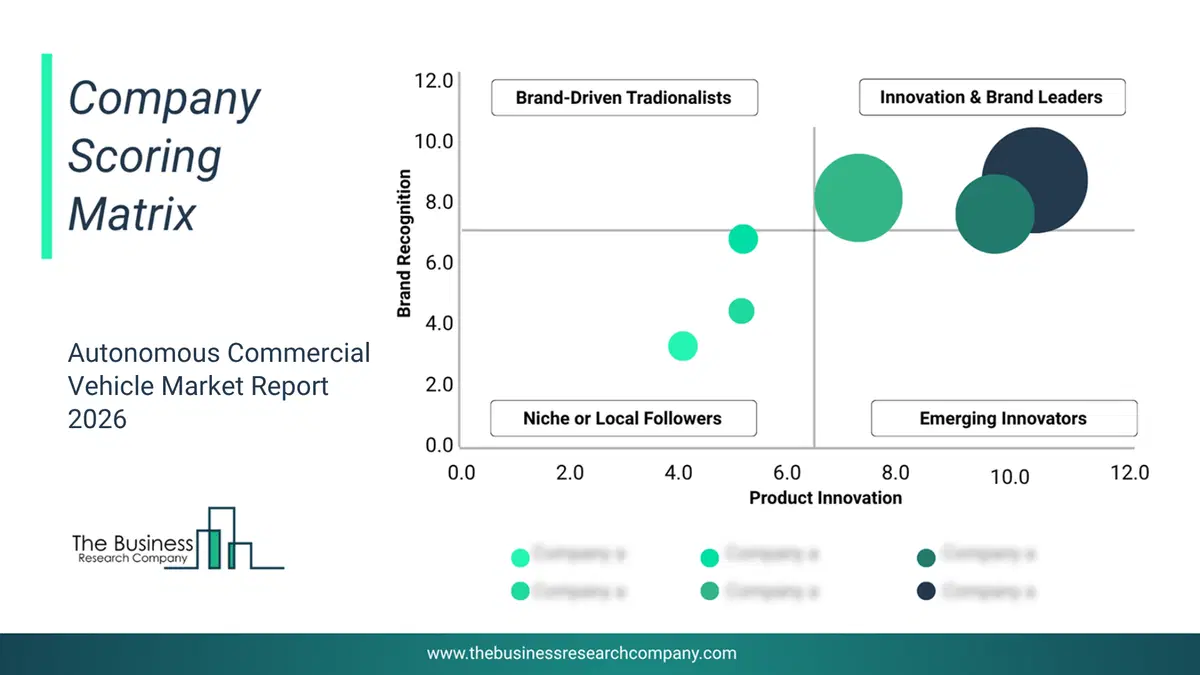
This chart maps companies by product innovation and brand strength, with bubble size indicating relative revenue, helping identify market leaders, challengers, and niche players. This is an illustrative chart; the full report provides a complete and accurate competitive analysis.
Global Autonomous Commercial Vehicle Market Trends and Insights
Major companies operating in the autonomous commercial vehicle market are focusing on technological advancements, such as AI-powered autonomous driving systems, to meet the rising demand for enhanced safety, efficiency, and reduced labor costs within the logistics and transportation sectors. AI-powered autonomous driving systems integrate advanced artificial intelligence algorithms with sensor fusion technology, including LiDAR, radar, and cameras, to enable vehicles to perceive their environment, make real-time decisions, and navigate safely without human intervention, differentiating them from traditional manually operated vehicles. For instance, in September 2025, Kodiak Robotics, Inc., a US-based autonomous trucking company, launched the Kodiak Driver-equipped autonomous truck, an innovative AI-driven autonomous driving system introduced after 2022. This system combines modular and vehicle-agnostic hardware featuring proprietary SensorPods, an AI compute platform, a redundant Actuation Control Engine (ACE) safety compute, and advanced safety actuation mechanisms. The Kodiak Driver allows for scalable deployment in commercial trucking by enhancing operational efficiency, safety, and reliability in freight transport. The first Roush-upfitted truck equipped with this technology was delivered to Atlas Energy Solutions, demonstrating a critical step in the commercialization of autonomous trucking at scale.What Are Latest Mergers And Acquisitions In The Autonomous Commercial Vehicle Market?
In April 2025, Toyota Motor Corporation, a Japan-based manufacturer of automobiles and advanced mobility technologies, partnered with Waymo to enhance its autonomous driving capabilities by integrating Waymo’s self-driving technology into future vehicle platforms, accelerating development of next-generation personally owned vehicles and supporting its long-term zero-accident mobility vision. Waymo, a US-based developer of autonomous driving software and commercial robotaxi services.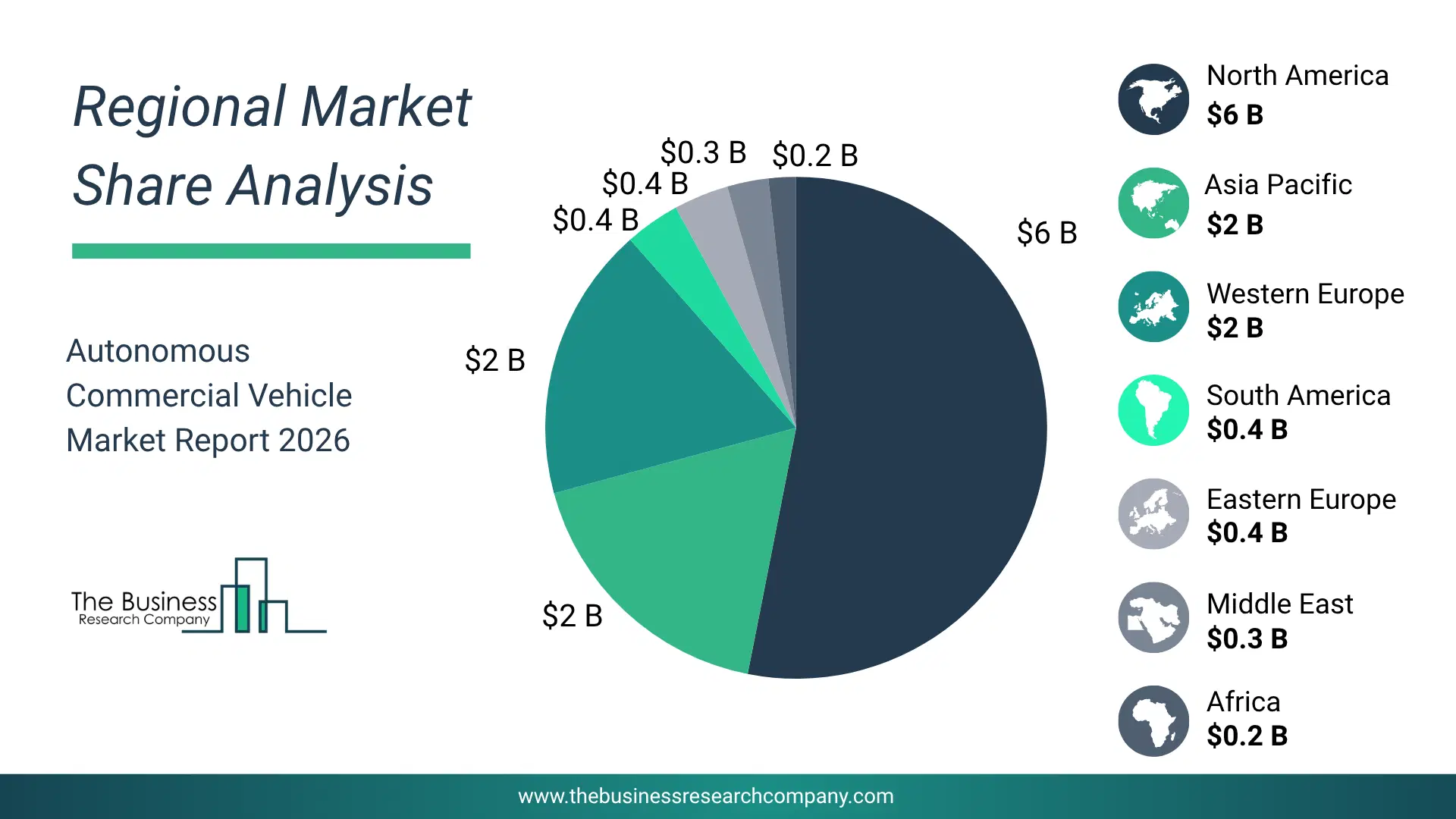
Regional Outlook
Asia-Pacific was the largest region in the autonomous commercial vehicle market in 2025. North America was the second largest region in the autonomous commercial vehicle market. The regions covered in this market report include Asia-Pacific, South East Asia, Western Europe, Eastern Europe, North America, South America, Middle East, Africa. The countries covered in this market report include Australia, Brazil, China, France, Germany, India, Indonesia, Japan, Taiwan, Russia, South Korea, UK, USA, Canada, Italy, SpainWhat Defines the Autonomous Commercial Vehicle Market?
The autonomous commercial vehicle market consists of sales of autonomous buses and coaches. Values in this market are factory gate values, that is the value of goods sold by the manufacturers or creators of the goods, whether to other entities (including downstream manufacturers, wholesalers, distributors and retailers) or directly to end customers. The value of goods in this market includes related services sold by the creators of the goods.How is Market Value Defined and Measured?
The market value is defined as the revenues that enterprises gain from the sale of goods and/or services within the specified market and geography through sales, grants, or donations in terms of the currency (in USD unless otherwise specified). The revenues for a specified geography are consumption values that are revenues generated by organizations in the specified geography within the market, irrespective of where they are produced. It does not include revenues from resales along the supply chain, either further along the supply chain or as part of other products.
This chart presents market attractiveness based on a quantitative evaluation of growth, competition, strategic alignment, and risk, offering a clear view of opportunity areas for decision-making. This chart is for illustrative purposes; the full report contains the complete analysis.

This chart highlights the Total Addressable Market (TAM) by estimating the maximum revenue opportunity using an assumption-driven approach, supporting strategic planning and opportunity sizing across markets. The chart is illustrative; the full report provides a more comprehensive analysis.
What Key Data and Analysis Are Included in the Autonomous Commercial Vehicle Market Report 2026?
The autonomous commercial vehicle market research report is one of a series of new reports from The Business Research Company that provides market statistics, including industry global market size, regional shares, competitors with the market share, detailed market segments, market trends and opportunities, and any further data you may need to thrive in the autonomous commercial vehicle industry. The market research report delivers a complete perspective of everything you need, with an in-depth analysis of the current and future state of the industry.Autonomous Commercial Vehicle Market Report Forecast Analysis
| Report Attribute | Details |
|---|---|
| Market Size Value In 2026 | $13.47 billion |
| Revenue Forecast In 2030 | $26.22 billion |
| Growth Rate | CAGR of 17.3% from 2026 to 2030 |
| Base Year For Estimation | 2025 |
| Actual Estimates/Historical Data | 2020-2025 |
| Forecast Period | 2026 - 2030 |
| Market Representation | Revenue in USD Billion and CAGR from 2026 to 2030 |
| Segments Covered | Vehicle, Automation Level, Fuel Type |
| Regional Scope | Asia-Pacific, Western Europe, Eastern Europe, North America, South America, Middle East, Africa |
| Country Scope | The countries covered in the report are Australia, Brazil, China, France, Germany, India, Indonesia, Japan, Taiwan, Russia, South Korea, UK, USA, Canada, Italy, Spain. |
| Key Companies Profiled | Volkswagen AG, Daimler AG, Tesla Inc., Denso Corporation, Continental AG, Waymo LLC, Bayerische Motoren Werke Aktiengesellschaft, Isuzu Motors Limited, General Motors Company, AB Volvo, Beiqi Foton Motor Co. Ltd., Skywell New Energy Vehicles Group Co. Ltd., Dongfeng Motor Corporation, China National Heavy Duty Truck Group Co. Ltd. (SINOTRUK), FAW Jiefang Automobile Co. Ltd., Shaanxi Automobile Group Co. Ltd. (China Shaanqi), Beiben Trucks Group Co. Ltd. (Beiben Trucks), SAIC Iveco Hongyan Commercial Vehicle Co. Ltd. (SAIC Hongyan), Jiangling Motors Corporation Group (JMC), Zhengzhou Yutong Bus Co. Ltd. (Zhengzhou Yutong Bus), Xiamen King Long United Automotive Industry Co. Ltd. (King Long Bus), CRRC Electric Vehicle Co. Ltd. (CRRC Electric Vehicle), Xiamen Golden Dragon Bus Co. Ltd. (Xiamen Golden Dragon Bus), Anhui Ankai Automobile Co. Ltd. (Anhui Ankai Automobile), Plus.ai Inc. (Plus.ai), Embark Trucks Inc. (Embark Trucks), Daimler Trucks North America LLC (Daimler Trucks), NVIDIA Corporation, Zoox Inc., Luminar Technologies Inc. |
| Customization Scope | Request for Customization |
| Pricing And Purchase Options | Explore Purchase Options |