Contact Us
  Search
The Business Research Company Logo
Autonomous Commercial Vehicle Market 2025
Published :May 2025
Pages :336
Format :PDF
Delivery Time :2-3 Business Days
Why 2-3 days? We update the report with the latest data and news before delivery. Let us know if you need us to expedite.
Report Price :$4,490.00

Autonomous Commercial Vehicle Market 2025

By Vehicle (Truck, Trailer, Bus, Other Vehicle Types), By Automation Level (Driver Assistance, Partial Automation, Conditional Automation, High Automation, Full Automation), By Fuel Type (Conventional, Hybrid Vehicle, Electric Vehicle), And By Region, Opportunities And Strategies – Global Forecast To 2035

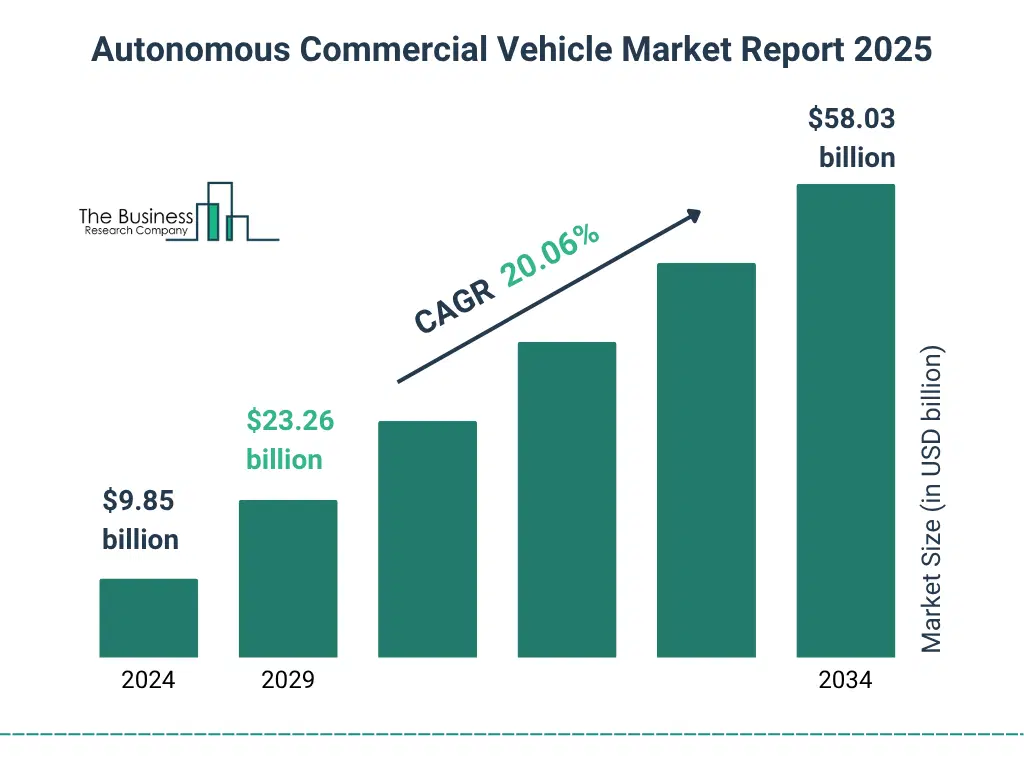
Autonomous Commercial Vehicle Market Size and growth rate 2025 to 2029: Graph

Autonomous Commercial Vehicle Market Definition

Autonomous commercial vehicles refer to self-driving motor vehicles specifically designed and manufactured for business and industrial applications, operating with minimal or no human intervention. These vehicles rely on an integrated system of advanced technologies, including artificial intelligence (AI), machine learning, LiDAR (Light Detection and Ranging), radar, cameras and global positioning systems (GPS), to perceive their environment and navigate accordingly. The autonomous commercial vehicle market consists of sales, by entities (organizations, sole traders, or partnerships), of autonomous commercial vehicle that are involved in manufacturing, integrating, or retrofitting vehicles with autonomous driving technologies for commercial use.

Research Expert

Book your 30 minutes free consultation with our research experts

Autonomous Commercial Vehicle Market Size

The global autonomous commercial vehicle market reached a value of nearly $9,848.28 million in 2024, having grown at a compound annual growth rate (CAGR) of 11.02% since 2019. The market is expected to grow from $9,848.28 million in 2024 to $23,263.23 million in 2029 at a rate of 18.76%. The market is then expected to grow at a CAGR of 20.06% from 2029 and reach $58,026.17 million in 2034. Growth in the historic period resulted from the shortage of skilled commercial drivers, favorable government support and surge in adoption of electric vehicles. Factors that negatively affected growth in the historic period were limited consumer trust and rising cybersecurity threats. Going forward, the rise in development of smart cities, increasing use of 5G and smart connectivity in vehicles, increasing consumer demand for faster deliveries and growth in e-commerce and logistics will drive the growth. Factor that could hinder the growth of the autonomous commercial vehicle market in the future include regulatory challenges and high development costs.

Autonomous Commercial Vehicle Market Drivers

The key drivers of the autonomous commercial vehicle market include: The Rise In Development Of Smart Cities The rise in development of smart cities are expected to propel the growth of the autonomous commercial vehicle market during the forecast period. As smart cities grow, so does the demand for automated, on-demand deliveries and services—from e-commerce to waste collection—which autonomous commercial vehicles are well-suited to handle. Smart cities feature advanced infrastructure like 5G, smart traffic systems and connected roads that enable safe and efficient use of autonomous vehicles. These cities also emphasize sustainability, making electric autonomous vehicles ideal for reducing emissions and improving energy efficiency. The rise in development of smart cities contribution during the forecast period in 2024 is 1.84%.

Autonomous Commercial Vehicle Market Restraints

The key restraints on the autonomous commercial vehicle market include: Regulatory Challenges During the forecast period, the regulatory challenges are expected to restrict the growth of the autonomous commercial vehicle market. Regulatory challenges create significant barriers to testing, deployment and mass production. Companies must navigate complex and evolving state, national and international laws, which often differ and lack standardization. Strict requirements related to vehicle safety, reporting of test data and operational transparency can delay approval processes and increase compliance costs. Growth affected by regulatory challenges during the forecast period in 2024 is -2.16%.

Need data on a specific region in this market?

Opportunities And Recommendations In The Autonomous Commercial Vehicle Market

Opportunities – The top opportunities in the autonomous commercial vehicle markets segmented by vehicle will arise in the truck segment, which will gain $7,426.47 million of global annual sales by 2029. The top opportunities in the autonomous commercial vehicle markets segmented by automation level will arise in the driver assistance segment, which will gain $4,256.66 million of global annual sales by 2029. The top opportunities in the autonomous commercial vehicle markets segmented by fuel type will arise in the conventional segment, which will gain $5,638.72 million of global annual sales by 2029. The autonomous commercial vehicle market size will gain the most in the USA at $5,072.85 million. Recommendations- To take advantage of the opportunities, The Business Research Company recommends the focus on advancing autonomous delivery solutions for urban logistics, focus on scaling purpose-built autonomous platforms for industrial and logistics applications, focus on advancing sustainable and region-optimized autonomous solutions, focus on strengthening strategic investments to accelerate autonomous innovation, focus on building integrated ecosystems for scalable deployment, focus on prioritizing the truck segment to maximize market growth, focus on capturing growth in the partial automation segment, focus on electric vehicle segment for accelerated growth, expand in emerging markets, focus on forming strategic partnerships to accelerate deployment and innovation, focus on tiered pricing and long-term value creation, prioritize targeted digital outreach to fleet operators and logistics buyers, collaborate with industry stakeholders to build awareness and trust, focus on end-user engagement through skilled workforce and customer support.
Chat with us