
Autonomous Debris Collection Satellite Market Report 2026
Global Outlook – By Satellite Type (Small Satellites, Medium Satellites, Large Satellites), By Orbit Type (Low Earth Orbit, Medium Earth Orbit, Geostationary Orbit), By Technology (Robotic Arms, Nets And Harpoons, Tethers, Lasers, Other Technologies), By Application (Space Debris Removal, On-Orbit Servicing, Satellite Life Extension, Other Applications), By End-User (Government And Defense, Commercial, Research And Academic Institutions) – Market Size, Trends, Strategies, and Forecast to 2030
Autonomous Debris Collection Satellite Market Overview
• Autonomous Debris Collection Satellite market size has reached to $1.39 billion in 2025 • Expected to grow to $3.28 billion in 2030 at a compound annual growth rate (CAGR) of 18.7% • Growth Driver: The Increasing Deployment Of Satellites Is Fueling The Growth Of The Market Due To Rising Orbital Congestion And Sustainability Needs • Market Trend: Autonomous Satellites Pioneer Advanced Debris Inspection And On-Orbit Management Capabilities • North America was the largest region in 2025 and Asia-Pacific is the fastest growing region.What Is Covered Under Autonomous Debris Collection Satellite Market?
Autonomous debris collection satellites are specialized spacecraft equipped with onboard computers, sensors, and robotic systems that enable independent detection, approach, and capture of orbital debris. These systems can stabilize and remove tumbling or non-cooperative objects, directing them to safe disposal trajectories or controlled atmospheric reentry, thereby mitigating collision risks and enhancing orbital sustainability. The main satellite types of autonomous debris collection satellites are small satellites, medium satellites, and large satellites. A small satellite is a compact, low-mass spacecraft designed to independently locate, capture, and remove space debris from orbit. The orbit types include low earth orbit, medium earth orbit, and geostationary orbit, using technologies such as robotic arms, nets and harpoons, tethers, lasers, and others, applied in areas such as space debris removal, on-orbit servicing, satellite life extension, and others, with end-users including government and defense, commercial, and research and academic institutions.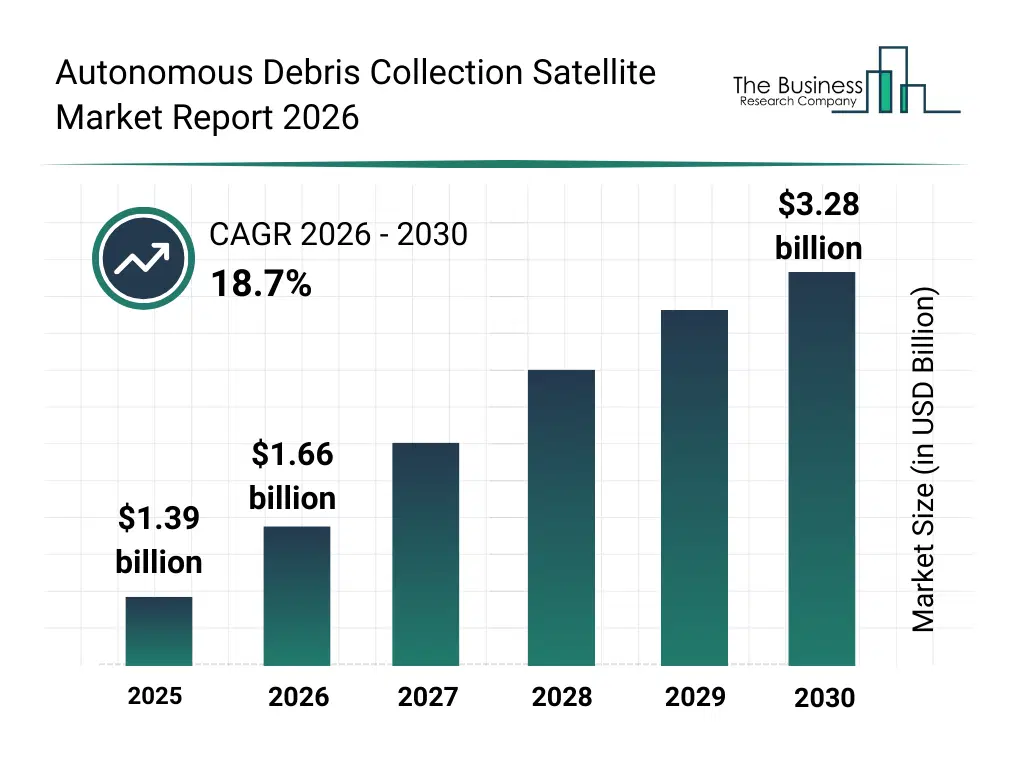
What Is The Autonomous Debris Collection Satellite Market Size and Share 2026?
The autonomous debris collection satellite market size has grown rapidly in recent years. It will grow from $1.39 billion in 2025 to $1.66 billion in 2026 at a compound annual growth rate (CAGR) of 19.0%. The growth in the historic period can be attributed to rising concerns over orbital debris, advancements in autonomous spacecraft navigation, growth in commercial and governmental satellite launches, development of robotic capture mechanisms, adoption of space traffic management services.What Is The Autonomous Debris Collection Satellite Market Growth Forecast?
The autonomous debris collection satellite market size is expected to see rapid growth in the next few years. It will grow to $3.28 billion in 2030 at a compound annual growth rate (CAGR) of 18.7%. The growth in the forecast period can be attributed to integration with AI-based collision avoidance, expansion of debris removal contracts with commercial satellite operators, advancements in multi-satellite coordination, development of reusable propulsion modules, adoption of real-time orbital monitoring analytics. Major trends in the forecast period include growth of multi-capture debris collection missions, advancements in autonomous proximity operations, integration of high-precision optical and radar tracking sensors, expansion of debris de-orbiting as a service (daas) models, development of modular debris capture and containment payloads.
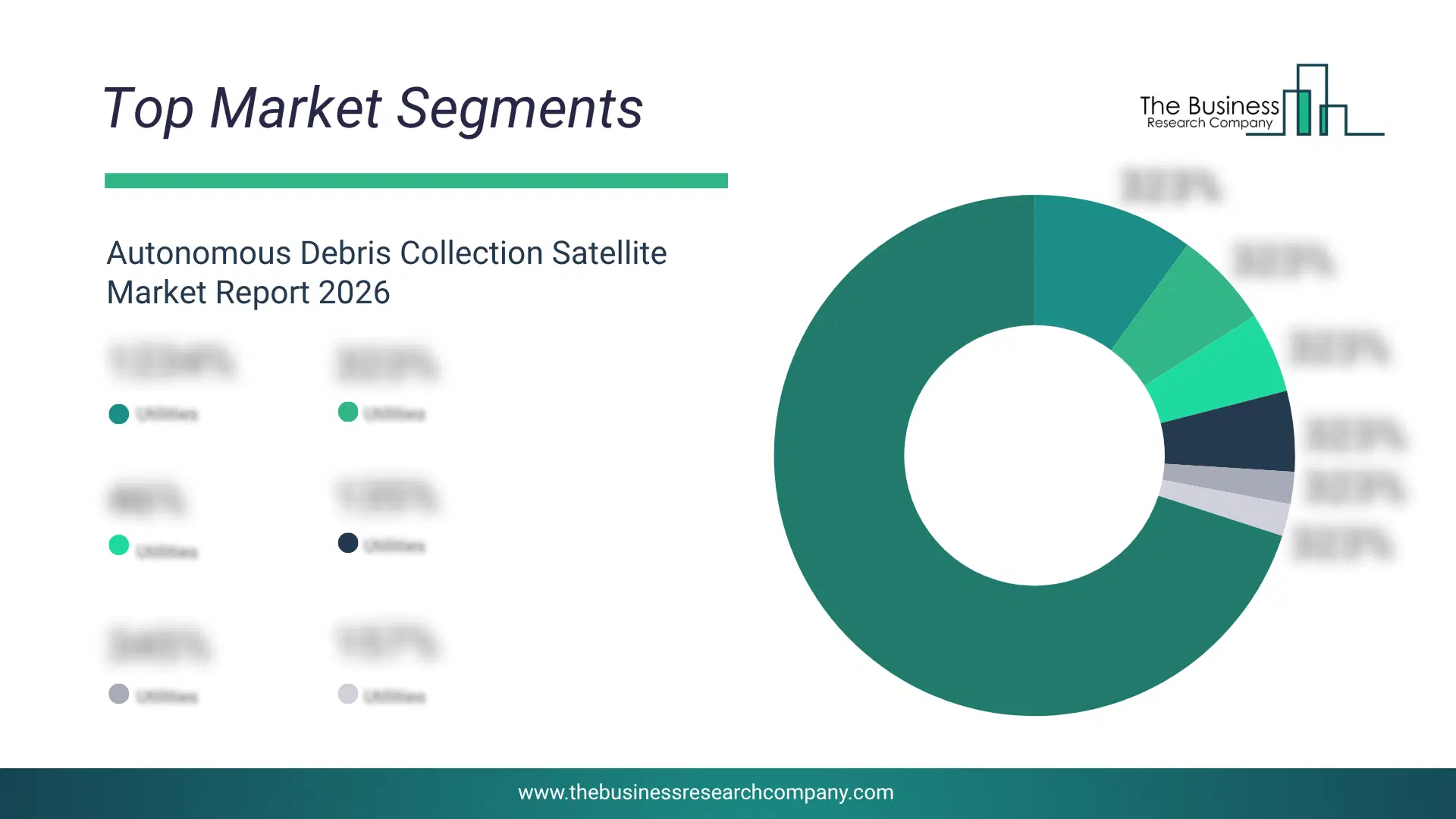
Global Autonomous Debris Collection Satellite Market Segmentation
1) By Satellite Type: Small Satellites, Medium Satellites, Large Satellites 2) By Orbit Type: Low Earth Orbit, Medium Earth Orbit, Geostationary Orbit 3) By Technology: Robotic Arms, Nets And Harpoons, Tethers, Lasers, Other Technologies 4) By Application: Space Debris Removal, On-Orbit Servicing, Satellite Life Extension, Other Applications 5) By End-User: Government And Defense, Commercial, Research And Academic Institutions Subsegments: 1) By Small Satellites: Micro Satellites, Nano Satellites, Pico Satellites 2) By Medium Satellites: Mini Satellites, Midsize Satellites 3) By Large Satellites: Heavy Satellites, Super Heavy Satellites, Mega SatellitesWhat Is Driver Of The Autonomous Debris Collection Satellite Market?
The increasing deployment of satellites is expected to propel the growth of the autonomous debris collection satellite market going forward. Satellites are human-made objects placed into orbit, mainly around Earth, to enable communication, navigation, Earth observation, and scientific research. Growing demand for global connectivity and real-time data is driving governments and enterprises to expand satellite constellations for broader coverage and reliability. Autonomous debris collection satellites support this expansion by reducing orbital debris, ensuring the safety, longevity, and sustainable growth of satellite networks. For instance, in May 2025, according to the Satellite Industry Association (SIA), a US-based trade association, a record 259 launches deployed 2,172 tons and 2,695 satellites into Earth orbit in 2024, with the US capturing 65% of the launch market, while the global space economy grew 4%, driven by the commercial satellite sector representing 71% of the industry. Satellite manufacturing revenue rose 17%, with U.S. market share surging to 69%, a 50% increase from 2023, and American firms produced 83% of the commercial satellites launched that year. Therefore, the increasing deployment of satellites is driving the growth of the autonomous debris collection satellite industry.Key Players In The Global Autonomous Debris Collection Satellite Market
Major companies operating in the autonomous debris collection satellite market are Airbus Group, Northrop Grumman Corporation, Kawasaki Heavy Industries, SENER Group, Voyager Space, ClearSpace SA, Starfish Space, Astroscale Holdings Inc., PickNik Robotics, Motiv Space Systems, Turion Space, TransAstra, Rogue Space Systems Corporation, Exodus Space Systems, Kall Morris Inc. (KMI), Kurs Orbital, Obruta Space Solutions, OrbitGuardians, Sky Perfect JSAT Corporation, Ironstar Engineering (PRISM), Future Space Industries, OSMOS X, Paladin Space, Space Cowboy.
This chart is for illustrative purposes; the full report includes a detailed competitor analysis and comprehensive overview of the top 10 companies in the market.
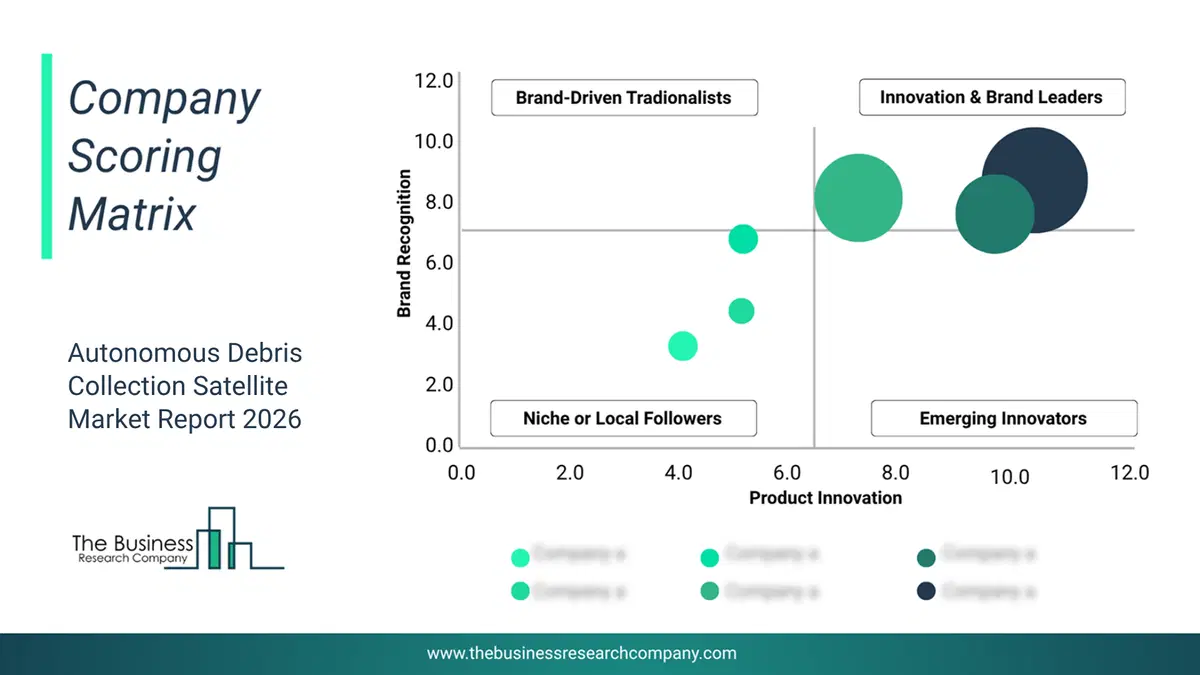
This chart maps companies by product innovation and brand strength, with bubble size indicating relative revenue, helping identify market leaders, challengers, and niche players. This is an illustrative chart; the full report provides a complete and accurate competitive analysis.
Global Autonomous Debris Collection Satellite Market Trends and Insights
Major companies operating in the autonomous debris collection satellite market are focusing on innovations, such as debris inspection satellites, to demonstrate autonomous capabilities for identifying and assessing orbital debris to support future debris management operations. A Debris Inspection Satellite is a spacecraft designed to autonomously locate, assess, and monitor objects in orbit to provide detailed information on their position, condition, and behavior for potential mitigation or removal. For instance, in February 2024, Astroscale Japan Inc., the Japanese subsidiary of Astroscale Holdings Inc., a Japan-based on-orbit servicing company, launched the ADRAS-J satellite. The satellite can autonomously approach and survey uncooperative orbital debris, including objects lacking Global Positioning System data, through advanced Rendezvous and Proximity Operations. This mission marks the first demonstration of such capabilities on a large debris object, generating critical data to support future on-orbit debris mitigation and removal efforts.What Are Latest Mergers And Acquisitions In The Autonomous Debris Collection Satellite Market? NASA Partners With Starfish Space To Assess Autonomous Debris Collection
In October 2023, the National Aeronautics and Space Administration (NASA), a U.S.-based government space agency, partnered with Starfish Space to conduct a study for a potential orbital debris inspection mission. This collaboration aims to assess the feasibility of utilizing Starfish's Otter satellite servicing vehicle to autonomously rendezvous with and characterize large pieces of space debris in low Earth orbit (LEO). Starfish Space is a US-based satellite company providing an autonomous servicing vehicle called Otter, which is designed to collect space debris.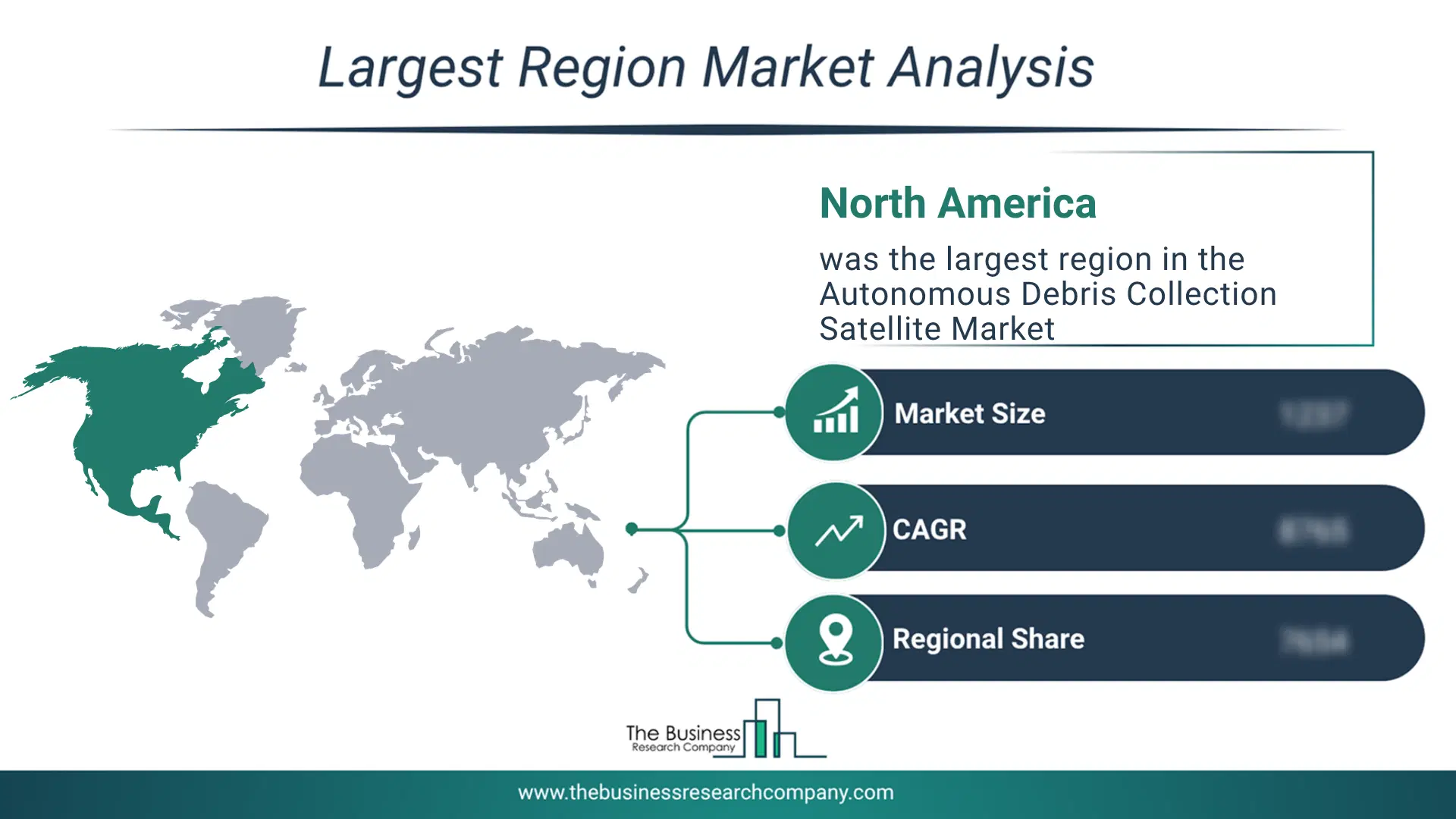
Regional Insights
North America was the largest region in the autonomous debris collection satellite market in 2025. Asia-Pacific is expected to be the fastest-growing region in the forecast period. The regions covered in this market report are Asia-Pacific, South East Asia, Western Europe, Eastern Europe, North America, South America, Middle East, Africa. The countries covered in this market report are Australia, Brazil, China, France, Germany, India, Indonesia, Japan, Taiwan, Russia, South Korea, UK, USA, Canada, Italy, SpainWhat Defines the Autonomous Debris Collection Satellite Market?
The autonomous debris collection satellite market consists of revenues earned by entities by providing services such as debris tracking and monitoring, collision risk assessment, mission planning and scheduling, satellite relocation, orbital traffic management, space sustainability consulting, and debris impact analysis. The market value includes the value of related goods sold by the service provider or included within the service offering. The autonomous debris collection satellite market also includes sales of autonomous navigation systems, propulsion modules, debris containment units, optical tracking sensors, radar tracking systems, and communication payloads. Values in this market are ‘factory gate’ values, that is the value of goods sold by the manufacturers or creators of the goods, whether to other entities (including downstream manufacturers, wholesalers, distributors and retailers) or directly to end customers. The value of goods in this market includes related services sold by the creators of the goods.How is Market Value Defined and Measured?
The market value is defined as the revenues that enterprises gain from the sale of goods and/or services within the specified market and geography through sales, grants, or donations in terms of the currency (in USD unless otherwise specified). The revenues for a specified geography are consumption values that are revenues generated by organizations in the specified geography within the market, irrespective of where they are produced. It does not include revenues from resales along the supply chain, either further along the supply chain or as part of other products.
This chart presents market attractiveness based on a quantitative evaluation of growth, competition, strategic alignment, and risk, offering a clear view of opportunity areas for decision-making. This chart is for illustrative purposes; the full report contains the complete analysis.

This chart highlights the Total Addressable Market (TAM) by estimating the maximum revenue opportunity using an assumption-driven approach, supporting strategic planning and opportunity sizing across markets. The chart is illustrative; the full report provides a more comprehensive analysis.
What Key Data and Analysis Are Included in the Autonomous Debris Collection Satellite Market Report 2026?
The autonomous debris collection satellite market research report is one of a series of new reports from The Business Research Company that provides market statistics, including industry global market size, regional shares, competitors with the market share, detailed market segments, market trends and opportunities, and any further data you may need to thrive in the autonomous debris collection satellite industry. The market research report delivers a complete perspective of everything you need, with an in-depth analysis of the current and future state of the industry.Autonomous Debris Collection Satellite Market Report Forecast Analysis
| Report Attribute | Details |
|---|---|
| Market Size Value In 2026 | $1.66 billion |
| Revenue Forecast In 2030 | $3.28 billion |
| Growth Rate | CAGR of 18.7% from 2026 to 2030 |
| Base Year For Estimation | 2025 |
| Actual Estimates/Historical Data | 2020-2025 |
| Forecast Period | 2026 - 2030 |
| Market Representation | Revenue in USD Billion and CAGR from 2026 to 2030 |
| Segments Covered | Satellite Type, Orbit Type, Technology, Application, End-User |
| Regional Scope | Asia-Pacific, Western Europe, Eastern Europe, North America, South America, Middle East, Africa |
| Country Scope | The countries covered in the autonomous debris collection satellite market report are Australia, Brazil, China, France, Germany, India, Indonesia, Japan, Taiwan, Russia, South Korea, UK, USA, Canada, Italy, Spain |
| Key Companies Profiled | Airbus Group, Northrop Grumman Corporation, Kawasaki Heavy Industries, SENER Group, Voyager Space, ClearSpace SA, Starfish Space, Astroscale Holdings Inc., PickNik Robotics, Motiv Space Systems, Turion Space, TransAstra, Rogue Space Systems Corporation, Exodus Space Systems, Kall Morris Inc. (KMI), Kurs Orbital, Obruta Space Solutions, OrbitGuardians, Sky Perfect JSAT Corporation, Ironstar Engineering (PRISM), Future Space Industries, OSMOS X, Paladin Space, Space Cowboy. |
| Customization Scope | Request for Customization |
| Pricing And Purchase Options | Explore Purchase Options |