
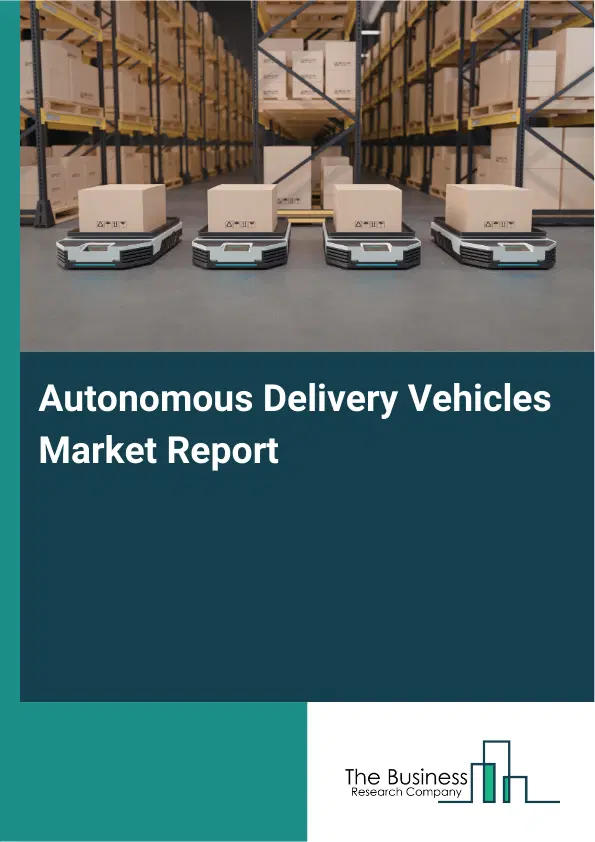
Autonomous Delivery Vehicles Market Report 2026
Global Outlook – By Vehicle Type (Ground Delivery Vehicles, Aerial Delivery Drones), By Component (Hardware, Software, Services), By Propulsion Type (Electric, Hybrid), By Application (Retail And E-commerce, Food And Beverages, Healthcare, Logistics, Other Applications) – Market Size, Trends, Strategies, and Forecast to 2030
Autonomous Delivery Vehicles Market Overview
• Autonomous Delivery Vehicles market size has reached to $1.31 billion in 2025 • Expected to grow to $3.82 billion in 2030 at a compound annual growth rate (CAGR) of 23.8% • Growth Driver: The Growth Of The E-Commerce Industry Driving The Growth Of The Market Due To Increasing Online Purchases And Internet Penetration • Market Trend: Revolutionizing Last-Mile Logistics With Advanced Unmanned Delivery Solutions • North America was the largest region in 2025 and Asia-Pacific is the fastest growing region.What Is Covered Under Autonomous Delivery Vehicles Market?
Autonomous delivery vehicles are self-operating cars, robots, or drones equipped with advanced technologies such as artificial intelligence, sensors, and GPS, enabling them to transport goods and packages from one location to another without human intervention. They navigate complex environments, avoid obstacles, and ensure efficient and secure deliveries through automated systems. Autonomous delivery vehicles aim to streamline logistics, reduce delivery costs, and enhance speed, contributing to the growing trend of automated and contactless deliveries. The main vehicle types of autonomous delivery vehicles are ground delivery vehicles and aerial delivery drones. Ground delivery vehicles refer to any vehicles that transport goods or packages over land, typically using roads or railways, including trucks, vans, bicycles, and autonomous delivery robots. The key components of these vehicles are hardware, software, and services, and various propulsion, such as powered by electric, hybrid, or fuel cell technologies. Autonomous delivery vehicles are used across various sectors, including retail and e-commerce, food and beverages, healthcare, logistics, and other industries.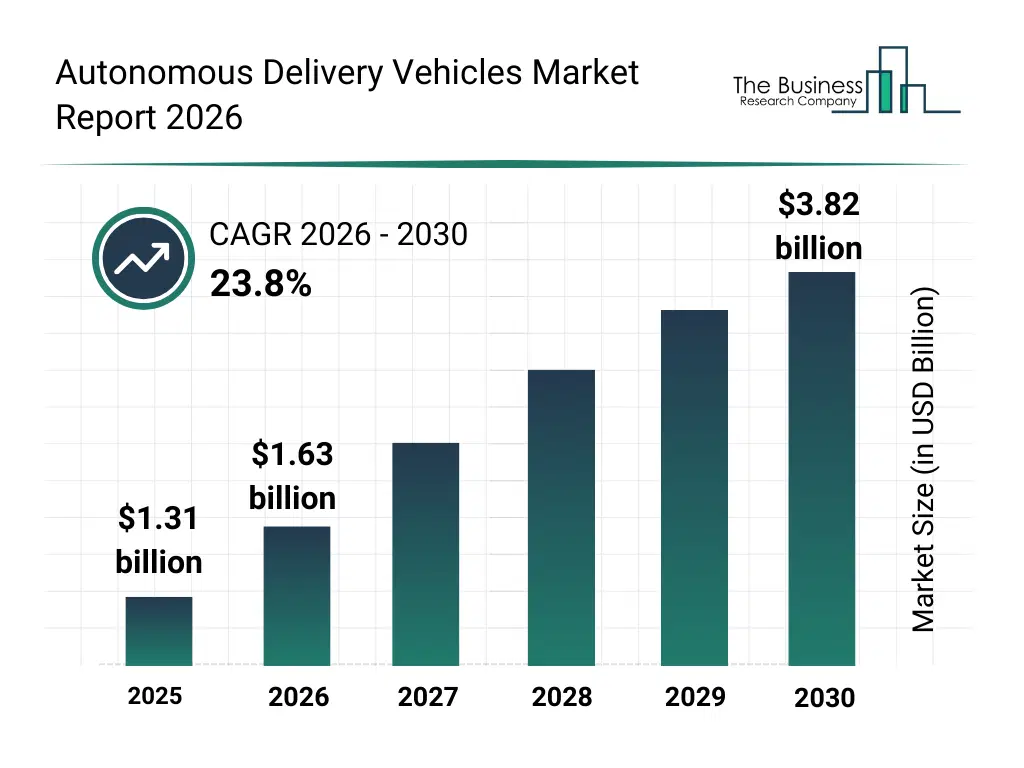
What Is The Autonomous Delivery Vehicles Market Size and Share 2026?
The autonomous delivery vehicles market size has grown exponentially in recent years. It will grow from $1.31 billion in 2025 to $1.63 billion in 2026 at a compound annual growth rate (CAGR) of 23.8%. The growth in the historic period can be attributed to e-commerce expansion, labor cost pressures, pilot delivery robot programs, urban congestion issues, consumer demand for fast delivery.What Is The Autonomous Delivery Vehicles Market Growth Forecast?
The autonomous delivery vehicles market size is expected to see exponential growth in the next few years. It will grow to $3.82 billion in 2030 at a compound annual growth rate (CAGR) of 23.8%. The growth in the forecast period can be attributed to scalable autonomous logistics, electric delivery platforms, smart city support, regulatory clarity for drones, AI-driven delivery optimization. Major trends in the forecast period include growth of autonomous last-mile robots, expansion of drone delivery networks, integration of ai route optimization, adoption of contactless delivery solutions, rise of urban micro-fulfillment.
Global Autonomous Delivery Vehicles Market Segmentation
1) By Vehicle Type: Ground Delivery Vehicles, Aerial Delivery Drones 2) By Component: Hardware, Software, Services 3) By Propulsion Type: Electric, Hybrid 4) By Application: Retail And E-commerce, Food And Beverages, Healthcare, Logistics, Other Applications Subsegments: 1) By Ground Delivery Vehicles: Autonomous Delivery Robots (ADRs), Self-Driving Vans, Self-Driving Trucks, Delivery Pods 2) By Aerial Delivery Drones: Fixed-Wing Drones, Rotary-Wing Drones, Hybrid DronesWhat Is The Driver Of The Autonomous Delivery Vehicles Market?
The growing e-commerce industry is expected to propel the growth of the autonomous delivery vehicles market going forward. E-commerce refers to the buying and selling goods and services over the internet, including online transactions, marketing, and customer interactions. The growth of the e-commerce industry is primarily driven by increasing internet penetration, which expands access to online shopping and enhances consumer convenience globally. Autonomous delivery vehicles are used in e-commerce for faster, more efficient, and cost-effective last-mile delivery, ultimately improving customer satisfaction and streamlining supply chains. For instance, in February 2025, according to the United States Census Bureau, a US-based government agency, total e-commerce sales were estimated at $1,192.6 billion in 2024, marking an 8.1% (±1.1) increase compared to 2023. Therefore, the growing e-commerce industry is driving the growth of the autonomous delivery vehicles industry.Key Players In The Global Autonomous Delivery Vehicles Market
Major companies operating in the autonomous delivery vehicles market report include Amazon.com Inc., JD.com Inc., FedEx Corporation, Uber Technologies Inc., Yandex N.V., Cruise LLC, Zipline International Inc., Nuro Inc., Gatik AI Inc., Oxbotica Ltd., Relay Robotics Inc., Einride AB, Starship Technologies Inc., Kiwibot Inc., ZMP Inc., Matternet Inc., Flytrex Aviation Ltd., Udelv Inc., Neolix Technologies Co. Ltd., Drone Delivery Canada Corp., Flirtey Inc.
This chart is for illustrative purposes; the full report includes a detailed competitor analysis and comprehensive overview of the top 10 companies in the market.
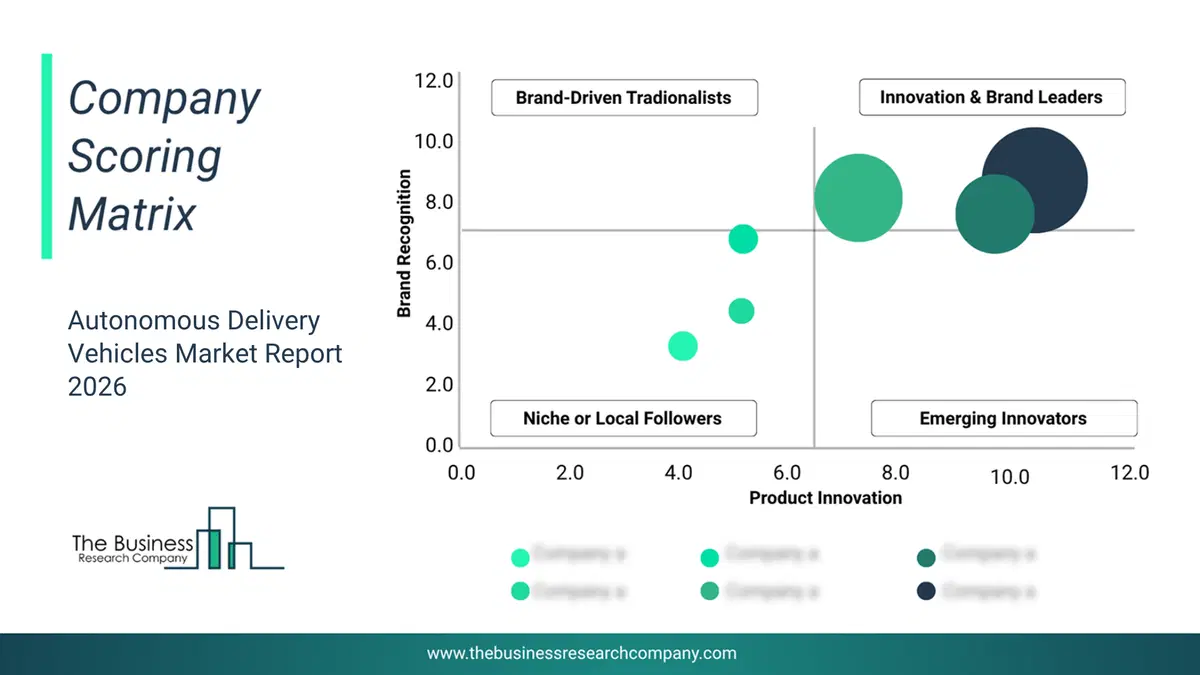
This chart maps companies by product innovation and brand strength, with bubble size indicating relative revenue, helping identify market leaders, challengers, and niche players. This is an illustrative chart; the full report provides a complete and accurate competitive analysis.
Global Autonomous Delivery Vehicles Market Trends and Insights
Major companies operating in the autonomous delivery vehicles market are focusing on developing technologically advanced solutions, such as unmanned delivery systems, to enhance efficiency, reduce costs, and improve last-mile logistics. Unmanned delivery systems refer to autonomous vehicles or drones designed to transport goods without human operators, utilizing advanced technologies such as artificial intelligence, GPS, and sensors for navigation and delivery. For instance, in February 2025, WeRide Inc., a China-based autonomous driving technology company, launched the Robovan W5, an autonomous delivery vehicle designed for efficient, fully unmanned urban logistics and last-mile delivery. These vehicles feature Level 4 autonomous driving technology with a redundant 360-degree sensor system for fully unmanned, 24/7 operation in all weather and traffic conditions and offer the largest cargo capacity in their class at 5.5 cubic meters with a 1,000 kg payload and up to 220 km range. It also supports intelligent path optimization, modular cargo configurations, and multi-vehicle platooning for scalable, cost-effective urban logistics and express delivery solutions.What Are Latest Mergers And Acquisitions In The Autonomous Delivery Vehicles Market?
In October 2023, Rockwell Automation, a US-based provider of industrial automation and digital transformation technologies, acquired Clearpath Robotics Inc. for an undisclosed amount. With this acquisition, Rockwell aims to simplify and transform material handling throughout manufacturing plants by delivering an end-to-end autonomous production logistics solution that optimizes operations, increases efficiency, and advances the connected factory vision. Clearpath Robotics Inc. is a Canada-based company that develops and sells self-driving vehicles and autonomous robots for industrial and delivery applications.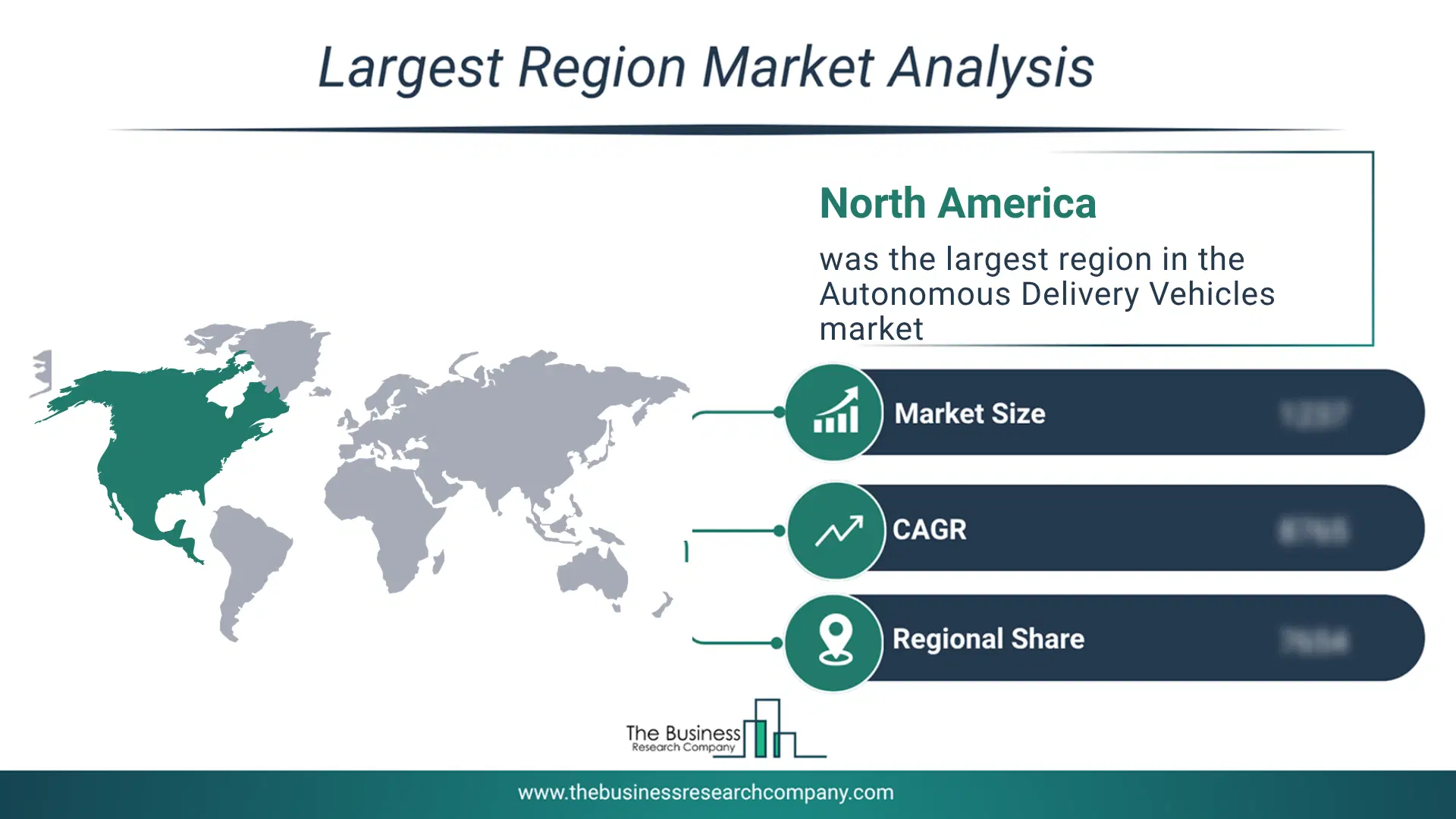
Regional Outlook
North America was the largest region in the autonomous delivery vehicles market in 2025. Asia-Pacific is expected to be the fastest-growing region in the forecast period. The regions covered in this market report include Asia-Pacific, South East Asia, Western Europe, Eastern Europe, North America, South America, Middle East, Africa. The countries covered in this market report include Australia, Brazil, China, France, Germany, India, Indonesia, Japan, Taiwan, Russia, South Korea, UK, USA, Canada, Italy, SpainWhat Defines the Autonomous Delivery Vehicles Market?
The autonomous delivery vehicles market consists of revenues earned by entities by providing services such as grocery delivery, package delivery, medical supply delivery, office supply delivery, and laundry and dry-cleaning delivery. The market value includes the value of related goods sold by the service provider or included within the service offering. The autonomous delivery vehicles market also consists of sales of products, including drone delivery systems, autonomous mail delivery systems, self-navigating logistics robots, autonomous sidewalk delivery vehicles, and unmanned aerial delivery drones. In this market, 'factory gate' values refer to the price at which goods are sold by their manufacturers or creators. This can be either to other entities such as downstream manufacturers, wholesalers, distributors, and retailers or directly to end customers. The value of goods in this market includes related services sold by the creators of the goods.How is Market Value Defined and Measured?
The market value is defined as the revenues that enterprises gain from the sale of goods and/or services within the specified market and geography through sales, grants, or donations in terms of the currency (in USD unless otherwise specified). The revenues for a specified geography are consumption values that are revenues generated by organizations in the specified geography within the market, irrespective of where they are produced. It does not include revenues from resales along the supply chain, either further along the supply chain or as part of other products.
This chart presents market attractiveness based on a quantitative evaluation of growth, competition, strategic alignment, and risk, offering a clear view of opportunity areas for decision-making. This chart is for illustrative purposes; the full report contains the complete analysis.

This chart highlights the Total Addressable Market (TAM) by estimating the maximum revenue opportunity using an assumption-driven approach, supporting strategic planning and opportunity sizing across markets. The chart is illustrative; the full report provides a more comprehensive analysis.
What Key Data and Analysis Are Included in the Autonomous Delivery Vehicles Market Report 2026?
The autonomous delivery vehicles market research report is one of a series of new reports from The Business Research Company that provides market statistics, including industry global market size, regional shares, competitors with the market share, detailed market segments, market trends and opportunities, and any further data you may need to thrive in the autonomous delivery vehicles industry. The market research report delivers a complete perspective of everything you need, with an in-depth analysis of the current and future state of the industry.Autonomous Delivery Vehicles Market Report Forecast Analysis
| Report Attribute | Details |
|---|---|
| Market Size Value In 2026 | $1.63 billion |
| Revenue Forecast In 2030 | $3.82 billion |
| Growth Rate | CAGR of 23.8% from 2026 to 2030 |
| Base Year For Estimation | 2025 |
| Actual Estimates/Historical Data | 2020-2025 |
| Forecast Period | 2026 - 2030 - 2030 |
| Market Representation | Revenue in USD Billion and CAGR from 2026 to 2030 |
| Segments Covered | Vehicle Type, Component, Propulsion Type, Application |
| Regional Scope | Asia-Pacific, Western Europe, Eastern Europe, North America, South America, Middle East, Africa |
| Country Scope | The countries covered in the report are Australia, Brazil, China, France, Germany, India, Indonesia, Japan, Taiwan, Russia, South Korea, UK, USA, Canada, Italy, Spain. |
| Key Companies Profiled | Amazon.com Inc., JD.com Inc., FedEx Corporation, Uber Technologies Inc., Yandex N.V., Cruise LLC, Zipline International Inc., Nuro Inc., Gatik AI Inc., Oxbotica Ltd., Relay Robotics Inc., Einride AB, Starship Technologies Inc., Kiwibot Inc., ZMP Inc., Matternet Inc., Flytrex Aviation Ltd., Udelv Inc., Neolix Technologies Co. Ltd., Drone Delivery Canada Corp., Flirtey Inc. |
| Customization Scope | Request for Customization |
| Pricing And Purchase Options | Explore Purchase Options |