
Autonomous Driving Software Market Report 2026
Global Outlook – By Components (Hardware Integration Software, Perception And Sensor Fusion Software, Mapping And Localization Software, Path Planning And Control Software, Vehicle Connectivity Management Software), By Vehicle Type (Passenger Cars, Commercial Vehicles), By Propulsion Type (Electric, Internal Combustion Engine (ICE)), By Level Of Autonomy (Level 1 - Driver Assistance, Level 2 - Partial Automation, Level 3 - Conditional Automation, Level 4 - High Automation, Level 5 - Full Automation), By End Use Industry (Automotive Manufacturing, Mobility And Ride Hailing Services, Logistics And Transportation, Public Transport Systems, Other End-Users) – Market Size, Trends, Strategies, and Forecast to 2030
Autonomous Driving Software Market Overview
• Autonomous Driving Software market size has reached to $2.41 billion in 2025 • Expected to grow to $5.35 billion in 2030 at a compound annual growth rate (CAGR) of 17.2% • Growth Driver: Increasing Adoption Of Advanced Driver Assistance Systems (ADAS) Driving The Growth Of The Market Due To Rising Vehicle Safety Demands And Technological Integration • Market Trend: Advancing Urban Mobility With Deployment-Ready Self-Driving Vehicle Software, Scalable Autonomous Solutions, And Passenger-Ready Operations • North America was the largest region in 2025 and Asia-Pacific is the fastest growing region.What Is Covered Under Autonomous Driving Software Market?
Autonomous driving software refers to advanced computer programs that enable vehicles to perceive their surroundings, make decisions, and navigate safely without human intervention. It integrates technologies such as artificial intelligence, machine learning, computer vision, and sensor fusion to analyze real-time data from cameras, lidar, radar, and GPS systems for accurate path planning and obstacle avoidance. This software continuously adapts to dynamic driving conditions, optimizes vehicle performance, and ensures safety by predicting and responding to complex traffic scenarios. The main components of autonomous driving software include hardware integration software, perception and sensor fusion software, mapping and localization software, path planning and control software, and vehicle connectivity management software. Hardware refers to the physical devices and systems that support, interface with, and enable the operation of autonomous driving software. The vehicle types include passenger cars and commercial vehicles. The propulsion types include electric and internal combustion engine (ICE) vehicles. The levels of autonomy include Level 1 - driver assistance, Level 2 - partial automation, Level 3 - conditional automation, Level 4 - high automation, and Level 5 - full automation. The end-use industries include automotive manufacturing, mobility and ride-hailing services, logistics and transportation, public transport systems, and others.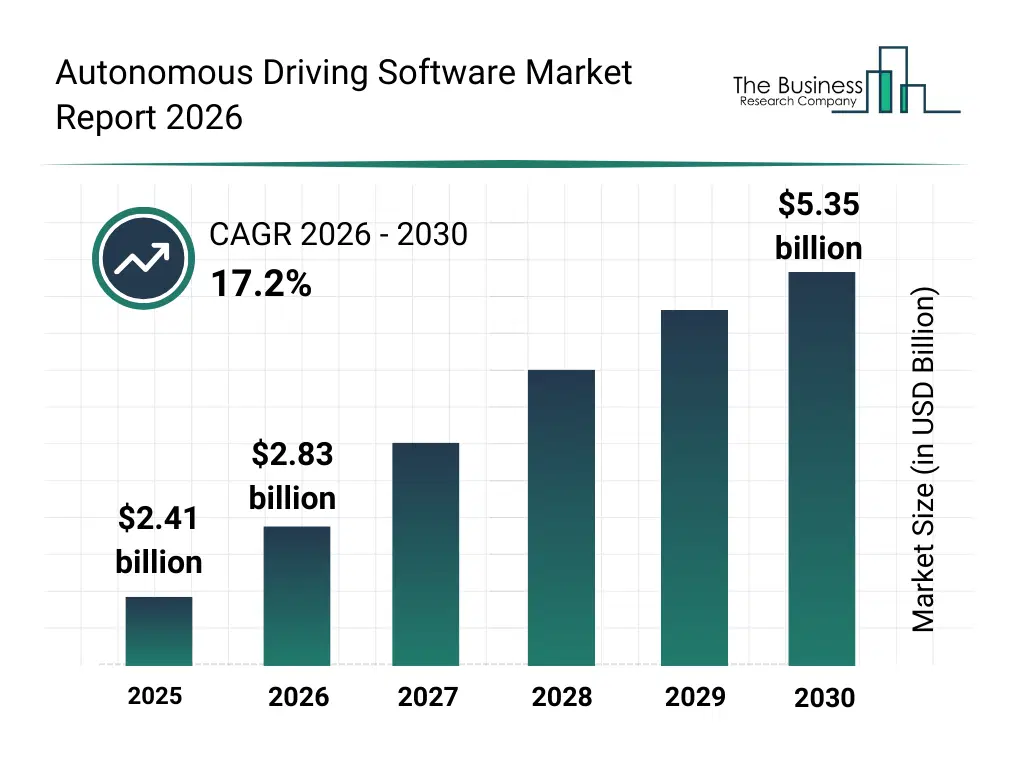
What Is The Autonomous Driving Software Market Size and Share 2026?
The autonomous driving software market size has grown rapidly in recent years. It will grow from $2.41 billion in 2025 to $2.83 billion in 2026 at a compound annual growth rate (CAGR) of 17.5%. The growth in the historic period can be attributed to increasing integration of advanced driver assistance features, growing adoption of machine learning-based driving models, rising development of high-definition mapping platforms, expanding use of sensor fusion software, and increasing investment in autonomous vehicle technology.What Is The Autonomous Driving Software Market Growth Forecast?
The autonomous driving software market size is expected to see rapid growth in the next few years. It will grow to $5.35 billion in 2030 at a compound annual growth rate (CAGR) of 17.2%. The growth in the forecast period can be attributed to growing demand for real-time autonomous navigation systems, increasing deployment of cloud-based driving intelligence platforms, rising requirements for predictive vehicle motion planning, expanding commercialization of robotaxi automation systems, and growing focus on improving vehicle-to-everything communication software. Major trends in the forecast period include technology advancements in artificial intelligence-driven perception software, innovations in deep learning-based scene understanding, developments in simulation and digital twin testing environments, research and development in cooperative autonomous driving capabilities, and technology advancements in edge computing-enabled driving algorithms.
Global Autonomous Driving Software Market Segmentation
1) By Components: Hardware Integration Software, Perception And Sensor Fusion Software, Mapping And Localization Software, Path Planning And Control Software, Vehicle Connectivity Management Software 2) By Vehicle Type: Passenger Cars, Commercial Vehicles 3) By Propulsion Type: Electric, Internal Combustion Engine (ICE) 4) By Level Of Autonomy: Level 1 - Driver Assistance, Level 2 - Partial Automation, Level 3 - Conditional Automation, Level 4 - High Automation, Level 5 - Full Automation 5) By End Use Industry: Automotive Manufacturing, Mobility And Ride Hailing Services, Logistics And Transportation, Public Transport Systems, Other End-Users Subsegments: 1) By Hardware Integration Software: Electronic Control Unit Firmware, Sensor Interface Controllers, Actuator Communication Protocols, Vehicle Network Gateways 2) By Perception And Sensor Fusion Software: Object Detection and Classification Algorithms, Motion Tracking and Prediction Systems, Occupancy Grid Mapping Software, Multi Sensor Data Correlation Engines 3) By Mapping and Localization Software: Simultaneous Localization and Mapping Solutions, High Definition Map Processing Engines, Precision Global Navigation Satellite System Corrections, Visual Odometry and Dead Reckoning Systems 4) By Path Planning and Control Software: Behavior and Trajectory Planning Modules, Motion Control and Stabilization Algorithms, Collision Avoidance and Emergency Maneuver Systems, Traffic Rule Compliance and Decision Engines 5) By Vehicle Connectivity Management Software: Vehicle to Everything Communication Stacks, Over The Air Update Management Platforms, Fleet Management and Coordination Software, Cybersecurity and Intrusion Detection SystemsWhat Is The Driver Of The Autonomous Driving Software Market?
The increasing adoption of advanced driver assistance systems (ADAS) is expected to propel the growth of the autonomous driving software market going forward. Advanced driver assistance systems refers to the suite of electronic technologies that assist vehicle drivers in navigating and avoiding collisions, including features such as adaptive cruise control, lane departure warning, and automatic emergency braking, and provides the technological foundation for higher levels of vehicle autonomy. Adoption of advanced driver assistance systems (ADAS) is rising as governments and consumers increasingly prioritize road safety reduced traffic congestion and improved driving comfort supported by maturing sensor and AI technologies and favorable regulations. Autonomous driving software supports advanced driver assistance systems by enabling real-time decision-making, environment perception, and adaptive control. It enhances vehicle safety and driving efficiency by facilitating features such as collision avoidance, lane keeping, adaptive cruise control, and automated navigation. For instance, in September 2024, according to the Massachusetts Institute of Technology Research and Engineering (MITRE), a US-based research organization, by 2023, 10 of 14 advanced driver-assistance system (ADAS) features had achieved over 50% market penetration, with five features, including forward collision warning, automatic emergency braking, pedestrian detection, and lane departure warning reaching around 91–94% penetration in new vehicles. Therefore, the increasing adoption of advanced driver assistance systems (ADAS) is driving the growth of the autonomous driving software industry.Key Players In The Global Autonomous Driving Software Market
Major companies operating in the autonomous driving software market are General Motors Company, Mobileye N.V., Zoox Inc., Waymo LLC, Motional Inc., Nuro Inc., Oxbotica Ltd., Momenta Inc., DeepRoute.ai Ltd., Einride AB, Pony.ai Inc., Wayve Ltd., WeRide Inc., Helm.ai Inc., Apex.AI Inc., Parallel Domain Inc., Robert Bosch GmbH, Phantom Auto Inc., Plus.ai Inc., Aurora Innovation Inc.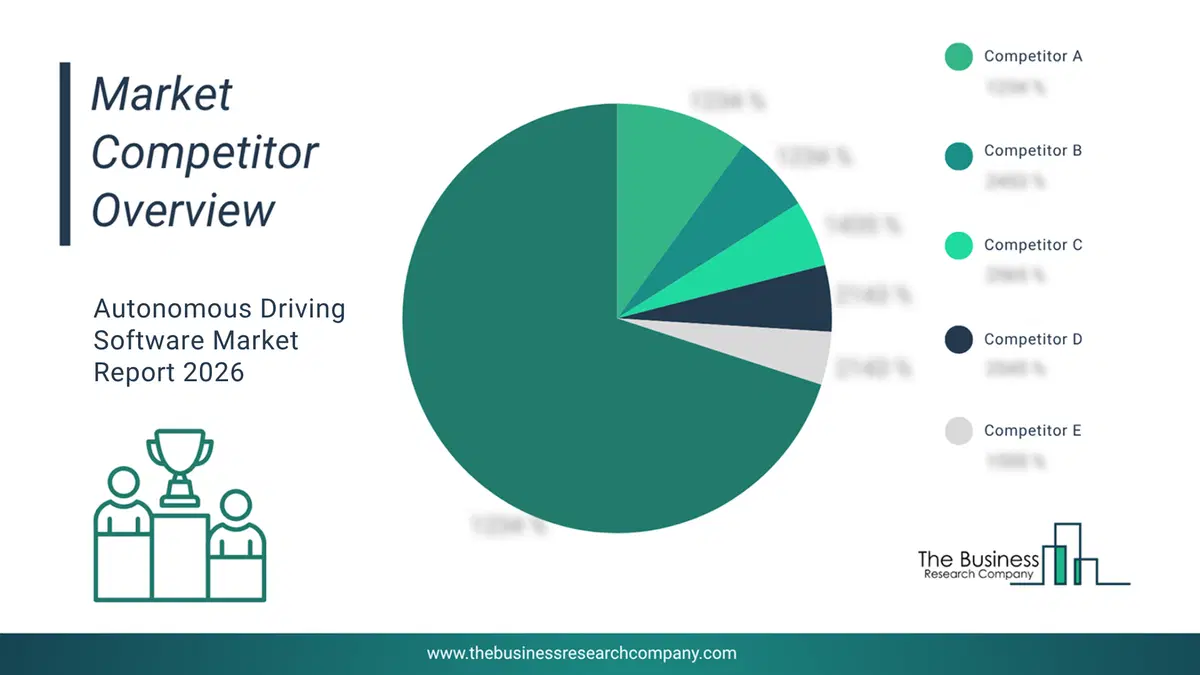
This chart is for illustrative purposes; the full report includes a detailed competitor analysis and comprehensive overview of the top 10 companies in the market.
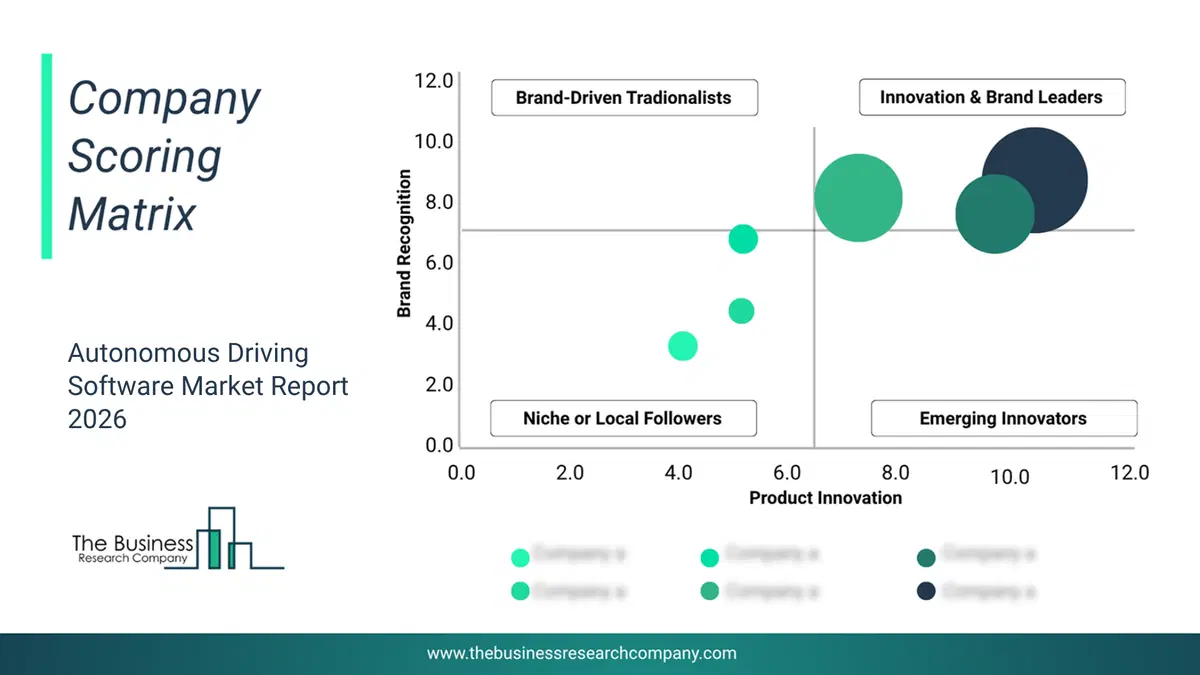
This chart maps companies by product innovation and brand strength, with bubble size indicating relative revenue, helping identify market leaders, challengers, and niche players. This is an illustrative chart; the full report provides a complete and accurate competitive analysis.
Global Autonomous Driving Software Market Trends and Insights
Major companies operating in the autonomous driving software market are focusing on developing advanced capabilities, such as deployment-ready self-driving vehicle software, to accelerate commercial operations, improve safety, and support the large-scale rollout of autonomous transport services. Deployment-ready self-driving vehicle software refers to fully integrated autonomous driving systems that have been tested, validated, and certified for real-world passenger transport, enabling vehicles to operate reliably without a safety driver under defined operational conditions. For instance, in February 2024, OXA Autonomous Technologies Inc., a US-based autonomous mobility software provider, deployed its commercial self-driving software Oxa Driver. The deployment-ready software integrates perception, planning, and control modules optimized for urban and mixed traffic environments, supporting safe, predictable navigation and passenger interactions. It enables operators to launch real-world autonomous mobility solutions that enhance public transport accessibility and passenger experience.What Are Latest Mergers And Acquisitions In The Autonomous Driving Software Market?
In June 2025, NXP Semiconductors N.V., a Netherlands-based provider of automotive semiconductors and intelligent edge processing solutions, acquired TTTech Auto for approximately $625 million. With this acquisition, NXP aims to strengthen its automotive computing and software portfolio by integrating TTTech Auto’s safety-critical middleware for software-defined vehicles, enhancing capabilities foundational to cockpit domain controller ecosystems combining infotainment, instrument clusters, and safety management. TTTech Auto is an Austria-based provider of automotive safety‑critical software for advanced driver assistance systems (ADAS), automated driving, and autonomous vehicles.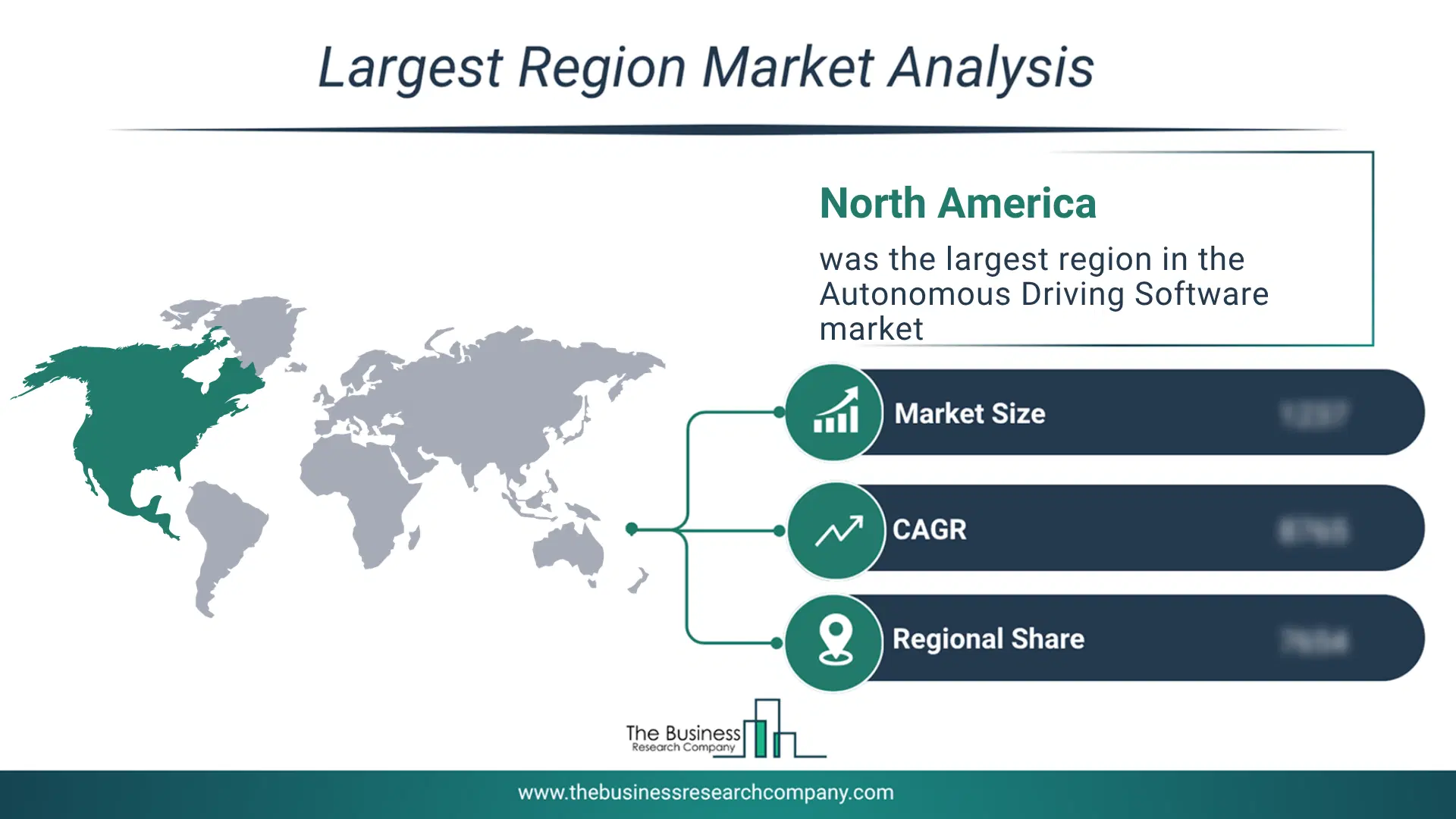
Regional Insights
North America was the largest region in the autonomous driving software in 2025. Asia-Pacific is expected to be the fastest-growing region in the forecast period. The regions covered in this market report are Asia-Pacific, South East Asia, Western Europe, Eastern Europe, North America, South America, Middle East, Africa. The countries covered in this market report are Australia, Brazil, China, France, Germany, India, Indonesia, Japan, Taiwan, Russia, South Korea, UK, USA, Canada, Italy, Spain.What Defines the Autonomous Driving Software Market?
The autonomous driving software market consists of sales of perception software, sensor fusion algorithms, path planning systems, high-definition mapping software, and driver monitoring systems. Values in this market are ‘factory gate’ values, that is the value of goods sold by the manufacturers or creators of the goods, whether to other entities (including downstream manufacturers, wholesalers, distributors and retailers) or directly to end customers. The value of goods in this market includes related services sold by the creators of the goods.How is Market Value Defined and Measured?
The market value is defined as the revenues that enterprises gain from the sale of goods and/or services within the specified market and geography through sales, grants, or donations in terms of the currency (in USD unless otherwise specified). The revenues for a specified geography are consumption values that are revenues generated by organizations in the specified geography within the market, irrespective of where they are produced. It does not include revenues from resales along the supply chain, either further along the supply chain or as part of other products.
This chart presents market attractiveness based on a quantitative evaluation of growth, competition, strategic alignment, and risk, offering a clear view of opportunity areas for decision-making. This chart is for illustrative purposes; the full report contains the complete analysis.

This chart highlights the Total Addressable Market (TAM) by estimating the maximum revenue opportunity using an assumption-driven approach, supporting strategic planning and opportunity sizing across markets. The chart is illustrative; the full report provides a more comprehensive analysis.
What Key Data and Analysis Are Included in the Autonomous Driving Software Market Report 2026?
The autonomous driving software market research report is one of a series of new reports from The Business Research Company that provides market statistics, including industry global market size, regional shares, competitors with the market share, detailed market segments, market trends and opportunities, and any further data you may need to thrive in the autonomous driving software industry. The market research report delivers a complete perspective of everything you need, with an in-depth analysis of the current and future state of the industry.Autonomous Driving Software Market Report Forecast Analysis
| Report Attribute | Details |
|---|---|
| Market Size Value In 2026 | $2.83 billion |
| Revenue Forecast In 2030 | $5.35 billion |
| Growth Rate | CAGR of 17.2% from 2026 to 2030 |
| Base Year For Estimation | 2025 |
| Actual Estimates/Historical Data | 2020-2025 |
| Forecast Period | 2026 - 2030 |
| Market Representation | Revenue in USD Billion and CAGR from 2026 to 2030 |
| Segments Covered | Components, Vehicle Type, Propulsion Type, Level Of Autonomy, End Use Industry |
| Regional Scope | Asia-Pacific, Western Europe, Eastern Europe, North America, South America, Middle East, Africa |
| Country Scope | The Countries Covered In This Market Report Are Australia, Brazil, China, France, Germany, India, Indonesia, Japan, Taiwan, Russia, South Korea, Uk, Usa, Canada, Italy, Spain. |
| Key Companies Profiled | General Motors Company, Mobileye N.V., Zoox Inc., Waymo LLC, Motional Inc., Nuro Inc., Oxbotica Ltd., Momenta Inc., DeepRoute.ai Ltd., Einride AB, Pony.ai Inc., Wayve Ltd., WeRide Inc., Helm.ai Inc., Apex.AI Inc., Parallel Domain Inc., Robert Bosch GmbH, Phantom Auto Inc., Plus.ai Inc., Aurora Innovation Inc. |
| Customization Scope | Request for Customization |
| Pricing And Purchase Options | Explore Purchase Options |