
Autonomous Farm Machinery Market Report 2026
Global Outlook – By Product Type (Autonomous Tractors, Autonomous Harvesting Machinery, Autonomous Planting And Seeding Machinery, Autonomous Spraying Machinery, Autonomous Fertilizer Application Machinery, Autonomous Weeding Machinery, Autonomous Mowing Machinery, Other Autonomous Farm Machinery), By Level Of Autonomy (Semi Autonomous Machinery, Fully Autonomous Machinery), By Sales Channel (Original Equipment Manufacturers, Aftermarket), By Application (Land Preparation, Planting And Seeding, Crop Monitoring, Harvesting, Weed Management, Livestock Farm Operations, Post Harvest Operations), By End User (Individual Farmers, Commercial Farms, Agricultural Cooperatives, Agricultural Service Providers, Research And Educational Institutions) – Market Size, Trends, Strategies, and Forecast to 2030
Autonomous Farm Machinery Market Overview
• Autonomous Farm Machinery market size has reached to $11.06 billion in 2025 • Expected to grow to $21.04 billion in 2030 at a compound annual growth rate (CAGR) of 13.6% • Growth Driver: Increasing Penetration Of Electric Vehicles Fueling The Growth Of The Market Due To Rising Demand For Energy-efficient Thermal Management Technologies • Market Trend: Advancements In Electric Vehicle Heat Pump Systems Enhance Automotive HVAC And Cabin Comfort Performance • North America was the largest region in 2025 and Asia-Pacific is the fastest growing region.What Is Covered Under Autonomous Farm Machinery Market?
Autonomous farm machinery is agricultural equipment that performs farming operations with little or no human intervention by integrating technologies such as artificial intelligence (AI), global positioning systems (GPS), sensors, machine vision, and robotics. It automates activities including planting, spraying, harvesting, and field monitoring to enhance precision and operational efficiency. Autonomous farm machinery reduces labor requirements, optimizes resource use, improves farm productivity, and promotes sustainable agricultural practices. The main product types of autonomous farm machinery include autonomous tractors, autonomous harvesting machinery, autonomous planting and seeding machinery, autonomous spraying machinery, autonomous fertilizer application machinery, autonomous weeding machinery, autonomous mowing machinery, and other autonomous farm machinery. Autonomous tractors refer to self-operating agricultural vehicles equipped with advanced sensors, navigation systems, and automation technologies to perform farming tasks with minimal human intervention. These machines are available in semi autonomous machinery and fully autonomous machinery configurations and are sold through original equipment manufacturers and aftermarket channels. The various applications involved are land preparation, planting and seeding, crop monitoring, harvesting, weed management, livestock farm operations, and post harvest operations, and they are used by several end users such as individual farmers, commercial farms, agricultural cooperatives, agricultural service providers, and research and educational institutions.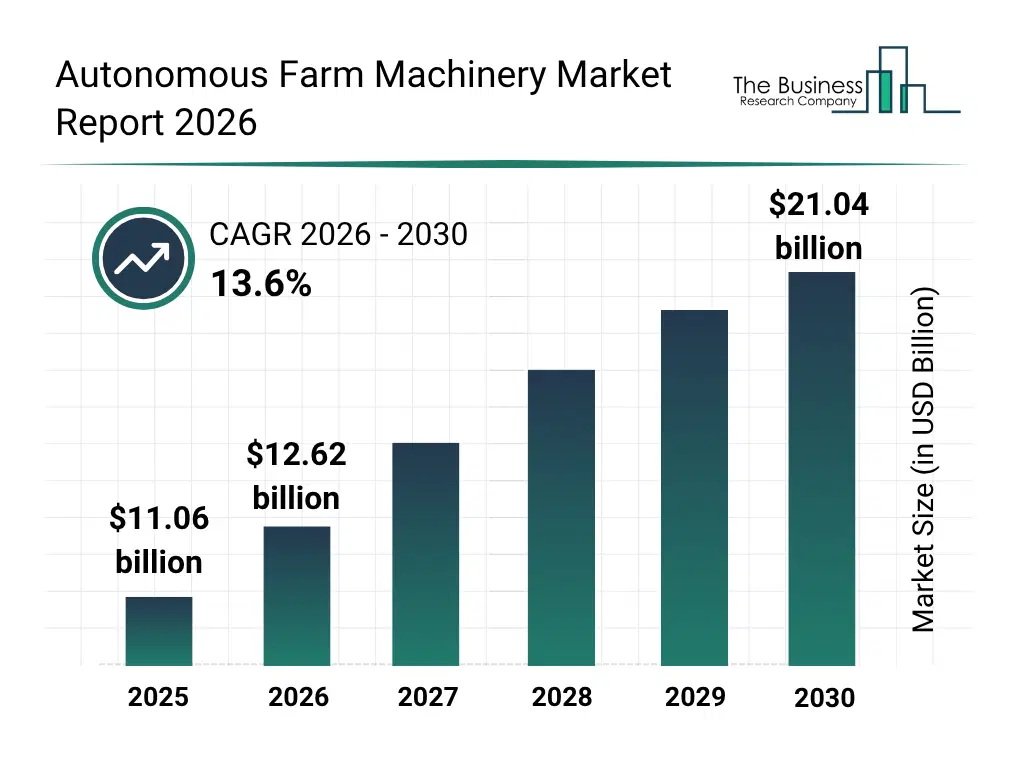
What Is The Autonomous Farm Machinery Market Size and Share 2026?
The autonomous farm machinery market size has grown rapidly in recent years. It will grow from $11.06 billion in 2025 to $12.62 billion in 2026 at a compound annual growth rate (CAGR) of 14.1%. The growth in the historic period can be attributed to increasing adoption of precision agriculture practices, rising demand for agricultural productivity improvement, growing shortage of farm labor, expansion of mechanized farming activities, increasing focus on efficient resource utilization.What Is The Autonomous Farm Machinery Market Growth Forecast?
The autonomous farm machinery market size is expected to see rapid growth in the next few years. It will grow to $21.04 billion in 2030 at a compound annual growth rate (CAGR) of 13.6%. The growth in the forecast period can be attributed to rising demand for fully autonomous agricultural equipment, growing adoption of smart farming solutions, increasing need for sustainable farming practices, expansion of autonomous machinery in commercial farming operations, rising investments in advanced agricultural technologies. Major trends in the forecast period include increasing adoption of autonomous navigation systems for precision farming operations, growing integration of advanced sensing technologies for real time crop and field monitoring, rising demand for autonomous equipment to address agricultural labor shortages, expansion of automated farming solutions for improving operational efficiency and resource utilization, increasing development of multifunctional autonomous machinery for diverse agricultural applications.Tariff Impact On Autonomous Farm Machinery Market
Tariffs are impacting the autonomous farm machinery market by increasing the cost of imported agricultural equipment, electronic components, sensors, GPS modules, and semiconductor-based systems required for autonomous operations. The impact is higher across machinery manufacturers and farmers dependent on imported automation technologies, particularly in regions such as North America, Europe, and Asia-Pacific where advanced agricultural equipment supply chains are globally connected. Product segments such as autonomous tractors, harvesting machinery, and precision spraying equipment are affected due to increased production and deployment costs. However, tariffs are also encouraging local manufacturing, regional supplier diversification, and investments in domestic agricultural technology ecosystems, supporting long-term market resilience.
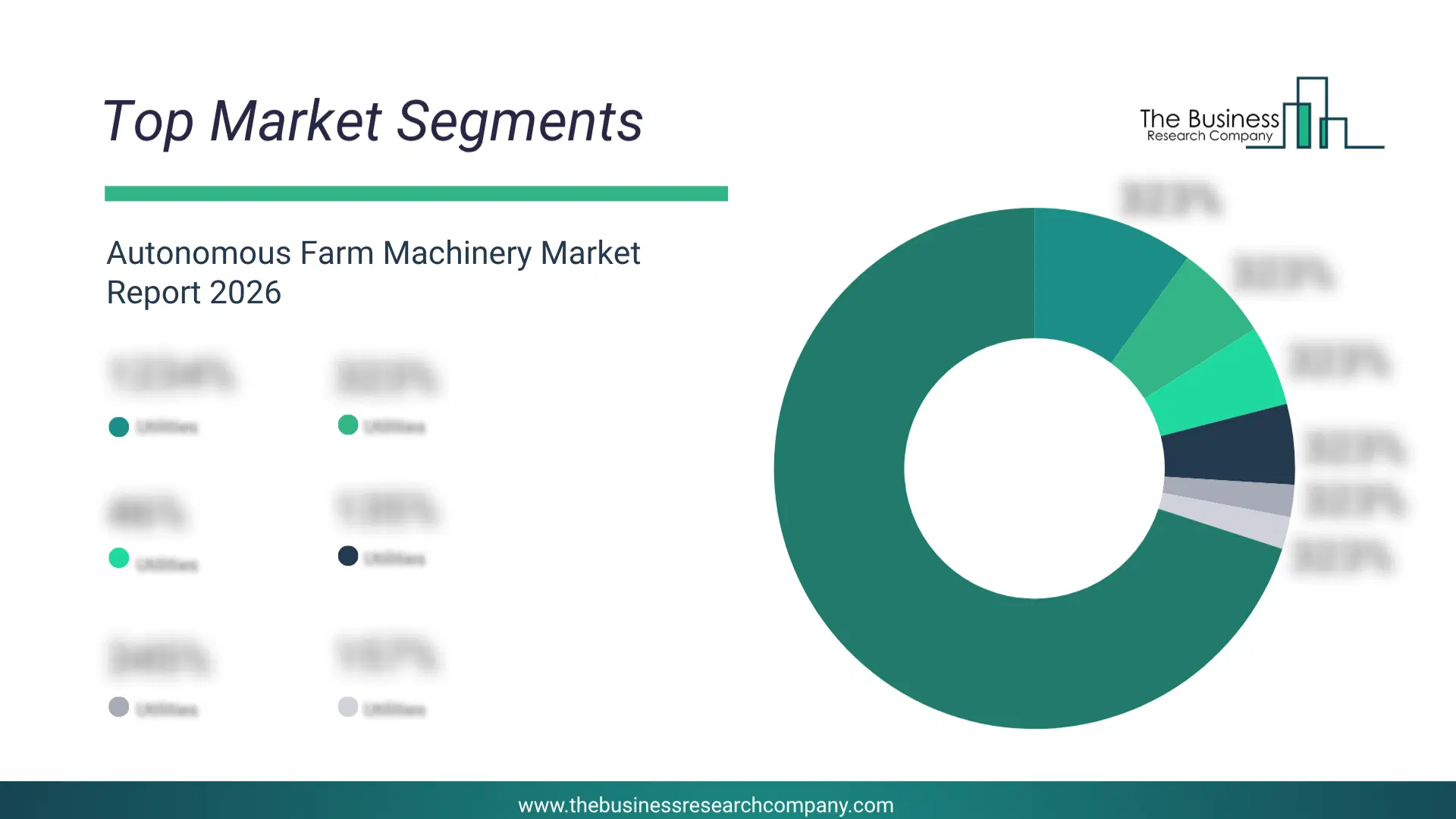
Global Autonomous Farm Machinery Market Segmentation
2) By Level Of Autonomy: Semi Autonomous Machinery, Fully Autonomous Machinery 3) By Sales Channel: Original Equipment Manufacturers, Aftermarket 4) By Application: Land Preparation, Planting And Seeding, Crop Monitoring, Harvesting, Weed Management, Livestock Farm Operations, Post Harvest Operations 5) By End User: Individual Farmers, Commercial Farms, Agricultural Cooperatives, Agricultural Service Providers, Research And Educational Institutions Subsegments: 1) By Autonomous Tractors: Driverless Row Crop Tractors, Driverless Orchard Tractors, Driverless Vineyard Tractors, Driverless Utility Tractors, Driverless Compact Tractors 2) By Autonomous Harvesting Machinery: Autonomous Combine Harvesters, Autonomous Forage Harvesters, Autonomous Cotton Harvesters, Autonomous Sugarcane Harvesters, Autonomous Potato Harvesters 3) By Autonomous Planting And Seeding Machinery: Autonomous Seed Drills, Autonomous Precision Planters, Autonomous Air Seeders, Autonomous Rice Transplanters, Autonomous Vegetable Transplanters 4) By Autonomous Spraying Machinery: Autonomous Boom Sprayers, Autonomous Orchard Sprayers, Autonomous Vineyard Sprayers, Autonomous Spot Sprayers, Autonomous Mist Sprayers 5) By Autonomous Fertilizer Application Machinery: Autonomous Broadcast Spreaders, Autonomous Spinner Spreaders, Autonomous Pneumatic Fertilizer Spreaders, Autonomous Manure Spreaders, Autonomous Liquid Fertilizer Applicators 6) By Autonomous Weeding Machinery: Autonomous Mechanical Weeders, Autonomous Rotary Weeders, Autonomous Inter Row Weeders, Autonomous In Row Weeders, Autonomous Thermal Weeders 7) By Autonomous Mowing Machinery: Autonomous Flail Mowers, Autonomous Rotary Mowers, Autonomous Disc Mowers, Autonomous Sickle Bar Mowers, Autonomous Mulching Mowers 8) By Other Autonomous Farm Machinery: Autonomous Bale Handling Machinery, Autonomous Feed Mixing Machinery, Autonomous Irrigation Machinery, Autonomous Field Transport Machinery, Autonomous Crop Scouting RobotsWhat Is The Driver Of The Autonomous Farm Machinery Market?
The rising agricultural labor shortages are expected to propel the growth of the autonomous farm machinery market going forward. Agricultural labor shortages refer to the insufficient availability of workers needed to perform farming activities such as planting, cultivating, harvesting, and livestock management. The rise in agricultural labor shortages is due to the aging agricultural workforce, as a growing number of experienced farm workers are reaching retirement age while fewer younger workers are entering the agricultural sector. Autonomous farm machinery helps address labor shortages by automating critical farming operations, reducing dependence on manual labor, improving productivity, and enabling continuous farm operations with minimal human intervention. For instance, in October 2025, according to the U.S. Bureau of Labor Statistics, a U.S.-based federal agency, the agricultural workforce declined by 155,000 workers (7%) between March and July 2025, exacerbating labor shortages across the agricultural sector. Therefore, the rising agricultural labor shortages are driving the growth of the autonomous farm machinery industry.Key Players In The Global Autonomous Farm Machinery Market
Major companies operating in the autonomous farm machinery market are AGCO Corporation, Ag Leader Technology Inc., Agrobot S.L., AgXeed B.V., AutoAgri AS, Burro AI Inc., Carbon Robotics Inc., CLAAS KGaA mbH, CNH Industrial N.V., Deere & Company, SZ DJI Technology Co. Ltd., Ecorobotix SA, Kubota Corporation, Lely Holding B.V., Naïo Technologies SAS, Robotics Plus Limited, Sabanto Inc., SwarmFarm Robotics Pty Ltd., TerraClear Inc., Trimble Inc., Verdant Robotics Inc., Yanmar Holdings Co. Ltd.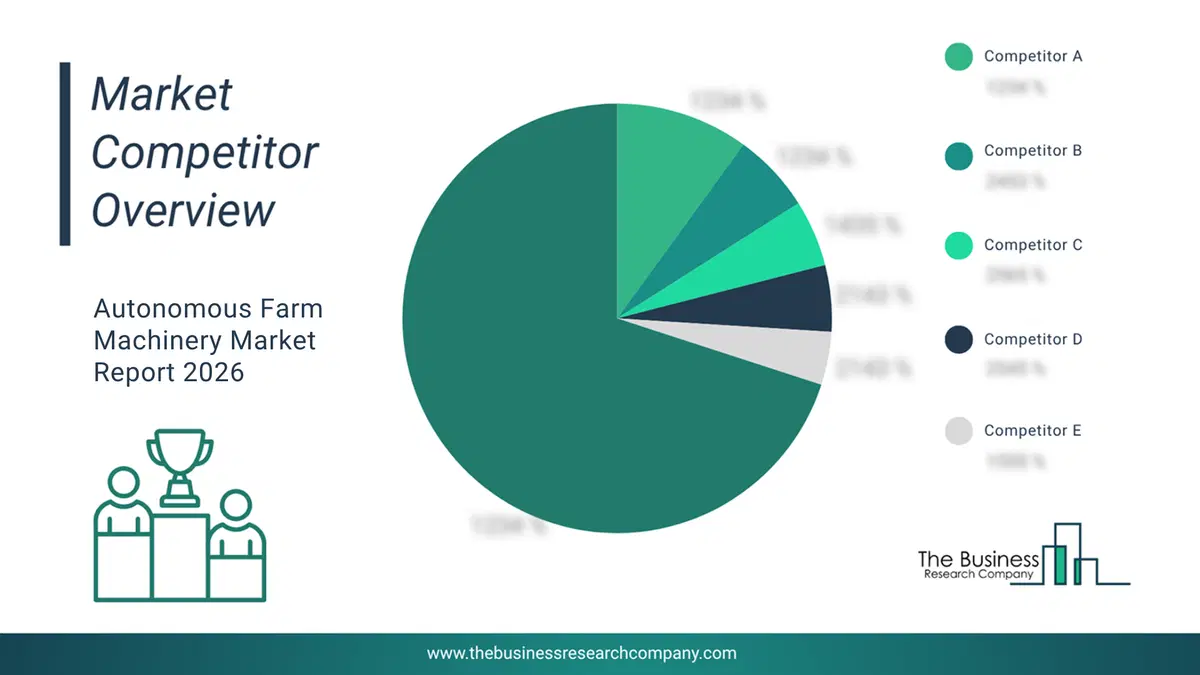
This chart is for illustrative purposes; the full report includes a detailed competitor analysis and comprehensive overview of the top 10 companies in the market.
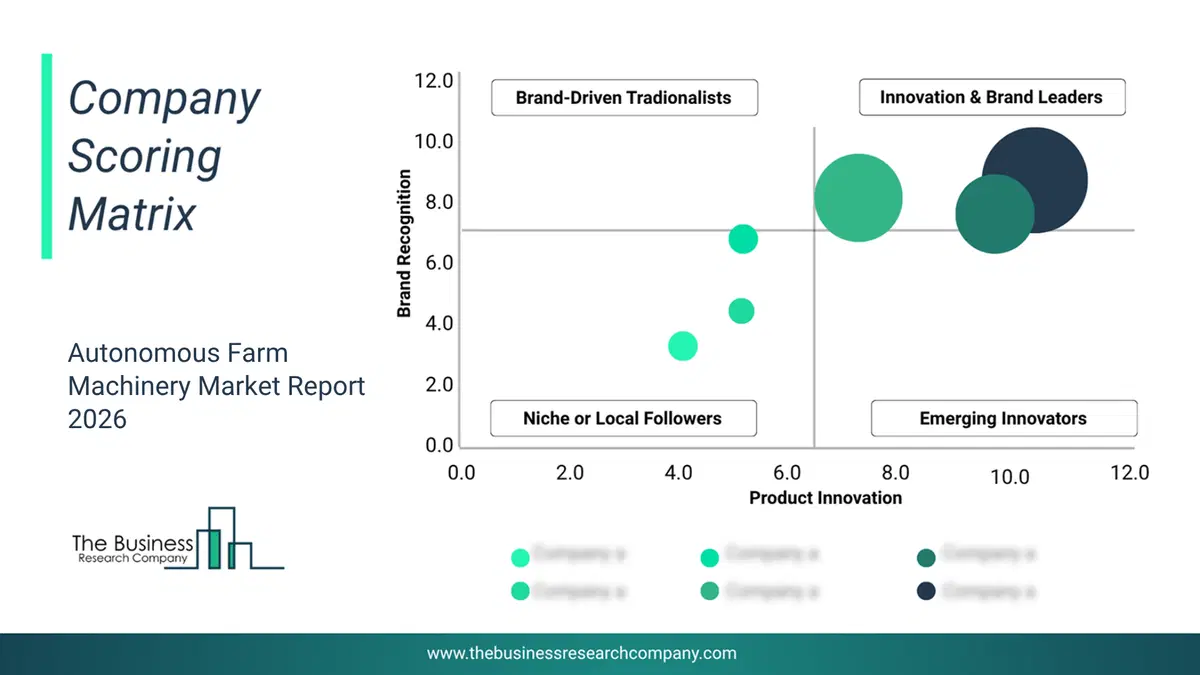
This chart maps companies by product innovation and brand strength, with bubble size indicating relative revenue, helping identify market leaders, challengers, and niche players. This is an illustrative chart; the full report provides a complete and accurate competitive analysis.
Global Autonomous Farm Machinery Market Trends and Insights
Major companies operating in the autonomous farm machinery market are focusing on developing advanced autonomous solutions powered by artificial intelligence (AI), computer vision, and machine vision technologies to improve operational efficiency, address labor shortages, and enhance precision farming. Autonomous technology refers to systems that enable agricultural machinery to perform farming operations with minimal or no human intervention by using sensors, cameras, and AI-driven navigation. For instance, in January 2025, John Deere, a US-based agricultural machinery manufacturer, unveiled new autonomous tractors alongside an autonomy kit that integrates advanced computer vision, artificial intelligence (AI), and multiple cameras for autonomous navigation. The company also expanded autonomy across additional equipment, including dump trucks and commercial landscaping mowers, while enabling existing tractors to be upgraded with autonomy kits, supporting greater automation and productivity in agricultural operations.What Are Latest Mergers And Acquisitions In The Autonomous Farm Machinery Market?
In August 2025, Deere & Company, a US-based agricultural machinery manufacturer, acquired GUSS Automation LLC for an undisclosed amount. Through this acquisition, Deere & Company aims to strengthen its autonomous agriculture portfolio, expand its presence in high-value crop automation, and accelerate the development of advanced autonomous spraying solutions for orchards and vineyards. GUSS Automation LLC is a US-based agricultural technology company that develops autonomous sprayers and supervised crop autonomy solutions for high-value agricultural operations.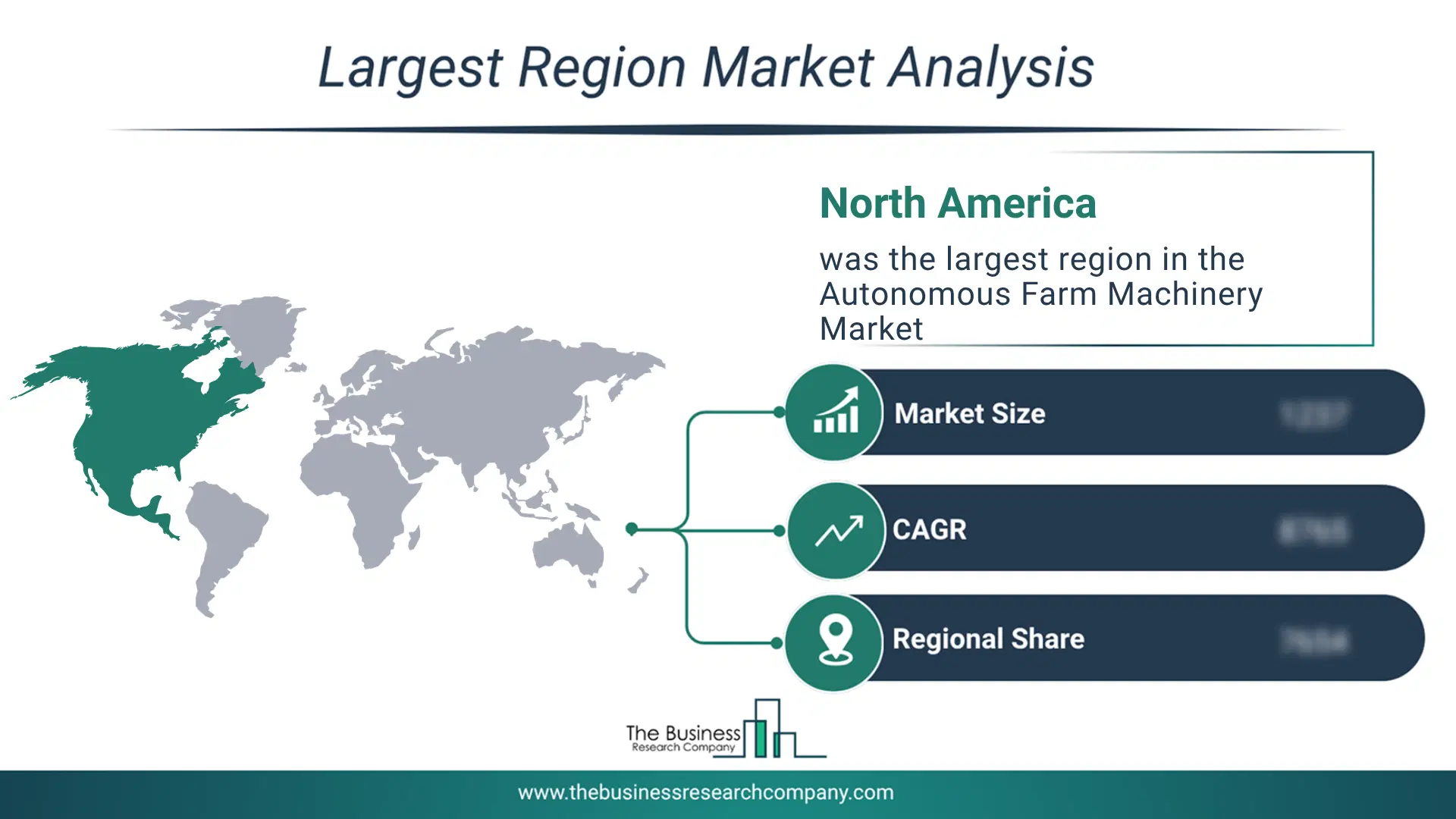
Regional Outlook
North America was the largest region in the autonomous farm machinery market in 2025. Asia-Pacific is expected to be the fastest-growing region in the forecast period. The regions covered in the autonomous farm machinery market are Asia-Pacific, South East Asia, Western Europe, Eastern Europe, North America, South America, Middle East, Africa. The countries covered in the autonomous farm machinery market are Australia, Brazil, China, France, Germany, India, Indonesia, Japan, Taiwan, Russia, South Korea, UK, USA, Canada, Italy, Spain.What Defines the Autonomous Farm Machinery Market?
The autonomous farm machinery market consists of sales of autonomous fencing robots, autonomous milking robots, and autonomous crop inspection robots. Values in this market are ‘factory gate’ values, that is, the value of goods sold by the manufacturers or creators of the goods, whether to other entities (including downstream manufacturers, wholesalers, distributors, and retailers) or directly to end customers. The value of goods in this market includes related services sold by the creators of the goods.How is Market Value Defined and Measured?
The market value is defined as the revenues that enterprises gain from the sale of goods and/or services within the specified market and geography through sales, grants, or donations in terms of the currency (in USD unless otherwise specified). The revenues for a specified geography are consumption values that are revenues generated by organizations in the specified geography within the market, irrespective of where they are produced. It does not include revenues from resales along the supply chain, either further along the supply chain or as part of other products.
This chart presents market attractiveness based on a quantitative evaluation of growth, competition, strategic alignment, and risk, offering a clear view of opportunity areas for decision-making. This chart is for illustrative purposes; the full report contains the complete analysis.

This chart highlights the Total Addressable Market (TAM) by estimating the maximum revenue opportunity using an assumption-driven approach, supporting strategic planning and opportunity sizing across markets. The chart is illustrative; the full report provides a more comprehensive analysis.
What Key Data and Analysis Are Included in the Autonomous Farm Machinery Market Report 2026?
The autonomous farm machinery market research report is one of a series of new reports from The Business Research Company that provides market statistics, including industry global market size, regional shares, competitors with the market share, detailed market segments, market trends and opportunities, and any further data you may need to thrive in the autonomous farm machinery industry. The market research report delivers a complete perspective of everything you need, with an in-depth analysis of the current and future state of the industry.Autonomous Farm Machinery Market Report Forecast Analysis
| Report Attribute | Details |
|---|---|
| Market Size Value In 2026 | $12.62 billion |
| Revenue Forecast In 2030 | $21.04 billion |
| Growth Rate | CAGR of 13.6% from 2026 to 2030 |
| Base Year For Estimation | 2025 |
| Actual Estimates/Historical Data | 2020-2025 |
| Forecast Period | 2026 - 2030 |
| Market Representation | Revenue in USD Billion and CAGR from 2026 to 2030 |
| Segments Covered | Product Type, Level Of Autonomy, Sales Channel, Application, End User |
| Regional Scope | Asia-Pacific, Western Europe, Eastern Europe, North America, South America, Middle East, Africa |
| Country Scope | The countries covered in the report are Australia, Brazil, China, France, Germany, India, Indonesia, Japan, Taiwan, Russia, South Korea, UK, USA, Canada, Italy, Spain. |
| Key Companies Profiled | AGCO Corporation, Ag Leader Technology Inc., Agrobot S.L., AgXeed B.V., AutoAgri AS, Burro AI Inc., Carbon Robotics Inc., CLAAS KGaA mbH, CNH Industrial N.V., Deere & Company, SZ DJI Technology Co. Ltd., Ecorobotix SA, Kubota Corporation, Lely Holding B.V., Naïo Technologies SAS, Robotics Plus Limited, Sabanto Inc., SwarmFarm Robotics Pty Ltd., TerraClear Inc., Trimble Inc., Verdant Robotics Inc., Yanmar Holdings Co. Ltd. |
| Customization Scope | Request for Customization |
| Pricing And Purchase Options | Explore Purchase Options |