

Autonomous Mobile Robots Market Report 2026
Global Outlook – By Component (Hardware, Software, Service), By Type (Goods-To-Person Picking Robots, Self-Driving Forklifts, Autonomous Inventory Of Robots, Unmanned Aerial Vehicles (UAVs)), By Battery (Lead, Lithium-Ion (Li-ion), Nickel-Based, Other Types), By End-User (Defense And Security, Warehouse And Logistics, Energy And Power, Automotive, Manufacturing, Oil And Gas, Mining And Minerals, Other End-User Industries) – Market Size, Trends, Strategies, and Forecast to 2030
Autonomous Mobile Robots Market Overview
• Autonomous Mobile Robots market size has reached to $5.79 billion in 2025 • Expected to grow to $13.35 billion in 2030 at a compound annual growth rate (CAGR) of 18.2% • Growth Driver: The Surging Role Of Autonomous Mobile Robots In The Global E-Commerce Landscape • Market Trend: Product Innovation In The Autonomous Mobile Robot Market • Europe was the largest region in 2025 and Asia-Pacific is the fastest growing region.Market Gains By 2030 – Top Opportunities By Segment
Market Gain identifies the most promising market opportunities by highlighting the segments or products expected to generate the highest incremental revenue growth over the next five years.
What Is Covered Under Autonomous Mobile Robots Market?
Autonomous mobile robots (AMR) refer to a kind of robot that can navigate its environment on its own and comprehend it. These robots can navigate through various complex sets of sensors, artificial intelligence, machine learning, and computation for path planning. The main types of autonomous mobile robots are goods-to-person picking robots, self-driving forklifts, autonomous inventory of robots, and unmanned aerial vehicles (UAVs). Goods-to-person picking robots refers to the robotic system that sends items straight to a preparation and packaging station as opposed to having someone pick them up one at a time. The various offering includes hardware, software, and service. The various batteries include lead, lithium-ion (Li-ion), nickel-based, and other types. These are used by end-users such as defense and security, warehouse and logistics, energy and power, automotive, manufacturing, oil and gas, mining and minerals, and others.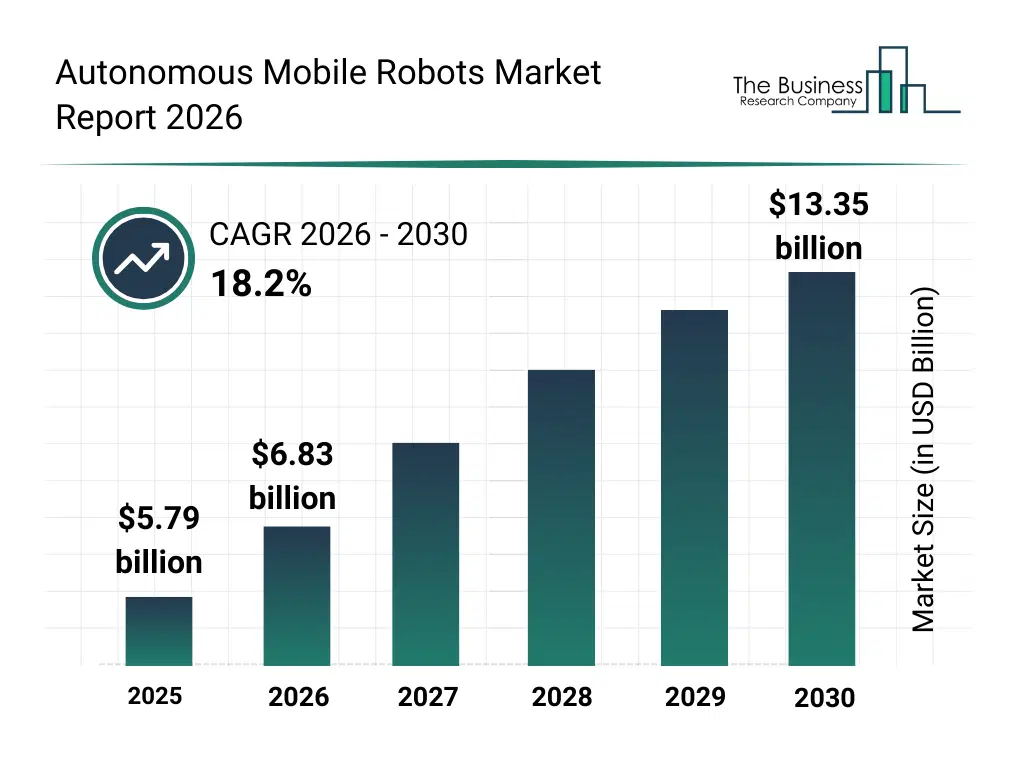
What Is The Autonomous Mobile Robots Market Size and Share 2026?
The autonomous mobile robots market size has grown rapidly in recent years. It will grow from $5.79 billion in 2025 to $6.83 billion in 2026 at a compound annual growth rate (CAGR) of 18.0%. The growth in the historic period can be attributed to expansion of e-commerce logistics, rising warehouse labor shortages, adoption of basic agvs, increasing use of warehouse management systems, early investments in robotics.What Is The Autonomous Mobile Robots Market Growth Forecast?
The autonomous mobile robots market size is expected to see rapid growth in the next few years. It will grow to $13.35 billion in 2030 at a compound annual growth rate (CAGR) of 18.2%. The growth in the forecast period can be attributed to increasing investments in smart warehouses, rising demand for scalable automation, expansion of robotics in manufacturing, growing adoption of ai-driven logistics, increasing focus on operational agility. Major trends in the forecast period include increasing adoption of amrs in warehouses, rising deployment of collaborative mobile robots, growing integration of ai-based navigation systems, expansion of fleet management and analytics platforms, enhanced focus on flexible automation.
Global Autonomous Mobile Robots Market Segmentation
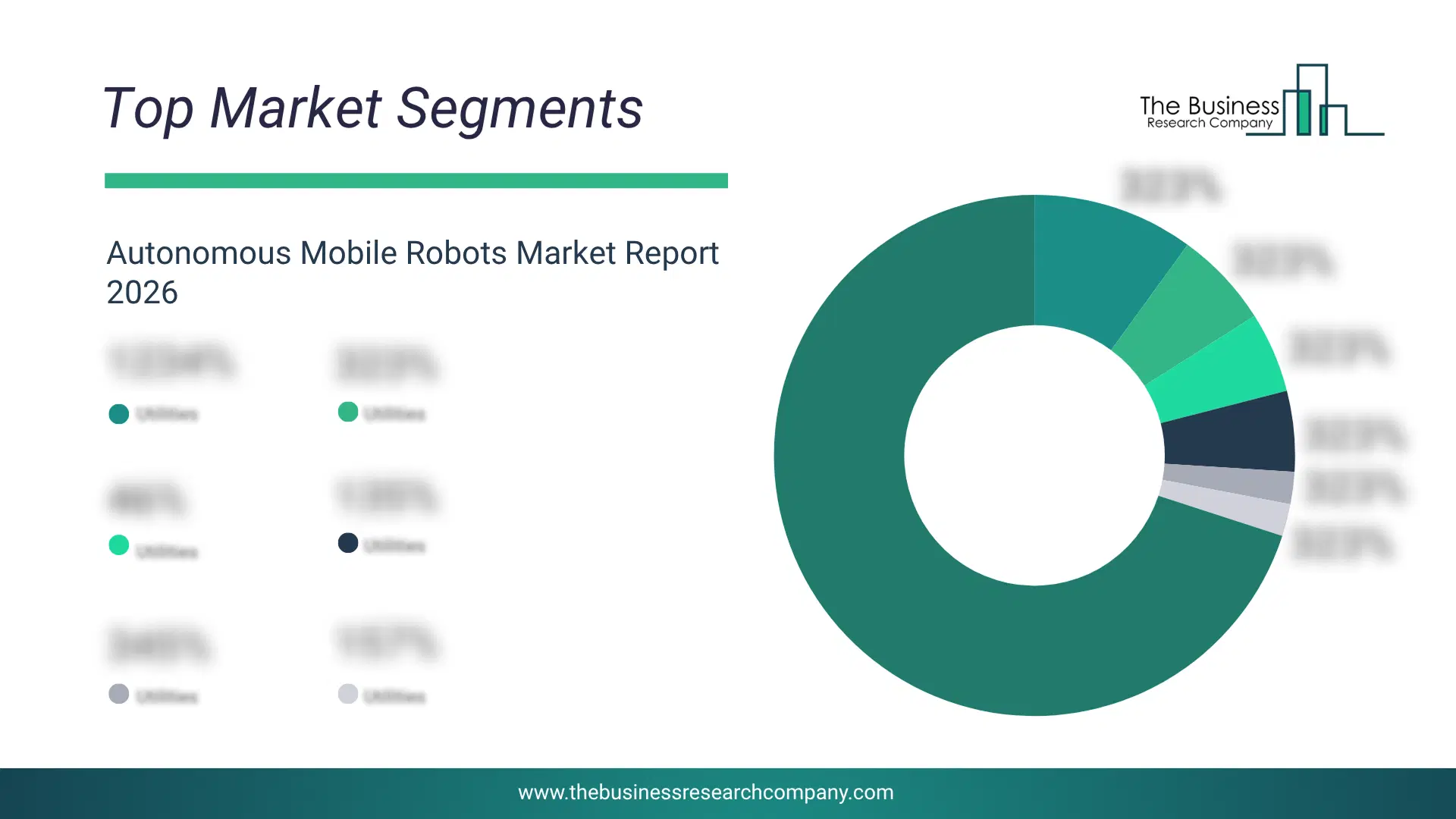
1) By Component: Hardware, Software, Service 2) By Type: Goods-To-Person Picking Robots, Self-Driving Forklifts, Autonomous Inventory Of Robots, Unmanned Aerial Vehicles (UAVs) 3) By Battery: Lead, Lithium-Ion (Li-ion), Nickel-Based, Other Types 4) By End-User: Defense And Security, Warehouse And Logistics, Energy And Power, Automotive, Manufacturing, Oil And Gas, Mining And Minerals, Other End-User Industries Subsegments: 1) By Hardware: Robot Chassis, Sensors And Cameras, Power Supply And Batteries, Navigation And Control Systems 2) By Software: Navigation Software, Mapping And Localization Software, Fleet Management Software, Integration And Analytics Software 3) By Service: Installation And Deployment, Maintenance And Support, Training And Consulting Services The top segments in the autonomous mobile robots market will be: • Hardware will reach $4.28 Billion by 2030. • Software will reach $2.35 Billion by 2030. • Services will reach $0.75 Billion by 2030.What Is The Driver Of The Autonomous Mobile Robots Market?
The rise in global e-commerce activity is significantly contributing to the growth of autonomous mobile robots going forward. E-commerce refers to buying and selling of goods and services by companies and individuals over the internet. Autonomous mobile robots (AMR) can be used in e-commerce warehouses to decrease labor costs and increase pick rates and can replace time-consuming, repetitive jobs, allowing operations to reassign people to other areas of the warehouse. For instance, in August 2024, according to United States Census Bureau, a US-based government agency, U.S. retail e-commerce sales for the second quarter of 2024 reached an estimated $282.3 billion, marking a 5.3% increase compared to the first quarter of 2023. Therefore, the rise in global e-commerce activity is significantly contributing to the growth of autonomous mobile robots industry.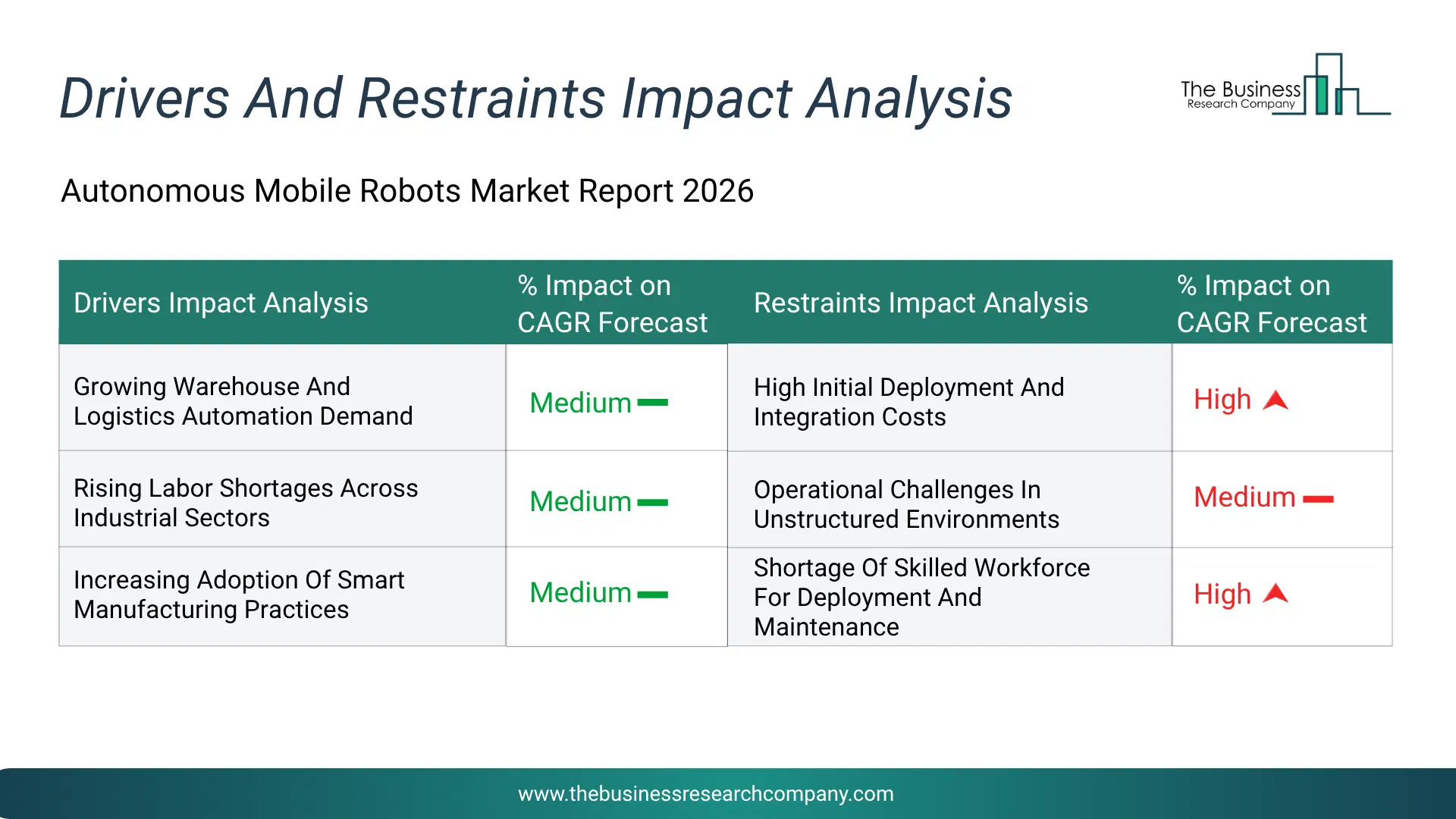
Infographic Chart Showing Key Market Drivers Analysis And Restraints For Autonomous Mobile Robots Market
The chart presents an impact analysis of key drivers and restraints, quantifying their relative influence on the market's growth rate and helping assess the balance between growth enablers and limiting factors. This chart offers a high-level perspective; the full report contains more detailed insights.
How Will The Drivers Impact Growth In The Global Autonomous Mobile Robots Market?
• Growing Warehouse And Logistics Automation Demand (Medium) – During the forecast period, the growing warehouse and logistics automation demand is expected to become a key growth driver for the autonomous mobile robots market by 2030. Growing warehouse and logistics automation demand is accelerating the adoption of autonomous mobile robots as companies seek to improve operational efficiency, reduce manual handling, and optimize material movement. Autonomous mobile robots enable continuous transportation of goods across warehouses and distribution centers with minimal human intervention. Increasing e-commerce activities and higher order fulfillment requirements are creating strong demand for automated intralogistics solutions. Organizations are also focusing on reducing operational bottlenecks and improving inventory management. • Rising Labor Shortages Across Industrial Sectors (Medium) – During the forecast period, the rising labor shortages across industrial sectors are expected to emerge as a major factor driving the expansion of the autonomous mobile robots market by 2030. Rising labor shortages across industrial sectors is encouraging businesses to deploy autonomous mobile robots to maintain productivity and operational continuity. Many manufacturing, warehousing, and logistics facilities face challenges in recruiting and retaining skilled workers for repetitive and physically demanding tasks. Autonomous mobile robots help address workforce gaps by automating transportation and material handling processes. Their ability to operate independently supports uninterrupted workflows and reduces dependency on manual labor. • Increasing Adoption Of Smart Manufacturing Practices (Medium) – During the forecast period, the increasing adoption of smart manufacturing practices is expected to act as a key growth catalyst for the autonomous mobile robots market by 2030. Increasing adoption of smart manufacturing practices is driving the integration of autonomous mobile robots into production and industrial environments. Manufacturers are emphasizing operational flexibility, streamlined workflows, and efficient resource utilization to remain competitive. Autonomous mobile robots support seamless movement of materials between production stages while enhancing plant productivity. Their ability to navigate dynamic industrial environments aligns well with modern manufacturing requirements.How Will The Restraints Impact Growth In The Global Autonomous Mobile Robots Market?
• High Initial Deployment And Integration Costs (Medium) – During the forecast period, the high initial deployment and integration costs limits the adoption of autonomous mobile robots, particularly among small and medium-sized enterprises. Implementing robotic systems often requires substantial investment in hardware, sensors, software, infrastructure modifications, and workforce training. Additional expenses associated with system customization and integration can further increase project costs. Organizations may delay purchasing decisions due to concerns regarding return on investment and budget constraints. These financial barriers can restrict market penetration across cost-sensitive industries. • Operational Challenges In Unstructured Environments (Medium) – During the forecast period, the operational challenges in unstructured environments restrict the effectiveness of autonomous mobile robots in certain applications. Facilities with frequently changing layouts, unexpected obstacles, or highly dynamic operating conditions can create navigation difficulties. Maintaining reliable performance in complex environments may require additional planning, monitoring, and operational adjustments. Errors in navigation or workflow coordination can impact productivity and operational efficiency. These challenges may limit adoption in environments where consistent autonomous movement is difficult to achieve. • Shortage Of Skilled Workforce For Deployment And Maintenance (Medium) – During the forecast period, the shortage of skilled workforce for deployment and maintenance is expected to restrain the growth of the autonomous mobile robots market. Autonomous mobile robots require specialized expertise for system configuration, software integration, navigation optimization, troubleshooting, and ongoing maintenance. However, many industries face a shortage of professionals with skills in robotics, artificial intelligence, automation, and industrial software, making it difficult to deploy and manage these advanced systems efficiently. Organizations may experience longer implementation timelines, higher labor costs, and increased dependence on external service providers for technical support. In addition, insufficient workforce expertise can reduce system performance, delay maintenance activities, and increase the risk of operational disruptions. These challenges are particularly significant for small and medium-sized enterprises with limited access to skilled personnel. Consequently, the shortage of skilled workforce for deployment and maintenance remains a key restraint on the widespread adoption of autonomous mobile robots.Key Players In The Global Autonomous Mobile Robots Market
Major companies operating in the autonomous mobile robots market are OMRON Corporation, inVia Robotics Inc., Geekplus Technology Co. Ltd., Grey Orange Pte. Ltd., Mobile Industrial Robots ApS, Aethon Inc., Vecna Robotics Inc., Clearpath Robotics Co., Hi-Tech Robotic Systemz Ltd., Softbank Robotics SAS, SMP Robotics corporation, NextShift Robotics Inc., Stanley Robotics SAS, Robotnik Automation SLL, SESTO Robotics Pte. Ltd., HAHN Robotics GmbH, ABB Ltd., Clearpath Inc., Locus Robotics Corporation, Boston Dynamics Inc., Conveyco Technologies LLC, IAM Robotics LLC, KUKA AG, Fortna Inc., Teradyne Inc., Seegrid Corporation, Radial Inc., Rapid Robotics Inc., Youibot Intelligent Technology Co. Ltd., Gideon Brothers d.o.o., TRACLabs Inc., Milvus Robotics Private Limited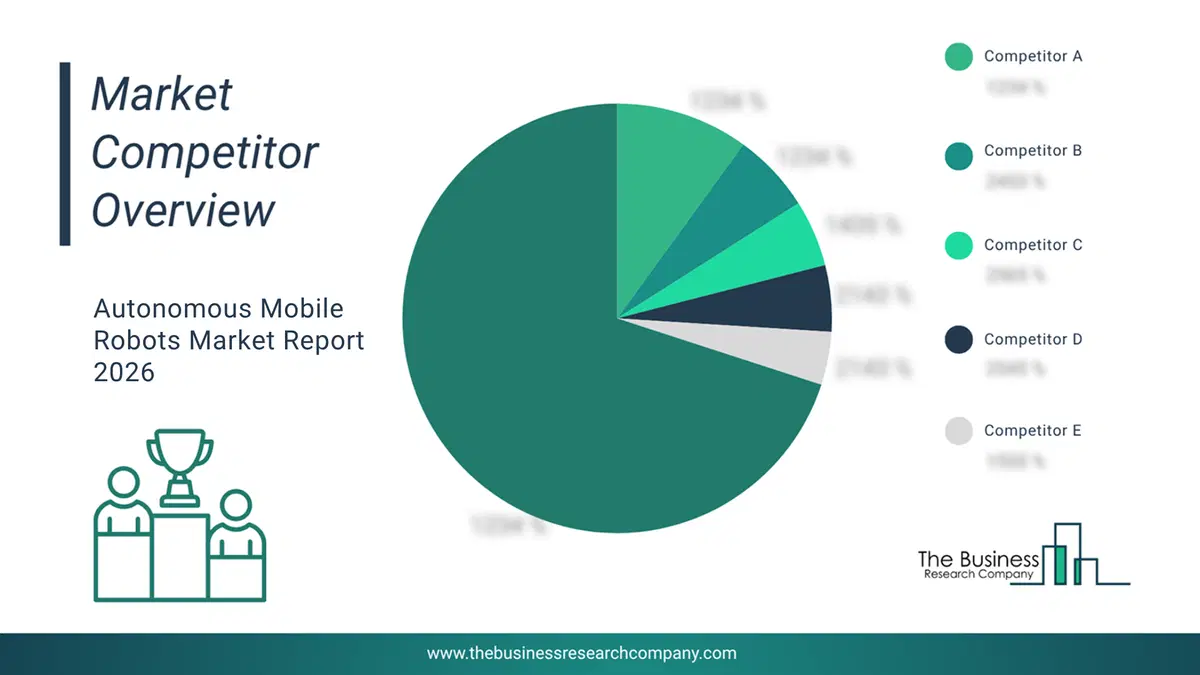
This chart is for illustrative purposes; the full report includes a detailed competitor analysis and comprehensive overview of the top 10 companies in the market.
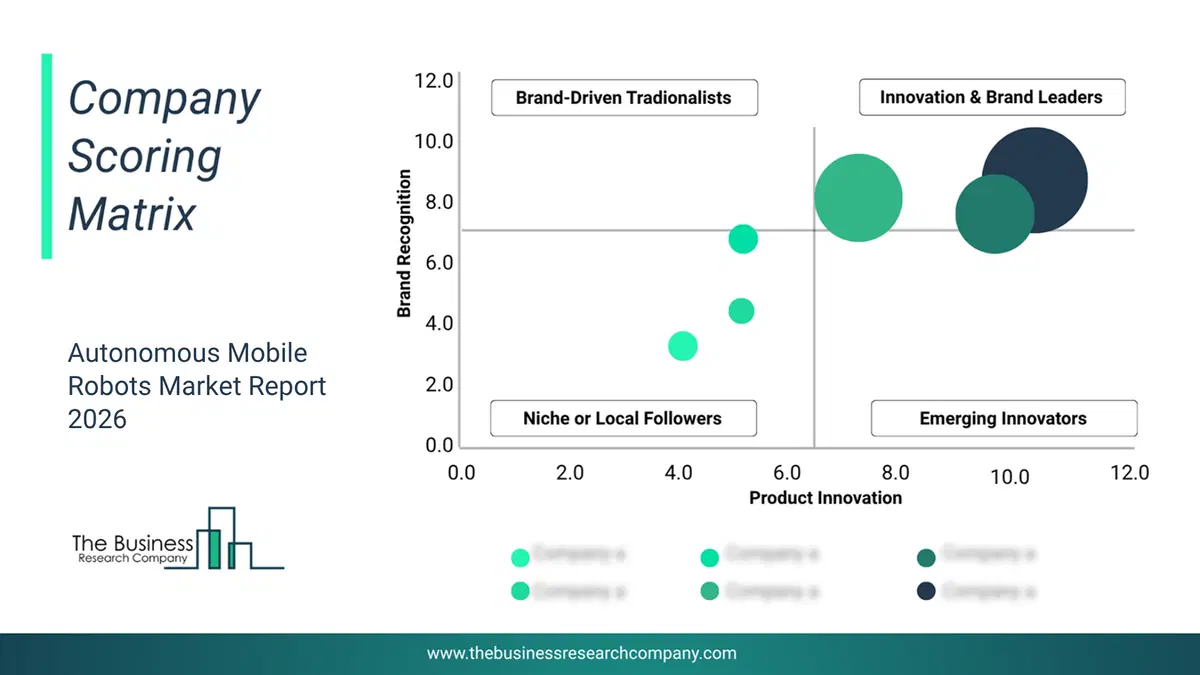
This chart maps companies by product innovation and brand strength, with bubble size indicating relative revenue, helping identify market leaders, challengers, and niche players. This is an illustrative chart; the full report provides a complete and accurate competitive analysis.
Global Autonomous Mobile Robots Market Trends and Insights
Major companies operating in the autonomous mobile robot market are developing innovative products such as autonomous mobile robots (AMR) for manufacturing operations to meet larger customer bases, more sales, and increase revenue. An autonomous mobile robot (AMR) for manufacturing operations refers to a self-guided, wheeled robot designed to operate within a manufacturing facility without the need for continuous human guidance. For instance, in March 2023, WEG, a Brazil-based motors and generators company, launched WMR (WEG Mobile Robot). The distinctive feature of this autonomous robot lies in its aim to enhance operational efficiency in industries requiring internal transport. Specifically developed to optimize repetitive tasks within production processes, the new WEG robot operates as an Autonomous Mobile Robot (AMR) system. Notably, it employs a unique natural navigation or contour strategy, utilizing methods such as Simultaneous Location and Mapping (SLAM). Through autonomous navigation, it adeptly avoids dynamic obstacles along its route and automatically re-plans alternative paths when encountering blocking situations.What Are Latest Mergers And Acquisitions In The Autonomous Mobile Robots Market?
In October 2023, Rockwell Automation, Inc. a US-based company, acquired Clearpath Robotics for an undisclosed amount. With this acquisition, Rockwell aims to expand its portfolio by incorporating Clearpath Robotics's expertise in providing autonomous robotics, including autonomous mobile robots (AMRs). Clearpath Robotics Inc. is a Canada-based company that offers autonomous robotics, including autonomous mobile robots (AMRs).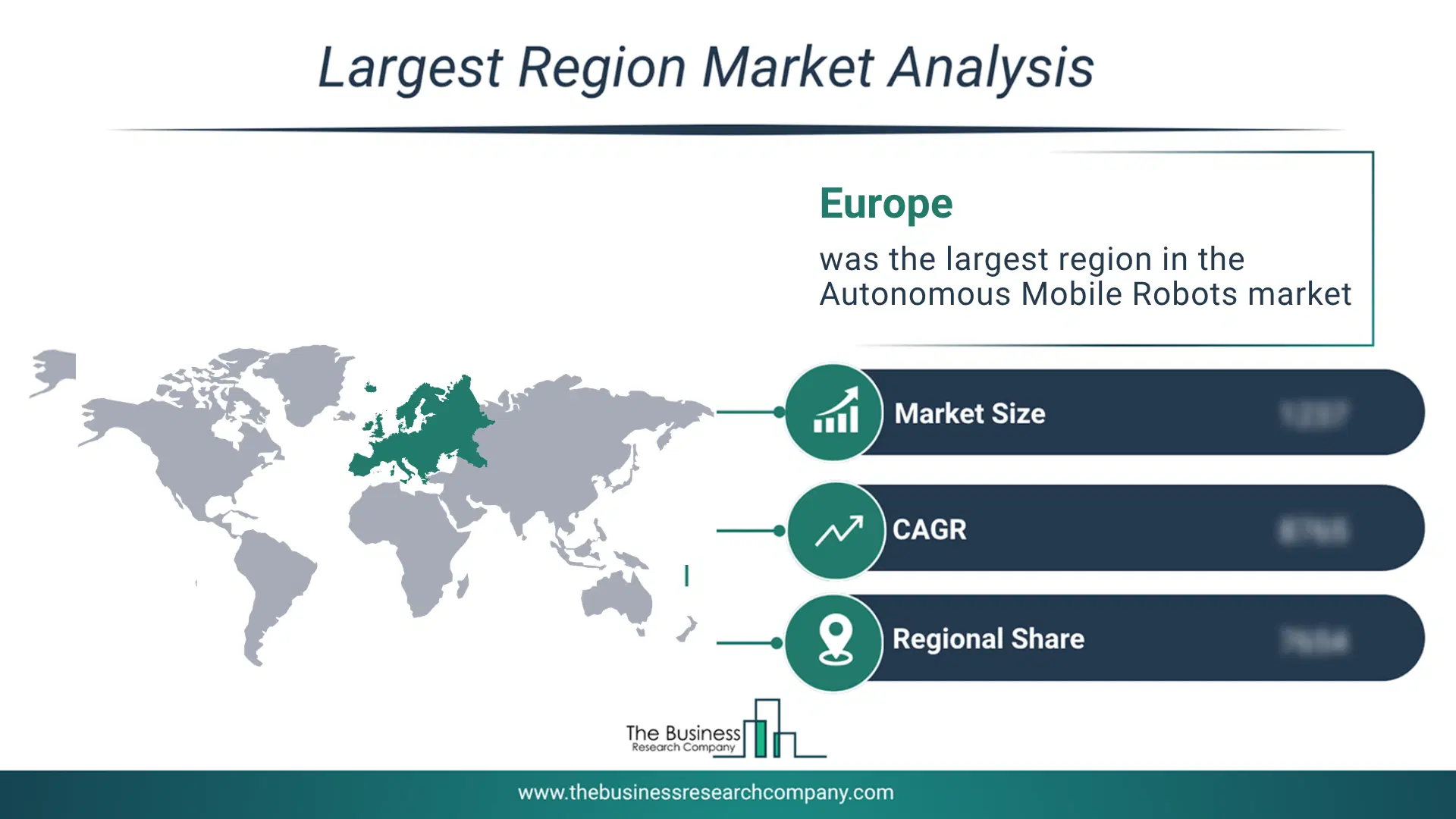
Regional Outlook
Europe was the largest region in the autonomous mobile robots’ market in 2025. Asia-Pacific is expected to be the fastest-growing region in the autonomous mobile robot’s market report during the forecast period. The regions covered in this market report are Asia-Pacific, South East Asia, Western Europe, Eastern Europe, North America, South America, Middle East, Africa The countries covered in this market report are Australia, Brazil, China, France, Germany, India, Indonesia, Japan, Taiwan, Russia, South Korea, UK, USA, Canada, Italy, Spain.What Defines the Autonomous Mobile Robots Market?
The autonomous mobile robots market consists of revenues earned by entities by providing artificial intelligence, machine vision and software services to manage uncontrolled environments and automate tasks. The market value includes the value of related goods sold by the service provider or included within the service offering. The autonomous mobile robots market also includes the sales of cameras, sensors, autonomous trolleys, and autonomous carriers, which are used in providing autonomous mobile robot services. Values in this market are ‘factory gate’ values, that is the value of goods sold by the manufacturers or creators of the goods, whether to other entities (including downstream manufacturers, wholesalers, distributors, and retailers) or directly to end customers. The value of goods in this market includes related services sold by the creators of the goods.How is Market Value Defined and Measured?
The market value is defined as the revenues that enterprises gain from the sale of goods and/or services within the specified market and geography through sales, grants, or donations in terms of the currency (in USD unless otherwise specified). The revenues for a specified geography are consumption values that are revenues generated by organizations in the specified geography within the market, irrespective of where they are produced. It does not include revenues from resales along the supply chain, either further along the supply chain or as part of other products.
This chart presents market attractiveness based on a quantitative evaluation of growth, competition, strategic alignment, and risk, offering a clear view of opportunity areas for decision-making. This chart is for illustrative purposes; the full report contains the complete analysis.

This chart highlights the Total Addressable Market (TAM) by estimating the maximum revenue opportunity using an assumption-driven approach, supporting strategic planning and opportunity sizing across markets. The chart is illustrative; the full report provides a more comprehensive analysis.
What Key Data and Analysis Are Included in the Autonomous Mobile Robots Market Report 2026?
The autonomous mobile robots market research report is one of a series of new reports from The Business Research Company that provides market statistics, including industry global market size, regional shares, competitors with the market share, detailed market segments, market trends and opportunities, and any further data you may need to thrive in the autonomous mobile robots industry. The market research report delivers a complete perspective of everything you need, with an in-depth analysis of the current and future state of the industry.Autonomous Mobile Robots Market Report Forecast Analysis
| Report Attribute | Details |
|---|---|
| Market Size Value In 2026 | $6.83 billion |
| Revenue Forecast In 2030 | $13.35 billion |
| Growth Rate | CAGR of 18.0% from 2026 to 2030 |
| Base Year For Estimation | 2025 |
| Actual Estimates/Historical Data | 2020-2025 |
| Forecast Period | 2026 - 2030 |
| Market Representation | Revenue in USD Billion and CAGR from 2026 to 2030 |
| Segments Covered | Component, Type, Battery, End-User |
| Regional Scope | Asia-Pacific, Western Europe, Eastern Europe, North America, South America, Middle East, Africa |
| Country Scope | The countries covered in the report are Australia, Brazil, China, France, Germany, India, Indonesia, Japan, Taiwan, Russia, South Korea, UK, USA, Canada, Italy, Spain. |
| Key Companies Profiled | OMRON Corporation, inVia Robotics Inc., Geekplus Technology Co. Ltd., Grey Orange Pte. Ltd., Mobile Industrial Robots ApS, Aethon Inc., Vecna Robotics Inc., Clearpath Robotics Co., Hi-Tech Robotic Systemz Ltd., Softbank Robotics SAS, SMP Robotics corporation, NextShift Robotics Inc., Stanley Robotics SAS, Robotnik Automation SLL, SESTO Robotics Pte. Ltd., HAHN Robotics GmbH, ABB Ltd., Clearpath Inc., Locus Robotics Corporation, Boston Dynamics Inc., Conveyco Technologies LLC, IAM Robotics LLC, KUKA AG, Fortna Inc., Teradyne Inc., Seegrid Corporation, Radial Inc., Rapid Robotics Inc., Youibot Intelligent Technology Co. Ltd., Gideon Brothers d.o.o., TRACLabs Inc., Milvus Robotics Private Limited |
| Customization Scope | Request for Customization |
| Pricing And Purchase Options | Explore Purchase Options |