

Autonomous Navigation Market Report 2026
Global Outlook – By Solution (Sensing System, Software, Processing Unit), By Platform (Airborne, Land, Space, Marine), By Application (Commercial, Military And Government) – Market Size, Trends, Strategies, and Forecast to 2030
Autonomous Navigation Market Overview
• Autonomous Navigation market size has reached to $6.14 billion in 2025 • Expected to grow to $15.74 billion in 2030 at a compound annual growth rate (CAGR) of 20.6% • Growth Driver: Driving The Future High Demand For Robots Fuels Growth In The Autonomous Navigation Market • Market Trend: Advancing Autonomy Technological Innovations Fueling Growth In The Autonomous Navigation Market • North America was the largest region in 2025.What Is Covered Under Autonomous Navigation Market?
Autonomous navigation means an ability of a vehicle or rover to design its route and execute it out without human involvement. The purpose of autonomous navigation or guidance is to regulate the vehicle trajectory to maintain it at a constant distance from the adjacent travel line or to arrange the strip side by side under conditions that do not overlap or have gaps. The main solution of autonomous navigation is sensing system, software, and processing unit. A sensing system refers to a sensor system or sensor resource as a collection of sensors combined into a single unit. A sensing system is used for both protection and monitoring, as well as the computation of non-measurable parameters like active and reactive power. It is used under various platform mainly airborne, land, space, marine, and weapon, which is applied in commercial and military, and government purposes.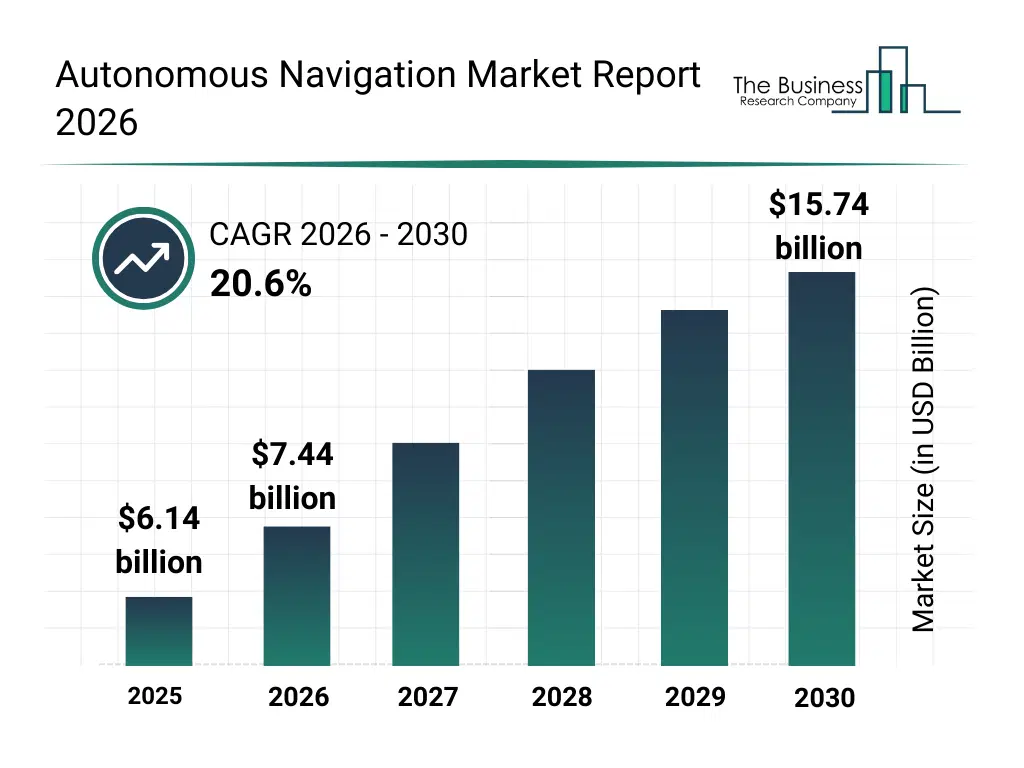
What Is The Autonomous Navigation Market Size and Share 2026?
The autonomous navigation market size has grown exponentially in recent years. It will grow from $6.14 billion in 2025 to $7.44 billion in 2026 at a compound annual growth rate (CAGR) of 21.1%. The growth in the historic period can be attributed to increasing use of navigation aids in defense systems, early adoption of gps-based guidance technologies, expansion of unmanned vehicle programs, growth in automated industrial vehicles, rising investments in navigation research.What Is The Autonomous Navigation Market Growth Forecast?
The autonomous navigation market size is expected to see exponential growth in the next few years. It will grow to $15.74 billion in 2030 at a compound annual growth rate (CAGR) of 20.6%. The growth in the forecast period can be attributed to increasing deployment of fully autonomous systems, rising adoption of ai-based navigation algorithms, expansion of smart transportation networks, growing demand for reliable localization in complex environments, continuous advancements in processing hardware. Major trends in the forecast period include increasing integration of sensor fusion algorithms, rising deployment of autonomous navigation software, growing adoption of real-time path planning systems, expansion of multi-platform navigation solutions, enhanced focus on precision localization.
Global Autonomous Navigation Market Segmentation
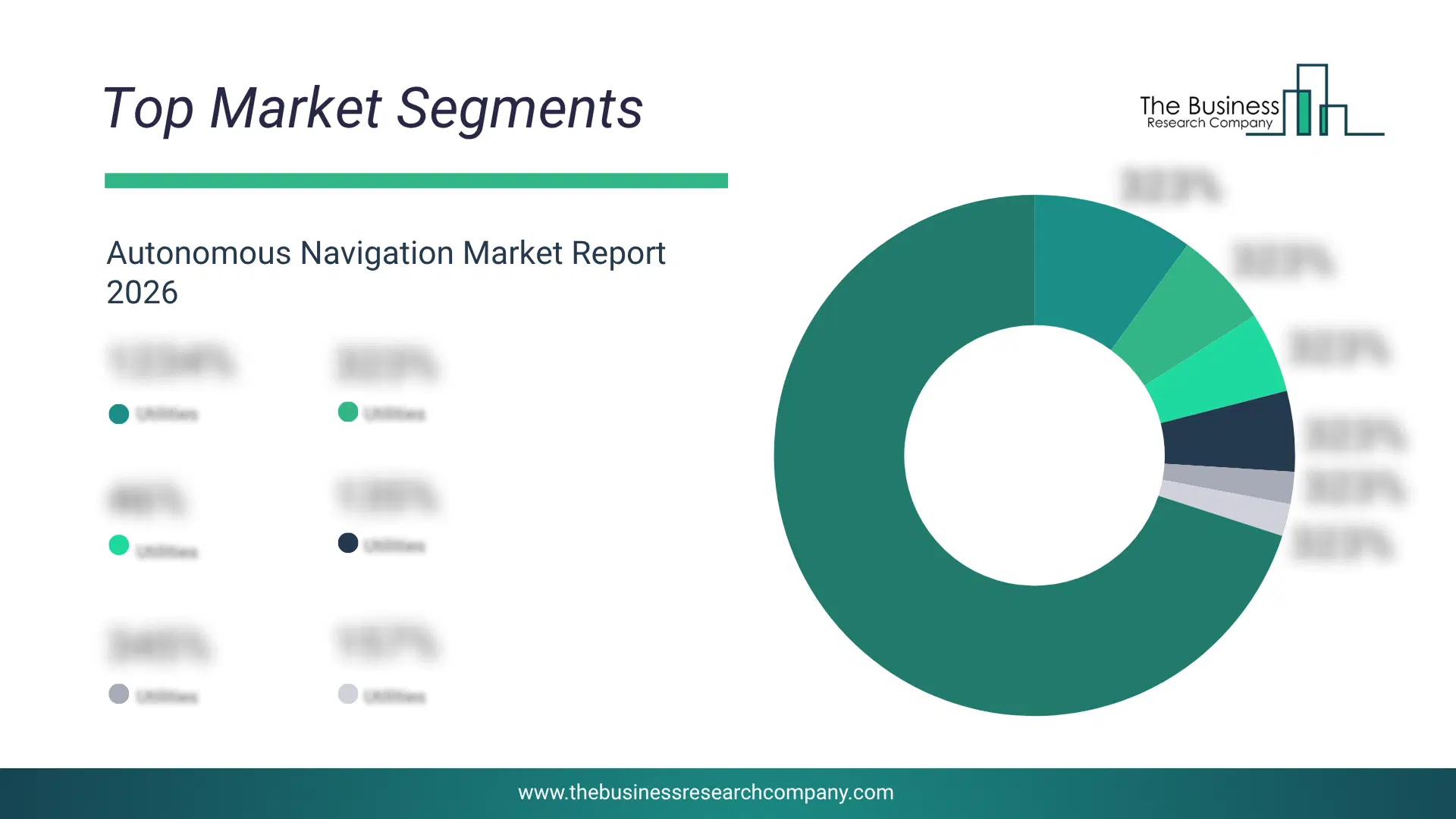
1) By Solution: Sensing System, Software, Processing Unit 2) By Platform: Airborne, Land, Space, Marine 3) By Application: Commercial, Military And Government Subsegments: 1) By Sensing System: Lidar Sensors, Radar Sensors, Camera Systems, Ultrasonic Sensors 2) By Software: Path Planning Software, Sensor Fusion Software, Machine Learning Algorithms, Mapping And Localization Software 3) By Processing Unit: Central Processing Units (CPUs), Graphics Processing Units (GPUs), Application-Specific Integrated Circuits (ASICs), Field-Programmable Gate Arrays (FPGAs)What Is The Driver Of The Autonomous Navigation Market?
High demand for robots is expected to propel the growth of the autonomous navigation market going forward. Robots refer to any autonomously run system that substitutes human effort. Robots help workers from dangerous activities by allowing them to manoeuvre without clashing with impediments and remain focused on several interventions. Such benefits from robots have increased the demand for autonomous navigation system to attain such crucial functionalities. For instance, in September 2024, according to the International Federation of Robotics, a Germany-based international organization, a total of 4,281,585 robots are now operating in factories worldwide, marking a 10% increase. For the third consecutive year, annual installations exceeded half a million units. By region, 70% of newly deployed robots in 2023 were installed in Asia, 17% in Europe, and 10% in the Americas. Therefore, the high demand for robots will drive the development of the autonomous navigation industry.Key Players In The Global Autonomous Navigation Market
Major companies operating in the autonomous navigation market are Honeywell International Inc.; Thales Group; Raytheon Company; Northrop Grumman Corporation; Furuno Electric Co Ltd.; Moog Inc.; Rolls-Royce Holdings PLC; Kongsberg Group; Trimble Inc.; ABB Ltd.; RH Marine Group; Safran S.A; General Dynamics Corporation; L3 Technologies Inc.; Collins Aerospace; Starfish Space; Blickfeld; Caterpillar Inc.; Charles River Analytics; Elbit Systems; Ghost Robotics; Fixposition AG; Xona Space Systems; Blue River Technology; Brain Corp.; Clearpath Robotics; Embark Trucks; Fetch Robotics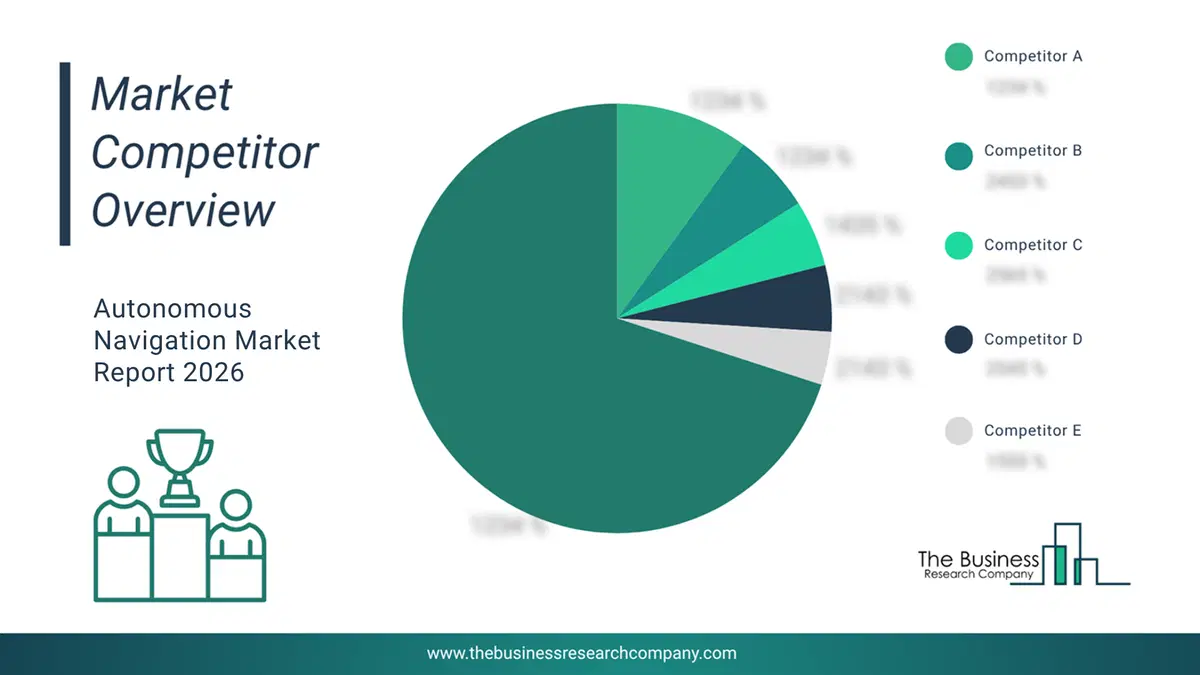
This chart is for illustrative purposes; the full report includes a detailed competitor analysis and comprehensive overview of the top 10 companies in the market.
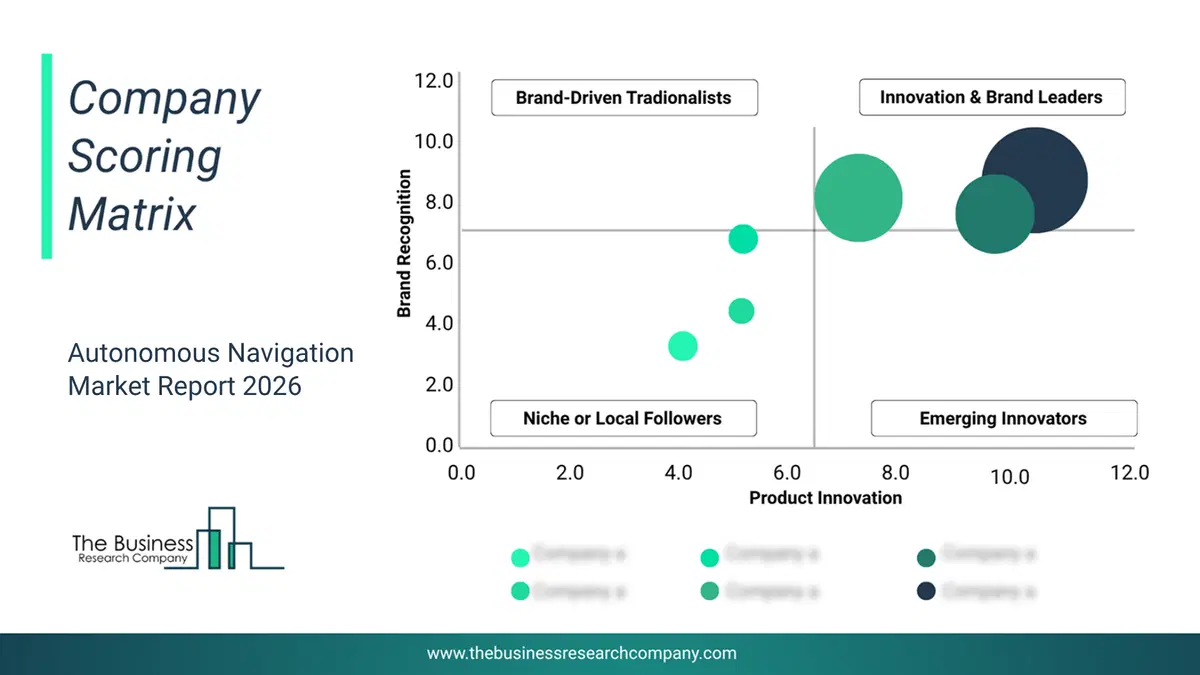
This chart maps companies by product innovation and brand strength, with bubble size indicating relative revenue, helping identify market leaders, challengers, and niche players. This is an illustrative chart; the full report provides a complete and accurate competitive analysis.
Global Autonomous Navigation Market Trends and Insights
Major companies operating in the autonomous navigation market are focusing on developing innovative solutions such as global positioning system (GPS)-independent autonomous drones ensure reliable navigation in global positioning system (GPS)-denied environments and improve operational efficiency. Global positioning system (GPS)-independent autonomous drones are drones that navigate using sensors, computer vision, and AI algorithms instead of GPS, helping ensure reliable and precise operations in environments where GPS signals are weak, blocked, or unavailable. For instance, in August 2024, SPARC AI, an Australia-based software company, launched an autonomous drone that operates without reliance on GPS. The groundbreaking system utilizes advanced sensors and artificial intelligence to navigate and perform tasks in various environments, including areas where GPS signals are weak or unavailable. It calculates the location and distance of objects solely using algorithms, making it ideal for operations in environments where GPS signals are unreliable or completely unavailable.What Are Latest Mergers And Acquisitions In The Autonomous Navigation Market?
In September 2024, Avikus, a South Korea-based autonomous navigation technology company, and DNV, the world’s leading classification society, have officially announced their collaboration on the development and approval of autonomous vessel systems. The aim is to achieve the world’s first type of approval for autonomous navigation systems, specifically the HiNAS Control system, under DNV’s regulations. This system integrates artificial intelligence (AI) and sensor fusion to process data from various navigation tools. It enables vessels to autonomously avoid collisions and optimize routes, enhancing safety and efficiency.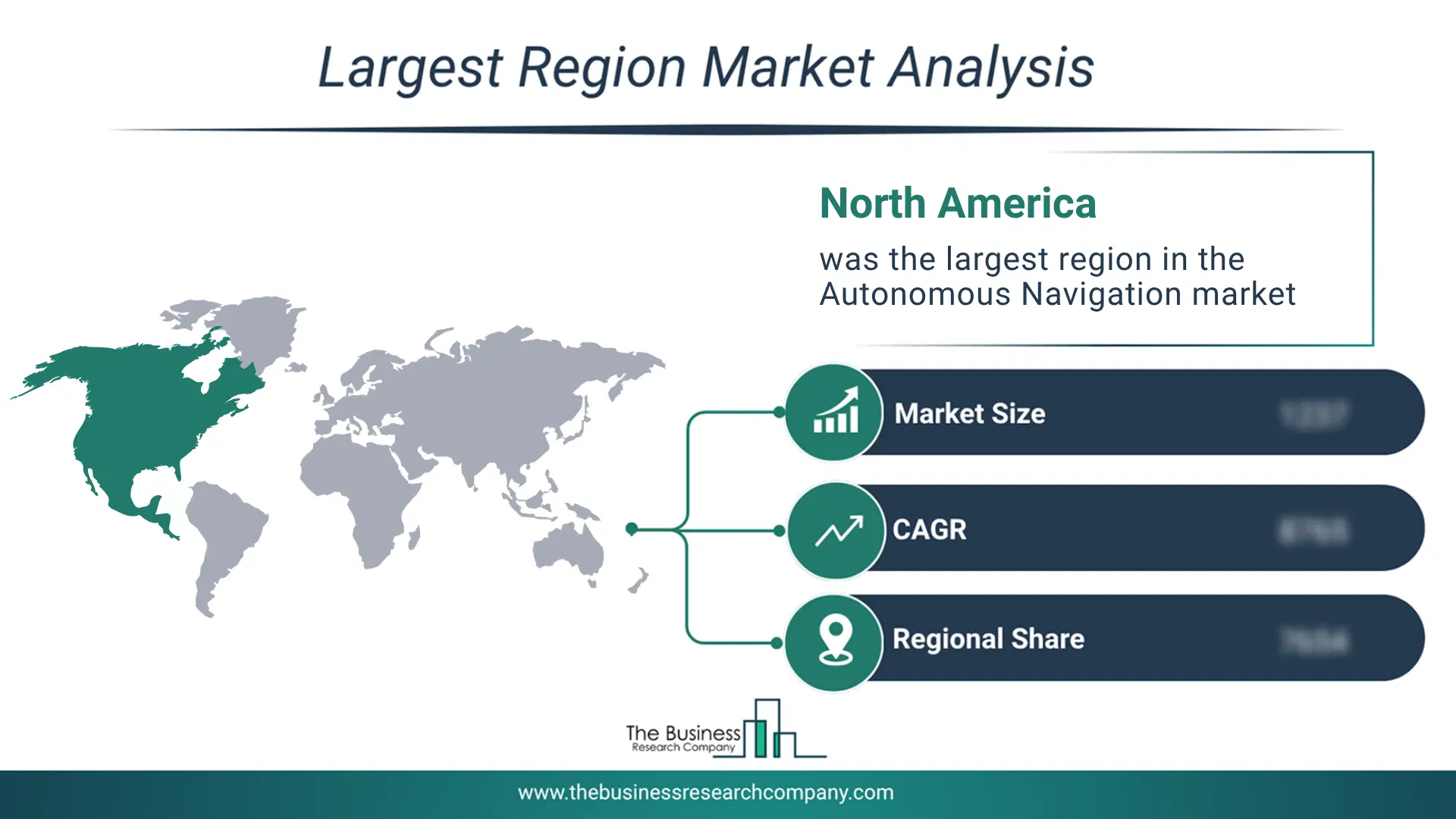
Regional Insights
North America was the largest region in the autonomous navigation market share in 2025. The regions covered in this market report are Asia-Pacific, South East Asia, Western Europe, Eastern Europe, North America, South America, Middle East, Africa. The countries covered in this market report are Australia, Brazil, China, France, Germany, India, Indonesia, Japan, Taiwan, Russia, South Korea, UK, USA, Canada, Italy, SpainWhat Defines the Autonomous Navigation Market?
The autonomous navigation market includes revenues earned by entities by providing services such as object detection, obstacle avoidance, mapping, and localization. The market value includes the value of related goods sold by the service provider or included within the service offering. Only goods and services traded between entities or sold to end consumers are included.How is Market Value Defined and Measured?
The market value is defined as the revenues that enterprises gain from the sale of goods and/or services within the specified market and geography through sales, grants, or donations in terms of the currency (in USD unless otherwise specified). The revenues for a specified geography are consumption values that are revenues generated by organizations in the specified geography within the market, irrespective of where they are produced. It does not include revenues from resales along the supply chain, either further along the supply chain or as part of other products.
This chart presents market attractiveness based on a quantitative evaluation of growth, competition, strategic alignment, and risk, offering a clear view of opportunity areas for decision-making. This chart is for illustrative purposes; the full report contains the complete analysis.

This chart highlights the Total Addressable Market (TAM) by estimating the maximum revenue opportunity using an assumption-driven approach, supporting strategic planning and opportunity sizing across markets. The chart is illustrative; the full report provides a more comprehensive analysis.
What Key Data and Analysis Are Included in the Autonomous Navigation Market Report 2026?
The autonomous navigation market research report is one of a series of new reports from The Business Research Company that provides market statistics, including industry global market size, regional shares, competitors with the market share, detailed market segments, market trends and opportunities, and any further data you may need to thrive in the autonomous navigation industry. The market research report delivers a complete perspective of everything you need, with an in-depth analysis of the current and future state of the industry.Autonomous Navigation Market Report Forecast Analysis
| Report Attribute | Details |
|---|---|
| Market Size Value In 2026 | $7.44 billion |
| Revenue Forecast In 2030 | $15.74 billion |
| Growth Rate | CAGR of 20.6% from 2026 to 2030 |
| Base Year For Estimation | 2025 |
| Actual Estimates/Historical Data | 2020-2025 |
| Forecast Period | 2026 - 2030 |
| Market Representation | Revenue in USD Billion and CAGR from 2026 to 2030 |
| Segments Covered | Solution, Platform, Application |
| Regional Scope | Asia-Pacific, Western Europe, Eastern Europe, North America, South America, Middle East, Africa |
| Country Scope | The Countries Covered In This Market Report Are Australia, Brazil, China, France, Germany, India, Indonesia, Japan, Taiwan, Russia, South Korea, Uk, Usa, Canada, Italy, Spain. |
| Key Companies Profiled | Honeywell International Inc., Thales Group, Raytheon Company, Northrop Grumman Corporation, Furuno Electric Co Ltd., Moog Inc., Rolls-Royce Holdings PLC, Kongsberg Group, Trimble Inc., ABB Ltd., RH Marine Group, Safran S.A, General Dynamics Corporation, L3 Technologies Inc., Collins Aerospace, Starfish Space, Blickfeld, Caterpillar Inc., Charles River Analytics, Elbit Systems, Ghost Robotics, Fixposition AG, Xona Space Systems, Blue River Technology, Brain Corp., Clearpath Robotics, Embark Trucks, Fetch Robotics |
| Customization Scope | Request for Customization |
| Pricing And Purchase Options | Explore Purchase Options |